I interviewed Karim Ben Khelifa about In 36,000 Ways on Sunday, November 16, 2025 at IDFA DocLab in Amsterdam, Netherlands.
Here are the 26 episodes and more than 24 hours of coverage from my IDFA DocLab 2025 coverage:
- #1682: Preview of IDFA DocLab’s Selection of “Perception Art” & Immersive Stories
- #1683: “Feedback VR Antifuturist Musical” Wins Immersive Non-Fiction Award at IDFA DocLab 2025
- #1684: Playable Essay “individualism in the dead-internet age” Recaps Enshittification Against Indie Devs
- #1685: Immersive Liner Notes of Hip-Hop Album “AÜTO/MÖTOR” Uses three.js & HTML 1.0 Aesthetics
- #1686: 15 Years of Hand-Written Letters about the Internet in “Life Needs Internet 2010–2025” Installation
- #1687: Text-Based Adventure Theatrical Performance “MILKMAN ZERO: The First Delivery”
- #1688: Hacking Gamer Hardware and Stereotypes in “Gamer Keyboard Wall Piece #2”
- #1689: Making Post-Human Babies in “IVF-X” to Catalyze Philosophical Reflections on Reproduction
- #1690: Asking Philosophical Questions on AI in “The Oracle: Ritual for the Future” with Poetic Immersive Performance
- #1691: A Call for Human Friction Over AI Slop in “Deep Soup” Participatory Film Based on “Designing Friction” Manifesto
- #1692: Playful Remixing of Scanned Animal Body Parts in “We Are Dead Animals”
- #1693: A Survey of the Indie Immersive Dome Community Trends with “The Rift” Directors & 4Pi Productions
- #1694: Reimagining Amsterdam’s Red Light District in “Unimaginable Red” Open World Game
- #1695: “Another Place” Takes a Liminal Architectural Stroll into Memories of Another Time and Place
- #1696: Speculative Architecture Meets the Immersive Dome in Sergey Prokofyev’s “Eternal Habitat”
- #1697: Can Immersive Art Revitalize Civic Engagement? Netherlands CIIIC Funds “Shared Reality” Initiative
- #1698: Immersive Exhibition Lessons Learned from Undershed’s First Year with Amy Rose
- #1699: Announcing “The Institute of Immersive Perservation” with Avinash Changa & His XR Virtual Machine Wizardry
- #1700: Update on Co-Creating XR Distribution Field Initiative & Toolkits from MIT Open DocLab
- #1701: Public Art Installation “Nothing to See Here” Uses Perception Art to Challenge Our Notions of Reality
- #1702: “Coded Black” Creates Experiential Black History by Combining Horror Genres with Open World Exploration
- #1703: “Reality Looks Back” Uses Quantum Possibility Metaphors & Gaussian Splats to Challenge Notions of Reality
- #1704: “Lesbian Simulator” is an Interactive VR Narrative Masterclass Balancing Levity, Pride, & Naming of Homophobic Threats
- #1705: The Art of Designing Emergent Social Dynamics with Ontroerend Goed’s “Handle with Care”
- #1706: Using Immersive Journalism to Document Genocide in Gaza with “Under the Same Sky”
- #1707: War Journalist Turns to Immersive Art to Shatter Our Numbness Through Feeling. “In 36,000 Ways” is a Revelatory Embodied Poem by Karim Ben Khelifa
This is a listener-supported podcast through the Voices of VR Patreon.
Music: Fatality
Podcast: Play in new window | Download
Rough Transcript
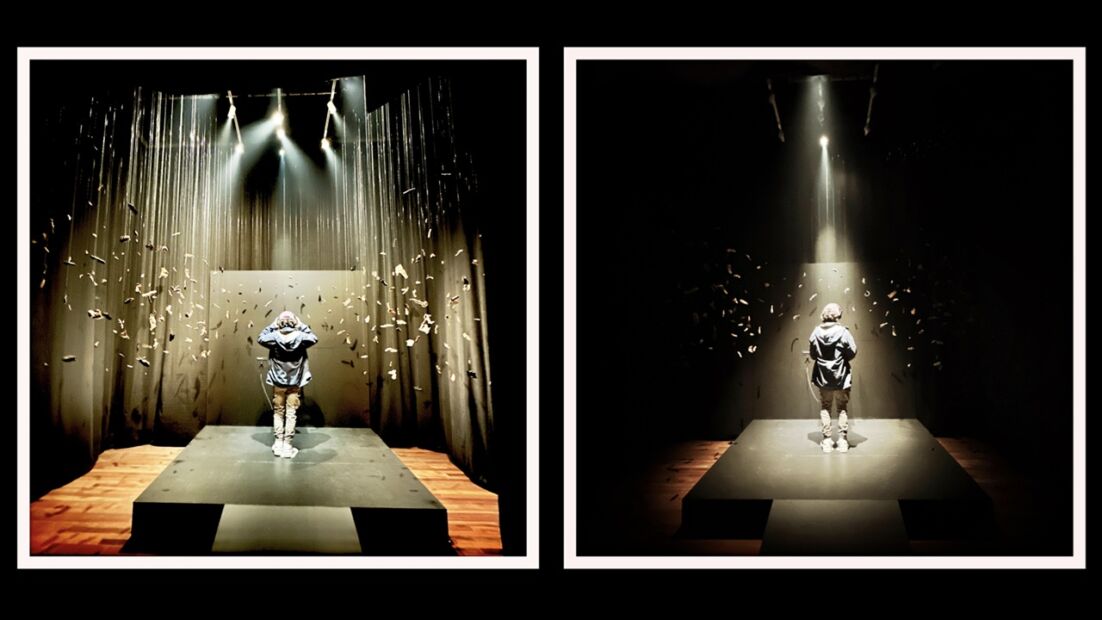
[00:00:05.458] Kent Bye: The Voices of VR Podcast. Hello, my name is Kent Bye, and welcome to the Voices of VR Podcast. It's a podcast that looks at the structures and forms of immersive storytelling and the future of spatial computing. You can support the podcast at patreon.com slash voicesofvr. So, this is the last episode in my coverage from IFA DocLab 2025, and... Today's episode is a piece called In 36,000 Ways, which this is a piece that probably stuck with me the most, just because I found it in my body, but also this conversation I had with Karen Ben-Kalifa really just was emotionally powerful and moving. So in this piece, it's a piece that is kind of an immersive art installation. You walk up, you see all these shards of shrapnel that are hanging from the ceiling. You walk up into where your feet are on the ground, and then the lights dim. There's a spotlight. You're asked to pick up a piece of shrapnel, which you're holding in your hands. You put some headphones on, and you listen to a narration around how these shrapnels that are surrounded, it feels like you're kind of in the middle of an explosion that's kind of freeze-framed. But you're also, you know, there's a camera that's pointing at you that is playing your heartbeat back to you. You're listening to it and you're standing on this butt kicker haptic device that's also beating with your heartbeat. So you really feel it throughout your entire body, which creates this kind of feedback loop. But it's telling the story of how in modern warfare with these missiles, there's like 36,000 pieces of these shrapnel that are being shot up into like up to 500 meters. Certainly lethal if you get hit by one of these, but even further out, you can also get killed by these shrapnel that are just designed to maim and kill humans. He's kind of reflecting on these aspects of war, but trying to create these visceral embodied experiences that are really quite powerful. They're very poetic and short, and he's hoping to expand it out. But I just found the piece really strong and powerful. And also in this conversation, he wrote this kind of social media post that was kind of reflecting on how we're in this kind of malaise of context collapsing just being flooded by all these imageries for all the horrors of the world and how we're not really processing it or getting the relational contextual information to get a story and so it's just kind of washing over us and making us numb without really viscerally feeling the emotions that are associated to all these different stories and so a lot of his work is trying to recenter experience into that embodied experience but just the way that he's kind of describing that current state of that malaise and that numbness it just kind of cracked me open and just unlocked all this frozen grief that i had around all the horrors in the world um So yeah, it's a powerful conversation and yeah, definitely listen to it if you want to tune in and feel and just really listen to an artist who's really trying to use the affordances of embodiment and immersive art practices in a very novel way. So we're covering all that and more on today's episode of the Voices of VR podcast. So this interview with Karim happened on Sunday, November 16th, 2025 at IFA DocLab in Amsterdam, Netherlands. So with that, let's go ahead and dive right in.
[00:03:24.019] Karim Ben Khelifa: My name is Karim Ben Khalifa and I'm a former war correspondent and I've become an artist today, still working in the realm of non-fiction and kind of conflict and wars. My subject, I've left any kind of medium. I'm not interested in the medium anymore. I'm interested in the subject. And depending on the dimension I want to reveal from conflict, I will use it one way or another.
[00:03:49.448] Kent Bye: Yeah, maybe you could give a bit more context as to your background and your journey into doing this type of war correspondence across media.
[00:03:56.933] Karim Ben Khelifa: Well, I started 27 years ago covering conflicts as a photographer and then specializing in conflicts. So it started with a war in Kosovo, then I went to Palestine, a second Intifada war in Afghanistan, in Iraq, and so on. until 2012, where I was invited as a Newman Fellow at Harvard University, spent a year there with my family, and then was invited as an artist-in-residence at the Open Dock Lab, the Massachusetts Institute of Technology, where I was part of the first cohort of fellows. I spent two years there with Sarah Wallerzin and William Erico, And then I was invited as a visiting artist by the Centre for Advanced Virtuality and the Centre for Art, Science and Technology.
[00:04:45.014] Kent Bye: Great. And maybe you could talk a bit about this transition from working with traditional media and photography and then getting into more immersive modes of virtual reality and other immersive art, immersive storytelling.
[00:04:56.939] Karim Ben Khelifa: Well, it all started, actually. I was really a frontline photographer, and that's what I was known for, working for Newsweek and other big magazines in the US and Europe. And in 2009, I was in Gaza for Vanity Fair magazine in New York, covering the ongoing conflicts there. And suddenly, I don't know why, I turned my camera and I started doing portraits. And along with this, I also had a recorder and I asked six questions to the fighters, the group of fighters from the Hamas that I was with at that point. And I asked a very simple question, who's your enemy? Why did you ever kill them? And what is violence to you? What is peace to you? And where do you see yourself in 20 years from now? And then I did the same across the border and went to Israel and did the same with the Israeli soldiers. And that became a photo project that, imagine a photograph on the wall, a portrait, and his enemy on the other side. And then I draw a border in between. We cross the border, you would hear one side. When you go the other side, you would hear the other one. Same questions. If you pay attention to the questions, the first three questions about the other, so there is not really a surprise in what they say and what we know. What comes as a surprise is the similarities of the answer. In the second set of questions, what is violence? Both answers have very same words or same ideas. What is peace to them goes the same way. And where do they see themselves in 20 years from now? They all see themselves outside of a conflict and in peace. And I thought it was very interesting because that revealing a common humanity that we don't acknowledge. And they certainly don't acknowledge themselves from the enemy. And in order to kill, you need to dehumanize. And that's what is the process based on facts on the ground and violence. It's true. But if you want to make peace, you're going to have to rehumanize. And so not that I can make peace with my work. That's not the point. I can go in that direction, but my idea here was really to reveal this common humanity, basic humanity that remains, talking about their children, about their fears, and both sides using the same words. I reproduced this because it's not just about Israel and Palestine. I reproduced this in Kashmir, and then I went to South Sudan. So that was the photo project. When I got invited at MIT, within a few weeks, a small company came to present their hardware, and it was Oculus, way before they were bought by Meta. I had heard of virtual reality, but I had never tried. And when I did the first, putting a headset on me, the experience was I was on top of a mountain. And it does happen that I have vertigo. And I felt. And I was like, what is this medium? I know I'm sitting here in a room at MIT, and I feel this vertigo. I left. And then quickly, I came back. And I asked questions. And I told them, like, I have this photo project with people, portrait, left, right, and center. Do you think we can put the people outside of the photograph and have them in the room? And they told me that, yes, the people Technology was mature enough, it had never been done, but it would be theoretically possible. They also told me it would be very expensive. But I had no budget at that point, and I could freely imagine something new. I was fortunate to find some people who were really interested in how do we produce such a piece. There was a bit of a buzz around virtual reality as a new medium coming up, and how do we broadcast in France, television for example. My producer in Chloé Jarry also jumped on board and we started producing this. It took four years and it became The Enemy, which is actually the first location-based experience, multi-user, that has been proposed to the public. And we can see today, in virtual reality, this is what exists and what is sustainable in terms of commercial aspect. But it's not what I had in mind. What I had in mind was really to try to create an experience without looking at the future, just trying to find the best way to deliver that message of common humanity. And I believe it was quite successful. And with this, I left photojournalism, obviously, and started working with big teams, different budgets. And I started thinking very differently about how I can do stories. After this, I did a project called Seven Grams, an augmented reality app. And for this, I thought differently. As a photojournalist, I have a subject that I want to do. I will find a magazine, and the magazine has an audience. What happens if we switch audience and medium? I have a subject. Who should listen to this? Who should be aware to be able to have an impact? And in which medium are they on? I had very early on decided that for this project, I'd like to talk to the next generation of buyers, the people who perhaps don't have the means today to buy a lot of electronics, but will buy electronics all their lives. So Generation Z, 17, 24 years old. And obviously the medium of choice for them is the smartphone. And that kind of coincided also in 2015 when I was producing The Enemy. I was in the mines in Eastern Congo and I was photographing with my iPhone. And I suddenly realized, well, there are mining mines. the resources I needed in this phone. With this phone, I'm photographing the mining. It's like, it's circle. So all of it came into place. We produced that again with France Television and PBS, American Doc. And we released that in 2021. That's how I came into kind of new media. But I don't feel like I'm a new media person. I feel like I have a subject. And again, as I said earlier, for me, it's trying to reveal aspects of conflicts that traditional media can't do. And in the case here, I've moved to sensory.
[00:10:51.525] Kent Bye: And so when did The Enemy premiere and where did it premiere?
[00:10:54.850] Karim Ben Khelifa: The anime premiered in 2017 at l'Institut du Monde Arabe in Paris, and then toured, went to the MIT Museum, went to Korea, went to Geneva, went to Amsterdam here, Tel Aviv. It was very interesting to bring this back to one of the point of origin of the work. And so, yeah, touring this, it was hard to do it because we were really at the forefront of immersive media, multi-users. Today is much more easy. The technology has evolved tremendously in the last eight years regarding distribution and deployment for that. But we were still very, very successful and we always did sold out. So the word of mouth, the new media, I think it's a combination of things that people were interested. But ultimately, if you do a good piece, people forget the medium, forget the media you're using, the technology you're using. And that's my goal.
[00:11:46.516] Kent Bye: Yeah, in my conversation with Casper and Nina, Casper had mentioned The Enemy as a real key piece. And I would go to a number of different festivals and cover things, but it's hard to see everything. And so I just haven't been at a place where it was screening. So I hope to be able to see it at some point.
[00:12:00.683] Karim Ben Khelifa: I have a good news. In 2026, we're going to start touring again. with the enemy. We did a technological update and we're ready to go. So I know there was negotiation left, right and center by my producer. And soon enough, we should be able to announce where we're going to premiere and where we're going to start touring in the world.
[00:12:18.198] Kent Bye: Amazing. Yeah, that feels like the world needs that right now. That type of story. It sounds really quite powerful from the people that I've talked to that had a chance to see it. They all said that was really quite moving, especially with all that's happening in the world today. Um, and I do have a unpublished interview that we did as your premiere at Sundance with seven grams, you know, the first encounter that I had with your work with seven grams. And then now this year with the 36,000 ways. And so maybe you could give a bit more context for where did this project begin?
[00:12:46.916] Karim Ben Khelifa: It began in Ukraine. I was on the front line around the region of Kherson. And I was getting to a petrol station that had been destroyed by missile strikes. And I started picking up pieces of the shrapnels of the missile on the ground. And the object is telling. Perhaps we'll let you describe what is the feeling. There's something very telling about the object. It's very brutal. It's sharp. It's heavy. And at the same time, it's a product of high technologies. And it reminds me of the first tools we used as human beings. So there was something very primal and brutal about it. So it begs the question, how much did we evolve?
[00:13:31.403] Kent Bye: Yeah. And holding this piece of shrapnel, well, the whole theatrical staging for how you have it set up for the immersive quality of the experience is like a whole other impactful moment with what you were doing with the other holistic context of the installation, with the sound design, with the lighting, you know, you walk into a room and you pick it up and then the room transforms in a way that really speaks to the impact of that moment. it's almost like a snapshot of a moment, like a freeze frame. I'm in a freeze frame of a moment. Like my experience of like, I feel like I'm in the middle of an explosion, but I'm holding this piece of shrapnel and it's heavier than I thought and looking at it. And so it's like got a lot of density and there are quite a lot of sharp edges that it's a type of sharpness that felt like if I were to rub my finger across this with pressure, it like could cut me. I'm sure that it's maybe been, um, chosen or filed down in a way that it's not going to actually cut people as they pick it up. But it felt like, Oh, if I handle this in the wrong way, I could like hurt myself. And so it felt like this visceral connection to the story. And it hasn't been in a lot of other projects where there's been like this totem of a physical object that really transports me into another story world. And I think that you were able to do that with the fact that you're holding this object that is at the center of the story. So, um, Yeah. I'm curious to hear a little bit more around this. And it also sounds like this piece is a prototype. So you're in the very early phases, but it feels like this is going in a very good direction. I'm very curious to see how it continues to develop because we're really just seeing like the first prologue of a much larger story that's going to be told here, but. Yeah, I just felt like it was really a powerful start and kind of almost like a visual poem in a way. It has this short and sweet poetic quality that was really impactful when I was doing it. I could feel my physiology of my body shifting in my heart. Yeah, hearing my heartbeat because you're sort of detecting different aspects of my physiology and sort of in this feedback loop, I'm listening to my heart as I do this. Yeah.
[00:15:35.475] Karim Ben Khelifa: You know, when a missile strikes, it can produce up to 36,000 of those shrapnels you just described. And they will all fly 1,000 meters seconds in all directions. The blast alone is lethal around 70 meters. This flies 500 meters, so it becomes very indiscriminate in a way that it kills and touch and maim people. And we've heard for the last three years a lot of missile strikes on the news, sadly. And a lot of those happen in civilian's area, whether it's in Sudan, whether it's in Ukraine, whether it's in Gaza. even Pakistan and India lately. So really, I'm trying to stop the numbness we have looking at those conflicts through social media and the news. And I'm trying to cut through that and bring back an aspect that people don't know. And the sensory aspect, I hope, is touching the memory and printing the memory. And hopefully, next time you hear there is a missile strikes, you'll have another sense of what that means, really. And in that case, I'll do my job. I've done my job. And that's just what I'm trying to do.
[00:16:39.288] Kent Bye: Hmm. Yeah, there's a beautiful piece of writing that Casper read at the beginning of the Doc Lab opening night where it sounded like it may have been written for a part of this piece. Maybe you could give a little bit more context of what was that written for? And you sort of alluded to certain aspects of it here just now, but I'm just curious if you'd be willing to elaborate a little bit more on, you know, as someone who's a storyteller and using immersive techniques in a way that you're finding new ways to tell these stories that really land with people, right? But there's also a writing process where you're telling a deeper story that is trying to break us out of this trance of this numbness. And so, yeah, just wondering if you'd be willing to share a little bit more around some of that writing that was shared by Casper.
[00:17:22.501] Karim Ben Khelifa: Well, it wasn't written for the piece. It was me. feeling very uncomfortable with what I could see, not finding a way to channel those emotions, and realizing perhaps I should write something about it. Just give it a try. Writing is not naturally my medium. And then I wrote it. And I said, okay. Now it's written. Now you managed to put something there that you feel kind of channeling your emotion into that. Let's put it out there and see what happens. And I wasn't expecting, but I received hundreds of messages of people thanking me for formulating something they could feel. And I realized I was not alone in this. I mean, obviously, I knew I was not alone, but I wasn't expecting that I could formulate for others this malaise, this balance in between the reality and what we see and what we can do. And there is a gap there. There is a hole, and it's really hard to become engaged. And Caspar read the piece and proposed me actually to read it at the opening of the Advado club. So they're not really linked, yet they are always, because it's still on the subject of war. And perhaps here I can say and I can formulate something that other pieces of my work aren't. It's also pointing at the direction that I'm going where I'm not trying to show war. And perhaps this piece in 36,000 ways presented here, I've been a visual person for most of my career. And about three years ago, I went to see a dance performance in Berlin, where I live. And during that performance, just one hour, I had three times tears coming up to me. I could not understand what was that. There was not a story. It was beautiful what I was looking at, but there was no story. dances, music, sounds, objects moving, lights, but not a precise story. So I was really left wondering how those emotions were coming from. And as I walked back home, I realized that actually it was half of the story. That something in me was resonating, and this was a trigger. And I realized, this is what I want to do with war. Because my problem has always been, what can I show you? Where is your limit when it comes to violence, when it comes to the reality of a conflict? Most people, me included, we love to move our head away and not see the reality. And when you're visual, this is a lingering question. So I had editors when I was a photojournalist. They would choose. But then later, later, when I had my own work, when I had to do exhibitions or books, I had to make those calls. And I decided, like, I'm not going to show war anymore. Everyone knows what war is. We have those images in our minds. I'm just going to trigger something one way or another. And this is why when I was on that petrol station near Kherson in Ukraine, when I took that object, Not that I made the link directly, but I felt there was something in the object that could become a trigger. And suddenly after researching and then coming back to Ukraine and picking up way more shrapnels to start working more seriously on the subject, that things took form. But yeah, I'm trying to trigger your imagination. And with this, I can be more visceral because you're only going to call on you what you can bear and you're not going to call what you can't. And that's still going to be very emotional. That's still going to be touching you in a way that perhaps with the physical contact and your own Hearing your own emotions through the heartbeat, the most sensitive part of a human being, we're not used to hear our own heartbeat, and we can't control it. So if you hear your heartbeat going faster and faster, you know you're reacting to the thing in a way that you couldn't expect and you couldn't even figure out before. And so that's really this relation, you and the object, and in the bigger picture, what is war? And this is one of the dimensions I'm trying to reveal.
[00:21:19.746] Kent Bye: Whew. Yeah. Really feeling that in my body as you were saying that there was like memories, body memories of different moments from your piece. And yeah, I think that there can be this sort of desensitization that we have where it just becomes a part of the social media feed. And did you post this on Instagram? Yeah. And would you be willing to read or share a little bit of that? Yeah. Yeah.
[00:21:46.178] Karim Ben Khelifa: There is something obscene in the way we consume war now. It arrives not with the weight of history or stench of blood, but as a fleeting image on a screen. Compressed between an influencer's breakfast and an ad for the latest electrical car. The crying child in the cratered streets. The severed limb in the rubble. The dust cloud hanging like a ghost. All of it is real. The camera does not lie. But the camera cannot speak. What it captures, it's stripped of its context. Violence, without memory. Suffering, without history. The viewer scrolls on. The missile strike dissolves into a meme. The tragedy fades behind a tap. We are living through a collapse of moral proportion. War and comedy. Atrocity and lifestyle tips. Carnage and celebrity news. All of it delivered in the same feed. All of it treated the same. Even the legacy media now trades in euphemism: "Surgical intervention." "Kinetic action." "Targeted neutralization." Words chosen not to disturb. Not to offend. Not to feel. And this detachment is not neutral. It shapes opinion. It shields us from guilt. It makes war seem manageable. And a war that is not felt is a war that can be ignored. The tragedy is real for those who endure it. But unreal for those who consume it. Filtered. Softened. Suspended between spectacle and fact. In my work, I try to tear through that veil. Not to show war, but to make it present. To restore agency. Because war has many dimensions. And unless we find ways to feel what we cannot see, we become numb to the horror untouched by the very catastrophes we allow to continue.
[00:24:14.852] Kent Bye: Wow. That really hit me.
[00:24:33.413] Karim Ben Khelifa: It's a reality. It's the reality of where we are now and we need to wake up. And this is what my work is doing. I'm just trying to wake up the people. We cannot ignore war. We cannot leave people suffering the way they suffer. We have power. We have power together. We have a sense of agency. We have a spending power. We have a right to vote. We have to voice our concern and we have to do something in what we can.
[00:25:02.645] Kent Bye: Yeah, it's another piece here, Under the Same Sky, that's around the genocide in Gaza and all the destruction that's been happening there. And it's a 38-minute piece. And in talking to the filmmakers, one of the things that they were saying was that all the 2D images that were coming out of Gaza... the Israeli army was saying, well, that's not real. That's fake. It's generated CGI. And so by having a 360 video camera, they were saying that, well, we can start to show, no, this is actually what's happening because now you can see all around the camera that there's nothing that's behind the camera. But there's this dimension of what's truth, what's reality, what's spectacle, what is kind of real facts on the ground, the hard material reality. And I feel like, um, so much of what's happening right now with our world is that we have this fracturing of what's truth or what's delusion. That was really a key theme that I think you're, you're writing here is also really tapping into. And, um, this experience of the, you know, the internet is a lot of what we're reflecting on here off the internet, but also just kind of looking at the full scope of our lives with the internet as a theme of a number of different projects. And that we can look to see with the rise of social media, which is sort of like the midway point from when the beginnings of the internet from like 2007, when the iPhone came out smartphones. And that's also when Sundance New Frontier and if a doc lab started with this real excitement around the potentials of new media that has really now that we're kind of in the beginning of a new cycle, we're looking back at all that time, but also seeing all the ways that the social media has impacted our lives and been a detriment to civil society and democracy in a way that I think a lot of people and artists right now are thinking around how do we get back into our bodies and break out of the spell that we have of these algorithms that feed us with these dopamine hits, but are ultimately disconnecting, alienating and not really making us feel satisfied. And so I think there's. a lot within that piece of writing which is absolutely beautiful it really was deeply moving for me just listening to it because i think it's speaking to trying to cut through that numbness that trans state and dissociation that we have right now with all the social media so yeah i don't know if you have any thoughts about that
[00:27:33.258] Karim Ben Khelifa: I wasn't expecting that text to be so useful and engaging the people as much as it does. We need to speak from the heart and we need to reconvene our values. One of the terrible things with the conflict in Gaza is that people like me feel like we've turned to Europe or the Western world for the values it told us it was holding, human rights, equality. And you realize with the conflict with Gaza that is not true. There was this speech from Ursula von Leiden, head of the parliament, European parliament, saying it is not acceptable that power grid are destroyed, that hospital are destroyed by missile strikes, that school and civilian infrastructure. And that speech, I was listening to it, end of October 2023, and I said, like, finally someone is saying something. but a speech was a year old and was talking about ukraine and we never heard a speech about gaza on the same tone from the same person and so there is spineless leadership that tell us human rights but that don't apply that and same goes for international justice we cannot lose that we will lose so much of our lives and our values if we lose this So, yes, we need to do what we can. But the time, we're in an emergency. The time is hard and things are coming in our way. But as I said earlier, it's also beautiful. We need to take position. Perhaps we didn't need to do that before. But now we can. Now we know. And now we will.
[00:29:24.673] Kent Bye: Yeah, the phrase that comes to mind is that I forget how exactly you phrased it, but the idea of how it doesn't become real until you feel it or that you're really trying to evoke emotions and feelings. Maybe you could elaborate on how you see this as a path forward or a way through to getting back to being present in our body through our emotions.
[00:29:44.256] Karim Ben Khelifa: You know, I don't have a master plan. I'm very instinctive. I didn't expect to do a project on shrapnel and fragmentation weaponry. It just happened because I took that in my hands and it was telling and I saw something to say about war. I think it's about being sensitive, and I have this ability to go at war. I've done that for a very long time. People think I'm crazy, but I actually have a lot of experience. And I'm not crazy. I'm going there with a sense of purpose. But something changed. When I was a photojournalist, I wanted to impact the life of the people I photograph. And I realized, 10 years doing this for the biggest magazine, reaching the best audiences, that I was breaking a moral contract. One day I realized I had a moral contract with my subject, and I knew the publication I was working for would not engender the change for the people I was photographing, or at least not immediately. But why people let me photograph them in the worst time of their life? Because they think I can make a difference. And if I know I can't, then I'm breaking that moral contract and I decided to do something else. So instead of trying to be impactful on the ground, I want to be impactful to you. I want to bring back conflict here. I want to wake up the people. And so my targets, my audiences now, is the Western world, for them to understand what a war is in different aspects. So I'm not even sure what I'm going to do after. What's the next project? But I will first finish this one, and this one will grow. Now it's a very introspective experience. In the future, it will be a frozen explosion with thousands of pieces hanging from the ceiling, It will be really trying to reproduce visually an explosion and that cloud, that cloud of death, remnant of war, will be reactive. So if you approach the cloud, the cloud will open for you. You will be able to penetrate the cloud. Once you're in, I will use military hardware to capture your heartbeats and that heartbeat will be played for everyone in the room. So I want to go from an introspective experience which works to a collective experience because the future needs to be collective. We need to be together understanding things. It's great that it works as an individual, but it's going to be so much more powerful if we are fully in the room and we understand what's going on.
[00:32:17.648] Kent Bye: Yeah, the phrase that was coming to my mind before you talked about the collective aspect was that there's a sort of ritualistic quality to this piece where you're going in and going through this shift and change that you're crossing through a threshold and coming back out. So it feels like you're being initiated into the story in a way that really kind of hit me in a way that was like a emotional gut punch that helped to sort of break out of that dissociative numbness that Um, and so I feel like that as I was listening to you read your piece, I was like thinking of that body memory, but also this experience of just being bombarded and flooded with this horrific imagery of genocide. And yet. Not feeling it in a way to really kind of intellectually process it. But like you said, it's like decontextualized. It's not put into a larger story. And so just the experience of going through a number of different pieces, the under the same sky, as well as your piece that are adding that larger context that now that I have a deeper understanding. body memory of these places and these experiences was able to pierce through that kind of numbness of dissociation that I was really grateful for to actually feel it.
[00:33:34.229] Karim Ben Khelifa: And I think this is the power of new media. This is the power of using different ways. You know, in 36,000 ways, I have 170 euro of technology. The scale is 10 euro, the sensor is 10 euro, and the butt-kicker you feel under you is 150 euro. So it's just about putting a concept and things can be very simple and yet very efficient. It's a three-minute thing, you call it a shot. And I think it is, even though I don't want to show anyone, obviously. But if it works, and it seems that it works well, then it's a testimony of those media, of those new ways of telling stories. And thanks to my host, IDFA, DocLab, Kaspar, Carlotta, and everyone, because they allow people like me to experiment. They push us to the experiments. They offer us a platform. And this can inform other people, other storytellers, and say, like, we don't necessarily something different, using technology in a way. I'm going to be using thermal cameras in the future. Thermal cameras is not in the registers of XR Media, but I'm going to be able to do my work with this. And with thermal cameras, it offers something more. When you go on stage and you've got those thousands of pieces hanging and you're inside the cloud, If you stress, if you somehow think, I shouldn't have come here, I'm not feeling good, you're going to lose 0.4 degrees at the top of your nose. You're going to start breathing faster. You're going to start sweating. And the camera will see that. And we can open directly the other part, and you can leave the cloud if you wish to. And so this is military hardware. Suppose to do the opposite, we can turn things around. As I always said, when I was a photogenic people which camera to use it doesn't matter it's a tool all of those things are tools we don't need to see I'm not into the innovation I don't actually I'm not good at all of this but I need to understand what the technology can do and what it can do to change our perception and to take another perspective and that's what I'm spending my time doing it's actually the only thing I can do
[00:35:47.045] Kent Bye: Yeah. And as I think around this experience and how you expand it out to a collective experience, this phrase of a ritual comes to mind again, this collective ritual, and perhaps maybe even a collective grieving ritual that can allow people to spectate perhaps, or maybe you could elaborate on the invitation for how that would work. If it would be kind of a rolling one person at a time, we'd be going in and There were people that would just be fine watching, but they would have to wait or like, how is this going to be like a collective experience of this piece? If there's only one person that goes in or if they all, yeah, just love to hear a little bit how you're going to create an invitation for people to come and experience this in a collective context.
[00:36:29.684] Karim Ben Khelifa: Well, first, everyone coming in the room will have a shrapnel in his hand. And on that shrapnel, you'll have a little note hanging with a nylon wire, exactly like the shrapnels are hanging in the structure. On that little note, you will have the information. When a missile strikes, it can produce up to 36,000 shrapnels. They all fly 1,000 meters a second. The blast is killing in a 70 meters radius, but those will kill in a 500 meters radius. So the information is there. The sensor is there. I believe not everyone will want to walk in the clouds. I think the installation will be most of the time quiet and just a structure and a sculpture hanging in the air. But if someone is there, then it becomes alive. And it's interesting to have life in between remnants of death. And that heartbeat is heard by everyone around. And if we all have that shrapnel and we all see this, this is where the collective experience is happening. And for me, this is what art needs to be. Art is an information. It's nothing else. And this is why I've become an artist, because then I can do this. And as a photojournalist, as a documentary immersive, I was doing interesting work. I've always loved my work, but I've always found a limitation at some point. While here, as an artist, I don't have limitation. Yet everything is nonfiction. The object you hold in your hands, the information you've been given, everything is nonfiction. So I bring you to reality through a form of art. And yeah, and I hope to be ready next year.
[00:38:05.939] Kent Bye: Amazing. Yeah, I can't wait to see that. That sounds really quite incredible. Do you already have a place where you're going to show it?
[00:38:13.067] Karim Ben Khelifa: I'm going to first have to prototype that. I'm really a believer that I have an intuition and I'm going to have to work on my intuition and I'm going to have the users helping me out to get to the right place. There is nothing definitive in my work unless a lot of people have went through and have the feedback the same way I've done it for this piece here. I really believe in the iteration process, failing and correcting and making it right.
[00:38:40.802] Kent Bye: Yeah. Casper had described this piece as a prototype and it's a short piece. It's three minutes, but it feels like such a strong poetic experience that just really sticks with me. So I feel like that it doesn't need to be like an hour or, you know, any longer. It feels like it's the perfect length for what it is and that it's really brilliant concept that feels like you can start to expand it. But in the spirit of being in prototype, what were some of the biggest lessons learned that you had from making an installation and prototype here?
[00:39:07.639] Karim Ben Khelifa: Well, you know, you start with an intuition. You start with a concept in your mind. In my way of processing this and developing my project, there is a fundamental step where I need to write. And I need to be able to explain you in one and a half page what I'm going to do and what I'm intention. And when you read this, you need to be convinced. And if I can't get to the writing parts, I'm not getting to the project. So this is really the first part, the conceptualization. And then there is the application of that concept. We did a prototype at the Max Planck Institutes in Berlin, where I live, where I'm associated with. It's the Center for Humans and Machines. And I've been welcomed there, and they give me space to iterate and to try. And when I started it, I had things written on a wall, the information I just said. I didn't have a light, my voice was not in, and I could look at the users and they were, yes, fascinated by the object, but they were expecting something else. The user experience wasn't there yet. It was a very raw kind of first small dash of what I had in mind. And then from there, correcting it, I said, okay, if we play the light, And only the light at some point when you take the shrapnel in your hands will be on your hands. Then the user experience will concentrate on his hands and the objects. And then the writing information are distracting. So I'm going to bring my voice in. And yes, and the heartbeat, oh, maybe we can bring something else. And I have to think, well, a lot of people that helped me out on the process said, especially Kling Klang Klang, which is an immersive sound studio in Berlin, which have been working on the piece. And they've been incredible creative technologies working around the sound and incredible at helping me out formulating and finding the fine tuning of all of this. So yeah, big shout out to them.
[00:40:55.911] Kent Bye: Yeah, and because there is another piece that's so thematically connected to 36,000 Ways with Under the Same Sky, I'm just curious if you had a chance to see it and if you had any thoughts on it.
[00:41:06.372] Karim Ben Khelifa: I didn't saw it, and I don't want to see it, because I know what it is. I've been to Gaza 20 times. Not that I've seen Gaza in the state that it is, but with the image I've seen. And I've covered wars in Gaza before, so I know when one entire neighborhood is flattened down. I know what it looks like. I've worked in that already. And there is a fact. You cannot forget what you've seen. I've seen war for 25 years. I'm not sure I need to see that. I'm engaged. Nobody needs to wake me up. I don't need this to do my work. I know the injustice. I know the genocide. I know all of this. But I recommend everyone to do it. And I really hope that that's between you and I, that they get the prize, because it's really powerful. We are recording on the record. On the record. I really hope they're going to get the prize because it's so powerful. Even though I haven't seen it, my best friend who's a war correspondent was in it yesterday. He's seen it all, like me, and he walked out and said, like, wow. And it's for two facts. I mean, the courage to do it. And it's a historical document. My piece is not a historical document. This is history. And this needs to be kept for history. So I really hope the jury will recognize this for all its quality and all its complexity. But it deserves. And it has at least my rights. I'm giving them to them.
[00:42:27.253] Kent Bye: Yeah, for me, it's the one that sticks with me the most. I'm also, in my heart, the one that I hope wins as well, just because I think it's such an important story and also just a revelation to be able to bear witness in that way. That was allowing me to have some sense of not actually being there, because they're saying this is only like 2% to 5%, and I know the limitations of VR, but it was... able to go beyond what I've seen in the social media feeds and add more context that I have more understanding, but also the stories that I heard in the story that helps to kind of give this through line to the larger context. So focusing on a small story, but then telling a much, much larger story. So, but yeah, there's also a wide variety of different projects this year that I think it's going to be particularly difficult for the judges to sort of decide what's going to be merited. Yeah.
[00:43:16.835] Karim Ben Khelifa: I was a jury last year and I'm glad I'm not a jury this year because there was really a lot of very, very interesting projects and the way storytellers are tackling different subjects. And you feel it's coming from them. You feel it's under their skin. You feel it's their stories they call. And then trying out so many different ways. I mean, this place, Idfa, is really unique in that sense. It's not glittering. It's not shiny. It's efficient. And yeah, big shout out to the team.
[00:43:44.938] Kent Bye: Awesome. And finally, what do you think the ultimate potential for this type of immersive art and immersive storytelling might be and what it might be able to enable? I'm not sure.
[00:43:54.270] Karim Ben Khelifa: I've been always bad at predicting the future. I'm good at analyzing the present and trying to do something about it. But it's... Perhaps if I would think of something and there is not enough innovation. Let me explain. We found many ways now to commercialize VR, to distribute VR. I think there needs to be more innovation in the storytelling and bring new things. Just the headsets and the location-based is very interesting and it needs to find a sustainable model. But we need more innovation. And I don't know what it is, but to keep trying new things and take different angles. perhaps this is also one of my call is to try to keep innovating but you see 170 euro of technologies and things that are off the shelves it's like nothing special but this is innovation it's putting things together in the context so yes I think I would like to see more risk-taking even though I understand there needs to be a model but also find ways to to touch the people awesome is there anything else that's left and said that you like to say the broader immersive community keep going, keep going.
[00:45:15.312] Kent Bye: Awesome. Well, Karen, thanks so much for joining me here on the podcast to share a little bit more of your journey into the space and your process of related space and 36,000 ways. And yeah, I feel like it's a really strong beginning to this concept that I'm excited to see where you continue to take it out into this kind of spatial art installation that has storytelling aspects and this kind of documentary fusion of holding these physical objects that I feel like they're like a portal into the story that, yeah, there's like a weight there that's different than I can't think of another project that used objects in a way to create a vehicle for me to really enter into a story. And so, yeah, and all the other theatrical elements and the heartbeat and just all tied together in a way that it's a really powerful piece. So, yeah, I'm really, really looking forward to seeing where you take it all in the future. And thanks so much for joining me here on the podcast to help break it all down.
[00:46:02.991] Karim Ben Khelifa: Thank you very much for welcoming me.
[00:46:05.310] Kent Bye: That's all that we have for today, and I just wanted to thank you for listening to the Voices of VR podcast. If you enjoyed the podcast, then please do spread the word, tell your friends, and consider becoming a member of the Patreon. This is a listen-supported podcast, so I do rely upon donations from people like yourself in order to continue to bring you this coverage. You can become a member and donate today at patreon.com slash voicesofvr. Thanks for listening.