I interviewed Jeroen van Loon about Life Needs Internet 2010–2025 on Wednesday, November 19, 2025 at IDFA DocLab in Amsterdam, Netherlands.
This is a listener-supported podcast through the Voices of VR Patreon.
Music: Fatality
Podcast: Play in new window | Download
Rough Transcript
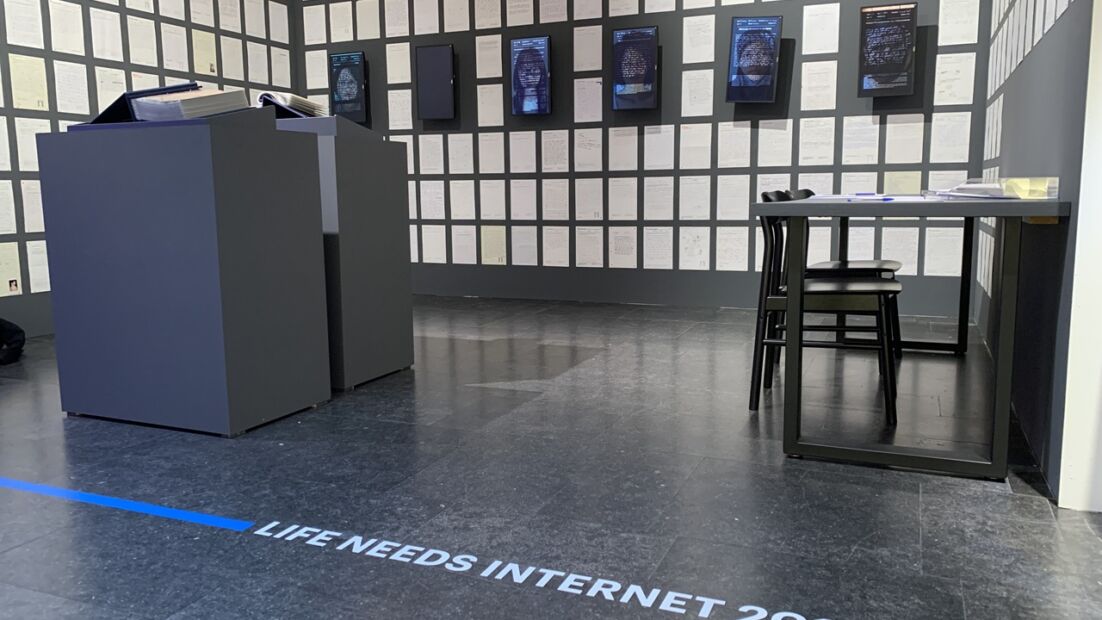
[00:00:05.458] Kent Bye: The Voices of VR Podcast. Hello, my name is Kent Bye, and welcome to the Voices of VR Podcast. It's a podcast that looks at the structures and forms of immersive storytelling and the future of spatial computing. You can support the podcast at patreon.com slash voicesofvr. So continuing my series from If It Not Club 2025, today's episode is with a piece called Life Needs Internet 2010-2025. So this is a 15 year project that Jaron Van Loon has been doing where he's studying like digital culture. He's asking people the question, explain how you interact with the Internet on your daily life. And so he's getting these handwritten letters that he's been aggregating for 15 years now. And so. In his exhibition, he has letters that are pasted on the wall. He's got translation of these letters into kind of like more video capsules where he'll show a picture of the person, but he'll also show the letter that was written. And he's also got this book that is 300 pages or so, which encompasses around everything. 150 letters where he's got the original letter on one side with the handwritten text and then it's typed out and translated into English on the right hand side and so you get some information as to like when the letter was written where they're writing it from and how old the person was at the time and so He's been traveling around the world and gathering these letters, and it's like a 15-year project. So every five years, he kind of updates it to a certain extent. And so this year, he was showing kind of a retrospective look at the internet, which was really timely because the theme was off the internet for IFA Doc Lab. And so there's been a number of projects that were kind of taking this retrospective look of Looking at the impact of the Internet. And this is a great example because you kind of see the evolution of people's ideas around the Internet changing over time. But you also see that throughout you have people that are both having a good experience on the Internet where it's giving them opportunities for their job, their work, their romantic life and all sorts of ways that they're using the Internet to connect on their day to day tasks that they're doing. But also, I think over time, I started to see a number of letters that really jumped out to me in terms of this dark turn for people kind of reckoning with the impact on the Internet that it's had on our lives. And not always the best, especially when it comes to democracy. So anyway, it's a really interesting project. And I really enjoyed talking to Jaron about this piece called Life Needs Internet 2010 to 2025. So that's what we're covering on today's episode of the Voices of VR podcast. So with that, let's go ahead and dive right in.
[00:02:42.394] Jeroen van Loon: So welcome. My name is Jeroen van Loon, a Dutch artist. And I mainly make projects, installations, sometimes VR work that deals with documenting or visualizing digital culture or certain aspects or niches of digital culture. Yeah. Hmm.
[00:03:00.578] Kent Bye: Great, and so maybe you could give a bit more context as to your background and your journey into the space.
[00:03:05.820] Jeroen van Loon: I studied at the Art School of Utrecht in the Netherlands. Back then, I studied digital media design. I wasn't really focused on becoming an artist working with digital media, but it's a thing that I ended up doing. And since then, I've tried to create sort of multiple, mainly physical installations, artworks that deal with digital culture.
[00:03:26.306] Kent Bye: Okay, so this year you're showing Life Needs Internet from 2010 to 2025. So where did this project begin?
[00:03:33.752] Jeroen van Loon: It began actually at the end of my graduation, so 15 years ago. My graduation project was a project in which I tried to explore how it would feel and how it would be if I went offline for two months. I did that back then in 2010, which obviously now would be completely different, but it One part of that project was that I also created an analog blog with a typewriter and an old-fashioned stencil machine to communicate and distribute my thoughts about this experiment where I went offline. I couldn't use a computer. And one part of the analog blog idea was that I would also communicate with blog readers, but then with a traditional post system, and they would write me letters, I would write them letters. And that was really sort of the kickstart for this live internet project. Because from then on, I started to collect handwritten letters in which people write to me and in which they explain how they feel about the influence of the internet on their daily life. And since 2010, I've been doing that ever since. And what we see here now here at DocLab is sort of a... a large physical spatial archive installation-ish in which you really can dive into 15 years of anecdotes on how we feel about the internet around the world.
[00:04:52.870] Kent Bye: Nice. Yeah. I just had a chance to read through the, I guess, 300 page book, 150 letters that represent this 15 year period. And you're spanning this 15 years. You're also spanning different places, different languages, really casting a wide net. Maybe if we go back to where it began with this correspondence, this analog blogging concept, because there was a letter that I came across that It seemed like someone was responding to you in the correspondence. So was it more that when you had those early analog blog commentaries that people were reflecting on how you're going back to like another era of letter correspondence and that people were naturally reflecting on the Internet? Or was the prompt already to have them comment or reflect on their own relationship to the Internet at the very beginning? Yeah.
[00:05:43.029] Jeroen van Loon: At the very, very beginning of this project, while I was graduating, they responded to certain things I would write. And sometimes I would also ask them specific questions. So how do you feel about life without a computer? Or who would your, I think I called the computer back then like a digital master that would push us to do stuff or spend time with it. And so they would have liked on that. But after I graduated and I went traveling as a sort of cliche student or graduate student, then I realized, oh, I can keep asking the same question about the influence of the computer and the Internet, but to all sorts of different people and also outside Utrecht or the Netherlands or Europe. And so I think around 2011 or so, 12, the question became more clear that it was really the question of how does the internet influence your daily life and how do you feel about this? And that has not really changed since then.
[00:06:42.429] Kent Bye: And so back in 2010, 2011, 2012, did you know that you were going to be doing this for 15 years of this kind of project? No, no.
[00:06:51.294] Jeroen van Loon: I did always had the idea in my mind that if I just keep on doing this, the archive and the collection of letters, it will mean more and become more important and more interesting if I keep doing this for longer periods of time and if I collect more and more letters. So that was always like sort of the end goal. I didn't know when that end would come, but that was something always on my mind. And the other thing was that the last 15 years I made three sort of video installations that also work with these handwritten letters. And then I create video portraits of people who wrote those letters to highlight these letters. And that is something that I would do every five years. So each version would showcase all the letters, but also again, new ones and make new compositions and new connections. And I just had to read, okay, I'll keep doing this every five years and we'll see where it ends. But when I thought about, okay, will I submit something for DocLab this year? Yeah. Can I also create a sort of total overview of the last 15 years? Yeah. Yeah.
[00:07:55.966] Kent Bye: Nice. It reminds me of that film series Seven Up where they follow these children in United Kingdom for every seven years. And I don't know what they're up to now, but it's been going for at least 49, maybe 56 years, maybe even longer now, but longitudinal projects. And so I guess as you were doing these five minute increments and checking in and doing these video installations and then You're kind of coming up to the 15-year mark and then submitting this project to be Life Needs Internet 2010 to 2025. And you're also inviting people to submit their own letters. And so do you intend to continue on this project as you move forward then?
[00:08:32.528] Jeroen van Loon: Well, to be really honest, when I submitted it to DocClub, I thought that this would be like a great ending. You know, 15 years, it's okay. It's been a long run. Let's just leave it at this. But when I was installing everything and I saw the sort of total overview and the spatial archive, it made me doubt that final decision. So I'm not sure. I don't think I will quit right away. There are also things happening now in our current digital culture that are not really reflected just yet in the personal anecdotes. So, for example... I feel that all we do now in our field is talk about AI. There is almost not a single letter in which somebody writes about the influence of a typical AI system on their daily life, which is also mesmerizing. And I would very much like to, in the future, to somehow create like an old-fashioned book, like a publication that can go out in the world, that you can take it from the shelf and you have like a... a selection of this entire archive in your home.
[00:09:36.069] Kent Bye: Yeah, well, you have a book prototype here where you have like around 150 letters. And so you're separating it into different chapters and different sections. And so I guess, what was your process like of trying to figure out either the structure or the taxonomy or how to categorize what ends up being the full multitude of all the domains of human experience? And then how do you tell a story out of all these disparate segments?
[00:09:59.836] Jeroen van Loon: Yeah, that was super fun and interesting, but also quite hard thing to do. I wanted to come up with a sort of book concept. I didn't want to categorize the letters in such a way that I would already give like a judgment about them, if they were positive or negative or emotional or not or whatever. And if I look back on how that started, I just started to read letters. Then I realized, okay, what am I really asking in this letter? It's about daily life and the internet. What does daily life consist of? And that was, I think, the key moment that I thought, okay, daily life, it's, I don't know, work, education, connections with other people, love, maybe mental well-being. There's always a moment when you're not using the internet. There are maybe moments of reflection that you... Don't really talk about specific internet tools or things, but just reflect on how our society is changing. So I'm trying to come up with eight chapters which sort of tackle all these things. And they start with the very beginning, with the user. So the first chapter is My First Computer, in which I collect letters where people write about an anecdote about the first time they used a computer and the internet. Then you go to work and to education and then you get to a new chapter of the book. So the first three chapters are the user, then the three chapters are the impact of the internet and then the last two chapters are things about the world. So what do you do without the computer and how do you think about the world at large and the influence of the computer and the internet. So somehow I tried to, with these eight chapters, to only give the reader like a frame of reference. But then within each frame, within each chapter, all these letters could still be ordered non-chronologically, which was a big thing that I wanted to do. And that you can also see in one chapter, I don't know, positive, negative, fun, serious, neutral letters all together. Yeah.
[00:12:02.458] Kent Bye: Yeah, and I really enjoyed reading through all the letters and trying to discern different trends or other things and sentiment and change. Like a tech clash, I think, happens at some point, maybe around 2016 with Cambridge Analytica. You have the pandemic that you actually change the question to specifically have people reference the coronavirus. And so, in times of corona, it was a phrase that started to appear a lot more in 2020, 2021. So I'm curious in terms of like the kind of research methodology, sometimes when you have these longitudinal studies, you try to keep the question the exact same over time. And so just curious, like at certain points, you make changes to that question. And if you've thought around, if you might have gotten the same type of reactions around the context of that moment without having to specifically reference it.
[00:12:49.778] Jeroen van Loon: Yeah, that's a good point. I think for me what is important to communicate is that it's definitely not like a scientific project. It's not like that every first Monday of the month we ask the exact same question every month, every year to the same people. So the way that I gather the letters is a bit throughout my practice and my personal life. When I present to work and people, the audience can write letters. When I would give lectures or workshops, people would write letters. When I would travel personally, I would ask people to write a letter. So it's definitely not like a solid scientific project, but it does contain a lot of different perspectives. And concerning the methodology, I think one thing that always stays the same was that people would handwrite their story. Because it made me think already in the beginning when I would ask a handwritten story... people would often write more personal, more anecdotal stories instead of I would ask the same question by email, for example, because then you can use Backspace and edit the text and shuffle paragraphs around and stuff like that. So when people have to write, you want to submit like... Most people want to submit a nicely written, handwritten letter without too many sentences crossed out and stuff like that. So that's one part of it. And the other part is that... Somehow, I tried to steer a bit towards it. I really was looking for anecdotal stories. Because I noticed during the middle of the whole 15-year project, a lot of letters were sometimes just also a bit boring, where people would just write down all the things that they would do on the internet. And the most beautiful letters, inspiring letters for me as the author were letters where people really write about a specific experience in their lives that really reflected how they feel about the internet. So I started also to add that in the templates or the questionnaires. So we are looking for honest personal anecdotes. And during Corona, I really wanted to hear how does your relationship with the internet changed because of the fact that we are now all at home and the internet is sort of our gateway to the entire world now. Yeah.
[00:15:03.325] Kent Bye: Yeah, and so what were some of the big trends that you saw in terms of themes that you're pulling out?
[00:15:09.250] Jeroen van Loon: Yeah, everybody wants to hear that. And I'm a bit mixed about that because on the one hand, I think one of the beautiful things about this archive and this project is that it shows this gigantic multitude of perspectives. So that it even almost becomes quite hard to say this is a trend or this is a change or this is really what a lot of people do. Because for every positive, happy letter, there's a negative, angry letter. Even within the aspects of the internet that the letters are describing. So internet and work or something, or internet and love. So it just shows you the gigantic variation of all these personal stories. On the other hand... If I still try to get like a sort of trends from the whole archive, I do see a few large changes, which was in the beginning, you could say the first five years, especially older people would write much more critical and negative about the internet. I'm guessing because it was something that they needed to learn and it asked them to change, whereas the younger generation was much more embracing and open and positive. Then five years later, that's swapped places. So younger generation, I think they were more aware, okay, it's not all fun and games. If your stuff gets on the internet and people can do something nasty with it, it still has dangers. You maybe need to protect yourself a bit. Also 10 years ago, that was, I think, much more Wild Wild West than now, for example. You couldn't set your social media profiles to private. And then the older generation became much more open and much more positive, I think because they realized, okay, I can get in contact with old colleagues that I missed, you know, for very easily or it's not that bad of a thing that I can just get all the information for free. And then even five years later, so the last five years, the trend that I'm seeing now is that across all different generations and ages, even backgrounds or even countries often, a lot of people are writing about the sort of struggle to balance their internet use. So there is a chapter in the book which is called Access and Excess, and I think that really sort of highlights the struggle that we're now in a bit, and also maybe even the topic of DocLab this year, is that it's a lot of different age groups are trying to find ways that the internet is in their life, but in a useful, positive way. Because if you don't do anything about it, it can create negative effects, to say it very broad.
[00:17:50.916] Kent Bye: Yeah, it was interesting to read through and to notice the times and the dates. And I did see that there is after 2016, after Cambridge Analytica, I think broadly there was more awareness of the influence of social media as like being perhaps detrimental to democracy itself and kind of undermining democracy. Different social structures that it felt a little bit more contained in a way that was not so much these kind of uncontrollable mass social effects. So I did see a little bit more criticisms that arrived after that. And that may have been after that five or six years after you started it, 2016. But also that there was this persistence throughout the entirety of time. There were people that were recognizing their compulsion or addictions or excess of the Internet even more. young ages across all the times. But I think even more so, I think people are thinking around like this type of digital detox and the ways that all the algorithmically driven dopamine hit optimizing culture of the internet has refined itself to the point that has got people a lot more dependent upon it in a way that I did see also an increase of people wanting to find ways to kind of step back or do a digital detox and this year's theme of doc lab is off the internet which is trying to reflect on these trends but also a number of other projects that are also taking this kind of retrospective look over the entire life span of the internet from like probably let's say 89 94 95 up until today and so there's a number of projects that are sort of taking this retrospective look and yours i think is also a perfect example of that of doing this retrospective look of the influence of the internet on our lives. And just curious to hear some of your reflections on hitting into the zeitgeist at the moment of DocLabs theme, but also your project exploring these themes.
[00:19:37.000] Jeroen van Loon: Well, yeah, it's funny because I got, obviously, a mail for the open call of Duck Club and I was busy with sort of a book version of the project and I thought, well, it's not really anything for Duck Club. But back then I didn't know the theme of the exhibition. But then I told my wife that I wasn't really sure if I would submit anything and she became quite mad. And she almost yelled, what do you mean you don't have anything? It's right there, the whole, the book and the letters and the whole thing. So, and then later I heard, okay, it's off the internet. And I realized, yeah, that makes actually perfect sense. So it was a bit of a sort of not luck, but in a different universe, I might not have shown it here.
[00:20:19.299] Kent Bye: yeah what was your question oh just uh reflecting on hitting into the zeitgeist of like there's other projects and so i don't know if you've had a chance to see some of the other projects like individualism is like a video essay reflecting on the early nostalgic software development early days of computers also just other projects that are kind of like anti-futurist manifesto from feedback so there's a number of projects that are kind of taking a more critical look at technology and influence in our lives that's
[00:20:44.927] Jeroen van Loon: In that sense, I think it coincides also with my own sort of vision or relation with the internet. My son is now 11, almost 12. So through that perspective as a father, I noticed that I'm sort of doubting the current state of the internet because I see how he gets engulfed in it or something. It's such a different world when I was young. There was also open internet and I saw a lot of stuff that I definitely shouldn't have seen back then at that age. But it wasn't so, like you say, dopamine hit focus that everything that is designed is only designed there to keep us clicking and watching and liking. And the last two years or so, I felt a sort of, I cannot really describe it, but I felt a sort of feeling that I've been backstabbed or something, or they played a joke on me. And they is then, I don't know, the people in charge of the large internet corporations. And then that really made me realize, well, is this it after 15 years? I mean, it started out quite nice and there was all these possibilities. And now the only thing I'm doing is on the bathroom when I have to take a shit, I look at Instagram and five minutes later, I realize what did I see in the last five minutes? And I don't like that behavior anymore. So, yeah, the thing that I'm trying to do now, at least in my art practice, is to sort of take a step back. Also, what the exhibition is doing. Do I like the way the Internet now has evolved? And can we do something to change it or to at least to change my own Internet consumption?
[00:22:17.778] Kent Bye: Yeah. Yeah, and the other thing that was striking was the kind of representation of different countries and different perspectives. And there's different layers of access or what the internet means for that specific location in terms of new opportunities for work and career and just new possibilities that wouldn't be possible otherwise. So I'm just curious to hear a bit around your process of like you have letters from Cuba and Afghanistan and like how you were getting access to some of these more remote, sometimes hard to reach locations to get insights from what was happening there.
[00:22:53.167] Jeroen van Loon: Yeah. That brings me back to the point I made earlier that it's definitely not like a scientific research project. So you could say there are also a lot of gaps in there with countries that are not in the archive or when there were years where there were less collected letters compared to other years. But the examples that you give, Cuba and Afghanistan, I don't know, that just happened throughout my practice. For example, the Cuba one, I was invited to show a very early version of this work, I think in 2016 or something, in Amsterdam, during a whole day focused on Cuban culture. I can't even remember how I got in there, but then I saw the possibility, okay, if I'm going to be here, can you distribute these forms in Cuba and send them back to me? And the same thing happened with Afghanistan. Once I read an article online about a sort of, not an official school, but an after-school institute in Afghanistan where young girls would go to learn how to code and stuff like that. And I thought, I'm just going to write them a mail, I'm doing this project, could you maybe handwrite these stories? Sometimes that works, sometimes it doesn't. Yeah, so I don't have like a super clear answer. It's just a bit things that I found on my part. And I try to make the best of it in terms of where can I get interesting letters.
[00:24:19.579] Kent Bye: Yeah, and I've been doing the Voices of VR podcast for 11 and a half years now. And I used to ask one question of what people thought of the ultimate potential of VR and what it might be able to enable. And then after I sort of reached a mapping of these contextual domains and landscapes, I felt like, OK, well, I've got that broad scope of these different domains, which are kind of essentially roughly mapped over to similarly over to your chapters. Although I have a little bit different schema that I'm using. However, there's a lot of overlap and similarities to these domains in which the Internet has pervaded our lives is all encompassing. So it's changed all dimensions of our lives. And so it makes sense that when you ask around that. the internet in general, then you end up getting a mapping of the human experience. And so similarly, when I ask about VR or XR or any technology, then it's similarly kind of like looking at all these different domains that I've seen over the years. So it was interesting for me to look through and to see how you're focusing on work and home and relationships, but also there's certain kind of more contemplative, you know, thinking around deliberation and freedom and other things that come later that are not necessarily specific to a domain but more of an expression of character of people able to really live into that I felt like the contemplative chapters at the end were kind of a bucket to include some of these other aspects that maybe didn't neatly fit into the other ones but still were saying something that was really strong in terms of what people's experiences of the internet were So I'm curious to hear a little bit elaboration on this contemplative chapter that allowed you the freedom to put the letters that people were making these strong statements that maybe didn't really fit into other ones. Or maybe they did, but they were strong enough to be held on their own and put into the context with kind of like concluding statements within the book.
[00:26:05.922] Jeroen van Loon: Yeah, there was a difficult part because I initially had nine chapters or ten. But when I look back at it, I came up with the chapter titles and the chapter content. Then I started to read letters again and just shoved them into different chapters. And for a lot of letters, you have to make a choice because it can go into work or love and connection and relationship. So... But there were also a bunch of letters that sort of seemed to talk about like sort of made-up vision or a world vision or much more reflective story. And those all ended up in the last chapter. And to this day, I'm still like not 100% sure if the title Contemplate really covers everything. Yeah, but it felt as the only place where these letters could go. And it also made sense to really put them at the end of the book.
[00:26:56.888] Kent Bye: Yeah, I definitely noticed that there'd be a number of letters that were spanning multiple contexts that could fit in different places. But usually there's a bit of a center of gravity or a statement that sort of anchors it in a way that, you know, this is the main point that seems novel and that then it makes sense.
[00:27:12.253] Jeroen van Loon: Yeah, and also, you know, I can read a letter and then I can see maybe it can fit into two or three different chapters. But once I, at least as the author, make the decision that it will go into a chapter of work, then the audience will also see, okay, this is a work letter. And I hope then when they read it, they also maybe see it a bit to that lens that, okay, the main thing I should take away is about internet and work. So it's a bit... You change a bit of the meaning of the letter, but that's something I try to do as little as possible. Yeah.
[00:27:50.168] Kent Bye: Yeah. And I think there's certainly a lot of value for each of these individual letters within their own kind of historical document. And, you know, it's really helpful to see when it was submitted, where it was submitted from, you know, gender, the age of the person who's submitting it to get a sense of like where they're at in their life cycles and the whole history of what's happened over the last 15 years. Yeah. to give some context there. It was nice to be able to read through it all the way through with each of the letters, but I also found myself almost wanting like a narrative version that was taking excerpts and highlights. And I'm just curious if you've thought around that or played around that with a little bit. I know you had the playroom where you were doing cutups of some of the different letters to have people taking other words that people had said and doing a little bit of a collaging of that for people to express their thoughts on the internet. But I'm just curious if you've... thought around taking these quotes and excerpts to create more of a narrative arc that is telling like a broader story? Or if you feel like you're more interested in just gathering the data and presenting it raw for other people to sort of build upon?
[00:28:51.485] Jeroen van Loon: Yeah, that's a good question. I think in terms of quotes or headlines or titles or something, I didn't do it in the main sort of letter collection, the two books that are here. But you see it in the video screens because there you see the video portraits of the actual people and the original letter, translation, the metadata. And each letter has a title, so it's easy to scan. But then again, all in total, I think there are like 50 video portraits, all in total. So it's doable also for the audience to look at it and to read it. For the book it crossed my mind but I didn't do it because then again I have to make a choice within each letter which what I think is title worthy. And with the video screens I find it okay because it's a small selection of letters and The video portals are also grouped in, so one screen shows around six to seven letters. They are grouped around certain themes or topics. But in the book, I just wanted to give them the experience as if they would go through the original collection, or really the original archive that they have in their hands. So I didn't want to sort of highlight stuff there. Those were all things that I had in the beginning in my mind, but eventually I cut them out, yeah.
[00:30:09.192] Kent Bye: Yeah, another thing that was interesting to see was the young people. I think the youngest was maybe five years old or so that some were making just drawings and like little comics. So I always appreciated when people would make a little diagram or other graphic novel, comic book style depiction of their relationship to the Internet. So, yeah, I'd love to hear any comments on some of the art that you were getting and also the youth that you were talking with.
[00:30:33.365] Jeroen van Loon: Yeah, that's great to see. So first, how they write. It's not as neat as somebody who is maybe in their 60s nowadays. So it goes all over the place. But it's also very open, very honest, and very honest, I would say. And I think what really struck me with especially the young writers was that they might be children and they might be young, but they are sometimes very often really spot on. They tell maybe the same bigger trends or bigger things that are happening in our daily life with the Internet as some of the older writers. And they're very well aware that maybe how they're using the Internet or, for example, YouTube shorts and stuff like that, that that's maybe not the best thing for them to constantly look at that. Or maybe we should play outside more, all these cliche things. So, yeah, they are very able to reflect on that and to write about that. And I also like it very much when they started to draw and then we see a Fortnite, Netflix and super simple sketches of happy faces or angry faces. And also when I present it here together with all the original letters on the walls, it also creates a visual dynamic that I very much like. The color of the pens that are used is slightly different each time. The handwriting is different. Then there are some drawings in between. So it's It's interesting to look at.
[00:31:56.135] Kent Bye: It's also striking to see the differences between people who were alive before the Internet became really prominent and then people only lived in existence that the Internet was all pervasive in their lives. And so just curious if you had any reflections on the people who had the privilege of living without the Internet to know the difference of what might have been lost versus people who are living in an assumption where this is the only thing they've ever known.
[00:32:21.244] Jeroen van Loon: Yeah, that's a really good question. The first thing that comes to my mind, or at least what I think now, is that it's not a really good answer to your question, but I would love to read stories like in 20 years from people who grew up now, right in the middle of the way we now have the social media system and the ecosystem and the notifications and the dopamine hits and etc., I would love to hear and read their stories in 20 or 30 years. That they can reflect on this starting point, this moment in time, compared to 30 years from now. Because you do see these changes also in quite young people, like 25, 26, when they write about the good and old days of the internet, where it was still sort of hopeful. A bunch of letters write about the hopeful times of the internet compared to today. And I wonder how that will change the upcoming 20 to 30 years. So that's actually maybe a good argument for me to continue. The other question, the difference between people who grew up with the internet. I think what I read in some of the letters is people can make a distinction. You know, back then there was no internet or things were so different. But what I also see that the internet is so pervasive today that maybe these stories don't even really matter anymore. A few people are asked to write a letter twice with 10 years in between. I wanted to highlight those letters somehow, some way, but I didn't do it because I thought it might not be super interesting. But there was one person, a woman from Amsterdam, who wrote a letter exactly at the beginning of this project in 2009 or 10. And she was super critical about the internet. It was like a copy-paste culture. over our society and no privacy anymore and people can't spell anymore, et cetera, et cetera, et cetera. And people should focus on quality and not quantity. And then I asked her to write a second letter 10 years later. And the whole letter was about her having the feeling that everything I do, it feels like an addiction. I wanted to stop, but I don't know how. So it doesn't really tell a story that it was better before. It just tries to figure out, okay, I couldn't escape it. How do I deal with it now?
[00:34:35.089] Kent Bye: Yeah, one of the other things that I also noticed in the themes were the sense of alienation or disconnection. And Casper Sonnen, I think it was the introduction of DocLab this year, was talking around how we're more connected than ever online, but also distracted and a little bit dissociated in the sense that how connected are we really in that sense. And I felt there was a bit of longing for that type of connection. I mean, there's a number of letters that were also written during that. And so you also get this natural disconnection and people reflecting upon what was lost with their physical connections in that context of the pandemic. But also outside of the context of the pandemic, there's also people that are just commenting about how much of their life is mediated through the Internet. It's not as much physical connections. I think that was a pervasive theme that I saw throughout all the different chapters was recognizing the difference between the digital and the physical cultures and what might be lost by having everything mediated through being online and through the Internet.
[00:35:37.506] Jeroen van Loon: Yeah, no, I think you're right. I think that is a big part of it. I have often wondered, do people write that? A lot of letters are written during exhibitions. So when the audience sees other letters and then they start to write themselves. So I wondered, is that because they just read stories about that and then that they are now writing their own story, but mediated through what they just saw? Or is it actually happening throughout society? I think maybe both. On the other hand, If you look really well, there are like beautiful stories in here and anecdotes that can tell the exact opposite, you know, where communication and connections that are mediated through the internet actually bring something new to the table or bring something very, very positive or people meet a life partner or there's a letter from a non-binary person from Zimbabwe who writes, well, I live in a small town village and The internet really gave me like a sense of security and community because I can see and exchange and communicate with all these different people from my community that don't live here, but they are somewhere out in the world. So I also myself see a lot of struggles with the internet. But if you look closer, there are a lot of beautiful, positive anecdotes in there.
[00:36:54.415] Kent Bye: Yeah, a number of people saying they met the love of their life through the Internet and also the people who are managing long distance relationships over the Internet in a way that wouldn't even be possible. So that merited a whole chapter of people talking around the way that they're able to remain connected to friends and family over all these different digital technologies. So, yeah, I don't know if you have any comments reflecting on that.
[00:37:16.204] Jeroen van Loon: there's a beautiful letter also a quite old one from a woman who has a long distance relationship around 5 000 kilometers away and in the beginning they would only call each other because there was no internet or skype or whatever and it was super expensive so you really have to like say the stuff that you want to say otherwise it costs a lot of money then skype was introduced and they couldn't really believe it was free because how could it be free after all these years And I also talked to her personally. She said, yeah, we just turn on Skype during the dishes. Sometimes we wouldn't talk, but we know the other person is there and you can if you want. Then later in the relationship, they moved in together in the same house. And in the letter she writes, well, what happened then was that I missed these Skype conversations. So when I would hear the Skype jingle, it would remind me of sort of quality time moment with my partner. And now what they sometimes do is they both go into a different room in the same house and then start to Skype with each other. So that's like a super beautiful, touching story where the internet isn't like this wall between people, but is used in a way that we couldn't really imagine before. So nobody coded Skype with the idea, we should use this in the same house with two people. Yeah.
[00:38:32.816] Kent Bye: Yeah. And I think there is skeptical perspectives throughout the entire archive that are kind of sprinkled throughout. But there was one that hit me particularly hard in terms of like a recent 2025 letter of someone that was like invoking all of the things around techno fascism and the billionaires and just all the ways that the systems of control that have been. used by these rich billionaires and tech oligarchs that are having such a disproportionate influence on our lives. And there was something around that letter that I think really speaks to this moment that I was really feeling. And maybe kind of also catalyzing this retrospective look of considering all the different previous lifespan of the last 30 to 35 years of the internet. So yeah, I don't know if you have any comments on critical takes, but also the ones that seem to maybe see an increase of that more recently.
[00:39:23.703] Jeroen van Loon: It's funny because the first letter that comes to mind, I don't know if it's the one that you read, but it's from a young student who came to the Netherlands. He studied, I don't know the exact name, but sort of digital culture studies at university in Utrecht. So he was trained to be like hypercritical about all these systems that you just described. But then he realized, yeah, but it's almost impossible for me to not use them. For example, he didn't want to use WhatsApp, but he kept using WhatsApp because his grandfather who lived in India, only had a phone where he could use WhatsApp and he didn't want to buy a new phone and new updates and stuff like that. So the student who wrote the letter kept a second phone in his pocket always with WhatsApp on it because it was his only way to communicate with his grandfather back in India. And he wrote about this in the sense that, yeah, I've been trained to, you know, critically deconstruct all these large concepts and theories about the Internet. But sort of when push comes to shove, I still use them to connect with people I love. Now that I think of it, I don't know if that's like a super positive story, because it also if you interpret it in a wrong way or in a negative way, you could say even then you cannot escape them. But it does show at least for me sort of the humanity through everything and that's I think the main thing that I'm interested in also with other projects that I've done in the past and it's maybe not like a super harsh critical look or activist look on tech monopolies or whatever but that I try to look at the internet and its influence and impact from a very human sort of perspective.
[00:41:01.604] Kent Bye: Yeah, I found myself like taking out my camera and taking like little snapshots of the letters just because there would be a little passage or a phrase that really would resonate with me. And so I felt like it was a real interesting retrospective look of kind of reflecting upon the full spectrum of the human experience and the way that the internet has changed our lives. And so I'm just curious if you've heard any other like feedback from people, what kind of comments you're getting and receiving from folks who are spending time with this archive?
[00:41:28.826] Jeroen van Loon: I think the main thing that at least strikes me and also what I hear from the audience is that they love to read those stories. It's funny that this project is here because a lot of other projects are in VR or interactive or game and so many visual inputs and stimulation. And this is just paper almost. Everything is paper and handwritten text and a lot of text to read. and still people find the calmness of mind and the space and the time to read a lot and very often they want to keep reading so something happens I think with the audience that they love to read maybe stories about their own daily life even though they haven't written the letter or to read the letter and then to be able to reflect on their own life Every time I show a version of this project, it always strikes me that people really spend the time to stand still and just read a lot of text on the screen or on a piece of paper, which is not always the case.
[00:42:28.649] Kent Bye: Yeah, and have you thought around digital archives and making this available in some fashion? Or are you really focusing on publishing a book, hardbound book? It's sort of ironic to think around, to what degree are you going to embrace the internet itself to distribute some of these reflections on the internet?
[00:42:45.134] Jeroen van Loon: Yeah, you know, I have a quite strong opinion about that. I do not want to make a sort of online interactive archive with all the letters. It would be very, you could see how it works, right, with all the metadata and the locations and that you can click and you can make your own selection, your own orders and stuff like that. I did something similar in the past when I had sort of a website like that but I don't want to do it anymore and one reason is I can't remember one moment where I was at home on the couch where I would love to see all these letters and I would take up like a digital website and go through it I can give a bunch of examples where something similar happened to me and I took a book from the shelves and did that And I also like that I really would like to publish it into a book and it's like a static archive and a moment of time. And these are the selected letters in this order with these chapters. And who knows, maybe in 25 years or 15 years, there will be a second version of the book. But I love the fact that it's hopefully one day it can be sort of written in stone and that this is it. This is the order. This is the selection. These are the stories. And who knows, there will be a second version 10, 15 years later.
[00:43:58.141] Kent Bye: Nice. And what do you think the ultimate potential of the internet might be and what it might be able to enable?
[00:44:04.325] Jeroen van Loon: The ultimate potential of the internet? You know, I haven't really written a letter myself. I did once, but I didn't really put any effort in it. I only wrote it because I thought, okay, there should be at least one letter on the table so that the audience members, they see a letter, etc. If I start to think about that, the things that come to mind is... I couldn't have had the career that I have now without the internet. It offers me the ability to show my work across continents, but also just to come in contact with people that I want to be in contact with or that can help me with projects. In the past I did a project in which I collaborated with laboratory glass specialists. I would have had not a clue how to reach these people if it weren't for the internet. So then it really comes down to all the practical stuff that you are able to do with the internet. I do wonder how AI will change a lot. The whole landscape from searching and getting information and collecting information. If we have to believe all the hypes, then who knows, maybe in five years we'll all be talking to AI persons, AI chatbots. So I'm not sure how it will, what the true potential is.
[00:45:32.983] Kent Bye: Yeah, the thing that comes to mind is that the ways that the Internet empowers connection and then how often times when the Internet goes wrong, it's through these companies that have this process that Cory Doctorow calls and certification, which is sort of a. capitalism running its course and making things worse and just putting more barriers, but basically creating these systems that are trying to take away people's sense of autonomy and control and ability to make their own self-determined acts. And so there's a way that the internet's become a much more hostile place from the very early beginnings where there's a lot more threats and actors where that you could get your attention really hijacked. And so it feels like almost like a war zone or battle zone where you're entering in.
[00:46:18.892] Jeroen van Loon: There's one letter written by a young woman, 25, 26, written this year. And she writes exactly that, that the internet feels like a dark cloud hanging over her every day because she's confronted with all the bad things that are happening around the world. And again, she longs back to a sort of internet of the 90s or 2000s when it was much more hopeful. Yeah. Yeah.
[00:46:45.242] Kent Bye: Yeah. So I think my experience of the internet, I mean, well, I haven't written my letter yet, so maybe I'll sit down and write it and share much more of my thoughts. But anything else that's left unsaid that you'd like to say to the broader immersive community?
[00:47:00.982] Jeroen van Loon: Oh, no. That's a difficult question. No. Is there a way that people can submit letters? Yeah, they can write me an email and I will send a form. It's not up online somewhere, but definitely to a website, jeroenvanloon.com. So you'll mail them a form and then they mail it back? yeah all that or they make a snapshot or photo or or mail the physical thing yeah yeah they were bigger no i'm always looking for new stories and new letters not to like dig my own grave but i did after 15 years i know what the best way is to get people to write which is just when i hand them face to face a form and say write because if I do it in any other way it doesn't make it back to me in the end people forget or have busy lives or stuff like that but maybe there's one person listening now that's right that thinks yes I will definitely get it back to Jeroen so that hopefully that would be great they want to be a part of the archive and have their voice heard so
[00:48:00.680] Kent Bye: Yeah, well, I really enjoyed reading through this piece. I feel like it's a really reflective piece of not only like looking at digital culture over the last 15 years, but also the many ways that the internet has impacted people's lives around the world in many different locations, ages, contexts, and yeah, the different contextual domains of their lives that they're talking around and Yeah, it's a real beautiful archive that you've been able to collect over the last 15 years. And, yeah, like you said, I don't know if you're going to continue it in the future. And if you do, I hope to see future iterations, you know, another 5, 10, or 15 years from now.
[00:48:33.622] Jeroen van Loon: Yeah, I think I will continue. And also, even during this festival, I made some new connections and met new people, and they also sort of... That's maybe the last thing I would like to share in the podcast, is if you have an organization or if you do workshops or whatnot, who knows, maybe there's a way that we can collaborate and that the writing process of the letter can be part of a workshop that also means something to your students or to your pupils and also adds something to my archive around the world.
[00:49:03.760] Kent Bye: So the best way for people to see this work is to invite you out to a workshop or some other ways you can bring along the book. People will check it out and then get inspired and write their own letters and have an opportunity to do an installation with these video installations and these letters. And, yeah, it's a real beautiful installation with letters all plastered all over the walls and, you know, five different screens that are rotating through these different portraits. And then, yeah, a couple of books that people can sift through and, like, reflect on the Internet for the last 15 years. Yeah. Awesome. Well, thanks so much for joining me here on the podcast to help break it all down. Thank you. That's all that we have for today. And I just wanted to thank you for listening to the voices of VR podcast. If you enjoy the podcast, then please do spread the word, tell your friends and consider becoming a member of the Patreon. This is a listen, support a podcast. So I do rely upon donations from people like yourself in order to continue to bring this coverage. You can become a member and donate today at patreon.com slash voices of VR. Thanks for listening.