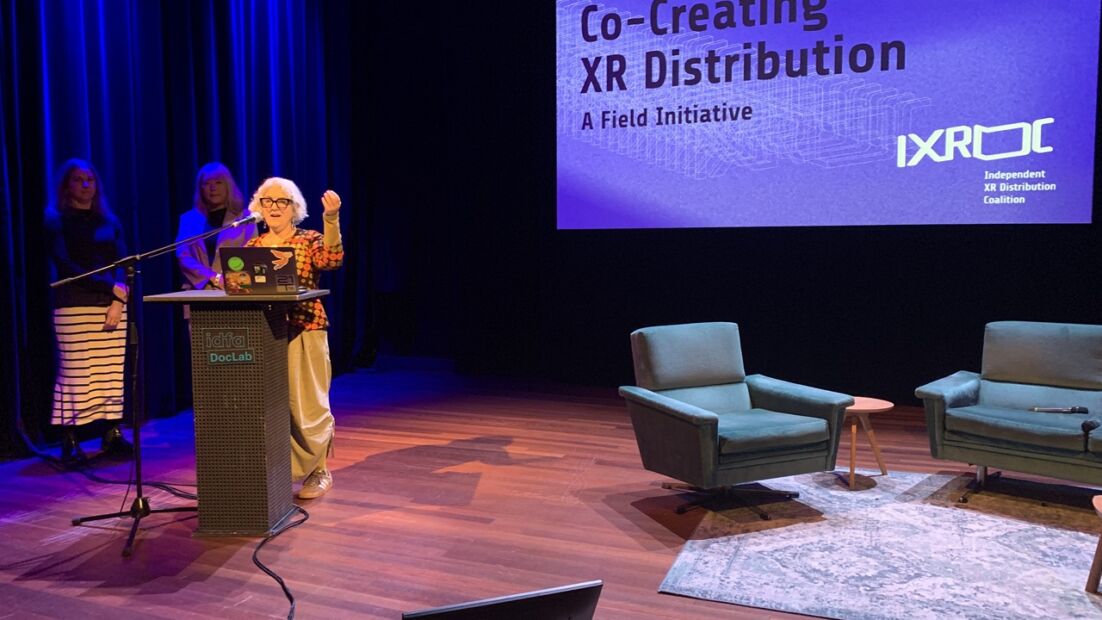
I interviewed Sarah Wolozin, Scarlett Kim, Julia Scott-Stevenson about MIT Open DocLab’s Co-Creating XR Distribution Field Initiative on Wednesday, November 19, 2025 at IDFA DocLab in Amsterdam, Netherlands.
This is a listener-supported podcast through the Voices of VR Patreon.
Music: Fatality
Podcast: Play in new window | Download
Rough Transcript
[00:00:05.458] Kent Bye: The Voices of VR Podcast. Hello, my name is Kent Bye, and welcome to the Voices of VR Podcast. It's a podcast that looks at the structures and forms of immersive storytelling and the future of spatial computing. You can support the podcast at patreon.com slash voicesofvr. So, continuing my coverage from IFA DocLab 2025... Today's episode is with the team from MIT Open Doc Lab, which has a whole co-creating XR distribution field initiative. So what that means is that they've been doing a survey of some of the deepest problems when it comes to immersive storytelling exhibition and distribution. And so they're trying to create a number of different tools, try to make a bit of a survey for what are the exhibition places, what are some of the things and formats that they're exhibiting. exhibiting but also kind of a pipeline for trying to see the different formats and create kind of a taxonomy for the different you know ways to help creators to kind of understand the process of their own creation but also as they define that and that's kind of feeding into the different types of exhibition places that are out there they're also doing like more of a kind of retrospective literature consolidation of all the different discussions around distribution issues and they're kind of in a phase of taking open feedback for these different tools that they're creating and so they had a number of sessions at the r&d summit where they were actively getting feedback and getting insights for these different regions that were not well represented within their first cut for some of the survey of these different exhibition centers but They're also going to be starting a newsletter. And so that's probably the best way to sign up and keep track of some of these different efforts. If you want to get like early access to some of these different tools to both use them as a resource, but also provide some feedback as they are continuing to kind of build everything out there. They're trying to solve a lot of these problems where there isn't really necessarily like a good entity to provide all this information. A lot of the distributors may have this, but they're kind of developing their own relationships and not necessarily like sharing it back to the community because that's part of how they're able to continue to run their business. And so. This is more of an open source effort to kind of do a curation of all these different stuff, but also to try to provide some tools for the broader community. And so they're also still in the process of trying to find full funding for some of these efforts, but they're at least partially funded and starting to gather up all these tools and present some of their preliminary findings there at the DocLab R&D Summit this year. So we're covering all that and more on today's episode of the Voices of VR podcast. So this interview with Sarah, Scarlett, and Julia happened on Wednesday, November 19th, 2025 at IFA Doc Lab in Amsterdam, Netherlands. So with that, let's go ahead and dive right in.
[00:02:45.034] Sarah Wolozin: I'm Sarah Wallison. I'm the director of the MIT Open Documentary Lab. We incubate and study new forms of documentary storytelling, and we do a lot of field building. We do research, we convene people, we build resources for the field, and really try to be a hub for people to think both creatively and critically about documentary and technology. I'm also the co-founder of the Independent XR Distribution Coalition.
[00:03:16.375] Scarlett Kim: Hi, my name is Scarlet Kim. I am a producer and director. I work at the intersection of live experiences and immersive media. I'm the co-founder of the Independent XR Distribution Coalition, and I see myself as a field steward at large, connecting independent artists with cultural institutions and innovative endeavors of all kinds.
[00:03:36.044] Julia Scott-Stevenson: And I'm Julia Scott-Stevenson. I'm an immersive media researcher and maker. I'm based usually at the University of Technology, Sydney, but I also work as lead researcher with MIT Open Doc Lab on their research partnership with IDFA Doc Lab and also as part of the Independent XR Distribution Coalition.
[00:03:54.295] Kent Bye: All right, so I always like to hear the different types of design disciplines and also the different kind of practices that people are bringing into the industry. So I'm just curious to hear a little bit more context around your background and your journey into the space.
[00:04:06.718] Sarah Wolozin: So I came into this space through documentary but also a real interest in every kind of media and every kind of technology and how you could combine the two and find new ways to tell stories and share information. I'm also a big believer and we have a studio around co-creation and participatory practices as ways to really shift the balance of power in the making of media and giving more equity and justice and being more equitable and just in the process of making documentary media.
[00:04:41.707] Scarlett Kim: I come from a theater background. I'm trained as a theater director. And I think Kent, actually, the last time we spoke was when I was at the Oregon Shakespeare Festival, building a transmedia and immersive department in the context of a large repertory theater, really imagining the future of what theatrical storytelling and collective experiences are. So that's what I'm passionate about. I love championing artists' mobility, supporting artists as they traverse between disciplines and mediums and industries. And as a creator, I draw from mediums like ritual, game, XR, theater, really across ancestral to emerging technologies. And I tend to be excited about context that champion artists as entrepreneurs and also kind of blur the boundaries between what is experimental and what is pop.
[00:05:31.201] Julia Scott-Stevenson: I also come to this area from documentary film and I did a PhD in documentary right around the time that interactive documentary was becoming a thing and was really intrigued by the possibilities for expanded documentary that became available. And then, of course, a few years after that, documentary took a bit of a pivot and started moving into XR and VR. And so I've sort of expanded my research and making in those areas with a particular focus on documentary environmental and social impact and how these different kinds of affordances of the tools are using creative and emerging technologies might enable audiences to perhaps experience a different kind of impact from traditional screen media.
[00:06:12.833] Kent Bye: Nice. Well, I know that I've been covering the film festival circuit in XR since I first went to Sundance in 2016 and had a chance to attend a number of these different amazing festivals. I have amazing works, but then a lot of them either do the very insular festival circuit and then they kind of disappear. They haven't really made success. their way out into the general public. And there's been this kind of stopgap with museums, heritage sites, location-based entertainment that has started to provide like the theater of XR or some distribution channels. And there's also the domes with like Cosm and Sphere and other emerging formats and lots of different disciplines that are coming together from the theater realm and live performance and cinematic tradition and the theatrical tradition. And so there's kind of like emerging ways that each of these different locations and contexts can start to exhibit the XR distribution. But I know that MIT last year started to identify this as a big need and problem with this immersive industry that there hasn't really been the distribution challenges haven't been fully figured out. And so I know last year had a chance to talk a little bit around some of the preliminary work. But this year at IFIT Doc Labs R&D Summit, you're presenting a little bit of your latest work that you've been able to do, but also kind of where it's going to be taken here in the future. So maybe you could give a bit of a context for how MIT started to identify this as an issue and then how you wanted to start to address it.
[00:07:35.854] Sarah Wolozin: Yeah, well, one thing is that the Open Documentary Lab is very much about access. That's a really philosophical foundation is access to knowledge. And that's something I've always really cared about. So from the beginning, every lecture we did, we posted online. We created these resources like Docubase so that anyone in the world could find out about the field and learn about it. And in fact, I have anecdotes of people who got into this field because they got to Docubase from school. like Poland or somewhere. So that was really important. And when we started the lab, it was all about cell phones in your pockets and a means of distribution through the Internet. And then, as Julia said, we went towards VR. And then it became very exclusive and very difficult to access and very difficult for the artists to put out in the world. And so that really became a big issue. You know, how can you promote and support a field and put all this effort into making these amazing pieces and also with people with important messages and not have it you know what kind of impact can you have and so that's where we really started to identify distribution exhibition as a problem i don't think we were the ones identifying it of course like everyone was aware of it and it was the elephant in the room frankly but it was always a question of what could we do and as a university that kind of has this bird's-eye view of the field, and we can do research and we can convene people, this seemed like somewhere we could really help.
[00:09:04.409] Kent Bye: Nice. And so what happened then?
[00:09:08.611] Julia Scott-Stevenson: So we, as Sarah mentioned, we were hearing from everyone that distribution was in a moment that just really needed some attention, and IDFA DocLab was also having that moment and saying, OK, I think this needs to be our focus. I think maybe it was Kasper Sonnen that said... what are the journeys here that artists can take? Like how do we, when we talk about these projects, we're often talking about such different forms of media that it becomes difficult to actually have a shared context. And so we collectively with Infant Doc Labs started talking about, all right, maybe we need to start defining some pipelines and thinking about what are the possible pathways that an artist might take to get their work to an audience? And that can look really different if you have made connections plug-and-play VR headset piece from If You Are Making, a piece of immersive theatre that has actors or a presenter in an audience of 30, for instance. So at last year's IDFA Duck Lab, we presented the topic as our point of research and we hosted a number of roundtables. with industry folk around a number of different topics. So we looked at location-based experiences. We talked about touring. We talked about online platforms. And we also talked about data because that's a real gap in this area is that people just aren't collecting or certainly not sharing data around these kind of pipelines and access to audiences online. So that was really informative and interesting. And then we started wrangling that into some ideas about pipelines as the kind of IDFA focused particular arm of the research, along with some audience case studies and interviews so that we could try and get some examples that would give real tangible ideas to other artists who might want to take these kinds of journeys. And then maybe I can hand over to Skal and Sarah to explain how that then kind of grew into this idea for a coalition.
[00:10:57.816] Sarah Wolozin: Yeah, and also Julia took the idea of pipelines and really thought about more of a toolkit. Besides these journeys, how can you help people through the journeys? So she started to think of questions that she would ask, you know, that you could be asked as you're going through, and these case studies so you could see examples, so you would really get a whole, sort of a holistic project that could help people in different ways. And we're also, I don't know if it's going to come out, I can't guarantee, but we are talking about, having an AI distribution collaborator who will work with you to help you come up with a plan. So that could be interesting.
[00:11:37.599] Scarlett Kim: Yeah, so last year at IDFA DocLab, we launched the coalition. And I think there was a moment where we did this exercise, participatory exercise, take the pulse of the room about what comes to mind for you when you think about distribution. And of course, in the word cloud were a lot of pain points and points of frustration and friction. And we were like, okay, well, how about we reframe that and really treat this as a moment of co-creation? Together, we have an opportunity to collaboratively imagine the future of distribution. So I think a couple of things kind of surfaced quickly around, okay, so let's think about an interdisciplinary approach that feels core. And I personally, someone coming from Performing arts, like I constantly feel like there's so much opportunity for exchanging strategies and insights and best practices that are currently siloed and currently kind of, I feel like sometimes I'm just constantly multiple hats in multiple spaces. So interdisciplinary approach felt key. I think we quickly started talking about defining XR pluralistically as a kind of this field that is a kind of meta field or a kind of expansive, constantly expanding field. I think we started hearing about shared challenges between artists and audiences and presenters and really seeing this as a collective mobilization effort as opposed to something that just benefits one of the constituencies that make up XR. So, yes, I can't believe that it's been a year since we launched a coalition. And since then, we've been working with an incredible group. group of field leaders across disciplines from presenters to producers to distributors to scholars to independent artists and the list goes on in terms of what kinds of brilliant minds we have as advisors in the coalition to really tackle this existential and also very tangible problem that our field is facing around distribution.
[00:13:30.765] Sarah Wolozin: Yeah, and I would add to that that another core principle for us was independence and independent media. Every field has an independent film, independent music, and this field is emerging. And of course, the market will take it in one way. But in order for there to be an independent part of this, you really need people to make that happen. And so that was something we also really wanted to make sure we could carve that out in this field as an independent media. And so what does that mean in this field? It's not only the art, it's the technology. So how do we move away from always being dependent on these big tech companies? And we have a case study, for instance, with an artist who created their own independent platform. And you see a lot more of that. So that's definitely one area of focus that we're really interested in.
[00:14:20.914] Kent Bye: And here at IFA DocLab R&D Summit, you all had a chance to present to the entire community where you're showing some of the latest products, I guess, that we're soliciting for feedback, including the pipeline and the database. And so maybe you could give a bit more context for all the things that you were sharing with the broader community that's bringing together both artists and producers and distributors and kind of like a cross-section of the key stakeholders within the XR industry are represented here at DocLab R&D Summit. And yeah, also the opportunity to solicit some feedback. And so, yeah, I'd love to hear just kind of like an overview of what you were reporting and what you were receiving back from the community.
[00:14:59.899] Sarah Wolozin: And I'm sure we each have our own take on it. But one thing I wanted to say also about where we are as a field is that we say it's a problem, but it also is really emerging. And that's something we saw is that it's happening all, you know, artists, cultural venues, they're really growing distribution and forming networks and coming up with new strategies, but often we don't know about it. So we really thought we could be a connector of all of this and surface this emerging distribution network that is taking place. And then within this network that we're creating, we're creating tools. And we have this basic data that we're gathering, and it's about sort of finding tools to make your way through that data. And so what we showed there were these different tools that would allow you to access the data and make sense of it in different ways, and I'll let them talk about it.
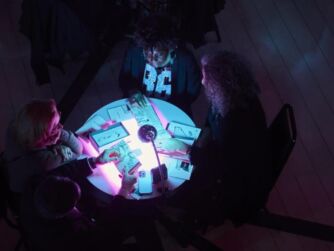
[00:15:49.895] Scarlett Kim: Yeah, so to share a little bit more about our database, which we also offered a little glimpse into during the R&D Summit, is that it's the raw material. It's the constellation of records and materials that right now informs the pipeline tool, which Julia can share more about, but can also inform many other tools. Sarah mentioned the kind of inkling of an idea we have around AI distribution collaborator, but we were also joking, but not really joking, seriously talking about, like, is there a card deck? Like, I think... all of the mediums and vehicles that can activate and access these tools, the data must be pluralistic and must offer different kinds of access. And also offering direct access to the raw data itself is something that we're thinking about seriously to make this as open source as possible, make it as living, breathing, evolving as possible, and something that really emphasizes the relational and iterative nature of our field and the decentralized nature of our field so that It's not trying to serve as a kind of be-all, end-all, exhaustive repository or to kind of claim any monolithic idea of best practice or one way of doing things. But it's really, I think, wanting to be something that can be nimble and grow. So right now, we have two sections of the database. One is platforms and venues. And... It kind of maps physical and digital platforms to develop, produce, present, or support immersive work around the globe. It can be sorted in many ways right now by platform type, discipline. We're also tracking how each venue curates or how the user might learn more about technical specification of a given venue. So what we were user testing in the roundtable is how much information is available. too much or too little. We're finding a balance between having detailed information, but also keeping it usable and pragmatic. And the second section right now of the database is around resources. So this is a kind of database that tracks the latest research, writing, and frameworks around immersive distribution. So it has reports, studies, opinion pieces, academic articles, instructional manuals, and all kinds of research around it. So yeah, we look forward to developing the database work and the pipeline in tandem. And like I said, also exploring all the other myriad of tools that can activate the database.
[00:18:05.791] Kent Bye: And just to follow on the database, because it sounds like that the platforms and the online exhibition is including not only the research, but also the platforms and the online exhibition context. But for the kind of venues and the physical locations, the exhibition centers, it seems like it's also categorized in terms of like different taxonomy terms that are trying to help to say, OK, this is maybe cinematic VR. Maybe there's some performative elements. Because there's essentially like some of these places are going to be more well suited to have more of a performance that have seats and or maybe you just need a big box. And so I guess that was one of the things that was identified at the Venice Immersives think tank that was thinking around immersive distribution that. There wasn't this repository that was gathering all of this information in a space that a creator could have as a resource as they were trying to plan out their tour. And so this sounds like this is the beginnings of that database, but also figuring out what kind of metadata and other stuff is going to be helpful for the creators. And so, yeah, I'm not sure if there's anything else you wanted to add or if that sounds correct.
[00:19:05.993] Scarlett Kim: Yeah, just to quickly add, and I think those were the questions we were asking the community during the roundtables of what do we even call this? Like, how nuanced do we want to be with these forms? Like, what about the forms that don't even have names yet and are unclassifiable? You know, how do we, for example, we're, you know, we've been, again, advisors have been instrumental in adding either venues they operate or the venues or platforms that they're connected to to this database. And even as an example, to name a primary discipline of an inherently transdisciplinary venue. What does that mean? If a venue is associated with 12 different primary disciplines, that maybe it's more accurate reflection of the venue, but it makes the sorting a little bit more challenging. So I think those are the questions that we asked the community, and we got some really incredible feedback around how we can grow this. And I think it'll just have to be a thing that we continue to iterate, the taxonomy of it all, and how to continue to receive,
[00:20:03.955] Sarah Wolozin: Yeah, and it has to be mobile. You know, it has to be able to transform as the field transforms. It essentially follows the field. And one of the problems that was identified very early on is that artists would make these beautiful bespoke projects, but without ever checking about where they could actually be distributed or exhibited, then they'd go out and it wouldn't fit the place that they wanted to exhibit or there wasn't a place to exhibit it or a venue wanted to exhibit it but couldn't because there wasn't a match. So that seemed really key. is having a place where an artist could go at the beginning when they're making their project to be able to see what venues carry, you know, what type of platform they're going to use, you know, what format they're going to use. And then finding the place and finding... Even perhaps the parameters of how big the space is or what amount of people can go through at one time and these kind of parameters. And that's really key is really connecting the artists and the platforms and the venues at the beginning, you know, so that they can be in conversation so that things can actually tour. Hmm.
[00:21:15.743] Kent Bye: And it seems like some of the taxonomy terms of these venues are perhaps in a relationship, iterative relationship to this pipeline that's being developed because it's trying to identify not only the forms of the media, but kind of like a tier of like as you go down of different levels of the actual immersive media and the different technical formats that are involved, which sometimes dictate where it can be exhibited. And so maybe you could just give a little bit more elaboration of this pipeline tool that has been developed.
[00:21:45.171] Julia Scott-Stevenson: Absolutely. One of the things that's been really clear from the beginning is how much knowledge already sits within the XR community that was having trouble getting out and how could we actually wrangle some of that into some form that was intelligible to a broader audience. And I think that was probably the primary impetus between designing a pipelines flowchart in some way that just supported artists and makers to be able to start thinking through those steps and asking themselves those questions like... what is the format that I'm making? How do I describe this to a venue? And it's been really interesting to see as we started putting it into a kind of visual diagram, how much intersection there is in the space, but also that by visualising this, there are actually some pathways that do start to appear that we can see are journeys that others have taken through this space. So we were trying to make it rather than What this very much isn't is us designing a distribution pathway for artists, but highlighting what exists and trying to show pathways that others have taken before. But as Scarlett and Sarah say, it's very much a living diagram and a living process because obviously the field is changing continually. For instance... trying to determine what the categories are for formats. So we have a range of different formats that we've identified and detailed. And already you can see how projects would fit maybe in one, but maybe also in another. So it's certainly not us about putting hard definitional boundaries around that, but trying to provide some of that support to artists to figure out, okay, maybe I'm going to start over here. And these are going to change in time already. We've seen like At the moment, we've got, for instance, a 6DoF VR headset is one category, and then we've got mixed reality headsets as a different category. But as the VR headsets become more and more capable with pass-through, for instance, maybe those categories are going to start collapsing over time. But for now, it seems sensible to offer those as two separate things because the projects we're seeing do follow slightly different pathways at the moment. And then the next tricky thing has been, yeah, how do we integrate that pipelines flowchart with a kind of link to the venues database? So once you follow that flowchart through, you say, okay, I'm making a sound led site specific piece. And so this leads me to these particular venues that might be most appropriate. It needs to be in this kind of venue and here's a list and then now you can follow out to the database which will give you a list that you can sort by that particular venue type. And so this is very much where we now are at that crowdsourcing and user testing phase because obviously we couldn't immediately list every venue that covers this kind of work and we had such a great response in the user testing this weekend where people were immediately coming up with so many different venues that we were missing. particularly regionally based. There's a lot of geographic regions that we're patchy on. And so we were starting to get a lot of contributions to really flesh this out. And it's going to be very much a community led approach to be able to obtain some more of that data.
[00:24:47.678] Kent Bye: That's awesome.
[00:24:48.683] Scarlett Kim: Yeah, I think, you know, something that one of the first discoveries, important discoveries we had starting our collaboration together was about relationships, like how core relationships are to distribution and how powerful it is and also how it can sometimes make things feel inaccessible. So it's kind of like, how do we create a database and tools in a way that really honors and celebrates that this happens? Feel this built on the tree roots in the forest and how they exchange information and resources, the rhizomatic nature of relationships, but also how do we not let that be a force of gatekeeping? So I think for me personally, one of the most exciting discoveries in the last few months is naming that intermediary layer of labor work. of kind of independent producers, distributors, catalog producers, impact producers, kind of these agents and liaisons in the field that connect between artists and their projects and institutions or presenters. So we've been kind of leading up to our presentation at this year's IDFA, have been talking about, okay, how do we, and actually festivals are also the shaman of of the distribution ecosystem. They are pervasive. They are the water. They are the connector. So how do we actually name that layer of connection or layer of labor, which is often kind of invisible or subsumed into other things, into something that is tangible and something that we recognize in our field? So To me personally, you know, working on the pipelines tool with my collaborators here, we were able to surface that. And we were just sharing with our advisors about that. And that felt like a kind of significant outcome of this work. And we look forward to continuing to be able to share those emergent discoveries as we have them.
[00:26:37.389] Julia Scott-Stevenson: I just wanted to, I guess, highlight a couple of the key findings or takeaways. One, which Scarlett actually mentioned already, so I won't sit on that for too long, but seeing this emergence of that interstitial layer of independent producers, which we think is really interesting and important for the field. And the other one that I think she touched on very briefly is that we're also seeing the emergence of more formalizing networks across the industry so groups of venues starting to partner together or to talk to each other beginning in informally and then moving to a more formal approach and realizing that it's really in their interests to share touring ideas even starting to think about co-commissioning but sharing that information about projects and how to support putting them on and how to support getting them to audiences so we're hoping to highlight some of those in some upcoming case studies which i think will be really interesting to hear
[00:27:26.031] Sarah Wolozin: As we talk to artists, a lot of them come into this field and if they're new, they have no idea where to go to distribute or exhibit their work. And also people... thinking about this kind of work. They have no idea. And so that's really an important part of this is making it more accessible to more artists and more people who want to try it. And also venues, traditional venues that say, oh, I want to do XR, but they have no idea. So they can also come to these pipelines and this mapping and see what's there, what their specifications are, how they work, contact them. So it really is about bringing more people into the field too, as well as highlighting those that are here.
[00:28:05.182] Kent Bye: Nice.
[00:28:06.263] Scarlett Kim: So we have our monthly think tank sessions with our advisors where it has been the kind of sandbox and playground to test some of these ideas in iterative form. And I think some of the other just to share a couple other fun emerging things, I think. Now artists are reaching out to us, to the coalition stewards, and saying like, oh, I have a new project, new idea, and I'm really wanting to develop the distribution strategy from the beginning. And I want a space, kind of a playful and collaborative space to workshop that. Could the coalition be that context? So I think that's really exciting to us because that shows us that maybe the coalition can be that space for mutual mentorship and peer exchange of strategies. I think we're also... seeing between venue operators, producers, presenters, sharing of thoughts, emerging thoughts and opportunities and kind of even just the exchange of like, oh, here's a kind of emerging consortium or a network that might be looking for new partners or additional funders. Could that be aligned with something else that someone else is thinking about in a totally different side of the globe, but might be aligned in value or timing or so many other ways? So I think, It feels like there's a kind of constant tinkering and a kind of workshop energy and a functionality that the coalition is taking on. And again, you know, same with a kind of all the self-awareness that we must have in the database itself. I think it's also about engagement. never trying to reinvent the wheel, you know, so to say, but really about having a wide lens to what is happening and how we can kind of be a catalyst or be the fertilizer that allows those things to connect. And really, I think also maybe last point I'll make is, you know, when we built the database and the pipeline tool, we wanted it to be something that is really helpful for both emerging artists or artists who are completely new to XR and folks who are very seasoned and have distributed many many works so I think in everything we do I think we're thinking about access in that way as well of how artists and their relationship to their work and how their relationship between their practice and their career but also venues and partners and platforms in that way too like those who are have been producing XR in the entire life of an institution or some of our partners who are newly energized about the idea and the prospect of working with XR. How can whatever we develop kind of be broadly useful and exciting to that full spectrum?
[00:30:40.259] Kent Bye: Awesome. So I know last year, as you're presenting this aspirations to do this research, you were still in the search for funding. And I know that I saw that MIT was listed as part of this larger coalition with the CIIIC. And I don't know if that's a part of this continued research that is going to be funded through that and if that's going to be fully funded as you move forward, assuming all that comes through. So just curious to hear a little bit of an update as the funding for this type of research.
[00:31:05.885] Sarah Wolozin: So right now we are part of this consortium and there will be funding to continue it. It's certainly not enough, but it helps us move forward the way we have been in the past. We also we have one of our methodologies is collaborative case studies. And so we seem to be better situated to get funding for specific case studies. So, for instance, we have one now as part of the Distribution Coalition Association. is to look at libraries and how they can be civic venues for distribution and exhibition and maybe even co-commissioning. So that's more the strategy to get funding, but we're definitely looking for funding and hoping that there could be a consortium of funders who also fund all the making of it. They put a portion towards thinking about distribution and exhibition.
[00:31:51.315] Kent Bye: Do you have any other things you wanted to add?
[00:31:55.211] Julia Scott-Stevenson: Maybe not specifically about our own funding, but perhaps just an observation that there's a real parallel there in terms of the lack of funding available for artists to do this own research for themselves. Something that's been really apparent in the case studies that we've done and interviews with artists is that each individual one seems to be developing their own expertise and in distribution as they make their work so it's really gratifying to be able to highlight that and share some of that with other artists but for so many of them they just don't find industry support in a formal way to do that journey and they're you know they might be artists but they're actually also having to become their own distributors and so yeah i mean there is while we're talking about distribution while so many people are talking about distribution and so delighted that we seem to be doing this as a focus. We're getting a lot of really, really positive responses from people across the industry, but also a kind of general agreement that there's a lack of funding for this kind of research. Like a lot of the funding in this field very much sits in artistic R&D, which is also incredibly needed. But one of the reasons we've decided to do this is because all of this R&D that happens in this creative development that happens then hits a point where suddenly the And I think maybe, Scarlett, would you agree it's kind of fair to say that maybe there's some parallels there in terms of funding a broader network that's actually looking at that next step? Is it a little bit complicated, I think?
[00:33:25.444] Scarlett Kim: Yeah, I think as we look to how to resource this work that we're doing, a term that comes to mind is shared stakes. We, as a field, I think all have a stake in this conversation. And I think this is a moment as legacy funding structures and institutions crumble, I think it's more of a moment for us to mobilize in solidarity and to develop new systems of interdependence so that we are actually in doing our work that is inherently also a field work our work is the field work and field work is our work and you know there is no slice of pie there's no pie like how can we be actually abundant and really imagine like infinite future of our field. And I think to do that, I think, you know, as someone who is also a practicing artist myself, like I see it as my responsibility to kind of contribute to the field in the work that I make as an artist and as a producer. So I think we're excited about starting to have those conversations. I will also say, I think all of our methodologies really centered artists and are really based on tangible, hands-on creative processes with artists. And I think that's been really rejuvenating that, you know, this is a... both deeply a research process and deeply a pragmatic creative process and i think to me like i'm very excited to discover and have conversations with folks who are interested in resourcing work that is really centering the artists as architects of our future and and really celebrating their process and the artist process as one of yeah imagining new futures
[00:35:02.263] Kent Bye: A follow-on on both the database and this pipeline tool is that here at the Ithaca R&D Summit, you're sharing it with the community with the spirit of getting feedback so it can continue to fill the gaps and continue to grow. And it's also the type of project that if you were to post it publicly, then people might feel like it's not covering everything and that there's a way that it does harm in a way that people feel overlooked. And so I'm wondering how you navigate this sort of paradox of wanting to solicit more information that's going to fill those gaps, but also not present it as if it's a finished product that is trying to do a comprehensive survey. So I'm just curious if that's going to be made available or what the plans are as you move forward.
[00:35:39.898] Julia Scott-Stevenson: Yeah, as you point out, that's a really fine balance to try and meet in that it's important that we release this as soon as possible to people so that it's actually getting used and it's getting tested and we're getting feedback. So what we've done initially is we did a very soft launch of the tools with our advisor community first, the majority of whom are students. Experts, practitioners, exhibitors, distributors, cultural institution leaders. And we got some initial feedback on that. And then this weekend we did for DocLab, we did some user testing where it got released a little more widely amongst the community so that people could tell us immediately where some of those gaps are. and we are very aware that particularly the database at the moment is like Europe and North America centric and we know there's so many other communities out there and we really need that information. So that's kind of why we wanted to release it to at least that kind of bounded community to start with to get some additional feedback. But yes, it's something we're thinking really carefully about and we have a form that people can fill in which I imagine we will share in our newsletter which is where people can... tell us that there is a venue or a platform that's missing and they can fill in those particular details about the kind of work that it takes, where it's based. So we're really hoping that we enrich this as widely as possible and certainly are trying not to suggest that everything that's on this list is all you need to know, that it's very much a community-focused work in progress.
[00:37:07.506] Scarlett Kim: Yeah, it's been really important to be aware of our blind spots, you know, and to be transparent and to be vulnerable and to be iterative in this process. And, you know, I think as we co-create this living, breathing resource, like I think it is our responsibility to continue to have those conversations and approach it as a kind of always unfinished, but constantly expanding work.
[00:37:32.469] Kent Bye: And finally, I'd love to hear what you think the ultimate potential of XR and a future where we might live where all these works that we're seeing on the festival circuit might be more widely distributed. So we're kind of solving all these problems that we have. So what do you think the ultimate potential of this immersive storytelling medium and XR might be and what that might be able to enable?
[00:37:53.953] Sarah Wolozin: Well, I'm a bit of a dreamer. So in my dreams, and maybe it'll become reality, and we're certainly going to work towards that, is that XR can be layered throughout all the traditional legacy disciplines as well. A lot of the legacy forms, such as theater, such as the arts, such as documentary and independent film, are trying to find new ways to distribute and exhibit and do what they do, tell the stories they tell. And so I feel like this field, which is interdisciplinary and thinking of new forms and following new technologies and also new practices, new ways that people interact, experience stories or think about stories or watch stories. And so this field seems like something that can really take storytelling into the future. And I think with all things that are futuristic and not in the mainstream, this distribution and exhibition is so important to really push towards moving it out there and reaching audiences. And I think the whole field is really doing the work on that and really thinking about it As you know, we have this coalition and we meet monthly to talk about and every time we learn all these new interesting networks that are forming or centers that are opening up. So I think you're really looking at the emergence of a field and that's the real issue, not that it is broken like other fields, it's emerging. And so as long as we keep on working on that and the other key thing and what I really want this distribution exhibition pipeline and toolkit and mapping to do is show the world there is a field. You know, look at all the different venues, look at all the platforms, look at all the work, you know, because it's buried. People come to IDFA, they don't come over here. So, you know, if there's a place where we can really show the amazing amount of work and creativity that's coming out of this field and that there are places to show it, maybe the funders will come back too.
[00:39:58.857] Scarlett Kim: I love coming to IFA always, but this year I was so inspired by all the shared commitment towards collective experiences, shared experiences. And of course, I come from theater, so I'm like a liveness and embodiment nerd. But I feel like, you know, the theme this year of the internet or off the internet really was a provocative question for us to think about. What is our relationship to technology beyond the input and output interface relationship? Is there a more kind of... quantum or kind of infinite or pluralistic relationship we can have to technology. And yeah, I think I'm, you know, I am someone who feels energized by thinking about technology very expansively from shamanism to XR. So I think for me, I'm really excited to continue to be guided by artists as they imagine possibilities of XR and possibilities of how really like In a world where we're constantly, I think, to borrow a term from this year's IDFA, like hacking reality, like what is our future? How can artists show us and tell us all the ways in which we can be empowered and have agency in our relationship to technology?
[00:41:09.341] Julia Scott-Stevenson: I never get tired of seeing people new to the XR field experience it for the first time and also particularly artists from other fields also experience these possibilities for the first time. And so I really look forward to there being a moment where XR kind of takes its place as a really firm cultural sector that is understood by audiences and artists as another opportunity option in the spread that they have available to them. And there's a much broader practice of criticism and press and support within existing artistic events and institutions and where it just becomes yet another way that we come and support interaction between people who maybe don't know each other so well or in between communities or in between larger publics. I think that will be really exciting. Hmm.
[00:42:02.441] Kent Bye: Nice. And is there anything else that's left unsaid that you'd like to say to the broader immersive community? Any ways that folks are interested in getting more involved or anything else that we haven't talked around that you'd like to share?
[00:42:12.011] Sarah Wolozin: So we're starting a public newsletter in which we're going to highlight new networks and new strategies and really try to show the different emerging projects and networks, as I said. So you can go to our website, the Open Documentary Lab website, and sign up for the newsletter. And that will be in your inbox. So just right there, you'll start seeing new strategies. You'll see new methods and new venues so we're really going to try to track and share the knowledge we're gaining about what's out there in the distribution exhibition world.
[00:42:49.150] Julia Scott-Stevenson: Only just to reiterate how much of an open process this is for us and so how willing we are to hear from anyone in the community that has suggestions or contributions to make because we really are hoping to lift up what's already happening and what's already existing across the space and so we'd love to hear from anyone that would like to contribute.
[00:43:07.130] Scarlett Kim: Yeah, definitely. I think our public newsletter will be live. We're continually doing interviews with different stakeholders in this question. So looking forward to having more conversations. I think we already have a long list after this year's IDFA. Like we mentioned, we're also looking for creative ways to resource this initiative and this coalition and the research. So folks who are interested in having those conversations, we're very open to it. And Yeah, I think this is an exciting moment. It's a one-year anniversary of this collaboration and the coalition having launched, and we can't wait to continue to share updates and continue to adapt with the field.
[00:43:45.430] Kent Bye: Awesome. Well, I'm really excited to see where this coalition goes here in the future because I think it's a really big problem in the industry in terms of the knowledge and aggregating all this information of what's out there. And it was kind of identified as something that needed to be done, but there wasn't necessarily an entity that was willing to invest the time and energy or money to actually go out and do it. unless they were already a distributor where they have their own private versions of that for their own business, but nothing that was sort of open and shared to the wider community. So for me, it's really exciting to see that this is developing as a resource and excited to see how it can be kind of an ongoing living document that is not only expanding and keeping up to date, but also discovering new places that allow the artists that are making this type of work to have an exhibition context for them to be able to share it with audiences around the world. So, yeah, really excited to see where this goes here in the future and how it continues to develop. So thanks again for joining me here on the podcast to help break it all down.
[00:44:36.896] Julia Scott-Stevenson: Thank you so much for having us, Kent. Thank you. Thank you, Kent.
[00:44:40.563] Kent Bye: That's all that we have for today, and I just wanted to thank you for listening to the Voices of VR podcast. If you enjoyed the podcast, then please do spread the word, tell your friends, and consider becoming a member of the Patreon. This is a listen-supported podcast, so I do rely upon donations from people like yourself in order to continue to bring you this coverage. You can become a member and donate today at patreon.com slash voicesofvr. Thanks for listening.