I interviewed Vitor Freire & Monique Grimord about Unimaginable Red on Wednesday, November 19, 2025 at IDFA DocLab in Amsterdam, Netherlands.
This is a listener-supported podcast through the Voices of VR Patreon.
Music: Fatality
Podcast: Play in new window | Download
Rough Transcript
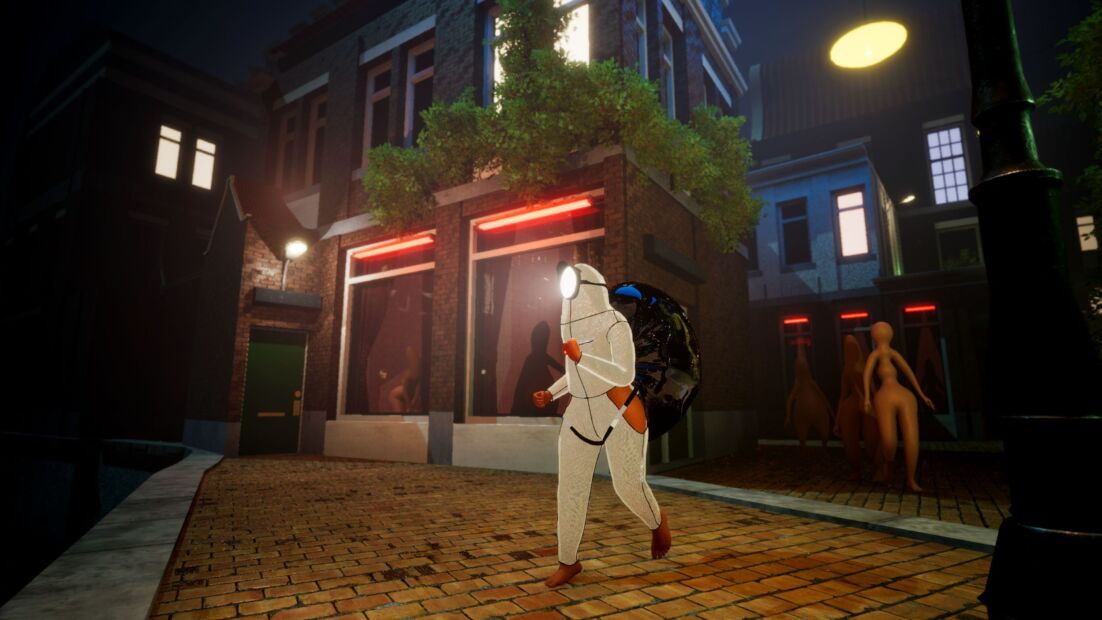
[00:00:05.458] Kent Bye: The Voices of VR Podcast. Hello, my name is Kent Bye, and welcome to the Voices of VR Podcast. It's a podcast that looks at the structures and forms of immersive storytelling in the future of spatial computing. You can support the podcast at patreon.com slash voicesofvr. So, continuing my series of looking at different experiences from IFA DocLab 2025, today's episode is with a piece called Unimaginable Red. So this is a piece that is making this kind of poetic imagination to kind of imagine what would be possible for this potential future and speculative future for the future of the red light district. And so it's kind of an interesting conversation where we're discussing like all the different dimensions of the existing red light district and also the way that they're using this open world game as part of the live interactive cinema that they had this year, where there are five different pieces where you have kind of an audience that would be watching one person up on stage and playing this interactive game and so this was like a game where you're going around and the mechanic is basically that there's lube that you're gathering and you're basically giving the lube to these different people who they call them drones but they're also dressed up as these sex toys but your interactions are mostly from people who are also other people that are just roaming around and so there's more of a kind of a gifting culture of lube that's happening but also kind of like exploring different mechanics throughout the course of this piece. So we're covering all that and more on today's episode of the Voices of VR podcast. So this interview with Vitor and Monique happened on Wednesday, November 19th, 2025 at IFA Doc Lab in Amsterdam, Netherlands. So with that, let's go ahead and dive right in.
[00:01:47.839] Monique Grimord: I'm Monique Remord, and we have a small creative studio called Imagination of Things. We are medium agnostic, so this is one of many sort of experimental projects, this time playing with games. I think the thread that sort of connects everything is play and playfulness, and that can be in person, it can be using new media, new technology, emerging technology. So we've worked with augmented reality, we've worked with traditional gaming methods, and in-person experiences.
[00:02:18.315] Vitor Freire: Hi. Well, I'm Vitor. I'm the co-founder of Imagination of Things. And I don't have much to add about our studio. I think often what we're trying to propose is this idea that play can be in itself a medium. So I would upgrade us into not necessarily being medium agnostic, but depending on the context, we might... choose whatever technological medium is the most appropriate but i think play is our medium we're really trying to push that forward with all the implications potential side effects but in general play that is not like the let's say not the shallow understanding of play that is like playground for kids i think we have first-hand experience using play with serious topics sparking serious conversations but like navigating friction social friction dealing with like more let's say profound context and I think play literally can play a role on that as well great and maybe each of you could give a bit more context as to your backgrounds and your and all the different design disciplines you're bringing in and your journey into the space
[00:03:40.163] Monique Grimord: I'm all over the place. I mean, I studied graphic design and interactive design. You know, I've worked in more traditional settings like tech companies. I worked in advertising. So I passed through that sort of rite of passage. And now I get involved in everything. I mean, with this project, I was functioning as kind of art director. I also was very heavy handed with the process of character design and environment design, also involved in the game design. So yeah, I'm getting involved in all of these things.
[00:04:16.417] Vitor Freire: Well, if the question was about the background, I think it's a given that we are all over the place. I think this studio is a manifestation of that sentence. But my background is actually originally in filmmaking. I'm originally from Brazil, so I did a lot of editing for documentaries, documentaries that went to the public broadcast in Brazil. And then at one point, creative advertising, kind of like... took me for a spin and i worked inside that environment for a few years and then my curiosity around technology kind of like led me back to school i did my masters in new york at itp it's an interactive program And that is kind of shaping a little bit of what we're doing right now with immersive tech, where there's a narrative spin into the way we're using technology. And I think that at least the confidence to explore that, it really came through my grad school.
[00:05:26.866] Kent Bye: I'd love to hear you describe Unimaginable Red and give an overview of what this project is and how you would describe it to someone.
[00:05:35.930] Monique Grimord: Well, it's an alternative, fantastical, wonky version of the Amsterdam red light district. Nothing is sort of realistic in the sense that the characters are these... sort of walking sex toys. You, in the game, are a kind of a public servant in charge of managing the pleasure flow of this alternative red light district. And I'll pass it to Vitor to give him some chance as well, because I feel like I've hogged it a little bit. So yeah, you give it.
[00:06:20.853] Vitor Freire: I think that's it. I think it's an artistic game. I think we operate with a few premises. The first one is a wild premise where we could make a game in collaboration with real stakeholders in the area that inspired this game. That means this all started with like ideation workshops with activists, sex workers, open-minded heritage professionals, architects. And that was something that was... extremely fulfilling but at the same time very risky because it wasn't clear that we could translate all that energy into a proper game so that's the very first premise can we do that in this way with that level of co-creation collaboration I think the second premise, it was just like, this is a creative reaction to something that is going on in the city. The municipality has clear plans to remove or move to another part of the city. Everything that has something to do with erotic sensuality, I don't know. And that generated a big backlash. I think our reaction is... another one potential artistic contribution to a scene that is um that was happening um and i think the idea that a game could somehow be a contribution to that conversation is also one of the premise we had and the third one to be honest it was as we made some progress with the game, as we saw the visual directions, play testing, we watched first reactions, we just realized how, even though still there's a lot of stigma in the topics, but how much this game is also very connected to this idea of understanding how pleasure in itself is revolutionary, connecting to the political layer of that, but without being too brainy. It's a very sensual, whimsical experience inspired by a place that has centuries of, has a heritage and a history of attracting people to seek pleasure and we just hold space to that idea and wanted to unlock other ways of existing in this area using game as a medium.
[00:09:27.329] Monique Grimord: I can say a little more. I mean, a little bit of, like, why this topic. So our studio, like, our physical studio space was in the Red Light District for, I don't know, six years maybe. We're on the edge of it on SPAO. And I think it's a little bit of a love letter. I mean, we, you know, this district is so complicated and exhausting. But, of course, like, we do love it. And... We also, yeah, we wanted to make something to show our appreciation for it. Mark a moment in time if it's, you know, there's a possibility it could be disappeared. And sort of embracing this heritage aspect. I mean, the game touches on so many different areas, but one of them is historical heritage. And like Victor said, the Red Light District has been there for centuries. It's as old as Amsterdam. So this is a heritage place. Yeah.
[00:10:27.543] Kent Bye: Yeah, so I had a chance to play through the experience, but before I played through it, I heard the contextualization from Kasper Sonnen, who was talking around how being from Amsterdam, whenever he talks to people from coming out of town, that's often the first thing they'll say is like, oh, I've been to the red light district. And he also mentioned that there was this kind of ongoing debates around whether or not that area was going to get gentrified. And so when I was in my mid-20s, took a trip through Europe and with my college roommate, we came to Amsterdam. We didn't get a night, a place to stay. And so we just walked around the red night district all night and then left in the morning. It was a very quick turnaround, but you know, so it was sort of like that, uh, uh, cliche, um, story that Casper was talking around. And so I played through the experience, but I haven't, you know, been back to the red light districts, you know, you know, coming to Amsterdam almost every year for since like 2019 or, you know, uh, 20, 2018. And then, missed a few years in the pandemic and so I actually played through the game and then I was like I need to just check out what's going on in the red light district just because I forget what it was like and just I wanted to check in and my impression as I was walking through it was sort of like this you know in some cities they have like these tourist traps where people just go and congregate and it felt like this and there it felt like there was this kind of spectacle element but also something is unique that I don't I can't think of very many other places around the world that have a scene like that with this kind of tourist trap with mashed up with this kind of sex worker, red light district and all these kind of live sex shows and just a whole range of museums and events and tourist attractions essentially, but also, um, sex workers that are actively working there. And so, so I gave, I walked away with this sort of like, you know, this hyper capitalism, uh, uh, hyper capitalism type of experience of sex work. Um, And other sort of experiences. So then I was thinking back to your experience to sort of see how there didn't seem to be any of the capitalistic elements, but still just kind of the pure pleasure. I'd be very curious to hear around like any additional context to the discussions that you were aware of. It sounds like you were in that area, but also that you were holding these kind of like speculative world building and. trying to imagine what the future could be of this space with the actual stakeholders of the area. And so, yeah, just curious to hear around like this original intake and maybe set some more context for how you think of what the red light district is and some of the different kind of conflicts and how this game is kind of trying to further the conversation about that.
[00:13:06.277] Monique Grimord: Yeah, well, I think we sort of started with these sort of fetish pillars, or pleasure pillars we called them. But they really are sort of angles of different fetishes. And we wanted to give space to alternative ideas of pleasure, or just a really varied idea of pleasure. um and even including pleasure that is not necessarily explicitly erotic you know this is this is like hedonism this is just pleasure for pleasure's sake so i think we that was that was really a big part of it was was giving space to that um so that's why the character is sort of collecting these pleasure objects and you'll you'll see like uh you know one of them is sort of like a um a healing crystal um one of them is is a is sort of a flower that has a reference to marijuana and and also is quite phallic so we're sort of mixing together these these elements um but it's definitely our interpretation of it definitely puts the sex workers at the very center of it i mean they're occupying most of the space the character that you meet initially is the dom patrol um Um, and they are, they are sort of like the, the, the person in charge of, of, you know, keeping the order in this place and also like an explicit reference to, to sex work. Um, and, and I think we tried to make it clear that this, in this fantastical version, the sex workers have, have taken control of the island and made it what they want it to be.
[00:14:45.170] Kent Bye: It's sort of a sovereign entity as well.
[00:14:47.751] Monique Grimord: Yeah. Yeah. The island itself, you mean?
[00:14:50.390] Kent Bye: Yeah, it's like it became its own country?
[00:14:52.750] Monique Grimord: Yeah, so maybe I didn't mention the sort of architectural or landscape of it. So of course, it looks like the red light district in some ways, but you can see that it's almost been cracked and separated from the rest of the city. So it's sort of island-like in that sense. Yeah.
[00:15:12.954] Vitor Freire: I would just add super quick a few things. First, I don't think the game is a mirror to the reality of the Red Light District. If anything, maybe a lens in which we take a look at something that is definitely not there. So it's a very unrealistic, outrageous, but playful, hopefully, version of it. You're right. Right now, consumerism is... how you make sense of this area it's this sense making device and that creates a lot of side effects to be honest I think even the local stakeholders might be might be critical of that as well. We just assume that flocks of tourists are necessarily good for them, but I think that can be a problematic assumption. I think the issue of gentrification is way more complex. I would just plug a recommendation for a book called Smooth City. It's also a love letter to Amsterdam, but it talks about that in a way that it really... It almost, like, unpacks some of the stereotypes and assumptions we have, even about gentrification or this idea of, like, over-tourism. I think the problem is a bit more complex than that, and I think what we did with the game, it's less of, like, just reacting to that. It was in a polarized conversation where top-down municipality had a plan, and... unusual allies from a resident to a sex worker had a backlash. We just realized that there was like a lack of imagination. There was a lack of space to imagine something else. We brought the game, we set up this playground as a proposition for that. So we are less involved in problem solving in that way.
[00:17:34.182] Kent Bye: It's sort of like a speculative future of what if an entire region was oriented around liberatory pleasure, it sounds like.
[00:17:45.154] Monique Grimord: Yeah, that's a good, yeah, summarization. Yeah.
[00:17:49.558] Kent Bye: And not so much that you're kind of having a transactional nature, but it's almost more of like a Burning Man-esque where there's more of a gifting culture where people are kind of giving things to each other freely rather than having. So I guess in that sense, it's more relational in the sense of rather transactional. Yeah.
[00:18:09.440] Monique Grimord: Absolutely. We were looking at gifting culture when we were researching different ways to arrange the gameplay. So yeah, the character is sort of collecting things and finding things, which is part of the fun, I would say, is searching. And you, the player, have to sort of share it with the visitors who are kind of wandering drones and they look... They're just sort of zombying around a little bit. So, yeah, you have to share it with them. And it's... So then, of course, yeah, it does eliminate any kind of transactional aspect here. But it's also... I think caretaking and care was a huge part of it. And the artists and the... The sex workers and the thinkers that we talked to during our initial research process really highlighted this. And I think, yeah, the district today, you don't think of care when you go there, right? So that's not a word that comes to mind, but I think that could be, especially in a district that's oriented around pleasure.
[00:19:16.212] Vitor Freire: And maybe I would just add, there isn't a political undertone. Well, our collaborator, Grace Turtle, she always, and when we did our introduction Saturday, she really pointed that out, how pleasure is political, even though we're taking like a more playful approach. But I would like to highlight some of the inspirations that they are from social movements that happened in this place. There was a movement, 60s in Amsterdam, called the Provo Movement, that at the time was deemed to be very unrealistic, unreasonable. But deep down, they played a major role into making this a bike city.
[00:20:06.432] Kent Bye: So I also like this idea of like... So just to clarify, does it mean something that was coming and being born out of the Red Light District or a different movement? Maybe just elaborate what you mean.
[00:20:18.357] Vitor Freire: The Provo movement wasn't specific about the Red Light District. It was about the city, Amsterdam city. It was... Great graphic design meets anarchy and an attempt to be more involved with actual politics. So it was an anarchic movement, but with a lot of proposals. I'm not going to go deep on that, but please Google the Provo movement, Amsterdam. But for me, this is just a metaphor in the sense of something that at one specific time can be considered to be outrageous, can plant a seed to change. And I think... In many ways, the game is taking inspiration from that. I think there's some street posters in the game that is doing a little homage to that. My point is that the... the political movements, the social movements, the queer movements that is also part of the heritage of the city, not only the red light district, they're also an inspiration to the game.
[00:21:40.345] Kent Bye: Yeah, the thing that comes to mind is that there's this sort of idealism that can dream big and then sort of shoot for the stars and settle for the moon, as it were, like you are able to be really super ambitious, but then, you know, kind of settle for something that's like better, but not maybe as the sort of the far ideal as you wanted. And so it sounds like that was a part of the Provo movement. And in this piece, I can see how, you know, it's in this kind of like Burning Man-esque context of like, what would it be like to have, A context and environment where people were freely sharing pleasure with each other in a way that was supported by its sovereign political nature. A lot of this isn't fleshed out in the details of the story. Or at least it was a pleasure liberation day it starts off with. And so I guess there's some illusions there that there's kind of like... you know, becoming autonomous as a kind of the beginning point. And so there's a, a sort of a sense that you're in that, that, uh, birthday of the holiday of celebrating like this, this transition into sovereignty to be able to really celebrate the pleasure. So maybe just, uh, start a little bit around the, the cut scene, the beginning that starts to set the context for what this world is and what kind of, uh, world building that you're trying to do in terms of describing this context that you're about to explore. Yeah.
[00:23:02.901] Monique Grimord: Maybe I'll pass it to Vitor, because he was really more working on the narrative aspect of this.
[00:23:11.092] Vitor Freire: I think it was a combination of two things. First, we needed a fictional plot, a fictional device to allow us to have more freedom in the world building. I think the idea of almost temporarily disconnecting the red light district from the rest of the city early on was something that we felt like it makes sense. And I think there is also... All the other things we wanted to explore, like we talk about a less transactional manifestation of pleasure, a more collective way of dealing with a city, citizens, people. I think it made sense to almost like take a break from the rest of the city and really fully embrace some level of autonomy. The game starts with, like you said, it would be the holiday. It's a holiday to celebrate Pleasure Liberation Day, to celebrate the moment when this whole transformation happened. So when you start the game, those things are already established. This happened in the past, and you just enter for your first day of work in a very special day. I think the other thing we tried to do with this intro as well is... It's a very... in many ways, sensual, but very experiential I don't know what other ways to describe, but it's like once you are playing, it's not very heavy in terms of narrative. And that's intentional. We really wanted to provide small opportunities for you to reflect on some of the topics, but in a way that it's not an intellectual reflection. And that can range from us provoking you about how your fingers are touching the game controller to a bit more other... breaking the fourth wall a little bit. We break the fourth wall in the sense that we state that we see the player, but we also see the person behind the player. And I think proposing this exploration of pleasure, what is pleasure for each of us, is also part of the intentions of the game. I think with that set of very... experiential gameplay, we realized that the intro needed to set the stage. All the other intentions we had in terms of narrative, you really need an introduction that can set the stage, set the vibe, so we have more room to fully explore sensual gameplay.
[00:26:49.789] Monique Grimord: I just wanted to touch on the topic of querying the district. I think that's quite clear in the gameplay. Grace, who we worked on with this game, they are working on their PhD in querying data, querying tech. and they really arrived with this idea of the pleasure pillars and this sort of like expanding pleasure using the word care more often so there are sort of like side quests in the game that Vito is mentioning and one of them for example is the care cruise one of them breaks the fourth wall and asks you you know how do you feel about care and or how do you feel about pleasure and Yeah, so I think these are all coming from that perspective of queering in the broadest sense of the term and how that can expand our understanding of pleasure. Also, I think the characters are really coming from that perspective as well. So, I mean, the characters themselves are sex toys, they're dildos, which are, you know, like sexual prosthetic, you know, so this is really sort of coming from that perspective of pleasure.
[00:28:06.127] Kent Bye: Yeah, and they're kind of walking around and they're identified as drones. And so I didn't quite know if they were human or non-human or if they were in costumes or if this is... It was sort of decontextualized to the point where I didn't quite know what kind of entities these are. So maybe you could describe a little bit around you as a main character, but also some of the other characters that you're encountering throughout the course of this piece.
[00:28:33.988] Vitor Freire: Um... Yeah, well, we describe them as, let's say, horny drones. Most of the characters, when they enter the island, that's the state in which they are in. They are a bit confused, disconnected with their sense of pleasure. And I think, as a player, you kind of... Not only are you in charge of the pleasure flow of the island, but to achieve that, you have to help transition them to other modes. So it's the same NPC, they just transition to other modes to become fully pleasure seekers, to become more euphoric, to become more stable. Maybe not stable, but more settled in their own... ways of connecting to their source of pleasure. It's a very fantastical world. They are definitely not... They take some elements from human-like aspects. They walk around, of course. It's hard to describe. I think it was very intentional to not, at one point... it wasn't clear if they had outfits or not. I think... I think we... We entertained the idea of outfits being another form of expression for some of the characters. I think that's something that we still like. But for the core bulk of characters, I would say... They remind me... It's funny, like maybe it's not even appropriate, but it reminds me of a children's book that was very influential for me, Where the Wild Things Are. I think those are the little monsters. And if you keep digging deep, they live inside you somehow. Maybe it's a weird... Metaphor, but I think all these characters, they live inside us in the sense of like, we have these moments of being very confused, very disconnected with our sense of pleasure. And there's things that happen in our life that hopefully will help you transition to some other state. We created a little island where you have a whole district with those playful monsters, but in the end, I think they live inside us.
[00:31:44.813] Monique Grimord: Yeah, so shout out to our character designer, Fabilou Victoria Sachs. I passed to her some references, some images of these kind of high-end dildos that are also sold very often in the Red Light District. um they're just really you know they're beautiful designed they have really nice uh sort of like shapes and forms and i showed her these and i was like how would you interpret this as a sort of humanoid uh walking characters um and it was a lot of iterations but in the end we decided to to make them flesh colored um so i think like you know vito's reference to this sort of something deep inside of you uh they do have this sort of like some sort of internal organ feeling as well um and yeah you'll notice that some of them are like decked out so some of them have something sort of attached to them or this sort of outfit and these are referencing um in in a not so obvious way but but the process was that these are referencing the pleasure pillars so So different fetishes, different obsessions, different ways of looking at pleasure. So some of them have like sort of salt crystals growing on them. Some of them have this like sort of bondage rope play stuff going on. And others are wearing, I don't think you encounter them yet in the game, but others are wearing like a full fursuit, you know, so the sort of the fur play and these kind of references. Yeah.
[00:33:24.386] Kent Bye: Yeah, after I played through Unimaginable Red, I, you know, later that evening, I had actually took a little walk through the different streets of the red light district. And what was striking to me was just how like more heteronormative the sort of expression of sexuality was in terms of like a very certain identity. male centered oriented. That was like the dominant take I had. I'm sure there's other forms that may have been a little bit more hidden or in the side corners. I didn't do a comprehensive survey, but that was just sort of my high level assessment. And maybe there's a few leather shops with more fetish gear and the windows as more like costumes that are being sold. But in terms of like an expression that goes into a more wider spectrum of different types of sexualities, it felt different. fairly binary and limited, um, from my first kind of rough take. Uh, so I'm curious if that was a part of the inspiration to create an unimaginable red, something that's like a little bit more of a full spectrum.
[00:34:20.766] Monique Grimord: Absolutely. I mean, yeah, it's, it's, uh, the district is catering to a very, very specific person. Um, I, I mean the actual district, you know, which is this heteronormative, um, uh, sexual desires that are, that we all know, um, Yeah, it's very, it's man seeking woman. That's what it is. And that's clear when you walk through. So I think that was, that was one of the first things, you know, we agreed on when we were working on thinking about this game was like, we need to scratch that. And, you know, how can this district be different varieties of seeking?
[00:34:59.943] Vitor Freire: I think this brings back the other point you made about consumerism. I think as much as it's heteronormative, it's also, this is deeply connected to, there is one type of consumer that is, it takes over the attention, the experience in the real red light district. I think those things are very connected because I think there is, There's an intention to think about pleasure that can even go beyond, not only beyond heteronormative manifestations, but be really more fluid about how to embody that. in a ways like you never if you play our game you would never think about that distinction that distinction doesn't make even sense anymore like hetero or queer it's it's connected to your sense of pleasure or not and And I think there is something about how limiting the consumerist take on the sexuality that we see right now on the red light district can be. And in many ways, the game is just like breaking that open to what else? And can we coexist in the same area?
[00:36:42.662] Kent Bye: Yeah, another thing I noticed as I was walking around was just how many of the sex workers were on their phones, sort of disconnected. Some of them were paying attention, but also the men in the street are not allowed to take pictures of women, so I didn't see as many of them on their phones just because they perhaps would get in trouble if they were trying to take photos. Yeah. there's not in your, in your, and so they're, they're, they're kind of, uh, walking around leering and, uh, looking at the objects of sexual desire as it were, um, very kind of objectification, um, interactions that's very transactional. And so in your game you have, I don't see any like digital technologies. People seem to be present. They're connected to each other, but also there's the people in the streets that are more interacting with each other in a way that, um, goes beyond you know there are these um kind of like uh sex workers within the windows uh but you have a lot the primary mode of interaction is actually the people uh interacting with each other on the streets which i thought was interesting as the kind of primary mode of the center of interaction was actually people connecting to each other in this context
[00:37:53.272] Vitor Freire: So I don't know if that was deliberate or... It was, and just your remark made me think of certain conversations we had about another element, which is The two layers that pleasure can have, there is the most obvious, that is the individual layer, but there is also like a collective layer, meaning a group of people. When I say collective, it's not even... I'm not talking about like group sex, I'm just talking about like there is something way beyond the individuals you can see that somehow... some of your actions, some of your behavior will influence that, influence the pleasure of someone that you don't even see. Which I think it's something that maybe the game is just touching, but it was a big conversation of how is that possible? Because that is when we go back to the initial provocation that led to this game where like... If we think in those terms, can this type of mindset influence policymaking, urban design? Because then you start thinking of pleasure as a key variable to plan things like that. These are all provocations. We don't have necessarily the answer to that, but I just hope... by allowing yourself, either with this game or with some of these ideas, if you allow yourself to play out these possibilities, maybe interesting things might emerge.
[00:39:44.043] Kent Bye: So we've been talking a lot around the narrative. Maybe we'll talk a little bit on what were some of the things that you were focusing on as you were building out Unimaginable Red?
[00:39:53.311] Monique Grimord: I mean, I was so focused on the environment. Um, we worked with initially with an environment designer who made a kit for us of like, okay, here's some ingredients, um, to, to build this island. Um, and with, yeah, I mean, that was for me just, it's so much like hours, just hours and input.
[00:40:15.402] Kent Bye: Um, when you say ingredients, do you mean architectural ingredients or gameplay ingredients? Maybe you could elaborate what you mean.
[00:40:21.318] Monique Grimord: architectural ingredients. So yeah, he made a kit of sort of elements, like the street elements and the building facade elements and all these things and showed me how to, you know, how can I arrange them? What are different combos I can make? So this this process is just hours and hours of literally placing things. But also as I'm placing, I'm like, how how is this what story is this telling? You know, so it's all happening at once. There's a lot of moments of like I've spent so many hours arranging things and placing things. And then I'm like, no, this is not telling the right story anymore or it is telling the right story, but it looks bad. So it's too visually overwhelming. So how can we. make it more appealing, uh, and stay truthful to the narrative. So those that, that occupied probably most of my time with the game. Um, and yeah, there's, there's like a, a lot of decisions were made like with the neon signs and how, um, how can we build a narrative with them? Of course, like neon is a huge, there's the red on the windows that's clear, but then there's also like just so much neon on the facades of the buildings. Um, And in the actual district, that is very much a representation of capital and transaction, as you said. So how can we turn that into something else in the game? So, of course, NEON is a really nice opportunity for text and for writing things and naming things. So that was a decision that was made. Okay, let's use this to sort of define spaces and build the world a bit that way. And, yeah, I think that was huge. The signage was a huge way of building the narrative.
[00:42:08.798] Kent Bye: Yeah, another part of it is that at the end it ends up being a pretty vast city that you're walking through, but it's gated so that you are only able to explore through a small section until you're able to solve a puzzle or find the scavenger hunt or find the right person to unlock something. uh, the next step or in one case to, to figure out the right interaction of how to give this kind of lube gel flow thing to these, to the different characters, to, to help the pleasure flow, I guess, as it were. Um, so your, your job is to sort of share the pleasure through this lube that you're, um, squirting onto people, uh, that, that are, I guess, consensual in the sense that they're, they feel like they're walking around in the cloud and you're, you're trying to get them out of their, out of their, um, days of, of depression. Um, And feel more connected. So that's kind of what it felt like as I was going through the game. But there's certain scavenger hunt elements, puzzles you have to solve to kind of go through. And so maybe just talk a bit around the context of some of those different types of interactions that you wanted the player to have in order to progress to the next part of the world to start to explore around.
[00:43:18.379] Monique Grimord: Yeah, so there's boss. There's a boss experience. We call the boss the over-stimmed. So this is a drone that's sort of gone wrong. This drone is making a mess. They're banging into things. They're sucking all of the energy out of the district, and that is represented by the lights actually turn off. So where that boss is, you find them by looking for the dark corners of And you resolve it just by finding it and squirting it, and then it's solved. But I think this is also a nice way of bringing the narrative across of what... What is sort of the problem in the district? And when, you know, the visitors start to wreak havoc and why, what can we do about it? I think it was touching on that a little bit. And yeah, the scavenger aspect. At one point, we really thought, okay, we need to let the player go on the roofs, on the rooftops. This is just like a perspective of the city that no one gets to have. It's a super claustrophobic district, right? Because you're sort of in these corridors, always on the ground. So we wanted the player to be able to scale the sides of the buildings. You can do that by sort of moving blocks around to get yourself up there. I think this is like a pro move, maybe. You have to be a gamer to discover these things.
[00:44:51.891] Kent Bye: Yeah, I didn't. They were asking the blocks to be moved, but I didn't figure out a way to jump. How do you climb up them?
[00:44:58.757] Monique Grimord: Yeah, there's just a basic button for jump and then to get up. But you have to place them strategically so you can get onto the roof. And once you get on the roof, of course, there's more collectibles up there so that you can grab. Another way of sort of passing to the next corner of the map, you have to share pleasure with every one of the drones. Yeah. There are a lot of drones that enter, visitors that enter. Slowly they sort of start to glow. They're asking you for pleasure. And you have to catch everyone. So this sort of experience of sort of resolving that part of the map to move on to the next.
[00:45:47.611] Kent Bye: And I did make it to like a little boat ride around the city. And when I was in the red light district, I didn't know if there was something that was actual boat ride. Is that something that actually exists or is that something that was an imagination to see like to get... No, maybe not. I just saw a sign that I thought, oh, maybe that's as similar as I was walking through. But I don't think it was actually that. But yeah, just maybe.
[00:46:13.284] Monique Grimord: So there is a boat ride in the game. Yeah, you can get on a boat and it sort of steers you around. So you can see the scale of the island properly that way. Yeah.
[00:46:23.789] Kent Bye: And I did make it to the glory hole, but my time ran out and the jurors were coming in, so I had to stop. And so I couldn't play through that part. But there seemed to be some sort of mechanic where, yeah, what's happening with the glory hole?
[00:46:40.822] Vitor Freire: I think the glory hole is an example of, the type of experience that we want to have more and more in this game. It's a small side quest, let's say. It's not part of the main narrative. The glory hole is really breaking the fourth wall, and it's inviting you into an exploration of... through your fingers, through the way you're touching the game controller, to reflect on your own sense of pleasure, I think. Those are the ingredients in which we... And for a game that is extremely visual, it's also a little breathing space because it's mainly a black screen with prompts. It's just prompting you to think about certain things or touch the controller in a certain way. I think that's the idea of the glory hole. There is something about... exploration and unknown and just letting yourself be it well the real glory holes they are like very risky but but there is something about um um surrendering yourself to something else playing a little bit of like it requires some level of trust but this idea of like surrendering yourself I think was an inspiration of course it's a game and we maybe we for now we're focusing on you surrendering your fingers for just a few seconds nice so what's next for unimaginable red
[00:48:35.029] Monique Grimord: Good question. I think we because this is the first time we've produced like what is really a video game, traditional video game in that sense. We just we didn't realize the undertaking that was. So we had initial funding from the stimulating funds here in the Netherlands, which was really a nice way to sort of get us into this phase. But I mean, to complete something like this, we really need to look for more funding, look for more opportunities. How can we get to the next step? And, yeah, so that was a surprise, I think, to us. Like, wow, this is a big bite. But, yeah, hopefully we can. There's about two-thirds of the map still that it exists, but it hasn't been completed yet.
[00:49:33.319] Kent Bye: So this is about a third of the game so far.
[00:49:35.000] Monique Grimord: That's right, yeah. Okay.
[00:49:37.286] Vitor Freire: um at least i don't know i think the future of the project um is it's not super clear right now but i think that's one of the reasons we are at idfa doc lab i think this is the space in which um in many ways we are play testing in many ways we are in a safe environment to see how people react uh to what we are proposing The difficulties of fully developing something like that are many. I think there's the obvious one, which is distribution, game distribution. Well, the game industry is not our industry. It's very complicated to navigate as a proper independent developer. So that's already well established as a challenge. But on top of that, even though there's nothing graphic, even though perhaps some of the sound effects and the moaning, but other than that, it really is whimsical and playful. But you cannot deny how full of stigma some of these topics are. And that adds an extra layer of challenge when you're talking about financing or distributing a game like that. But I think we're getting... a recharge of energy at this festival because I do think there is an audience out there that they deserve to play with this and we want to have that conversation so we're definitely looking forward to a moment where we can release at the same time There is a whole track of this project that it's not necessarily as a proper game on one of these distribution platforms, but also as a proper immersive experience. I think that's one of the takeaways of how this idea of having a setup where you can immerse yourself, even the dynamic where there's one person playing, but a lot of people watching that. There's so many of these dynamics that we want to properly frame as an immersive experience that we can move forward as well.
[00:52:11.174] Monique Grimord: Well, he touched on something that we really ran into when it came to looking for funding, which is like this sort of not safe for work interpretation of the game, which is really frustrating because you see things like Final Fantasy and other games that have representations of female bodies that are hypersexualized. And that somehow is fine. That's safer work. But then representations of, you know, like really barely references to sex toys is not fine. So that was really a frustrating realization for us to see that this interpretation of sexuality is seen as taboo. But, you know, the traditional male seeking woman is not. Yeah.
[00:52:51.516] Kent Bye: Yeah, and I did have an experience of watching someone else play it and being frustrated in the sense of me would have made different decisions. So I think some of the live interactive cinema works when it's more passive pieces and then more interactive pieces. Sometimes I just wanted to get up and be in the driver's seat. But I feel like there's some aspects where some people are happy with watching it if the person playing it is matching their own play style or if they don't feel like you know, they would be making different decisions. So there was kind of a tension there. And so then I wanted to actually go up and play it myself, which I had a chance to do, which I was glad to be able to do that. And actually I was able to go further because I was able to learn from what I saw before. So I would have probably gotten stuck on a few moments of, you know, not knowing the upper right button to be able to squirt was something that wasn't, you know, immediately clear to the person that was originally playing it. So, and one, I got two, three more questions to wrap up. But one other comment or question I have around this piece is that this piece is in a documentary festival, and yet it's also kind of in these speculative realms of looking at things that are in the future, and so... I know that when I've talked to Casper Sonnen, he's talked around John Grierson's definition of documentary being the creative treatment of actuality. And so there is some actuality, but there's also some speculative futures that are involved here. And I think throughout the course of this conversation, we were able to make that tether between the fuller context for what this is in reference to and fleshed out. All that isn't necessarily in the piece. And so I'm curious, as you think around the context of documentary or as this project moves forward, you know, how you think around documentary or how Unimaginable Red fits in the context of a festival like DocLab and also within the context of documentary and this kind of creative treatment of actuality.
[00:54:43.655] Monique Grimord: I think for me it's simply because the topic is about an actual district that is in question right now, an actual district that could be eradicated, that has a space in heritage and now is under attack. And I think because we're talking about that space, it makes it that we're documenting something. And yeah, in my mind, it's simply for that reason.
[00:55:13.570] Vitor Freire: I think because I see this project as the result of the collective imagination of a small group of people that has a stake on this area. I think that's the way in to have a dialogue with a documentary festival. This is not... It's very intentional fiction. It's fiction that is acting out, reacting to certain things in reality. If you just think about all the topics we talked in this interview... We are doing that dance. You are bringing your analysis or things that you notice on the real red light district and then we are drawing parallels and we are having a conversation that I think... the game is allowing us to have that conversation maybe in a different way and I agree with the quote from that Casper just did I think those are the elements but honestly I think the doc lab is kind of having a life on itself. It has a connection with the rest of the IDFA. But it really, if you look around, it's not only our project, but there's quite a lot of projects where that same question could be relevant as well, the question that you just did. And I love that because it's expanding possibilities around narrative that... It doesn't stay in the dichotomy of like fiction, non-fiction. It just goes beyond that. And I'm interested in that. I'm less interested in the definitions or spending too much time justifying why we're here.
[00:57:37.731] Kent Bye: No, yeah, just very interesting to hear you describe it as a collective imagination of a community, which I think is really on point in terms of, you know, documenting that and kind of representing that in this piece. So I very much appreciate that. And, yeah, I guess as we start to wrap up, I'd love to hear what each of you think the ultimate potential for these types of interactive media and speculative futures might be and what it might be able to enable.
[00:58:02.305] Vitor Freire: Um...
[00:58:08.700] Monique Grimord: Ooh, hard. There's something to be said for just making something. Yeah, because you realize what it does afterwards. And I think we chose a topic that was hot, was sensitive, that we had connection with. that a lot of people want to talk about right now. And we're like, let's just, you know, let's make something beautiful and provocative and thoughtful around something that deserves, that people want to give their attention to and it does deserve their attention. So I think that's already a lot and that's great.
[00:58:50.194] Vitor Freire: I think the point I would make is connecting to a few things we talked about. First of all, well, right now we are as like a spin-off of a documentary festival. And I would argue that what I would love to see more is immersive media, games, VR, to have... more independent channels the same way even with all the challenges a documentary movie have. I think there is well-established independent venues and channels and ways to make the distribution of this type of work in terms of movies and documentaries. It's not the case with immersive media. Sometimes they can be very connected to one specific commercial platform. I'd love to see more financially viable, independent ways to... put this type of works out there and and ways in which audience can find them that's the other thing that not only festivals but in general like when you have a community around a certain medium or a certain festival then slowly people know where to find and if right now if you are interested in in this type of projects where do you go where where do you go look as an audience member as someone interested and as someone with the curiosity about this type of project I think, and then connected to the consumerism, that's the other problem with games specifically. It's a highly commercial medium. It makes a lot of money for a small group of people. And I would love to see more... Other alternatives to making games, distributing games. I think I'm an outsider in that industry, so I'm critical of things that maybe people are just accepting and I don't accept and I would love to see change.
[01:01:33.774] Kent Bye: Nice. Is there anything else that's left unsaid that you'd like to say to the broader immersive and interactive communities?
[01:01:42.128] Vitor Freire: Thank you.
[01:01:43.889] Kent Bye: Awesome. Well, thanks so much for joining me here on the podcast today. I really enjoyed playing through Unimaginable Red. It gave me a reason to go check out the red light district in a way that was taking a bit of an observational and critical look and trying to see, to better understand the story that you were telling in your piece and just to see the different parallels. And yeah, I just really enjoyed the process of this conversation to kind of unpack a little bit around the Different dynamics of what's happening in that district and some of the issues that you're trying to open up the collective imagination around what might be possible for a place like this. So, yeah, thanks again for joining me here on the podcast and help break it all down. Thank you.
[01:02:22.519] Monique Grimord: Thank you.
[01:02:24.048] Kent Bye: That's all that we have for today, and I just wanted to thank you for listening to the Voices of VR podcast. If you enjoyed the podcast, then please do spread the word, tell your friends, and consider becoming a member of the Patreon. This is a listen-supported podcast, so I do rely upon donations from people like yourself in order to continue to bring you this coverage. You can become a member and donate today at patreon.com slash voicesofvr. Thanks for listening.