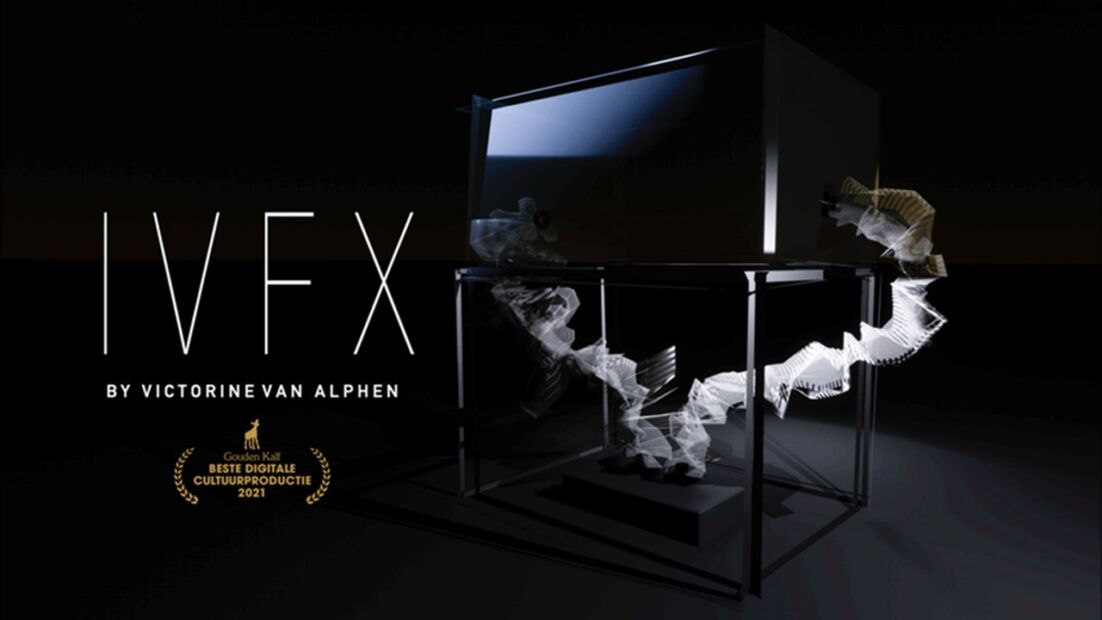
I interviewed Victorine Van Alphen about IVF-X on Saturday, April 8, 2023 at New Images in Paris, France.
This is a listener-supported podcast through the Voices of VR Patreon.
Music: Fatality
Podcast: Play in new window | Download
Rough Transcript
[00:00:05.458] Kent Bye: The Voices of VR podcast. Hello, my name is Kent Bye, and welcome to the Voices of VR podcast. It's a podcast that looks at the structures and forms of immersive storytelling in the future of spatial computing. You can support the podcast through patreon.com slash voicesofvr. So I'm continuing on my series from IFA DocLab, but also kind of taking a little bit of a diversion by going back to New Images 2023, where there's a creator that was at DocLab this year that also had a piece that I have a previous unpublished interview that I wanted to also get out. Because I think there's a lot of similarities to how Victorine Van Alphen is thinking around the way that she's using these various kind of immersive experiences to have these philosophical provocations around different concepts of posthumanism and our relationships to technology. And in this case, there's a piece called IVF-X. And so this was a piece where you basically go in as a couple. You're paired up with someone that either you know or don't know. And you're basically kind of constructing a post-human baby. So what would it be like to architect these different qualities of what your gender of your baby? And, you know, you're kind of having to decide all these quantities and give like a numerical value from like zero to one. And you kind of have this spectrum where you can calculate. kind of have a slider where you're trying to decide the different characteristics of your baby. And there's a number of different phases where you watch introductory video, you're making these choices. And then at the end, you get to have this encounter with your virtual post-human baby that you're creating, where you are kind of passing back and forth the VR headset to see a very short life of this post-human baby as it's going through a very rapid evolutionary development. And then it kind of like descends into some sort of like coma. So it's kind of a provocative experience that has lots of deeper philosophical concepts that we unpack here. And then we'll also be digging into Victorine's latest piece called the Oracle Ritual for a Future in the next episode. So we're covering all that and more on today's episode of the Voices of VR podcast. So this interview with Victorine happened on Saturday, April 8th, 2023 in Paris, France at the New Images Festival. So with that, let's go ahead and dive right in.
[00:02:20.996] Victorine Van Alphen: I'm Victorine van Alphen and I am a transmedia artist. I work with all kinds of technologies because I'm generally trying to create experiences in which you can relate to a topic in various ways. So each of those elements or media or different technologies are kind of like tools for me to create those different ways of relating towards a topic, for instance. from very sensual, very bodily experiences to more intellectual ones or philosophical ones. I also have a philosophical background and work as a curator for two festivals in the Netherlands. I used to be an aerialist, so I have a very physical background that got me into theatre and experimenting with people a lot. and an interdisciplinary scientific program that really helps me to analyze quickly what kind of perspectives and disciplines I could use and could unfold and also maybe lead to different kinds of making, different kinds of seeing.
[00:03:28.720] Kent Bye: Yeah, it sounds like you're covering a lot of different bases from the science and arts and performance and philosophical backgrounds. Maybe you could give a bit more context to your background and your journey into how that evolved and progressed to what you're doing today with showing this piece here at the New Images Festival.
[00:03:45.345] Victorine Van Alphen: Yeah, where would you like to start with that background? I have like some people say like I'm like a cat. I have like nine lives. And I guess that's exactly the point. Like I'm experimenting myself with the different modes of being that I can exist in. Like when I was for instance performing as an aerialist it's like extremely intensely bodily. The kind of concentration you're in, the awareness, the flow, the sensuality, the connection with the rope or the curtain that you're working with or the human being like when you're dancing with someone. So it's a very extreme form, maybe, of being a body. And then I was also studying philosophy, which was completely the opposite. And the kind of contact that I would have with, for instance, other philosophy students was completely cerebral, based on logic and reasoning, mostly. I mean, we were also making a lot of jokes. But I noticed such fundamental differences in how... the communication would be or how even the perception would be like yeah the contact with other dancers for instance would be mostly non-verbal and cuddly and and then maybe the communication with philosophy really based on the reasoning and and responding to that and that's only one of the two modes that we could be in and I guess I've always been very sensitive to witnessing those different modes that I can be in so for instance now we're sitting in a park above the cave of new images and it's a different way of being here like you have all those sounds around you and it's kind of blending and then there's the awareness of the conversation that we have and the awareness of maybe what I'm going to say etc. But I believe I change a little bit in each of those situations. I become a little bit of a different person, focusing on different aspects of my existence and dimensions of my presence and of other elements. So when we were walking here, I was paying a lot of attention to the spatial situation and what would be a nice place to sit in relationship to other human beings that were here, etc. Well, the moment that we go into a conversation, maybe it forms like a sort of kind of bubble and then there's a focus on the interaction with you. And so I'm constantly quite aware of and noticing of how there's these different aspects of reality that are crucial and are influencing what I am experiencing. And I guess that really came from having those different backgrounds, unfolding things in a sociological way or unfolding them on a more performance arts way or unfolding them from a sort of scenography way would give me different insights into how the reality is experienced for me and for others. And as soon as I started to work as an audiovisual artist, I started to really tweak that, to really refine it, to find the devils in the details by Creating my own realities or situations and installations in which I could tweak what elements would be there, what elements would be dominant, what elements would be subconscious. And also playing with footage or editing footage. found footage was very crucial for me to also play with meaning in a very direct way in a very sort of like the film in the beginning of the installation was really an investigation of my own relationship towards reproduction and towards the vulnerability of analogue existence and birth Really just tasting the footage by editing and trying out different meanings, transforming them to cutting and interweaving them and playing with those meanings, feeling them shift. So I'm kind of a taster. It's not like I think in advance, like I'm going to make it like this. I'm curious for a certain topic and I explore and unfold it by tweaking its elements.
[00:08:03.049] Kent Bye: Yeah, I know we had a chance to briefly chat this morning and that you were saying that you were interested in science and quantum mechanics, quantum ontology and the realms of philosophy. But maybe you could talk about your journey from that scientific mode of thinking into the more philosophical realms and what branches of philosophy that you were really digging into.
[00:08:23.536] Victorine Van Alphen: Yeah, there's actually, well, I want to defy some taboos, so I think I should share it. But let's start with the beginning, like, I was in love with mathematics. Like, I was reading Turing and Gödel when I was 11 and I was, to me it was like I was getting a taste of how I could understand, that there was some kind of understanding that seemed very important and interesting. But then Gödel also showed some of the limits of calculability and of systems. And that sort of got me into philosophy and also quantum physics also showed so many weird options for the metaphysics that I sort of had to become a philosopher in order to still understand like I was looking to understand how the world worked and then there were all these weird limits or ambiguities and I went further and further and further until I I guess got into this postmodern situation where where I realized that our human experience and maybe a phenomenological approach of our human experience that that is the only thing where I could really unfold any moment without ever having an answer to everything but any situation is completely different in quality from another situation and just unfolding that fascinated me and I guess that's the artist in me that's where the artist in me awoke like having this Total fascination and sensitivity for the quality of each situation that can be unfolded in all those aspects, the social aspects, the political aspects, the spatial aspects, the sound, the light, the relationships, the dynamics, etc. There's so much to unfold in each of those situations. And how meaning emerges, that is what I'm now researching as an artist. And I find that immensely fascinating, especially because when it's about meaning, like about life or about reproduction, like huge topics, how can we shift those meanings and play with them and look into imaginary futures and what kind of new meanings can come out, like how far can we stretch them?
[00:10:44.051] Kent Bye: You mentioned something about taboo. Did you cover the taboo? What did you mean by that?
[00:10:48.874] Victorine Van Alphen: Yeah, you're sharp. I didn't cover the taboo. So what happened was, I was pretty logical. My reasoning was quite sharp at that time. I include a bit more intuition now in my reasoning, but at that time I was quite a logical thinker. I was studying philosophy and I was trying to find out what could be the rights for men in abortion. Because my father had wanted to abort me, but he didn't have a right to do so. So, well, there I was. And he kind of sometimes complained about that. He did really love me, but he kind of sometimes complained about it. And I did want to research his rights. I was like, okay, how would that philosophically, politically work? Very complex. Very interesting. But... Then I got pregnant during that research and that completely changed the whole situation because I had feelings that I couldn't rationalize. And that clash made me realize that our existence is fundamentally multi-dimensional in a way like we have emotions that we don't think and then we have we do things that we don't choose and then we have like we're like we're kind of paradoxical beings and like finding the tension between sensual and rational sort of existence and it's much more complex than that but i sometimes use that binary just to yeah to name one of our biggest clashes I really experienced it I had this weird lioness feeling like a lion losing her cup while I had chosen such a rational way like oh I want to be a highly educated person and it's not the time yet and I didn't plan this and like and it's just a bunch of cells and I just aborted and I had And then I realized that my feelings were so different and my relationship to life was completely... I ignored my bodily or human relationship to life and my own body. so that clash was something I needed to process and it was something that revealed how important it is to have all those perspectives not just that intellectual perspective but have all those perspectives and especially me as a dancer was also I actually was already quite sensitive to that but it was like living two lives I was like two beings the philosophical being and the dancer being and that moment it clashed so much that I needed to integrate them and I started creating experiences Yeah, they were on all those dimensions, unfolding all those dimensions, creating, using all different kinds of technologies to create different ways of relating to a topic.
[00:13:35.117] Kent Bye: Yeah. And you'd mentioned some of the phenomenological strand, I'm presuming from a bit of the continental tradition, but you, in this piece that you have here at New Images, you also have these kind of post-human elements and potentially some aspects of feminism and talking about other aspects of LGBTQ plus IA, aspects of philosophy and the gender binary. And so maybe you could just explain a little bit more of how those other dimensions of post-humanism and other philosophical strands starting to come into your journey philosophically?
[00:14:06.253] Victorine Van Alphen: Yes, yeah. Sometimes things come together, right? I mean, sometimes not, but I was turning 30. That was one big thing. Like somehow that number for a woman is like a thing. You feel like you need to have a house and a job and a kid or something. Even though I'm from a very progressive single mother in a progressive Amsterdam, it was still a thing. And then I noticed that all my peers were also struggling with the question of whether to have a baby and what that even means to have offspring or to create an organism. And as an artist, I was also quite afraid that I would have to sacrifice my life as an artist. And then I discovered the Cyber Manifesto by Donna Haraway. and there not only she talks about all those binaries that I was talking about all those clashes that I had sensed about the mind and body and the male and female and the natural or the natural and the technological or the organism and system like all those binaries that she was trying to go beyond by describing the cyborg as embracing a sort of yeah maybe ambiguous or new new field that i was very interested in exploring and with me a whole querying and post-humaning community and especially also my my mother had always been the masculine one and my father had always been the feminine one so already i was a bit I look like a cis, hetero, blonde woman, but I think queering is for everyone. There's so much to explore when it comes to gender, gender norms, and also even our sex, what biological gender we are. like discovering that you get pregnant I thought that I was mainly like a guy you know like there was a lot of male philosophers and then suddenly you get pregnant and there's this difference there's this sort of undeniable thing like a womb that has a consequence for your whole life and And to emancipate from that and to think about a future in which we would sort of want to emancipate from that was kind of desirable and undesirable for me at the same time, because it was a very invaluable experience for me. It was like I turned into a woman the moment that I got pregnant. That was the moment I realized I was a woman. I'd never really thought about that. So I realized like this undeniable biological element was what that meant or what it could mean or maybe and also what I wanted to liberate from and if I could liberate from that. So then from that came the idea of creating a cyborg, so merging motherhood and artisthood and merging in the cyborg the organism and a system and the sensual and the rational and merging all those binaries. And that was where my interest lied.
[00:17:15.786] Kent Bye: Yeah, I could really see how all those elements are coming together in culmination of this piece of IVFX that you're showing here at New Images. But before we get into that piece, I'm curious, when did VR come into the picture for you? What was your journey into getting into virtual reality?
[00:17:31.973] Victorine Van Alphen: Yeah, that's a really funny question because I... Because I was making film and audiovisual installations, I was working with the digital as a material. And when I turned 30, I started to think, okay, some of my friends are making living beings and I'm making digital things. What does that mean? Is there a difference? How can I compare that? What does it mean to make digital things? And then I realized, for me, there was a moment where I was at IDFA DocLab in Amsterdam and there was a guy standing in front of me in a VR experience. And he was sort of moving a little bit awkwardly in that space that I couldn't see because he was in that VR space. And I was just waiting in line. And then he took his goggles off and he looked at me And he said, you are so real. And it was for him like a sort of rediscovery of the realness of an analog person. That was just, like, I just happened to stand there. I was not more real than any other person. But it was so amazing how he said, like, you're so real. And that's also what I... I had never in VR sensed something that was a presence, that I could feel a presence. And I was missing that because as a dancer and performer I was very sensitive to that. As a performer we would often find moments with someone really feeling the other person's presence or really letting our presence be felt by our movements and by our physical control. So not feeling a presence was a reason for me to kind of hate VR and thus also challenge it. And I was like, I want to see if I can create a digital being. And I didn't necessarily want to create it in VR. I was also considering holographs. But the interesting thing about VR is that it's a void. Or it can be a void. If you start with it, it's basically a void and you're alone in it. And because of that, anything that is there, is there. So there's already this sort of exaggeration of the presence of something that is there, except for that presence is not like a living presence. So I wanted to see, can I create a living presence? Like kind of a Frankenstein-esque sort of dream I had of like, can I create something that feels present in the digital? Because that was something that I felt the digital can do everything. You can digitalize everything except presence.
[00:20:08.086] Kent Bye: Yeah, and so in your piece, you have three different phases that you're going through where you get introduced to a broader context and you're kind of making, in some ways, a philosophical argument for why analog babies are bad. Maybe we should look at the post-human aspect. And it's kind of... a little bit of like humor in it, but also like a lot of moments that are shocking or how to best describe it. It's like you see the harshness from different animals and different beings of what it means to be born into this world and all the rites of passage you have to go through, let's say, and that you are in some ways making a philosophical argument through this film. So I'd love to hear that background in philosophy or how to set this context for how we're entering into this liminal space where we're going to like
[00:20:53.218] Victorine Van Alphen: set the broader context for why this is important or why we're going on this level of inquiry of childbirth and the analog versus the digital yes it's funny that you say that like it seems like I'm making an argument for how like the harshness of the analog and like woof we can do it post-humanly and then you don't need to rip your vagina and it's like and you don't even need to have a womb you can just be gay and choose to have a child which is of course very emancipating and liberating in some sense Yet that's not the argument I tried to make at all, actually. That's also your interpretation seeing that video. And that's the whole point with that video. It's quite open to interpretation and it's quite provocative and effective for everyone, but in a very different way. Like whenever I go to my actors here, they say every person responds differently. to every aspect of the installation. There's not a single person that has a similar response. Like everything I try to create has a fundamental ambiguity that you respond to in your way. So we mostly as actors or as the guides and me as director see what kind of person you are and you discover what kind of person you are by seeing that it's about harsh analog reality some other people were like really inspired by how she was just standing there giving birth to a baby and someone else was completely horrified by that and saw it as a complete statement for going post human post body birth so For me, I'm trying to unfold that hyper personal relationship that people have to this subject of reproduction, that we have all these ideas about it. How do you really feel when confronted with aspects of that process?
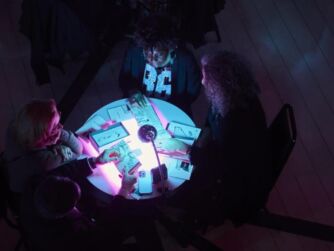
[00:22:45.939] Kent Bye: Yeah, I should say before that first section, just the way that it's set up here at New Images, it's quite an epic onboarding because you're walking into this massive theater and you see on the stage this one aspect of this three-part installation. You walk down all the stairs and you're entering into this magic circle of this performance or this installation. So there's a lot of... immersive theater and theatrical elements because we're being guided by a guide who's taking us through this we're presumably have signed up for this and we're discovering what we're doing by getting this introductory video so after this introductory video then we go into the second stage where there's one person that gets to choose how to lay down and this Freudian analysis or Jungian analysis and an iPad and then I was actually paired up with a female colleague in the XR industry and so we're sort of like the mother and father in this role and so we're confronted with making a whole slew of different choices for what kind of digital being that we want to create. And for me, this is where I think the real magic of the experience comes up because it's actually a lot of those realms of potential that you're laying out and you're being asked to collapse that potential very much of sort of the collapsing of the metaphoric wave function of quantum ontology where there's all these possibilities and you're forced to take what's possible and to make it actual by making a choice. And so I feel like you were kind of setting and going through all these different decision making processes to the point where we kind of see the end result of our decisions in the final phase. But I'd love to hear about that process of like how to step through each of those different phases, because, you know, some of them are questions that most folks who choose the analog version of parenting wouldn't have the opportunity to make. But by putting them as a possibility in this post-human context, it actually kind of reflects in this larger relational dynamic of other aspects of race and gender and biological sex and other things that for most parents wouldn't have the opportunity to make these fated decisions in a much more deliberate way and in a way that is never really explicitly deliberate. So, yeah, I'd love to hear about your process of creating these realms of possibility.
[00:24:48.789] Victorine Van Alphen: Yeah, so when I started creating presents or trying to create sideworks, kind of like a 21st century Frankenstein version, I realized that my position as an artist trying to create a sidework was actually maybe as interesting as... seeing that cyborg. So I realized it was about that process of making choices, of having those dilemmas like what skin color should it have? How should it look? What kind of characteristics should it have? What kind of being should it be? How should it behave? How should it move? And I, like you said, like there's, I even took like much bigger concepts. Like for instance, you have the choice, you can choose between cultural, natural, and then those are quite difficult choices. Or between mind and body, you can slide like on a scale between mind and body and feel sort of is weird possibilities in between with your finger on the slider and And people actually very intuitively make choices, create like mixes of gender, mixes of characteristics and sort of tasting those possibilities. but never knowing really how that would look like. And then we use all these procedural algorithms and a combination of different kind of motion capture combined with interactive calculated movement, etc. So to create these different cyborgs and their different characteristics. But everybody is completely surprised with the result. Like they had all these ideas, they had this amazing taste of possible choices and futures and their baby. And then what comes out is like complete, in a way, a very big surprise in which they can recognize some of the sex, but which also has its own existence, like an undeniable existence that just confronts you with like, I'm here like this and whatever. I'm your cyborg now and you actually maybe don't control me. Maybe in a way like the real birth process in which you just get this baby that has a certain personality or happens to have a certain personality. And sometimes people are really surprised. I remember a friend of mine who said she gave birth to a baby and she said... I don't understand why people say someone is my child. Because she said like from the moment onwards I saw it was its own. It was its own somehow. So that confrontation with all those expectations that are built up. And all those choices that are even uncomfortable to make. Like for instance skin color can be quite uncomfortable for people in many ways. Especially sometimes couples that have different skin tones. then often the lighter skin tone person wants the darker skin tone for the cyborg and the darker skin tone person said no I want a lighter skin tone because that will be easier in society and then they were like yeah but it's a post-human cyborg so then maybe shouldn't be necessary to make it lighter and then they're having these discussions about it and so they have all this expectation and Once that creature is an emergent sort of being, often people turn speechless. And I think that is what for me also maybe the presence of a human being is. It's like we can try to categorize and try to analyze and sort of cut it apart in aspects, but that's not how I see you. Like you are this emergent being that defies all my categories. So that moment where they're making all those choices, that is sort of a quasi-intellectual thing, because actually a lot of prejudice and intuition and gut feel enters into that, but it's still a sort of cerebral thing where people make choices, is very much in contrast and very deliberately in contrast with that moment where they just see that cyborg and are completely surprised and... like sort of the cognitive shuts down, like it becomes this alien encounter where people are often quite speechless. And yeah, that to me is that, yeah, it's one of those clashes that you can think about these topics in a certain way and then you can feel about them in such a different way and you can choose about them in such a different way and that is what each stage tries to realize, like creating those different relationships to the topic.
[00:29:32.045] Kent Bye: Yeah, there was a couple of them that were certainly very provocative, like choose the skin color of your post-human baby that you're creating. And again, this is all like we're at a festival. I presume it's going to be a time-bounded experience where I'm creating something and then not necessarily being tied to something for the rest of my life, if it was something I was creating for the rest of my life. the stakes of making those decisions would be a lot higher than, you know, in this contrived context that is much more ephemeral in some sense. And so in that ephemerality, you get a little bit of freedom to experiment. Like there's a dial to say, is it natural or post-human? And because it's like a VR experience, it's like, well, I think it'd be actually more interesting in the context of this VR experience to see how this artist is going to be representing the post-human baby. But if I had to actually have some sort of embodied presence with this post-human baby for the rest of my life, I might have made a different decision. But there's other moments of, say, both the skin color, where it's like, oh, choose a skin color of your baby, and we're both two Caucasian people making this decision. But then there's a whole other, like, oh, you can make your baby blue, or other sort of exotic colors. This is post-human. You can go beyond the existing skin tones, which, as I talk to other people afterwards, they're saying, well... you know in some ways you can escape actually making a choice by making these other choices or to not actually choose what the gender representation of your child is and say okay I want it straight down the middle right in the middle gender fluid but by doing that it's also like not making a choice as to what the preference is so I found those moments interesting of like being forced to make those decisions and how there were options to not make a decision and take a pass and say oh we'll just make it 50 50 down the middle and not move the dials anyway and so yeah i don't know if like you have any way of seeing if that's a common thing or if there's certain questions that people do that more or what kind of reactions you get with people that end up in some ways by presenting the choices it's just the realm of possibilities that is the end goal whether or not they actually make a choice that is changing it so by not making a choice at the end of the day they are making a choice which I think is also an interesting reflection.
[00:31:33.633] Victorine Van Alphen: Yeah and making a choice is also making a choice so there's a lot of sort of meta choices in it like some of the meta choices I made like I made the choice with choices they will make which I think is already the most radical thing in which I hope that people would sort of hate me for some of those choices but they like only like two or three out of thousand people are critical of that I actually make them choose, for instance, whether the cyborg may reproduce itself or not. I had some religious people that said, like, that's not up to me. But only a few criticized the choices they had to make. So that's already a choice to follow the choices that you get. And then you have that element of trying not to make a choice while making a choice. And I played this installation in a queer festival in Brazil. And the actors were trans themselves. So that was really adding to the situation. And there were many queer people who were indeed like... putting the fluid button completely on in gender so you could be traditional or very fluid and they would put it completely on fluid and then having the gender completely in the middle between male and female and masculine and feminine trying to go beyond the gender question in that way and also it was interesting how sometimes power dynamics between couples like one would really want something And then another option, the other could choose. So they would sort of, you know, that kind of politics would happen. And those kind of things happened a lot, that people were sort of strategically choosing, like literally like a sort of micro politics was happening, trying to sometimes avoid certain questions by, for instance, choosing alien green, not having the difficult choice of what kind of human skin tint they would choose. and yeah even if it's not completely serious even if it's just trying out a certain option or avoiding a certain option there's still a realness to making that choice that i think is very intimate like whenever you make a choice even in this fictional situation it is real like it is a fictional thing and you're playing a game even if you're lying It's still real. It's performative. Like, making a choice is performative. It's an act. And I find that really interesting. Like, to me, that really adds to the realness of the experience.
[00:34:14.304] Kent Bye: Yeah, it reminds me of the relational realism interpretation of quantum mechanics, where Epperson and Zephyrus talk about those realms of possibility in those quantum realms, and that how... those potentia are real and with substance metaphysics orientation you only have the realness when it collapses and it goes from the possibility into actuality so there's sort of a mirroring there of just even being presented those realms of possibility have a real impact on us which i think gets into that deeper relational ontology of process relational metaphysics so anyway that's sort of a From a process relational perspective, there's those correspondences there between presenting those possible options and how much they can have a real impact, especially in a narrative where you see this is all the possibilities what could happen with these range of choices. And just knowing what those range of possibilities are influences the different type of dramatic tension that you see when you watch a movie, especially like an action movie or dramatic turn where you understand what's at stake depending on how these choices are being made. But I wanted to get to the last section because I feel like that's where, in some ways, you have a culmination of all these choices that you've been making. You have no idea about any of these little incremental things that you're doing, how that's going to dictate what's coming at the end. And so you have kind of a mixed reality exhibition where you have a physical installation of this kind of incubator world, but you have... one virtual reality headset that you have the couple pass back and forth between each other, which I thought was an interesting choice to have one that you have to share because you have this information asymmetry where some of you get to see different parts of the evolution of this entity, but not one person gets to see the entirety of both. And so for me, I got to see it second. So I'm like, I'm wondering what is, what is happening? What's it look like? What's going on? And so then there's an additional communication dynamic because of that because you're like oh what do you see what's you know because you're trying to compare as to like how is it changing and you want to have that moment of like i don't know it was an interesting choice i'd love to hear a little bit of that decision if that was a deliberate choice to just have one headset and have it pass back and forth because there's part of me that just wanted to just watch it but i thought there was also an interesting social dynamic that was happening because i wasn't able to see everything as it was unfolding
[00:36:22.441] Victorine Van Alphen: Yeah, these asymmetries are also in the second phase, like when you have to choose a main donor, and then one lies on the couch and the other sits next to it. And that different bodily position is already creating such a big asymmetry. And actually, it wasn't a choice at first that we had one headset, like it was kind of the first setup to try, because it's very complex to make it for two headsets. And then I really embraced actually that asymmetry because that internal communication that you mentioned and not knowing a phase in which it was in also creates this curiosity towards and again this expectation and again sort of maybe a feeling of like I'm not in control. Like you're extra not in control. People are already... not in control but they're also because they are seeing something that they can't fully describe so they're not trying to describe that to their partners who are very curious and can't see anything at all and then there's this sort of different kind of powerlessness that people try to solve in different ways So some have really intriguing ways of describing it, or some are just blank and then, okay, now you get to see it and they keep switching. Then the director of Eye Institute in Amsterdam suggested to exhibit this work there with two headsets. And I have to say that I'm still not completely sure if I would make that possible, if I would want that, because It's very hard to create a connection to an alien presence and really feel that, making us sensitive to that. It's not easy. It's like when you're in a subway, all the people are basically like sort of random objects. You don't really sense that they're humans because there are so many. But once you're in a bedroom with only one person and there's low light and you're close to that person, then it's just you and them. And then there's this presence is much more. Yeah, it can be felt much more. That's also kind of the situation I created. It was a very dark, very sort of low-light situation in which there's only one presence and there's not even your own body and nobody even talks about that. Nobody even says like, hey, I don't have a body in the VR. They're so focused on that cyborg. And as soon as there would be someone else, then you would have this contrast with an actual human being and the cyborg. the presence of the cyborg is now enhanced by the fact that it's the only and it can be sensed like completely without any disturbing factors or anything so I think that is really essential having your connection with the cyborg alone and then sharing about that immediately after and seeing your partner going in there but having that moment of feeling your own connection or disconnection or alienation for yourself
[00:39:33.746] Kent Bye: So, yeah, and thinking about this, because, you know, in the moment, I certainly wanted to see my post-human baby in real time. And I appreciated the aspects of communication, but I feel like in some ways there's different dimensions there of the way that I see it, at least, that there's this active presence of agency. We've already expressed our agency by these choices that we've made. There's the mental and social presence. So there's a social presence of this interaction between the two people. You may know the person, you may not, so you may be interacting with a stranger. So it ends up being this moment that's really the culmination of the piece that turns into trying to communicate something that is highly abstract and it's difficult to fully communicate it. There's the emotional presence, and I feel like by focusing on the social dynamics of the communication, you actually are taking away this emotional presence that I might be able to facilitate with this post-human baby. And I feel like an obligation to not really fully be present with the embodied presence of this entity and to really watch it and observe it. So for me in the moment, I definitely wanted two headsets because I felt like this was the whole culmination of the piece of creating this post-moon baby. And I was like missing half of the life of the baby. Maybe that's sort of a metaphor for what it means to be a parent. And it's hard for me to know because I don't know what that would feel like. You know, I've already gone through the experience, but I'm just sort of projecting out of what could be possible was I didn't feel connected to the baby at all. it felt more abstract it felt more of like this is like an art piece that i'm trying to describe to somebody else and it became more of like a limited constrained resource thing where now i'm turning this whole experience that is all about these realms of possibility of creating a post-human into this kind of weird escape room i'm trying to describe something to someone in a way that transcends what language can really do to describe this thing because it's kind of indescribable it's kind of like beyond anything i've seen before and I felt like the downside is that I felt less emotionally connected to the overall experience, and certainly to the post-human baby, because it kind of goes through these different evolutionary phases and then kind of disappears. So I felt like it puts the focus back on the couple and the relationship and the communication dynamics rather than the emotional connection of all this thing that we just created. So that was at least my experience of projecting out what it might have been like had I been into headsets, but also there was a frustration because it was like, we spent all this time this is like the climax of the piece plus it was going through these different changes and shifts and that i didn't quite get a sense of all the different things that were happening and it was a post-human baby an artistic expression and it was a loss of like what was actually happening in that moment and if i would have just been able to see it then i would have been able to see its full life and maybe had a deeper connection to it so it's hard to know because we're talking about these realms of possibility of what i didn't experience but that was at least my experience in the moment
[00:42:17.625] Victorine Van Alphen: Yeah, that's interesting. And we also noticed that some people feel really connected and some people feel really disconnected. In a way, sometimes that disconnection to it, that alienation almost, is also, to me, a very valid experience. You have this experience of getting a digital baby and then you're not connected to it as you would have hoped. And then that also reflects something back on your hope. in a way but I do really hear you about that dynamics I mean it also mattered that you were just coupled with someone like on a professional basis which is very different from like we often have real couples and then somehow the fact that their spouse is watching already creates a connection because they would really empathize with the feeling that their spouse would be feeling or not so that's a different kind of emotional relationship and like normally people are able to choose if they want to go alone and some people really prefer that because they can completely be with the cyborg and their own and can really sense like okay what is
[00:43:31.101] Kent Bye: You mean that they would each go alone? Because there's a couple, so what does that mean to go alone? Or just the whole experience alone?
[00:43:36.506] Victorine Van Alphen: Yeah, the whole experience alone. So they would be with the cyborg, and also we see that the longer people are with the cyborg, the more they connect. They often say, like, whoa, it's such an alienating to be with this cyborg, and then... the longer I'm with it and interacting with it and sort of being with it they start to kind of find it a bit cute and they're like starting to connect and we had one girl that was completely connected and we had like various people who were very much connected and then we have a whole spectrum of connection in responses And, yeah, I noticed some variables sort of for that. I mean, sometimes it can be like this clash of expectation. Yeah, that cannot be overcome anymore. It's like, oh, I had all this expectation. Now it's so different. Like, because people are sort of expecting a human. Like, because they don't know what is post-human. And then the cyborgs are definitely very post-human. So people are surprised. And some people... completely embrace that surprise and be like oh that's my cyborg and and then they they connect to it because of its sort of weird human bodily emotions and some human aspects and then there's this alienating aspects that they can somehow connect to very much and that i think also really has to do with the person so some people We're able to love it and other people couldn't connect at all. And it also has to do, strangely, with their connection to the actor. So the stronger the connection to the actor is and the stronger the presence... Like if the actor is tired, we notice that the connection with the cyborg was much less. So it's also sort of a general openness to having a connection and to embracing a sort of being that is maybe different than you expect. It's a very big condition for that connection. And then, yeah, sometimes it's really the other way around. So it's really have this whole spectrum. And I can imagine that it was a bit of, yeah, a surprise, but also maybe a disappointment of the climax moment. But that... I mean it's also really hilarious that you have made all these crazy decisions and then expect really a post-human cyborg baby that you could bring home. And then there's also, there has to be a moment where fiction collapses a little bit. and for some it's only when the cyborg goes to sleep and then they have to let it go and then that's the moment where they have to go back into normal life and they were really connected and for others it's already that moment where it comes out differently than they expected even though that if i ask you what did you expect to see then i'm kind of sure that you wouldn't really be able to maybe you would like well i think
[00:46:36.334] Kent Bye: When given the option of dialing it from 0 to 10, from 0 to human to 10, the most post-human you could get, we sort of dialed it up to 11 to see what's the most post-human we could get. And then we see it, and it really does feel like this alien creature that I wonder if we would have chosen a more humanoid representation of. you know i feel like artistically that's less interesting because i've seen lots of virtual babies before but this is probably the first virtual post-human baby i've ever seen so you know i want to see like what's the best you can give me in terms of the most exotic like what's that look like what's that even mean we're making all these choices we're not getting any real-time iterative feedbacks we're all projecting in our imagination about what this thing is going to be what's going to look like and so then when we see it then it's like oh wow that's It's kind of gross looking or it's like this visceral level of disgust that I had that was surprising because it was, you know, we're kind of in this fictional world of creating a child or a baby. And how much can I maintain that suspension of disbelief in this contrived context of going through all these choices and going through this whole theatrical elements of the staging as I'm going through each of these different phases, right? Really felt like I was walking into this kind of weird sci-fi speculative future post-human baby clinic. Like you kind of nailed what the process would be like in each of the different phases. And so, yeah, I guess that was my own visceral gut reaction to it. But it was more of an intellectual exercise rather than emotional exercise, I guess you could say, because it was more of like... how do you translate this idea of post-humanism into an embodiment? You know, and what's that look like? And I was just imagining, ooh, what kind of, like, is this what everybody sees? Is this procedurally generated? Is this, like, some sort of genetic algorithm that's, like, generating all these things? Like, my mind is being flooded with all the technical aspects of what I'm seeing rather than, like... I mean, I guess in some ways, when I've interacted with, say, Kevin Mack's blorts that he has in both Blortation and Anandala, they're these artificially intelligent entities where... I felt like I had more emotional engagement with those abstract entities because they were responding to my embodied movements. So I would move and it would move in response to me. And so there was a direct connection to how I was interacting with it. But here there was no level of embodied interaction. It was kind of like... Oh, I didn't notice in the moment how it was responding to anything that I was doing in a way that I was able to have any sort of direct correlation between how I was moving and how it was interacting. My experience of it, at least, was that it was in this sort of unfolding cinematic. And maybe I didn't test it enough to try to see it because it's encapsulated into this incubator thing. And it didn't have any sort of eyes of anything. And it felt like its body was facing in a different direction. I felt like it couldn't even see me. So all these sort of subtle things where I couldn't find any traces of my agency, I guess is another way of saying it, of like how my embodied interactions were resulting in a direct response of this digital post-human baby. So that was just like my experience of it.
[00:49:33.177] Victorine Van Alphen: Yeah, there might have been actually then a problem because they do respond to you. I mean, even they're in a primitive state, like they're not going to talk to you like in sort of elaborate sentences because they're cyborg babies. But they do respond. So maybe there was something. Yeah, that I was just kind of standing there watching it.
[00:49:54.391] Kent Bye: I wasn't trying to like move back and forth and cause it to move. I didn't even think to do that because I was like, yeah, I don't know.
[00:50:00.855] Victorine Van Alphen: They do notice you. So if you were stiff, then there was maybe not happening so much. Which you then also couldn't explore, I guess. But if you consider the budget with which we have made this, the amount of connection that people do feel and the interaction they can have with it. Some people start to go like... And then I really sort of completely connect and others a little bit less. I do feel that there's things I would really want to tweak in that. But in overall doing this with a thousand people or even couples and threesomes... Yeah, it is working very interestingly. Actually, in a way, it's working better than I expected in having that sort of presence feeling that people have with it. And it might really be that maybe the interaction at that moment didn't work or the actor was not as present and a bit tired. Because I heard that there was a little bit of a situation just before that. So those things completely affected, like all the elements need to be right for you to experience it. So it's quite a tricky business to get you into really that suspension of disbelief and really feeling that connection and presence. So, yeah, yeah. And we notice that like there's often we reach it and then there can be like one little thing, like one little word even that the actor says or one interaction that doesn't work or glitches or something or misses. And then the connection is completely gone. So it's so tricky to establish. Yeah.
[00:51:48.646] Kent Bye: Yeah. Presence research, Mel Slater called that like breaks in presence where you get taken out of it. But you'd mentioned that there's a sort of dimension of people have to realize this is a fiction and they have to go away. And so, I mean, there's a part of me that wants to see like, what's the gallery of all these babies that have been made? Because I'm just like curious to see what the spectrum of different decisions and types and it's like i'm very curious about like just the artistic rendition of that but there's another element where there's a bit of like a sand painting where you make it and then it gets destroyed and then you walk away and it's done it's like the completion cycle is done so i don't know if does the entity does it go to sleep does it die or is it going to like it was ambiguity as to what happened at the very end like what happens at the end of this evolution of this life of this digital post-human baby
[00:52:36.141] Victorine Van Alphen: Yeah, it sort of hibernates and then enters into another digital space where we can see it. And that is ambiguous. So for some people that feels like a sort of empty nest syndrome, like it went into the digital world that we don't see, like a teenager kind of going off. But for others it has a little bit of a... being left alone or even having a kid dying. So some people who had a miscarriage had a really beautiful story. I had one man crying once. That feeling of having the cyborg leaving him because when he goes to sleep it sort of enters into this other space that we don't see it anymore. And then that really touched him. So people are sometimes left with a bit of an empty nest syndrome. I mean it's only like a 40 minute experience but there's still already a little bit of that absence and I think absence I chose to end with absence to have a little bit of the presence going into infinity because if before I let people just leave the room they would leave the cyborg behind and that didn't feel good at all and also people had to break their own spell But now the cyborg would be somewhere, but where? And that would leave them with that sort of presence that was still sort of somewhere, so they could take a little bit of that suspension with them and not need to break the spell completely and being left a little bit in the dark about this ambiguity.
[00:54:13.410] Kent Bye: Yeah, yeah, for sure. I could definitely see how there would be a broad range of ways of interpreting that. And I guess, given that you do have such a background in philosophy and looking at investigating these questions more from an embodied experience way, where you're giving these people these embodied experiences, are there any research questions that you're looking at in terms of this type of work? Or do you feel like it's more of an artistic embodied experience that you're trying to give to people rather than try to come up with how it's going to drive your deeper philosophical inquiries?
[00:54:43.703] Victorine Van Alphen: There are several research questions underlying this. On the level of the topic, like how to think about reproduction, but also on the level of how to play with those different ways of relating to something. Yeah, how to have those emotional connections and cerebral hypothetical playgrounds and how people integrate that afterwards. Like you have those three different, very different stages with different experiences. One, this visceral video that really creates a lot of affection and then the stages where you have to make the choices and then the stage where you meet the cyborg are very different and I'm very much also investigating and people often want to speak about those experiences. I'm investigating how people integrate those sort of clashing or very incomparable experiences in a way. So there's various research questions. I think that would be a whole new conversation. But mostly I'm investigating my hypothesis of choreographing modes of being. So choreographing... the audience through different modes of relating, of being, of feeling, of sensing, of thinking and how in each moment that is choreographed to another mode through the use of actor, a chair, a screen, experimental, very visual video, etc. All those elements, how to choreograph people through those modes and how then do they integrate that, unfold their own relationship towards the topic from those different perspectives.
[00:56:35.241] Kent Bye: Yeah, as you're listing all those modes, it reminds me of both the work of Dustin Chertoff and the elemental theory of presence that I have from both the different aspects of the thinking, feeling, acting, and sensing. So yeah, I guess as we start to wrap up, I'm curious what you think the ultimate potential of virtual reality might be and what it might be able to enable.
[00:56:56.775] Victorine Van Alphen: Yeah, I really want to find new digital material. I'm kind of sad that lots of VR resembles reality still way too much. I want to explore the edges of what we could understand even as a reality. And I think the next thing for VR could be to explore our internal realities. And I've seen some works that already sort of you can really... like music somehow you can totally go with the movements you feel that there's something meaningful in there but it's completely abstract and yet it's not it's a completely like it can go right straight into your heart and i feel that vr could do that in a visual way exploring those internal movements and our internal realities sort of psychological processing without words in a completely sort of experiential way, I think that's really intriguing to me. So our internal realities and also the edges of what a reality could be for us, like what our brains can still understand as something. Like we don't need gravity. We can really... play and be in really abstract worlds at least I can and I want to see how far we can go with that and I I would like VR to go a bit more into like something that really doesn't represent anything that looks like reality and explore how to do that meaningfully and is there anything else that's left unsaid that you'd like to say the broader immersive community well I realized I'm not a storyteller I'm creating conditions for people to unfold and yeah I don't believe in stories I believe that there's multi-dimensional ways for each person I mean like different ways of relating to a topic and that from that you derive the meaning of that requires a lot of unfolding and I'm trying to create the conditions for that because Each of the audience has such a different experience and such a different interpretation. It's amazing and that's exactly what I wanted because it's unfolding all those aspects and layers and their own relationship to it and their own feelings and their own thoughts. And I think that's fascinating. I really want to allow for that process of people unfolding that.
[00:59:30.717] Kent Bye: Yeah, well, really appreciated the depth of the experience of both going through it but also unpacking all the different dimensions of it because I think there's a lot of really fascinating dimensions that you're poking at and creating these conditions, possibilities for transformation, these different modulation of different modes of experience. So, yeah, thanks again for creating the experience and for sitting down with me today to help break it all down. So, thank you.
[00:59:52.338] Victorine Van Alphen: Thank you.
[00:59:53.533] Kent Bye: That's all that we have for today, and I just wanted to thank you for listening to the Voices of VR podcast. If you enjoyed the podcast, then please do spread the word, tell your friends, and consider becoming a member of the Patreon. This is a listen-supported podcast, so I do rely upon donations from people like yourself in order to continue to bring this coverage. You can become a member and donate today at patreon.com slash voicesofvr. Thanks for listening.