I interviewed Celine Daemen about Nothing to See Here on Monday, November 17, 2025 at IDFA DocLab in Amsterdam, Netherlands.
This is a listener-supported podcast through the Voices of VR Patreon.
Music: Fatality
Podcast: Play in new window | Download
Rough Transcript
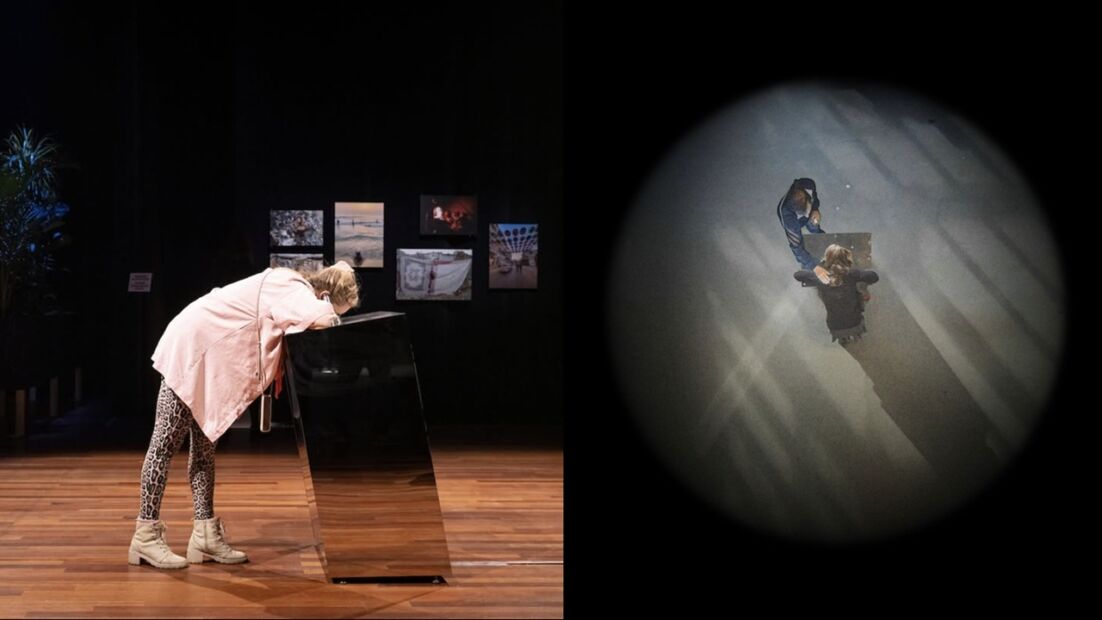
[00:00:05.458] Kent Bye: The Voices of VR Podcast. Hello, my name is Kent Bye, and welcome to the Voices of VR Podcast. It's a podcast that looks at the structures and forms of immersive storytelling and the future of spatial computing. You can support the podcast at patreon.com slash voicesofvr. So continuing my series from If the Doc Lab 2025, today's episode is with a piece called Nothing to See Here by Celine Dahman. So Celine has had some really amazing pieces, Venice Immersive, Songs for a Passerby, one back in 2023. And so a lot of her work ends up finding new ways of using spatial capture technology to kind of do a volumetric capture of you and then kind of insert your embodiment into the scene. And so in this piece, it's kind of a piece that's way different than what I've seen before in terms of like, this is a public art project where... it's basically this box says nothing to see here but it's got these two little eye holes that you look in and then it's got these kind of like two little pipes that look like submarine eye holes that you would see kind of popping out of water but they've got these really great speakers that when you stick your head and you look down into the scene Then you start to see kind of a mixed reality experience where you see yourself as a kind of a diorama. So you're being captured and being projected into this. And then there's also things that are happening in and around you that aren't actually there. And so it's kind of really playing with your perception of like, what's real, what's not real. And yeah. this character ends up coming up to you and having this whole interaction. And they're, they have all sorts of really innovative ways that they're trying to create the simulation of this character that is speaking to you. And so sometimes you have like real-time interaction where as you move, you can see yourself moving, but there'll be other times where there'll be prerecorded parts of you that are being run back in order to serve the narrative. And so they're, they're really playing with what Casper Sonnen and Nita Van Doren and the rest of the doc lab team have been trying to categorize what it is that people were doing with immersive storytelling, new media, trans media. There's been a number of different names that nothing's really kind of a great fit for this kind of emerging technology and immersive storytelling field, but they're really settling upon this idea of perception art. And so art that is kind of playing with your perceptions in different ways. And this is kind of like a paradigmatic example of that. Yeah. So we're becoming all that and more on today's episode of the Voices of VR podcast. So this interview with Celine happened on Monday, November 17th, 2025 at IFA Doc Lab in Amsterdam, Netherlands. So with that, let's go ahead and dive right in.
[00:02:39.548] Celine Daemen: Hi, I'm Celine Dame. I'm a transdisciplinary artist. I've created several virtual reality operas in the past few years. So people might know me from Eurydice Descendant to Infinity and Songs for a Passerby, which both premiered in Venice in 22 and 23. And now we're here with our first installation for public spaces called Nothing to See Here.
[00:03:02.468] Kent Bye: Great. And maybe you could give a bit more context as to your background and your journey into the space.
[00:03:07.228] Celine Daemen: Absolutely, absolutely. I graduated from Academy of Performing Arts in Maastricht. So I look at immersive media a bit from this kind of lens of theater, but mostly like the presence of the audience or the embodied presence of the audience within this space. So I think that's also very relevant when we think about immersive media to think of pieces in which it is very relevant that they're actually there or where their bodies become a part of the artwork or a part of the narrative even.
[00:03:37.227] Kent Bye: Yeah, and I think since the last time I had a chance to do an interview with you on the record about Songs for a Passerby back in 2023 at Venice, after that you went and you managed to get this fellowship at the Lincoln Center, which sounds like a pretty sweetheart deal where you're able to get a very generous stipend and not have any obligations to do open-ended research and be in New York City at the Lincoln Center and there's Onassis that's there in town. And so maybe just give a bit of a report of like what you were able to do in that fellowship.
[00:04:10.442] Celine Daemen: Absolutely. Absolutely. I think you described it very well, mostly saying that it's just a really wonderful deal. And we have been working in New York for eight months. So between October and May, both me and my art director, Aaron, have been in in New York working in the wonderful spaces and with the wonderful staff of the Lincoln Center to do research and they were really kind to just kind of let us do research for whatever we felt that our career needed so we started actually the research for this installation at the Lincoln Center just making tests and trying out different things with different techniques. And indeed Onyx is also a partnership of this residency, so we could kind of play around in their spaces too, use their technologies that they have lying around, which is like a nice combination of This kind of R&D space combined with also these very lovely spaces that you have at the Lincoln Center and the network that they have that got invited to do open studios. So we had three open studios in which we tested first prototype versions of this installation that we're presenting here today.
[00:05:27.939] Kent Bye: So I'm curious, as you're in the context of this kind of open-ended R&D residency or fellowship, where did you begin? Was it starting with public spaces or like what was the initial provocation or question or thing that you were trying to figure out?
[00:05:42.353] Celine Daemen: We really wanted to make something for a public space that kind of was one of those things that we were kind of thinking about, like, how cool would it be to, after making these virtual reality operas that were always presented in more like a theatrical space or a museum, It would be great to just kind of get outside and present something in the wild. And at the same time, we were also still very much intrigued by some of the techniques that we had been using in Songs for a Passerby, which involved the live capture of the audience. So in Songs for a Pass-by, we worked with volumetric video captures that showed the audience in real time as a kind of live feed in VR, which made their bodily presence a part of these narrative scenes. And we started thinking like, oh, maybe we can make something out of this that has this same technique, but could even do this kind of playback of time. with these captures of the audience kind of desynchronizing from reality.
[00:06:48.013] Kent Bye: Yeah, this piece for me felt the most like a magic trick or something that there is some ways that Kasper Sonnen was describing what DocLab does is this form of perception art. And this was the example giving in terms of like pieces that, you know, may not fall into things that we traditionally think of as, narrative film or even nonfiction this is more of around like how are you starting to like mash up and mix up our perceptions in a way that is going beyond what we expect but kind of at the end feels like you've just experienced something magical or like you've been seduced by some sort of illusion that you weren't quite aware of and you still are maybe walking away from it being like okay how did that happen so just curious to hear you know coming from a theatrical tradition in this type of project how you start to self-identify for what kind of piece this is
[00:07:37.136] Celine Daemen: I think Casper puts it quite right when he calls it perception art. At least I think of the piece a bit as a kind of instrument in a way. That's also a bit what it looks like, right? It's this kind of shiny mirrored box and it has these two peeping holes which the audience is invited to peek in and then they see themselves in 3D capture and there is some stuff happening around them that is not actually happening in the real space. So they start kind of questioning like... Is this real? Is this not real? And when even like this life capture starts desynchronizing from reality, I think they also form a kind of different bond with reality itself. You start also looking at yourself funny, like, oh, was I actually doing that? Oh, that's funny. And it feels a bit strange or weird. Maybe some other things happen that you feel like, oh, this looks like fiction, but it is actually real. So those things kind of start to blur. So I think of it like this instrument that in a way also reveals this kind of structure, like the way that we perceive reality through your perception. You kind of shape reality. So we often think of reality as something that is this kind of absolute reality. there is this one reality and we all agree on it but in fact I think that's not really true and I think with our embodied relationship to reality and the way that we move through the world and use our bodies to kind of make sense of where we are and what's happening around us we continuously shape very like presently shape what we believe that is true what we believe that is reality
[00:09:25.643] Kent Bye: Yeah, there's certainly a lot of themes around what's truth, what's delusion, you know, in terms of the current political context in the United States, but also all around the world. There's like polarizations that are happening in terms of, it's like a battle for reality in a lot of ways and how to establish a shared sense of that reality. And so... this piece is a provocation at that almost you know trying to pervert people's expectations for what they sense of that reality and also this kind of like you said the spectrum of pluralistic views of like a multitude of many different perspectives that each have their own validity within certain contexts of people's lives and what they believe to be true and so that all these layers of perception and belief become a empirical fact even if they're not a deeper truth to these things so at These are topics that are really in the cultural zeitgeist right now in many layers. And so I'm curious if you could elaborate on what you were seeing and what's happening right now that was really catalyzing you to really dig into this concept.
[00:10:27.651] Celine Daemen: Absolutely. I think it's exactly what you described. It's a combination also of us and with me and the whole team kind of discussing this, right? Like we don't actually seem to agree on what's real anymore. And it's definitely in the zeitgeist in many ways. It's both politically and also in this discussion about AI, that it's really generating things that look so real that are actually not. And I think in whole society there is a kind of like crisis happening of us realizing that we don't agree on what is real anymore and I think in this installation it's not necessarily something we wanted to like address in a very heavy way but more in a kind of playful way that people could kind of explore this idea of perception and explore their relationship with shaping reality in a very playful and light way and in a very accessible way as well because we present it in public spaces which is also a place where these discussions could kind of be shared amongst people that's something that I really love about the installation too that it kind of sparks this conversation and in that sense also brings people together a bit more because it's really sad to see how much this is kind of, yeah, parting us in a way.
[00:11:56.805] Kent Bye: Yeah, well, I'd love to dig into my own experiences of this piece and, you know, kind of break down what's happening in the piece, why I think it's so compelling. And I guess there's a bit of a spoiler alert that, you know, we've been talking about the piece in certain different aspects. But if you were to sort of describe what actually happens in this experience, how would you describe it as sort of a narrative arc?
[00:12:17.318] Celine Daemen: Well, so I explained already a little bit about you are invited to peek into this box. That's like the first kind of stage of the piece is also kind of social provocation that there is suddenly there is a mirrored box in the middle of a public space. So we prototyped it, for example, at a train station. And we placed this mirrored box in the middle of this train station. People are just kind of rushing to get to their train. But suddenly they notice that this box in the middle of the space starts making noise and sounds. So when people pass by it, it suddenly starts making these weird sounds. So it attracts some attention and people start peeking into it. And when one person peeks into it, another person is kind of, you know, starting to wonder, what are they peeking in? So there is this whole kind of social dance happening around this mirrored box already in that first stage. And when people do peek inside, they see themselves from top view, like four meters up. They see themselves looking inside. into the box. So there is a little bit of a dross effect happening there. You can imagine that your mirror self, your miniature person that you see exist in the box, would see themselves again. So you see yourself looking into this box, but also notice that there are some things happening outside of this box that are not actually happening in real life. So you see a little plastic bag kind of... blow around in this space you can hear it in binaural audio kind of slip around your head there are some other elements also entering this space like a little dog that sticks around and suddenly looks you in the eye and eventually the narrative unfolds to this point where there is a man approaching you tapping your body double on its shoulder and And this is when you see your body double rise, although you as a spectator are still looking into this box. So this is where we start altering this video feed by playing around with this playback of the live capture. And then this person starts to tell this story or kind of starts... I heard people call it trauma dumping. So this person starts this way too long conversation in which he tells you about his difficult relationship with his brother who seems to live in a different reality and the kind of struggles he has with that. And I think that's also very key to the piece. He kind of starts... questioning why you look into this box he starts questioning your own behavior as an audience really directing you like why are you still looking into this box what do you hope to find this is not reality what you're looking at there is no point of you looking for some different reality because there is just one and this is all we have so he's very tied to this idea that there is only one material reality that we all agree on And I wrote this character like that together with Stephanie Kolk, the writer of this monologue. So the audience kind of would start questioning reality themselves, kind of thinking like, well, maybe he's not right. Maybe there are some other ideas to look at reality, especially because this guy is a fictional character that is not actually there in the space with you. So he himself is existing in this kind of other layer of reality.
[00:15:47.785] Kent Bye: Yeah. Yeah. And I went through the piece, I guess the first time I saw it, I kind of peeked in and saw it. And then I kind of pulled away fairly quickly in the sense that I couldn't necessarily. Well, at first I was kind of testing to see how live of the live it was. So when you put your head down, then it triggers the beginning and I can sort of move my body and see, OK, now this is actually me because as I'm moving, I can see the movement. But the first time that I tried it, I sort of went out fairly quickly just because I guess I wasn't patient enough to see the other triggers as it was unfolding. And then I remembered that you had told me that it was like a 10-minute loop. I was like, oh, I need to just give it a little bit of spaciousness here to kind of let it unfold, that there's going to be other things that happen. But also in the program, I think it said that the runtime was like zero minutes, which was sort of an interesting choice. Cause there are some of these projects where, you know, obviously it's not like you can instantly take it all in and zero time passing. And so, but I'm curious to hear around this like disclosure of how long it is because there's, I mean, obviously this is a type of piece that doesn't necessarily always fit within the normal formats, but there is a runtime, like maybe an optimal runtime or maybe it's an average, but yeah, just curious to hear around that decision to say that it was zero minutes.
[00:17:03.578] Celine Daemen: Yeah, that's a good question. Well, the installation is made for public spaces to be presented ongoing. So that's why we decided to call it like zero minutes, because it's a kind of ongoing duration in that sense for the installation, especially because I kind of want people to feel free to look as long as they want or come back to it. I don't want it to be a piece that is too structured. And in that sense, like in this exhibition, we're a bit like out of our comfort zone. Because it should be presented eventually at these more vibrant in-between spaces like train stations or foyers or shopping malls even. Where a ton of people will just peek in there, watch maybe one minute and disappear again. And I'm a true believer that that's a whole experience in itself. So I think we built the narrative in a way that it kind of deepens itself. There is a point of watching the entire thing or the entire amount of material that can happen. But there is also... These experiences of people that are just there on their way to their train, they look into the box, they see themselves, they see that there are things off, they start sharing this experience with their friends and they disappear again. And it's not up to me to decide that that's not the whole thing. I think people experience it all in a different way and duration is a part of that difference.
[00:18:37.188] Kent Bye: Yeah, I ran into a couple of people who were asking me about the piece, and they were like, what do you think about it? And then I could sense that they maybe didn't experience all of it, and then I asked them back. I was like, well, did you see all of it? And they're like, oh, I don't know. And I said, well, did you see at least the man coming up to talk to you? And they're like, no. And I was like, oh, well, just go and just at least give it up to that point. I think my experience with it was that there was – quite a lot of ambient stuff that didn't have a clear narrative in the sense of seeing what the progression of the piece was. There was change, but then sometimes there's repeating elements. And so then there was repeating, and then I was like, oh, wait, is this repeating or is it progressing? And those are the types of questions I'm asking in a piece like that. And then as soon as I don't see a perceived level of progression, then I might eject and then kind of miss this other part. But I guess, you know, there's a part of creating these types of experiences where just the kind of magic trick of seeing yourself in this kind of virtual context may be enough for people that want to see more of the more narrative components. Then if they wait longer, then they can see that. So I don't know if you have any thoughts on that.
[00:19:42.452] Celine Daemen: Yeah, absolutely. I think it's a bit of a tension too about what's the invitation to the audience as well. Because I also kind of, of course, we thought about this, like we're in this public space, we have to kind of, how do you say that? Like deceive our audience to stay longer. You're trying to lure them or? Yeah, you have to lure them to stay as long as possible or something. But at the same time, if I start giving into the rhythm that they would want it to be, I kind of want them to slow down. So it's this tension as a creator that you have to give them enough to stay and at the same time be true to the rhythm of the piece and what the piece kind of wants them to slow into. So if I give in too much to this kind of pace that they're in, they just want to go catch their train. So I could, you know, make an Instagram reel appear in there and maybe then I would be able to capture them longer or something. But for sure it's a tension. I kind of enjoy the people that do stay long enough now. Also get this kind of rewards that they actually stayed long enough to meet this man who started telling you about his life So it's yeah, but it's it's for sure. It's it's attention. Yeah
[00:21:04.662] Kent Bye: Yeah, yeah. I guess in the context of a, I guess here in the doc lab is also an environment where people are kind of rushing around to some extent. In this kind of artistic context, I think people are more open to like seeing a piece to really understand the full extent of it so they understand it. But I guess in a more public space, people may be in a way that they're in a certain rush pace and this could be a way of kind of slowing them down into another rhythm.
[00:21:29.554] Celine Daemen: Yeah, and I was quite surprised, actually, that we counted the amount of people passing through the installation at our prototype at the train station. And in 10 days, we had 1,300 people looking into the box, of which 250 watched the entire thing. And I think that's quite a good number. Like I never expected so many people to stay for the entire thing, especially in this chaos of a train station. So that kind of proves to me that like it works good enough at this point, that there are enough people that there is almost like every other time someone stays for the entire experience. Yeah, it's quite good.
[00:22:14.246] Kent Bye: Yeah, I know a lot of online video folks would be quite happy with a 25% or so retention rate for people watching the whole video. So yeah, that's really awesome. Well, let's talk a little bit around the technology to pull off some of this magic trick, because I think a big part of it is that when I look at it, it appears as real-time stereoscopic video, but because it's being... captured and played back and composited then it seems like you're also doing this similar type of volumetric capture from what we saw in Songs for a Passerby so I'm just curious to hear a little bit about your process of creating this kind of diorama mirror box experience and the different technology stacks that you had to figure out both the display but also the camera technology and we'll talk about the audio separately because I think that's a whole other interesting dimension of that
[00:23:03.706] Celine Daemen: Absolutely, absolutely. So the cameras that we worked with are indeed stereoscopic cameras. So it just like shoots for one eye a certain image and then the image of the left eye, like the other eye, slightly differs. So that's why you see a 3D image appear. But on top of that, this is a system that analyzes the difference between, like a machine learning system that analyzes the difference between those two eyes to make a kind of depth map that enables us to play around with these triggers of certain things. So for example, our whole audio system, our audio triggers and also the timeline triggers, they work with this depth calculation that the system makes. Because then we know, oh, Kent is now looking into the box because his head is this high. So he must be looking into the box now. So that's the moment where we can say that the pigeons should fly away. So it's a bit more, indeed, like it leans a bit towards this volumetric capture. But it is a stereoscopic image that also generates the depth of this image. and the display is a display it's quite like a very very bare bones vr headset that is kind of hidden in there that we had made by a stereoscope builder in the netherlands which is just two lenses and then two tiny led screens behind it the micro oleds No, it's not OLED. No, we wish, we wish. It's a LED screen. I think it is a very high resolution LED screen. I don't know specifically what kind. But we did also 3D print a kind of black circle to cover up these grey edges of the LED. Because we wish it would have been OLED, but it was pretty hard to get the right OLED screens indeed in that resolution. So we covered up everything that we were not showing because the installation works with this kind of few round spotlights on you. So it was all covered up with a black 3D printed mask kind of to feather the edges.
[00:25:19.028] Kent Bye: Yeah, it's kind of making different aspects of the VR technology a lot more accessible for people to kind of just put up their face into it and to be transported into this other realm. I really appreciated the quality of the sound of the experience overall, because I feel like you kind of have these two pipes coming up, and it reminds me a lot of the Valve Index audio system that is really high-quality audio that's being beamed into your ears, but I really appreciated how you're able to create this real spatial experience and I guess before we get to the audio specifics, in terms of rendering all this out, are you doing this in Unity, or how are you delivering all this content together?
[00:25:57.723] Celine Daemen: Yeah, it's a combination of Unity, and for the sound, it's Wwise.
[00:26:03.984] Kent Bye: Okay, and so maybe talk around the sound design process, and if you are using a spatialization, and if it's translating into binaural audio, or if it's doing ambisonics in any fashion. Yeah, I'm just curious to hear a little bit more around how you're able to do this really sophisticated sound sphere that is coming out of these two headphones. I guess it's technically more of a binaural audio that is creating this really in-depth sound experience.
[00:26:30.501] Celine Daemen: Absolutely, absolutely. So we worked together with a composer called Aurélie Nirabikari-Lierman and sound engineer Wouter Snoei, who will both be very happy that you said all these nice things about their design. This is something they worked very hard at because we were very strict that they couldn't use headphones in this piece, which of course would have been great quality for binaural audio. because you really need to separate those two ears. Same like the stereoscopic vision, your left ear should hear something fundamentally different than your right ear. But we wanted it to be something that people could experience just on the go. They put their head between those hearing tubes and they hear spatial sound. So that's why they started kind of creating those what you described as hearing pipes it's like these two pipes kind of sticking out of the installation and you place your head between those pipes because we know kind of where your ears are gonna be it's like when you look into the viewing box there is only kind of one way to position your head so the hearing pipes are located at that specific point and it's indeed like it's recorded in mostly binaural audio some in ambisonic and so you do have some ambisonic audios in there yeah yeah yeah that's mostly because it's a little easier to play around with afterwards because you have sometimes like what sounds like a real rich sound field so were you doing like field recordings and then putting them in Yeah, absolutely, absolutely. So this is what Aurélie did a lot. She traveled with her binaural set or ambisonic set, recorded many, many, many soundscapes that are layered in the work that you hear both when you walk outside of the installation and when you're inside of the installation, you can hear these kind of spatial soundscapes. And some of them are made by Wouter Snoei, not like literally captured with binaural audio, but ambisonically made by playing around like spatially sound engineering with this plastic bag that was just a mono recording of a synced up plastic bag that he placed within the space.
[00:28:46.383] Kent Bye: Yeah, because it's being rendered out in binaural speakers, but I feel like there was a lot of sophisticated soundscapes that would be difficult to fully recreate within the context of what you're doing. I mean, it reminds me a lot of Half-Life Alyx experience that has a lot of layered sound design. But yeah, I really appreciated the sound experience of it because there's a certain amount of... illusion that you're trying to sell. And there's a visual aspect, but I really feel like in some ways the audio landscapes that you're able to create help to sell the illusion, sometimes more so than what you're seeing, because you have this more spatial immersive quality of being able to hear in a lot larger field of view around you. And so when you hear the objects that are around you and you see the visual artifacts of them, then my brain kind of wants to believe that those are actually there, even though that they're not.
[00:29:35.825] Celine Daemen: Absolutely, absolutely. I think the sound is the most important part. It always gets forgotten in these kinds of experiences, but it's absolutely true. I really love also, there is this one switch in the soundscape that is so impressive to me. It's when you stand in front of the box and you kind of bend over. to go into the installation, you have this beautiful spatial kind of... where you suddenly hear all this chaos of the soundscape before kind of be quieted down into this underwater feeling of you looking into this box, which I think is a very strong kind of... way to get into the piece it's a very very powerful basis of a soundscape that all the other spatial elements are layered on and there is also one like fun easter egg for people who are still about to see it it might be cool to try and notice it before people kind of bend over the installation to peek in There is a speaker hidden also in the air that is a kind of directional speaker. So it has a very weird sound quality. It's not the hearing pipes that bring these binaural sounds to your ear. But it's a directional speaker that hangs in the air and it's kind of projected on the back of your head. So if you stand up in front of the installation, you can hear this plastic bag kind of already dancing through the space. But these directional speakers are kind of laser beam of sound, right? So you only hear it when you're like exactly in the right spot. But it's a very weird sound because it just kind of makes this plastic bag kind of sound on the back of your head. So it's a kind of weird layer in the space.
[00:31:17.523] Kent Bye: Oh, wow. OK, I'll have to go back again to go check that out because, yeah, there's this triggering of going up and putting your face down and then it starts and gets triggered because it's like you said, it's measuring the depth of your head and identifies that it's a person looking at it. And so, yeah, there's also this really fun thing when I saw it the second time. Well, I noticed as I was watching through it, there's a lot of these kind of like looping moments where I also noticed I'm somewhat of a fidgety person as I'm standing there kind of like kicking my feet around. And it was to my benefit because if I was just standing there completely still, I wouldn't see the different times that you're looping or playing things backwards. So the second time I came up and see it. I put my head down and I started like doing a little dance and moving my hands all around. And then I saw that that was actually repeated. It helped me identify to how much some of these different sections are being repeated over time. And so you get this kind of looping nature of time where you are doing real time capture and repetition, but at some point you kick into this loops of your body movements. Can you describe a little bit of the, the architecture of like how you think around, um, the real time versus these other kind of looping. And then you're playing it backwards. And it's kind of a mixing and mashing of all these together.
[00:32:34.036] Celine Daemen: Absolutely, absolutely. So this is what Aaron, the art director, and Sjoerd van Akker, the programmer, called the time bending, or the developer is the right word, the time bending mechanism that they built, which means like it starts capturing you at the moment that you start looking into the box, because this is the moment where we know like, okay, this is a moment, or actually it starts capturing you when you are in front of the box. And then when you bend over and look into the box it knows like okay this is the moment you are bended down and then this is played back at the exact right moment when this character taps you on your shoulder to kind of create this illusion of you reacting to him I think that's a very strong moment in this time bending mechanism and this is what we play around with so it's a kind of illusion that you react to these fictional characters that which you actually didn't you're still just looking into this box but i think that's what we made this illusion for and then we keep kind of doing this at one other point there is a point where okay the the character kind of almost breaks and he's kind of like telling you that he kind of hopes that there would be maybe a different reality but concludes that he doesn't want there to be this different reality which is also a very important part in the dramaturgy where we also have the audience stand upwards and bend down again so they kind of ignore him again because that's what I really love about this image of you looking into this box and this guy explaining way too much about his life to you that you get this image in which you ignore this character very much. So I really wanted to play with this kind of visual of you ignoring him by looking back into the box and then him kind of becoming angry at that again. And then at the end, which I think is kind of also maybe a very strong moment to me, is that he walks away all the fictional characters kind of leave you behind but then you see the entire capture be reversed back so you kind of see whatever has happened before you started watching the piece and now and you kind of see it synchronize with reality again so it's a kind of way back you find your way back to reality again at the end of the piece
[00:34:59.454] Kent Bye: Yeah, and the second time I did it, I was moving a lot more throughout the entirety of the experience because I knew that there was going to be an opportunity for all that to be played back to me at the end. Yeah, and there's also these little moments of things being triggered when people are walking by. I think the IFA DocLab co-curator, Nina Van Doren, said that there are these little moments that are being triggered based upon who happens to be walking by, which in some ways, as you're watching here in doc lab is completely like unpredictable is who's going to walk by and like what timing. And so can you talk around, like there's the different layers of like, there's a person that you are looking to the box and there's the character that's coming up and talking to you. And then there's, at the very beginning like a dog and pigeons and the bag and so there's different layers of compositing so that if someone does actually walk through then they might be clipping through something that they're interacting with the virtual character that they can't see and so but there is this other wider field that is kind of open-ended that is inviting other people to kind of walk through and participate but it seems to be people walking through those other spaces starts to trigger other things that are happening in the narrative and Just curious to hear a little bit around those other additional things that people may or may not have seen.
[00:36:10.840] Celine Daemen: Absolutely, absolutely. I think indeed there is also something smart happening in the layering, like all the tiny elements that are close to the floor are layered, of course, like lower than the people that actually accidentally are going to pass by. So it kind of looks like people just step over this pigeon or step over this plastic bag that is lying on the ground. So we kind of layer it in a way that those kind of elements accidents of what is happening in real life, like not in the way of what we fictionally add to reality. And I think most of these triggers, they are related to the person who is watching, right? So if you look into the box, Suddenly these pigeons fly away. Or if you look into this box, this plastic bag also kind of is scared away. But all the other stuff are kind of happy accidents, mostly. I think that's also something that the piece does, is that people kind of start looking for these synchronicities. So the people around you don't necessarily trigger new images. But I hear everyone describing to me how they do. relate to each other so I think that's like something that the piece does and I have it myself too that you start kind of searching for these links so you can see that this person is looking at the accidental person who walked in looks at this dog that is not there but that's just a happy accident I couldn't have programmed that in any way because it's all linear videos that we work with right it's all stereoscopic videos so it's the only thing we trigger is timing and the rest are happy accidents okay so there's no additional things that are happening in the periphery because you are taking people that are walking through and they're like walking backwards but they're not actually triggering anything when other people walk through the space no
[00:38:05.856] Kent Bye: Okay, so that's good to know.
[00:38:08.746] Celine Daemen: They do trigger sound.
[00:38:10.913] Kent Bye: Are there people walking through trigger sounds?
[00:38:12.970] Celine Daemen: Yeah, but only when no one is looking. So there is a huge soundscape that is triggered by people passing by the box. There is these different fields around the box that people kind of could... Like when you stand in a certain spot, there's different sounds than you would stand somewhere else. So there is a lot of weird soundscapes triggered with the movements of people in the space around it. But that's all to kind of lure people into the installation, right? So if no one is peeking in there and it's just this mirror box in a train station, you can hear this box kind of go crazy to get your attention and tell you like, look into me, look into me.
[00:38:56.573] Kent Bye: Okay, that's good to know. Yeah, I'll have to do some more walking around and testing. And as I've been walking through the space, I have an awareness of what people are seeing. And so sometimes I'll like walk backwards through because sometimes you'll be reversing that footage. And so if people are watching it, then I like the idea that I'm able to also have people question the reality as to whether or not I actually was walking through or not.
[00:39:19.452] Celine Daemen: Absolutely. I love that so much.
[00:39:23.393] Kent Bye: Great. So what's next for this project? What do you plan on doing with it next? Since, you know, that's the type of project that you could show at film festivals and continue to show it, but it also provides an opportunity to start to have like other public exhibitions. So I'm just curious to hear a bit around, like, what are you going to do with the piece like this?
[00:39:40.067] Celine Daemen: Absolutely. We're very happy to be able to showcase it next at the Muziekgebouw in Amsterdam, which is like the big music hall close to the river.
[00:39:50.697] Kent Bye: Is it like outside or in the public space?
[00:39:52.860] Celine Daemen: It's in a public space in their lobby, but inside. Because we always need a ceiling to hang our cameras. That's our only limitation when presenting it. But indeed, I'm very excited to have it have a life in public spaces again. so we're talking to libraries and train stations and shopping malls and theater halls foyers to present the work like it could be there for a long time as well at the music well we are presenting it for almost one and a half months so that's going to be really fun to have a piece up for such a long time and be so accessible and visible to a large audience in terms of
[00:40:30.615] Kent Bye: When you think around taking this piece and pitching it to cultural institutions or these different public spaces, how do you pitch it in terms of like, what is this going to do? How do they justify it in terms of like return of investment or if they're investing in the culture? Like what's the story that either you have to tell to explain what this is and what it will do, but also internally, how do they make sense of what this type of art can do in the context of what they want to create for themselves? their own brand or their own kind of experiences that they want to provide for their communities.
[00:41:01.469] Celine Daemen: Yeah, it's of course also really depends on what venue we are selling it to, what story it can tell for them, right? It's, I think to me, the most important part is what we briefly touched upon is that it's this beautiful, also social provocation that you can put into your space. You have this box there that says nothing to see here, which will definitely kind of socially provoke a conversation that I think is very relevant and meaningful at this point in time. Having an audience interact with each other, having them talk about what is real and what is not, if we can actually truly grasp what is real ever. So I think that is a very relevant piece for them to present in their spaces to kind of provoke these conversations. And for some of those places like, for example, theaters or something, it's also a very fun way to have a very accessible piece in their space for a broad audience that can kind of lure them into their spaces or make these spaces a more fun place to hang out in. I think that's also a very cool side effect of the pieces that it can just make a space something where you maybe want to stay a little longer for a while because it works so much with this kind of in-between space where people pass by and we want to keep them there a little longer to have them think about something.
[00:42:28.873] Kent Bye: Yeah, it makes me think of a little bit of the experience I've had of seeing Handle With Care here at IFA DocLab. Have you had a chance to see it yet? No, no, no. Okay. Yeah. It feels like after I've seen it, I feel like I've been initiated into that experience. And then now I can like talk to people about that experience. And I feel like this could be a kind of a similar thing where people have a shared experience and that initiates them or creates a context for them to be able to have a conversation about something that they may have not otherwise been have a context to be able to talk about it.
[00:42:57.784] Celine Daemen: Absolutely. I think that's beautiful. Yeah.
[00:43:00.305] Kent Bye: Nice. And so finally, what do you think the ultimate potential of all these forms of immersive art and immersive storytelling might be and what it might be able to enable?
[00:43:10.272] Celine Daemen: I think like we touched upon this a few times in interviews probably that I feel like immersive media enables us to create stories that touch on kind of different subjects and really incorporates this subject of perception because it's a medium that works so closely to you as someone observing something, being present, triggering the things that you are seeing. It's really something that enables us to create experiences that incorporate this kind of embodied presence and that that also helps us think about who we are in a different way.
[00:43:52.518] Kent Bye: Awesome. And is there anything else left unsaid or any final thoughts you want to share with the rest of the immersive community?
[00:43:58.527] Celine Daemen: just thank you for covering so much lovely, lovely pieces again. Yeah. Yeah.
[00:44:03.608] Kent Bye: Yeah. It's my pleasure. I always enjoy coming to these festivals, seeing all the work and talking to as many artists as I can. And yeah, I think this piece really does fit into what Casper was talking around this, this idea of perception art as a way of describing this, that goes beyond what our expectations of documentary are, but invites us into these spaces that can allow this type of immersive media to mash up our perceptions and transcend our expectations and be provocations for different deeper ideas that can catalyze these different conversations that we have with other people. So yeah, Celine, thanks again for joining me here on the podcast to help break it all down.
[00:44:37.318] Celine Daemen: Thank you. Thank you so much.
[00:44:39.249] Kent Bye: That's all that we have for today, and I just wanted to thank you for listening to the Voices of VR podcast. If you enjoyed the podcast, then please do spread the word, tell your friends, and consider becoming a member of the Patreon. This is a listen-supported podcast, so I do rely upon donations from people like yourself in order to continue to bring this coverage. You can become a member and donate today at patreon.com slash voicesofvr. Thanks for listening.