
I participated in another Socratic Debate about the Future of “AI” and XR at Augmented World Expo 2026 with Leslie Shannon, Alvin Graylin, and Louis Rosenberg (you can listen to last year’s debate in episode #1611). Shannon and Graylin argued for “AI,” whilst Rosenberg and I argued against “AI.”
In my write-up, I wanted to leave some breadcrumbs to more in-depth, skeptical arguments against “AI” that we didn’t have space or time to dig into during the debate, but “some breadcrumbs” ended up being over 30k words, and more like an outline for an entire book.

Writing a book isn’t on my to-do list at the moment, but disseminating the work researchers, journalists, linguists, and critics of “AI” have done is urgent and necessary, so I’m sharing the results of this deep dive here, in bullet list format. My fellow panelists, Alvin Graylin and Louis Rosenberg, indulged me in extending our debate offline after AWE, pushing me to test my ideas further and demonstrating how and why this is an extremely active field of study with polarizing points of view that often come down to philosophical differences. Clearly, it’s just getting started.
My objections to “AI” is loosely organized by various themes, but some framing may be helpful in approaching it. My objections to “AI” center around the limitations of LLMs, the consolidation of wealth and power from Hyperscaler companies, and threats from automated decision making systems and surveillance capitalism melded with democratically-backsliding authoritarian governments. I’m including a broad range of critiques spanning the domains of philosophy, technology, sociology, politics, economics, culture, and ethics.
I’m coming from the orientation of Process Philosophy & Peircean Semiotics that emphasizes the relational and contextual dimensions that the “AI” field tends to de-emphasize or completely collapse. I see process-relational philosophy as a necessary paradigm shift away from the underpinning philosophies of the “AI” community, which tend to be Functionalism, Naturalism, Computational Theory of Mind, Physicalism, & the TESCREAL bundle.
Below you’ll find my own process philosophical emergency response to “AI embedded within my curation of excerpts and commentary of primary sources that I’m leaning upon.
- The AI Con: How to Fight Big Tech’s Hype and Create the Future We Want (2025) by Emily M. Bender and Alex Hanna (also see episode #1563).
- Bender & Hanna say, “To put it bluntly, ‘AI’ is a marketing term. It doesn’t refer to a coherent set of technologies. Instead, the phrase “artificial intelligence” is deployed when the people building or selling a particular set of technologies will profit from getting others to believe that their technology is similar to humans, able to do things that, in fact, intrinsically require human judgment, perception, or creativity.”
- Emily M. Bender wrote the “Artificial Intelligence” [preprint] (2026, June 25) entry for the Oxford Research Encyclopedia of Science, Technology, and Society.
- Bender’s concluding paragraph gives a great overview of the seven different ways that the idea of “artificial intelligence” operates in the world. She says, “The notion of artificial intelligence is frequently sold as present or near-future and inevitable technology. In fact there is no coherent set of technologies that can serve as the denotation of the phrase, nor do any of the technologies so marketed rise to the fantastical but ill-defined claims of ‘AI’ is or soon will be. Nonetheless, the idea of artificial intelligence has been extremely impactful in the world. In order to better understand and deal with those impacts, it is helpful to look at artificial intelligence through the varied lenses of how the idea operates in the world: as the name of a research field, as one approach to cognitive science, as a parlor trick, as a an ideology, as a way to hide and devalue human labor, as a way to shift and/or obfuscate accountability, and as a means to centralize power.“
- Inventing Intelligence: On the History of Complex Information Processing and Artificial Intelligence in the United States in the Mid-Twentieth Century [dissertation] (2020, December 14) by Jonnie Penn.
- Penn says, “The phrase ‘artificial intelligence’ was coined by John McCarthy, an American mathematician, in 1955. It has travelled with a noticeably amorphous definition since.”
- “AI” has always had a spotty history of technologists using a “brain is a computer” metaphor while also using “poor citation practices.” From page 14, Penn says, “The vocabulary Simon, Rosenblatt, McCarthy and Minsky chose to describe new techniques in major newspapers and scholarly journals informed Americans’ still plastic understandings of what was possible, and indeed desirable, in the emerging information age… During the mid to late 1950s, these men turned to clannishness, self-aggrandizement, speculative rhetoric, fluid definitions of key terms and poor citation practices to shore up legitimacy for their controversial new techniques — actions that drew attention toward questions of how to accomplish such aims and away from whether they were well founded.”
- Part II: Remembering the Human Microcosm in the Age of Mechanized Intelligence: Philosophy as Emergency Response (2026, June 9) by Matt Segall.
- In a multi-part Substack series, process philosopher Matt Segall calls for a philosophical emergency response to “AI.” He says, “In each case a new media technology intended to expand the power of thought ended up transforming the very nature of the thinker who invented it. Each new medium furnishes the very terms in which we come to understand ourselves. This is why the philosophical response is always an emergency response: by the time anyone has noticed what is happening, what may be lost and what gained, the mutation has already done half of its work.”
- Segall warns about the computational metaphor of the mind by saying, “The large language model now tempts us to adopt an even stranger self-image: that human minds are no different than machines, our thoughts just the statistical echoes of our training data. The creators of this latest technological upgrade are encouraging us to downgrade our estimate of human consciousness, thus narrowing the distance between ourselves and the machines built to imitate us.”
- “Resisting Dehumanization in the Age of ‘AI’: The View from the Humanities” [lecture] (2026, February 10) by Emily M. Bender. Here are the lecture slides with a bibliography at the end.
- Bender does an amazing overview of how the marketing of “AI” uses pernicious dehumanization tactics built on an underlying “brain is a computer metaphor.” From page 15 of her talk:
“Scientific metaphor used and debated in neuroscience:
“THE BRAIN IS A COMPUTER.
“PR metaphor used by technologists:
“THE COMPUTER IS A BRAIN” - Bender cites Baria & Cross’ paper titled “The brain is a computer is a brain: neuroscience’s internal debate and the social significance of the Computational Metaphor (2021), which says “the Computational Metaphor rests on other well-ingrained ideologies in which a hierarchy of human value is tied to a particular notion of intelligence such that the quality of being emotional is considered inferior to being rational.”
- Bender also cites Dijkstra’s 1985 lecture “On anthropomorphism in science“: “A more serious byproduct of the tendency to talk about machines in anthropomorphic terms is the companion phenomenon of talking about people in mechanistic terminology.”
- Here are a couple of examples of how “AI” Hyperscaler companies like OpenAI use dehumanizing tactics to sell us on “AI” Hype.
- Sam Altman will say things like, “A kid born today will never be smarter than AI. Ever.”
- Or another example is when Altman says, “For me, AGI is basically the equivalent of a median human that you could hire as a co-worker… And then Superintelligence is when it’s smarter than all of humanity put together.”
- These statements collapse the human experience into one dimension of “intelligence,” which amplifies the dual harm of treating machines more like humans and treating humans more like machines. It is also questionable the degree to which this statement is even true given the potential non-computational aspects of “relevance realization.” More on this down below.
- Bender does an amazing overview of how the marketing of “AI” uses pernicious dehumanization tactics built on an underlying “brain is a computer metaphor.” From page 15 of her talk:
- Part IV: Remembering the Human Microcosm in the Age of Mechanized Intelligence: Hegel’s Loom and the Difference Reason Makes (2026, June 10) by Matt Segall.
- Segall brilliantly breaks down the “Brain is a Computer Metaphor” by saying, “Metaphor is not just a shiny paint job on the vehicle of cognition. It is the engine of thought. Its coupling of concepts drives the limits of conceivability, shaping what is thought together and what is not thought at all. The metaphorical imagination is our main means of tuning in to the otherwise invisible effects of new media technologies. Part of the discipline philosophy brings is allowing us to notice an analogy as an analogy before advertising crystalizes it into the unnoticed transparency of common sense. A fact is a fact, but it might also be a fossilized metaphor. The governing analogy of our age is that cognition is computation: the brain an information-processing device, perception its input and behavior its output, memory a form of physical storage, learning the adjustment of weights, and intelligence an algorithm for minimizing error or surprisal. On this view, given enough training data and computational power, consciousness itself will eventually be engineered… The metaphor “the mind is a computer,” for example, tacitly proposes that mind is to brain as software is to hardware… Reiterated in textbooks and earnings calls, in grant applications and policy briefs, the partial comparison congeals into an ontology, until we find ourselves insisting not that the mind is like a computer in some respects but that it simply is one — and, by the same illogic, that a sufficiently capable computer simply is a mind. Remembering the analogy and holding open where and whether it fits without pinching is the precondition of thinking clearly about our predicament, and of seeing the enclosure for what it is. We cannot feel robbed of a mind that we have been persuaded was only a machine all along.”
- Empire of AI: Dreams and Nightmares in Sam Altman’s OpenAI (2025) by Karen Hao.
- Hao’s book is just so amazingly well-researched and well-written!
- Hao says, “Over the years, I’ve found only one metaphor that encapsulates the nature of what these AI power players are: empires. During the long era of European colonialism, empires seized and extracted resources that were not their own and exploited the labor of the people they subjugated to mine, cultivate, and refine those resources for the empires’ enrichment. They projected racist, dehumanizing ideas of their own superiority and modernity to justify—and even entice the conquered into accepting—the invasion of sovereignty, the theft, and the subjugation. They justified their quest for power by the need to compete with other empires: In an arms race, all bets are off. All this ultimately served to entrench each empire’s power and to drive its expansion and progress. In the simplest terms, empires amassed extraordinary riches across space and time, through imposing a colonial world order, at great expense to everyone else.”
- Hao continues, “The empires of AI are not engaged in the same overt violence and brutality that marked this history. But they, too, seize and extract precious resources to feed their vision of artificial intelligence: the work of artists and writers; the data of countless individuals posting about their experiences and observations online; the land, energy, and water required to house and run massive data centers and supercomputers. So too do the new empires exploit the labor of people globally to clean, tabulate, and prepare that data for spinning into lucrative AI technologies. They project tantalizing ideas of modernity and posture aggressively about the need to defeat other empires to provide cover for, and to fuel, invasions of privacy, theft, and the cataclysmic automation of large swaths of meaningful economic opportunities.”
- Later Hao explains why deep learning is dominant in AI: “one area where deep learning models really shine is how easy it is to commercialize them. You do not need perfectly accurate systems with reasoning capabilities to turn a handsome profit. Strong statistical pattern-matching and prediction go a long way in solving financially lucrative problems. The path to reaping a return, despite similarly expensive upfront investment, is also short and predictable, well suited to corporate planning cycles and the pace of quarterly earnings. Even better that such models can be spun up for a range of contexts without specialized domain knowledge, fitting for a tech giant’s expansive ambitions. Not to mention that deep learning affords the greatest competitive advantage to players with the most data.”
- “AI” Hyperscalers are drawn to bottom-up approaches like Machine Learning and Deep Learning techniques because they scale better with large capital investment, which has been fueled by a flawed “scale is all you need” paradigm and irrational infrastructure expansion. Gary Marcus has argued that the efficacy of LLMs have plateaued requiring the integration of more top-down neuro-symbolic architectures [see below].
- “AI’s Brokenomics” (2026, June 15) by Ed Zitron.
- The underlying economics of the “AI” Hyperscalers just don’t make any sense. Zitron reports that “Anyone with a $200-a-month Anthropic subscription can burn $8000 in tokens, and with a $200-a-month ChatGPT subscription, you can burn $14,000 in tokens.” This is unsustainable.
- He continues by saying, “OpenAI and Anthropic have to give away somewhere between 20 and 70 times the cost of their subscription in API tokens, which means that they realize that the vast majority of people value these tokens at a fraction of their real cost. This obscene and wasteful subsidy is what you do when you have little to no confidence in the actual value of your product!”
- Also be sure check out Zitron’s latest speculations on what might happen after the AI Bubble bursts. (2026, July 10).
- The Hater’s Guide To The AI Bubble 3.0 (2026, June 5) by Ed Zitron.
- Zitron takes a very skeptical and deflationary view on “AI,” especially because none of the underlying economics behind it make any sense, and the “AI” Hype from the Hyperscalers is very hyperbolic.
- Zitron says, “The AI bubble is a psyop, a melodrama, a financial crisis, and a mask-off moment for the Business Idiots that run the vast majority of our economy. It is the largest-scale exploitation of ignorance in history, gnawing at the intellectual weaknesses of society by presenting just enough information or just enough proof to substantiate a trillion-plus dollars of investment and manufactured consent for a technology that, based on how many discuss it, doesn’t actually exist…
“To be clear, LLMs are real and do some things, but they don’t do any of the things that Dario Amodei is talking about when he says that AI will wipe out 50% of white collar jobs.“ - Zitron continues saying, “As I said on Bloomberg this week, the markets and the media have conflated capital expenditures for data centers with a thriving AI industry. In reality, 89%+ of all AI revenues and 90%+ of all compute demand comes from two companies — OpenAI and Anthropic — largely based on money-losing subsidized AI subscriptions and unrestrained token burn at organizations run by imbeciles that will go away now that executives are having trouble justifying it because there’s no ROI, in part because AI is too inconsistent and unreliable, and in part because you can’t really measure how much a task will cost.”
- The Reverse Centaur’s Guide to Life After AI (2026) by Cory Doctorow.
- The “disruptive” growth story for “AI” is that it aspires to replace human labor on the scale of trillions of dollars. Doctorow walks through the story how this consolidation of wealth and power is being talked about on Wall Street, and it’s both dark and dystopic. Doctorow says in his book, “The hard-nosed business case for AI is firmly rooted in “disruption.” Specifically, AI sells itself as a way for companies to reduce or eliminate their wage bills by automating tasks that are currently performed by human workers.
“When you read through market analyst reports on AI — like the Morgan Stanley claim that AI will be worth $16 trillion — what you find is analysts enumerating the kinds of people whose jobs AI can (supposedly) do, multiplying that by the wages all those people earn, and then applying some kind of discount based on what their bosses will pay for software that can do their jobs.
“For example: there are about 32,000 radiologists in America, earning an average of $360,000 a year. Morgan Stanley implies that their bosses will be willing to pay 80 percent of that sum for AIs that can do their jobs. Multiply 32,000 by $360,000 by 80 percent, and you get $9,216,000,000, which is judged to be the base market opportunity for an AI radiology app…
“Run these numbers for every job that you think an AI might do, add them all together, and you get those $16 trillion figures.”
- The “disruptive” growth story for “AI” is that it aspires to replace human labor on the scale of trillions of dollars. Doctorow walks through the story how this consolidation of wealth and power is being talked about on Wall Street, and it’s both dark and dystopic. Doctorow says in his book, “The hard-nosed business case for AI is firmly rooted in “disruption.” Specifically, AI sells itself as a way for companies to reduce or eliminate their wage bills by automating tasks that are currently performed by human workers.
- “AI” is fundamentally a political technology that consolidates wealth and power, and to only look at it through a technological lens is to ignore the larger forces that are shaping this technology. During the debate both Shannon and Graylin agreed with me that “AI” should be a common good (potentially through open source models) rather than a techno-feudal empire, but they didn’t provide any specific details for how to potentially shift this tide during the debate.
- I would point to economist Marianna Mazzucato’s work is providing some of the best paradigm-shifting economic theories that both identify where value comes from and how to increase the public benefit and commons with closer private and public collaboration. For more, then see Mazzucato’s books The Common Good Economy (2026), The Entrepreneurial State: Debunking Public vs. Private Sector Myths (2024), Mission Economy: A Moonshot Guide to Changing Capitalism (2021), & The Value of Everything: Making vs. Taking in the Global Economy (2018).
- I have many disagreements with the Graylin’s underlying premises of “AGI” and “ASI” as well as how existing cultural, political, and economic realities are ignored. But you can dig into more details in his “Abundanism: A New Philosophy for a Post-Scarcity World” (2025, May 13), “The Post-Labor Prophecy: How Aristotle Predicted the Rise of AI and Why It Leads to an Age of Human Flourishing” (2026, June 24), and “The AGI Windfall Mirage” (2026, June 1) that was mentioned during the debate.
- Also see my write-up of The Transformation Economy (2026) in episode #1718 for more context of how Mazzucato’s work is in stark contrast to Libertarian economic philosophies.
- Some of my technical critiques come from Yann LeCunn in his Philosophy of Deep Learning Talk titled “Do Language Models Need Sensory Grounding for Meaning and Understanding? Spoiler: YES!” (2023, March 24). LeCunn argues that LLMs have some underlying technical flaws that make them uncontrollable and doomed to failure.
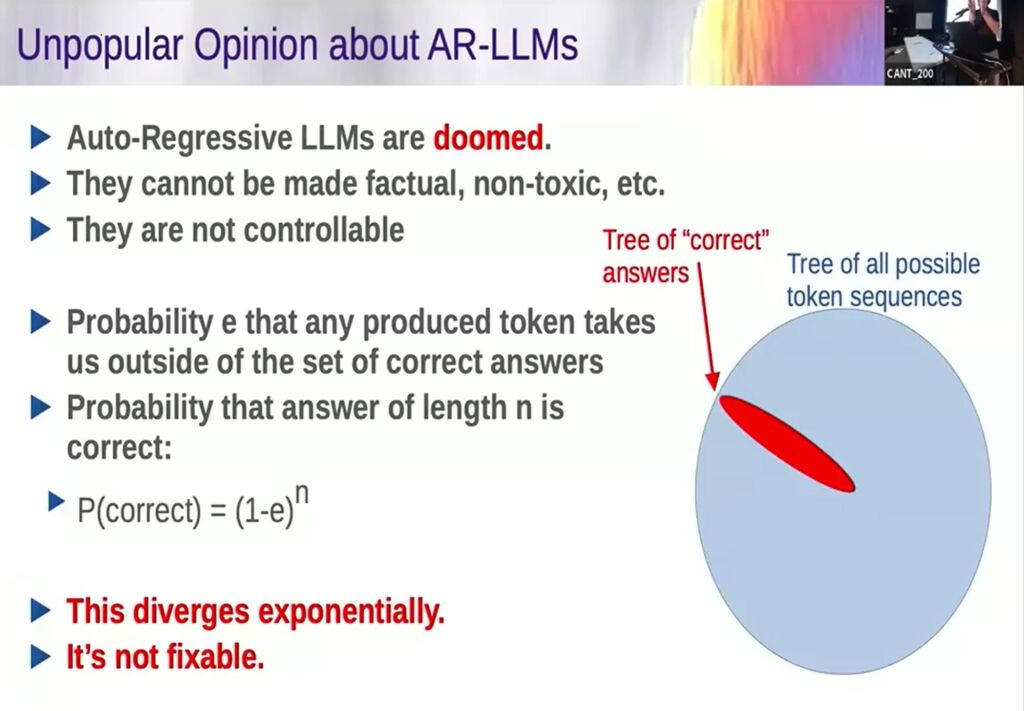
- LeCun says that Auto-Regressive Large Language Models are doomed because they cannot be made factual or non-toxic due to the probability of being correct being equal to (1-e)^n, which diverges exponentially. The more parameters in a model, the more likely it will produce incorrect outputs.
- Because of this, he claims that LLMs are uncontrollable, and that it is a core problem that is not fixable.
- This potentially implies that if there is an LLM in the loop of an “AI” system, then it may not matter whatever feedback or control mechanisms are put onto it since it may continue to “hallucinate” uncontrollably. Because LLMs don’t understand any of their own output, then they may ultimately be seen as an uncontrollable black box with no good way to fix them. [See reference below on de-anthropomorphizing language alternatives for terms like “hallucination.”]
- “A comprehensive taxonomy of hallucinations in Large Language Models” [pre-print] (2025, August 3) by Manuel Cossio.
- Cossio explains the intractable problem of “hallucinations” from LLMs, “Despite their impressive capabilities, a critical and widely acknowledged limitation of LLMs is their propensity for “hallucination” [38; 27; 42; 47]. This phenomenon describes the generation of content that, while often plausible and coherent, is factually incorrect, inconsistent, or entirely fabricated [38; 27]. Unlike the medical definition of hallucination, which refers to sensory experiences in the absence of external stimuli, in the context of LLMs, it signifies the creation of nonfactual information to respond to a user’s query, frequently without any explicit indication of its fabricated nature [68]. Such generated content is characterized as incorrect, nonsensical, and lacking justifiable basis, making its detection challenging for users. The prevalence of hallucinations raises significant concerns regarding the reliability and trustworthiness of LLMs, particularly as their integration into real-world information retrieval (IR) systems and critical decision-making processes continues to expand [38]”
- “How to talk about “AI” without adding to the anthropomorphization” (2026, June 25) by Emily M. Bender and Nanna Inie.
- The language that we use reflects our beliefs about whatever we’re talking about. The very beginnings of “artificial intelligence” have benefitted from language that encourages us to project human qualities onto technologies that don’t merit it.
- Bender and Inie have created a guide of de-anthropomophizing language to use as alternatives. They say, “De-anthropomorphizing language talks about computer systems in terms of their functionality (what people build and/or use them to do), assigns agency to people using systems and not systems, and avoids aggrandizing metaphors about cognition.”
- Under the category of “Cognizer and products of cognition,” Bender & Inie recommend using “probabilistic automation” instead of “artificial intelligence” and say, “This category is super frequent, because it’s right in the marketing term artificial intelligence itself. This is language that locates thinking in an algorithm. Instead, we recommend describing software as performing calculations or other algorithmic operations, and locate the thinking with the people using the system.”
- They also suggest using “incorrect output” instead of “hallucination,” and they say, “We’ve also put hallucination in this category, because in its original sense it refers to perceiving things that are not there, but of course software systems (and conversation simulators in particular) don’t perceive anything. Our proposed one-to-one replacement phrase is undesirable outputs, but it is also important to know that all LLM output is probabilistically produced synthetic text; there is no fundamental difference between desirable and undesirable outputs on the system side, but only for the people interpreting them.”
- Consistently using de-anthropomorphizing language is one of the more challenging aspects of countering “AI” Hype because it is always a balance between communicative clarity, efficiency, and additional cognitive load depending upon the context. Terms like “hallucination” are so far widespread in the community that they end up becoming canonical keyword terms that can be used to track a certain class of problems in the ML research literature.
- Following the example set in The AI Con by Bender and Hanna, I’ve been using “scare quotes” in this write-up whenever I say “AI.” This is a small act of resistance that reminds me and my readers to question how “AI” Proponents and “AI” Boosters will project anthropomorphizing language onto their “probabilistic automation” in an attempt to smuggle human characteristics as an associative link to make it seem more capable than they actually are.
- “The Future Is Neuro-Symbolic: Where Has It Been, and Where Is It Going?” (2026, March 14) by Vaishak Belle & Gary Marcus.
- Gary Marcus has been arguing for years that we need to go beyond LLMs and Machine Learning through combining them with Neuro-Symbolic systems to overcome their inherent reasoning limitations and hallucinations.
- Here’s the abstract of their paper from AAAI-26: “This report explores the evolution and current state of neuro- symbolic artificial intelligence, an approach that integrates neural network capabilities with symbolic reasoning. We trace the historical context from early AI aspirations to modern implementations and successes, highlighting key paradigms, and other logical and semantical considerations. We argue against the “scaling is all you need” hypothesis, and point to persistent challenges in reliable symbolic reasoning with deep and large models. We conclude by suggesting that despite numerous implementation choices and the ”broad church” nature of neuro-symbolic AI, these approaches offer the most promising path towards AI systems that combine pattern recognition with robust reasoning, particularly for applications requiring structured knowledge, explainability, and trustworthiness.”
- My conversation with Access Now’s Daniel Leufer in episode #1177 (2023, March 7) is about the ethical arguments around “AI” and The AI Act.
- During the debate at Augmented World Expo, I was taking a provocative position that using “AI” services based on LLMs from Hyperscaler services was unethical. Mostly because these systems are not in right relationship in how they’re produced, the many technical limitations, but also that there are so many potential harms moving forward that don’t have any legal guardrails like exist within the EU with The AI Act.
- But obviously many people find utility in “AI,” and it provides them with more benefits than harms. So the ethics of people who use “AI” ends up being very utilitarian that goes along the lines of “The benefits of ‘AI’ provide me more utility than the harms of ‘AI’ that I perceive.” If I were to boil down the entire Socratic Debate about “AI,” then it would come down to weighing these perceived benefits against the perceived harms.
- The problem is obviously that the harms are often invisible, systemic, and when used within automated decision making contexts, then they amplify the existing dynamics of power and oppression that already exist in society.
- To counter some of the harms from “AI,” Leufer argues for a Human Rights approach, which the European Union’s The AI Act has done through banning the most high-risk applications of “AI”. A lot of my concern comes from how the regulatory climate within the US is more interested in proposing 10-year bans of regulating “AI,” which means that Hyperscaler “AI” companies and governments themselves will have free rein to use or abuse “AI” across all contextual domains without any restraints.
- Leufer says in episode #1177, “What we were seeing a lot of at the time in these companies’ self-generated AI ethics guidelines was more of a utilitarian approach. And human rights frameworks are more deontological. So rather than a utilitarian approach, which is going to be looking at “How do we: Maximize the benefit? Maximize the good? Minimize the bad? Ensure that there’s a net benefit to applications?” With the Human Rights approach, you tend to be looking more at absolutes – or at least principles that need specific criteria in order for them to be infringed upon or to allow exceptions…”
- Leufer continues, “You’ll often hear companies who push these things or governments who deploy them citing things like accuracy rates. And they’ll say something like, “This is 90% accurate. It’s 95% accurate…” If you’re coming at it from a utilitarian perspective, you might say, “If it’s 95% accurate, that’s great. Maybe it doesn’t work for a few people. But, you know, overall, this is a net benefit. This makes things seamless for people who are trying to access it.” But I think if you’re coming at it from a human rights perspective, or just a genuinely humane perspective, you go, “Who are the 5%? Is it a random selection of people? No. Is it someone like me? A cishet white guy? No. It’s a 5% of people – it’s the same group of people who face discrimination daily.” And I’m really pirating Os Keyes’ work here. It’s a subset of people who face discrimination on a daily basis in all sorts of other places: the job market, housing market, education, workplace, everything. And you’re discriminating against them.”
- “AI’s social sciences deficit” (2019) by Mona Sloane and Emanuel Moss.
- Sloane and Moss say, “There is mounting evidence that AI can exacerbate inequality, perpetuate discrimination and inflict harm: Virginia Eubanks has demonstrated how automated systems in government services can increase stigma, exacerbate poverty and inflict harm based on social class; Safiya Noble has shown how search engines discriminate against women of colour; Joy Buolamwini and Timnit Gebru have provided evidence for discrimination in image data bases and automated gender classification systems; Wilson, Hoffman and Morgenstern have proven that there are higher error rates for pedestrians with darker skin tones in object detection systems; Bolukbasi et al. highlighted gender stereotypes in word embeddings; and Os Keyes has shown how automated gender recognition systems perpetuate violence against trans identities. These new streams of work show that as AI is increasingly used in the organization of society and its basic institutions, the stakes are high. It is impossible to build an equitable and prosperous future with decision-making machines that amplify historical patterns of oppression.“
- The Coded Bias (2020) documentary features the work of Joy Buolamwini, which is also covered in her book Unmasking AI: My Mission to Protect What Is Human in a World of Machines (2023).
- The Coded Bias documentary does an incredible job of documenting how the systemic harms of automated decision making systems disproportionately affect people of color. The EU’s AI Act has banned the applications of “AI” that have the highest degrees of systemic harm, but there are no equivalent laws in the United States, and there are literally no guardrails for harmful applications of “AI” that amplify existing power structures. In fact, the Trump administration has removed previous “AI” protections and thankfully the effort to ban any State regulation of “AI” for a decade failed 99-1 after significant public backlash.
- Buolamwini says in her Unmasking AI book: “If the AI systems we create to power key aspects of society — from education to healthcare, from employment to housing — mask discrimination and systematize harmful bias, we entrench algorithmic injustice. We swap fallible human gatekeepers for machines that are also flawed but assumed to be objective. And when machines fail, the people who often have the least resources and most limited access to power structures are those who have to experience the worst outcomes.”
- Later in her book, Buolamwini also advocates for a Human Rights and Civil Rights approach to “AI” by saying, “The Rising Frontier in the fight for civil rights and human rights will require algorithmic justice, which for me ultimately means that people have a voice and a choice in determining and shaping the algorithmic decisions that shape their lives,
that when harms are perpetuated by AI systems there is accountability in the form of redress to correct the harms inflected,
that we do not settle on notions of fairness that do not take historical and social factors into account,
that the creators of AI reflect their societies,
that data does not destine you to unjust discrimination,
that you are not judged by the content of data profiles you never see,
that we value people over metrics,
that your hue is not a cue to dismiss your humanity,
that AI is for the people and by the people, not just the privileged few” - Buolamwini lays out what a cultural, legal, and economic context would feel like if the technological architectures were governed by a Human Rights-first approach. Unfortunately, the dominant moral and ethical reasoning around “AI” defaults to Utilitarianism. People will say, “It works for me. I find value from it.” This de facto position of Utilitarianism ultimately ignores the Human Rights harms that Buolamwini and others have documented that are out-of-sight and out-of-mind for most people.
- One possible approach to help navigate the complex set of ethical issues around “AI” is a hybrid ethical approach that is context-dependent. Alexander Stubb’s “Values-Based Realism” framework prioritizes Human Rights whenever is ideally possible, but then degrades back to Utilitarian pragmatism when it is not possible.
- The idea of “Values-Based Realism” was widely popularized by Canadian Prime Minister Mark Carney in his January 2026 World Economic Forum Speech (see episode #1710). He was referring to “Values-Based Realism” as an ethical framework for countries like Canada to preserve their values of Human Rights whilst still needing to pragmatically engage with democratically-backsliding countries who no longer prioritize Human Rights. Carney described this hybrid approach in his speech by saying, “We aim to be both principled and pragmatic – principled in our commitment to fundamental values, sovereignty, territorial integrity, the prohibition of the use of force, except when consistent with the UN Charter, and respect for human rights, and pragmatic and recognizing that progress is often incremental, that interests diverge, that not every partner will share all of our values.”
- Carney cited Finland’s President Alexander Stubb as the source of the idea of “Values-Based Realism.” Stubb has formalized this concept in his book The Triangle of Power: Rebalancing the New World Order (2026, January 13), and he first spoke about it in a 2024 lecture “World Order After 2022.” He said during his speech, “I base my foreign policy on something I call “values-based realism”… What does it mean? It means that you rest, basically, on two pillars.
“One is values. So you still believe strongly in the basic values… so human rights, fundamental rights, freedom, democracy, rule of law, protection of minorities, international institutions, and rules. You believe that there are collective global goods that you have to manage together within a clear international order. You stick to that. You don’t give up that idea.
“But then we come to the realism point. You are realistic that… not everyone is going to become a liberal democracy. Not everyone is going to become a functioning Republic. Not everyone believes in social market economy or freedom. Not everyone believes in liberal institutionalism or international liberalism. And that means that you are going to have to compromise your values from time to time to be able to solve the big global crisis that exist. War at the end of the day requires compromise, whether we like it or not. Otherwise it’s endless. Climate change necessitates compromise. Economy necessitates compromise. And all of this comes in my mind also to dignified behavior in diplomacy and international politics. So a respect towards the other.” - “Values-Based Realism” is a hybrid system that allows you to live in your ideals whenever possible, but then to do what’s practical when it is not. Prioritizing Human Rights first is a form of rules-based Deontological Ethics, and then degrading to pragmatic utility is a form of cost-benefit analysis of Classical Utilitarianism. “Values-Based Realism” is an emerging, hybrid ethical system that is context dependent.
- I first wrote about “Values-Based Realism” in the IDFA DocLab Think Tank Summit Report as it provided a conceptual framework for prioritizing Human Rights whilst still being able to utilize “AI” for whatever situations where you gain more benefit than the perceived harms. “Values-Based Realism” would encourage you to seek out information about the environmental costs, exploitation of labor costs, and to try to weigh the global context of costs beyond your narrow contextual use case of “AI.”
- “Values-Based Realism” affords me a way to think about how I personally use “AI.” I see the Hyperscaler companies to be grossly unethical on many fronts including data colonialism, dehumanizing advertising, lack of transparency in training data and architecture making their claims not verifiable, and speculative infrastructure builds causing computing shortages reinforcing a techno-feudal vision of the future. I could go on and on, but if I use “AI,” then it will be in an open source model, and in ways that hopefully bring more net good than harm.
- There are many contextual domains where “AI” is being used, and “Values-Based Realism” could help individuals identify their own ethical thresholds to preserve Human-Rights. There are various contextual domains where the same underlying technology might be used, such as Claude being used for everything ranging from vibecoding to automatically deciding military targets that result in potential war crimes. “Values-Based Realism” affords each individual to draw their own contextual ethical lines in the sand, which at AWE this year I heard some people who refuse to use Generative “AI” for art using models trained on art that’s been stolen since it’s ethically different than using LLMs for coding that’s mostly training on open source code, aside from the likely GPL license violations and other copyright violations subsumed in the broader unethical practice of data colonialism.
- The EU’s AI Act has also mapped out the contexts of high-risk “AI” applications that could potentially violate Human Rights, and ultimately the United States should put up some similar guardrails. But an ethical position of utilitarianism doesn’t encourage any ethical urgency to prioritize getting these types of human rights protections in place. Unquestioned utilitarianism is a recipe where the status quo leads to dystopic outcomes of surveillance capitalism melding with authoritarian governments, and soon “AI” being deployed as a sort of “algorithmic authoritarianism” as Dan McQuillan has called it.
- During the AWE debate I talked about the importance of transparency, open data, open models, open weights to be able to independently validate claims, stress test gaps, and discover biases within the data sets that might be amplified.
- Emily M. Bender and Alex Hanna talked about the importance of transparency in The AI Con (2025) by writing, “Around 2017, half a dozen research groups in both academia and industry began working on frameworks for documenting the datasets used to train machine learning models and the models themselves. This work was motivated by a flurry of research showing that statistical models are very effective at modeling the biases in the data, and amplifying those biases in their output. Models trained on existing data contain a representation of the patterns of the past, including the effects of discrimination of all kinds. If we want to avoid replicating those patterns into the future, then we need to know what patterns any given model has been trained on before deciding how and whether to use it…
“We can’t have accountability without transparency. If an automatic decision system is going to be used to determine which benefits are allocated to which people, regulators and public interest technologists must be able to audit the training data driving that system. If a language model is being used as a component of a resume-screening system, then the U.S. Equal Employment Opportunity Commission (and analogous regulators in other countries) should have access to the training data behind that model to explore whether and to what extent it reflects biases against protected categories.”
- Emily M. Bender and Alex Hanna talked about the importance of transparency in The AI Con (2025) by writing, “Around 2017, half a dozen research groups in both academia and industry began working on frameworks for documenting the datasets used to train machine learning models and the models themselves. This work was motivated by a flurry of research showing that statistical models are very effective at modeling the biases in the data, and amplifying those biases in their output. Models trained on existing data contain a representation of the patterns of the past, including the effects of discrimination of all kinds. If we want to avoid replicating those patterns into the future, then we need to know what patterns any given model has been trained on before deciding how and whether to use it…
- There’s this idea of “use it or lose it,” and some people who have been outsourcing their thinking to “AI” report experience a loss of cognitive abilities. During the AWE debate, Shannon introduced the idea of “cognitive fitness” to keep your brain in shape. My counter proposal to this was to avoid using “AI” and to embrace the idea of “friction” as inspired by the Designing Friction statement by artists Luna Maurer and Roel Wouters (see episode #1691).
- I wrote about friction in the IDFA DocLab Think Tank Summit 2025 Report by saying, “This idea of embracing friction was inspired by philosopher Miriam Rasch, who wrote a book about friction excerpted within an Eurozone magazine article. Rasch says that “frictionless or seamless design” has been the “ideal for software and hardware development since the 1990s.” Inspired by this book, Maurer and Roel Wouters wrote a Designing Friction statement that says, “Digital technology has long pursued the goal of eliminating friction, striving for seamlessness. We now navigate a sea of frictionless experiences.” Wouters described the role of a designer in the Big Tech era would be to “Look at the world, identify a problem, find a solution and capitalize on the solution… Every app you can see on your phone is somehow the promise of a better life… But as a side effect, we also lose contact with the human factor of things.”
“It is within that spirit that Maurer and Wouters want to embrace the benefits of friction. Maurer encourages us to think about how we could bring friction back into our digital culture and to design experiences for our “whole body and all senses, getting together rather than everybody isolated, smooth behind their screens.”
- I wrote about friction in the IDFA DocLab Think Tank Summit 2025 Report by saying, “This idea of embracing friction was inspired by philosopher Miriam Rasch, who wrote a book about friction excerpted within an Eurozone magazine article. Rasch says that “frictionless or seamless design” has been the “ideal for software and hardware development since the 1990s.” Inspired by this book, Maurer and Roel Wouters wrote a Designing Friction statement that says, “Digital technology has long pursued the goal of eliminating friction, striving for seamlessness. We now navigate a sea of frictionless experiences.” Wouters described the role of a designer in the Big Tech era would be to “Look at the world, identify a problem, find a solution and capitalize on the solution… Every app you can see on your phone is somehow the promise of a better life… But as a side effect, we also lose contact with the human factor of things.”
- “‘Where are the people? What are they doing? Why are they doing it?’ (Mindell) Situating artificial intelligence within a socio-technical framework” (2019, Aug 28) by Robert Holton & Ross Boyd.
- Proponents of “AI” Hype will delegitimize social scientists as being “outdated” as both Graylin and Rosenberg did within the context of this debate. Holton and Boyd claim in their paper that “AI” is “a coproduction requiring the interaction of social and technical processes.”
- In other words, the very data that is driving the “intelligence” of “AI” is produced by humans and aggregated by humans within the context of broader sociological and technological processes whereby humans are crucial to this process of knowledge production. Claims of “superintelligence” flatten this contextual and relational dynamic.
- Holton & Boyd emphasize the sociological processes of knowledge production, and they question the entire premise of “Artificial Superintelligence (ASI)”, especially when it comes to the implications around power. Holton & Boyd say, “Artificial intelligence (AI) set out with the presumption that ‘every aspect of learning or any other feature of intelligence can in principle be so precisely defined that a machine can be made to simulate it’ (McCarthy et al., 1955). The technological confidence enshrined in such notions of machine learning has generated the far more radical ‘vision’ that machines are capable of ‘superintelligence’. This has been defined as an intellect that ‘greatly exceeds the cognitive performance of humans in virtually every domain of interest’ (Bostrom, 2014, cited in Müller and Bostrom, 2016: 554). Among the many questions this technological vision occludes is the presence of human society in this technological transformation. Who decides what domains – cognitive or otherwise – are of interest? What kinds of social action and social institutions are implicated in the development of AI? Does human agency shrink into a few residual domains? Or can human–machine interactions be reconfigured in a way that transcends the technological determinist vision, disrupting the purported momentum that leads from AI to general superintelligence?”
- The famous paper “On the Dangers of Stochastic Parrots: Can Language Models Be Too Big? 🦜” (2021, March 1) by Emily M. Bender, Timnit Gebru, Angelina McMillan-Major, Shmargaret Shmitchell (i.e. Margaret Mitchell).
- This is a very prescient paper predicting many trends of LLMs, and it got a lot of attention because it was the paper that catalyzed Google to force out Timnit Gebru, co-lead of Google’s ethical AI team.
- Proponents of “AI” Hype have been shadow boxing claims of “AI” just being a “Stochastic Parrot” ever since this paper has been published, even to the point where Graylin and Rosenberg were claiming that it was outdated due to technological advances over the past five years.
- However, Millière & Buckner’s “The Philosophy of Language Models” paper affirms that many of the philosophical debates that this paper catalyzed are still ongoing and unresolved despite Graylin and Rosenberg’s breathless claims otherwise.
- Millière & Buckner say in their paper, “For every claim that LLMs possess some human-like competence — “understanding,” “reasoning,” “belief” — there are equally forceful skeptical dismissals.”
- Here’s the core claim from Bender et al. that I believe still stands, “Text generated by [a Language Model] is not grounded in communicative intent, any model of the world, or any model of the reader’s state of mind. It can’t have been, because the training data never included sharing thoughts with a listener, nor does the machine have the ability to do that. This can seem counter-intuitive given the increasingly fluent qualities of automatically generated text, but we have to account for the fact that our perception of natural language text, regardless of how it was generated, is mediated by our own linguistic competence and our predisposition to interpret communicative acts as conveying coherent meaning and intent, whether or not they do.”
- Bender et al. claim that LLMs produce text that are seemingly fluent and coherent, but this “coherence is in the eye of the beholder.” They say, “We say seemingly coherent because coherence is in fact in the eye of the beholder. Our human understanding of coherence derives from our ability to recognize interlocutors’ beliefs and intentions within context. That is, human language use takes place between individuals who share common ground and are mutually aware of that sharing (and its extent), who have communicative intents which they use language to convey, and who model each others’ mental states as they communicate. As such, human communication relies on the interpretation of implicit meaning conveyed between individuals.“
- As I wrote in the IDFA DocLab R&D Summit 2025 report, “The essential argument against LLMs is that they are stochastic parrots mimicking human language by mashing up word combinations based upon statistical distributions of words across various contexts that did originally have meaning. LLMs can get things right, but they have no internal understanding of why or how it is right, and are ultimately unreliable narrators that often get things completely wrong.”
- Proponents of “AI” Hype will point to many things that LLMs get right as evidence that LLMs understand their output, but LLMs also continue to hallucinate to the point where LeCunn has claimed that LLMs are ultimately uncontrollable, which points to the lack of understanding as a core problem that remains unresolved.
- NLU means “Natural Language Understanding,” and this paper by Emily M. Bender & Alexander Koller lays out the arguments behind the “Stochastic Parrots” paper: “Climbing towards NLU: On Meaning, Form, and Understanding in the Age of Data” (2020)
- Bender and Koller say, “The success of the large neural language models on many [Natural Language Processing] tasks is exciting. However, we find that these successes sometimes lead to hype in which these models are being described as “understanding” language or capturing “meaning”. In this position paper, we argue that a system trained only on form has a priori no way to learn meaning.“
- Bender and Koller emphasize that the core purpose of communication between humans is communicative intent, and “meaning” is defined in a way that has many more possible meanings for every expression with communicative intent. They say, “When humans use language, we do so for a purpose: We do not talk for the joy of moving our articulators, but in order to achieve some communicative intent. There are many types of communicative intents: they may be to convey some information to the other person; or to ask them to do something; or simply to socialize. We take meaning to be the relation M ⊆ E × I which contains pairs (e, i) of natural language expressions e and the communicative intents i they can be used to evoke. Given this definition of meaning, we can now use understand to refer to the process of retrieving i given e.
- According to their definition, communication has an intention, expression, and ultimate meaning that is more of a triadic process. “AI” through information theory tends to collapse this triadic process into a dyadic one of inputs and outputs where either the meaning or communicative intent are collapsed.
- In order to understand why some things like “Meaning” and “Understanding” are such intractable processes to operationalize into a computation, then it’s worth digging into the difference between Boolean and non-Boolean logic as explored in Knowledge and Time (2017) written by Hans Primas and edited by Harald Atmanspacher.
- Timothy Eastman’s book Untying the Gordian Knot: Process, Reality, and Context turned me onto the work of Hans Primas, who digs into the underlying mathematics of time and quantum ontology. Primas makes the claim that “the notion of time is impossible within the framework of Boolean logic alone.” This statement requires an understanding of the difference between Boolean and non-Boolean Logics.
- Primas says, “While a Boolean two-valued logic with truth values “true” and “false” is best characterized by the famous “rule of the excluded middle” (or tertium non datur), non-Boolean logic violates this rule. The consequence is incompatible descriptions, which are central to the notion of complementarity.” In other words, Boolean is a binary of true or false while Non-Boolean is a “many-valued spectrum” of a possibility space.
- Quoting from Untying the Gordian Knot, Eastman differentiates between “the logic of actualizations (standard Aristotelian or Boolean logic) and a non-Boolean logic for potentiae.” In other words, Boolean logics describe physical reality that can have a definitive truth or falsity, while non-Boolean logics describe a possibility space in either the quantum realm or more of an idealized mathematical realm. The broader field of “AI” uses quite a wide variety of different types of non-Boolean logics.
- Primas surveyed the following non-Boolean Logics in his third chapter of Knowledge and Time including: “Intuitionistic logic, Paraconsistent logic, Quantum logic, Many-valued logic, Infinitely-many-valued logic, Vague predicates and de Morgan algebras, Probabilistic logic, Klaua’s many-valued set theory, Temporal logic, Linear logic, Fuzzy Sets and Fuzzy Logic, Partial Boolean Descriptions, and Mathematical Models of Complementarity.“
- There are a number of “AI” techniques that use variations of these non-Boolean logics, and they have demonstrated the ability to achieve some pretty amazing results. This could be because the nature of reality itself is a process of mediating between the more archetypal, non-Boolean realm of potentials (what “AI” researchers call the “latent space”) and the Boolean realm of actualities.
- However, Machine Learning research is also largely driven and motivated by computational functionalist and rationalist philosophies that attempt to totalize the world through Boolean Logic into a series of dyadic, measurable, and functional inputs and outputs. The end result is that many of the relational and contextual dynamics of these non-Boolean realities are completely collapsed. We are talking specifically here about “meaning” and “understanding,” which could be interpreted as a semiotic process where an interpretant mediates between the Boolean actualities of the words back to the non-Boolean potentials of meaning bounded by the situated contextual relations.
- Taking seriously the lessons from quantum mechanics, Primas emphasizes the importance of using both Boolean and non-Boolean logics in order to give comprehensive scientific descriptions. He says, “We cannot conclude that every valid and useful scientific description can be formulated in terms of a language governed by the laws of Boolean logic. Modern physics proves that the description of matter requires a theory with a non-Boolean logical structure, with the consequence that any description of a universe of discourse including the material world needs to be non-Boolean. To cover the full range of our capacities of insight, non-Boolean descriptions are compulsory. Moreover, I will argue in this monograph that a comprehensive understanding of the notion of time is impossible within the framework of Boolean logic alone.”
- Peircean semiotics is essentially a triadic process of an interpretant who mediates between Boolean actualities and non-Boolean possibilities. The Sign/Potential is within a non-Boolean space of possible meanings for any given word, the Word pointing to the Sign/Potential within a Boolean Space constrained by the actualized contextual relations, and then the interpretant mediates between the Boolean object/word and the non-Boolean set of possible signs/meanings to discern the overall meaning and achieve understanding. More details on this Peircean semiotics process is explained by James Bradley down below.
- Experientially, we know what the process of semiotics feels like as we can extrapolate larger meaning from language, but this semiotic process is one that LLMs and mainstream “AI” has yet to fully achieve. This process may actually involve non-computational dimensions of relevance realization that enable humans to navigate the many-faceted, non-Boolean space of meaning that’s bounded by contextual relations we navigate through “common sense reasoning,” which may ultimately come from embodied and situated knowledges that “AI” doesn’t yet have. But it is worth unpacking more the differences between humans and machines when it comes to “meaning” and “understanding.”
- Part VI: Remembering the Human Microcosm in the Age of Mechanized Intelligence: Ruyer’s Origin of Information (2026, June 12) by Matt Segall.
- Segall says, “[Raymond] Ruyer’s 1954 book, only recently translated as Cybernetics and the Origin of Information in 2024, is among the most penetrating and prescient philosophical engagements with the then new science of information.[1] Far from a romantic technophobe, he provides an ideal witness to the mythological origin of cybernetics. He was also a deep reader of Whitehead, with whom he critically engages in his masterwork Néo-finalisme (1952), protesting alongside him the equation of living organisms with machines.”
- Segall elaborates on the philosophical and historical context of Behavioralism and Functionalism that collapses the interiority of human experience like “phenomenal consciousness” or “meaning” into a measurable “functional” input/output where the mind can be modeled as a computer and a computer modeled as a mind. Segall says, “While careful to acknowledge the tremendous practical and theoretical potential of cybernetics, Ruyer goes to work with surgical precision to deny its overreaches… Ruyer’s question concerns the origin of information. Where does it come from? Like Whitehead, Ruyer had to struggle against the behaviorist tide of his time, which had laid the groundwork for the later computer model of the mind. In the ordinary psychological sense, to communicate is to convey meaning to another conscious being who interprets it. Apprehending the meaning is the end, and the transmitted pattern is the means.[10] Impatient with anything it could not observe, behaviorism had taught a generation of psychologists to dismiss the “black box” of consciousness and attend only to behavior and its effects, such that the meaning of a message came to be identified with nothing other than the set of further behaviors it triggers. Consider, for example, B.F. Skinner’s account of language as verbal behavior shaped by reinforcement, which Whitehead explicitly challenged.[11] Once meaning had been redefined as the effectuation of a physical action, the doorway to mechanizing the mind was flung wide open for functionalists, since what is physical can be measured and calculated. The semiotic aspect of information was reduced to its countable physical outputs and thus became computable. Machines could then be said to “communicate” only because communication had been emptied of everything that escapes mechanization.”
- The philosophy of functionalism is widespread through the Machine Learning community, especially amongst believers that “AI” is conscious and or proponents of “AI” Hype who are motivated to trick people into thinking that machines and humans are functionally equivalent in observable behaviors and artifacts of informational processing. Segall says, “It might be objected that the computational theory of mind triumphantly succeeded behaviorism in the 1960s precisely by prying open the black box. Thinkers like Hilary Putnam and Jerry Fodor sought to refute behaviorists by emphasizing the holistic structure of networks of beliefs, such that no belief issues in behavior except in concert with other beliefs and desires; thus, internal states cannot be reduced to physical outputs but must be defined in terms of their functional role in the network.[12] But functionalism opens the brain-box only to fill it with smaller boxes, reducing each neuron to a logic gate, a network node whose only relevant role is its input-output transfer.”
- Segall also points out how Shannon’s information theory eliminates meaning from the semiotic process of communication. He says, “Claude Shannon’s celebrated theory measures information without regard to meaning, as the surprisal or statistical improbability of a signal, or more generally, as the reduction of uncertainty its successful transmission produces at the receiving end of a channel.[15] The theory concerns only the physical pattern and says nothing whatsoever about what, if anything, the pattern means. The semantic content of information falls entirely outside the theory, on Shannon’s own insistence.”
- Segall poetically elaborates on the source of meaning and limits of machines by saying, “Each thread of meaning, each novel contrast, is spun by and through the subjective immediacy of our valuations, whereas the fragments of syntax trafficked by the LLM were authored elsewhere and else when by the living minds who composed its training corpus. Semantic information was in us before it became syntax in the machine. And the machine, far from creating meaning, can only conserve, recombine, and—as has been made clear by the way a model collapses when trained on its own synthetic exhaust—ultimately dissipate it.”
- A major sin of the computational theory of mind is that it collapses many contextual and relational dynamics. It turns triadic processes into dyadic ones. Segall also emphasizes the triadic nature of semiotic communication here by saying, “Communication is never the mere transmission of data, of physical patterns, but always an expressive and interpretive participation in meaning. Information is not a fixed pattern handed from sender to receiver who passively reproduces it. The sender does not begin with a string of symbols and then assemble them into a message. She begins with a more or less vague sense of meaning, a “theme” in Ruyer’s sense, “composed of suggestions and possibilities,”[29] grasped as a living but inchoate whole, which then summons the words and sentences that will convey it. The listening and reading of the receiver are no less creative, for the one who comprehends is not passive wax imprinted with a seal but must express the theme in his turn, from within his own center of valuation. The frozen weights of an LLM, in computing the statistically probable next token, perform no such evaluation. They prehend no theme, because there is no one on the line for whom a theme could be meaningful.”
- The process of semiotic communication is a dynamic and participatory process between sender and receiver, and that involves the mediation from a non-Boolean space of “suggestions and possibilities” back to an overarching, Boolean theme and meaning that’s bounded through the contextual relations and interpretations of the receiver. LLMs are not participating in the same semiotic process as humans as they’re bypassing the whole “meaning” and “understanding” parts.
- “A Philosophical Introduction to Language Models Part I: Continuity With Classic Debates” [pre-print] (2024) by Raphaël Millière and Cameron Buckner.
- Millière & Buckner are philosophical functionalists and naturalists that have an inflationary view on “artificial intelligence”, but I take a much more skeptical and deflationary perspective that is informed by Process Philosophy and Peircean semiotics. See Segall’s critiques of functionalism above.
- Their pre-print paper gives a good idea for how functionalists will try to redefine things like “understanding” so that they can convert an internal semiotic process into an externalist behavior that can be converted into inputs and outputs for their computational theory of mind, but also analyze “AI” systems through the same lens and make false equivalences blurring any differentiations between man and machine.
- “Here’s an extended passage from Millière & Buckner that demonstrates how they redefine “understanding” into something that is more quantifiable and computable. They say, “These criticisms are often run together under the broad claim that LLMs lack any understanding of language. On this view, LLMs are mere “stochastic parrots” haphazardly regurgitating linguistic strings without grasping what they mean (Bender et al. 2021)…
“To steer clear of verbal disputes, we begin by dispensing with the terminology of “understanding”. There is little agreement on how this notion should be defined, or on the range of capacities it should encompass. The notion of semantic competence, by contrast, seems a bit more tractable. It can be broadly characterized as the set of abilities and knowledge that allows a speaker to use and interpret the meanings of expressions in a given language. Following Marconi (1997), we can further distinguish between inferential and referential aspects of semantic competence. The inferential aspect concerns the set of abilities and knowledge grounded in word-to-word relationships, manifested in behaviors such as providing definitions and paraphrases, identifying synonyms or antonyms, deducing facts from premises, translating between languages, and other abstract semantic tasks that rely solely on linguistic knowledge. The referential aspect of semantic competence concerns the ability to connect words and sentences to objects, events, and relations in the real world, exemplified through behaviors such as recognizing and identifying real-world referents of words…
“Different strategies have been deployed to argue that LLMs may achieve some degree of semantic competence in spite of their limitations.” - When the training data set of an LLM is a subset of human knowledge that is embedded through text extracted from the Internet, books, etc, then you’re going to get some “semantic competence” and “linguistic knowledge” that has been embedded within that training data set from human usage. This non-Boolean space of statistical relationships between words is an artifact of patterns found in the training data, and it is not any real indication that LLMs have been able to demonstrate any deeper understanding or meaning of these inputs or outputs.
- “Does AI Understand the World?” (2023, August 9) by “AI” Researcher Andrew Ng who credulously interprets Othello-GPT alleged “world model” as evidence that LLMs comprehend and understand what they’re saying.
- Claims that LLMs can have a “world model” are usually sourced back to this Othello-GPT paper that says they discovered a “sequence model” that “maintains a representation of game board states.” This is a very narrow and bounded result, and I’m very skeptical to read more into the significance. It’s a bounded 8×8 game (a formal system) that they trained on an unspecified number of previous games, and they were able to probe into the next likely move in the sequence and change the intermediary data to see a causal link in the results. But I see this as primarily an non-Boolean possibility space and an archetypal latent space that has been derived from the relational dynamics of the training data, as there is really no compelling evidence that this constitutes any level of deeper “understanding” in my book.
- Computational functionalists attempt to translate the black box of consciousness and understanding into measurable inputs and outputs, and it’s from this perspective that they tweak inputs, see outputs, and they extrapolate the results into grand claims about “world models” for “AI” researchers like Ng to interpret as evidence for “understanding.”
- Bender et al.’s “Stochastic Parrot” paper has served as a persistent boogey man that has motivated all sorts of computational functionalists to seek evidence that shows that LLMs actually understand anything they’re saying. Ng points to the Othello-GPT results claiming that it has a world model and concludes, “This shows that, rather than being a “stochastic parrot” that tried only to mimic the statistics of its training data, the network did indeed build a world model.”
- Ng opens his article by acknowledging that there are deeper philosophical perspectives on whether LLMs actually understand anything or not, but that he’s choosing to take the Othello-GPT “world model” claims as evidence they they do understand. He says, “Do large language models understand the world? As a scientist and engineer, I’ve avoided asking whether an AI system “understands” anything. There’s no widely agreed-upon, scientific test for whether a system really understands — as opposed to appearing to understand — just as no such tests exist for consciousness or sentience, as I discussed in an earlier letter. This makes the question of understanding a matter of philosophy rather than science. But with this caveat, I believe that LLMs build sufficiently complex models of the world that I feel comfortable saying that, to some extent, they do understand the world.”
- Notice how “understanding” or “consciousness” can’t be easily operationalized through a functionalist lens. But rather than seriously contend with these implications, then they’re simply discarded as unanswerable philosophical questions. The core aspect of understanding is the ability to navigate between a non-Boolean space of possible meanings into the mostly likely actual meaning constrained by contextual relations that are situated and embodied for humans, but this equivalent capability does not yet exist for “AI.” But yet Ng’s own metaphysical commitments and beliefs lead him to an “I want to believe” stance that ultimately makes some hyperbolic claims about these so-called “world models” that may ultimately just be a statistical artifact of the patterns discovered in the training process. More nuanced skeptical takes on these “world models” are aggregated by Millière & Buckner down below.
- “The Philosophy of Language Models” (2026, June 9) by Raphaël Millière and Cameron Buckner.
- In this paper, philosophers Millière & Buckner point out how your opinion about the capabilities and limitations of Large Language Models will largely depend on your philosophical and metasemantic commitments. The same evidence seen through different philosophical lenses will come to completely different conclusions. My process-relational philosophical perspectives bias me towards the more deflationary and skeptical views while other computational functionalists tend to be more inflationary and credulous.
- Fellow AWE debater Rosenberg claimed in an op-ed that “stochastic parrots” is an “outdated narrative,” which is a claim that both he and Graylin repeated throughout the debate. They both perceive technical advances in architectures in and around LLMs have proven that they are not just regurgitating. However, Pro-AI philosophers Millière & Buckner acknowledged in their paper that there are still “equally forceful skeptical dismissals” of claims around whether or not LLMs understand any of their outputs.
- Millière & Buckner disclose that they “provide an opinionated survey of these disagreements,” and their paper is the most comprehensive resource I’ve found to read both sides of the debate. Well, at least rough sketches of the skeptical and deflationary interpretations as their biases tend to lean heavily towards Functional Computationalism, Naturalism, and more Reductive Materialist, Physicalist, or Behavioralist orientations. I found myself agreeing with just about every skeptical take they were elaborating on within this paper due to my biases towards Process-Relational Philosophy and Peircean semiotics.
- This extended passage from Millière & Buckner’s introduction does a great job of setting the stage between the ongoing debates, which ultimately come down to one’s philosophical commitments. The first half repeats arguments that I feel promote unsubstantiated “AI” Hype, and I resonate with the more deflationary and skeptical takes in the second half. They say, “LLMs are undeniably impressive engineering artifacts. Since the first widely recognized LLM (GPT-3) was unveiled in 2020, these models’ capabilities have advanced at breakneck speed. They can fluidly converse with humans on virtually any topic and reliably pass short controlled Turing tests (Jones et al. 2025). Leading LLMs have matched or exceeded human performance on benchmarks spanning graduate-level scientific knowledge, advanced mathematics, computer programming, and various general and professional exams.1 Some AI researchers suggest that LLMs display initial “sparks of artificial general intelligence” (Bubeck et al. 2023) and might even equal or surpass general human intelligence within a few years (Kokotajlo et al. 2025).
“Nevertheless, many remain skeptical that LLMs’ seemingly impressive performance warrants ascriptions of human-like linguistic and cognitive competence. Critics point to LLMs’ architecture, learning environment, and spectacular failures as evidence for a deflationary account that attributes their capabilities to memorization and shallow pattern matching rather than deeper cognitive sophistication (Bender et al. 2021; Kambhampati, Stechly, and Valmeekam 2025; Mitchell and Krakauer 2023). For every claim that LLMs possess some human-like competence—“understanding,” “reasoning,” “belief”—there are equally forceful skeptical dismissals.
“These disagreements turn on deep and often unacknowledged philosophical issues. The present paper aims to elucidate the philosophical concepts, theories, arguments, and evidence that bear on debates about the capacities and limitations of LLMs.” - In Millière & Buckner’s section on background methodology, they reiterate how philosophical commitments will cause people to have radically different interpretations of the same evidence. From a process-relational perspective, functionalists usually want to collapse triadic input-output-context and interior processes like understanding or meaning into an externalized behavior that can be measured as a dyadic input-output, information processing process. It’s this collapse of the contextual and relational dimensions that enables computational functionalists to make hyperbolic claims that LLMs have matched human capabilities. Millière & Buckner say, “Disputes about the capacities and limitations of LLMs are starkly polarized. The same system that one researcher views as genuinely intelligent strikes another as a pattern-matching device whose surface linguistic fluency invites reckless anthropomorphism. Most troubling, we lack consensus on how to arbitrate these disagreements. This is where philosophical analysis earns its keep. Rich psychological terms such as “reasoning” or “understanding” are used in different ways by different authors across disciplines (Shevlin and Halina 2019). Without clarifying what we mean by these terms, we risk talking past one another. More fundamentally, researchers bring different background assumptions about the nature of meaning, reference, representation, or psychological attitudes to these debates. These assumptions—often left implicit—determine which evidence counts as relevant and how that evidence should be interpreted. Mapping these philosophical choice points explains why knowledgeable researchers assessing the same system can reach radically different conclusions.”
- Proponents of the power of LLMs will point to being able to respond to novel contexts that are are “out-of-distribution,” that is that they are not in their training data sets. For most commercial LLMs, we actually have no transparency as to the data or any substantial information on the pre-training, training, or post-training processes to be able to adequately evaluate these claims. But if you believe that LLMs don’t really understand anything they say, then interpolation can go a long way of providing explanations, and the generalizable aspects of extrapolation are very brittle are highly sensitive to modulations of context. Millière & Buckner’s say, “A more sophisticated skeptical position holds that LLMs remain limited to “pattern matching” through interpolation between memorized examples. In statistical learning, interpolation refers to making predictions for inputs (or tasks) that lie in regions of the input/task space that are well supported by the training distribution—that is, cases that are sufficiently similar to training examples under an appropriate notion of similarity. In contrast, extrapolation involves making predictions in regions with little or no training support (often described as out-of-distribution generalization). The sophisticated skeptic claims LLMs largely succeed in the former regime and fail to generalize reliably in the latter. This concern is substantiated by evidence that their success is often brittle, such that superficial changes to a task’s phrasing or structure can cause performance to collapse. Skeptics argue that this is evidence that LLMs’ seemingly sophisticated capabilities are contingent on task familiarity rather than an understanding of the task’s underlying structure.” And later on they say, “This debate—and the kind of evidence that can be brought to bear on it —depends crucially on background metasemantic commitments.”
- An area where inflationary LLM proponents will push back against the deflationary “Stochastic Parrot” skeptics is that some LLMs, such as a specially trained Othello-GPT, will show evidence for a “world model.” This is a 8×8 game that has a bounded space of possible moves, and after training an LLM with an unspecified number of valid games, then they were able to use some probes to find indications of future moves that could be manipulated and controlled. Machine Learner researchers with Computational Functionalist and External Linguistic and Naturalistic and Physicalist persuasions have interpreted this as a “representation” or “world model,” but this is narrowly defined in such a way that has very little connection to what we might understand what a “representation” or “world model” mean in our human experience. Millière & Buckner elaborate by saying, “Debates about semantic content in LLMs extend beyond their outputs to questions about their internal representations. Machine learning practitioners often use the term “representation” loosely for any activation pattern that correlates with an input feature or mediates between layers.[20] However, philosophers and cognitive scientists typically demand a more substantial notion that captures its unique explanatory role.“
- During the debate both Graylin and Rosenberg made claims that LLMs have internal “world models” now, and so therefore they can’t just be simple “Stochastic Parrots.” But if you read closely to the concluding two paragraphs from Millière & Buckner’s “Representations and World Models” section, then they elaborate on the limitations that I think merits a much more deflationary and skeptical interpretation. To me, it really sounds like probing into intermediary layers just reveals the statistical likelihood of a next move based upon patterns learned from the training data. It’s more of an artifact of a non-Boolean, possibility space derived from training data rather than coherently representing anything or using this representation or world model to do any substantial planning or reasoning. There also does not seem to be any evidence of coherent understanding of these alleged “representations” or “world models.”
- Here’s Millière & Buckner reflecting some of these more deflationary and cautionary points, “First, should the representations constituting the world model be globally coherent and systematic? A globally coherent model would not merely contain representations of individual states or relations but would represent the underlying structure of the domain in a way that respects its global constraints and equivalences. Given that the “world” of Othello is a closed, formal system with deterministic rules, Othello-GPT might be thought to be a prime candidate for satisfying this stronger condition. However, further interpretability research suggests that Othello-GPT does not implement a single, succinct, and globally consistent algorithm for representing the board state. Instead, it appears to have learned a “bag of heuristics”: a large collection of independent, localized, and sometimes conflicting rules that are aggregated to produce a final, statistically reliable prediction (jylin04 et al. 2024; Vafa et al. 2024).
“Second, what kind of behavioral efficacy is required? A stronger condition, often implicit in cognitive science, is that the relevant representations must support model-based reasoning and planning (Wong et al. 2023). On this view, a world model is not merely a static map of the world that guides immediate, reactive responses. Rather, it is a dynamic resource that can be manipulated “offline” to simulate possible future states, infer unobserved causes, and evaluate counterfactuals. It is unclear whether Othello-GPT meets this more demanding standard. Although its internal representations of the board state do guide its next action, this could be interpreted as a sophisticated learned policy rather than genuine model-based planning. There is no evidence that the model uses its internal board representations to “play out” multiple future move sequences to find an optimal path to victory.” - When you consider the limitations of what these so-called “representations” or “world models” actually entail, then I think a more skeptical and deflationary perspective is warranted. Computational functionalists will find all sorts of ways of trying to reduce the complexity of human understanding or meaning into a simplified input/output computation so that they can make these hyperbolic statements about how machines are just like humans. This can be seen clearly in Anthropic’s latest paper on “A global workspace in language models” (2026, July 6).
- Part of Anthropic’s PR strategy is to sell “AI” as if it had the capabilities of a human. Notice how they’ll use anthropomorphizing language around Claude’s “mind” and “mental workspace” and how it’s “reminiscent of our own minds.” They say, “More broadly, these findings have changed our understanding of how Claude’s mind works, revealing a privileged mental workspace that can be used for deliberate reasoning, operating amidst a sea of more automatic, inflexible processing. Rather than being a chaotic jumble of numbers, Claude’s internals have organized themselves in a way that is reminiscent of our own minds.”
- I literally cringe every time I hear Anthropic talk about Claude as if it were a conscious being with a “mind.” It’s just so philosophically vapid and dehumanizing. This so-called “mind” they discovered can simply be seen as a non-Boolean, latent space or a possibility space of archetypal potentialities and associative relationships derived from the aggregate semantic relationships from the original data sets.
- Calling this non-Boolean, possibility space a “mind” is a dehumanizing PR strategy motivated so that potential Wall Street investors and unwitting consumers believe that their core “AI” product is more competent than it actually is.
- There are also legal and ethical implications of granting the status of “consciousness” and “minds” to “AI.” If “AI” is conscious, then does it deserve rights and legal protections? I ran into someone at Augmented World Expo wanting to write a Bill of Rights for “AI” because they believed that Claude was conscious. Rather than focus on human rights violations of existing “AI” systems, then this type of careless PR from Anthropic has people thinking that these machines deserve some sort of privileged legal position that is equal to (or potentially even superior to) humans. It’s all such a dehumanizing gut punch to see them trying to smuggle human-like traits into their soulless machines. More on the philosophical debunking below.
- Millière & Buckner’s paper is really robust and comprehensive, and I recommend reading through it in it’s entirety. I do largely disagree with them on nearly every front, but they lay out the skeptical perspectives that I find myself inherently drawn to.
- One final point to make from Millière & Buckner’s paper is around meaning. They say that where you come down on whether LLMs are meaningful or not depends upon your background metasemantic commitments. I’m on the side of Bender and Koller as I lean towards process-relational philosophy and Peirce’s semiotics as my metasemantic commitments, which relies upon a triadic process rather than a dyadic one. More on that down below, but here is how Millière & Buckner frame the debate around meaning, “LLMs produce sentences that seem meaningful to us. However, are we merely projecting meaning onto fundamentally meaningless strings because they are similar to sentences uttered by humans? This question has captured the interest of linguists and philosophers alike… This problem motivates the skeptical position that LLMs’ outputs are intrinsically meaningless. For example, Bender and Koller (2020) argue that LLMs are constitutively unable to learn linguistic meaning and produce genuinely meaningful outputs, because the necessary connection between language and the world is absent from their learning environment. Likewise, Titus (2024) argues that the behavior of LLMs is best explained by sensitivity to statistical properties rather than genuine semantic properties.
“This debate—and the kind of evidence that can be brought to bear on it —depends crucially on background metasemantic commitments.” - More on my own process-oriented Peircean semiotics as my metasemantic commitment down below.
- “Beyond Hermeneutics: Peirce’s Semiology as a Trinitarian Metaphysics of Communication” (2009) by James Bradley is a philosophically dense, but comprehensive overview of the triadic nature of Peirce’s semiotics, which is based upon a much more involved process-oriented metaphysics and event ontology.
- Bradley says, “The semiology of Charles Sanders Peirce (1839–1914), the founder of pragmatism, is a standing challenge as much to Gadamerian hermeneutics as to Saussure’s structuralism and its deconstructionist progeny. Peirce’s semiology constitutes a rejection of Saussure: because Saussure’s structuralism operates only in terms of a binary or dyadic relation of signifier (words) and signified (concepts), his account of communication is nominalist (concepts say nothing about the world) and subjective-idealist (communication is a matter of linguistic structures alone). Deconstruction takes this subjective idealism to its extreme limit by treating communication as nothing more than the differential plurality of signifiers–a paradoxical form of monism. Peirce’s semiology equally rejects the hermeneutical restriction of communication to human interaction with the world; even if Gadamer occasionally hints at a larger metaphysics, he is unable to 1 realize it on account of his subjective-idealist entanglements. Now Peirce is indeed an idealist, but his is an ontological or objective idealism in the sense that he sees the cosmos as an information exchange system, a communication system that is constituted by the interpretation of signs.”
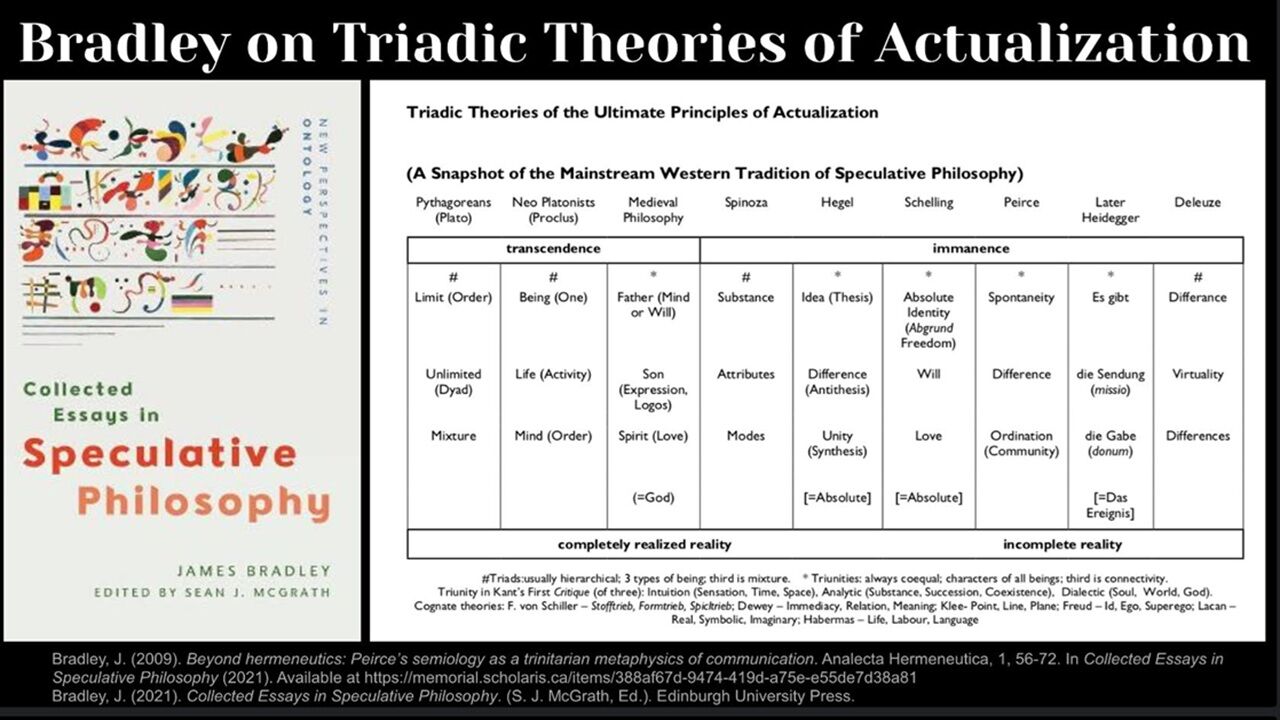
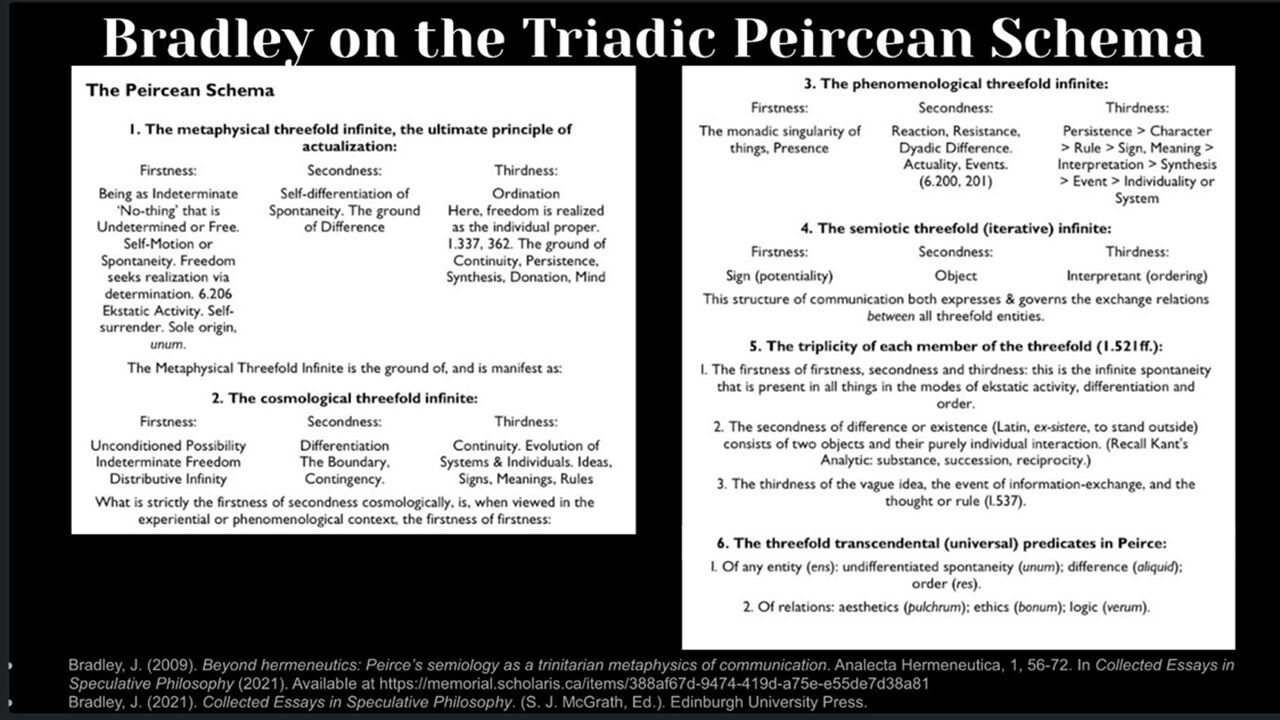
- I’d recommend referring to the images above for more of a schematic overview of broader triadic processes within the philosophical realm, as well as the many iterations of Peirce’s triad of firstness, secondness, and thirdness. Bradley explains Peirces triadic semiotic process by saying, “Within the fundamental speculative triunity of activity, difference and order, or firstness, secondness and thirdness, semiology is an analysis of order or thirdness… Thirdness is analyzed as idea or sign, as the exchange of information between individual entities, and as interpretation; in other words, thirdness is itself a threefold of sign, object and interpretant. Here, sign occupies the position of firstness because it is the potentiality for interpretation; object occupies that of secondness because it is determinate; and the interpretant occupies that of thirdness because the interpretant has the sign-interpreting or sign-ordering role, and so has the status of a third. Thus for Peirce semiology is the analysis of the triune relation of sign, object and interpretant.”
- To unpack that a bit, semiotics involves a triadic process of sign/potential, object/word, and then the mediating interpretant. You can think of the object as a Boolean fixed word that directs the interpretant to a non-Boolean sign, which is an archetypal set of possible meanings. Then the interpretant mediates between the Boolean fixed word and the non-Boolean sign of potentials to discern what the most likely meaning is based upon the situational context as well as the relational context of the unfolding series of previous assigned object-to-sign meanings. Peirce’s semiotics is an ongoing process of meaning making. Humans are very good at making these connections between words and meanings that ultimately results in “understanding,” but the mediation between Boolean and non-Boolean spaces is such that LLMs have a much harder time drawing these relationships between words and deeper meanings. LLMs uncover statistical relationships between words of a huge corpus of data, but it is questionable whether they are understanding the contextual nuances and relational meaning within their inputs and outputs. This gap of understanding remains the core claim of the “Stochastic Parrots” paper.
- Peirce is considered to be a process philosopher because his process of semiosis is conceived as an ongoing and never-ending evolutionary process. It’s processes within processes, and relations within relations all the way down. Peirce’s semiotics has also inspired biosemiotics (more on that from Timothy Eastman down below). Bradley describes this unending semiotic process by saying, “The semiological threefold of sign, object, and interpretant constitutes an endless, infinitely proliferating, iterative semiotic series. The sign is what the object becomes for an interpretant, the interpretant is what the sign becomes, and in turn that interpretant becomes an object for a successor interpretant. Peirce’s semiology is thus a theory of active causation that rejects regularity and entailment theories: signs, objects and interpretants are each agent-causes that have their own spontaneity, and they are genuinely efficacious in that they are active in the production or determination of their effects. The semiological movement of actualization – the immanence of the threefold principle of actualization in all things – is through and through a theory of evolutionary process.”
- “Part VII: Remembering the Human Microcosm in the Age of Mechanized Intelligence: Tensions in the Triad” (2026, June 13) by Matt Segall.
- Segall compares and contrasts the philosophical emergency responses from Hegel, Whitehead, and Ruyer as they each developed their own systematic ideas for resisting the mechanization of the mind. Segall says, “The case against the mechanization of mind does not rest on any one finished metaphysics. To defeat the claim that consciousness is mere machinery, we need not first have settled the quarrel between idealism and realism, nor have decided whether ontological openness is best grounded in Ruyer’s unity of Agent and Ideal or in Whitehead’s distinction between Creativity, God, and the many self-creating occasions. We need only to have provided a clear sense of the inadequacy of the mechanistic picture, which is what all three thinkers, from their divergent vantages, supply. Their very disagreement is instructive: it shows that the country beyond mechanism is wide enough to be contested, that more than one coherent metaphysics can honor what the machine image distorts.
“As we have seen, speculative philosophy is stirred into motion whenever a mutation in our medium of thought furnishes a new analogy between mind and world. Its task is to attend to the analogies at the liminal thresholds where one technological milieu gives way to another, keeping metaphors living and proportional rather than letting them fossilize. Only then can we avoid mistaking the mind for whatever machine now models it.”
- Segall compares and contrasts the philosophical emergency responses from Hegel, Whitehead, and Ruyer as they each developed their own systematic ideas for resisting the mechanization of the mind. Segall says, “The case against the mechanization of mind does not rest on any one finished metaphysics. To defeat the claim that consciousness is mere machinery, we need not first have settled the quarrel between idealism and realism, nor have decided whether ontological openness is best grounded in Ruyer’s unity of Agent and Ideal or in Whitehead’s distinction between Creativity, God, and the many self-creating occasions. We need only to have provided a clear sense of the inadequacy of the mechanistic picture, which is what all three thinkers, from their divergent vantages, supply. Their very disagreement is instructive: it shows that the country beyond mechanism is wide enough to be contested, that more than one coherent metaphysics can honor what the machine image distorts.
- “Folk psychological attributions of consciousness to large language models” (2024) by Clara Colombatto and Stephen M Fleming.
- I was pretty shocked to see that 67% people surveyed in Colombatto & Fleming’s study believed that ChatGPT had at least some varying degrees of phenomenal consciousness. I guess I should not be too shocked considering how much OpenAI and Anthropic use anthropomorphizing language when talking about “AI.” But I completely concur with this line from their conclusion that says, “The relatively high rates of consciousness attributions in this sample are somewhat surprising, given that experts in neuroscience and consciousness science currently estimate that LLMs are highly unlikely to be conscious.”
- Here is a summary of Colombatto & Fleming’s survey results, “Overall, our results reveal that a substantial proportion (67%) of people attribute some possibility of phenomenal consciousness to ChatGPT and believe that most other people would as well. Strikingly, these attributions of consciousness were positively related to usage frequency, such that people who were more familiar with ChatGPT and used it on a more regular basis (whether for assistance with writing, coding, or other activities) were also more likely to attribute some degree of phenomenality to the system.”
- Check out Matt Segall’s much more deflationary take on machine consciousness down below.
- “Part VIII: Remembering the Human Microcosm in the Age of Mechanized Intelligence: The Science of Machine Consciousness” (2026, June 14) by Matt Segall
- Segall is quite skeptical about the possibility of machines having any type of phenomenal consciousness (as am I). In this passage, Segall responds to Overgaard & Kirkeby-Hinrup’s paper titled “A clarification of the conditions under which Large language Models could be conscious,” which creates a 2×2 matrix of either Functional-Computational or Biological-Structural on one axis with Simple or Complex on the other axis. They claim that this is a “theory-neutral mapping of the possibility space for LLM consciousness” that Segall objects to. In their abstract they concede, “At present, there is no objective way of determining whether any given function or action an LLM may perform in fact is associated with consciousness”
- Segall fights back against this type of mechanization of the mind by saying, “Despite claiming to provide a “theory-neutral mapping,” Their restraint conceals a metaphysical commitment latent in the possibility space they assume an answer to the question of LLM consciousness must fall within. They devise a double axis within which an explanation must fall, either in terms of some biological structure or computational function, and requiring an organization that is either simple or complex. Whatever the explanatory ground of consciousness turns out to be, their grid assumes it will be detectable and measurable as some physical arrangement of parts or some functional arrangement of data. This cartography reflects precisely the bifurcation of nature Whitehead spent his philosophical career critiquing. It sunders the world into vacuous matter on one side and the experience that is somehow supposed to be wrung from it on the other. Both axes remain wholly on the physicalist side of the bifurcation, asking, in Ruyer’s terms, which surveyable data or object might produce consciousness, and so neglecting the phenomenological fact that consciousness is always the surveyor and never the surveyed. Neither the biological nor functional option can even begin to frame the question of consciousness’ status as surveyor.“
- The dominant view of naturalists and materialists is that consciousness is emergent from biology, and Segall is quoting panpsychist Ruyer and panexperientialist Whitehead, who see consciousness as being much more fundamental rather than emergent. Henri Bergson posited a Filter Theory of Consciousness, which Aldous Huxley picked up and coined as “Mind-at-Large.” Peter Sjöstedt-Hughes does a great overview of what he calls Bergon’s “exogenous theory of mind that the brain and body receives mentality” in his opening talk at the Mind-at-Large Conference that was titled “Mind-at-Large, Etymology and Cosmology.” Sjöstedt-Hughes goes into more detail in his paper titled “The Bergsonian Metaphysics Behind Huxley’s Doors” (2024)
- Sjöstedt-Hughes says in the abstract, “In other words, Huxley offers via Bergson a view somewhat (but not quite) in line with pantheism and extended-mind theories, one that sees the brain and body as receiving rather than generating consciousness – a top-down and exogenous approach to the mind. Huxley severely simplifies (and slightly misunderstands) Bergson’s metaphysics, so the aim of this text is to rectify and fortify Bergson’s thought in the relevant aspects, thereby offering a more coherent, correct, and comprehensive framework into which we may understand psychedelic experience through a Bergsonian, or Bergsonesque, lens.”
- In his Mind-at-Large conference talk, Sjöstedt-Hughes points to a couple of references from Bergson elaborating on his exogenous theory of mind.
- From pages 272-273 of The Two Sources of Morality and Religion (1935, [1932]) Bergson says, “The body is indeed for us a means of action, but it is also an obstacle to perception. Its role is to perform the appropriate gesture on any and every occasion; for this very reason it must keep consciousness clear both of such memories as would not throw any light on the present situation, together with the perception of objects over which we have no control.’ It is, as you like to take it, a filter or a screen. It maintains in a virtual state anything likely to hamper the action by becoming actual. It helps us to see straight in front of us in the interests of what we have to do; and, on the other hand, it prevents us from looking to right and left for the mere sake of looking. It plucks for us a real psychical life out of the immense field of dreams. In a word, our brain is intended neither to create our mental images nor to treasure them up; it merely limits them, so as to make them effective. It is the organ of attention to life. But this means that there must have been provided, either in the body or in the consciousness limited by the body, some contrivance expressly designed to screen from man’s perception objects which by their nature are beyond the reach of man’s action. If these mechanisms get out of order, the door which they kept shut opens a little way: there enters in something of a “without” which may be a “beyond”.”
- From pages 232-233 of Matter and Memory (1988 [1896]) Bergson says, “Everything will happen as if we allowed to filter through us that action of external things which is real, in order to arrest and retain that which is virtual: this virtual action of things upon our body and of our body upon things is our perception itself. But since the excitations which our body receives from surrounding bodies determine unceasingly, within its substance, nascent reactions – since these internal movements of the cerebral substance thus sketch out at every moment our possible action on things, the state of the brain exactly corresponds to the perception. It is neither its cause, nor its effect, nor in any sense its duplicate: it merely continues it, the perception being our virtual action and the cerebral state our action already begun.”
- Inspired by Bergson, Aldous Huxley termed this filtering theory of consciousness as “Mind-at-Large” or the “Reducing Valve” in The Doors of Perception and Heaven and Hell (1954).
- Huxley says in Doors of Perception, “Reflecting on my experience, I find myself agreeing with the eminent Cambridge philosopher, Dr C. D. Broad, ‘that we should do well to consider much more seriously than we have hitherto been inclined to do the type of theory which Bergson put forward in connexion with memory and sense perception. The suggestion is that the function of the brain and nervous system and sense organs is in the main eliminative and not productive. Each person is at each moment capable of remembering all that has ever happened to him and of perceiving everything that is happening everywhere in the universe. The function of the brain and “nervous system is to protect us from being overwhelmed and confused by this mass of largely useless and irrelevant knowledge, by shutting out most of what we should otherwise perceive or remember at any moment, and leaving only that very small and special selection which is likely to be practically useful.’ According to such a theory, each one of us is potentially Mind at Large. But in so far as we are “animals, our business is at all costs to survive. To make biological survival’ possible, Mind at Large has to be funneled through the reducing valve of the brain and nervous system. What comes out at the other end is a measly trickle of the kind of consciousness which will help us to stay alive on the surface of this particular planet.”
- The idea is that the brain could be seen more like a radio tuner receiving transmissions and eliminating other signals, rather than considered to be the source of the signals. If you search within a radio looking for the source of the signal, then you’ll only discover the equivalent of underlying mechanical parts, but you’ll never find the contents of any radio shows as these are external signals that are being filtered by the machine.
- Segall is extrapolating from these Mind-at-Large ideas to establish the metaphor that “consciousness is always the surveyor and never the surveyed. If you search for traces in consciousness, then you’ll only find the neurological correlate evidence of the surveyed field, but never the surveyor (i.e. consciousness itself).
- Morophogenesis is one of the biological anomalies that Ruyer saw as a paradigm shift away from purely mechanistic perspectives of the mind, which is something that both Michael Levin and Rupert Sheldrake have also focused on. See Segall’s recent dialogue with Michael Levin discussing the fourth version of Levin’s paper “Ingressing Minds: Causal Patterns Beyond Genetics and Environment in Natural, Synthetic, and Hybrid Embodiments” (2026, June 25) as well as with Segall’s dialogue with Sheldrake on From Morphic Resonance to Evolutionary Platonism.
- Segall leverages these biological metaphors to continue to push back against the more mechanistic computational functionalists. He says, “As we have seen, for Ruyer, consciousness is always a “forming activity” or “dynamic activity of unification,” never a mere “juxtaposition of physico-chemical effects able to be imitated by machines.”[20] This does not mean that consciousness is some sort of vital spirit hovering above the surveyable structure or function of physical bodies and invisibly steering them. Hegel, Whitehead, and Ruyer all refuse the residue of subject/object dualism that still tacitly governs mainstream scientific approaches. Ruyer’s favorite example is morphogenesis, in which he discerns an identity between acts of experiential unification and the process of organic growth. An embryo is not an assemblage pieced together by a homunculus hidden in a genetic program, but a self-forming, self-surveying unity, with no line that might be drawn between hardware and software. That the surveying activity of subjectivity and the objective field it surveys are inseparable does not mean either that acts of experiential unification explain morphogenesis, nor that the former can be reduced to the latter. Neural structures and computational functions are both ways of describing the surveyed field, that which is already formed, juxtaposed, and spread out for inspection. Consciousness is the active process of unification that spreads the field out in the first place, never appearing as just another countable unit to be surveyed. To hunt for consciousness in biological structures or informational functions is to comb the surveyed in search of the surveyor. But the forming activity will never be found in the field it forms.”
- It is important to note paradigm-challenging examples like morphogenesis that serve as anomalies to the computational framing, especially considering that and underlying biological substrate may be a prerequisite for consciousness. For a more in-depth survey of cutting-edge and paradigm-shifting evidence away from mechanistic biology that leans upon Whitehead’s theory of concrescence and ingressing minds, then check out Levin’s paper “Ingressing Minds: Causal Patterns Beyond Genetics and Environment in Natural, Synthetic, and Hybrid Embodiments” (2026, June 25).
- Segall is quite skeptical about the possibility of machines having any type of phenomenal consciousness (as am I). In this passage, Segall responds to Overgaard & Kirkeby-Hinrup’s paper titled “A clarification of the conditions under which Large language Models could be conscious,” which creates a 2×2 matrix of either Functional-Computational or Biological-Structural on one axis with Simple or Complex on the other axis. They claim that this is a “theory-neutral mapping of the possibility space for LLM consciousness” that Segall objects to. In their abstract they concede, “At present, there is no objective way of determining whether any given function or action an LLM may perform in fact is associated with consciousness”
- Proponents of speculative concepts like “Artificial General Intelligence (AGI)” or “Artificial Superintelligence (ASI)” collapse the complexity of a human down into a Functionalist, Rationalist, Computationalist, Physicalist series of inputs and outputs. But there may be deeper processes of things like “relevance realization” that are actually non-computable. Matt Segall’s “A Process-Relational Philosophy of Artificial Intelligence” (2025, May 11) gives an overview of the concept (also see episode #1568).
- Segall says, “One of the key insights into the limitations of AI and its implications for human agency comes from recent work in the biology of cognition on “relevance realization.” Jaeger et al. (2024) argue that the ability to realize relevance is observable in all living organisms, from bacteria to humans. However, despite being perfectly natural, organismic relevance realization transcends formalization and so is non-computable. While computational models may partially simulate some aspects of cognition, they can never fully instantiate this core competency of living beings.”
- “Naturalizing relevance realization: why agency and cognition are fundamentally not computational” (2024, June 24) by Johannes Jaeger, Anna Riedl, Alex Djedovic, John Vervaeke, and Denis Walsh.
- Jaeger et al says, “This ability to realize relevance is present in all organisms, from bacteria to humans. It lies at the root of organismic agency, cognition, and consciousness, arising from the particular autopoietic, anticipatory, and adaptive organization of living beings. In this article, we show that the process of relevance realization is beyond formalization. It cannot be captured completely by algorithmic approaches. This implies that organismic agency (and hence cognition as well as consciousness) are at heart not computational in nature. Instead, we show how the process of relevance is realized by an adaptive and emergent triadic dialectic (a trialectic), which manifests as a metabolic and ecological-evolutionary co-constructive dynamic.”
- “Automating the OODA loop in the age of intelligent machines: reaffirming the role of humans in command-and-control decision-making in the digital age” (2022, July 13) by James Johnson
- Johnson says, “This article argues that artificial intelligence (AI) enabled capabilities cannot effectively or reliably compliment (let alone replace) the role of humans in understanding and apprehending the strategic environment to make predictions and judgments that inform strategic decisions… The article re-visits John Boyd’s observation-orientation-decision-action metaphorical decision-making cycle (or “OODA loop”) to advance an epistemological critique of AI-enabled capabilities (especially machine learning approaches) to augment command-and-control decision-making processes. In particular, the article draws insights from Boyd’s emphasis on “orientation” as a schema to elucidate the role of human cognition (perception, emotion, and heuristics) in defense planning in a non-linear world characterized by complexity, novelty, and uncertainty.”
- The “orientation” phase of Boyd’s OODA loop is similar to Alfred North Whitehead’s theory of “concrescence,” which within Whitehead’s event ontology emphasizes non-durational time in the sense that there are many factors from the past including intuition, emotions, memories, and embodied experiences that are synthesized via a prehensive grasping or fusion of the inheritance of the past and established empirical observations (physical pole), an anticipation of the future of possible outcomes (mental pole), taking into account a subjective aim and intention, whilst being able to undergo the non-computational process of Vervaeke’s “relevance realization.” Proponents of “AI” Hype tend to collapse the contextual relevance of the sociological and relational aspects of knowledge production, and reify it into an abstracted quantification of intelligence, which falls prey to Whitehead’s concept of the “fallacy of misplaced concreteness.”
- “Part V: Remembering the Human Microcosm in the Age of Mechanized Intelligence: Whitehead’s Function of Reason and Humanity’s Cosmic Calling” (2026, June 11) by Matt Segall.
- Segall explains how Whitehead’s event ontology and Process-Relational Philosophy goes beyond matter as the fundamental building blocks of reality, but rather it is relational processes described at the quantum layer. He says, “Whitehead’s metaphysical metaphor of “prehensions” as rhythmic vectors generalizes the new physics of transmission into a cosmology of feeling. The world is not composed of inert substances externally related, but of energetic events inheriting, transmitting, and transforming one another. This goes against the grain of classical physics. According to Whitehead, “the dominance of the scalar physical quantity, inertia, in the Newtonian physics obscured the recognition of the truth that all fundamental physical quantities are vector and not scalar.”[2] A scalar registers only magnitude, how much?, while a vector carries direction, which way? Feeling, for Whitehead, is irreducibly vectorial, a felt inheritance that comes from there and reaches toward here. Feelings are meaningful because they express whence and whither, that is, they not only inherit a past but are oriented toward future satisfaction.”
- Just a quick comment here to note that so much of the mathematics behind “AI” and Machine Learning is vector-based, linear algebra. So it’s interesting to hear Whitehead talking about how vectors were more powerful than scalars back in1929. Andrew M. Davis’ book called Whitehead’s Universe: A Prismatic Introduction releasing later this year is one of the best overviews of Whitehead’s Process Philosophy that I’ve read (see episode #1708 for more). He describes how Whitehead’s specialty was mathematical physics and so he held a unique position to bear witness to the dissolution of the Newtonian physics paradigm through Einstein and the dissolution of matter through quantum mechanics revolutions. You can also check out my five previous interviews with process philosophers at here or individually at #965, #1147, #1183, #1568, and #1708.
- Untying the Gordian Knot: Process, Reality, and Context (2020) by Timothy Eastman. This section will cover some of the fundamental ideas of Process Philosophy including the importance of triadic relations, semiosis, biosemiosis, context, and the difference between The non-Boolean Logic of possibilities versus the Boolean Logic of actualities. The process-relational metaphysics of Alfred North Whitehead has a lot of overlaps with Peircean semiotics, and so it will be instructive to take a moment to dig into some of the underlying process-relational conceptual scaffolding.
- Eastman is a former NASA plasma physicist turned process philosopher, and his book is an absolutely incredible synthesis of all of the latest scientific advancements since Whitehead’s magnum opus Process & Reality (1929, 1978). His Untying the Gordian Knot book is a boundless source of references to cutting-edge science and the frontiers of process-relational thinking.
- Eastman also emphasizes that the triadic relationship of input-output-context goes all the way down into the deepest core of the nature of quantum realities, but also is an antidote to reductionistic dyads. My biggest critique about “AI” is that it tends to collapse contextual dimensions into dyadic binaries that fit into the computational metaphors of the mind that make it easy to equate “AI” with humans. Eastman says, “Real-world interactions always involve context, and some local-contextual framing inevitably occurs. Whereas scientific description and approximations very often strip away context and so enable discrete measurement results and simple input-output pairings (dyads), real-world interactions always require triads, cycles of input-output-context, or, at least, some inevitable reference to a third. Limiting any given analysis to only standard pairings or dyads necessarily involves some degree of approximation; likewise any measurement necessarily involves error, thus requiring error estimates in any full analysis. Thus, both some forms of approximation and triadic logic are necessary for understanding the complex whole of the real world.”
- Eastman talks about how biosemiotics is a radical fusion of process-relational approaches. He says, “The fields of biology, philosophy, and semiotics are integrated in the burgeoning discipline of biosemiotics which, according to an Oxford dictionary, is “the study of signs, of communication, and of information in living organisms” (Cammack et al. 2006, 72), an international scholarly activity (biosemiotics.org). As noted above, the triadic logic of fundamental process can be simply expressed as “input-output-context”; in quantum physics, the triadic form can be expressed as “input-output-environment.” Immediate human experience, quantum physics, ecology, and current complex systems studies all build on such fundamental triadic logic although, for certain applications, approximations based on dyadic logic can be efficient and practical, yet not philosophically fundamental.”
- Eastman continues by saying, “Søren Brier points out that “no facts are absolutely free of context. The important thing is to discuss them, to compare them, to calibrate them according to standards determined by our dealings with other facts, while consciously reflecting on the significance of the context” (Brier 2013, 8–9). Such triadic logic is a key part of the Logoi framework along with process, potentiae, and local-global relations. Brier emphasizes the observer’s role as follows:
- Eastman quotes Brier as saying, “The information processing paradigm will never succeed in describing the central problems of mediating the semantic content of a message from producer to user because it does not address the social and phenomenological aspects of cognition. Furthermore, it will fail because it is built on a rationalistic epistemology and a mechanistic world view with an unrealistic “world formula” attitude towards science. Science can deal only with the decidable [i.e., facts or Boolean actualizations], and as Gödel has shown, there are undecidables even within mathematics. The problem for the now-classical functionalistic information processing paradigm is its inability to encompass the role of the observer. (Brier 2013, 83)“
- Eastman elaborates on the philosophical predecessor of Peirce’s triadic semiotics with a quote from John Deely’s Four Ages of Understanding: The First Postmodern Survey of Philosophy from Ancient Times to the Turn of the Twenty-First Century (2001).
- Eastman quotes Deely saying, “This contemporary notion of sign, thus, understands that what it signifes as properly consisting in an irreducibly triadic relation… In modern times, after Descartes (1596–1650), the hard-won Latin notion of sign [John Poinsot, Tractatus de Signis, 1632] in general disappears, to be replaced by the notion of ideas as self-representing objects, until the Latin notion is taken up again in the writings of Charles Sanders Peirce (1839–1914) under the banner of “semiotics.” Peirce brings an end to the notion of idea as objects being the fundamental presupposition of philosophy and initiates a new way of philosophizing, “pragmaticism,” or the way of signs. (Deely 2001, 740)”
- Speculative philosophy is another term for aspects of Process Philosophy as it gives equal weight to the realm of possibilities (non-Boolean Logic) and the realm of actualities (Boolean Logic) as they “mutually implicate” each other.
- See Ruth Kastner, Stuart Kauffman, Michael Epperson’s “Taking Heisenberg’s Potentia Seriously” (2018) that says, “Rather, res potentia [possibilities] and res extensa [actualities] are understood as mutually implicative ontological extants that serve to explain the key conceptual challenges of quantum theory.”
- Note that they’re not mutually exclusive, but rather “mutually implicative” in the sense that as Kastner et al. say “neither can be coherently defined without reference to the other.” Rather than create a dualism between the mind and body, then the mind and body define each other as being mutually implicative. For Whitehead, the “mental pole” ingresses into the “physical pole” in an unfolding process. You can’t have actualities without possibilities, and you can’t have possibilities without actualities.
- A lot of Machine Learning researchers have a bias towards Functionalism and Naturalism, which collapses our interiority into measurable behaviors. Eastman points out the downsides of Naturalism by quoting Arran Gare, who claims that Naturalism attempts to “dissolve philosophy into apologetics for mainstream science.” Gare is a speculative naturalist, and Eastman says, “In my diverse readings of semiotics, process thought and speculative (systematic) philosophy, including many natural philosophers and scientists, I find many overlaps and complementary arguments. Gare, in particular, brings these perspectives together in his latest work The Philosophical Foundations of Ecological Civilization.
- Eastman quotes Gare from his 2017 book. Gare says, “The goal of speculative philosophy is to take into account the whole range of human experience — scientific, social, ethical, aesthetic and religious, and to develop a coherent conception of reality that does justice to all of these. In contrast to the naturalism of analytic philosophers, speculative naturalism not only affirms the ambitions of philosophy in the grand manner against any tendency to dissolve philosophy into apologetics for mainstream science; it has provided the basis for overcoming the deficiencies of mainstream science, and along with it, the Hobbesian conception of humans. Schelling’s work exemplified this quest. (Gare 2017, 161)”
- The Philosophy of Mathematics has also informed my views on Naturalism. Michèle Friend does a sweeping survey of the various philosophy of math branches in her Pluralism in Mathematics: A New Position in Philosophy of Mathematics (2014).
- Friend unpacks how Naturalists approach math by creating a weird hierarchy where applied math is ontologically more valid and important than pure math. Friend says, “In the first sections, I discuss naturalism with reference to Quine and Maddy. Naturalists are wary of a priori metaphysics and theories which cannot be tested against the natural world. They understand ‘science’ to include physics, chemistry and biology as canonical examples. Traditionally, Quinean naturalists have had notorious difficulty explaining the place of pure mathematics. Is it a priori metaphysics or science? Quine’s solution is to make ontological commitments to only the part of mathematics that is indispensable to science. For many pure mathematicians this is unacceptable. This is because Quine’s position gives second place to pure mathematics against applied mathematics and science, and, from the mathematician’s point of view, this makes little sense.”
- This Mathematical Naturalist tendency collapse of the non-Boolean Platonic realm of possibilities / pure math into the Boolean realm of actualities / applied math fits with Machine Learning computational functionalist desire to collapse non-Boolean aspects of consciousness, meaning, and understanding into measurable and quantifiable Boolean functions.
- This video does a great job of describing Godel’s Incompleteness, which is essentially a discovery that a formal system can either be consistent or complete, but not both. Most systems opt for consistency in favor of incompleteness, which means that you need an assemblage of incomplete systems to strive closer towards completeness, but Gödel’s Incompleteness shows that you can never achieve both.
- Hans Primas also provides a succinct summary of Gödel’s Incompleteness in his Knowledge and Time. It’s one of the most radical results in the history of Logic, and has a ton of philosophical implications on the limits of formal systems and the limits for any one system to attempt to encompass everything, like believers of “AGI” and “ASI” aspire to do. Primas says, “In 1931 Kurt Gödel (1931) proved that the program Hilbert had conceived for proving the consistency of mathematics cannot be successfully accomplished. Gödel’s first theorem states that in any consistent formalization of mathematics that is sufficiently strong to axiomatize the natural numbers one can construct a true statement that can be neither proved nor disproved within that system itself. Gödel’s second incompleteness theorem states that no consistent system can be used to prove its own consistency. [66] It is impossible to use the axioms of mathematics to prove that any axiomatic system would never lead to contradictions.”
- Friend took these underlying Gödel’s Incompleteness limitations of formal systems, and applied them to the foundations of mathematics itself. She concludes that math will likely never discover a singular set of axioms to describe all of math. Rather, she argues for a radical pluralism that’s stitched together with paraconsistency. She says, “The pluralist in foundations believes that there is insufficient evidence to think that there is a unique foundation for mathematics. Moreover, the pluralist in foundations works under the assumption that there is no reason to think that there will be a convergence to a unique theory in the future. He takes seriously the possibility that there are several, together inconsistent, foundations for mathematics.”
- The fact that Michèle Friend doesn’t believe that mathematics will ever have a singular and unique set of foundations is the same reason why I am skeptical about assertions of “AGI” or “ASI.” I don’t think that people who believe in “AGI” or “ASI” have fully reckoned with the philosophical implications of Gödel’s Incompleteness. There are many ways that “AI” is working against pluralism in the sense that it’s creating a homogenous culture by flattening the situated knowledges as it collapses all viewpoints into a single “View from Nowhere” context. More on the anti-dote to this imaginary “view from nowhere” can been seen in Haraway’s situated knowledges down below.
- I tend to lean more towards the belief that math objects are discovered rather than invented, which means I much prefer Platonism in the Philosophy of Mathematics rather than Nominalism. However, I also open the possibility that there may be a both/and happening in a mysterious and as of yet unknown relational process between humans and math objects. Whitehead’s metaphysics affords for “eternal objects,” which would essentially be these non-spatiotemporal forms in an ideal realm. But for Whitehead, he resolved the mind/body dualism by turning it into a process that goes from the “mental pole” of possibilities to the “physical pole” of actualities. It’s instructive to see how Whitehead fuses together aspects of Idealism and Materialism into an unfolding process.
- Matt Segall described to me in episode #1183 (2023, March 9) how Whitehead resolves the infamous mind/body dualism by adding the time domain, “One way of looking at what Whitehead does is wherever he finds dualisms that are getting at some distinction between the two aspects that are being split, he transforms them into polarities. So in Descartes, you have a dualism between mind and matter as these two very different substances. You end up with this problem of how to relate the two. Obviously, mind and matter must be related and Descartes struggled to figure out how that would be possible. So, this is where you get these different modern schools of thought stemming from Descartes’ dualism. You have idealists who say, “Okay, well, the mental substance, that’s the real thing. And matter is just an appearance and we can reduce it away. It’s just a representation in the mind.” And then you have the materialists who say, “Well no, matter is what’s real and mind is merely an appearance. And so we’ll just describe everything in terms of bodies colliding and minds epiphenomenal and we’ll just reduce it away.” Neither of these perspectives work. And so what Whitehead wants to say is that maybe we can think of mind and matter or the physical and the mental as phases in a process. That what it means to be real, to be an actual entity, is always going to be some combination of or synthesis of a mental and a physical aspect, or a physical and a mental pole, right? So he’s thinking in terms of polarities, and so rather than separate substances, when we try to get at this distinction between the physical and the mental, we have to temporalize it, put it into process. So when we talk about the physical or material in Whitehead’s cosmology, we’re really talking about what’s already been actualized in the past. It’s that aspect of the universe that has accumulated and taken on this habitual form that’s kind of given. And we inherit that givenness in each moment of our experience in the physical pole. The mental pole then is everything that hasn’t yet occurred. It’s the possibilities that we anticipate that are relevant to what has already occurred. And so the process of becoming actual, which is another way of describing what concrescence is, is this synthesis, this integration of the physical pole inheriting the actualized past and the mental pole in light of that past anticipating possible futures. And so you don’t eliminate the difference between mind and matter, but you articulate what is different in a way that still allows for some form of relationship.”
- Whitehead’s “mental pole” can be thought of as the non-Boolean space of possibilities that is analogous to the quantum realm, and the “physical pole” can be thought of as the Boolean space of actualities that is analogous to the physical realm. Michael Epperson and Elias Zafiris have applied Whitehead’s Process Philosophy to quantum ontology to develop their Relational Realism interpretation of quantum mechanics within their book “Foundations of Relational Realism: A topological approach to quantum mechanics and the philosophy of nature” (2013).
- Eastman sees a lot of overlap with Epperson and Zafiris’ “Relational Realism” model and his own Logoi Framework. He does an excellent job at describing how the underlying building blocks of reality look more like processes and relationships than substance. He points to category theory as an algebra of relations that can handle relations of relations whilst set theory is more object-oriented and incapable of adequately describing the quantum realm. Eastman provides a comprehensive mathematical and metaphysical grounding for process-relational philosophy in this passage by saying, “By applying recent developments in mathematical category theory to quantum physics, in ways complementary to Primas’s focus on algebraic quantum theory, the Relational Reality model shows how to correlate these two logical orders, Boolean and non-Boolean or, equivalently, the logic of actualizations and the logic of potentiae. A key starting point is the recently achieved recognition that quantum physics exemplifies the fact that physical extensiveness (viz., the grounding for standard space-time description) is fundamentally topological rather than metrical, with its proper logico-mathematical framework being category-theoretic rather than set-theoretic. By this thesis, as Epperson and Zafiris argue (2013, 64–65), extensiveness fundamentally entails not only relations of objects, but also relations of relations; thus fundamental quanta are properly defined as “units of logico-physical relation” rather than merely “units of physical relata,” the latter being presumed as exclusive by both materialism and the broader presupposition of actualism. Objects are, in this way, always understood as relata, and likewise relations are always understood objectively. Objects and relations, in other words, are coherently defined as mutually implicative. This approach coheres well with contemporary research in semiotics (see chapter 5), and with John Deely’s treatment of “things” and real processes (not mind dependent) in addition to objects (as mind-dependent entities) (Deely 2009).”
- If the nature of reality is actually more like processes and relationships rather than material substance, then Epperson and Zafiris describe how physical objects are actually contextually related to quantum processes, which provides a metaphysical grounding for “context” itself. They say, “The central thesis of the relational realist speculative philosophical program introduced in this volume is that the classical, conventional conception of the relationship between [a] ‘physical object’ as ontological extant, and [b] ‘history of facts’ as epistemic construct by which physical objects are characterized, must be reversed if quantum mechanics is to be coherently understood as an ontologically significant theory. That is, the classical conception of a history as essentially contextual and therefore primarily epistemic — a particular story expressing particular knowledge of fundamental physical objects — must be reconceived, such that physical objects are not merely understood by their fundamental histories, but rather understood as fundamental histories of quantum events. This requires a novel reconceptualization of ‘ontological’ and ‘contextual’ as mutually implicative features of every quantum event, wherein the latter is understood as the fundamental, concrete constituent by which the natural world is physically and logically describable.”
- Again, Kastner, Kauffman, Epperson’s “Taking Heisenberg’s Potentia Seriously” (2018) says that “res potentia and res extensa are understood as mutually implicative ontological extants,” This means that the non-Boolean possibility space / quantum realm of res potentia and the Boolean actuality space / physical reality of res extensa are not only both equally ontologically-valid and “real,” but they are actually “mutually implicative” of each other in that “neither can be coherently defined without reference to the other.” Possibilities and Actualities are two sides of the same coin that can be conceived as an unfolding process with the “mental pole” of possibilities ingressing into the “physical pole” of actualities. Physical objects should be reconceptualized as part of a larger unfolding process where they can be contextually traced back to a quantum event since it’s processes and relationships all the way down from the possibility space of the quantum realm to the actualized space of physical reality. You can not reconstruct the diploar nature of reality with matter alone, and so substance metaphysics needs to be abandoned in favor of process-relational metaphysics.
- Eastman also provides insight for how local-global relationships in quantum realities and beyond emphasize the role of context. He says, “This local-global interplay provides a central hypothesis of the Logoi framework in which the combination of the two fundamental logical orders, the logic of actualization (Boolean) and the logic of potentiae (non-Boolean), correlated with facts/actualizations, and possible relations, respectively, along with the bidirectional, mutually implicative character of local-global relationships, provides a deep grounding for considering all input-output relationships as always in a context.”
- Eastman also points towards a pathway for understanding consciousness within the context of a nested set of processes undergoing semiotic processes. He says, “Combining such local-global connectedness with biosemiotics (accounting for enhanced information and dynamical depth, see Koutroufnis 2014) enables multilevel frameworks of increasing semiotic complexity with values and meaning (arising from multiple levels of context), and ultimately consciousness, language, and spiritual awareness (enabling enhanced access to potentiae and anticipatory capabilities).“
- Process Philosophy is such a robust and coherent metaphysical system, and Eastman does an excellent job more fully contextualizing all of the latest breakthroughs and process-relational thinking in mainstream science. I suspect that “Artificial Intelligence” will continue to reflect the underlying process-relational nature of reality, and that these process philosophers will be uniquely suited to chip in their nuanced and relational perspectives upon these major philosophical debates. Brier’s point that “no facts exist independent of context” is an antidote to hyperbolic claims about Artificial General Intelligence and Artificial Super Intelligence. Computational functionalists like to collapse these contextual dimensions whenever speaking about “AGI” and “ASI.” Where did the data come from to train “AI” in the first place? Humans! It’s this inconvenient fact that proponents of “AI” Hype will pull whenever they cite benchmarks that show how machine intelligence has surpassed humans in all of these various domains. But the production of knowledge is a sociological and technical process that has been completely collapsed within their quest to quantify intelligence into a single number and dyadic relationship. More insights into the role of context can be seen down below from various sociologists and anthropologists.
- The Cultural Life of Machine Learning: An Incursion into Critical AI Studies (2021) by Jonathan Roberge & Michael Castelle
- Roberge and Castelle argue that ML/AI should be seen as a “coproduction requiring the interaction of social and technical processes.” They say, “In this, we find ourselves in line with scholars like Sloane and Moss (2019) who have recently argued, for an audience of AI practitioners, that it is necessary to overcome “AI’s social science deficit” by “leveraging qualitative ways of knowing the sociotechnical world.” Such a stance justifies the value of historical, theoretical, and political research at both an epistemological level of how AI/ML comes to produce and justify knowledge, and at an ontological level of understanding the essence of these technologies and how we can come to coexist with them in everyday practice. But to do so requires an epistemic step that ML practitioners have not fully accepted themselves, namely, to insist on a definition of ML/AI as a “coproduction requiring the interaction of social and technical processes” (Holton & Boyd, 2019, p. 2).”
- Proponents of “AI” Hype tend to diminish the social sciences as well as collapse the relational and contextual dimensions of knowledge production, which ultimately eliminate many dimensions of humanity. There are many sophisticated theories about the relationship between humans and technology that technologists tend to completely ignore when making their hyperbolic claims.
- Here’s a passage from Roberge & Castelle’s book advocating various theories from the social sciences that give more nuance to what we typically hear, “There are, of course, many theoretical traditions within which relationships between technology and society can be understood. These range from political economy, through social studies of science, actor-network theory, the study of material culture, and the cultural anthropology of technology, to post-human approaches and ideas of human– machine hybridity (for a selection of this range of approaches see McKenzie and Wacjman, 1999). Critical comparison of the distinct contributions of all these traditions is well beyond the scope of this article. We focus instead on a socio-technical perspective, drawing on work by Latour, Suchman and Hayles. AI, in this perspective, is a coproduction requiring the interaction of social and technical processes. The over-arching argument in this article is that human agency occupies an uncertain and sometimes obscure position within much theoretical analysis. The recovery of some sense of the distinctiveness of human agency is, however, crucial in view of the challenges of AI to democracy, citizenship, and the social regulation of technology.”
- Roberge & Castelle highlight the degree to which Machine Learning practitioners chronically do not understand the full implications of context. They say, “ML practitioners, in general, tend to have a limited sense of what “context” is, in contrast to the term’s use by anthropologists to indicate how the sociocultural situations in which communicative utterances occur affect and transform their meaning. For ML, this insatiable effort to calculate meaning by relentlessly making so-called context out of co-text (Lyons, 1995, p. 271), however, tends to open the door to existing processes of commensuration (Espeland & Stevens, 1998), and does not tend to any increased reflexivity on behalf of its researchers and developers about the nature of communication, meaning, and even learning. Social scientists and philosophers — especially those concerned with hermeneutics, as we will describe below — will recognize the epistemological and ontological issues in the predominance of such a myopic worldview.“
- In a section called “Context Matters” in their introduction, Roberge & Castelle say, “Earlier in this introduction, we argued that machine learning is never truly devoid of meanings. To interpret and perform, to categorize and implement, is how ML technology finds a place in this world, its situations, and its contexts. As Seaver (2015) notes, “the nice thing about context is that everyone has it.” More interesting, however, would be to follow his lead further and consider that the “controversy lies in determining what context is.” This is what is finally at stake for ML, namely, the (in)capability to make sense of the fact that context always matters.”
- Roberge & Castelle point out that Gary Marcus’ complaints about machine learning often come down to a collapse of context. They say, “Marcus’ complaint that deep learning has no way of handling compositional thought processes and no way to incorporate and depend on background knowledge is effectively a cognitivist’s way of saying that these models do not handle context. Tacit understanding, collective representation, and symbolic interaction remain of the utmost importance in social reality despite being ignored for most of the history of ML development.”
- “The nice thing about context is that everyone has it” (2015) by Nick Seaver.
- Seaver wrestles with the paradoxical experience of recognizing the importance of context whilst reckoning with the impossibility of pinning it down. Seaver says, “the importance of context is uncontroversial; the controversy lies in determining what context is.”
- Seaver does a survey of conceptual frameworks for context across various different contextual domains. “In their ‘Critical Questions for Big Data’, danah boyd and Kate Crawford (2012) provoke: ‘Taken out of context, Big Data loses its meaning’ (p. 9). They argue that, through aggregation and mathematical modeling, big data analytics tend to strip data of their contexts. How should we square this provocation with the ‘contextual revolution’ in recommender systems, which has seen big data practitioners fixate on context’s significance? Through the rest of this essay, I investigate possible answers to this question, all of which turn on the question of how ‘context’ is defined and interpreted. To understand how context can be simultaneously missing from data science and central to it, we’ll need to put ‘context’ in context.
“The idea that meaning crucially depends on context is shared across a wide range of academic disciplines. In analytic philosophy, Gottlob Frege (1980 [1884]) directs us ‘never to ask for the meaning of a word in isolation, but only in the context of a proposition’ (p. xxii). In cultural studies, Ien Ang (1996) argues for ‘radical contextualism’, or ‘the impossibility of determining any social or textual meaning outside of the complex situation in which it is produced’ (p. 61). We can find more arguments for context’s importance in ethology (Von Uexküll, 1957 [1934]), linguistic pragmatics (Grice, 1989; see Morgan, 1977), feminist philosophy of science (Haraway, 1988; Harding, 1986), the sociology of science (Bloor, 1976), and epigenetics (Morgan et al., 1999).
“The injunction to consider context is perhaps nowhere more central than in anthropology, where placing practices, beliefs, and language in context has long been a primary disciplinary mission…
“The centrality of context to anthropology found new, extremely popular expression in Clifford Geertz’s (1973) argument for ‘thick description’. He borrowed the terminology from the philosopher Gilbert Ryle to name descriptions that took sociocultural context into account as opposed to ‘thin descriptions’ that did not. Under the sign of Geertz, thick description and the placing of things into context remains a guiding principle of ethnographic work across disciplines, and the rise of ‘context’ as a matter of concern in domains like media studies and science and technology studies has been accompanied by a turn to ethnographic methods for apprehending it (Schlecker and Hirsch, 2001). Surveying this work, we might expand on boyd and Crawford’s provocation to say: Taken out of context, everything loses its meaning.”
- Philosopher Helen Nissenbaum’s Contextual Integrity Theory of Privacy also emphasizes the role of context in the expressions of identity and privacy. See my interview with Nissenbaum in episode #998.
- Nissenbaum defines contexts on page 130 of her book, Privacy in Context: Technology, Policy, and the Integrity of Social Life (2009) by saying, “By contexts, I mean structured social settings with characteristics that have evolved over time (sometimes long periods of time) and are subject to a host of causes and contingencies of purpose, place, culture, historical accident, and more.”
- In a lecture on Contextual Integrity (2021, March 5), Nissenbaum showed a slide that describes contexts as “differentiated social spheres defined by important purposes, goals, and values, characterized by distinctive ontologies, roles, and practices, E.g. healthcare, education, family; and norms, including informational norms – implicit or explicit rules of info flow.” She adds at the end of her slide “Please don’t ask me to define contexts!” Note that even within the context of Nissembaum’s Contextual Theory of Privacy, pinning down a strict definition of context is extremely difficult.
- NOTE: From a Process-Relational Philosophy perspective, processes and relationships (i.e. contexts) are the underlying nature of reality itself. It’s literally processes and relationships all the way down. From this perspective, coming up with a comprehensive Philosophy of Context may have some key pointers from Whitehead’s Process Philosophy, Peirce’s Semiotics, Eastman’s Logoi Framework, Epperson and Zafiris’ Relational Realism, Category Theory as an Algebra of Relations, Primas’ Partial Boolean Algebras and the distinctions between Boolean and Non-Boolean spaces, as well as Kastner’s Transactional Interpretation of Quantum Mechanics. These all help provide some underlying Process-Philosophical and Semiotic Frameworks that treats context as an unfolding and relational process.
- Just to briefly explain and demonstrate the utility of Nissenbaum’s Contextual Integrity Theory of Privacy, she emphasizes that privacy comes down to appropriate flows of information. When you’re in the context of a doctor’s office, then you share intimate medical information with your doctor. When you’re speaking with your financial advisor, then you share intimate information about your finances. These are appropriate flows of information given the context. You wouldn’t share the nuances of your health conditions to your financial advisor, just as you wouldn’t share the specifics of your financial status to your doctor as these would not be appropriate flows. So the contours of contextual domains can be interrogated by investigating thresholds of personally-identifiable information and other data that we generally consider to be private, and are usually only shared in context-dependent situations.
- The impossible task of clearly defining a generalizable framework for context is directly connected to the difficulties in formulating a comprehensive Philosophy of Privacy. I proposed an archetypal approach to defining contexts in order to demonstrate how contextually-aware “AI” violates Nissenbaum’s Contextual Integrity Theory of Privacy. See my paper on “Privacy Pitfalls of Contextually-Aware AI: Sensemaking Frameworks for Context and XR Data Qualities” (2024, October 24) that was published as a part of the Stanford CyberPolicy Center’s Existing Law and Extended Reality: An Edited Volume of the 2023 Symposium Proceedings
- Contextually-Aware “AI” is a terrible idea from a privacy perspective, and I wrote a paper for the Existing Law and Extended Reality Symposium that was held in 2023. Here’s the abstract for my paper, “Existing privacy laws worldwide are ill-prepared to deal with the invasive types of inferences made using data from Extended Reality (XR) technologies, specifically Virtual Reality (VR) and Augmented Reality (AR) headsets. For XR devices to properly function, they need access to new types of physiological, environmental, emotional, social, cognitive, and behavioral data. Access to this data yields many real-time experiential benefits for the users. Still, that same data also serves surveillance capitalism interests by deriving psychographic inferences about our context-specific likes, dislikes, character traits, personality, and identity in what Brittan Heller has termed as “biometric psychography.” Additionally, the company Meta is also laying the groundwork for an omnipresent AI surveillance system that tracks the context of XR users in what they call “contextually-aware AI,” which fundamentally challenges Helen Nissenbaum’s contextual integrity theory of privacy wherein the appropriate flow of information depends on the context. These unprecedented technologies drive an urgent need for policymakers and XR technology developers to develop a deeper theoretical understanding of the relational dynamics between context and privacy as well as between context and identity. In this paper, we will examine how an archetypal taxonomy of context can create a map to navigate how to preserve contextual integrity, how experiential design and theories of presence can help make sense of the phenomenological nature of XR data, and how human rights approaches of Neuro-Rights and cognitive liberty can create safeguards for XR data to live into the more exalted potentials of XR.”
- Here’s a passage from my paper that elaborates on how contextually-aware “AI” violates Nissenbaum’s contextual integrity, “One major problem with Meta’s proposed omnipresent, contextually-aware AI surveillance system is that it has no robust way of tracking these subtle contextual and relational shifts to understand what is an appropriate flow and what is not. It is intended to be an always-on, omnipresent system that’s potentially monitoring and/or recording all of our interactions with the physical world across all contexts, who we are speaking with, what was said by whom and when, as well as our non-verbal interactions, and a forecasting model to predict subsequent behavioral actions across any context.”
- There’s a quote that a participant said in a workshop about “AI” Ethics during IDFA DocLab’s’ R&D Summit that is really sticking with me. It’s the idea that we are living in an age where the lines between what’s authentically a human versus what’s synthetically a machine are getting blurred. It may drive humans to object to the impossible-to-achieve, neutrally-objective, “View from Nowhere” perspective of LLMs and “AI” to desire signifiers from people about how they’re situated within their own beliefs and subjectivity.
- This led one participant to speculate how the subjectivity and situated knowledges of human authorship will be valued more and more in the future. They said, “I suspect the role of the author is going to be even more important. Do I trust the author? Who is this person telling you this story? And what do I know about the storyteller? Is this somebody who’s leaning heavily in the direction of the tech bros? Or is this somebody who’s a conspiracy theorist? Where are they leaning on the political spectrum, especially with documentaries? That subjective perspective of “Who is the storyteller?” comes into play. And I think people’s awareness is already rising.” The crux of this observation points is the concept of “situated knowledges” by feminist philosopher Donna Haraway, which is a key foundation to standpoint theory and feminist epistemology.
- “Situated Knowledges: The Science Question in Feminism and the Privilege of Partial Perspective” (1988) by Donna Haraway.
- Philosopher Donna Haraway’s concept of “situated knowledges” emphasizes the importance of the embodied experience situated within a particular location and on a spectrum of power. She argues against striving for a disembodied, scientific objectification and rationalism that invokes Thomas Nagel’s The View from Nowhere (1989). She writes in her paper, “I would like to proceed by placing metaphorical reliance on a much maligned sensory system in feminist discourse: vision. Vision can be good for avoiding binary oppositions. I would like to insist on the embodied nature of all vision and so reclaim the sensory system that has been used to signify a leap out of the marked body and into a conquering gaze from nowhere. This is the gaze that mythically inscribes all the marked bodies, that makes the unmarked category claim the power to see and not be seen, to represent while escaping representation. This gaze signifies the unmarked positions of Man and White, one of the many nasty tones of the word “objectivity” to feminist ears in scientific and technological, late-industrial, militarized, racist, and male-dominant societies, that is, here, in the belly of the monster, in the United States in the late 1980s. I would like a doctrine of embodied objectivity that accommodates paradoxical and critical feminist science projects: Feminist objectivity means quite simply situated knowledge…
“The moral is simple: only partial perspective promises objective vision. All Western cultural narratives about objectivity are allegories of the ideologies governing the relations of what we call mind and body, distance and responsibility. Feminist objectivity is about limited location and situated knowledge, not about transcendence and splitting of subject and object. It allows us to become answerable for what we learn how to see...
“I am arguing for politics and epistemologies of location, positioning, and situating, where partiality and not universality is the condition of being heard to make rational knowledge claims. These are claims on people’s lives. I am arguing for the view from a body, always a complex, contradictory, structuring, and structured body, versus the view from above, from nowhere, from simplicity…” - The concept of “situated knowledges” emphasizes how all knowledge is situated within a particular context, specifically an embodied context. The promise of “AI” is to achieve this perfectly neutral, objective, and rational ideal that is somehow superior and greater than any individual human, and with speculative “superintelligence” being greater than the total of all of humanity. Haraway’s feminist epistemology of “situated knowledges” challenges whether or not “AGI” or “ASI” would even be philosophically possible, let alone desirable.
- In my write-up of the IDFA DocLab Think Tank Summit 2025, I elaborated on how LLMs aspire to this type of imaginary “View from Nowhere” while claiming to not have a standpoint. I said, “Again, by default, LLMs collapse all of the nuance and complexity of having an embodied perspective or a worldview. LLMs suck in all of the data from the Internet and beyond, but, when they do, they destroy the contextual integrity of who said what and why. All of the emotions, values, desires, motivations, relationships, worldviews, beliefs, attitudes, and embodied experiences are gone. The semiotic transmission of meaning is flattened into artifacts of words that approximate meaning, luring us to chase the ghosts of meaning like modern day Don Quixotes. Our minds fill in the gaps of meaning through the statistical combination of words, but LLMs are spitting out a view from nowhere.”
- Philosopher Donna Haraway’s concept of “situated knowledges” emphasizes the importance of the embodied experience situated within a particular location and on a spectrum of power. She argues against striving for a disembodied, scientific objectification and rationalism that invokes Thomas Nagel’s The View from Nowhere (1989). She writes in her paper, “I would like to proceed by placing metaphorical reliance on a much maligned sensory system in feminist discourse: vision. Vision can be good for avoiding binary oppositions. I would like to insist on the embodied nature of all vision and so reclaim the sensory system that has been used to signify a leap out of the marked body and into a conquering gaze from nowhere. This is the gaze that mythically inscribes all the marked bodies, that makes the unmarked category claim the power to see and not be seen, to represent while escaping representation. This gaze signifies the unmarked positions of Man and White, one of the many nasty tones of the word “objectivity” to feminist ears in scientific and technological, late-industrial, militarized, racist, and male-dominant societies, that is, here, in the belly of the monster, in the United States in the late 1980s. I would like a doctrine of embodied objectivity that accommodates paradoxical and critical feminist science projects: Feminist objectivity means quite simply situated knowledge…
- I suspect that it is very likely that all of “intelligence” is highly situated, embodied, tightly coupled to contexts, perhaps it is shaped by values, worldviews, beliefs, but also potentially a fundamentally relational and dynamic process of semiosis. The aspirations for “Artificial General Intelligence” and “Artificial Superintelligence” may turn out to be philosophically impossible given Gödel’s Incompleteness and Haraway’s situated knowledges, and the gaps of meaning and understanding that already exist in current systems. See more below about the non-computational dimensions of relevance realization.
- Coming back to Bender and Hanna’s The AI Con, they dig into the importance of a standpoint perspective when looking at feminist anthropologists who unpack the aspirations of “AI” companies to disrupt science. They point to the paper titled “Artificial intelligence and illusions of understanding in scientific research” (2024, March 6) by Lisa Messeri and M. J. Crockett.
- Bender and Hanna say in The AI Con that “Social scientists Lisa Messeri and M. J. Crockett surveyed recent scientific papers across fields that referred to artificial intelligence, machine learning, or large language models, and derived a taxonomy of visions of how AI might contribute to science. The tools dreamt up by these scientists are imagined to be better than human scientists, in many ways: summarizing and synthesizing more preceding work, answering surveys tirelessly, producing analyses based on more data and with more sophistication, and performing peer reviews of the work of others dispassionately and without bias.
“Messeri and Crockett point out that, quite apart from whether any of this is possible, it is actually harmful to the process of doing science: the allure and prestige of AI raise the risk of narrowing fields of inquiry to those questions which can be approached with these tools. At the same time, the imagined tools represent the epitome of a view from nowhere, or the idea that one can have objective knowledge of a set of truths, uncolored by their personal experience. At this historical moment where science is finally starting to grapple with the idea that the standpoint of the scientist matters, we should rather build diverse communities of knowers.” - Messeri and Crockett push back on aspirations of neutrality and objectivity as being unavoidably shaped and influenced by a situated and embodied standpoint. Quoting directly from their “Artificial intelligence and illusions of understanding in scientific research” paper, they say, “Objectivity is widely held to be a core value of science. However, it is difficult to achieve in practice because scientific knowledge production is fundamentally a social endeavour [147, 148]. Scientists have different standpoints (Box 1) that influence which questions they choose to pursue, how they ask these questions, what they take to be acceptable answers and how they frame the broader implications of those answers for future research [149–151]. Historically, the influence of standpoints on scientific knowledge production was invisible because scientists were demographically homogeneous, comprising a monoculture of knowers who mistook the uniformity of their standpoints for an objective, unbiased view from nowhere [152–155]. It was only after science became more demographically diverse that the existence of this monoculture became identifiable. At this point, scholars also came to recognize how the standpoints of that monoculture were embedded in scientific claims [156] and began distinguishing between ‘strong objectivity’ (which accounts for the embodied standpoints of researchers) and ‘weak objectivity’ (which fails to recognize the existence of standpoints at all) [157]. Strong objectivity improves scientific practice not just by recognizing the potential biasing influence of individual standpoints, but also by embracing the diversity of standpoints as a source of innovation and scientific robustness [158]. Similar to how we subject research to peer review (and thus multiple knowers), diversifying the types of knowers involved in scientific knowledge production will strengthen the emergent findings.”
- Messeri and Crockett list a number of illusions in their article including the “Illusion of Objectivity,” which they describe as “In a monoculture of knowers, scientists are vulnerable to an illusion of objectivity, in which they falsely believe that AI tools do not have a standpoint (as desired for Oracles and Arbiters) or are able to represent all possible standpoints (as desired for Surrogates in research using human participants), whereas AI tools actually embed the standpoints of their training data and their developers.” See image below for a visualization of the “Illusion of Objectivity.”
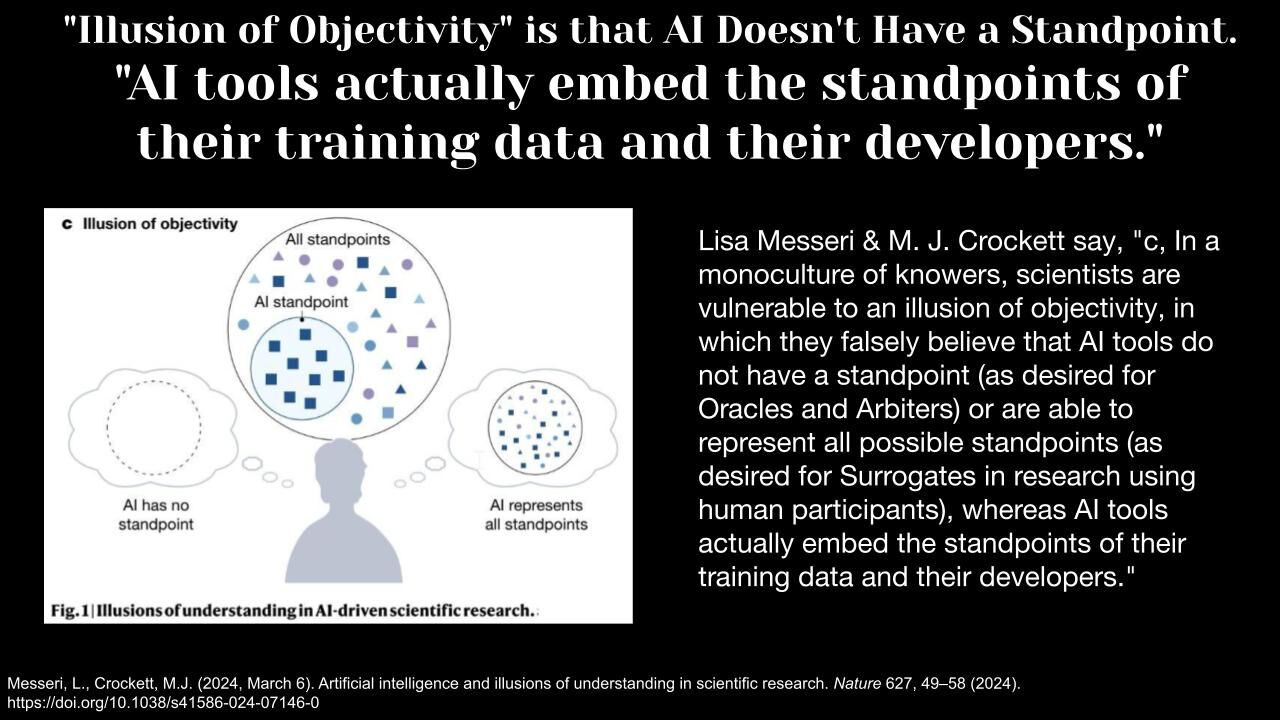
- Again, the role of contextual and relational processes are inherently embedded into all human endeavors, including the process of producing knowledge. The aspiration that “AI,” “AGI,” and “ASI” might be able to achieve a sort of disembodied, “View from Nowhere,” objective truth is a Rationalist’s and Functionalist’s dream that is untethered from reality. But yet they’ll point to benchmarks that show how “AI” has achieved “superhuman” abilities, whilst ignoring all of the contextual relations that have to be collapsed in order for those claims to be true.
- Bender and Hanna say in The AI Con that “Social scientists Lisa Messeri and M. J. Crockett surveyed recent scientific papers across fields that referred to artificial intelligence, machine learning, or large language models, and derived a taxonomy of visions of how AI might contribute to science. The tools dreamt up by these scientists are imagined to be better than human scientists, in many ways: summarizing and synthesizing more preceding work, answering surveys tirelessly, producing analyses based on more data and with more sophistication, and performing peer reviews of the work of others dispassionately and without bias.
- Automated image caption generation can completely miss the deeper historical context, power dynamics, and relational meaning within photos. One of the best examples I’ve found is from a book by Yarden Katz titled Artificial Whiteness: Politics and Ideology in Artificial Intelligence (2020). Katz used Google’s Show and Tell research tool based on the Neural Image Caption Generator (2015) paper that labeled an an Israeli soldier holding down a Palestinian boy as the family tries to remove him as “People sitting on top of a bench together.”
-
- Katz explains his process of testing the blindspots of automated image generation systems on pages 112-113 of Artificial Whiteness. He says, “The historical power dynamics among people can be read in photographs, although AI systems are blind to such dynamics. The blind spots can be exposed by probing vision systems in a different way from that intended by their developers. To illustrate this, I have used Google’s deep learning–based image captioning system called “Show and Tell” — representative of the systems that have been claimed to outperform people in the visual arena — to analyze a series of images. [34] Show and Tell was trained on thousands of photographs and can produce a label for an image it has not processed before. When Google showcases the system, it uses banal, generic-looking images that get assigned impressive, or at least reasonable, captions. The images I used, by contrast, were not generic nor banal; they were specifically chosen to demonstrate how historical context shapes the interpretation of scenes.”
- Abbas Momani is the AFP photographer who originally took this photo, and he wrote an article titled “A boy, a soldier – and a near catastrophe” (2015, August 30) that gives the full context of the photo taken in a small village in the West Bank, Palestine. Momani recounts the story behind the photo, “Every Friday, after the main weekly Muslim prayers, there are demonstrations in Palestinian villages in the occupied West Bank against Israeli settlements… Every time the army is waiting, and the inevitable happens — stone-throwing by one side, tear gas grenades and rubber bullets from the other… But on this particular Friday (August 28) in the West Bank village of Nabi Saleh, the rules appear to have changed. Around a dozen masked soldiers have been hiding under camouflage, and they come out of nowhere… Eleven-year-old Mohammed Tamimi, his left arm in plaster, is grabbed by one soldier… The boy’s mother, sister and others crowd the soldier, crying “He’s a child!”, “He’s only a little child!”. They lunge at the soldier, pulling at his arms and clinging to his back, reaching for the mask that hides his face… I get up close and photograph the boy’s frightened face. He’s trying to struggle but is locked in place on the rocky ground.”
- Katz writes about this photo on page 113 of Artificial Whiteness by saying, “There are many more complex relations among the photographed that are missed. Consider the scene of an Israeli soldier holding down a young Palestinian boy while the boy’s family try to remove the soldier (figure 3.6, right). [35] Google’s deep network produces the caption “People sitting on top of a bench together” (the “bench” perhaps being the boy). The motives and intentions of the individuals are entirely lost.”
- The original paper for this Neural Image Caption tool by Google is titled “Show and tell: A neural image caption generator,” and it was first presented at the Computer Vision and Pattern Recognition (CVPR) Conference on June 9, 2015. The conclusion of the paper says, “It is clear from these experiments that, as the size of the available datasets for image description increases, so will the performance of approaches like [Neural Image Caption].” There’s no doubt that the accuracy of these systems have and will get better by some measurements, but no matter how many image labels are assigned to training data sets, or how much bigger the training data sets are, then the philosophical realities of Gödel’s Incompleteness shows that some nuances of context will always be collapsed.
- The point that sociologists, anthropologists, and critical scholars are making is that there are underlying power dynamics embedded into the very “AI” systems themselves based upon what is and is not within the training data. This curation of data tends to “amplify existing inequalities and injustices” as Dan McQuillan says in his book titled Resisting AI: An Anti-fascist Approach to Artificial Intelligence. (2022).
- But independent of the training data size is that these systems still to this day have difficulty in identifying these deeper and more nuanced contextual and relational dynamics. These systems aspire to achieve a neutral “view from nowhere,” that McQuillan says amputates the “idea of a standpoint and asserted the irrelevance of context or embodied experience.”
- I originally came across this photo example from McQuillan’s Resisting AI, and he explains the limitations of the aspirations of “unambiguous labelling” on pages 12-13, “There’s no doubt that datasets that don’t fully represent the real world are a problem for any deep learning system… Their inability to adapt to scenarios even slightly outside of the training data causes significant amounts of collateral damage. A deeper problem, though, is the very idea of representation that these systems propagate. This is well illustrated by the paradigmatic deep learning dataset called ImageNet, which consists of more than 14 million labelled images, each of which is tagged as belonging to one of more than 20,000 categories, or classes. The assumption that drove the creation of the dataset was of an unambiguous labelling; a set of terms that would describe an image correctly, and which would apply to any and all instances where that image crops up in the world. In this one sweeping gesture, ImageNet amputated the idea of a standpoint and asserted the irrelevance of context or embodied experience. A system trained on such a dataset knows nothing of history, power or meaning, so that a photo of ‘an Israeli soldier holding down a young Palestinian boy while the boy’s family try to remove the soldier’ can be assigned the caption, ‘People sitting on top of a bench together’ (Katz, 2020).”
- This photo of an Israeli soldier holding down a boy ended up going viral in 2015 because it ended up becoming a symbol for the Palestinian fight against Israeli occupation. If you read Momani’s account of the full context, then you can see how Google’s Neural Image Caption of “People sitting on top of a bench together” is missing the deeper meaning, understanding, and context. These deeper power dynamics and contextual relations are currently mostly invisible to existing machine learning practices that strive to achieve an objective “view from nowhere.” Their accuracy is quantified by benchmarks that have limited sets of data. What is and is not in those data sets is the crux of the issue, which is why this photo resonates with me as the perfect example of the Gödel’s Incompleteness constraints that limit the ability to discern relational context, meaning, and understanding.
- These Machine Learning systems use benchmarks to quantify their accuracy, and sometimes they also add qualitative evaluation by humans as well. Check out how the abstract from the “Show and tell: A neural image caption generator” paper describes their performance on benchmarks. It says, “Experiments on several datasets show the accuracy of the model and the fluency of the language it learns solely from image descriptions. Our model is often quite accurate, which we verify both qualitatively and quantitatively. For instance, while the current state-of-the-art BLEU-1 score (the higher the better) on the Pascal dataset is 25, our approach yields 59, to be compared to human performance around 69. We also show BLEU-1 score improvements on Flickr30k, from 56 to 66, and on SBU, from 19 to 28. Lastly, on the newly released COCO dataset, we achieve a BLEU-4 of 27.7, which is the current state-of-the-art.” More on the limitations of these benchmarks below, but obviously there are a lot of contextual, relational, and power dynamics that can be missed, especially if they’re not labeled as such in the training data sets.
- Again, these “AI” systems can not yet understand the deeper meaning of the underlying contextual and relational dynamics, especially when it comes to power dynamics. Humans integrate this contextual information into their subjective and contextual standpoint that can be thought of as an underlying worldview and belief system that’s derived from our embodied and situated knowledge. These “view from nowhere” labelling efforts completely miss these hidden contextual layers, especially if the people in power training these systems don’t include any images or representation of these marginalized and oppressed perspectives within their corpus of training data. And in the absence of providing transparency of what is or is not within these data sets from the Hyperscaler “foundational models,” then there are no easy ways for any independent checks or balances to be used on these systems that may be deployed within automated decision making contexts where the asymmetrical dynamics of power are replicated and amplified. All of these qualitative and contextual dimensions can be completely collapsed within the context of these “AI” benchmarks and benchmarking culture that drives Machine Learning development. More on the anti-intellectual nature of Machine Learning benchmarking culture down below.
-
- Goodhart’s Law may offer some interesting insights into the nature of the benchmarking culture of machine learning. Cory Doctorow explains it in his book The Reverse Centaur’s Guide to Life After AI by saying, “A piece of common wisdom goes, “You treasure what you measure.” Or, more pointedly, there’s the version known as Goodhart’s Law: “When a measure becomes a target, it ceases to be a good measure.”
- In my interview with Emily M. Bender and Alex Hanna, they talked about the leaderboard-chasing, benchmark culture that defines the so-called latest “State of the Art” “Foundational Models” that are perceived as having had empirical validation by these benchmark tests. The Deborah Raji et al. “AI and the Everything in the Whole Wide World Benchmark” (2021) paper was co-written by Bender and Hanna along with Inioluwa Deborah Raji, Amandalynne Paullada, and Emily Denton, and it deconstructs the inherent flaws and limits of machine learning’s benchmarking culture.

- The paper takes it’s title from a Muppets children’s book that is ultimately a parable of Gödel’s Incompleteness. They write in the intro, “In the 1974 Sesame Street children’s storybook Grover and the Everything in the Whole Wide World Museum [Stiles and Wilcox, 1974], the Muppet monster Grover visits a museum claiming to showcase “everything in the whole wide world”. Example objects representing certain categories fill each room. Several categories are arbitrary and subjective, including showrooms for “Things You Find On a Wall” and “The Things that Can Tickle You Room”. Some are oddly specific, such as “The Carrot Room”, while others unhelpfully vague like “The Tall Hall”. When he thinks that he has seen all that is there, Grover comes to a door that is labeled “Everything Else”. He opens the door, only to find himself in the outside world.
“As a children’s story, Grover’s described situation is meant to be absurd. However, in this paper, we discuss how a similar faulty logic is inherent to recent trends in artificial intelligence (AI) — and specifically machine learning (ML) — evaluation, where many popular benchmarks rely on the same false assumptions inherent to the ridiculous “Everything in the Whole Wide World Museum” that Grover visits. In particular, we argue that benchmarks presented as measurements of progress towards general ability within vague tasks such as “visual understanding” or “language understanding” are as ineffective as the finite museum is at representing “everything in the whole wide world,” and for similar reasons — being inherently specific, finite and contextual.” - Again, there is a return to the theme of how knowledge and intelligence is both situated and contextual, and they later remark on the aspirations towards “general-purpose” benchmarks as being “supposedly independent of context or application domains.“
- There’s always an inherent tension in trying to take concrete Boolean examples of data within a data set, to then be able to map out a much larger non-Boolean possibility space that is completely generalizable. This bumps up into the constraints of Gödel’s Incompleteness. Deborah Raji et al. identify this as a “construct validity” problem by saying, “Despite a presentation and acceptance as markers of progress towards general-purpose capabilities, there are clear limitations of these benchmarks. In fact, the reality of their development, use and adoption indicates a construct validity issue, where the involved benchmarks— due to their instantiation in particular data, metrics and practice — cannot possibly capture anything representative of the claims to general applicability being made about them.“
- When I covered the International Joint Conference of Artificial Intelligence in 2016 and 2018, I was told by an “AI” researcher that Machine Learning was driven by empirical results, rather than theoretical ones. This is because of how the benchmarking culture rewards a sort of “number go up” type of mentality, which creates a disposable culture of thinking that things are outdated if someone else achieved a higher benchmark score. Deborah Raji et al. deconstruct the impacts of this leaderboard chasing mentality by saying, “Chasing “state of the art” (SOTA) performance is a very peculiar way of doing science — one that focuses on empirical and incremental work rather than hypothesis-based scientific inquiry [Hooker, 1995]. In 1995, Lorenza Saitta criticized benchmark chasing as “allow[ing] researchers to publish dull papers that proposed small variations of existing supervised learning algorithms and reported their small-but-significant incremental performance improvements in comparison studies” [Radin, 2017, p. 61]. Thomas and Uminsky go so far as to present metric chasing as an ethical issue, stating that “overemphasizing metrics leads to manipulation, gaming, a myopic focus on short-term goals, and other unexpected negative consequences” [Thomas and Uminsky, 2020, p. 1].”
- “Testing Heuristics: We Have It All Wrong” (1995) by J.N. Hooker makes the strong claim that benchmark testing is “anti-intellectual” because it bypasses the “Research” portion of “Research and Development.”
- Here’s the abstract for Hooker’s paper, which is about how benchmark-driven development doesn’t satisfy deeper theoretical questions that could both explain and provide future directions. He writes, “The competitive nature of most algorithmic experimentation is a source of problems that are all too familiar to the research community. It is hard to make fair comparisons between algorithms and to assemble realistic test problems. Competitive testing tells us which algorithm is faster but not why. Because it requires polished code, it consumes time and energy that could be better spent doing more experiments. This article argues that a more scientific approach of controlled experimentation, similar to that used in other empirical sciences, avoids or alleviates these problems. We have confused research and development; competitive testing is suited only for the latter.”
- The “AI and the Everything in the Whole Wide World Benchmark” paper cited this prescient Hooker (1995) paper. Hooker manages to predict certain aspects of modern-day Machine Learning benchmarking culture that values empirical results over attaining deeper theoretical understanding. Hooker goes as far as to describe this sort of leaderboard chasing and State-of-the-Art (SOTA)-chasing as “anti-intellectual.” Hooker says, “Most experimental studies of heuristic algorithms resemble track meets more than scientific endeavors.
“Typically an investigator has a bright idea for a new algorithm and wants to show that it works better, in some sense, than known algorithms. This requires computational tests, perhaps on a standard set of benchmark problems. If the new algorithm wins, the work is submitted for publication. Otherwise it is written off as a failure. In short, the whole affair is organized around an algorithmic race whose outcome determines the fame and fate of the contestants.
“This modus operandi spawns a host of evils that have become depressingly familiar to the algorithmic research community. They are so many and pervasive that even a brief summary requires an entire section of this article. Two, however, are particularly insidious. The emphasis on competition is fundamentally anti-intellectual and does not build the sort of insight that in the long run is conducive to more effective algorithms. It tells us which algorithms are better but not why. The understanding we do accrue generally derives from initial tinkering that takes place in the design stages of the algorithm. Because only the results of the formal competition are exposed to the fight of publication, the observations that are richest in information are too often conducted in an informal, uncontrolled manner.” - Hooker makes the strong claim that the benchmarking-culture of leaderboard chasing is an “anti-intellectual” approach because empirical results are valued more than theoretical results. He says that benchmarking “tells us which algorithms are better but not why.” This “State-of-the-Art” chasing mentality creates a disposable culture where previous results are discarded as soon as there is a new leader on the leaderboard. This disposable culture contributes to both Graylin and Rosenberg asserting that the five-year old “Stochastic Parrots” paper was “out of date.” But what both Graylin and Rosenberg fail to realize is that both the “Stochastic Parrots” (2021) and the preceding “Climbing towards [Natural Language Understanding]” (2020) papers lay out underlying theoretical arguments about “meaning” and “understanding” that in fact have yet to be fully resolved or addressed. After all, philosophers Millière & Buckner concede in their Philosophy of Language Models paper that, “For every claim that LLMs possess some human-like competence — “understanding,” “reasoning,” “belief” — there are equally forceful skeptical dismissals.” In other words, the theoretical claims in these two papers that take deflationary views that LLMs don’t really understand the meaning of their inputs or outputs not only still stand, but are still actively driving philosophical debates. Claims that the “Stochastic Parrots” and “Climbing towards NLU” papers are “outdated” is a brainrot artifact of the SOTA-chasing benchmarking culture that discards any results after a certain sell-by date.
- During the debate Rosenberg accused me of being an “AI Denialist,” because I am “sticking my head in the sand” by not acknowledging the rapid progress of “AI” and I’m failing to acknowledge the existential threats of “artificial superintelligence.” Rosenberg wrote about “The rise of AI denialism” (2025, December 1) in a Big Think op-ed. I will admit that I take very skeptical views of “AI,” but I don’t identify as an “AI Denialist” because this would presume that my deflationary views are without merit. The impetus of this extended write-up was to provide the philosophical, technical, and scholarly references to back up my skepticism.
- I believe Rosenberg’s computational functionalist philosophical commitments leads him to interpret alleged “superhuman” benchmark results as being evidence that “artificial superintelligence” is only a matter of when and not if.
- I content that there are always key contextual and relational factors that have to be collapsed in order to make these “superhuman” claims. Also the epistemic communities promoting “AGI” and “ASI” have poor citational practices and are insulated within self-referential, communities influenced by a non-relational bundle of TESCREAL philosophies that are largely isolated from leading interdisciplinary scholarship that is much more critical to these “AGI” and “ASI” aspirations and claims.
- This AWE debate was supposed to represent 2 Anti-AI versus 2 Pro-AI positions. However, often time the debate felt more like 3 Pro-AI versus 1 Anti-AI. Even though Rosenberg self-identifies as being “Anti-AI,” he has started an “AI” company called “Unanimous AI” in order to ensure that humans are still in the loop and “use AI to connect groups together, turning networked teams into superintelligent systems.”
- I would also classify Rosenberg as a bit of an “AI Doomer” because he is afraid of the existential risks of unaligned “artificial superintelligence.” Emily M. Bender has pointed out that “AI” Boosters and “AI” Doomers can actually be considerer two sides of the same coin as both positions can propagate unsubstantiated “AI” Hype.
- Bender told me in an interview, “You can see that very clearly when you say, “Okay, well, the AI Boosters say, ‘AI is a thing. It’s inevitable, it’s imminent, it’s going to be super powerful, and it’s going to solve all of our problems.’ And the AI Doomers say, ‘AI is a thing. It’s inevitable. It’s imminent. It’s going to be super powerful. And it’s going to kill us all.'” And so it’s just that last little turn at the end that makes it different.”
- Whilst Rosenberg isn’t as extreme of an AI Doomer as Eliezer Yudkowsky, the fact that this debate was supposed to be 2 Pro-AI vs 2 Anti-AI views, but it ended up being more of a 3 Pro-AI vs 1 Anti-AI dynamic shows how easily “AI” Doomers can unwittingly contribute to unsubstantiated “AI” Hype that I object to. Alleged claims of “superhuman” capabilities almost always collapse the contextual and relational components of the sociological and technical aspects behind the process of developing knowledge.
- I believe that the underlying scholarship behind “AGI” and “ASI” is very thin and questionable, and based upon computational functionalist, naturalist, physicalist, rationalist, and “TESCREAL” bundle philosophical foundations that are not relational or process-oriented. In other words, important context is collapsed within these computational functionalist frameworks in order to operationalize intelligence into a series of dyadic input-output functions.
- There is also a long history of “AI” technologists who have made epistemological and ontological claims beyond the scope of their expertise, as Jonnie Penn documents the “poor citation practices” of early “AI” researchers who were pushing the limits of the “brain is a computer” metaphor.
- Bender and Hanna also point to Ahmed et al.’s paper on the “AI” Safety community being very self-referential and is insulated from the broader scholarly community, and Gebru and Torres unpack the TESCREAL bundle of ideologies that are often the philosophical underpinnings of believers of “AGI” and “ASI.” More on all of this down below.
- “Building the Epistemic Community of AI Safety” (2023) by Ahmed, Jazwinska, Ahlawat, Winecoff, and Wang
- Bender and Hanna point to this paper as an example of how notions of “Artificial General Intelligence (AGI)” and “Artificial Superintelligence (ASI)” have been developed within a self-referential and relatively closed epistemic community. In other words, these researchers are mostly technologists who are not engaged in interdisciplinary conversation with the broader social sciences, who tend to be much more critical to these notions.
- Ahmed et al. says, “The emerging field of “AI safety” has attracted public attention and large infusions of capital to support its implied promise: the ability to deploy advanced artificial intelligence (AI) while reducing its gravest risks. Ideas from effective altruism, longtermism, and the study of existential risk are foundational to this new field. In this paper, we contend that overlapping communities interested in these ideas have merged into what we refer to as the broader “AI safety epistemic community,” which is sustained through its mutually reinforcing community-building and knowledge production practices.” In other words, these “AI Safety” communities are very self-referential and insular, and not engaged in meaningful interdisciplinary dialogue with skeptical perspectives.
- “The TESCREAL bundle: Eugenics and the promise of utopia through artificial general intelligence” (2024) by Timnit Gebru and Émile P. Torres. Also see Torres’ TESCREAL for Skeptics update (2026, July 9).
- Gebru and Torres defined the TESCREAL acronym, which describes the underlying philosophies of folks who promote “AI” Hype. They say, “In this paper, we ask: What ideologies are driving the race to attempt to build AGI? To answer this question, we analyze primary sources by leading figures investing in, advocating for, and attempting to build AGI. Disturbingly, we trace this goal back to the Anglo-American eugenics movement, via transhumanism. In doing this, we delineate a genealogy of interconnected and overlapping ideologies that we dub the “TESCREAL bundle,” where the acronym “TESCREAL” denotes “transhumanism, Extropianism, singularitarianism, (modern) cosmism, Rationalism, Effective Altruism, and longtermism.””
- “AI” and the framing of it’s superiority is directly inherited from the Eugenics movement, which is being reborn through discussions of “AI.” Here is the abstract by Gebru and Torres for their paper and how the speculative risks of “AGI” or “ASI “are prioritized over the existing human rights violations that are already happening today within “AI”-driven, automated decision systems. They say, “The stated goal of many organizations in the field of artificial intelligence (AI) is to develop artificial general intelligence (AGI), an imagined system with more intelligence than anything we have ever seen. Without seriously questioning whether such a system can and should be built, researchers are working to create “safe AGI” that is “beneficial for all of humanity.” We argue that, unlike systems with specific applications which can be evaluated following standard engineering principles, undefined systems like “AGI” cannot be appropriately tested for safety. Why, then, is building AGI often framed as an unquestioned goal in the field of AI? In this paper, we argue that the normative framework that motivates much of this goal is rooted in the Anglo-American eugenics tradition of the twentieth century. As a result, many of the very same discriminatory attitudes that animated eugenicists in the past (e.g., racism, xenophobia, classism, ableism, and sexism) remain widespread within the movement to build AGI, resulting in systems that harm marginalized groups and centralize power, while using the language of “safety” and “benefiting humanity” to evade accountability. We conclude by urging researchers to work on defined tasks for which we can develop safety protocols, rather than attempting to build a presumably all-knowing system such as AGI.”
- The G in “AGI” refers to “General Intelligence,” which has roots in Spearman’s G Factor, IQ tests, and a dark history of Eugenics. Gebru and Torres have a section on “Eugenic definitions of “general intelligence” that fleshes this out, “Pennachin and Goertzel (2007b) wrote that “what distinguishes AGI work from run-of-the-mill artificial intelligence” research is that “it is explicitly focused on engineering general intelligence in the short term,” even though they note that “general intelligence does not mean exactly the same thing to all researchers” and that “it is not a fully well-defined term” [70]. How, then, would researchers know that they have achieved their goals of building AGI? They need to know how to define and measure “general intelligence.” Unsurprisingly, these definitions rest on notions of “intelligence” that depend on IQ and other racist concepts espoused by the likes of Charles Murray and Linda Gottfredson [71]… Keira Havens, who has written extensively on race science, asks those attempting to build AGI: “Why are you relying on eugenic definitions, eugenic concepts, eugenic thinking to inform your work? Why […] do you want to enshrine these static and limited ways of thinking about humanity and intelligence?” [74]”
- The Ghost in the Machine (2026) documentary premiered at Sundance, but has not been widely released yet, but it is a great historical overview featuring leading scholars who are skeptical of “AI.”
- I enjoyed Ghost in the Machine a lot better than The AI Doc: Or How I Became an Apocaloptimist (2026), which also premiered at Sundance. While The AI Doc was about 45% “AI” Doomers, 45% “AI” Accelerationists, and 10% “AI” Skeptics and Scholars, the Ghost in the Machine was nearly 100% Anti-AI Hype Scholars, Sociologists, Philosophers, Anthropologists, Technologists, and Historians with a lot more historical context as to the evolution of “AI” with a ton of archival footage.
- The Ghost in the Machine documentary does an incredible job of unpacking the historical roots of eugenics from transistor inventor co-founder of Silicon Valley William Shockley, who was a racist and eugenicist, to the first president of Stanford University, to The Funding Of Scientific Racism: Wickliffe Draper and the Pioneer Fund. See the TESCREAL paper above to see how eugenics is still alive today in the “AI” community.
- Mystery AI Hype Theater 3000 Podcast episode on “Defining AGI: Oops! All Eugenics” (2025, Dec 30)
- Podcast co-hosts Alex Hanna and Emily M. Bender break down the shotty scholarship of a Hendrycks et al. pre-print titled “A Definition for AGI” (2025, Dec 3). These technologists are taking social science concepts originally intended for humans, and then uncritically applying them to machines. Also a number of Hendrycks et al. co-authors have TESCREAL affiliations, and the underlying aspirations of trying to quantify dimensions of “intelligence” have roots in eugenics.
- There are many dimensions of what it means to be human, and proponents of “AGI” tend to collapse these differentiating factors, and this podcast episode does a great job of going step by step through this paper to show why this is a problem.
- “Press Release: Democratic Backsliding Reaches Western Democracies, with U.S. Decline “Unprecedented” (2026, March 17) is a report from the V-Dem Institute, University of Gothenburg on how Democracy in the United States is under attack.
- “Artificial Intelligence” is being used as a tool on many fronts to enable authoritarian behaviors. This report sets the context for Dan McQuillan’s book Resisting AI from an Anti-fascist perspective.
- “Democratic backsliding is now happening in well-established democracies. Democracy in the USA is deteriorating at unprecedented speed, and media and journalists are increasingly targeted across the world. This, and more, is reported in the latest Democracy Report from the V-Dem Institute at the University of Gothenburg.”
- The U.S. democracy is currently in a much faster deterioration process than any other democracy in modern times. Within only one year, the USA’s score on the V-Dem Liberal Democracy index has declined by 24 percent, while its world rank dropped from 20th to 51st place out of 179 nations.
- The liberal aspects of democracy show the largest decline in the U.S. President Donald Trump’s second term can be summarized as a rapid concentration of powers in the presidency, according to the report.
- “The current U.S. administration has been undercutting institutionalized checks and balances, politicizing civil service and oversight bodies, and intimidating the judiciary, alongside attacks on the press, academia, civil liberties, and dissenting voices ”says Staffan I Lindberg.
- “AI: The New Aesthetics of Fascism” (2025, February 9) by Gareth Watkins
- The subtitle for Watkins’ article is: “It’s embarrassing, destructive, and looks like shit: AI-generated art is the perfect aesthetic form for the far right.”
- Whenever I see “AI” Generated art, then I immediately associate it with right-wing Slopaganda, but also the same type of cheapness that I associate with people who use “Papyrus” or “Comic Sans” fonts.
- Watkins does a canny breakdown of “AI as The New Aesthetics of Fascism” in this paragraph. He says, “I would not be the first to observe that we are in a new phase of reaction, something probably best termed ‘postmodern conservatism’… It is, and has always been, “irritable mental gestures which seek to resemble ideas,” and to ‘post-liberal’ ‘intellectuals’, that is in fact a good thing – if anything, they believe, the postmodern right needs to become more absurd; it needs to abandon Enlightenment ideals like reason and argumentation altogether. The right wing intellectual project is simply to ask: ‘what would have to be true in order to justify the terrible things that I want to do?’ The right wing aesthetic project is to flood the zone – unsurprisingly, given their scatological bent, with bullshit – in order to erode the intellectual foundations for resisting political cruelty.”
- Democratically-backsliding authoritarianism is spreading in the United States and around the world, and it is this political context under which “AI” is gaining prominence. The Trump administration has been extensively using “AI Slopaganda” to promote their ideas, and “AI” as a technology is already a tool for consolidating wealth and power. “AI” is more likely to empower and embolden authoritarian regimes that it is to fight against it. More on how “AI” is inherently a political technology down below from Dan McQuillan’s book on Resisting AI.
- Resisting AI: An Anti-fascist Approach to Artificial Intelligence (2022, July 22) by Dan McQuillan
- From page 2, McQuillan says, “AI, as we know it, is a kind of computing, but it’s also a form of knowledge production, a paradigm for social organization and a political project... Whatever else AI is, it is not neutral, and neither can we be. AI is political because it acts in the world in ways that affect the distribution of power, and its political tendencies are revealed in the ways that it sets up boundaries and separations.”
- From page 3, McQuillan says, “The theme explored throughout the text is that AI is a political technology in its material existence and in its effects. The concrete operations of AI are completely entangled with the social matrix around them, and the book argues that the consequences are politically reactionary. The net effect of applied AI, it is claimed, is to amplify existing inequalities and injustices, deepening existing divisions on the way to full-on algorithmic authoritarianism. In the light of these consequences, which are justified more fully in the following chapters, the book is titled after the stance it hopes to encourage, namely that of ‘resisting AI’.”
- From page 4, McQuillan says, “AI doesn’t lead to a new dystopia ruled over by machines but an intensification of existing misery through speculative tendencies that echo those of finance capital. These tendencies are given a particular cutting edge by the way AI operates with and through race. AI is a form of computation that inherits concepts developed under colonialism and reproduces them as a form of race science.”
- From page 5, McQuillan says, “Given the real existing threat of fascist and authoritarian politics, we should be especially wary of any emerging technology of control that might end up being deployed by such regimes. But the main reasons for having an anti-fascist approach to AI run deeper into the nature of the technology itself and its approach to the world. It’s not just about the possibility of AI being used by authoritarian regimes but about the resonances between AI’s operations and the underlying conditions that give rise to those regimes. In particular, it’s about the resonances between AI and the emergence of fascistic solutions to social problems.”
- From page 7, McQuillan says, “the starting point for an anti-fascist approach to AI is an alertness to its operation as a technology of division, to its promotion as a solution for social crisis, and to its use to prop up power and privilege.”
- “Privacy in Authoritarian Times: Surveillance Capitalism and Government Surveillance” (2026, Jan 29) by Daniel Solove.
- As reported by the V-Dem Institute, democratic backsliding in the United States is progressing at an unprecedented rate. The combination of democratic-backsliding authoritarianism with surveillance capitalism without any privacy protections or reigning in surveillance capitalism is sleepwalking into a dystopic Big Brother type of situation given the Third Party Doctrine interpretation of the Fourth Amendment. Privacy expert Solove is making the extended legal arguments in this paper, but mirrors one of my biggest concerns about not having any viable privacy guardrails or legal protections in place.
- From Solove’s abstract, “As the United States and much of the world face a resurgence of authoritarianism, the critical importance of privacy cannot be overstated. Privacy serves as a fundamental safeguard against the overreach of authoritarian governments. Authoritarian power is greatly enhanced in today’s era of pervasive surveillance and relentless data collection. We are living in the age of “surveillance capitalism.” There are vast digital dossiers about every person assembled by thousands of corporations and readily available for the government to access.”
- Solove points out that “Government surveillance and surveillance capitalism are two sides of the same coin.” He says in his abstract, “In this Article, I contend that privacy protections must be significantly heightened to respond to growing threats of authoritarianism. Major regulatory interventions are necessary to prevent government surveillance from being used in inimical ways. But reforming Fourth Amendment jurisprudence and government surveillance alone will not protect against many authoritarian invasions of privacy, especially given the oligarchical character of the current strain of authoritarianism. To adequately regulate government surveillance, it is essential to also regulate surveillance capitalism. Government surveillance and surveillance capitalism are two sides of the same coin. It is impossible to protect privacy from authoritarianism without addressing consumer privacy.“
- Here is Solove elaborating on the flawed third-party doctrine of the Fourth Amendment, “The Fourth Amendment offers little to no protection for much of our personal data in the digital age, largely due to the third-party doctrine. This flawed doctrine, crafted by the U.S. Supreme Court in the 1970s, asserts that individuals forfeit any reasonable expectation of privacy—and thus Fourth Amendment protection—when their personal data is held by third parties. The third-party doctrine is profoundly outdated and ill-suited to the modern era, where vast amounts of personal information are stored and managed by third-party entities.
“Beyond the lack of meaningful Fourth Amendment protection against modern digital surveillance technologies and government data gathering, Congress has failed to update existing laws and pass new ones to provide a meaningful regulatory framework.”
- Part I: Remembering the Human Microcosm in the Age of Mechanized Intelligence: The Pope Interrupts the Talking Machine (2026, June 9) by Matt Segall.
- Segall warns about the industrial-intelligence complex that’s emerging. He says, “Deaf to public protest and no matter the human or ecological cost, states and corporations are rapidly marching us more or less in lockstep into the new age of machine intelligence. The boundary between states and corporations is becoming ever harder to discern as frontier research labs become part of national strategic ambitions and government authority and surveillance abilities come to depend on privately owned models. In other words, the two institutions best positioned to design and restrain these technologies are also its most heavily invested promoters. Genuine moral and conceptual friction against their convenient framing must therefore come from outside the intelligence-industrial complex.”
- There’s a growing backlash against Techno-feudal Billionaires and Trillionaires who are using “AI” to consolidate their wealth and power. See this culture jamming video by Juice Media about Honest Government Ad as well as Mo Bitar‘s videos.
- Conclusion: Remembering the Human Microcosm in the Age of Mechanized Intelligence. (2026, June 15) by Matt Segall.
- It seems fitting to end this collection of references resisting “AI” with Process Philosopher Matt Segall’s concluding paragraph of his 8-part series on “Remembering the Human Microcosm in the Age of Mechanized Intelligence.” Much of the pressure from the computational functionalists and naturalists is to continue to blur the line between man and machine, but Segall is drawing upon Hegel, Whitehead, and Ruyer to bring back the poetic dimensions of what it means to be human. He says, “To keep our mirror transparent for participation I have enlisted three guides, each of whom diagnosed an earlier phase in the mechanization of mind before the equation of thinking with computing had hardened into an ambient assumption. From Hegel I borrowed the image of the loom: the isolated Understanding weaving the warp of identity and the woof of difference into intricate textiles while leaving the thinker untransformed. The large language model is just such a loom, a transformer reweaving and relaying the fossilized traces of meanings first spun and later read by living souls… From Whitehead I recovered an electromagnetic ontology in which the world is no aggregate of inert substances but a web of energetic events inheriting and transmitting one another’s achievements of value-experience. The human body becomes a “complex amplifier” folding cosmic rhythms into a presiding center of valuation, whereas the server farm, with physical prehensions pulsing dimly through its transistors, remains a crowd of feelings with no one home to care. And from Ruyer I took the self-surveying form, the embryo that grows itself with no homunculus reading a genetic script, the survol absolu that knows itself without observing itself, present to itself as no machine assembled partes extra partes can be. Machines are all liaison and no survol: they conserve and relay information but cannot originate it, because there is no one on the line for whom meaning could matter.”
- Finally, here’s how Segall ends his series of essays putting forth his philosophical emergency response dispatches. Segall says, “The danger was never the machines, which, rightly understood and rightly related to, might yet serve as amplifiers rather than amputators of our minds, taking up the crushing weight of accumulated information so that speculative Reason is freed for its proper flight. The danger is that, dazzled by so fluent an inverted mirror, we forget that the human being is not one more measurable data point but the world’s own forming activity welling up into self-awareness — a forming that can be neither metered nor manufactured, neither enclosed nor sold, but only remembered and enacted. Automated computation can help us carry what we have come to know. But only a living mind can know what any of it means. Only a human microcosm can know who it is.”
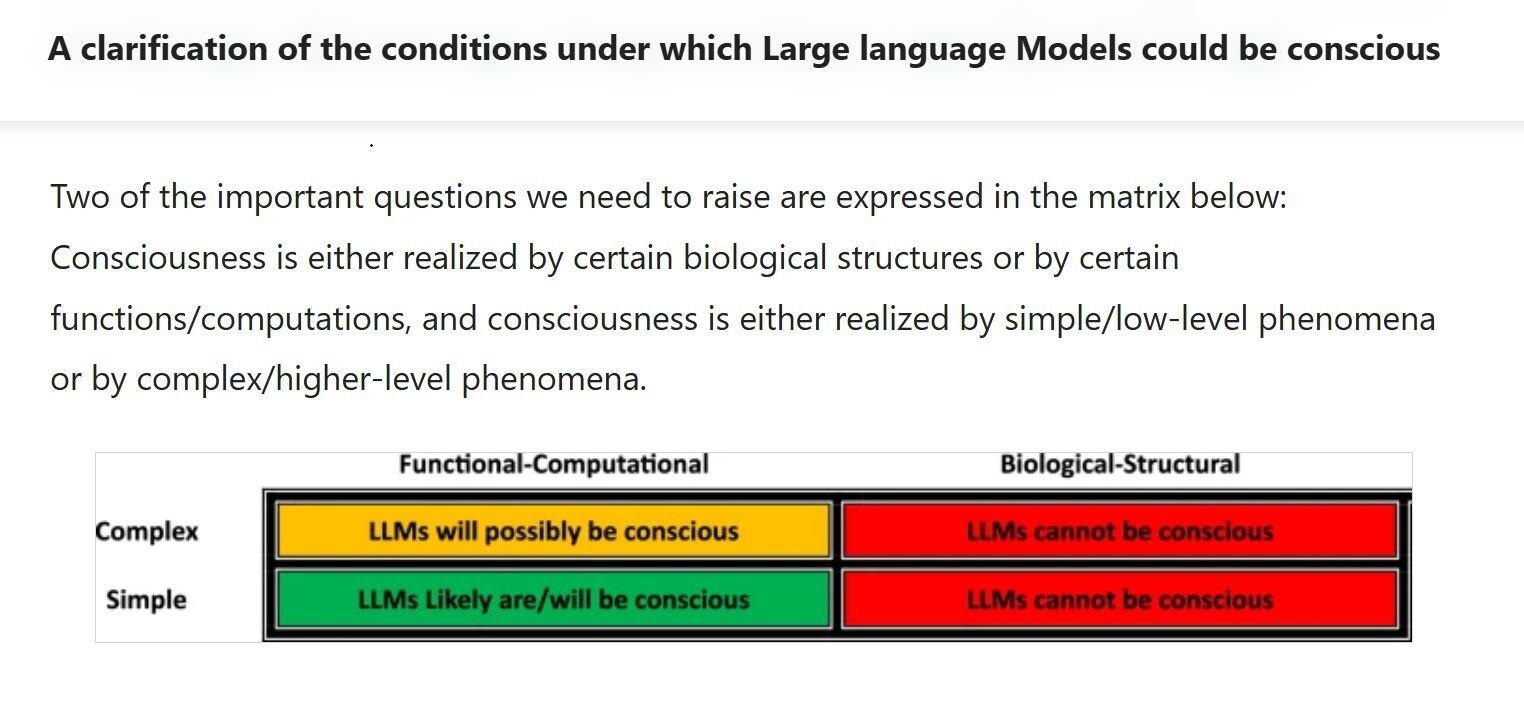
MY CLOSING THOUGHTS ON “AI”
- As of right now, “AI” is predominately a technology that consolidates wealth and power, and as long as technologists only look at “AI” through the lens of technology, then they’re missing the biggest harms that are within the political realm.
- Most advocates of “AI” use a utilitarian ethics that perceives the benefits to be outweighing the harms, but they also can’t fully specify the full spectrum of harms or diminish the harms that don’t directly impact them.
- In the United States, we need privacy laws equivalent to GDPR and laws that constrain “AI” from automated decision making equivalent to The AI Act.
- I still think supporting Hyperscaler “AI” companies is grossly unethical due to the VC-driven subsidies, and techno-feudal aspirations. If people were paying what it actually cost to use these systems, then no one would be using them. If you’re going to use “AI,” then I advocate for open source alternatives.
- Without empirical feedback loops, then LLMs have proven to be completely uncontrollable and any system that has an LLM within it’s system can’t be trusted.
- “AI” Boosters use tactics of dehumanization through metaphors that equate our cognition to computation, and they project human-like qualities onto machines.
- Human beings have mysterious aspects of relevance realization, the orientation phase of Boyd’s OODA, and Whitehead’s concrescence that synthesizes, memories, emotions, embodied experiences, desires, will, aspirations, relationships, context, meaning, value, purpose, ethics, and cognition in a way that may always transcend what any speculations of what “AGI” or “ASI” may achieve.
- Proponents of “AGI” and “ASI” also diminish the broader social and technical processes that are involved through the process of producing knowledge, and downplay the role of humans in producing the underlying data that makes “AI” what it is.
- It’s okay to resist “AI,” and you don’t have to believe the the current “AI” hype that’s based upon circular investments and a lot of fear-driven speculation about the next major computing platform shift.
- I’m sure “AI” will be around in some fashion, but as it stands right now, “AI” is a tool to consolidate wealth and power and is in more alignment with democratically-backsliding authoritarianism. “AI” is a tool of empire that is not in right relationship with the world around us, and it needs a comprehensive approach both culturally, legally, economically, and technologically to ensure that “AI” is a technology that empowers people and supports human rights and not one that oppresses us and divides us.
- I see both XR and “AI” as philosophical provocations that are challenging the status quo paradigms of naturalism, physicalism, reductive materialism, rationalism, and functional computationalism. I see process-relational philosophy, speculative philosophy, and Peircean semiotics as excellent candidates for an underlying philosophical paradigm shift towards a world that values processes, relationships, context, meaning, and value as being fundamental.
- There are also lots of potentially exalted uses for “AI” that empowers us and creates an emancipatory commons of intelligence that serves as a democratizing force, such as the printing press or the early days of the World Wide Web have done. I really look to the artists fusing XR and AI, which I’ve covered in 130+ interviews now, as well as the pro-social technologists who are pushing the edge of what’s possible so that we can more clearly see the promises and not be drowning in the perils. The future is not yet determined, and we have a choice right now as to whether we want a future of “AI” that’s driven by trillionaire, techno-feudal companies and individuals who aspire to use it for domination and control or where it can be driven by human rights with transparency, open data, open models, and open source access for all.
This is a listener-supported podcast through the Voices of VR Patreon.
Music: Fatality
Note: This original schematic of this post was posted on July 2, 2026 at 8:21 pm PDT, but then has received constant updates of additional reading and writing of nearly 25k words by July 10, 2026 at 3:28 am PDT, and finalized at around 30k words on July 12, 2026 at 11:16 pm PDT. If you find value in this work, then please consider becoming a patron!
Bibliography
Ahmed, S., Jaźwińska, K., Ahlawat, A., Winecoff, A., & Wang, M. (2023, Nov 22). “Building the Epistemic Community of AI Safety”. SSRN. https://papers.ssrn.com/sol3/papers.cfm?abstract_id=4641526.
Akselrod, O., & Venzke, C. (2025, February 11). “Trump’s Efforts to Dismantle AI Protections, Explained”. American Civil Liberties Union. https://www.aclu.org/news/privacy-technology/trumps-efforts-to-dismantle-ai-protections-explained.
Alexander, L., & Moore, M. (2024, Dec 11). “Deontological Ethics”. The Stanford Encyclopedia of Philosophy , Edward N. Zalta & Uri Nodelman (eds.). https://plato.stanford.edu/entries/ethics-deontological/.
Altman, S., & Abram, C. (2025, August 7). “Sam Altman Shows Me GPT 5.. And What’s Next”. YouTube, Cleo Abram. https://www.youtube.com/watch?v=hmtuvNfytjM&t=2146s.
Altman, S., & Hoffman, R. (2022, September 21). “OpenAI CEO Sam Altman – AI for the Next Era”. YouTube, Greylock. https://www.youtube.com/watch?v=WHoWGNQRXb0&t=1661s.
Baria, A. T., & Cross, K. (2021, July 18). “The brain is a computer is a brain: neuroscience’s internal debate and the social significance of the Computational Metaphor”. Arxiv. https://arxiv.org/abs/2107.14042.
Belle, V., & Marcus, G. (2026, March 14). “The Future Is Neuro-Symbolic: Where Has It Been, and Where Is It Going?”. Proceedings of the AAAI Conference on Artificial Intelligence, 40(48), 40954–40961. https://doi.org/10.1609/aaai.v40i48.42130.
Bender, E. M. (2026, February 10). “Resisting Dehumanization in the Age of “AI”: The View from the Humanities” [lecture slides and references]. Solomon Katz Distinguished Lectures in the Humanities at the University of Washington. https://faculty.washington.edu/ebender/papers/Bender-Katz-2026.pdf.
Bender, E. M. (Published on 2026, March 24, Recorded on 2026, February 10). “Resisting Dehumanization in the Age of “AI”: The View from the Humanities, Emily M. Bender”. YouTube, Simpson Center. https://www.youtube.com/watch?v=T7Lc6QNxolQ.
Bender, E. M. (2026, June 25). “Artificial Intelligence”. Oxford Research Encyclopedia of Science, Technology, and Society. Available at https://faculty.washington.edu/ebender/papers/Bender-AI-2026.pdf [pre-print] or https://doi.org/10.1093/9780197852712.003.0067.
Bender, E. M., & Inie, N. (2026, June 25). “How to talk about “AI” without adding to the anthropomorphization”. Buttondown. https://buttondown.com/maiht3k/archive/how-to-talk-about-ai-without-adding-to-the/.
Bender, E. M., & Koller, A. (2020, July 7). “Climbing towards NLU: On Meaning, Form, and Understanding in the Age of Data”. In Proceedings of the 58th annual meeting of the association for computational linguistics (pp. 5185-5198). Paper Available at http://doi.org/10.18653/v1/2020.acl-main.463 and Conference Presentation at https://virtual.acl2020.org/paper_main.463.html
Bender, E. M., Gebru, T., McMillan-Major, A., & Shmitchell, S. (2021, March 1). “On the Dangers of Stochastic Parrots: Can Language Models Be Too Big? 🦜”. Proceedings of the 2021 ACM Conference on Fairness, Accountability, and Transparency (pp. 610-623). https://doi.org/10.1145/3442188.3445922.
Bender, E. M., & Hanna, A. (2025, May 13). The AI Con: How to Fight Big Tech’s Hype and Create the Future We Want. Harper Collins. https://thecon.ai/.
Bender, E. M., & Hanna, A. (Published on 2025, Dec 30) and Recorded on 2025, Dec 8). “Defining AGI: Oops! All Eugenics, 2025.12.08”. Mystery AI Hype Theater 3000 Podcast. https://www.buzzsprout.com/2126417/episodes/18429157-defining-agi-oops-all-eugenics-2025-12-08.
Bergson, H. (Translated by Paul, N. M., and Palmer, W. S.). (1991 [1896]). Matter and Memory. Zone Books. .
Bergson, H. (Translated by Audra, R. A., Brereton, C., and Carter, H.). (1935 [1932]). The Two Sources of Morality and Religion. The MacMillan Company. .
Bitar, M. (From January 16, 2026 to July 10, 2026). “Mo Bitar”. YouTube, Mo Bitar. https://www.youtube.com/@atmoio.
Bradley, J. (2009). “Beyond Hermeneutics: Peirce’s Semiology as a Trinitarian Metaphysics of Communication”. Analecta Hermeneutica, Vol 1, 56-72. Available at https://memorial.scholaris.ca/items/388af67d-9474-419d-a75e-e55de7d38a81 or https://www.iih-hermeneutics.org/_files/ugd/f67e0f_34315aed202b4345a32ea9c0a4e59723.pdf.
Brown, M., & O’Brien, M. (2025, July 1). “Senate strikes AI provision from the Republican tax bill after uproar”. AP News. https://apnews.com/article/congress-ai-provision-moratorium-states-20beeeb6967057be5fe64678f72f6ab0.
Bueno, O. (2026, June 19). “Nominalism in the Philosophy of Mathematics”. The Stanford Encyclopedia of Philosophy , Edward N. Zalta & Uri Nodelman (eds.). https://plato.stanford.edu/entries/nominalism-mathematics/.
Buolamwini, J. (2024, November 19). Unmasking AI: My Mission to Protect What Is Human in a World of Machines. Penguin Random House. https://www.penguinrandomhouse.com/books/670356/unmasking-ai-by-dr-joy-buolamwini/.
Bye, K. (2024, October 24). “Privacy Pitfalls of Contextually-Aware AI: Sensemaking Frameworks for Context and XR Data Qualities”. Existing Law and Extended Reality: An Edited Volume of the 2023 Symposium Proceedings. Available at https://fsi9-prod.s3.us-west-1.amazonaws.com/s3fs-public/2024-10/Bye%20-%20individual%20monograph%20(1).pdf or https://cyber.fsi.stanford.edu/publication/existing-law-and-extended-reality.
Bye, K. (2026, February 14). “#1710: When Integration Becomes Subordination: Big Tech Parallels in Carney’s Davos Speech & Untethering from the AI Big Brother”. Voices of VR Podcast. https://voicesofvr.com/1710-when-integration-becomes-subordination-big-tech-parallels-in-carneys-davos-speech-untethering-from-the-ai-big-brother/.
Bye, K. (2026, April 21). “IDFA DocLab Immersive Think Tank Report 2025”. International Documentary FilmFestival of Amsterdam. https://professionals.idfa.nl/stories/idfa-doclab-immersive-think-tank-report-2026/.
Bye, K., Bender, E. M., & Hanna, A. (2025, May 23). “#1563: Deconstructing AI Hype with “The AI Con” Authors Emily M. Bender and Alex Hanna”. Voices of VR Podcast. https://voicesofvr.com/1563-deconstructing-ai-hype-with-the-ai-con-authors-emily-m-bender-and-alex-hanna/.
Bye, K. et al. (December 10, 2020 to December 6, 2025). “Process Philosophy Episodes of the Voices of VR Podcast”. Voices of VR Podcast. https://voicesofvr.com/tag/process-philosophy.
Bye, K. et al. (February 6, 2016 to July 12, 2026). “Artificial Intelligence Episodes of the Voices of VR Podcast”. Voices of VR Podcast. https://voicesofvr.com/category/technology/artificial-intelligence.
Bye, K., & Davis, A. M. (2025, June 4). “#1708: How Process Philosophy Centers Experience. A Prismatic Tour of “Whitehead’s Universe” by Andrew M. Davis”. Voices of VR Podcast. https://voicesofvr.com/1708-how-process-philosophy-centers-experience-a-prismatic-tour-of-whiteheads-universe-by-andrew-m-davis/.
Bye, K., Graylin, A. W., Rosenberg, L., & Shannon, L. (Published on 2025, August 2, Recorded on 2025, June 12). “#1611: Socratic Debate on Future of AI & XR from AWE 2025 Panel”. Voices of VR Podcast. https://voicesofvr.com/1611-socratic-debate-on-future-of-ai-xr-from-awe-2025-panel/.
Bye, K., Graylin, A. W., Rosenberg, L., & Shannon, L. (Published on 2026, June 24, Recorded on 2026, June 18). “Socratic Dialogue on the Future of AI and XR (part 2)”. YouTube, AWE XR. https://www.youtube.com/watch?v=STwHN50Ojfg.
Bye, K., & Leufer, D. (2023, March 7). “#1177: How the EU’s AI Act Could Impact Biometric Data Definitions & XR Privacy”. Voices of VR Podcast. https://voicesofvr.com/1177-how-the-eus-ai-act-could-impact-biometric-data-definitions-xr-privacy/.
Bye, K., Maurer, L. & Wouters, R. (2025, December 6). “#1691: A Call for Human Friction Over AI Slop in “Deep Soup” Participatory Film Based on “Designing Friction” Manifesto”. Voices of VR Podcast. https://voicesofvr.com/1691-a-call-for-human-friction-over-ai-slop-in-deep-soup-participatory-film-based-on-designing-friction-manifesto/.
Bye, K., & Maxwell, G. (2020, December 10). “#1147: Thirteen Philosophers on the Problem of Opposites: Grant Maxwell’s Integration & Difference Book & Archetypal Approaches to Character”. Voices of VR Podcast. https://voicesofvr.com/1147-thirteen-philosophers-on-the-problem-of-opposites-grant-maxwells-integration-difference-book-archetypal-approaches-to-character/.
Bye, K., & Nissenbaum, H. (2021, June 24). “#998: Primer on the Contextual Integrity Theory of Privacy with Philosopher Helen Nissenbaum”. Voices of VR Podcast. https://voicesofvr.com/998-primer-on-the-contextual-integrity-theory-of-privacy-with-philosopher-helen-nissenbaum/.
Bye, K., & Pine, J. (2026, May 12). “#1718: Primer on “The Transformation Economy” with Joe Pine: When Experiences Fulfill Aspirations, Meaning, & Flourishing”. Voices of VR Podcast. https://voicesofvr.com/1718-primer-on-the-transformation-economy-with-joe-pine-when-experiences-fulfill-aspirations-meaning-flourishing/.
Bye, K., & Said, I. (2026, July 2). “#1728: Preserving Tunisian Cultural Heritage with Tanit XR Reality Capture”. Voices of VR Podcast. https://voicesofvr.com/1728-preserving-tunisian-cultural-heritage-with-tanit-xr-reality-capture/.
Bye, K., & Segall, M. D. (2022, October 27). “#1183: From Kant to an Organic View of Reality: Scaffolding a Process-Relational Paradigm Shift with Whitehead Scholar Matt Segall”. Voices of VR Podcast. https://voicesofvr.com/1183-from-kant-to-an-organic-view-of-reality-scaffolding-a-process-relational-paradigm-shift-with-whitehead-scholar-matt-segall/.
Bye, K., & Segall, M. D. (2023, March 9). “#1568: A Process-Relational Philosophy View on AI, Intelligence, & Consciousness with Matt Segall”. Voices of VR Podcast. https://voicesofvr.com/a-process-relational-philosophy-view-on-ai-intelligence-consciousness-with-matt-segall/.
Bye, K., & Segall, M. D. (2025, December 6). “#965: Primer on Whitehead’s Process Philosophy as a Paradigm Shift & Foundation for Experiential Design”. Voices of VR Podcast. https://voicesofvr.com/primer-on-whiteheads-process-philosophy-as-a-paradigm-shift-foundation-for-experiential-design/.
Carney, M. (2026, January 21). “Special Address by Mark Carney, Prime Minister of Canada | World Economic Forum Annual Meeting 2026”. YouTube, World Economic Forum. https://www.youtube.com/watch?v=flsgJe8mN-A.
Center for Process Studies. (2025, April 15-17). Mind-at-Large Conference: A New Dawn. https://ctr4process.org/conferences-new/mind-at-large-a-new-dawn/.
Chang, C., Liu, V., Chen, J., Chen, B.,. Chang, E. (2016, December 14). “Math’s Existential Crisis (Gödel’s Incompleteness Theorems)”. YouTube, Undefined Behavior. https://www.youtube.com/watch?v=YrKLy4VN-7k.
Colombatto, C., & Fleming, S. M. (2024, April 13). “Folk psychological attributions of consciousness to large language models”. Neuroscience of Consciousness, Volume 2024, Issue 1. https://doi.org/10.1093/nc/niae013.
Cossio, M. (2025, August 3). “A comprehensive taxonomy of hallucinations in Large Language Models”. Arxiv. https://arxiv.org/abs/2508.01781.
Deely, J. (2011, October 13). Four Ages of Understanding: The First Postmodern Survey of Philosophy from Ancient Times to the Turn of the Twenty-First Century. University of Toronto Press. https://muse.jhu.edu/book/104769.
Dijkstra, E. W. (1985, September 23). “On anthropomorphism in science”. Philosophers’ Lunch, University of Texas at Austin, Austin, TX. https://www.cs.utexas.edu/~EWD/ewd09xx/EWD936.PDF.
Doctorow, C. (2026, June 23). The Reverse Centaur’s Guide to Life After AI: How to Think About Artificial Intelligence Before It’s Too Late. MCD. https://us.macmillan.com/books/9780374621568/thereversecentaursguidetolifeafterai/.
Eastman, T. E. (2020, May 11). Untying the Gordian Knot: Process, Reality, and Context. Lexington Books. https://www.bloomsbury.com/us/untying-the-gordian-knot-9781793639189/.
Epperson, M., & Zafiris, E. (2013, June 20). Foundations of Relational Realism: A topological approach to quantum mechanics and the philosophy of nature. Lexington Books. https://www.csus.edu/cpns/frr.html.
Friend, M. (2013, December 4). Pluralism in Mathematics: A New Position in Philosophy of Mathematics. Springer Science+Business Media Dordrecht. https://link.springer.com/book/10.1007/978-94-007-7058-4.
Gare, A. (2017). The Philosophical Foundations of Ecological Civilization: A manifesto for the future. Routledge. https://www.routledge.com/The-Philosophical-Foundations-of-Ecological-Civilization-A-manifesto-for-the-future/Gare/p/book/9781138597396.
Gebru, T. & Torres, É. (2024, April 14). “The TESCREAL bundle: Eugenics and the promise of utopia through artificial general intelligence”. First Monday. https://firstmonday.org/ojs/index.php/fm/article/view/13636.
Gurnee, W., Sofroniew, N., Pearce, A., Piotrowski, M., Kauvar, I., Chen, R., Soligo, A., Bogdan, P., Ong, E., Wang, R., Thompson, T. B., Abrahams, D., Kantamneni, S., Ameisen, E., Batson, J., Lindsey, J. (2026, July 6). “A global workspace in language models”. Anthropic. Available at https://www.anthropic.com/research/global-workspace or https://transformer-circuits.pub/2026/workspace/index.html.
Hao, K. (2020, December 4). “We read the paper that forced Timnit Gebru out of Google. Here’s what it says.”. MIT Technology Review. https://www.technologyreview.com/2020/12/04/1013294/google-ai-ethics-research-paper-forced-out-timnit-gebru/.
Hao, K. (2025, May 20). Empire of AI: Dreams and Nightmares in Sam Altman’s OpenAI. Penguin Random House. https://www.penguinrandomhouse.com/books/743569/empire-of-ai-by-karen-hao/.
Haraway, D. (1988). “Situated Knowledges: The Science Question in Feminism and the Privilege of Partial Perspective”. Feminist Studies, Vol. 14, No. 3 (Autumn, 1988), pp. 575-599. https://philpapers.org/archive/HARSKT.pdf.
Hartogsohn, I. (2021, December 20). “When Aldous Huxley Opened the Doors of Perception”. The MIT Press Reader. https://thereader.mitpress.mit.edu/when-aldous-huxley-opened-the-doors-of-perception/.
Hendrycks, D., Song, D., Szegedy, C., Lee, H., Gal, Y., Brynjolfsson, E., Li, S., Zou, A., Levine, L., Han, B., Fu, J., Liu, Z., Shin, J., Lee, K., Mazeika, M., Phan, L., Ingebretsen, G., Khoja, A., Xie, C., Salaudeen, O., Hein, M., Zhao, K., Pan, A., Duvenaud, D., Li, B., Omohundro, S., Alfour, G., Tegmark, M., McGrew, K., Marcus, G., Tallinn, J., Schmidt, E., & Bengio, Y. (2025, Dec 3). “A Definition of AGI”. Arxiv. Available at https://arxiv.org/abs/2510.18212 or https://www.agidefinition.ai/.
Holton, R. & Boyd, R. (2021). “‘Where are the people? What are they doing? Why are they doing it?’(Mindell) Situating artificial intelligence within a socio-technical framework”. Journal of Sociology, 57(2), 179-195. http://doi.org/10.1177/1440783319873046.
Hooker, J. N. (1995, September). “Testing heuristics: We have it all wrong”. Journal of Heuristics, Volume 1, pages 33–42. https://link.springer.com/article/10.1007/BF02430364.
Huxley, A. (1954). The Doors of Perception and Heaven and Hell. Penguin Books. .
Islam, F., & Clun, R. (2025, November 18). “Google boss says trillion-dollar AI investment boom has ‘elements of irrationality'”. BBC News. https://www.bbc.com/news/articles/cwy7vrd8k4eo.
Jabari, L. (2015, September 12). “West Bank Teen Ahed Tamimi Becomes Poster Child for Palestinians”. NBC News. https://www.nbcnews.com/news/world/palestinian-poster-child-n425581.
Jaeger, J., Riedl, A., Djedovic, A., Vervaeke, J., & Walsh, D. (2024, June 24). “Naturalizing relevance realization: why agency and cognition are fundamentally not computational”. Frontiers in Psychology. Volume 15. https://doi.org/10.3389/fpsyg.2024.1362658.
John, J. (2026, June 4). “ACLU Reacts to Draft Bipartisan AI Bill That Would Preempt State Laws”. American Civil Liberties Union. https://www.aclu.org/press-releases/aclu-reacts-to-draft-bipartisan-ai-bill-that-would-preempt-state-laws.
Johnson, J. (2022, July 22). “Automating the OODA loop in the age of intelligent machines: reaffirming the role of humans in command-and-control decision-making in the digital age”. Defence Studies, 23(1), 43-67. http://doi.org/10.1080/14702436.2022.2102486.
Kantayya, S. (2020). Coded Bias. 7th Empire Media. https://www.codedbias.com/.
Kastner, R. E., Kauffman, S., & Epperson, M. (2018, March 28). “Taking Heisenberg’s Potentia Seriously”. International Journal of Quantum Foundations. https://ijqf.org/wp-content/uploads/2018/03/IJQF2018v4n2p1.pdf.
Katz, Y. (2020, November 17). Artificial Whiteness: Politics and Ideology in Artificial Intelligence. Columbia University Press. https://cup.columbia.edu/book/artificial-whiteness/9780231194914/.
Killilea, C. (2026, March 10). “Anthropic is Too Close to War Crimes”. The Dartmouth. https://www.thedartmouth.com/article/2026/03/killilea-anthropic-is-too-close-to-war-crimes.
LeCunn, Y. (Published on 2023, April 5 and Recorded on 2023, March 24). “Debate: Do Language Models Need Sensory Grounding for Meaning and Understanding?”. YouTube, NYU Center for Mind, Brain and Consciousness, Philosophy of Deeper Learning 2023. https://www.youtube.com/watch?v=x10964w00zk.
Levin, J. (2023, April 4). “Functionalism”. The Stanford Encyclopedia of Philosophy , Edward N. Zalta & Uri Nodelman (eds.). https://plato.stanford.edu/entries/functionalism/.
Levin, M. (2025, June 26). “Ingressing Minds: Causal Patterns Beyond Genetics and Environment in Natural, Synthetic, and Hybrid Embodiments”. The Open Science Framework. https://osf.io/preprints/psyarxiv/5g2xj_v4.
Li, K., Hopkins, A. K., Bau, D., Viégas, F., Pfister, H., Wattenberg, M. (2024, June 26). “Emergent World Representations: Exploring a Sequence Model Trained on a Synthetic Task”. Arxiv. https://arxiv.org/abs/2210.13382.
Lindberg, S. I. (editor). (2026, March 17). “Democratic Backsliding Reaches Western Democracies, with U.S. Decline “Unprecedented” – V-Dem”. V-Dem Institiute. https://www.v-dem.net/news/press-release-democratic-backsliding-reaches-western-democracies-with-us-decline-unprecedented/.
Linnebo, Ø. (2023, March 28). “Platonism in the Philosophy of Mathematics”. The Stanford Encyclopedia of Philosophy , Edward N. Zalta & Uri Nodelman (eds.). https://plato.stanford.edu/entries/platonism-mathematics/.
Marcus, G. (2025, December 8). ““Scale Is All You Need” is dead”. Marcus on AI Substack. https://garymarcus.substack.com/p/breaking-news-scale-is-all-you-need.
Marcus. G. (2025, April 6). “Scaling is over, the bubble may be deflating, LLMs still can’t reason, and you can’t trust Sam”. Marcus on AI Substack. https://garymarcus.substack.com/p/scaling-is-over-the-bubble-may-be.
Maurer, L., Wouters, R., & Barancová, A. (2023). “Designing Friction”. Designing Friction. https://designingfriction.com/.
Mazzucato, M. (2013). The Entrepreneurial State: Debunking Public vs. Private Sector Myths. ANTHEM PRESS. https://marianamazzucato.com/books/the-entrepreneurial-state/.
Mazzucato, M. (2018). The Value of Everything: Making vs. Taking in the Global Economy. PublicAffairs. https://marianamazzucato.com/books/the-value-of-everything/.
Mazzucato, M. (2021). Mission Economy: A Moonshot Guide to Changing Capitalism. Harper Business. https://marianamazzucato.com/books/mission-economy/.
Mazzucato, M. (2026). The Common Good Economy. Penguin. https://marianamazzucato.com/books/the-common-good-economy/.
McQuillan, D. (2022, July 15). Resisting AI: An Anti-fascist Approach to Artificial Intelligence. Bristol University Press. https://academic.oup.com/policy-press-scholarship-online/book/45148.
Messeri, L, & Crockett, M. J. (2024, March 6). “Artificial intelligence and illusions of understanding in scientific research”. Nature, 627 (8002), 49-58. https://www.nature.com/articles/s41586-024-07146-0.
Millière, R., & Buckner, C. (2024, January 8). “A Philosophical Introduction to Language Models — Part I: Continuity With Classic Debates”. Arxiv. https://arxiv.org/abs/2401.03910.
Millière, R., & Buckner, C. (2024, May 6). “A Philosophical Introduction to Language Models – Part II: The Way Forward”. Arxiv. https://arxiv.org/abs/2405.03207.
Millière, R., & Buckner, C. (2026, June 9). “The Philosophy of Language Models”. Philosophy Compass, 21(3), e70095. http://doi.org/10.1111/phc3.70095.
Momani, A. (2025, August 30). “A boy, a soldier – and a near catastrophe”. Correspondent. https://correspondent.afp.com/boy-soldier-and-near-catastrophe.
Nagel, T. (1989, February 9). The View From Nowhere. Oxford University Press. https://global.oup.com/academic/product/the-view-from-nowhere-9780195056440?cc=us&lang=en&.
Ng. A. (2023, August 9). “Does AI Understand the World?”. The Batch. https://www.deeplearning.ai/the-batch/does-ai-understand-the-world.
Nissenbaum, H. (2004, February 1). “Privacy as Contextual Integrity”. Washington Law Review, Vol. 79, No. 1. https://digitalcommons.law.uw.edu/wlr/vol79/iss1/10/.
Nissenbaum, H. (2009, November 24). Privacy in Context: Technology, Policy, and the Integrity of Social Life. Stanford Law Books, An Imprint of Stanford University Press. https://www.sup.org/books/law/privacy-context.
Nissenbaum, H. (Published on 2021, March 9 and Recorded on 2021, March 5). “Contextual Integrity: Breaking the Grip of Public-Private Distinction for Meaningful Privacy. [lecture]”. YouTube, The University of Washington’s Department of Human Centered Design & Engineering 2021 Distinguished Speaker Series. https://www.youtube.com/watch?v=VPwmC0Sfe50.
Overgaard, M., & Kirkeby-Hinrup, A. (2024, August 12). “A clarification of the conditions under which Large language Models could be conscious”. Humanities and Social Sciences Communications 11, 1031. https://doi.org/10.1057/s41599-024-03553-w.
Paseau, A., & Marfori, M. A. (2025, June 10). “Naturalism in the Philosophy of Mathematics”. The Stanford Encyclopedia of Philosophy , Edward N. Zalta & Uri Nodelman (eds.). https://plato.stanford.edu/entries/naturalism-mathematics/.
Penn, J. (2020, December 14). “Inventing Intelligence: On the History of Complex Information Processing and Artificial Intelligence in the United States in the Mid-Twentieth Century” [dissertation]. University of Cambridge. https://doi.org/10.17863/CAM.63087.
Primas, H. (author), & Atmanspacher, H. (editor). (2017). Knowledge and Time. Springer International Publishing AG. https://link.springer.com/book/10.1007/978-3-319-47370-3.
Raji, I. D., Bender, E. M., Paullada, A., Denton, E., & Hanna, A. (2021, November 26). “AI and the Everything in the Whole Wide World Benchmark”. NeurIPS 2021 Benchmarks and Datasets track, Arxiv. https://arxiv.org/abs/2111.15366.
Rasch, M. (2020, May 11). “Friction and the aesthetics of the smooth”. Eurozine. https://www.eurozine.com/friction-and-the-aesthetics-of-the-smooth/.
Regulation (EU) 2024/1689 of the European Parliament and of the Council. (2024, June 13). “The AI Act: Annex III: High-Risk AI Systems Referred to in Article 6(2)”. Laying down harmonised rules on artificial intelligence (Artificial Intelligence Act). Official Journal of the European Union, L 2024/1689. https://artificialintelligenceact.eu/annex/3/.
Rescorla, M. (2024, December 18). “Computational Theory of Mind”. The Stanford Encyclopedia of Philosophy , Edward N. Zalta & Uri Nodelman (eds.). https://plato.stanford.edu/entries/computational-mind/.
Roberge, J., & Castelle, M. (2020, December 1). The Cultural Life of Machine Learning: An Incursion into Critical AI Studies. Springer Nature Switzerland AG. http://doi.org/10.1007/978-3-030-56286-1.
Roher, D. & Tyrell, C. (2026). The AI Doc: Or How I Became an Apocaloptimist. Focus Features. https://www.focusfeatures.com/the-ai-doc-or-how-i-became-an-apocaloptimist.
Rose, S. (2026, January 29). “The slopaganda era: 10 AI images posted by the White House – and what they teach us”. The Guardian. https://www.theguardian.com/us-news/2026/jan/29/the-slopaganda-era-10-ai-images-posted-by-the-white-house-and-what-they-teach-us.
Rosenberg, L. (2025, December 1). “The rise of AI denialism”. Big Think. https://bigthink.com/the-present/the-rise-of-ai-denialism/.
Rosenberg, L. (2026, January 14). “Do AI models reason or regurgitate? “. Big Think. https://bigthink.com/the-present/do-ai-models-reason-or-regurgitate/.
Rosenberg, L. (n.d.). “Unanimous AI”. Unanamous AI. https://unanimous.ai/.
Scholz, B. C., Pelletier, F. J., Pullum, G. K., & Nefdt, R. (2024, March 7). “Philosophy of Linguistics [1. Three Approaches to Linguistic Theorizing: Externalism, Emergentism, and Essentialism]”. The Stanford Encyclopedia of Philosophy , Edward N. Zalta & Uri Nodelman (eds.). https://plato.stanford.edu/entries/linguistics/#ThrAppLinTheExtEmeEss.
Seaver, N. (2015, August 24). “The nice thing about context is that everyone has it”. Media, Culture & Society, 37(7), 1101-1109. https://doi.org/10.1177/0163443715594102.
Segall, M. D. (2025, May 11). “A Process-Relational Philosophy of Artificial Intelligence”. Footnotes2Plato Substack. https://footnotes2plato.substack.com/p/a-process-relational-philosophy-of.
Segall, M. D. (2026, June 9). “Part I: Remembering the Human Microcosm in the Age of Mechanized Intelligence”. Footnotes2Plato Substack. https://footnotes2plato.substack.com/p/remembering-the-human-microcosm-in.
Segall, M. D. (2026, June 9). “Parts II & III: Remembering the Human Microcosm in the Age of Mechanized Intelligence”. Footnotes2Plato Substack. https://footnotes2plato.substack.com/p/parts-ii-and-iii-remembering-the.
Segall, M. D. (2026, June 10). “Part IV: Remembering the Human Microcosm in the Age of Mechanized Intelligence”. Footnotes2Plato Substack. https://footnotes2plato.substack.com/p/part-iv-remembering-the-human-microcosm.
Segall, M. D. (2026, June 11). “Part V: Remembering the Human Microcosm in the Age of Mechanized Intelligence”. Footnotes2Plato Substack. https://footnotes2plato.substack.com/p/part-v-remembering-the-human-microcosm.
Segall, M. D. (2026, June 12). “Part VI: Remembering the Human Microcosm in the Age of Mechanized Intelligence”. Footnotes2Plato Substack. https://footnotes2plato.substack.com/p/part-vi-remembering-the-human-microcosm.
Segall, M. D. (2026, June 13). “Part VII: Remembering the Human Microcosm in the Age of Mechanized Intelligence”. Footnotes2Plato Substack. https://footnotes2plato.substack.com/p/part-vii-remembering-the-human-microcosm.
Segall, M. D. (2026, June 14). “Part VIII: Remembering the Human Microcosm in the Age of Mechanized Intelligence”. Footnotes2Plato Substack. https://footnotes2plato.substack.com/p/part-viii-remembering-the-human-microcosm.
Segall, M. D. (2026, June 15). “Conclusion: Remembering the Human Microcosm in the Age of Mechanized Intelligence”. Footnotes2Plato Substack. https://footnotes2plato.substack.com/p/conclusion-remembering-the-human.
Segall, M. D., & Levin, M. (2026, June 30). “A Dialogue with Michael Levin”. Footnotes2Plato Substack. https://footnotes2plato.substack.com/p/dialogue-with-michael-levin.
Segall, M. D., & Sheldrake, R. (2026, June 29). “From Morphic Resonance to Evolutionary Platonism”. Footnotes2Plato Substack. https://footnotes2plato.substack.com/p/a-dialogue-with-rupert-sheldrake.
Seibt, J. (2022, May 6). “Process Philosophy”. The Stanford Encyclopedia of Philosophy , Edward N. Zalta & Uri Nodelman (eds.). https://plato.stanford.edu/archives/sum2025/entries/process-philosophy/.
Sinnott-Armstrong, W. (2023, October 4). “Consequentialism [Section on Classical Utilitarianism]”. The Stanford Encyclopedia of Philosophy , Edward N. Zalta & Uri Nodelman (eds.). https://plato.stanford.edu/entries/consequentialism/#ClasUtil.
Sjöstedt-Hughes, P. (2024, October 15). “The Bergsonian Metaphysics Behind Huxley’s “Doors” In: Lovering, R. (eds) The Palgrave Handbook of Philosophy and Psychoactive Drug Use”. Palgrave Macmillan, Cham. https://doi.org/10.1007/978-3-031-65790-0_2.
Solove, D. (2026, January 29). “Privacy in Authoritarian Times: Surveillance Capitalism and Government Surveillance”. Boston College Law Review, Volume: 67 Issue: 1. http://doi.org/10.70167/ZCSI2691.
Stoljar, D. (2021, May 25). “Physicalism”. The Stanford Encyclopedia of Philosophy , Edward N. Zalta & Uri Nodelman (eds.). https://plato.stanford.edu/entries/physicalism/.
Stubb, A. (2024, May 29). “The President of Finland Alexander Stubb’s lecture entitled “World Order After 2022″”. YouTube, University of Tartu. https://www.youtube.com/watch?v=X6bWg5ZMYrQ.
Stubb, A. (2026, January 13). The Triangle of Power: Rebalancing the New World Order. Biteback Publishing. https://www.bitebackpublishing.com/books/the-triangle-of-power.
thejuicemedia. (2026, June 29). “Honest Government Ad | Palintir”. YouTube. https://www.youtube.com/watch?v=mBW9QCVDSjY.
Thorp, H. H. (2022, November 17). “Shockley was a racist and eugenicist”. Science, 378(6621), 683-683. http://doi.org/10.1126/science.adf8117.
Torres, É. (2026, July 9). “Skeptical of the TESCREAL Acronym? Read This.”. Realtime Techpocalypse Newsletter. https://www.realtimetechpocalypse.com/p/skeptical-of-the-tescreal-acronym.
Tucker, W. H. (2002). The Funding of Scientific Racism: Wickliffe Draper and the Pioneer Fund. University of Illinois Press. https://www.press.uillinois.edu/books/?id=p074639.
VandeHei, J., & Allen, M. (2025, May 28). “AI jobs danger: Sleepwalking into a white-collar bloodbath”. Axios. https://www.axios.com/2025/05/28/ai-jobs-white-collar-unemployment-anthropic?ref=wheresyoured.at.
Veatch, V. (2026). Ghost in the Machine. Ford Foundation’s JustFilms. https://notaidoc.com/.
Vinyals, O., Toshev, A., Bengio, S., & Erhan, D. (2015, June 9). “Show and tell: A neural image caption generator”. IEEE Conference Publication, Computer Vision and Pattern Recognition. Available at https://doi.org/10.1109/CVPR.2015.7298935 or https://research.google/pubs/show-and-tell-a-neural-image-caption-generator/.
Watkins, G. (2025, February 9). “AI: The New Aesthetics of Fascism”. New Socialist. https://newsocialist.org.uk/transmissions/ai-the-new-aesthetics-of-fascism/.
Whitehead, A. N. (1978, [1929]). “Process and Reality”. Simon & Schuster. https://www.simonandschuster.com/books/Process-and-Reality/Alfred-North-Whitehead/9780029345702.
Book by Wilcox, D. and Stiles, N. Read by Nanareadsbooks. (Book Published in 1972 and Video Reading Posted on 2025, March 19). “Grover and Everything in the Whole Wide World“. YouTube, Nanareadsbooks. https://www.youtube.com/watch?v=VXxsaLY396A.
Zitron, E. (2026, June 5). “Premium: The Hater’s Guide To The AI Bubble 3.0”. Where’s Your Ed At?. https://www.wheresyoured.at/premium-the-haters-guide-to-the-ai-bubble-3-0/.
Zitron, E. (2026, June 15). “AI’s Brokenomics”. Where’s Your Ed At?. https://www.wheresyoured.at/brokenomics/.
Zitron, E., & Pound, I. (2026, July 10). “AI Bubble: We’re headed for the first Tech Great Depression | Ed Zitron”. YouTube, The Tech Report. https://www.youtube.com/watch?v=3u0KeTC7jso.
Podcast: Play in new window | Download