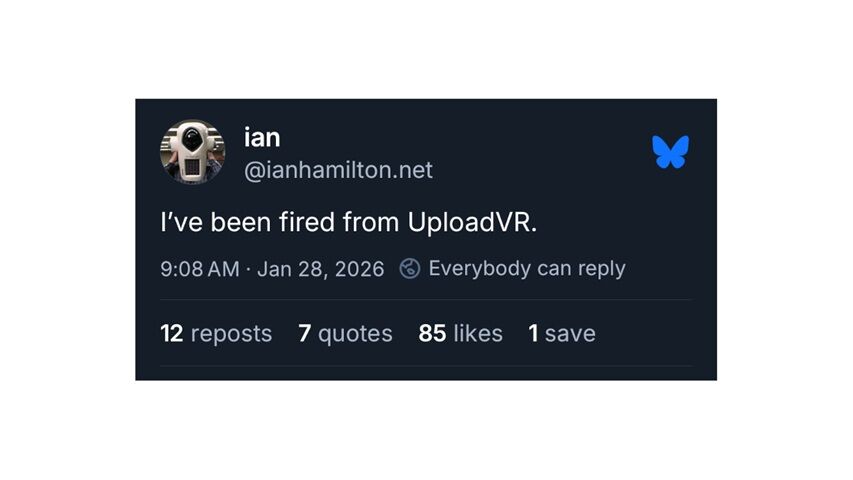
On Wednesday, January 28, 2026, Ian Hamilton announced on Bluesky that “I’ve been fired from UploadVR.” He was the editor in chief at UploadVR, and he wrote a Substack post titled “Ian is Typing” on January 30th detailing how is co-workers were pushing to do a test of a “clearly disclosed AI author for UploadVR,” and that he had three specific concerns that it be brief, for the ability for readers to turn off and hide all AI-authored posts, and for human freelancers to have the right of first refusal. Hamilton claims to have tried to raise these concerns in the context of Slack, but that the experiment was going to proceed regardless. He writes, “Unable to shift the direction of my colleagues and out of options to affect what was coming, I stepped out of Slack and sent a final email to them on Wednesday morning with a number of my contacts in the industry copied, raising some of these concerns. Not long after, I was called by my boss and fired.”
I spoke with Hamilton last Friday after his Substack post in order to get more context that led to his departure. Hamilton claims that UploadVR Editor & Developer David Heaney and UploadVR’s Operations Manager Kyle Riesenbeck were behind the push to test this clearly disclosed AI author on UploadVR, and that ultimately the proposed test was a business decision made by Riesenbeck. It was a decision that Hamilton ultimately disagreed with, and he cites it as the primary factor that led to behavior that ultimately led to his firing. (UPDATE Feb 5, 2026: It is worth noting here that UploadVR has yet to run this AI bot author test, but that it was the proposed test that was the catalyst for Hamilton’s behavior).
The specific reasons and circumstances around Hamilton’s firing are publicly disputed by Heaney, who reacted on Twitter after Hamilton’s Substack post went live by saying, “It is indeed only one side of the story. And an incomplete telling of it, with key omissions and wording choices that serve to paint a misleading picture.” In another post Heaney says, “I can’t get into it more at this point for obvious reasons, but don’t believe everything you read, especially a single side of a complex story.” I asked Hamilton for his reaction to Heaney’s claims that he’s being misleading during our interview, and he did provide more context in our conversation that lead up to his firing. Ultimately, it does sounds like the proposed AI bot author test was the primary catalyst for Hamilton, and that this disagreement may have led to other behaviors and reactions that could also be reasonably cited for why he was fired. UploadVR may have a differing opinions as to what happened, but no one from UploadVR has made public comments beyond what Heaney has said on Twitter. I have extended invitations to both Riesenbeck or Heaney to come onto the podcast for a broader discussion about AI, but nothing has been confirmed by the time of publication.
My Personal Take on AI: Technically, Philosophically, Legally, and Culturally
Public discourse around AI has split into a binary of Pro-AI vs Anti-AI, and while my personal views can not be easily collapsed into one side of the other, I’d usually take the Anti-AI side of a debate if given the opportunity. I do think some form of AI is here to stay, and will be around for a long time, but that right now there is a lot of hype and deluded thinking on the topic. I see AI as a technology that consolidates wealth and power, and so a primary question worth asking is “Whose power and wealth is being consolidated?” Karen Hao’s The Empire of AI elaborates on how the past patterns of colonialism are replaying out within the context of data and the field of AI, as well as how scaling with more compute power has been the primary mode of innovation in AI, and that Gary Marcus has been pushing against the “Scale is All You Need” theory for many years now.
Technically speaking, I’m more of a skeptic in the short-term around LLMs along the lines of Stochastic Parrots critique that is elaborated upon by Emily M. Bender and Alex Hanna in The AI Con book, but also Yann Lecun’s call for more sensory grounding, as well as Gary Marcus’ calls for more neurosymbolic cognitive architectures. AI has always been a marketing term as elaborated by Dr. Jonnie Penn’s Ph.D. thesis on “Inventing Intelligence: On the History of Complex Information Processing and Artificial Intelligence in the United States in the Mid-Twentieth Century.” My perspective on AI has been informed by 122 unpublished interviews with AI researchers, many of whom also cite how the empirical results often outpace the theoretical results (i.e. there are often benchmark improvements without full knowledge around the theoretical foundations behind it leading resulting in plateaus rather than monotonic progress). I’ve also spoken to over 100 XR artists, storytellers, and engineers about AI on the Voices of VR podcast over the past decade. When the context is bounded, and the data are gathered while being in right relationship, then there can be some real utility. But there’s also many gaps and ways that LLMs cause harm to marginalized communities. See the film Coded Bias for more details on that front.
Philosophically speaking, Process Philosophy has had a big influence on me, and so check out my conversation with Whitehead scholar Matt Segall on AI. Timnit Gebru and Émile P. Torres’ paper on the TESCREAL bundle has also been a key influence that deconstructs the influence of philosophies like Transhumanism, Extropianism, Singularitarianism, Cosmism, Rationalism, Effective Altruism, and Longtermism on AI research. I don’t think AI is conscious, but I lean towards Whitehead’s panexperientialism, which sees experience as going all the way down. This perspective also helps to differentiate humans from machines by looking at things like emotions, meaning, value, intention, context, relationships, all of which can easily get collapsed if only looking through the lens of “intelligence.” I’m curious about Data Science as Neoplatonism ideas, and Michael Levin’s work on ingressing minds (influenced by Platonic forms and Whitehead’s eternal objects) and his general calls for SUTI: the Search for Unconventional Terrestrial Intelligence. I also love Timothy E. Eastman’s Logoi Framework as elaborated in his Untying the Gordian Knot: Process, Reality, Context book. He highlights the triadic nature of reality being input-output-context, and the logic of actualizations being Boolean logic and the logic of potential being non-Boolean logic, which is something that Hans Primas elaborates on in Knowledge and Time. So AI needs to account for the pluralism of non-Boolean realities, but often collapses them into a singular formal system that collapses situated knowledges. Also see James Bradley’s “Beyond Hermeneutics: Peirce’s Semiology as a Trinitarian Metaphysics of Communication,” which elaborates on Charles Saunders Peirce’s semiotics as being a triadic system that includes a sign, object, and interpretant, and LLMs take a nominalist, dyadic approach that collapses the deeper meaning or interpretation (see computational linguist Bender’s elaboration of this argument in The AI Con). Also see Michèle Friend’s Pluralism in Mathematics: A New Position in Philosophy of Mathematics as it applies Gödel’s Incompleteness to the foundations of mathematics itself and points out the limits of Boolean logic, and the need for an overall paraconsistent logic. AI researcher Ben Goertzel wrote a paper on “Paraconsistent Foundations for Probabilistic Reasoning, Programming and Concept Formation.” Here’s a talk I gave with some of my preliminary thoughts on AI. I also have a lot more thoughts and resources in my write-up from when I argued against AI in a Socratic debate at AWE 2025. Also check out this recent philosophical talk that digs into some of the philosophical foundations to my experiential design framework and Whitehead’s panexperientialism.
Legally speaking, I generally advocate for a relational approach as well as open source, decentralized approaches, but also I see that there’s a need for some legal checks and balances around privacy. I elaborate on these in a paper titled “Privacy Pitfalls of Contextually-Aware AI: Sensemaking Frameworks for Context and XR Data Qualities” that was written for the Stanford’s Cyber Policy Center’s “Existing Law and Extended Reality” Symposium. But there is no sign of any new comprehensive federal privacy law in the US, which is where these major Big Tech companies are located. So the privacy implications of contextually-aware AI remain to be extremely fraught, especially with the trend of democratic backsliding in the US and beyond.
Culturally speaking, I find the forced integrations of AI into many layers of UX / UI to be largely non-consensual and with me being left with the feeling that AI is being shoved down my throat when I didn’t ask for it and usually avoid using it whenever I can. I don’t want AI to write for me, because writing is the process of thinking for me, and I’d rather think for myself (see “thinking as craft” argument from Hanna in The AI Con). I do find the experience of AI slop videos, photos, and text to be profoundly dehumanizing and makes me want to retreat from any social media space where AI slop is flooding the feeds. I hate the experience of having to question the provenance and legitimacy of everything I see and hear, and the AI-driven misinformation campaigns are a blight on democracy. I really resonate with the view that AI is the Aesthetics of Fascism considering the extent of how authoritarian leaders are using AI slop to push their democratic backsliding agendas.
So my perspectives on AI don’t fit neatly into a single category, but I do resonate with some of the Anti-AI, Neo-Luddite sentiment. I’d point to Emily M. Bender and Alex Hanna’s The AI Con book, Karen Hao’s Empire of AI, Shoshana Zuboff’s Age of Surveillance Capitalism, and Nina Farahany’s Battle for Your Brain as references that have deeply influenced my perspectives on AI.
Conclusion
My conversation with Hamilton brings the larger issue of AI and how it is used in the context of an independent news site in 2026 to the forefront. Even whilst the details of his departure are being actively debated, it seems clear to me that the conflict around AI and how it is used was a major catalyst from Hamilton’s perspective. I’m largely sympathetic to the larger issues that Hamilton is bringing up, while also being aware that UploadVR employees are claiming his take to be an incomplete telling, and that Hamilton may be referring to AI technologies and processes that UploadVR isn’t ready, willing, or able to speak about publicly yet, especially considering that their AI bot author test has never been run. So this conversation is one side of the story of how it came to be that Hamilton left UploadVR, and I have an open invitation for UploadVR to share their visions of AI and how they see it fitting into their technology stack, the context of a news site, and within the broader XR community.
This is a listener-supported podcast through the Voices of VR Patreon.
Music: Fatality
Podcast: Play in new window | Download
Rough Transcript
[00:00:05.458] Kent Bye: The Voices of VR Podcast. Hello, my name is Kent Bye, and welcome to the Voices of VR Podcast. It's a podcast that looks at the structures and forms of immersive storytelling and the future of spatial computing. You can support the podcast at patreon.com slash voicesofvr. So in today's episode, I'm featuring Ian Hamilton, who is the former editor-in-chief of UploadVR, and on January 28th, 2026, he announced that I've been fired from UploadVR, and I'm going to be talking to him around the surrounding circumstances of what happened, get his side of the story. And he wrote a post on the Substack. He's got a new Substack called goodvr.substack.com. And on January 30th, 2026, he talks about how his coworkers at UploadVR were planning on deploying a test of a clearly disclosed AI author on UploadVR that sounds like it was going to be taking in press releases and digesting them and basically putting it in next to other articles within UploadVR. At least that was the concern that Ian had was that he said, okay, if we're going to do this, then we need to obviously clearly label and disclose that, which that was already kind of a baseline. But he was saying that he also wanted it to be brief and He wanted it to have an option for the readers to turn it off if they wanted to not see any of this AI authored content. And then finally, he wanted to have the ability to have a human the right to first refusal to turn down a writing assignment and then have the bot go do it. So Ian had some pushback. He had trouble communicating a lot of his concerns within the context of Slack. And then he says in his post, unable to shift the direction of my colleagues and out of options to affect what was coming, I stepped out of Slack and sent a final email to them on Wednesday morning with a number of my contacts in the industry copied, raising some of these concerns. Not long after, I was called by my boss and fired. And I had a chance to talk to Ian on that same day that he released this sub stack. And then during our conversation, David Heaney, who was one of Ian's coworkers, who it sounds like he was the one who was creating the spot and pushing it forward along with Kyle Reisenbach, also known as Rev and Kyle back in the day from the RevVR podcast. So David Heaney on at Heaney555 said on January 30th, it is indeed only one side of the story and an incomplete telling of it with key admissions and wording choices that serve to paint a misleading picture. So I wanted to talk to Ian to get his side of the story. And then the first half of this conversation, we give some of the broader context as to what's happening in the XR industry, this kind of move and push towards AI. What's it like to work in a virtual workplace where everything is mediated through text and Slack windows? And then the second half, we really dig into what happened with the AI bots. That sounds like as editor-in-chief, Ian would not have any editorial control over these AI bots. And then also the impact. in terms of what does it mean to have AI-authored content that's at the same level as some of the other articles on UploadVR. And so there's these larger discussions around, like, what's it mean to be human? To what point is the technology adopting intelligent-like, human-like behaviors? And to what degree are humans treated like robots or AI? There's a underlying dehumanization that can happen with AI, but there's also this other side of the proponents of AI that are pushing it forward that are seeing all these potential benefits and integrating all these new capabilities within all these platforms. It definitely feels like we're at this beginning of a new immersive cycle where there's all of these factionalizations of people who are anti-AI and pro-AI. And myself, I'm sort of more on the skeptical camp. And, you know, if I were in a debate, I'd probably take the anti-AI stance just because there doesn't seem to be a lot of checks and balances. It's not in right relationship. There's a lot of data colonization that's happening. And there's a lot of ways that large language models are hallucinating and getting facts wrong. And there's certain populations are disproportionately affected by the types of gaps that are not necessarily always captured within large language models. And that There's not these sophisticated neurosymbolic cognitive architectures that are not in there as well. And it doesn't really embody these kind of relational ontologies of being in right relationship to the world around us. And so it seems to be a tool of consolidating wealth and power. So I just have a lot of critiques around how there's been this sometimes uncritical integrations of artificial intelligence into various contexts. I have an interview with Emily Embender and Alex Hanna back in episode 1563. They wrote a book called The AI Con, which I think sets a lot of the foundational perspectives of my views on AI. But I've also talked to over 100 people in the XR industry and artists and storytellers. And AI is obviously a tool that has narrow applications, that has utility and pragmatism. but also kind of weighing that against the harms that are also there and this larger kind of ethical issue of what's it mean for a news organization to start publishing AI authored content in a way that is the same type of headlines that are right next to human authors. Like who's writing the headlines? I mean, there's a lot of open questions and hopefully I'll be able to have somebody from Upload on the show at some point. I've always wanted to have David Heaney on to explore some of these different questions. But in this conversation, it's going to be Ian's side of the story in terms of what it was like for him to be editor-in-chief and to already be working with these bots for the last nine months of having all of his articles be edited by bots. And also these larger questions that he had as editor-in-chief for how they move forward for how to potentially integrate some of these different large language model AI bots within the context of a news organization in 2026. So we're covering all that and more on today's episode of the Voices of VR podcast. So this interview with Ian happened on Friday, January 30th, 2026. So with that, let's go ahead and dive right in.
[00:05:37.625] Ian Hamilton: My name is Ian Hamilton. I'm an editor, writer, journalist. I've been covering virtual reality since... Oh, the early 2010s. I can't put a date on it now exactly when I first started writing about it because I did write about it before Oculus. It just wasn't that big. But we're talking Eon Reality and Disney. I did stories on them doing VR technology. Prior to Oculus, and then Oculus was a local startup to me when I was at the Orange County Register in 2012. So I basically got to cover their first two years as a daily technology reporter for a major metropolitan newspaper. My articles were some of the first to be a mainstream organization to believe in VR technology. Like my first big story was on the front of the business section of the Orange County Register. And it was really pretty early on in their fundraising when I got that story on to the front of the business section. And I think that particular article helped legitimize the effort a little bit to, I don't know, at least the local Orange County community where I was and maybe a little bit more broadly. But yeah. I went into a demo with Brendan E. Reeb and I met Palmer Luckey over there with a disassembled gadgets over by his desk. And they gave me the first duct tape demo like that summer of 2012. And it was life changing to do that demo and then also have to come back and be a neutral journalist about it as well.
[00:07:10.572] Kent Bye: Yeah. Yeah, well, we're coming together because there's been some changes and shifts in your professional life working with UploadVR back on January 28, 2026, which is a couple of days ago at 9 a.m. You said to Blue Sky that I've been fired by UploadVR. And I want to dive into that. But before we dive into what happened, I'm wondering if you'd be willing to give a bit more context as to your journey into VR. You already shared a little bit of your early beginnings, but... You know, this is a nice moment to kind of reflect on your time covering the XR industry as one of the few professional journalists that have been working full time in the space for as long as anybody out there. It's like Ben Lang is probably out there for Road to VR, but you and him have been writing about this for a really long time in a professional capacity. So I'd love to hear that. A bit more context as to how you make sense of your journey into this space. And then, you know, we'll get into your crossroads and where you are going to be going here in the future. But I'd love to kind of look in the past and how you kind of describe your journey so far.
[00:08:11.154] Ian Hamilton: Oh, that's a big area. I think I have to start off by describing the fact that I'm a journalist in my heart in a very deep way. there's just a curiosity in me that is unquenchable. You know, it is quenchable, actually. There's certain things I do learn. I've learned not to investigate because they're too painful sometimes. But at the same time, I say that, and I'm sure I just alerted some of your readers, like, a journalist doesn't do that. A journalist is always curious. And that's the basis of me beginning here, Kent, of saying virtual reality is... is a place for us to do things we couldn't in the real world and so like that's the beginning of virtual reality right like the beginning of virtual reality is enabling you to do things you couldn't do physically and so like that's the beginning of all the genres of all the things that you might want to do is give me superpowers and give me all sorts of fantasies that i couldn't actually do in the physical world. Well, go back to that demo in 2012 with the duct tape prototype, and I'm looking around some simple environment from a video game. And I'm there, right? I'm living inside of the video game that I played a few years earlier. And that never leaves me, that spark of, yes, this is the future. This makes sense. Everything feels like magic, right? So I could do that demo in 2012, and then you go forward several years, and I'm just looking for excuses to write about VR. And the newspaper I was at, the Orange County Register, held layoffs. So this was 2014, and this was very close to the time that Oculus was bought by Facebook. So I had just got one of my first front page articles about Oculus. So over those two years, I had been able to move coverage of VR from the business page to the front page of the newspaper, only because Mark Zuckerberg showed up and spent $2 billion on on the venture. But I did it, right? I finally got my front page articles, and they were good front page articles. But I finally got to do it. And then these layoffs come. And I learned so much from those editors who respected the newsroom, respected the people who came to work in the newsroom, The work that goes in that you don't get paid for beyond hours. I remember in that time frame, I think I'm free to probably talk about this now. One of the editors of the Orange County Register called a meeting and he pulled out a big chart in front of the whole newsroom, all the 20, 30, 40, 50 reporters and photojournalists. And he pulls up this big whiteboard and he draws two arrows. One arrow is going down. And he says, this is our print revenue. And he does one arrow going up. And he says, this is our digital revenue. And at some point, the digital revenue is going to overtake the print revenue. And that's where we're going. And it was an enlightening conversation. I was so thankful for him to explain that to all of these journalists. But it didn't change the overall economic forces that every six months or a year, they're going to lay off another round of journalists working at a print newspaper and try to put them into producing for digital content. And getting enough money from the digital content to employ all of these people. So that was one editor who explained that thing. Another editor comes out and gifts the entire staff. There was a period at the Orange County Register where a new investor came in and bought the company. and invested an extraordinary amount in journalists and journalism in the Orange County area down in Southern California. And it was a remarkable time to see that up front. The year is like 2013. And they are increasing the number of pages in the print newspaper. They're adding new print publications to try to unify this whole Orange County community and speak to them all and turn this around, this overall trend. Well, they had about a year at that, and clearly the money was running out from their investment. And all this hiring they had done of very expensive journalists from all over the world, that time was coming to an end, and they were going to need to go start hacking again. And so the editor, this other editor, calls us into a room and says, my gut tells me we're going down to X number of journalists in the next year. And we're having to cut this many today. And I've negotiated a agreement with the owners of the company to get you all like a week of severance for each year you've been with the company. So that whole long story is to say that was my context around taking my final paycheck from the Orange County Register. I took that buyout. And I got my five weeks of pay for five years of employment at the Orange County Register. And I believe I bought a PC, a big hulking PC to drive the DK2 I'd already bought for myself with that final check. So that was the beginning of me trying to be independent from about 2014 to 2015 and just see what I could build on my own as a freelancer. I started a newsletter with my friend covering VR news. And then in about middle of 2015... I'm seeing Road to VR and Upload VR gaining traction in the community. Their blogs are starting to get circulated quite a bit. And I got invited by Oculus PR to come to the announcement of the Oculus Rift, the formal unveiling of the consumer Oculus Rift. So they've got years of development already through two Dublin kits. And now they're ready to announce the final thing. And so I drove up to San Francisco with my family, got dropped off as they just parked somewhere and went inside for the two or three hour Oculus event. And when I was there, I met one of the founders of UploadVR. And I'm sitting there for myself, trying to photograph and cover this event for myself. And the founder is sitting right next to me and asks me if I can take photographs for him for free. He doesn't offer me any money. He just asked me if I would take his camera out of his hand and take pictures for him. I basically laughed at him and said, no. And from there, I got hired. So that was the beginning of a conversation that ended up being a freelance agreement where I was producing. They wanted me to produce 42 articles per month, counter-offering against me over doing 40 articles a month. I agreed to do 40. And they just wanted to push it just a little bit further on me. And they wanted 42 because that's the Hitchhiker's Guide to the Galaxy number. You can tell I'm a little irked about that all these years later. Because I couldn't even get across then, it's not about the volume. It's never about the volume. It's always about the content. It's always about the quality of the content, the words that you're putting on the page. But that's what they need. They need to fill the site. They need to keep those regular viewers coming back. And I mean, that's my 10-year struggle here at UploadVR, to go from this freelancer to the editor-in-chief who's managing content from multiple staffers who are on different continents, different time zones, etc. Yeah, so an exhausting journey when I look back on it of just struggling, struggling, struggling to raise up voices and places inside VR that are going to be around for a while. Like, it's wild to think about in retrospect, things like Echo, right? I'm live inside of virtual reality on Upload VR's YouTube channel when Meta announces they're closing down virtual reality when they announce Echo Arena is being shut down. And so there's live video out there of me reacting to one of the biggest failures, one of the biggest misses, bad decisions that Meta has made over the years to shut down one of the places in virtual reality that people wanted to go in Oculus headsets. Come off of my journey and go back to Meta's journey. I see so many mistakes over the years. But think about that as a journalist watching it. I'm investing time and effort and resources into covering Echo Arena because, holy crap, it's got a community. There's real people loving this thing. So it goes to the top of our list of coverage. Whenever anything happens in Echo Arena, we're going to be on it. We're going to be on it. And then Mena just comes around one day and says, Echo Arena is an idea of the past. We're done. And so all that investment in trying to become experts in that community, connections in that community, be the site that becomes the place that Echo Arena fans want to come read We couldn't do that. It all dies because of a decision out of our control. And so there's such a small example here of how our coverage decisions were always influenced by the elephant in the room of meta. They closed down a whole area of VR that we were interested and excited to cover. And now we're going to cover what they put in its place. So, I mean, all right. So I've talked for a lot here. Did that answer your question?
[00:18:39.836] Kent Bye: Yeah, that's a really great context because, you know, I think through and through you're a shoe leather journalist who's out there really doing the work of investigating, doing reporting. And I think of you as this kind of quintessential journalist of the XR space. And really also the editor in chief for UploadVR for the past decade or so that you've been there, that Upload has been at the cutting edge of covering all of the breaking news, I'd say. Rodeo VR has less of a clip in terms of their frequency, but in terms of the news of the day and covering, I've been able to, in the past, rely upon Upload VR covering all the biggest news in the XR space. And so you've done a great job of doing that. And I think bringing in and invoking meta... And their stewardship to the XR community, they've had a very transactional relationship or ways that they aren't necessarily in relationship to the community in a way. I go back to Oculus Share and then the way that they treated the Gear VR and Oculus Go and how they kind of cut off those relationships and just kind of shut that down. and also Echo Arena, it always gave me this sense of someday they're going to have something similar to the Quest ecosystem. And we've kind of seen the beginnings of that. I don't know to what extent they're going to be fully committed to VR and XR. They're basically shut down all their gaming studios, had a bunch of layoffs. But they had this huge pivot towards AI, which I think is kind of a theme that is maybe rippling through what you're alluding to, this shift from the XR into more of the AI focus with their AI glasses. And there's Gemini and Google. And basically, there's a lot of excitement, the tech companies around AI and the potentials of AI. But also, the other side, a lot of people who, like me, as an everyday user, every time I have an opportunity to say, no, don't give me the AI, I always click it off. And it's like intrusive user interfaces that I feel like AI is being shoved down my throat. And I feel like I'm in a world where... even just scrolling on social media, I now have to constantly ask, is this real or not? Or is this generated? Is this, what's the provenance of this? And so it's maybe not want to spend as much time on the social media, ingesting all that, but also, you know, at AWE, I was on a panel that was having a Socratic debate around AI and I was debating against AI. And so I've been kind of a critic or skeptic towards the AI turn. And I've been more hesitant or it's made me uneasy to see the larger xr industry kind of like fully adopt these ai concepts and to be like a whole like trajectory of where things are going that just make me completely uneasy so anyway i'll hand it over to you and get some of your take on on that oh goodness there's so much kent um there's so many places i can take that prompt um let's go with
[00:21:27.879] Ian Hamilton: Imagine me trying to be a balanced person, balanced journalist, always trying to see both perspectives. And imagine me working at a place where I have an AI maximalist on one side of me and a no AI person on the other side. And I'm in the middle going, what is the usefulness of AI to an online publication in the year 2026? And I still don't know. I've been shown lots of really interesting ideas. UploadVR had a... I don't know if I can say it since that would be proprietary to them. So I won't say that since that's probably their secret to tell. But I mean, I've been edited by a bot for the last nine months.
[00:22:18.656] Kent Bye: Oh, wow.
[00:22:19.753] Ian Hamilton: so yeah think about that all right so what this means is i turn in a story and the system tells me if i got any facts wrong or had any spell check problems so i get an update i get i get an update that says you had this name spelled wrong in slack i go make that changes or i tell the bot to make the changes that's really easy Yeah, this is, I appreciated your human reaction to that, Ken, of ooh. Because like, I need to, how many of your listeners have a workplace that is almost entirely in Slack? And what does that workplace mean to them? What is it like to always be waiting for another co-worker to finish typing what you need to do for them? What's it like to always have Slack, the AI that's in Slack, always observing everything you say on the company network? What is it like to have access to certain channels within your organization, but not others? Because... You'll screw up the flow, right? Like, there are people that I've talked to over this industry, like people that work for Pico, who were kept inside of one channel with inside the larger Pico organization. And it's like, that's not open. That's not like... You really want to work like that? Like, I'm not getting across here. Okay. If Slack is your workplace, and I mean that literally in the sense that you are a remote worker, you don't have a place to go to the office. All right. So your place of work is home with an app on all of your devices. I imagine that you have a very large number of your listeners who that is their life. Their life is a Slack window on all of their computers. And I am dumbfounded by the lack of respect on the part of corporations, large or small, to respect what they're doing to people's personal lives by being that invasive with a technology like Slack, right? So those workers that I'm speaking to that are theoretically in your audience, right, that use Slack and that is their place of work from home, how many of those people have been issued a work phone on which Slack lives? So how many of those people that live inside Slack as their workplace and work from home always leave the house with Slack there, with their workplace always with them? Right. That's the madness of the industry the last 10 years. AI, everything. There's the story of everything, right? We went from working in offices to work from home to VR is going to be the future. And what happened? A whole lot of office spaces closed and people moved into Slack. And in theory, you get to choose your hours, you get to choose exactly when to get your job done. And so you can arrange everything around this little window in theory. In practice, I would love to hear from your viewers to my email address or my site that I'm doing now, whether I'm making sense to them, right? Like, How many of you folks out there working in the VR industry have two phones? How many of them have been issued to you by your company? Have you been able to keep that workplace from invading or commanding your entire way of life, right? I imagine that there's more than zero in your audience who have the same kind of difficult relationship with the way work from home has revealed itself, right? So that's my initial response to your, like, what is the... You're talking about AI there. I could talk about meta. I can go over to... what they're doing.
[00:26:31.571] Kent Bye: Well, let's, because of the imminent event of getting fired, let's get into that and then unpack that for people who are listening and being like, what the hell happened? You wrote up a post on your sub stack that was called Anna's typing. And basically when you're typing, there's a phrase that says like Anna's typing. And so there's been a lot of times that you've been in this Slack environment, you're setting the larger context of communication context. Yeah.
[00:26:57.560] Ian Hamilton: All right, so I mean, like, that's my workplace for 10 years is I communicate with my coworkers through Slack. I beg them for phone calls. You know, I'm trying to get on the phone and have anything, right? The most human contact I have had some weeks at Upload VR has been on the VR Download podcast. So the only time I ever see my coworkers sometimes is on that podcast. And I need to point out how socially isolating that is at the same time it is empowering in other ways. So when you're talking about AI, it's not so different when you start thinking about the larger picture of this. One person going, I feel so darn empowered by this. And the other person going, I feel completely disempowered by this. Yeah, so what happened here in Slack? So I wrote a draft of this and then I edited it down to just what is published on the sub stack. But in the early draft, I shared this story with one of my former coworkers who I... Let me think about this for a second, Kent. Kent, when I'm talking to you on this podcast, I am talking to you in a completely different way. Top of my mind, straight from my heart. I'm going to make mistakes. And I'm going to go off on tangents. Different things are going to pop into my head as I'm trying to express this idea to you. That's not how I write. Right. So the way I write is I just dump all of my thoughts into a window and I hone it down. I cut down. I pick out the words. I rip out the wrong words. I hone every sentence. I delete paragraphs. Right. You take that writing style into Slack and your coworkers have to stare at Ian is typing for hours on end before I finally hit the send button and let you know exactly what I'm thinking and what I think needs to happen here. So like, you give me a window, I'm going to write in it until I'm happy that what I've said is saying all the right words. It's so the completely opposite end of this, right? So what are we seeing today, Kent? Are we seeing a rise in podcasts? Are your numbers doing okay, Kent? Because it seems like there's a rise in podcasts lately. Am I wrong on that?
[00:29:24.187] Kent Bye: Oh, is that a question?
[00:29:25.728] Ian Hamilton: Like in terms of- Yeah, like do you think podcasts as a medium are on the upswing right now?
[00:29:29.770] Kent Bye: Oh, I, you know, okay. When you ask me a question like that, are podcasts on the rise? It's like, well, I know my own experience in terms of like, I know I listen to things, but I wouldn't be able to say this is a general trend.
[00:29:42.510] Ian Hamilton: The reason I asked it is because I would posit that podcasts are one of the last places where you can hear two humans talking to each other on a regular basis.
[00:29:52.880] Kent Bye: Yeah. I feel like podcasts are this last bastion of humanity that As AI takes over everything. But yeah, I get to kind of hone it back into this whole thing around AI. It seems as though there were some AI propositions that were being made. You had some checks and balances that you wanted to make. It sounds like from your interaction with Slack, you have a culture where that is very text-driven, which can be very linear and definite in speaking in real time. You get emotion.
[00:30:22.115] Ian Hamilton: Yeah.
[00:30:23.616] Kent Bye: Well, speaking in real time, you get a way to kind of like tap into the moment in a way that, you know, some people who are programmers and other people see meetings as a waste of time where the end result is like, oh, that could have been an email. But I think there's still a lot of value for making decisions as a group. And I love conversations when I go to conferences, like that's the heart of what I do is to have hallway conversations because there's so much. value that you can get out of these conversations that at the end of it, you find the thread of a story or you get an intuitive hit or you feel an emotional pain where if you're just dealing with the written text, then it's a whole other thing. So you're in this environment and AI is starting to come up in terms of integrating more and more in your workflows. You propose some checks and balances. So maybe you could set that larger context for your concerns that you had around these AI proposals and then what happened?
[00:31:19.199] Ian Hamilton: So, uh, so yeah, uh, upload VR has been, uh, I got to speak more broadly than speaking to them. I've watched AI being used in really interesting ways everywhere. The term AI, it's a tool. And just like any tool, you can be good with that tool or you can be really bad with it. And I've seen endless examples of being bad with it. Just so many examples of doing it wrong. And it's all economically driven. There's very few people that are like, I'm doing this because it's genuinely better than the other way in every way, shape or form. It's just like, no, this is letting me do this at a little bit cheaper. And Andrew Bosworth is out there with quite a heavy quote somewhere on one of his podcasts that I just need to point out to right now. And he's something like, AI is a better pattern finder than a human. On one of his podcasts, he's talking with someone and he's like, we think of humans as being the top dogs when it comes to finding patterns. And no, that's not true anymore. That's actually AI. I think about that comment from him and like, what does that mean? How significant is that? If robots can find patterns better than humans, how dead are we?
[00:32:48.986] Kent Bye: I wanted to just jump in and give a broader pushback to that quote. In my conversation with Alex Hanna and Emily Inbender, they wrote a book called The AI Con, which I think for me was a real canonical piece of pushback towards the AI hype. And one of the big arguments that they're making in this book is that there's a tendency to translate human into computing metaphors so that we kind of reduce the humanity down into a computer so that you can equate computers to humans and And make these types of comparisons that are totally dehumanizing. Humans are much more than just pattern matching algorithms. We are humans. We have emotions. We have intentions. We have relationships. We have context. We have meaning. All these things, AI is collapsing. And so I just wanted to push back towards this broader framing of AI that is totally dehumanizing. It's one of those things where... I feel like we're in the midst of this huge AI bubble that is inevitably going to pop at some point because the experience of it for so many people is just they don't like it. They don't see benefit. In 2016 and 18, I went to the International Joint Conference of Artificial Intelligence because there was so much AI that, you know, AlphaGo had happened and people were talking about it. And I feel like there was a similar kind of wave of AI that happened in that context. period when all the vr was launching it was kind of like a zeitgeist of a moment as it were and i think now i feel like we're at the beginning of a new immersive cycle because it does feel like the sands are shifting we have people that are launching new things that are probably be the baseline of platforms for like apple and google and you know we have steam coming out with an open source linux version and you also have companies like meta who are turning to this ai glasses which i feel like this whole idea of surveillance capitalism and privacy i feel like with the way that we're going we're basically like just going all in and not what is the play what is the best place in virtual reality to you right now ken
[00:34:49.814] Ian Hamilton: What is your favorite place to go? What is your favorite destination? Give me a world.
[00:34:54.100] Kent Bye: Dr. Morrow. Okay.
[00:34:57.367] Ian Hamilton: You said VR chat. So a giant social platform and a set of worlds inside that social platform is your favorite place to go inside virtual reality. So you put on a VR headset, you got to open an app that says VR chat on it. You got to navigate to the world that you want to go to. And then you got to wait 10 seconds or so for the world to load. You're talking two minutes of travel, two minutes of travel time to go to your favorite spot in virtual reality. Why is it not three seconds of travel time? It should be three seconds of travel time. You should put on the headset and be where you want to be instantaneously inside virtual reality. There's only one headset right now that does that for me. It's the Apple Vision Pro. It's $3,500, and it's the most expensive piece of hardware I have. So I put on the Apple Vision Pro. And I begin in reality. The headset turns on. First, it shows black. Then it fades in the world. And I'm looking at my world through an opaque VR headset that's reconstructing the world using augmented reality or mixed reality, however you want to term it. You know Paul Milgram's chart, right? I'm sure you're very familiar with it, right? Do you remember that chart? Yeah, that the spectrum and on the right side of the spectrum is a virtual environment and on the left side of the spectrum is a real environment. So Apple ships a headset in 2024 that begins you on the left side of Paul's chart. It begins with you looking at the real world. You can take a dial on the top of the headset and dial it all the way to the right, and you are in a virtual environment. You're in VR. You have transferred. You've used the dial to move yourself along that spectrum, that scientific spectrum from the 1990s, the studied spectrum, right? And you've used the dial to move yourself from a real environment to a fully virtual environment. I put on the headset. It wakes up in about five seconds. And then I turn the dial over about two seconds. And now I'm on a moon around Jupiter. And I'm looking at the giant red spot. And if I don't have the patience to realize that the giant red spot is moving, I might not be impressed by this spot on Jupiter, but if I have the patience to just sit here for a minute and just take a deep breath, I'll realize that the clouds on Jupiter are moving as they rotate around the planet right in front of me from my vantage point on the moon around Jupiter. So what I just painted for you is from the moment I put my headset on to finding my favorite place in virtual reality is about 10 seconds. My favorite place in virtual reality is that moon around Jupiter. And I haven't even described all the things I can do in the moon around Jupiter. I can pull up the menu and I can change the speed of time. I can change the speed of time. I get frustrated saying sentences like that because I just described science fiction magic. I can press a button on the user interface and Jupiter's clouds move faster than they did before. And so if I don't have the right amount of patience to watch the clouds around Jupiter move in real time as they actually do, I can change time in virtual reality and make it move to my liking. And that's being demonstrated right there in this home experience of Jupiter. All right, so I've just told you how smartly Apple has positioned itself along that spectrum. How has Meta done with its positioning along that spectrum? So they have the Meta glasses that are on the left side of that spectrum. They're doing just real world. You're only seeing the real world. And they're going to stuff AI to the gills. to try to provide you services that you want to use while looking at a real environment because it's too expensive to put the displays in there. So they're selling millions of these things and they're pumping AI into this left side of the chart. The Vision Pro, I have to log into my Apple account in order to use it. I hate that. I hate it. It's the most closed off you can possibly be. It's also true that Meta is the same way. It's also true that Android XR, I had to log into Google to get into that one. So, like, you know, I have to log into all of them.
[00:39:41.007] Kent Bye: I'll just say that Valve is coming out with a Linux version, which I think is going to be the antithesis to all that.
[00:39:47.441] Ian Hamilton: Right. Yes. Thank you, Kent, for pointing that out because that's the minefield that Meta walked into. That's their mistake on planning right here. And this is what I'm trying to get at here. All right. So I put on my Apple Vision Pro. I'm in my virtual environment on the right side of the chart. I am essentially in a place that is all platform, right? It is all Apple provided. I cannot go there unless Apple gives me permission, like grants my eyes access to the headset, and then its UI lets me get there. It's all Apple provided. It's all closed. It's all Apple closed. So what I'm saying is Apple in 2024 entered the VR market with a VR headset. that was also simultaneously the best AR headset ever made, and went with an approach that was even more like closed off than the iPhone in some ways, like iris locking to access is, I don't know, that's pretty darn locked down to you. So like you can't see my eye. So like in theory, my eye iris is protected because it's being protected by the Apple platform. What I'm getting at here is that Apple's strategy for entering the VR market was to do the most closed off approach imaginable. And that's the complete opposite of some of the other strategies like Valve that you just introduced. Valve is about to come out with the complete open strategy of VR. So they're going to do the right side of that chart, but they're going to be about as open as they possibly can be. They've said that you're going to be able to install your own operating system on that, that's your computer, your hardware to do with as you please. So on the right side of the chart, Kent, you have a low-cost system. a Quest-like VR headset from Valve that is fully open. You also have a super expensive computing tool from Apple that is totally closed off. The picture I'm trying to paint, if you follow from that chart all the way over here, is Apple and Valve have been first movers on standalone computing platforms based around virtual reality, and they have opposing strategies on the right side of that chart. So Apple has gone the fully closed route, and Valve has gone the fully open route to take over the right side of that chart. What the hell is meta doing? What have they been doing? When did they go wrong, right? I think they went wrong somewhere around 2016, 2015. Like it was a really long time ago when they started following the wrong. So what they started following. So I've tried to paint this picture of openness, closed, right? All right. They kept doubling down on gaming, gaming, gaming. That was the original Oculus Vision. They also had things like they needed to ship headsets that wouldn't break when you drop them. They also needed to like... They don't have repair locations, so they have to make it from certain materials that can be dropped and you don't have to replace them because you don't have a place to go and get it repaired. So there's all these restrictions on how good of a product they can make. If their strategy is... we're going to make a social network out of virtual reality. If their strategy is, we're going to make a social network out of virtual reality, it explains a lot of mistakes, right? You can go hear CarMax comments alluding to this, right? You can see it at every step of the way from like Echo Arenas, Facebook Spaces. They cancel everything as they realize that imposing social interactions on people in virtual reality is not effective. Open. Open is putting together a computer yourself. and then pressing the power button. Or it's bringing your own operating system and trying to get your computer to work. And then when it works, you connect it online, right? And then you maybe pull up a webpage or install an app from a repository online. Where I'm discussing is a difference in where you're thinking a computer begins. Meta made all these assumptions that you're going to have a Facebook account, you're going to have a Meta account. You're going to like doing either of those things. You're going to like using your Facebook account. You're going to like using your meta account. There's all these mistaken assumptions about how to make people use VR more. Sorry, Ken. I've been unable to express my thoughts on the overall situation facing all of these platforms.
[00:44:52.489] Kent Bye: Yeah.
[00:44:53.009] Ian Hamilton: And I had to just... I had to just rant at you here for a little bit. Yeah, I'm curious. Thanks for that.
[00:45:00.293] Kent Bye: Yeah, I'm curious. Did you ever come across Mark Zuckerberg's memo he sent out on June 22nd, 2015 at 1054 a.m. called VR AR Strategy N1? Did you ever read that?
[00:45:11.641] Ian Hamilton: Probably. I mean, it's probably informed some of what I'm thinking here. So if you Google for...
[00:45:17.125] Kent Bye: So Facebook was thinking about buying Unity. So if you Google for Facebook buying Unity, you'll come up with a TechCrunch article. This is ahead of Blake Harris's book, History of the Future. He got a hold of all these emails. One of the emails that he leaked to TechCrunch was this strategy document. So in this email that Mark sends out, he says, I think you can divide the ecosystem, the XR ecosystem or VR ecosystem at that point into three major parts, the apps experiences, platform services, and then the hardware systems. So in my vision of ubiquitous AR VR, these are listed in the order of importance. And so in that, he's saying the most important things are the experiences. The second most is cultivating a viable ecosystem. And then third is getting money from hardware. And he says it's worth noting that Apple has built the world's most valuable company with the high-end vision by reversing that order by getting the hardware done. I think this holds true. Like this was their strategy and they always had this conflict between wanting to develop their own first party apps. There's been all this anti-competitive behaviors that have been alleged over the years to kill any third party applications in their ecosystem or to delay them or to prevent them from existing. And all this general fuckery that Matt has been doing where they've been trying to serve these two masters of like do their own thing and have their own first party apps, buying up all these companies, and then also trying to cultivate a viable ecosystem. But they never really were into that. That was their second priority. And it always showed that they were trying to create all these contracts to always have like the highest grossing apps, have some investment or stake it so they could always be drawing additional profit from that. So I feel like that meta was never really a great steward to the ecosystem.
[00:46:59.088] Ian Hamilton: Because they needed the platform. They needed to be the social connectivity glue. Whatever essays you read from Mark Zuckerberg, like we're going to build a human-centered computing platform. What does that mean, dude? Like you say it over and over again. And here's the thing I like to do with computers. I like to make things inside of my computers. I like to use the computers to make things. And so like... Mark, why do I need to be the center? I don't want to be the center mark. I would like to make things in computers. That's what I'm doing in Apple Vision Pro. That's what everyone who uses Gravity Sketch does, right? But like, again, it's this closed versus open thing. Meta has to be the layer. If meta is not the ground under your feet, it's not worth it to them to invest in the technology. They need to be everywhere inside everything in order to do the same things they've done in the past. And when Zuckerberg says human-centered computers, that's what I hear a code for. I don't hear him saying, I want to enable you to make cool stuff in space. That's not the MetaQuest ecosystem.
[00:48:25.891] Kent Bye: Yeah, I feel like that we're in this space now where the technology companies are also in this place where are they actually liberating us and giving us more sovereignty and agency and autonomy over our lives? Or are they systems of control that are going to be subtly trying to shape us in ways that are beyond our awareness or our full consent? So I did want to come back to the main question of the hour. And I wanted to read my tweet length summary of what happened. And then David Heaney has a response that I just wanted to also read. So you wrote a post on Substack that I highly recommend folks go check out to get more context as to what led up to your firing from Upload. You say that there's a clearly disclosed AI author that was being discussed with the best practices around that. You published three main points. One of that they need to be brief, not go on and on. It needs to be shorter than the press release, in other words. And also an option for readers to opt out of all AI content. So if there's a button that says, don't show me any AI content, you push that button. You don't see any of the AI. So you could just see what's being produced by humans. And then third is that you'd have a human writer write a first refusal. So then you send out this message, you kind of log off Slack, and then you say you get a phone call from your boss saying that you're being fired. So this post has been going around on social media today and, you know, your news being fired and people speculating. So I'm glad to have a chance to be able to talk to you. One thing that David Heaney said is that he says, is indeed only one side of the story and an incomplete telling of it with key omissions and wording choices that serve to paint a misleading picture. So as a oral historian, in the past, I have thrown myself in the middle of these he said, she said types of situations. Sometimes it's impossible from only getting one side. Obviously, there are going to be multiple sides to what is happening here. But what is the best recap of retelling that you can share in terms of why you got fired? What's happening now?
[00:50:18.744] Ian Hamilton: I wrote it, right? And so you started this conversation by saying talking is so different than writing. Yeah. And so I put it into writing as clearly as I could. And now you're pointing out that David Heaney is very carefully choosing his words in writing to pick apart my words in writing. So give me a second just to breathe here and think about where I want to start here.
[00:50:43.325] Kent Bye: Yeah. Take your time.
[00:50:47.952] Ian Hamilton: In college, so I did the daily newspaper in college, and we were given a budget from the advisor of how much we could spend. Let's say it's like $1,500 a month to spend on your staff. And you look at that amount and go, okay, you get the sheet from how the last editor paid out everyone. And you look at it and go, hmm, how shall I improve this? Well, I've got these incredible students that are in my class with me, and they've got these areas of expertise. I know that they want to work on these sorts of things. Let's see if I can make this balance sheet work for all these experts in my newspaper class. And so now I've got a staff of 10 editors all working on the daily newspaper where the previous staff had seven editors. And I've taken a pay cut on my level and given it to these three other writers. So I made too much. I think I made too much money for Upload VR. And what it meant was they needed several hungry writers at the lower end. And I tried to bring those people in again and again and again. I wanted to lean into those people. I didn't start managing those people directly until January 2nd of this year. I had a different staffer, another editor who was in charge of our freelancers, and I worked with them to bring in a bunch of these voices. And that staffer left and I was picking up the slack and now I was doing this directly. I was excited to be doing this directly because I'd essentially just inherited a freelance pool of a couple dozen hand-selected people by the previous staffer who had done this. And they're all hungry and thoughtful and experts in the space now having, in many cases, listened to Upload VR and VR Download and really listened intently to our reporting. And so these people that are in that freelance pool, they're great. They're worth more than Upload VR can pay them. And I'm spending the first three weeks of 2026 working with a bunch of these people to try to figure out how do I pay them what it costs to try out a VR experience. And over the last three weeks, as I was working with these human writers on my own, I felt enormous relief. I felt good about what I was doing. I did some of the best work of my career at Upload over the first few weeks of this year as I worked to spin up these writers with them guiding the content based on what interests them. I was so encouraged by working with these humans and building up what they were doing. while simultaneously knowing that David and Kyle wanted to run this bot author test. And I just felt so alone in trying to rally support for doing things the way I was doing with them. So like, I'm three weeks into the year making individual agreements with each writer to try to accommodate the difficulty of reviewing VR. I had a writer come by my house to wear my Apple Vision Pro because I didn't have an hour to watch a Lakers game. and then four more hours to write about the Lakers game. So I needed five hours to go to the Lakers game and then come out and write about it. Maybe I could have done it in two or three if I really pushed myself. But let's say that's a four or five hour project to go to the Lakers game that's happening in a VR headset and then come back out and write about it. I chose, over the last three weeks, to have a writer come to my house who has just lived in the area, put on my headset that I've paid for and haven't ever been paid back for. Like, I bought it. It's not Upload VR's VR headset. I'm putting this writer for Upload VR in my VR headset at my dinner table to spend this time. He's going to spend the hour in the headset over there, and then he's going to spend however many hours it takes to write. And he's also got to park at my house. So he's got to spend money to come to my house just to park on the street from where I live. So there's all these costs is what I'm getting at. It's time and cost and difficulty. God, your graphics card went out on you in the middle of a review. What the heck? How can you expect to get around that? UploadVR has to go buy you a new graphics card and ship it to you for you to do this review? Like this is the insanity of the VR market and trying to like bear hug it, like cover all of it, right? While all of these things are going wrong and making it harder to do your job left and right. And so like my job has been, like right before this breaking point basically, has been to try to build up this freelance effort And they made this choice to test an AI bot that just didn't sit right with me. It was the wrong decision at the wrong time to try the bot out now. But it was not my decision. It was clearly a business decision being made by Kyle. And that's a business decision I didn't want to go along with. I got fired for that. And that's fair. Because, yeah, I wasn't going to go along with that business decision. And the thing about how it happened, put it in context of that Slack window and begging your coworkers to get on the phone with you for years to talk things out. Begging your coworkers for years to... give us the space to talk through things from time to time instead of having to write it out in a Slack window. That has not been my workplace. My workplace for 10 years has been write it out in a Slack window. And Kent, I don't want to get into the specifics. I don't want to give you the blow by blow, but I know what pissed them off. And I know why. And it feels so personal and so not at the same time. So I'm struggling with trying to be fair and balanced at the same time that I'm not at the very same moment.
[00:57:58.687] Kent Bye: No, I get it. I think I set up this question by having a quote from Heaney saying, no, what you said is wrong. And Heaney is sort of, I've always wanted to talk to Heaney because his entry into this whole industry was notoriously as this fanboy on Oculus that even Palmer Luckey had called out as being kind of insufferable. That said, I think he's amazing and I think he does great work. I just I think he gets into this debate mindset and that he's got a very particular strong view. So anyway, I set up this whole conversation by he said, she said.
[00:58:29.948] Ian Hamilton: Let me be fair. I'm going to give you a blow by blow of how my week went very directly.
[00:58:34.952] Kent Bye: Sure.
[00:58:37.233] Ian Hamilton: I'm starting to begin my planning for 2026. And I'm balancing all of these, you know, juggling all of these freelancers. David is making clear that his bot is coming together, and he presents an example sometime early in the week of the bot-produced article. And what the hell? The bot-produced article, the sample, was about the new vinyl records coming out for Half-Life Alyx. So Half-Life Alyx announced that you can get the vinyl record of the soundtrack to the game. I think you can find that article on UploadVR.com written by a human instead of by the bot that I had a problem with. So I am frantically spending a lot of time in Slack earlier this week trying to get them to see the underlying problems that introducing the bot author will cause to put it alongside all the human authors. I'm simultaneously trying to get across to my boss the complexity of the freelance situation I'm trying to manage. And they kept moving forward with like, they kept saying no to everything I'm saying as well as they're moving forward with it. And so like, I'm starting to panic, frankly, like I can't do this. I can't be part of this. And so I'm reaching out to industry contacts privately, asking them about their thoughts on this. because I need to know what the value is of our authorship to them. And it was actually incredibly eye-opening to go into some of these conversations. And I wanted to relay my learnings from those conversations to my colleagues. Because the example I would use here is imagine you've got a company that knows it's going to produce three DLC content packs for VR in 2026. What is the value to that company of having UploadVR write a hands-on review or impressions piece on each one of those three packs that are going to release throughout 2026? Is it $100 to the company? Is it $3,000? How much value is there in having those articles on UploadVR.com? The reviews might be really negative. The reviews might be really positive. But... it's covered, right? Like your thing is still in the news. That's not how journalism works. We don't promise coverage based on anything. We just follow where the news is. But the thing I'm going at here is, do we send a bot out to write three press release articles about the three releases? Do we have a bot rewrite what the company is telling us How do we rewrite it? And then do we go and assign three people to go do those DLC analysis deep dives? I don't think we do. I think we end up just running the bot. I don't think those three hands-ons get written because the bot has written what the community needs to know about the thing. That's not right. That's not like... This is so in the weeds of how these decisions get made, and I'm struggling so much because, like, what is upload VR to the community? It's the paper of record, right? Like, it's the place you go to to expect the thing you want to see covered, covered. So there's an article on there somewhere that I did last year of Purpsy, I think is his name. He's a bird of VRChat, and he has hacked with the MetaQuest Pro eye tracking. He now has his eye movements attached to the head movements of his bird avatar in VRChat. So as he's looking around with his eyes, his head is pointing in different directions, exactly like a bird is. So now this bird person of VRChat is more embodied and appears more embodied to others because they've used eye tracking to feel like a bird person. All right, that's an article that I saw on Blue Sky and I reached out to Perpzy and they gave me information and I produced a nice little article on that. I don't know how to bottle up that process and repeat it with writers who are in every country on earth on every time zone, have different interests of their own, have different voices of their own, and, I don't know, may not be interested in the story, like, may only be interested in a certain subset of stories. So, like, they had a solution for scaling this. And the solution was to produce a lot of extra space for ads to peer against bots. You suddenly have a whole bunch of bot articles that cost us almost nothing to produce and tons of ad space to put against those articles. The community gets the upload VR paper of record because we've covered everything, not just the subset of things that we're actually able to get to. And in theory, that's a win-win-win for them. But I couldn't partake. I didn't see the budget, right? Like I'm sitting there going, the guy that came over to sit at my table to try my Apple Vision Pro, like that cost him a bunch of money to come to my table to do that. Now I've got to go to another writer and ask them to review something. And I've got to give these people fair rates in completely different situations, economically, time-wise, how they've had to do the work of VR. And again, this is the last three weeks when I'm doing this job for the first time, hands-on, right? So, like, I'm trying to build a coalition, and I'm imagining, like, yeah, I'm trying to figure out how do I get all of these writers to write everything and not leave anything for the pot? while it was such a horrible, horrible time here this last week to be like, I'm the editor-in-chief of a publication. But you don't edit the bots, so you're not involved in this decision. And you're going to affect... When everything happened with Twitter and it became X, a bunch of people left social media altogether. They're not coming back. There's nothing that social media can do to them to bring them back. There's a chance social media as a concept is actually on its way out. You remember there was a time where you could have called Facebook a fad back in 2008 or 2009, and everyone would have laughed at you because clearly Facebook is the future of everything. Everyone is going to be on Facebook. Right? And so go forward 10 years and now Facebook is this legacy thing that is all AI slop all the way down. If you look at AI and the social network that Andrew Bosworth and Mark Zuckerberg have set up in front of those pictures, it's almost like you're layering on anonymizing details on top of photographs and sharing those instead of actual photographs. How insane is that? I just made my normal scene outside my house look like a dystopia because I wanted to. Why? Why would I share the dystopia photo instead of the real photo? And is that like... Hmm. I've operated a large section of the last 10 years trying to follow, the last 15 years, 20 years, trying to accept Mark Zuckerberg's assumptions as right. So he comes up and says, real identities on Facebook, and we're going to verify stuff like that. And you got to use your real name on Facebook. And I'm like, there's a good period there where I'm just like, that will solve a lot of problems, won't it? And at the same time, five years had to go past for me to realize, maybe even 10 years had to go past, for me to realize that attaching everything you do online to your name is actually a bad idea. Yeah. Right? You say yes so quickly to that. But it was 10 years of learning. And now we're on the backswing of that where it's actually like... oh, maybe we should anonymize almost everything about what we do in the U.S. as protection for behavior. Like, Kent, I believe they can figure out body movements from Wi-Fi signals.
[01:08:25.992] Kent Bye: Yeah, exactly.
[01:08:27.006] Ian Hamilton: So we're moving around homes where our Wi-Fi base stations may be tracking where we're going and who's in the house and collating that information with others to fingerprint things that weren't supposed to be fingerprintable. And when you make everything a person does fingerprinted and you track it, you actually start denying them choices. You're starting to funnel them in a direction and deny them another path that they might've been on. And that's the thing I've always been worried about with everything in this market for more than, yeah, it's what I've obsessed about. That's the lurch in my stomach that I felt back when Facebook bought Oculus was, oh God, he did it. He's gonna own the future. Mark Zuckerberg is gonna own the platform of the future. And what I think we just saw with the Quest was, was that his strategy missed some things about what the market needed, why it needed it, and how to grow it. Like it was too forced. Yeah, there was too much forced growth.
[01:09:36.862] Kent Bye: They basically did all these anti-competitive behaviors to put everyone else out of business.
[01:09:41.803] Ian Hamilton: Sorry, every time you bring up anti-competitive, I have to mention big screen. Big screen was in the ecosystem. And Bosworth demanded 30% from tickets of movies sold inside big screen. It completely killed the business model. This allowed big screen from making blockbuster within the meta ecosystem. So we could have had blockbuster video stores to go rent movies from inside of the Quest ecosystem. And you and I could have gone down the rows at Oculus Video, or whatever you end up calling it, and picked our movies and watched them together in their ecosystem from big screen. But Meta said, you've got to pay up. you have to pay your dues as part of our current policies right now, while making loopholes for other people to get through. What does Big Screen Go do? They build their own headset. They were pushed out of Meta's ecosystem. What they left inside Meta's ecosystem is a shell, their software shell for the big screen software. And you can go and get it for free and enjoy any movie at any... Like you go into big screen on a quest today, you will find a movie or a television show playing in a movie theater. And... There won't be anybody talking. The voice chat will be turned off for the room. And you can watch a TV with the slight subtle social feeling of being with other people. That was all that made sense for big screen to leave inside of the ecosystem once Meta closed off this business to them. And so what do we have? We have big screen on its second headset, and it's a super slim design. It's PC-oriented. It's still using the old base stations, but it solves the problem that NoQuest solves in being light on your face. And I guarantee you, the next headset that Meta ships is going to be light on your face. It's going to try to push the market past where Steam Frame is about to put it. So they're going to try to make something that's lighter than Steam Frame, does more than Steam Frame, and does more than Apple Vision Pro. And we'll see if they get there and on what timescale, right? But what I'm just demonstrating for you is that Meta learned... that they had the wrong hardware by ejecting big screen from the ecosystem and then realizing a bunch of years later, oh no, our headsets are too heavy.
[01:12:32.202] Kent Bye: Yeah, and they've been essentially operating as a mob boss after they put everybody else... Imagine the other route.
[01:12:41.632] Ian Hamilton: Imagine they had invited Big Screen in and made some kind of an agreement that it benefits Big Screen. Big Screen still makes a profit on its sales. but they're allowed on the store. There would have been indications of movie watching inside the meta ecosystem that Bosworth and Mark Zuckerberg could have used to determine the designs of Quest 2, Quest 3, Quest 3S. All those headsets could have been designed differently. if the ecosystem had a Blockbuster Video store in 2019 or 2020. But we weren't allowed to go to Blockbuster Video in the Quest ecosystem. It's all gaming, gaming, gaming, gaming, gaming. And because they've made that bad decision of keeping Blockbuster Video out, they're not getting any useful data that, oh, wow, people like watching movies in VR an incredible amount. Maybe we should invest in big screen and cooperate with them and grow with them. They didn't do that, did they?
[01:13:47.236] Kent Bye: I think this goes back to this memo, why I think it's so important that Mark Zuckerberg wrote on June 22nd, 2015, where he laid out that the first party apps were the most important. The second most important was supporting the broader ecosystem. So in my coverage of Meta over the years, I've come to find out that there were certain protected things that Meta had aspirations to. Maybe they wanted to do that and they wanted to own it. And if that was in their list of things that they wanted to do and they wanted to own, then you were not going to get onto the store and a number of different tactics to try to copy and clone or buy out. So this conflict of interest of having first-party apps versus supporting a third-party ecosystem is... It's basically the thing that Meta cannibalized themselves because they basically pushed everybody out doing all these tactics. I mean, just even discussions I've had from people in the enterprise market, the type of shenanigans that was going on there in terms of like trying to get information. If you weren't like a partner, like what's your business model? How many customers do you have? It's like, that's the type of information they don't need to know, but yet they're trying to mine all this information to kind of like undermine the It's like a mob boss. They're acting like they're not operating with any type of ethics or values or principles. It's just all around power and money.
[01:14:59.031] Ian Hamilton: It was about owning everything. It was about trying to be the only provider of the virtual reality platform. And they failed at that. I would like to write a whole book about why they failed at that. I think there is at least a whole book about why they failed at it. And when I say that they failed at it, that they can still succeed. They were so far ahead.
[01:15:19.626] Kent Bye: They still have plenty of time. I think they've burned a lot of trust and goodwill in the industry. And also, they have so much cruft in their systems that's not built on a solid foundation it's basically like a lot of backwards incompatibility it's just a lot of things that just don't work it just breaks all the time that shouldn't break they kind of abandon their operating system and then from that they're porting all these things on top of something that just feels like a frankenstein that's not coherent so i don't have faith that they're going to come out on top or even maybe even as a viable player given that as a beginning of this new cycle they seem to be more interested in these ai glasses And then in talking to people, it seems like some people are relieved that they're not going to be like interfering with the market in a way that they have before. Maybe there'll be a bit of reset for things that aren't being artificially propped up with all this kind of mob boss behavior that they've had. And now I'm saying all this in a way that is more candid that I've been in the past. I've had many people whispering and telling me things over the years that they don't feel comfortable talking about. But I think that now that meta is starting to take a step back, you're probably going to have a lot more people that feel comfortable and like, Oh, here's all the fuckery that's been happening over the last decade.
[01:16:28.994] Ian Hamilton: Yes. I mean, that's what, that's what made the bot coming now so painful. Right. That's what sent me into this panic of like not being able to communicate with my coworkers and, of just, are they not seeing that we're in this new era? Are they not getting that meta pulling back here has actually freed our writers up to not think about that, to not think about whether meta gives a shit. Now they can just think about whether I give a shit. Like me, the writer, or like me, the person who's passionate about VR, do I care about the thing? Oh, I do? Okay, now I'll write about it, right? Like with meta dropping however many millions of dollars on Asgard's Wrath 2 and trying to adapt like gameplay mechanics that work in a flat screen where you're just pressing a button every two seconds, right? Now you're doing all these physical things for those 20 and 30 hours. And then you wonder why it doesn't succeed. And you also have the pressure of the community expecting that it get reviewed well, because that's the type of game they want. That's the type of game they've told Meta that they want. Meta's provided it for them. they're going to play it, and it's not like something's not working with it. It's some combination of everything you're doing. Low resolution, it's too heavy on the face, interactions are too much instead of being a relaxing, laid-back experience. I need to go back and talk about the comment from David, and I need to say something personal here that I've loved appearing on VR Download with David over the last few years. Those conversations for the community, I think were fundamental in making space for the kinds of things I'm saying to you now. But over the last few years, I think I was saying these things to David and he was responding with alternative viewpoints. And I think that was an incredibly useful thing for the community. And I'm heartbroken that they're not going to pay me to appear on that podcast anymore to do that with them. And I'm heartbroken about losing this direct connection to those freelance writers who have such passion and love for virtual reality and such a big dream in their hearts for where it can go. And yeah, I wanted to say those things about what those conversations meant, what those conversations with David meant on the VR download. I think it was a critical place for these conversations. But yeah, bringing it back to like these last few weeks and just this new era we're in where we need to be guided by what interests us and not what interests Valve or Meta. And if you're a journalist or you're a writer and you follow that sort of thread in your heart of interest, you find good stories around you all the time. And I have very high hopes that David will be able to build that with the freelancers that I was given and now he's been given. And maybe one day they'll build that bot. I just couldn't participate in any... Like, as... keep thinking back to him saying that I'm misrepresenting things, right? And the thing that I know that triggered them.
[01:20:16.788] Kent Bye: He said incomplete telling. Not that what you're saying is wrong. It's just that there's other sides of the story that's an incomplete telling, I think is the phrases that he used.
[01:20:27.036] Ian Hamilton: So the other side of the story here, I imagine, is that I set up a competitor. via my sub stack where I demonstrated how I wanted to do things. And in my hastily worded email, as I'm panicking about being involved in this situation, I put a link to that sub stack, my first post on the sub stack, the one that I published the morning of the situation. And I mean, I put that sub stack together the night before at like 1130 at night and And I did it as a thought experiment, as I do everything of just, what would a website look like if I didn't have to live within the format of UploadVR? How do I use the headline space? How do I use the byline space? The subheader space is really useful on Substack. And I went and put that up. And it was also a space for me, and this is just how I do it, to just... Write fresh. And so I wrote that first blog post that you can see on my Substack on, I want to say it was Tuesday night before I'm fired. And I'm writing it there on Substack because it looks like they're going to fire me. It looks like they're going to force this. That's the insanity here. I'm doing all of this through this week of like expecting them to respond to the things I'm saying, expecting them to turn back or put a pause or like hear that I need a little bit to work with the freelancers and talk to you guys about the voice of your bot and how it should maybe be different from the other humans on staff. And they're just, they're keeping going, right? And so I'm panicking. And one of my ways of panicking was to set up this sub stack and on Tuesday night and write a fresh blog post where I could say what matters. And then I'm going through the different areas of Substack and I'm like, oh, if they do fire me, what should be here? If they do fire me, what should be here? And then I sent that email in the morning, in the morning I was fired, to David and Kyle, as well as a bunch of my industry contacts. In that email, I said some of what I said in the blog post. I didn't get to express everything as coherently as I did in my blog post. But in that email, I'm saying that, yeah, there's a bot author test coming and it's clearly disclosed and I will not participate. you can reply to my colleagues with your thoughts. Yeah, so, you know, setting up a competitor is the easiest way to get fired. A slightly less easy way to get fired is to tell your boss that you're not going to participate in their AI test. So there's two really great grounds for firing me on this. But ultimately, the human that I am, they had every choice to make there on how to make this work. I have given Upload VR 100% of my output and interest in virtual reality for over a decade. And I'm looking at this whole bot thing going, you know, Like, if you have to fire me, you're going to get a whole lot of funds for your freelancers. It's a win-win. It's firing me as a win. Like, I would prefer it if you didn't fire me. The way that email was worded was like, guys, I'm fucking done with Slack. And I'm done with your bot. I have reached my breaking point at communicating with you guys over this workplace that exists only in an app on my phone. I have asked you to give me phone calls from time to time to talk things through. It's never happened. And I'm done with that, number one. I am going to manage my content and the writers that I work with outside of your system. So like that was the number one warning frustration that they weren't listening to that I couldn't get through to them on was like being in Slack and doing all your writing, like communicating as that is your whole office and communicating with writers and now getting edited by bots and seeing pitches going to a bot and navigating which pitches go to bots and which pitches go to humans. I'm out, man. I'm done, right? And so that was part of the Substack experiment was just like, I got to show you guys what a fresh start here looks like. And if you want to reprint my stuff from my fresh start, I would be happy to do that. But you have taken 100% of my output for 10 years and haven't given me space to write about virtual reality for other people. That is also done. I'm now no longer doing that anymore here. That's the statement I'm also making here, in addition to the bot. So I'm going to put up a wonderful... When I'm off the phone with you, Kent, I'm going to call Kelly Guillory. And I'm going to talk to her about her incredible immersivism art piece. And then I'm going to publish that to my substack. And it will be the fourth article on my sub stack as she talks about painting a furry, right? She has painted a furry in her living room. And so you can read about that little article. You can see her art on my sub stack. And you can follow the trail that she's on, right? She's on a trail here herself of discovery inside of virtual reality. And she's got her own community and path. And it's fascinating. And I'm obsessed with all the things that she's discovering. But she just did a... portrait in virtual reality by giving someone else you know she invited a furry avatar into her living room and then painted it on an actual canvas and like I'm talking to my I'm sitting here with my wife going what kind of a budget do we have for asking Kelly whether she would sell us one of her art pieces because that's how much I believe in what she's doing and how inspired I am personally by the art that she's putting out here and And that's how much I believe in the long-term value of her vision here. And so there's no one else doing what she's just done. She's just this enthusiast out there, and there is no one else doing what she's done. It's got 100 views on the day one on her YouTube. But it doesn't matter that it only has 100 views. If I believe in it, other people are going to believe in it too. And so that's the guiding principle that I'm going by here on my own website. It's the guiding principle I hope I've left David with and the other writers to continue at UploadVR. So I wish them the absolute best. And I think that there's nobody else that can match what UploadVR is doing the way that it does if they... pick up these pieces and do them right. So like, great for them. This is ultimately a great move for them. But like, I could not be a more, here's my hat in my hand as an American journalist trying his best to sort out what is happening in the world and how VR fits into it. against AI and the biggest technology companies on the planet playing marketing games and access games to try to make their story be the main one of the day. And I'm dealing with writers who are coming to me from every hole there is on this planet And they found beauty and joy in a VR headset. And they've come to Upload VR or to hopefully me in the future as well to tell that story, to get more people to see what is out there.
[01:28:40.953] Kent Bye: I just want to thank you for taking the time to share a bit more context as to your story, how you're kind of in this milieu of your own personal story, kind of tapping into this larger collective story. And I just want to kind of reiterate this crossroads that I feel like I'm at. I think the whole industry is feeling like that, what's Meta doing, but it's also like this opportunity to plant some seeds to birth our full breadth of our creative imagination, juxtaposed against the harsh realities of these constrained or oppressive systems that are really trying to control us and limit us in different ways that are also enabling us. The kind of walled gardens can be great in terms of the systems that they've built, but at the same time, we live in a larger context where I think people are wanting to have more freedom in their computing technology. So I'm personally the most excited this year to see what Valve does and to see how Linux starts to be baked into the core of an operating system and that it being an exemplification of a compute technology that puts back into the hands of people without trying to have these other ulterior motives that are a part of trying to, I mean, obviously Steam has their own gaming integrations that I'm sure they're going to feature prominently, but, you know, you can put it on your own operating system. I mean, I think that there's not much more amount of freedom that I can think of than, you know, the ability to kind of like just wipe your hard drive and use some other operating system than the main one. assuming that there'll be other distributions that are working with it. So I'm just super excited to see where that goes.
[01:30:08.660] Ian Hamilton: Give me space here to say one thing. I got to speak to the outpouring of support that I received. I didn't want to do this this week. I didn't want to get fired. I didn't want to quit. Right. But I felt I had to force that choice on them. And they made their choice. I'm going to live with mine. They're going to live with theirs. I wish David Heaney the absolute best building on what we built together. Part of my panic, part of what led to this was not feeling like there's a support system out there. And I found that support system this week.
[01:30:57.282] Kent Bye: Hmm.
[01:30:58.419] Ian Hamilton: And it meant the world to me. And I want to say thank you to everyone who supported me this week. And if my voice is reaching you right now, I want you to turn around with that support and pay it back to a developer you believe in. Find an artist out there who you can throw $5 or $10 at and do it. They did that for me. And I needed it. And thank you.
[01:31:41.400] Kent Bye: Yeah, well, Ian, thanks so much for all the work that you've been doing in the XR industry for so long and for coming on and getting off of Slack and typing text and just speaking like a real human being.
[01:31:52.563] Ian Hamilton: We are real humans. I said it. Thank you for noticing the quote. The only thing that's real about virtual reality is the people.
[01:32:00.545] Kent Bye: Yeah. Yeah, the people and the human and the connections. And I think we're all trying to, you know, my big complaint about AI is that it's done in a way that isn't in right relationship to the world around us, be it energy, the data that's being trained on. It's basically this colonizing force. that is consolidating wealth and power. And so the real question is, is this being produced while being in right relationship to the world around us? And I think in a lot of cases, the answer to that question is no, it's not. And so I really appreciate you standing up for your own beliefs of saying, this doesn't feel right in your gut. to go in this direction. And that I have all the faith in the world that, like you said in your post, that it feels like at the end of the separation of either from a marriage or from getting fired, that you feel like it's a relief that you have the ability to step into your own shoes and not be in that same type of constraints that you were in before. You have the opportunity to chase your own
[01:32:58.172] Ian Hamilton: imagination for what you want to create in this industry and continue to tell the stories that you want to tell so i just really appreciate your time and and coming on and sharing all that thank you kent vr isn't the future anymore right it's here what is the future is mainstream acceptance but you can't argue that vr isn't here anymore can you it's here you just need to go find it
[01:33:21.715] Kent Bye: Yeah, there's a William Gibson quote, the future is already here, it's not widely distributed yet. So yeah, we've definitely been tracking the glimmers of where things are all going. And yeah, I think we're all at this intersection of trying to figure out our own footing as we navigate all these questions in our own professional context. And so yeah, I just really appreciate you sharing a bit of your story, how it's reflecting this larger trend that we're seeing in the industry. And yeah, just catching up with this kind of new immersive cycle that we're just starting into and You're kind of one of those omens that I'm watching that is like a shift towards something different.
[01:33:55.681] Ian Hamilton: Yeah, that's why it's important that I say it's still VR. And my platform has shifted under my feet, just like Meta's platform has shifted under everyone else's feet over there. But, you know, underneath that platform, underneath the platform the Meta tried to build, virtual reality is still there. And it's still as exciting as it was back in 2012. And God, even 1990, it's still as exciting. So I'm, thank you for being there, Kent. Yeah, thank you for what you do. And gosh, I hope I came off okay during this podcast because it was a therapy session for me and Yeah. Good luck to everyone out there.
[01:34:41.154] Kent Bye: Awesome. Well, thanks so much.
[01:34:43.174] Ian Hamilton: See ya.
[01:34:44.435] Kent Bye: Thanks again for listening to this episode of the voices of your podcast. And if you enjoy the podcast and please do spread the word, tell your friends and consider becoming a member of the Patreon. This is a, this is part of podcast. And so I do rely upon donations from people like yourself in order to continue to bring this coverage. So you can become a member and donate today at patreon.com slash voices of VR. Thanks for listening.