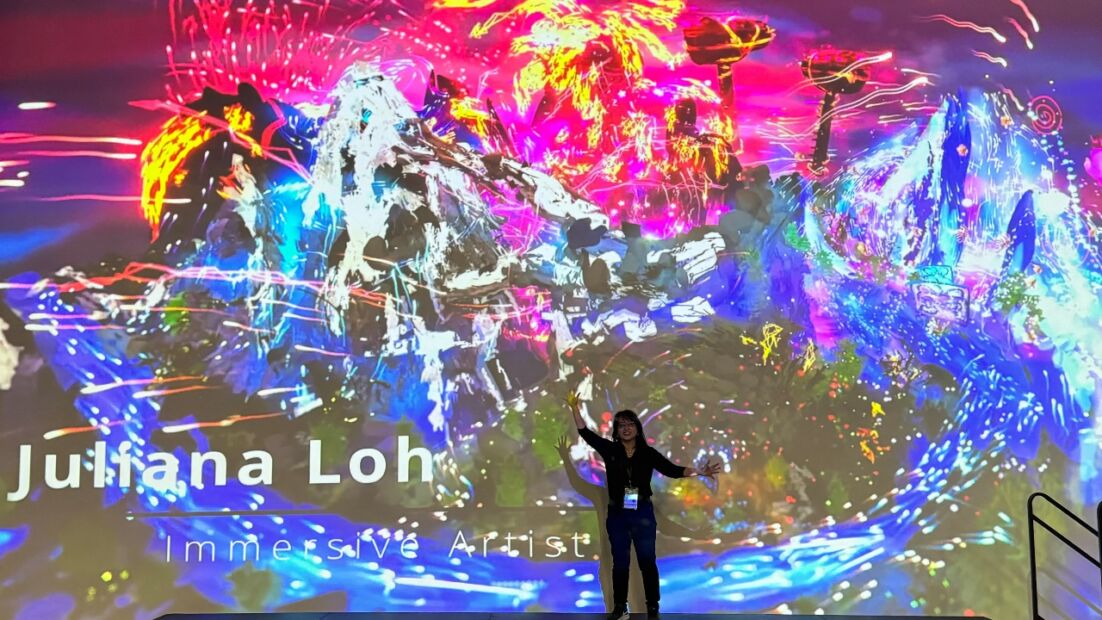
I spoke with Juliana Loh about creating immersive art in VR and AR as a part of my Raindance Immersive 2025 coverage. See more context in the rough transcript below.
This is a listener-supported podcast through the Voices of VR Patreon.
Music: Fatality
Podcast: Play in new window | Download
Rough Transcript
[00:00:05.458] Kent Bye: The Voices of VR Podcast. Hello, my name is Kent Bye, and welcome to the Voices of VR Podcast. It's a podcast that looks at the structures and forms of immersive storytelling and the future of spatial computing. You can support the podcast at patreon.com slash voicesofvr. So in today's episode, I have Juliana Lowe, who has previously been featured within Radiance Immersive, but was also one of the jurors with me on the Best Immersive Art Experience category. And she's going to be talking about So Giuliana is a tilt brush, open brush artist and has been able to create a number of different pieces over the years and also do some live performance in front of a symphony doing like live painting and also just been getting into augmented reality art as well and teaching different classes on immersive art and immersive storytelling and so Yeah, I just wanted to sit down with her and get a little bit more of her journey into the space and some of her thinking around what she's really paying attention to right now as to some of the different trends that are happening within the context of VR and immersive art more broadly. So we're covering all that and more on today's episode of the Voices of VR podcast. So this interview with Juliana happened on Wednesday, July 9th, 2025, as part of my broader Radiance Immersive 2025 coverage. So with that, let's go ahead and dive right in.
[00:01:20.444] Julianna Loh: Hi, Kent. I'm Juliana. And I just love being here. I can't believe I'm on Kent Bye's podcast. I support you 100% in so many different ways. And I've been working in VR for the last day, what, 2019? So what is that, five, six years already? And it feels really strange because I'm almost the person who was in that... It feels like I've been in that show. What was that show where Leonardo DiCaprio was in? What was that one?
[00:01:53.792] Kent Bye: Is that Inception?
[00:01:55.493] Julianna Loh: Yes, it is, my friend. Yes. And there was a scene, right, where all these people were strapped in, right? And they were like, oh, what are those people doing in there? Well, they were in the VR world and they never left because the world in which we live in is boring. And perhaps they weren't quite as successful in that world. But that wasn't my story. My story was actually different. I feel as though I am that person who lived more in the VR world for the last five or six years because I was working with people in the United States and in Europe. And so our whole timeline was all shifted, as you know. So their morning was my night. My night was their morning. It was just completely chaotic. And I felt like I was living in VR for like hours from day to night, 24-7. And I felt almost as if this world in which we're living in, was my dream world.
[00:02:52.837] Kent Bye: Yeah, nice. And maybe you could give a bit more context as to your background and a little bit more on your journey into VR.
[00:02:59.403] Julianna Loh: Yeah, so I've been, I guess I come from a, I've been doing fine art for a very, very long time, over 20 years, had really great mentors and was working in the game adjacent world and doing a lot of storytelling and design for clients and brands. People working in branding who really wanted to tell their stories on different medium, media. And so I was one of those people who weren't as privileged. So I didn't really have access to, you know, the headsets back then. The only thing that I could actually use was those little boxes. Remember the ones that you had to like...
[00:03:39.741] Kent Bye: The Google Cardboard?
[00:03:40.582] Julianna Loh: The Google Cardboard. And I had, you know, friends who gave me Google Cardboards. And when I, I think I took a visit to the Sistine Chapel and I freaked out. I was like, wow, this changed my life. And I knew that I wanted to bring about my fine art together with everything that I knew that I had ever lived. And I wanted to say like film and acting and games, right? Especially to bring them all together. And so when I connected with a person in 2019, I said, hey, you know what person? And I won't mention who that person was. I would love to go into VR and I want to try it. I would really, really like to try your Tilt Brush. Google Tilt Brush was all the rage. 2019, I know I came in late, but that's OK. You could come in any time. And he said to me, you can't. And I'm like, why not? He said, because you're not going to be good enough. You know, and he was actually archiving the show. And I looked at the work that was within the show and it was inspiring. But at the same time, I thought maybe I can do better. So, you know, just an Asian woman, like from a group that struggles sometimes to receive the attention. To be able to say, hey, you know what, give me a chance. And so he said no. And so, you know, I reached out to other people and they did. They were like, you know what? We believe in you. We don't know what you can do, but let's see what you can do. And they gave me the key to not just the building, but to my future. So I was like, oh, OK. And I tried out. And, you know, the first thing I did was absolutely just it was horrible. You know, I made things that were so like ludicrous. And I thought, oh, I don't understand this. And then I just clicked. I think after trying it a little bit, and I love painting nudes, right? And muscles and muscle masses and analyzing everything to bits. And I was able to create these muscle masses and then be able to teach people at the same time, hey, This is where your muscles are. This is how it works. And people were like, we get this. And I thought, I get this. And everything just flowed from there. So I basically came out into the world as an immersive designer, an artist, an educator, and somebody who inspires people who are sometimes disenfranchised. That's who I am.
[00:06:07.597] Kent Bye: You said that you've been doing fine arts for about 20 years. Did you go to art school or how did you get into fine arts?
[00:06:13.348] Julianna Loh: I did it on my own. Like, I mean, I mean, I knew I was pretty good at art, but my parents wouldn't let me go. You know, you have to have a degree. So I did a degree in history, which is great. And fine arts and visual arts to some degree. And then I learned on my own. I just struggled. I just said, okay, if I want to get to where I want to go, I'm just going to do it. So I got myself a mentor. His name is Sim Mendoza. And he was probably one of the preeminent painters hailing from the Philippines. And he's been sought out world-class fine artists for the last couple of decades. He passed away a few years ago, but he taught me. He didn't just teach me technique because I didn't learn technique from him, but he taught me how to tell a story. And that was the greatest gift.
[00:07:05.562] Kent Bye: Hmm. Yeah. And so I know that you had a piece that was at Rain Dance 2023 a couple of years ago that was in the best art, immersive art experience. But you've also been creating another other worlds and other pieces in your journey within making immersive art. And so from 2019, what were some of the big next steps in the kind of your journey as you trace back and think around different milestones? What what happened after that?
[00:07:33.331] Julianna Loh: I think when I started in 2019, I brought on a friend, his name is Nicholas Lang, and we decided that we wanted to reinvent what world building looked like, what worlds could possibly, how you can experience them, and what art galleries and art franchises might look like. be retold so met up first with my friend andy fidel so she's a she's been a fun collaborator and we started working in vr earning man right and i think that's the first time i met you kent back in 2019 so remember that
[00:08:14.206] Kent Bye: Well, I don't, I remember, so the Burning Man got canceled in 2020. And so then they had, despite all of the odds at the time, Burning Man chose Altspace as one of the platforms to have Burning Man. I think it was in large part because of BCVR that had actually done a photogrammetry scan of the whole space and they had recreated it in Altspace and it was actually a really vast and amazing space. place to be able to go explore some of the immersive art. And so, yeah, I remember being on the playa and I don't remember what event, but I do remember there was some Tilt Brush Worlds that maybe we were like flying around in and maybe even one of your pieces that we were going into.
[00:08:53.470] Julianna Loh: Yeah, so we started our journey really with something in alt space and it was called Jingleville. And it was just like a little Christmas village right in the heart of the pandemic. And it was absolutely stunning. I think we created like... little areas where you could go to. And I designed places where you can pick up souvenirs and I integrated this model where you could actually first, I'll talk about Burning Man later, but you could actually go into the place and through your narrative and through your imagination, you could actually feel in your body this very sense of cold, too hot, like senses, just showing you how your mental state has changed. power over your emotional and all of that. So basically, you had to walk through this really cute little Jingleville area, Christmas place, you got to see all the little, what would you see in that we saw lights, we saw gingerbread houses, and then you are invited to go into the water where you were polar bear dipping, and then immediately asked to walk up the hill and warm yourself at the fire. I was really actually testing back then in 2019 how your body would react to that imagination, that change of mindset. And it was really amazing, the results. We had people from all over the world come in and just through the power of suggestion alone, they were transformed in a way that I didn't even expect. And so we were able to take that lesson and then you'd have to go into a tree. And then I find really simple and fun ways, like taking pictures of mice, like going up the spiral of a tree until you reach the top where people didn't really understand that they were learning something, learning a new skill, in fact. So by the time you got up to the top, you looked up and you're looking down at this gorgeous place. And you're like, how did I even get up here? I didn't even know that I was learning something new. So I'm like, okay, now VR teaches things through your senses and through play. Okay, great. Now we have found out some areas where we can put into systems. And then I took that, everything that I learned in Jingle Bell, and then we brought it over to something called Awaken the Giants. Awaken the Giants was something that, yes, you actually came in with us, Kent. And it was crazy fun. I think it was all these giants and they're diverse and... It was a world that included like a game and finding things and talking about the different heritages and bringing in that sort of balance between the humanity, environment and technology. And the only way that you could find that balance is by conversation with other people. Thereby, we were challenging that notion of technology will only bring peace and communication. But no, it's the personal sense of presence within a VR world that will allow you to do that. And that's why it was powerful. That's what we brought to VR, VR Burning Man. To all our friends there who championed us and who supported us and who came away with this version of like, I had no idea that alt space could actually look like that. You know, and I just have to call out like, you know, Kaz and Christy. Kaz, you know, he's a friend of mine. He's prolific world designers as well too. And he said that. And when he said that, I kind of knew. I'm like, yeah, that's when I knew. Like we're inspiring people with our vision.
[00:12:31.004] Kent Bye: Yeah, it was kind of an interesting moment in Altspace's history just because it was owned by Microsoft. Altspace had failed. They basically unplugged and then they got rescued from the ashes of just being completely shut down. Microsoft kicks it back up and then doesn't really have a necessarily clear strategy for what they're going to do with it. So there was always this kind of like ugly stepchild type of situation where they had it, but they weren't really... Expanding it in a way that, I don't know, eventually they shut it down again. But there was a kind of moment where, despite all odds, Burning Man ended up in Altspace. It was just a really weird clash of cultures. And I've got some unpublished interviews with some Altspace employees and other conversations from that time that I'll have to dig into later. But yeah, it was kind of a really interesting moment. And so you were there and part of that, I remember, you know, meeting there in that alt space context. And then eventually I think, you know, you moved over into some of the other open brush slash silt brush artwork that you were doing. You bringing it into Engage with Chris Madsen and Madda. And so talk a bit about your next big project that you brought into, the one that was featured at Rain Dance around dragons. Yeah.
[00:13:45.307] Julianna Loh: Yeah. Well, maybe before I talk about that, I also delve deeply into augmented reality. So, you know, did some work with Brendan Powers, I believe. Created some work that celebrated the Me Too movement too, right? And diversity. Just noting that as an artist also, it's not just about the aesthetic, but it's about the message and how it's able to change people's viewpoints or to open up. people's understanding of not just their world, but everybody else's worlds. So yeah, you're right. So I was able to do that. And then just before getting to the Dragon Magic, I also did tilt brush artwork at the Chan Center for the Performing Arts, where I painted live to the symphony, UBC symphony, and they were presenting, of course, Star Wars and the Lord of the Rings. So it was like two of my favorites. And I practiced for a year to do that. for a performance that lasted, I don't know how long it was. I almost forget because it was so, it's one of those like highlight moments where you never forget, but you always forget because it's just too amazing.
[00:14:58.733] Kent Bye: Were you on stage drawing the entirety of the whole while the symphony is playing and they're like broadcasting you on the screen?
[00:15:07.170] Julianna Loh: No, we actually did it. We did some of it. So we did about 15 minutes of actual drawing, but I had pre-created an entire world of the Lord of the Rings, right? In Star Wars. To the point where my orchestral lead or our creative director He didn't even know that I'd done that. And when he went on stage and we were just fooling around and practicing, I said, you got to come to my world. And when he went in, he was like, oh, my God, you did this. And I'm like, yeah, yeah, yeah, it's cool. And it was really neat because we took that world and I resurrected it back in 2024 and presented it another show called Be Unframed. But I turned it into a game. So I've done all of these things before or after or around doing the dragon magic. And I can talk a little bit about that. So I didn't come from, you know, I just didn't come from VR. I think I'm one of those persons who was able to jump on different media and showcase what experimental work could do. Yeah.
[00:16:11.775] Kent Bye: Yeah, and moving on to the dragon magic, I remember going through the tour, and for one, it was not always easy to optimize open brush slash tilt brush to get into a shared social experience, and then also working out the colliders, or at least a way that you could have more of a journey through the piece of art on multiple layers, and then also just remember a lot of mythological references of different gods and characters, and that There was a whole story that you were telling as we were walking through, you were referencing and kind of weaving it all together through a larger narrative. So I'd love to just hear a little bit about your process of creating that world and where it began. Like what was the seed of that idea of dragon magic?
[00:16:56.792] Julianna Loh: Well, first, thank you for coming in. It was such an honor to have shared it to so many people representing so many different film festivals. I think it was really interesting because it allowed people to see that because it was an educational experience, that education could be, oh my God, fun and interesting and of incredible value. So, yes, I did bring in storytelling. There's several people whom I look up to or who have been central in my life in the last couple of years. And one of them is Jeff Gomez. And Jeff Gomez is someone who deals specifically with transmedia. And then there's Mike Manello, right? And there's Steve Peters. There's so many other people who understand the value of storytelling from a content kind of way, I guess. But I had to translate that into like, how would it translate from a VR point of view? And so Transmedia touches upon different aspects of storytelling, being able to reach out to their audience and to captivate them using imagination to fill out the different pieces of whatever story it is or brand or narrative or the canon itself so you know that's something done in star wars so you know there's so many spin-offs so when i looked at the way vr could be done i never thought of worlds as just being a place I always thought that it was more of a placeholder almost for different people to encounter what that story could have been, could be, and what it could potentially be. So I looked back into history and took out certain points and made it relatable to the audience by using empathy, using words, using universal themes to bring about that, to captivate people. who were interested in connecting in a social VR kind of way. Does that make sense?
[00:19:13.129] Kent Bye: Yeah. And just in terms of the order of that, were you like sketching out some of these and then piecing together from a spatial context? Or did you really start with, you know, you wanted to go from this beat of the story to this beat and then mapping out the script or the story or the pathway before you started to paint anything?
[00:19:30.641] Julianna Loh: No, actually the story. Thanks. That's a really good question. No, the story, it's beautiful. It's gorgeous to go and you see all these wonderful things. There's a ride that goes up and down, but the story actually starts off from a tragedy. And, you know, as all stories do. And so I told the story of the dragon, the person who wrote the dragon that represents refugees in a camp back in Uganda in the 1970s. And so the South Asian refugees basically were kicked out of Uganda by EDMN. And so I was invited to display my actual fine artwork here in Vancouver, British Columbia. you know, told a story of the people and their plight. So I had to go back and kind of figure out, okay, how do I create a VR world out of that? Because it's a hard topic. And so then I decided that some of the key elements were the things that connected all of us with a commonality, like common themes, like, who are you? Where do you come from? What's your heritage? What do you want to do? What do you, you know, want to be? And then when I figured out that part of it, what do you want to change? I realized that if I was concentrating on aspirational goals, because that's kind of really what bonds us. And I chose the aspirational goal of where do you want to begin? What have you done in your experience that has impacted you? What story do you want to tell? And most importantly, How do you want to change the world through your beginnings, beginning chapters? And that meant anything from moving house to starting school. And it was something that was united in a way that anybody could understand and to empathize with. And so then I figured out, okay, I got that, got the underlying structure. What do I want to do? I want them to find their dreams. That's it. And so from there, I, you know, I, I asked Matt DeLue and I asked Chris Madsen, and I was actually invited to create this engaging, amazing world in EngageXR. Steve Lewis was one, was someone whom I spoke to. He said, come on in, see if you can tell your story. And so I did. And it was magical. It was like two huge worlds. And part of the fun was having you visit Kent.
[00:21:51.243] Kent Bye: Yeah. And so you said it was in part inspired by a story from Uganda. You mentioned that you had studied history. Was this like some part of history that you came across in your studies or how did you get connected to that specific location in that story?
[00:22:07.509] Julianna Loh: I think it's because like during the fine art gallery opening, we were celebrating the lives of Ugandan refugees. And so, you know, that was also my personal story because my parents came over, you know, to Canada in the 1970s. And it was really difficult. The ability, and I don't know whether I can do that. Maybe you can do that. But to leave everything behind and to start fresh and start anew. So I thought that was inspiring because I knew that in this technological world that we were hitting places where we had to say goodbye to things faster than we were able to process. And it's happening now with AI coming in. So I thought we need milestones and benchmarks. And that's how it happened.
[00:23:03.942] Kent Bye: You gave a talk to the XR women and there was a slide that you were breaking down what you saw were the basic elements of a project where you were listing first the art direction and drawing upon the imagination. Then you have the architecture and the structure and the environment. And so just the way that that can invoke different levels of awe and wonder. And then the narrative, this kind of living stories idea. And then finally the interactive agency parts where there's some level of audience participation. And so as you were designing your own experience, maybe you could just walk through, you know, it sounds like you were starting with the story and the narrative. Then did you start to like, what's the difference between what you see as like the art direction is stemming from the imagination and the architecture and the actual kind of spatial layout and the structure of the environment and just wondering how you kind of have those two interplay and how you think about that.
[00:23:59.819] Julianna Loh: Whoa, big question. Thanks, Kent. Yeah. You know, I think so. You know, I really start with the premise of what social VR can do. You know, how do we how are we able to create messages that define a generation? you know, and what is it that makes social VR really special? So I don't just speak specifically about VR, but I work in other media as well, too. So I thought about the aspirational goals that would connect us because social VR really celebrates our ability to really share humanity. And so when you take away everything else, right, you are left with that specific goal. It's like the... yeah, when you strip everything away, you've got one thing left. And what is it? And so I always concentrated on that one thing. And that was, what could it do? What if we were able to forego borders? How would we be able to communicate in a manner that allowed people to speak freely? Because if you don't have that, you have perhaps maybe the kind of world that we're somewhat moving into. so after figuring that out like whatever inspiration or aspiration and then i looked at like comedy clubs right and we know we've been to some of them we've we've hung out with them and then i went to um fantasy worlds like we've we've just finished rain dance right and we've seen a lot of them and then i went to um listen to songs like people singing and performing Right. That was super great. Like all of these places where we could be children again. And no matter what, we could transcend who we were. We could become anything that we ever wanted. We could actually literally get into an avatar and become someone else. you know these things are really important and so i built my world first my imaginary world and then the architecture by the way i wanted to go to architecture school i wanted to do my master's in architecture school so i was able to create specific areas that would enable people to communicate but more so i think after that the metaphysical the sense of awe and wonder and The characteristics imbued or offered by the medium drove me to pursuing something completely different. I hope that answers your question. Does that process?
[00:26:35.179] Kent Bye: Yeah, yeah, yeah, for sure. I think it, you know, for starting with the story, you know, and kind of laying it out. And then, you know, I think there's other aspects where I just did an interview with Elizabeth Hohner and Martha Crawford, and they were talking a lot around dreams. And Martha said something that I've also been saying a lot, which is that, you know, symbols and archetypes are operating on these three levels of like, a universal archetype that everybody kind of understands. Then there's culturally specific archetypes that being from a certain culture you may get. And then there's sometimes very personal symbols that people are using. And it seemed like you were using a lot of figures from the canon of mythology and trying to tap into some of those more Either culturally specific, either you know who that god or goddess is, or you don't. And then also trying to tap into those more universal aspects. And so I'm just curious if you could elaborate a little bit on your strategy of trying to bring in this canon of other mythological stories within the context of your work.
[00:27:38.764] Julianna Loh: So I celebrate diversity, inclusion, and equity, right? And I sometimes feel that the only way that we can reach this level of incredible acceptance, I think, and wisdom is by finding out not just how other people live and work, but what is their history? So I'm a history major. And symbolism is important to me because it effortlessly connects to other people from every range, every culture. And that we are all telling somewhat the same sort of stories, but different times in history as we collectively move from A to B. And being able to manifest that through symbolism, through dreams, mythology, through all of these, I suppose, literary devices. Because, you know, we all... I think we all absorb information differently, but at some level, there's an archetype that we connect to the most within our particular culture. And that somewhat informs us even as we go out and like, I'm from Malaysia, right? It's my culture. And I don't know it well, but I'm completely integrated into Canadian life, but it's still my heritage. And it allows me to understand why I think a certain way. Like there's intergenerational understanding of how things work. And I think it's really powerful in a sense for people to claim that sense of who they are through their ancestry and through their families. And I think that's why there's so many people who are so interested in finding out where they come from, because that's the curiosity. If you don't know where you come from, the cliche is you don't know where you're going to go. But I also think if you don't know where you come from, then you will never be at peace with who you are. Anyway, that's part of the underlying thing that I'm trying to say. And we don't celebrate ourselves enough and we don't have enough areas where we can have these ritualistic celebration moments. You may have it in religion. You may have it in culture, like the bar mitzvah. But if you don't hit those moments, there's a feeling somewhat that maybe I'm not good enough. You know, and like, maybe I'm not connected. Maybe I'm not that important. And that's so hard because I think so many creative people go through that because creative people are the ones who've got to like constantly put their humanity out. It's hard. It's, you know, it's vulnerable 24 seven. Having a legacy of history gives us that resilience. Having an understanding of what our parents and grandparents and great-grandparents went through. Because you'll never understand who you are. You won't even know who your great-great is at fourth generations. You don't know what they've done. You just see them maybe in a picture. But it's from that legacy that you learn something really important about yourself.
[00:30:59.208] Kent Bye: Yeah. Yeah, it's been since November 2023 since I had a chance to see the piece. And so there's my memory of it is a little foggy, but I do remember that there was quite a wide range of pantheon of different mythological figures from different cultures. And in what you just said, there seems to be this experience of being assimilated into Canadian culture, but yet at the same time, yearning for finding connections to your Malaysian heritage. And so was there any specific things that were within your piece that were drawing upon Malaysian folklore or mythology? Or, you know, how does that play out in your art in this kind of yearning or searching for a reconnection to your heritage?
[00:31:43.615] Julianna Loh: Well, first of all, I created that piece celebrating the year of the dragon. So the giant piece was, of course, a dragon. And, you know, it's a really interesting thing because I looked up dragons and the symbology and what they represented in the Western culture. And oftentimes, like Game of Thrones, these dragons came in and just obliterated everybody, right? And it was, to some degree, it was kind of fun to watch. Yeah. But when an Asian culture, it's a little bit different, right? So it's this sense of protection and vulnerability and luck and all these amazing attributes. So I kind of celebrated that a little bit. And I kind of thought, okay, we need a lot of that coming in. And Why not? Why can't we bring out certain aspects of our culture? Because that's who we represent, actually. And then if you share them in a context where people can sort of... In a context of awe and wonder, your brain is completely collapsed. It is so enamored with that sense of, I'm in a place where I don't understand. Because you don't understand. You cannot understand awe and wonder in your mind. You can only understand it from your soul and from your heart. And so whatever I do, whatever I create, whatever pieces I create, there's a sense of, and there's an understanding that there are words unsaid that only you are privy to when you're in that environment. I honor that.
[00:33:19.468] Kent Bye: Yeah, the way I start to conceptualize some metaphors around awe and wonder is that you're seeing something that you don't necessarily have existing conceptual frameworks. It's like you're transcending the paradigms of all of your prior experiences and you have to figure out a way to categorize this experience that transcends anything else that you've seen before. And it creates this state of wonder and the awe and wonder in that. So I think of it as a bit of an opening to new possibilities. So that's been my kind of experience of it.
[00:33:49.642] Julianna Loh: Yeah. And I really enjoyed that. Like, I mean, I like that every time you go in to a place and you, you talk about like what your feeling is or what your thought process is interesting because it's, yes, I go through that as well too, that analytical part, but then there's another part that because I, first I'm Catholic, right. And, you know, I kind of think about a lot of times now where we come from, like, What are we made of? So, you know, asking the really big questions and what happens in a state of awe and wonder in some people, there's a sense of like being in a place where there's something so much bigger than themselves, right? beyond like even the rationale that one gives up of their anxiety, depression, whatever it is, whatever you're feeling to this omnipotent sense of, I want to say like, there's a feeling that something is taking care of you. So in the, in that moment, a lot of times that's when that point of realization from what I've seen and experienced is that that's when people are able to finally let go. So that's why if I take you, Kent, and I put you in front of Niagara Falls, right, and watch you, I can see that transformation when all of that, everything that you said and everything that I said combines to create a different Kent Bye.
[00:35:13.379] Kent Bye: Yeah, at the doc lab R&D summit, there was a presentation by Jazz Hee-Jung Choi, who is doing a lot of research on the art and science of awe and as it specifically applied to virtual reality. And so looking at how these different VR experiences can invoke these different states of awe and wonder. I didn't get a chance to talk to Jazz there, but it's certainly an area that I think similar to like the empathy research or empathy kind of as a meme within VR, I think All in Wonder is certainly in terms of the research community starting to have more and more folks take a look at it from more of a multidisciplinary approach. So I'm excited to see where that goes, but yeah. And one other follow-up, I guess, coming back to your framework of looking at these different dimensions and elements of an immersive design experience, one of the art direction reminds me of like, as we were looking at different experiences and listening to you process and talk about some of the different experiences we saw at Reindance, that you're very focused in on like the color and the color theory and how art projects are using color. Maybe you could elaborate on some of your thoughts on color theory, the importance of color theory, and maybe some things that some artists are not paying attention to when they're making art within the context of VR.
[00:36:29.270] Julianna Loh: Oh, yeah, right. Yeah, color theory is very, very important. Being able to juxtapose the cool colors with the warm colors to create something harmonious. Being able to highlight particular areas within the world that maybe you might think is more important than others. being able to create palettes that resonate completely with the audience and knowing, and in a way, you know, they've been doing this for history. Like, I mean, like, you know, Van Gogh and Rembrandt and so forth, they really understood how to bring about emotion using the color palettes, right? Using the darks, using the monochromatic, going from realism to high realism to... the different isms, impressionism and so forth, and being able to affect people, not just on a, you know, like a physical level, like I'm looking at reds, but I'm looking at reds that make me feel something, right? Or looking at blues that remind me and evoke a particular kind of emotion that connects me to my own memories and my own connectivity to what I feel is my own spiritual self. I think colors are really important and knowing how to use them wisely enables people to, I wouldn't say the word manipulate, but to control the environment in a way that allows people to easily move from one state to another.
[00:38:03.681] Kent Bye: Hmm. Yeah. Yeah. And you mentioned that you are an educator, that you've been doing different lectures and that sounds like you also may have been teaching some classes at some different universities. Maybe you could talk a bit about some of the different teaching that you've been doing.
[00:38:19.847] Julianna Loh: Oh my God, this is the most hilarious thing on earth. Okay, so last year I was able to put together a live dance performance. And it was really hard because you've got to use a Kinect and you've got to use a whole bunch of different things. And I wasn't really chasing popularity at all because I knew that I think art requires people to crash and burn. But luckily I did not crash and burn. And one of the persons who worked with me was this amazing sound person. She would create works that were fantastic and beyond anything that AI could do. So then she invited me this year to teach or to provide a workshop on experience design, actually, at the Berklee School of Music. And I'm like, so I didn't get it. Like for the longest time, I'm like Burke Lee, Burke, some guy named Burke and his last name was Lee. I didn't get it. And the funny thing is like back many years ago, my older cousins connected me to this story or something they saw, they were watching that was really important to them and was influential for their generation. It was called Fane. You remember that? It was like this, right? And it was called Fame. And it was about these people who were trying to, you know, realize their lives out in Berkeley, the Berkeley School of Music. And I always thought like, oh, one day I really want to not just teach. I want to go there. I want to be there. And then last year was the year that it happened. So my friend happened to be a professor there at Berkeley School of Music. And then I didn't get it till the day after. before I got to speak to them. And I'm like, oh my God, you guys are there. And I've always wanted to be there. And I get to connect with you and teach you whatever I know. And that was, I think I'll never forget that. That was my one coincidental moment that happened that brought my past self, my cousins, my family, my future self, my everything up, zoom back into one moment. So yeah, I enjoy sharing and teaching people.
[00:40:28.666] Kent Bye: And it sounds like that you're wrapping up another project that's going to be debuting at SIGGRAPH here coming up later this month. Maybe you could give a bit more context for what that project is and your role in it.
[00:40:38.612] Julianna Loh: Okay. Yeah. So I'm doing several projects right now, but one of them is, it's sort of like a sandbox. And I'm the creative director and was brought in by really... visionary friend of mine and she said you can do anything you can you can create and we have several different media to use we've got like a cam camera that allows people to do visualization on visual effects and then we've got like this stream and then we've got like this like five different sets of interactivity between dancers and actors and and streams and she basically said why don't you create a play why don't you create a dance or or some sort of thing and i said yeah okay so that's what i did today i was i spent the whole day connecting with everybody to figure out like what kind of world that we were going to build what was it going to look like what kind of message that we were going to put forth and to help to choreograph the dancers as to how to convey And the theme is BC, nature, the forest, the healing aspects of the forest, and how you deal with brain health. So, you know, there's so many different ways that you can see, like how mental health has affected so many of us, especially since the pandemic. And so, you know, people call this soft health. subjects you know as opposed to i don't know what else they accounting or something but these projects are like the powerful ones that that bring many of us from this time the present moment into a time of being able to bring all the pieces together. Because there's so many things floating around. There's too many things, right? Bring it all together and then finding assurance and peace. And only when you do that, then you can move forward. So that's what we're doing. We become shepherds.
[00:42:33.339] Kent Bye: We've had a chance to see a lot of different projects in the context of VR over the last five or six years. And I'm curious, what type of things do you want to experience in VR? And that could be either things that you want to build or just that you want to experience as a part of just being a fan of an audience member and seeing something that you haven't yet experienced within VR. But what are some of those things that you want to experience in VR?
[00:42:57.554] Julianna Loh: Well, and it's not just VR because I've worked in AR as well too. So, you know, I want to do a lot more work with the spectacles. But of course, you know, I'm also thinking about different things. The ethics, right? The security, especially. That's always front and center having my... Like my visa cards gets compromised all the time. I have no idea why. So, you know, that's, you know, looking at that. But I think what I'm mesmerized with is... How are you going to take augmented reality, virtual reality, and AI? How are you going to use all of those pieces to create something that's fundamental? It's something that I actually started as a talk at AWE like last year. So I talked about like, you know, the theme of celebrating humanity, bringing the aspects of a humanity, but augmenting who we might possibly be in the potential future using AI to create platforms in VR and AR in all of these spatial technologies to highlight one, who we are, because we have to, to figure out how to connect with the audiences that we need to simply because the audience have now been fragmented and we can't even nobody's listening to the same news nobody knows that nobody knows we're so incredibly fragmented we don't even know what we're listening to anymore so how is this going to bring truth because there's such thing as a universal truth you know to to the world. And number two, I think, or number three, I guess, basically, I'm really very curious about medical AI. We need that so much. We need to find out. And I think maybe the answers are out there already, but how do we create systems that will enable us to cure cancer? Right. The ideas are there. The political will, I'm not quite sure about. But I mean, if we got the the answers and the how to. Can you imagine how that might change the world for the positive? So I'm looking at that. I'm looking at the environmental situation that we're in right now. And I'm thinking that you're integrating the physical with the digital, with technology. What we've learned in AR, augmented reality, virtual reality, the sense of presence, the ability to bypass the conventional news and the vehicles that sort of keep us apart instead of bringing us together and moving into a place where the grassroots can win in some way.
[00:45:38.155] Kent Bye: Yeah. Beautiful. And finally, just curious what you think the ultimate potential of XR and AI and all these emerging media might be and what it might be able to enable. Oh, God.
[00:45:52.756] Julianna Loh: I will have to reserve a couple of hours to listen to your podcasts, Kent, before I can seriously answer that question. But really, I think it's... And I'm really handing it over to you. And I like to play and hang out with you because you're a lot of fun. And, you know, you think about all of these really big questions, but you also, and I'm going to hand it to you because you offer so many ways for us to think about things in a manner that we've never even thought about or even realized that we could think about. And I think it's really important first. I can't answer that question without really celebrating people like you, the journalists and the inquisitors and those who are wondering how we can change by offering a platform to many different kinds of people. I mean, I guess that's why I support you. And I really can't answer that question without saying thank you first.
[00:46:55.643] Kent Bye: Hmm. Yeah, you're quite welcome. I think this whole project of the Voices of VR that's been going for over 11 years now has been a little bit of an exercise in future dreaming of like thinking around what's possible, what can exist in the future that doesn't quite exist yet. So it's a bit, I'm really into this kind of speculative world building concepts. And I feel like asking and having people answer this question for over a decade now starts to kind of map out a world that doesn't quite exist yet, but might. And I think the tendency is that it can fall into a sort of techno-utopianism where the technology is going to come in and save the day. But we're in a really weird time right now where technology and systems of power and politics are kind of combining in a way that... some of these core underlying technologies, AI especially, even more than XR, can be like enablers of authoritarian, democratic backsliding and fascism. It's like this kind of really weird time where I can appreciate the creative potentials of all the technology, but also see the risks and danger of, you know, the technology enabling and empowering the more dystopic potentials rather than the more exalted utopian aspects. And so I find myself in this kind of dual place of being excited around the potential still. And I still enjoy asking people and talking to artists like yourself, but yeah, Also, you know, being in a place like AWE, I think it was facing this kind of fractured reality where there's either not looking at some of those more negative aspects and just kind of move fast and breaking things. But yeah, there's just more of the kind of larger ethical questions that I guess keep me up at night and keep me from falling firmly into the kind of pure techno utopian, like technologies are going to save us all. I think the more and more that I talk to people, I think it's, At the end of the day, both XR and AI is a metaphor for new ways of thinking. It's like we're in an existential crisis and that some of the solutions come from the new paradigms that are required by understanding how to really work with XR and AI that leads us toward these more relational ontologies, to be more in right relationship to the world around us, to... see the importance of process and that relationality being right relationship. So those are a lot of things that I'm thinking around, you know, kind of those more deeper philosophical principles that, you know, we need to have these deeper paradigm shifts to really enable what the technology is going to be able to empower us to do as a human culture. That's in right relationship to not only ourselves to understand ourselves, to understand what it means to be in relationship to other, but also to be in relationship to the planet.
[00:49:38.984] Julianna Loh: Yeah, I think, and bravo to you. Like, I mean, I have, I just want to call out to everybody and say, I think it's really important that we support The people who ask the questions and not so much the people who answer or respond. You know, I think it's a very courageous thing to be able to look at everything that we've been through, to sift through so much information and to peel back everything else. Right. Like what you said, the techno thing. optimism, even the dystopia, right? They're all narratives. They're all stories. And to really kind of dig into the essence of like, you know, what's going on? How is this going to affect us? Why will it affect us? And what do we want to see? And how can we get there collectively? And if you, you know, if I don't, I think, you know, I've, I've been I've been really lucky enough to work with so many amazing people and to be in a place where I could archive so many different projects. There's a commonality, there's a thread, right? That runs through so many of them. And I want to say that, you know, either we live or die, because there's like both sides, right? But there's always a little bit of hope. And I think if you bring that out through the work, the many years that you've been doing this, then you have succeeded.
[00:51:09.318] Kent Bye: Hmm. Yeah. And I really, in my coverage of AWE, I went back and I did a lot of interviews this year at AWE. I've had previously unpublished interviews. And so I've been going back and editing conversations that I had many years ago. And there's this interview I did with Caitlin Krauss back in 2019, where She turns the tables on me. And it's just kind of interesting to go back and listen to these conversations because it's really like a sampling of the cultural zeitgeist. It's a sampling of where my thoughts were at the time, what my dreams and aspirations were, but also just this kind of collective dreaming that can happen through these conversations in a way that can tap us into the imagination of possibility, of what's possible before it becomes actual reality. And yeah, there is a sense of hope that we can, despite all the signs otherwise, you can do all the doom scrolling on social media to see all the evidence of that. But I think having a space to have openness to possibility for what might be possible. And when I talk to artists, see artwork and be able to experience that, it really gives me a lot of hope, despite all the other things that are happening in our world today. Yeah. Yeah, I always love being able to go to these festivals and see all the artists and to, you know, be able to sit down to artists and artists like yourself and just, you know, hear what you're thinking about and just kind of put it on the record. And maybe the thing that's probably going to happen are the people that are the next generation that might be tapping into some of these archives and these thoughts. And, you know, who knows what some of these things that someone says, unlocks some idea or opens up a new possibility in their mind. So Yeah, just trying to bear witness to the community and reflect all that back to everyone and with the intent that we're going to create a better world.
[00:52:52.040] Julianna Loh: You said it. That's why we're here. That's why we slave 24-7. That's what we're doing. Wow, I want to thank you. I just love this. My God, you should show up more. There's not enough cats. We got to clone you. That's what we got to do, dude. Yeah. Thank you.
[00:53:13.336] Kent Bye: I do. I do have a lot of unpublished conversations that I could get out there as well. I think it's perpetual, you know, time travel. Sometimes my ingesting of content is a lot bigger than the output, but you know, so it's an argument against me being cloned and just like going back from these little samples that I've done and just getting that out there. But yeah, I really appreciate, you know, taking the time and having a chance to talk with you. Is there, is there anything else that's left unsaid that you'd like to say to the broader immersive community?
[00:53:41.423] Julianna Loh: Oh, my gosh, there's so much to say. But, you know, you know, well, you know, don't look at trends. The funny thing about Raindance, right, we just went through it and we were lucky enough. We do remember us together. So, you know, that was a lot of fun. And. What I realized between the Western culture and the Eastern culture is that for the most part, the Western culture concentrates on the quarter. Did we make a lot of money in the next quarter? And then that dictates what we see next or what's talked about next. But then you and I hung out in some of the Japanese places. Right. And listen to their philosophies. And it seems to me that their world dreaming is not particularly specified to connected to capitalism so much as it is looking out into a broader future, you know, so that the work that they do, the detail that they put into things, their particular philosophies is more about. How are we going to change things? Not today, not tomorrow, but many tomorrows. And it shows. It really does. You know, it's not as, okay, we stop. We don't do this anymore. And then, you know, we go over to AI or whatever it is. But they create things of beauty that endear for a very long time. And then later on, when the rest of the world has caught up or not caught up, and then they plug it back into again, they're like, how did they get here?
[00:55:15.499] Kent Bye: Hmm.
[00:55:17.648] Julianna Loh: Why are they so amazing? Well, maybe it's because they didn't give up on the dream that enamored them in the first place. So my thing is, don't give up. Keep going.
[00:55:31.141] Kent Bye: Yeah. And just a follow on that is that I wouldn't necessarily isolate that to just what's happening in Japanese culture. I think I see that within the context of anyone who's doing immersive art or XR art or immersive storytelling, just because there isn't really necessarily like a pot of gold at the end of the rainbow of, you know, do this project and you'll be able to even make your money back. It's mostly driven by passion right now. And so it's this really kind of interesting cinema of attractions era of XR where it's before it's been fully professionalized and there's still a lot of experimentation, but still trying to find the modes and methods of XR that's going to be that more mass scale and at least popular to the point where even like, even just self-sustaining, you know, a lot of art is being supported by government grants from these European countries, not so much here in the United States, but in the U S it is a little bit of a do or die situation. Like you either have to like figure out how it's going to be profitable or you don't do it. That's not necessarily the case when I go to the international festival circuit around the world, just because it is well-funded, at least to create some of these projects that may only appear at a festival like Venice Immersive. Right.
[00:56:42.578] Julianna Loh: Yeah, of course.
[00:56:44.062] Kent Bye: So I wouldn't necessarily say that's isolated to just Japan, but I see that more broadly for the whole XR community of artists. And even, you know, people are making worlds within VRChat. It's not driven by profit or money. It's driven by passion, creativity, the need to make something that people resonate with, to give something back to the community. So, so much of the culture and the virtual culture on VRChat is driven by this kind of gift economy, which... is a blessing, but it's also leaning into where the future culture may go, but it also is not quite fully sustainable yet. So they still have to figure out how capitalism fits into that whole equation. So that's part of the kind of open questions that I'm continuing to explore in my recent coverage of talking to different artists, talking to different folks from VRChat, trying to figure out what these new models are going to be.
[00:57:31.721] Julianna Loh: Yeah. I mean, that's true. It's so funny, right? I've tried to stop. Like I've tried to stop doing experimentation and doing, and just, just, just Juliana, get a, become a lawyer and become like, you know, get your millions. But you're right. Can't, you can't. Like if you're a creator, if you're an artist, if you're somebody who innovates, that's who you are. You, you can't stop. It drives you. And all those goals and giftedness and everything is all part of the the big picture of who a true artist is. And I think there's a lot of us, there's a lot of singers, dancers, like it's a lot of people. So yeah, to create a sustainable model, that's something that we have to work on. But in the meantime, being able to recognize and to understand, to have empathy, To realize the contributions made by creators in this space, the XR space, any space where you have to get out there and be vulnerable and to show up every single day. Yeah, I think we are in need of that. And I'm looking forward to people throwing pennies at... No, not pennies. Shall I say $100 bills? No, $1,000 bills at... That's what I'm looking for. That's what I leave everybody with. So if you guys, if anybody else encounters an amazing person, like I'm going to say Juliana and Kent. There we go. There's Patreon, right? So maybe you can speak about that. But understand and realize our value. Thank you.
[00:59:07.011] Kent Bye: Yeah. Yeah. And thanks for your support on Patreon. And yeah, it's, it's, I wouldn't be able to do what I'm doing without that support. And I think I've been realizing also that I have quite a bit of social anxiety as well as probably some rejection sensitivity disorder. It's a phrase that I got from things. And so there's things that kind of like prevent me from fully engaging on the ways that I want to on that Patreon, but that's something that I'm hoping to do some more, maybe even one-on-one or more engagements or kind of revitalization of my community. Cause I, you know, like I said, I wouldn't be able to do what I'm doing without that support. And I hope to find other new ways to kind of engage with that community. So, yeah. So thanks again for, for joining me here on the podcast. It was a real pleasure to get a little bit more context as your journey into the space and yeah, have a wide ranging discussion on, you know, different, art pieces you've worked on, but also where this is all going here in the future. So thanks again for joining me here on the podcast.
[01:00:03.547] Julianna Loh: Thank you very much, Kent. Bye. And we'll see you again in the world of imagination.
[01:00:09.969] Kent Bye: Yay.
[01:00:12.110] Julianna Loh: Yay.
[01:00:14.005] Kent Bye: Thanks again for listening to this episode of the Voices of VR podcast. And if you enjoy the podcast, then please do spread the word, tell your friends, and consider becoming a member of the Patreon. This is a supported podcast, and so I do rely upon donations from people like yourself in order to continue to bring this coverage. So you can become a member and donate today at patreon.com slash voicesofvr. Thanks for listening.