
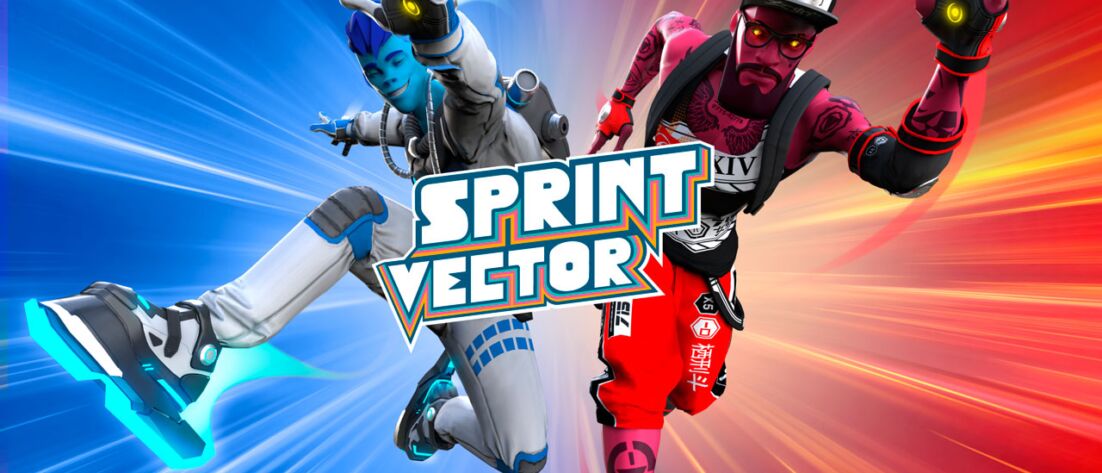
 Sprint Vector is an “adrenaline platformer” racing game that relies upon a unique locomotion technique of swinging your arms in order to run through an obstacle course. It’s the latest game from Raw Data developer Survios, but with a much more light-hearted stylized art aesthetic that has a unique mash-up of a game show, extreme sports, and a competitive racing game with an Sonic-inspired obstacle course. It’s also a unique combination of active exercise with a combination of embodied and abstracted gameplay mechanics.
I had a chance to catch up with Sprint Vector game designer Andrew Abedian at GDC where we talked about the mechanics of racing, the internal habits that are being formed by Survios developers, the intensity of exercise and stamina required to play the game, achieving flow states, and it’s potential to evolve into a competitive eSport. It’s a super fun experience to watch other people play either in a tournament competition in mixed reality or just as a quirky form of VR performance art (examples down below).
LISTEN TO THE VOICES OF VR PODCAST
Sprint Vector is now ready for Beta Sign-ups here.
Here’s a number of examples of different styles of people playing Sprint Vector
Gameplay footage from GDC
The future of video games is drunken VR goodness! I'm excited ahaha. #e3 #survios @Survios pic.twitter.com/EcNpHySIfg
— Holly Wolf @Anime Expo (@HollytWolf) June 15, 2017
@ElWarRoom #VR #gdc17 #Survios corre vato, corre!! pic.twitter.com/5odZc751rf
— NerDanger (@nerdangerous) March 3, 2017
Racing game #SprintVector is an INTENSE workout with VR locomotion that just works.
My interview w @Survios designerhttps://t.co/epqzzruUgK pic.twitter.com/ai37LNrty0— Kent Bye (Voices of VR) (@kentbye) June 15, 2017
Donate to the Voices of VR Podcast Patreon
Music: Fatality & Summer Trip
Rough Transcript
[00:00:05.452] Kent Bye: The Voices of VR Podcast. My name is Kent Bye, and welcome to the Voices of VR Podcast. So Servios is probably best known for their first-person shooter game called Raw Data, which really takes the first-person shooter into a new level of graphic fidelity and custom-built for virtuality. Well, at GDC this year, they premiered their new IP, which is called Sprint Vector, and it's a completely different take This is like an adrenaline platformer where you're essentially like running through an obstacle course and it's a race against another person and the basic mechanic is that you're swinging your arms in order to locomote through the space. So it's a super fun game. It's very active. You're exercising, but you're also competing and running against other people. So we'll be talking about Sprint Factor, how it can invoke different flow states and the future of these types of embodied exercise games on today's episode of the Voices of VR podcast. But first, a quick word from our sponsor. Today's episode is brought to you by the Voices of VR Patreon campaign. The Voices of VR is a gift to you and the rest of the VR community. It's part of my superpower to go to all of these different events, to have all the different experiences and talk to all the different people, to capture the latest and greatest innovations that's happening in the VR community and to share it with you so that you can be inspired to build the future that we all want to have with these new immersive technologies. So you can support me on this journey of capturing and sharing all this knowledge by providing your own gift. You can donate today at patreon.com slash Voices of VR. So this interview with Andrew Albedian of Servios happened at the Game Developers Conference on the Expo floor on Wednesday, March 1st, 2017 in San Francisco, California. So with that, let's go ahead and dive right in.
[00:02:00.491] Andrew Abedian: My name is Andrew Albedian. I am the core designer on Sprint Vector. I worked on the level design, the locomotion system, tuning, base concept, all that kind of stuff with my great team at Servios.
[00:02:11.983] Kent Bye: Great. So this is sort of a racing game in VR and you have this challenge of how do you actually take the input from your body and then put it into VR. So maybe you could talk about how you solve that problem.
[00:02:24.836] Andrew Abedian: Sure. So the system we're using we call fluid locomotion. The reason we call it fluid locomotion is because you easily transfer from running to jumping, to flying, to climbing, and all of this is incredibly arm-based and head-biased. And basically, you're starting your input on the controls, swing your arm, and then releasing to send out an impulse out of your hand. That way you can go in any direction. That being said, Sprint Vector is a racing game. You want to go forward and you want to go really fast. So, we put a lot of stuff under the hood to make sure you get going fast in the right direction, normally forward. regardless of what your hands are doing. So it doesn't matter if your hands are zigzagging, they're going up and down, they're kind of flat, it doesn't matter, we know what you're doing, it's all this special stuff under the hood to get you going.
[00:03:12.077] Kent Bye: Right, so maybe talk a bit about the mechanics of the button triggers and how you kind of design that around pulling the trigger and actually locomoting.
[00:03:20.182] Andrew Abedian: Sure. So, really, right now, as there is in Sprintrider, there's three buttons. There is the grips, which is for braking. We tell everybody first, just in case they go out of control. We have touchpad, which is for jumping, and then we put everything else on trigger. So... So why not jump to jump? Why not jump to jump? So we want to keep it all within the same system, so that you are basically jumping the same way that you're sprinting. So you easily transform from one to another. And we want to keep it flexible and extendable. And we don't want there to be any kind of accidents, right? Like, as you're moving around, like, I bob. I bob up and down as I'm running. I don't want that to accidentally jump me up. Potentially, like, that could be devastating when I'm doing a very fast race and I jump at the wrong time and I don't land at the right place. Stuff like that, yeah.
[00:04:07.425] Kent Bye: When I was doing it, I was jumping to jump, and it wasn't working. But that's what my body wanted to do, because I felt like I was already, I get very motion sick, so I think this was giving me a little bit of slight motion sickness moving around, but once I kind of jump up and down, it makes it more comfortable. So I really try to get my full body on it, and then so when I'm at the points of jumping, I was physically jumping, but nothing was happening. So you're doing sort of an abstracted jumping.
[00:04:36.184] Andrew Abedian: We're keeping it a little abstract. I find it interesting when people are moving inside of VR while they're moving in real life because you're kind of blending two types of locomotion at the same time. You're confusing yourself basically. That being said, it's a natural thing and it happens. We try to get people in a stance, a very skater-like stance to move their arms around, to locomote using primarily their arms. And we find that that's the best way to mitigate any kind of nausea factor.
[00:05:00.304] Kent Bye: I see. So I think for me, I like to feel like I have that level of embodied immersion. So I wanted to move up and down, but I also found that I was moving forward and backwards. And, uh, you know, I was so immersed that I was sort of hitting the back and then kind of moving around. So, you know, it was sort of like I was getting a little bit too immersed. And so I had to probably in the future have to dial that back a little bit.
[00:05:22.225] Andrew Abedian: Yeah, we definitely encourage a stance. We had a guy that we showed the demo to, it was his second time in VR, I told him to run forward and he literally ran into the wall. It was a fun experience, nothing was damaged, he wasn't hurt, his hubris was a little shattered. But overall, we all laughed it off. The main point being here that, like, as long as you keep your stance and you understand what's going on, that mitigates almost all nausea. Obviously, it's not perfect. This is a very early prototype. We're gonna keep tuning it going forward, and we just want to take this to the point where everybody can be comfortable with it. And we're purposefully making this thing super extreme. We're giving you the most extreme experience you can have in this type of VR space. So, hopefully it's working out.
[00:06:05.958] Kent Bye: Yeah, it reminds me of Wii Tennis in a way, where, you know, when you play tennis with a 3DOF controller, some people at the very beginning would swing their full arms, but then soon enough people realized that they could just kind of flick their wrist and still play and actually beat other people by hacking that system in some way. In this game, you're kind of doing this abstracted running, so it's not like, you know, someone who's a track star is necessarily going to be, like, have an advantage of somebody. But it seems like the primary mechanism here is the speed at which you could make full, long strokes with your arms. which I don't know if that means that people who have longer arms would have an advantage, or if you go faster and short. Maybe you could talk a bit about those trade-offs of how do you create a game that doesn't bias somebody who may just have a physiological advantage. Of course.
[00:06:53.623] Andrew Abedian: I'm tall, I got long arms. We have people who play short, got short arms. There's a very physical aspect to Sprint Vector. There's your internal stamina, for example. You run out of energy, you don't run anymore in the game. So, just jumping off of that, it's not just about what you are physically, it's how you master the locomotion. Getting really good at Sprint Vector is really two things. You master the locomotion, you understand it, you know how to do what you want to do, and then you understand the level. You understand the level design, the course, so you know how to get to places. So with both these things, it doesn't matter what shape you're in. I mean, I'm not in the greatest shape, yet I can get really good times. It doesn't matter how short you are, how tall you are. We recalibrate your height anyway. It really matters your technique and form. That's the most important thing.
[00:07:38.473] Kent Bye: But don't you think over the long run that playing this game enough that you would actually become more physically fit, and that could give you an advantage?
[00:07:44.654] Andrew Abedian: Oh, yeah. Look, like I said, I'm not in the greatest of shape. I don't hit the gym. Ever since we started developing, my muscles are constantly sore. I think there's a little bit of growth going on.
[00:07:56.067] Kent Bye: So there's a multiplayer dimension to this. So you're actually racing against another person. So are there network latency issues here when you're actually running? Because we're talking about a sprint here, so there could be a millisecond of difference. And so how do you account for racing against somebody else and then tracking what they're doing in real time enough to make it feel like if there's a photo finish at the end that it actually is represented accurately within the game?
[00:08:18.778] Andrew Abedian: So it's a pretty interesting question. It's interesting because we've also been racing in the studio and we have had photo finishes. I actually ran against somebody from our QA department. That was a hard match. It ended up with like a 0.5 second difference. We feel like it's fairly accurate right now. Again, early prototype, really early. We're gonna try and make sure that networking wise everything's clean. Everything that you're doing is kind of being recorded on the server. I'm not going to get into the techno babble because I'm not the engineer. But generally speaking, we have had photo finishes. And people feel like when they don't win, they could have put in that extra bit of effort to have won.
[00:08:55.784] Kent Bye: Yeah, I think that social dimension of playing against somebody else adds another interesting dimension to this. So let's break down the level design mechanics a little bit here, because you have a number of different mechanics. You're turning, you're going up walls. Maybe you could talk a bit about all the different things you can do within the course.
[00:09:11.654] Andrew Abedian: Sure. So very purposely, during this demo, I mean, there's a lot going on. There's a lot of depth to this system. We've been showing very basic things. So we tell you how to sprint forward, what you need to do to even get anywhere. We tell you how to turn, which is you basically sprint in the direction that you are looking. We tell you that the faster you move, the more control you have, the faster you'll turn, the more the system helps you out underneath. After that, we talk about jumping, and then we talk about climbing, and then eventually we talk about air control, flying. Even within something like flying, there is this layer of depth of you can put your hands forward and you can steer, or you can twist or tilt your hands to get an even more tighter turn, an actual rotation. On top of that, you can actually pull your hands apart to go slower. All of that just within the context of flying. And then if you feel like you're in the air for too long, if you hold down our brakes, you actually slam down to the ground. And you can alternate between the slam and back to flying and jumping. I mean, you have two jumps and it matters how your arms move. There's a lot going on here. And then we encourage all this movement with the level design being very clean. We put boosts in very specific areas to get you going super fast. And at the same time, we keep it varied. Like even just in this demo, we have multiple ways to do each section. You can get very creative. For example, if you find yourself on the lower path in the pottery area, you can easily get back up on the top path. If you jump up, you Superman, you grab onto something, you fling, you are kind of limitless. You could remix a style. Like, really get into it. Yeah. So what's your best time? OK, my best time from Friday, last Friday, was 1.33. My best time racing against QA, he got 1.32. And again, within a half second difference. So it was something like 1.32.9-something-something. I got like 1.33.2-something-something.
[00:10:56.588] Kent Bye: It was super intense. Do you feel like that you consistently get around the same time, or do you feel like you have the optimal best runs at your peak performance and a peak state of flow?
[00:11:06.269] Andrew Abedian: So it's interesting, even myself, like having developed the game and being constantly in it and like really seeing it form and coming up with decisions for it, I am still getting better at the system. So I'll do a run and I'll be like, all right, cool. I'm at 140. 140 is a pretty good time. Considering your first time, generally speaking, is about five minutes. If you're good, it's about three minutes. Your next run's like two minutes. And then it gets really difficult to get sub two minutes. I find that like understanding myself, my own stamina, I was capable of shaving off those extra seconds to get down to 132. And yeah. Nice.
[00:11:40.634] Kent Bye: So there seems to be another mechanic of flinging yourself. I'm not sure if I ever really, truly figured it out. How do you fling yourself in this game?
[00:11:47.289] Andrew Abedian: All right, so when you're climbing, at any point you can choose to do a fling, which is you hold down a knob, a climbing knob, and then you throw your arm down and release, and you will fly upwards. So the reason we have this in there, it's not very realistic, because you go super high, but the entire thing is that we don't want you to feel like just because you had to climb, you slowed down. That is the opposite of sprint vector. Sprint vector is all about speed, it's about flow state, it's about being fast. So ideally what you do is that you run into a wall, you jump into it. That causes you to wall run up it a little, and then you immediately grab the first climbing node that you see, and you fling yourself up, basically bypassing the entire wall. Even though we have a ton of nodes on that wall, so you can grab it in a bunch of different places, generally speaking, if you're really good, you only need to grab one.
[00:12:34.372] Kent Bye: And so maybe you could talk about the aesthetic and the environment that you're creating, and what kind of vibe you're trying to create there.
[00:12:40.276] Andrew Abedian: So we very purposefully went in the complete opposite direction of raw data. Raw data is a very sci-fi, realistic, grim future. Sprint Vector is very playful. We wanted to go with a very clear art style, something that's visually striking, but not too much. The focus here is on the locomotion. It's on the mechanics. It's on the gameplay, really. It's on the race. So we wanted to make sure that the environment was pleasant, but not overwhelming. And from that, we're creating all these awesome environments, such as the one that you're playing is like an Egyptian landscape filled with, like, space debris. It's a space battle. We're going to do a bunch of stuff like this. The story of Sprint Vector basically being that you are on this game show, Sprint Vector, and all these courses are different levels that you yourself play. Very meta, I know. And basically, we want to get the most out of all these different courses, give you a large variety of experiences, very different levels. How did this idea come about? Oh, man. There's a lot there. So, there's a ton of references that are going into it. Obviously, like I mentioned, game shows, big thing. Competitive athletic competitions, extreme sports. When it comes to games, there's a bunch of niche games, a bunch of, like, really mainstream games. I mean, like, talk about Sonic, stuff like that. There's a lot going into this from a lot of different angles. But that being said, Sprint Vector actually existed as a prototype. and that prototype is nothing like what you see now. We actually came back to it and kind of redesigned it. We were like, OK, well, we have this thing. It's really cool. How do we make it better? How do we make it something that people really want to play? And we started with Locomotion because we were like, OK, well, this is the problem right now. People are all talking about Locomotion, talking about, I can't move the player through this world. So let's try and take a look at what everyone has done in the community. And then let's take some of these ideas, make it our own, and put it back in and make this prototype, Sprint Vector, into this awesome game that's all about the locomotion and still upholds the original vision, which was basically an obstacle course.
[00:14:33.365] Kent Bye: So, to me, it feels like a unique thing about VR is embodiment, being able to actually be embodied in the experience. And I think that this experience wouldn't really be possible or even nearly the same within a 2D game. And so, maybe talk a bit about what you think the unique affordances of embodiment are in VR.
[00:14:52.870] Andrew Abedian: So, like you're saying, I couldn't see this happening in a 2D environment. Like, you could have a speedrunning game, and there have been speedrunning games, and I love speedrunning games. I think that's a little obvious with this product. But, generally speaking, it is all about you moving your arms. It's all about you being there. The adrenaline factor is what we call it, like an adrenaline platformer, because your heart is pumping as you're racing. And really, like, we just want a game that everybody could sit down and play, and they don't even realize that they're exercising. You know what I mean? Like, they're not moving their arms to get thin. They're moving their arms because they want to go forward. They want to get a better time. They want to beat their score. They want to beat their opponent. They want to experience the extremes of VR. And this is something that is very key, like, to that experience of being in VR. It's just literally something that 2D can't offer.
[00:15:45.088] Kent Bye: Yeah, it feels like there's a certain amount of body wisdom that's being cultivated here, like the precision of moving your body in a specific way and sort of timing it so that you let go of the trigger. And so it's like, I feel like there's a certain amount of, as we get more and more, we may look back on these early games and sort of see how rudimentary they are because we've developed our sense of body wisdom in the future of being able to do these very highly specific coordination tasks, which I see.
[00:16:12.492] Andrew Abedian: Honestly, I find that sprint vector is a very rhythmic game So you build a rhythm when you're sprinting and then you build like jumping into your sprint. That's a completely different rhythm you transition from one state to another and you kind of build this flow and that flow becomes the thing in the back of your mind when you're running this course. You get into this flow state, very focused, and you just have this entire tool set available to you that you can exploit to get a better time and do better in general. And I do agree, like, this is the broad horizon, right? Like, this is the beginning of all VR mechanics right now. And eventually we're gonna look at stuff, just like these days when you look at, like, any kind of video game. You're like, okay, well, people know All the basic stuff. They know like how puzzles work. They know how to move around. These are givens. These are given things. Eventually stuff like Sprintrider, all these locomotions, everything we're coming up with now are going to be givens. People will just know going in. There will be no teaching this type of locomotion system. You'll just kind of know it. It'll be expected.
[00:17:10.074] Kent Bye: Have you thought about experimenting with the HTC Tracker Puck and put on your feet to see? I know that I realize that you're probably likely designing this for the mass market. Not everybody's going to have these Tracker Pucks. But when I was playing it, I kind of wanted to move my entire body. And I was just thinking if there would be sort of a different side branch of a part of the game that actually could take that into account and have me move even faster if I'm moving my feet, not just my arms.
[00:17:35.177] Andrew Abedian: That'd be very interesting. I haven't had a chance to play around with the pucks. I know that we want to get some mounts set up for shoes back at the office. We'll play around with it. We'll see what we can get. I think it'll be very interesting. Personally, I just want to kick something. Very basic, primal instinct. I want to go into raw data. I want to see a crawler at my feet. And I just want to curb stomp it to death.
[00:17:56.065] Kent Bye: Visceral, right? You mentioned FlowState, and I've done some experiments with audio shield of being able to kind of do a context switch. If I've been doing one task and I want to switch and I want to kind of cleanse my palate, I might do some audio shield and then get into a bit of a flow state and then transition into a creative act. I'm just curious if you've started to use Sprint Vector in that way at all to kind of like change whatever you're doing and get into a flow state to do something with an intense focus.
[00:18:22.775] Andrew Abedian: Oh, like using it as a primer? Yeah, actually, so a lot of people at the office will just play Sprint Vector in the morning to kind of get them woken up, and we'll do races at the end of the day. Just kind of like, you know, you get pent up rage and aggression working with people, you take it off on the course, you know what I mean? You just have some fun. I find that, like, it's very stimulating. Just like, not only do you get the physical aspect of pumping your arms, you get this very mental aspect of like, okay, I know what I'm doing, I'm just gonna do it. This is where the flow state kind of exists, like this vague area in your mind where it's kind of a hypnotic trance state. I find myself slipping into that more and more as I play Sprint Factor. And then jumping into things like, okay, let's adjust this level. Let's work on something else, you know?
[00:19:05.907] Kent Bye: Yeah, my whole idea about VR is that we're training ourselves to get into these states of presence and flow states in VR, but that then we could actually transition into those sense of presence and flow states in real life. And I don't know if you've seen that translation between feeling that increased amount of flow within VR and then being able to achieve that while you're in your day-to-day life.
[00:19:26.484] Andrew Abedian: To be totally honest with you, when I'm done with Sprint Vector, I'm usually exhausted. So I need a couple of minutes to kind of recoup. I can't immediately go like, all right, I did a nice run here. I'm just going to go make another level. All right, yeah, just straight to the seat. All good. No, I'm usually like, you know, I go to the bathroom, I get some water, splash it on my face. I'm like, oh, Jesus, this was a... Yeah, it's just telling. I need to go to the gym.
[00:19:51.551] Kent Bye: So what do you want to do in VR then?
[00:19:53.411] Andrew Abedian: What do I want to do? Anything more specific? I want to do a lot. I mean, I want personal aspect of this is we've been watching Sprint Vector, people playing Sprint Vector. And Sprint Vector is very watchable. It has a very spectator sport kind of feel to it. And unlike a lot of other VR titles where you really need to show the mixed reality footage so people get it, Sprint Vector just kind of works watching in the first person. You get a lot of feel out of it. You see people's hands moving, their head is the camera you're watching, so you see them panic. You can feel the emotions of someone who's panicking when they slip, they mess up, they don't land on a platform, that kind of stuff. That's very visceral for a spectating situation, and I would love to see that going forward into more competitive, I dare to say eSport because that's a very loaded word, right? But we've been having tournaments at the office. It's incredibly amusing. I would love to see tournaments.
[00:20:49.148] Kent Bye: Awesome. And finally, what do you see as kind of the ultimate potential of virtual reality and what it might be able to enable?
[00:20:56.509] Andrew Abedian: ultimate potential. So if we talk out of games here, I am a true believer in VR. I was not. When I first started out and I was at my first job, we were like, hey, we're going to download this thing, the Oculus Rift. Oh, it's virtual reality. I was like, eh, it's probably going to be terrible. immediately flipped the switch as soon as I got that demo, and I believed. Then I got that same switch reflipped with the Vive when I had a full 360 experience. Experiencing everything I have in the last two years, and experiencing also augmented reality, like HoloLens, it is very easy for me to see a very uninterrupted, clear line to the future of people having both AR, VR headsets that are very lightweight in the future, hopefully affordable, that they switch back and forth between AR and VR, and that this is used for everything, right? It's not just used for games, entertainment, it's used for education, it's used for medical procedures, really anything you can think of. Start replacing screens in the real world with virtual screens. This is like very future talk kind of things, but I truly believe this is where we're going.
[00:22:03.378] Kent Bye: Awesome, well thank you so much. Yeah, no problem, man. Pleasure. So that was Andrew Albedian. He's the game designer for Sprint Vector for Servios. So I have a number of different takeaways about this interview is that, first of all, this is combining a lot of really interesting things for me. First of all, you're up and active. You're moving around. So it's like the fire element and cultivating a deep sense of active presence. It's like exercise. You're really getting a workout here. And then it's embodied presence, such that you actually have to use your arms as the primary mechanism for how you're locomoting through the environment. So you're really getting your body engaged. But it's also really engaging the mental presence, because you have to do these different levels of abstraction, which you're pushing buttons and having to grip and have a very specific timing and coordination in order to actually locomote through all the different obstacles within Sprint Vector. So I see that there are different trade-offs of having these levels of abstraction where you're pushing buttons to jump rather than actually jumping, but it introduces new levels of mental presence and gameplay such that you have to have the clarity of mind to be able to know the timing and to do it with your body so you're physically doing it but you also have to kind of strategically think about it so it's this really interesting mix of active presence and bodied presence and mental presence and so with that it's such a unique combination that i think this is going to be a huge hit because it's fun it's super fun but not only that it's super fun to watch other people play it And this is, I think, to me, one of the future of esports in VR is that it has to be interesting to watch the people who are playing the game. And I think this is an example where Andrew is right. You don't always necessarily need the mixed reality in order to get some level of entertainment of people playing this game. I'll include some links of videos of people playing Sprint Vector as well as a video of me doing it. So for me, I am actually bopping up and down and running. I don't think that's actually the recommended way. You're kind of supposed to just have stiff legs and just sit there and use your upper body. But I found that it was much more engaging for me to actually kind of run in place. The problem is that I was moving forwards and backwards. It's hard to control yourself. And for me, there's a certain level of locomotion sickness that can still happen if I am locomoting through a space and I don't have some sort of disruption to my vestibular system. So walking in place actually does that disruption of my vestibular system. And so it actually makes me feel more immersed. But the problem I had is that I wanted to jump and do a complete full body immersion when I did that. But yet the game was calling for me to do these different levels of abstraction. And so it's just a process of having to learn the mechanics of the game and actually be able to play it such that what my body intuitively wanted to do was not actually the thing that was set up to do within the experience. And I think there's probably a lot of really good reasons for that. Number one, first and foremost, is that this is the type of game where you could get so immersed that you lose track of how close you are to the walls. And it's very easy to potentially either hit the back wall that you're not necessarily paying attention to or the front wall. So the level of immersion that you have in this, I think that kind of speaks to the game, but it also speaks to the risk of being so immersed that you kind of lose track of where you're at in the real world, which happened to me for sure when I was playing this game. So I do think that the interesting thing about this game is that the more that people play it, the more that they develop this sense of unconscious body wisdom and intuition in order to play the game. And that's where your skills are matched with the challenges that are put forth in a game like this. And I've personally found that the rhythm games like Audio Shield and Sound Boxing is another one I've been really loving lately. But these games are requiring a level of embodied and active presence in combination with a different gameplay such that you do get into these flow states when you play the game. and because it is challenging you to be at a certain level. And like Andrew said, that there is a certain amount of learning curve that you have to have in this game, such that you can go from a runtime of five minutes, but very quickly drop big chunks of time so that at the very beginning of playing this game, you see this level of progress and improvement in your game, such the point when you get to the level of shaving off seconds or milliseconds off your time, that's when you have really achieved this peak performance of these flow states. And so I think that's another interesting thing is that people going in there, they're exercising, but they're also achieving these flow states, which I would argue from my own personal experience of playing audio shield as well as soundboxing, is that those flow states do start to translate into other parts of my life. From Andrew's perspective, it wasn't necessarily always like, oh, hey, I'm going to go do a sprint vector right before I sit down and do this really intense coding session. Because it is a very intense workout, and it takes a lot out of you, and it is kind of a different context switch. But like he said, people were playing it at the beginning of the day as well as the end of the day. And I've been using these types of games in order to do these context switches, such that if I'm doing one task and I need to kind of clear my palate, play a game like this, and then I'm ready to kind of dive into the next task. So I actually do think that Sprint Vector has a strong potential of becoming a viable esport because it is a very social aspect of watching other people play it and it's just fun. It adds another level of emotional presence when you have other people there watching you and you have these super close matches and it's just exhilarating and it kind of lives up to their aspirations to become an adrenaline platformer. So I'm super excited to see where this goes and for people to have their own experience of it. And I think it's going to be this kind of emerging branch within virtual reality, which are these like exercise games that you play that are super embodied and you get this crazy workout, but it's also super fun and kind of gamifying the process of getting into shape. So that's all that I have for today. I just wanted to thank you for listening to the Voices of VR podcast. And if you enjoy the podcast, then please do spread the word, tell your friends and become a donor. Just a few dollars a month makes a huge difference and allows me to continue to do the Voices of VR podcast. So you can donate today at patreon.com slash Voices of VR. Thanks for listening.


