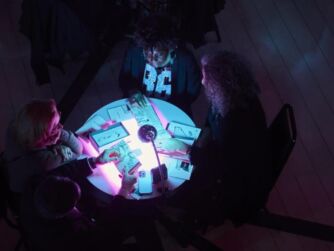
I interviewed Anne Jeppesen & Omid Zarei about Reality Looks Back on Tuesday, November 18, 2025 at IDFA DocLab in Amsterdam, Netherlands.
This is a listener-supported podcast through the Voices of VR Patreon.
Music: Fatality
Podcast: Play in new window | Download
Rough Transcript
[00:00:05.458] Kent Bye: The Voices of VR Podcast. Hello, my name is Kent Bye, and welcome to the Voices of VR Podcast. It's a podcast that looks at the structures and forms of immersive storytelling and the future of spatial computing. You can support the podcast at patreon.com slash voicesofvr. So, continuing my series of looking at different experiences from IFA DocLab 2025, today's episode is with a piece called Reality Looks Back by Anna Jeppesen and Omid Zarai. So this was a dome piece that was showing in like a mini dome, but also in the larger dome. And it's a piece that's exploring different concepts of quantum ontology, quantum reality. The piece is called Reality Looks Back, and it's kind of playing with the Copenhagen interpretation. So, you know, when you observe something, then it's reacting, the waveform reacting. And so, but they're kind of exploring different aspects of Everett's many world interpretations where all these possibilities are being actualized in these other universes. And so they're using like point cloud Gaussian splats as kind of a spatial metaphor for these clouds of possibility. And they're imagining quantum decoherence that are happening at the macro scale of different ways of re-imagining our concepts of reality so we had a really rich conversation here where we're kind of breaking down our differences of how we're making sense of a story of quantum mechanics you know this is something that there isn't any settled answers to there's lots of different interpretations and so it's really kind of like what's the most coherent story that you want to have but i think we can agree upon how looking at this quantum realm is providing these anomalies that is asking us to have these deeper paradigm shifts around the nature of reality and so yeah really enjoyed the kind of poetic nature that this piece is able to kind of follow a very synchronistic moment that happens within the context of this piece where they have an open-ended process that they're open to possibilities and that as they're open to those possibilities then there's like a very distinct turning point that happens where the hamster dies in the caption on audio and they kind of start to take a completely different direction for where they're taking the story and so it's a really interesting piece to kind of unpack all that um So we'll be covering all that and more on today's episode of the Voices of VR podcast. So this interview with Annie and Omin happened on Tuesday, November 18th, 2025 at IFA Doc Lab in Amsterdam, Netherlands. So with that, let's go ahead and dive right in.
[00:02:28.675] Omid Zarei: Hi, my name is Omid Saray. I'm an immersive producer and director. I've worked with VR for like seven, eight years now. And I work with real-time graphics, VR, everything between storytelling and immersive media, location-based. And that's me.
[00:02:44.713] Anne Jeppesen: Hi, my name is Anne Jeppesen. Yeah, I'm also an immersive producer, mostly focused on sound. And we form a duo together called Superposition XR. And we're based in Copenhagen.
[00:02:56.922] Kent Bye: Great. And maybe you can each give a bit more context as to your background and your journey into the space.
[00:03:01.775] Omid Zarei: So I started with films. I started in film school in Paris and then worked in film for a while. Director, cinematographer. I worked as a cinematographer for over 10 years. And somehow when DK1 came out, whatever year that was, 2015, I guess. DK1 was released in 2013. It took a while to reach us. And then I got involved with VR and the first project was a workshop we did in Finland to actually get people to try to do VR because nobody knew how to do it. It was called VR Filmmaking Workshop Helsinki. And then from there on we just started producing our own projects and then we formed our duo. And we had our previous project, Vocal Landscape, we showed in Venice, Biennale. And then we have another project, a UFO project we were working on, and then this one now is just being premiered at IDFA, Reality Looks Back.
[00:03:53.044] Anne Jeppesen: Yeah, so I mean, similar story, except my background is in sound. I started working with XR when we formed our duo, so that's it. But yeah, worked on the same project, Vocal Landscape, and now Reality Looks Back is premiering here in IDFA, yeah.
[00:04:10.728] Kent Bye: Great. So it sounds like from the credits that the project of Reality Looks Back started as a sound piece. And so maybe you could give a bit more context for where this project began.
[00:04:20.939] Anne Jeppesen: Yes, it started in this wonderful little festival called Luthier in Florence. They have this amazing program called the Yas Mentorship Program. And I pitched the idea, and I've actually pitched the quantum idea many times in many places, and usually no one bites on it. But this time they did, and I was assigned a wonderful Canadian mentor called Crystal Duhaime. And then we had half a year to develop the script. I developed the script and she was a great support. And then the audio version of it premiered in Florence last year in December. And then we figured that it had more potential, the story. We can put more visual meat to the bone. So then we did that for this year. It's been an interesting process, for sure. But it did start as an audio piece. Yeah.
[00:05:13.243] Kent Bye: Yeah, just to kind of elaborate on the theme. So you were pitching the ideas around the quantum. Maybe just kind of briefly give a sense of either the pitch or what the topics you wanted to cover around this quantum realm and the different ideas and philosophical implications that come out of that.
[00:05:29.457] Anne Jeppesen: Yes. OK, let me see if I can. OK, so the thing is that when I think both of us, when we get our ideas, it was mostly emotions. And then we kind of start from there and keep the process open and explore for a while. So in this case, it was the feeling of having waveform collapses or the idea of waveform collapse being present in your everyday life. so what i pitched was actually the scene with the cup so i wrote that out and that was my pitch and so it's about that feeling of having these wave of possibilities moving around you and i guess that's a feeling i get from diving into quantum physics for a while and just like starting to bodily understand what's going on and it's really hard to bodily understand quantum physics because There are different rules applying to that than the rules that we normally experience in our everyday world. So then the world gets kind of weird. But that's interesting to explore in the story.
[00:06:32.384] Kent Bye: Yeah. And from your perspective, as you're coming on to this project, what was some of your thoughts on either the topic or the potential for diving into the quantum realms of possibilities?
[00:06:43.416] Omid Zarei: It is funny because we talk about this very often. This is one of the things that we talk about on a night out. If we get a couple of drinks, we talk about quantum and stuff. And then when Anna's piece, The Voice, came together, we were out one day and we basically took a piece of paper and we just said, this is an immersive piece. This is something we could actually expand it to either VR or the first idea was actually projection mapping, like do a room of projection mapping. And then we had like doodle some stuff around with Gaussian splatting. With some of the footage that Anna has used as audio for the piece, we had taken the video and turned them into Gaussian splats. And then there was something about Gaussian splats and the quantum entanglement and clouds of possibility, like the way the splats look. It was just like, yeah, okay, all the ingredients are here. We should just find a way to turn this into an immersive piece, which, as you probably know, is very hard to do Gaussian splats in VR in 6DoF. So we thought, okay, it would be very great to do it as a projection mapping, and then maybe we can ease our way into the headset that way. Because in that sense, we can already have a version of the project that people can walk into and show these clouds of possibility that comes from this real documentary footage, and then expand it from there. And then, yeah, you know, when you train Gaussian splats, it's all about probability because it's interpolating in between things. So that visual language somehow had a quantum feel, you know, inherently into it. So it all felt very natural, you know, that this should be a mercy feast with Gaussian splattings. And it's very quantum, the whole thing. It's very like non-local and superpositioned, let's say. Yeah.
[00:08:22.185] Kent Bye: Yeah, there's a real elegant overlap there between the visual language of Gaussian splats and the way that they're embedded within themselves, these probabilities, and how the whole piece is around the relationship between these probabilities and the actual reality. And so, yeah, it's an interesting piece just because the narrative is going along and then there's sort of a turn and twist that happens that this really synchronicity moment of reality. Whatever happens in that moment sort of reflects the larger story that's being told. And so as you do your process, it sounds like you're starting with the emotion. And these conversations, are they scripted or you're just having these casual conversations and recording them? I'm just trying to get a sense of your process of capturing these stories and how much improv versus how much planning or... setting up a large higher level intention to be able to have a discourse but you know just curious if you can maybe break down the specific process that you two use because as i listen to it it sounds like you're just recording a conversation but if you take more of a documentary approach where you record these conversations and then script it afterwards or if you script it ahead of time so just curious to hear a little bit more around your process
[00:09:28.729] Anne Jeppesen: Overall, I think I alluded it before, it's like we started with an emotion and then we keep the process open for a while. I think that's similar to what we did with our latest piece, A Vocal Landscape. So we let reality bleed into the story, you could say, for a while. So we're not sure exactly what's going to enter, but we know when it hits the notes or not. And then we weave something together out of whatever comes in, if that makes sense. In this case, The conversation, because in the piece, me and Umid have a conversation about the specific thing that Umid has experienced, which is a split déjà vu. And that was completely unscripted. And also the event that happens is that our hamster died on tape and it made a sound and it all happened. But of course, because we had this openness in that time in the process, we were ready to take that in and be a major part of the narrative. So that's what happened.
[00:10:25.503] Kent Bye: yeah that's kind of how it felt when I was watching it and you take that moment and it's very symbolic in a lot of ways of this Schrodinger's cat is the cat alive or dead and you're talking around that very similar topic and then your hamster dies in that moment and that's captured on tape that then and then it sort of takes a turn into this whole deep dive into that and so once that happened then how do you start to introduce Oliver into the piece or how did like where did your process go at that point
[00:10:51.857] Anne Jeppesen: To be honest, that's when the story fell into place, and it was easy after that. I was grappling with a lot of different threads at that point, and I was curious about exploring death as a theme, but I didn't want it to be super heavy. But there is something about going to that realm of life and death, which is a very clear way of illustrating what's at stake when you think about these things. So Oliver died, it was very sad and a profound moment, but it was also, it was an old hamster and it was also a nice way to put him in as a character and explore this in a more, I wouldn't say light manner, but in a more, yeah, because he's the character that he is, it has a lot of warmth and yeah, love. Yeah. Yeah.
[00:11:41.374] Kent Bye: And Omid, you're listed as a co-director and producer. And so at this point, maybe you could just talk a bit about what your collaborative process looks like as you have this turn within the story and what that was like from your perspective.
[00:11:53.381] Omid Zarei: Well, as Anna said, basically like she was working on this for a while. It was like a solo project of hers before this thing happened, before I also started talking to her. And when the case with the hamster dying, we just really felt like, okay, this is it. This is basically like... the key point of the story and you know a story like something like quantum physics is like it's such a big topic that if you try to like make a story out of it just generally you really can't do much because it's such a you know ephemeral concept you know but then like something very tangible as death of your pets it just really gave like a solid ground to it that okay it's all you know turning around this event right And by itself, because we were sitting and literally talking about splitting Deja Vu when this happened. And that's the tape that you have in the movie. We didn't know if he's dead or alive because we just heard the sound. And it was just like a self-fulfilling prophecy, like this is happening. And we were like, okay, let's finish the conversation. I don't know, we didn't even stop. We just thought like, okay, something weird happened. And I just told Anna that I had a feeling that it was hamster dying, but I didn't want to say anything because it would bleed into the interview. I was like, okay, let's just finish the interview and then go check. And then you can imagine the rest of the evening was very different because then we had to take care of the situation. So it's funny because it's one of those projects that it really encapsulated the concept that he was talking about by itself at every level, both storytelling and technically. And it all fell together like just great pieces of puzzle. And then after the audio part was done, Creating the immersive part was also like so smooth because we had all the elements and it's just for all falling into place perfectly because we weren't inventing anything. It was all there. The quantum aspect of it, you know, the superpositioned hamster that are alive was there. The superpositioned visuals were there, like the splats were there. So we just had to like tailor it together. And yeah, you did a couple of versions of the audio and then you showed me and I was like, oh, it's great. And then, by the way, actually, Anna just won the best podcast award a couple of days ago at Aesthetica. So that work by itself was like really so strong. So we really had a really good ground to build on. And then was it for this specific episode?
[00:14:09.013] Anne Jeppesen: It was for this audio piece. Yeah. Nice. Yeah.
[00:14:11.957] Kent Bye: I was going to ask because it sounds like, I mean, as I was listening to it, I was like, oh, it sounds like an audio documentary slash podcast because it has a lot of other sound design. But yeah, it makes sense. Congratulations. But yeah.
[00:14:22.341] Omid Zarei: You were saying? Yeah, it was really, I don't know, you know, one of these projects that you start and you feel like you know that every piece are going to fall into place. You just have to like slowly pick them up and carefully put them in the right place. And unlike previous projects, we had very little struggle rounding it up, such as Moon Ride, you know. Because it was all the pieces. And then, you know, the structure that Anna had made with the audio piece was, in my opinion, was so well bookended that we couldn't mess it up too much after that, you know. It was just there.
[00:14:55.285] Kent Bye: Yeah, it's funny as I was... listening to the conversation as an interviewer, I'm always thinking around other associative links or things to ask next and other potentials. And so there's a piece by Joanna Babinska, The Choice. It was around abortion in Texas and people are sharing their oral history testimonies of that. And there's opportunities for you to ask a question and then that dictates the different answers that come. And then When I asked her about it, she said, yeah, you know, when you're having a conversation, you have to like think in your mind, like, where do you want to take the conversation next? And you have like a number of different threads where you could take it. And it's sort of like as a metaphor, like the possibilities of where things could go in the future versus like what you actually say is like the metaphoric quantum collapse where it's actually being actualized. And that's where it's going to go now. So anyway, I was thinking around that. And I was thinking around, oh, this is sort of like a documentary, audio documentary, but it's very podcast-like. And then moments later, you just said that it was sort of like podcast. So I find that happens a lot for me. But I just wanted to share that in terms of it felt very on point in terms of the process that we all go through in our lives is these realms of possibility of where things might go versus where things actually go. So it also sounded like they were exploring all those realms of possibility for where the project could go. But then when that moment happened, then there was like that metaphoric waveform collapse that said, okay, now this is where it's going. And then you go from there. So I think in our lives, we're always interfacing with this realms of possibility is always larger than what things actually happen. And so there's a kind of a nice symmetry there between these
[00:16:28.818] Omid Zarei: metaphor concepts that you're exploring in this piece but also like how that reflects our lives so I don't know if you have any thoughts definitely definitely I mean but also like you were at some point wanting to go different directions and you can maybe talk a little bit about how it like ended up being just again another intimate conversation do you want to talk about that here's an opportunity for you to make a choice
[00:16:50.199] Anne Jeppesen: I just want to say that it's very nicely put. I actually haven't thought about it exactly like that, the hamster. It was where it fell into place in a quantum manner.
[00:17:00.791] Omid Zarei: I'm not sure what you... I'm referring to the fact that you wanted to start working with scientists doing a quantum story. Yeah.
[00:17:06.578] Anne Jeppesen: Yes, yeah, yeah. It's because at the time also I had so many doors open, to stay in the metaphor that I was still using the piece. I had so many doors open and I was also still exploring quantum physics by myself and I just wanted to talk to a scientist and pick his brain and teach me more. But then I think maybe it's the same when you work with any immersive media, but especially with sound, I would say there's really a limit to how much information you can put into the listener's ears and have it be meaningful. So I had to scrape and scrape and scrape it down. And the starting point, again, was the emotion. What kind of emotion did it create? The world getting weird around you and just stay in that. But I had a lot of detours and a lot of writing that didn't make it. Which is fun and a part of this kind of process, I think. But in the end, it's about coming back to the emotion and then let things happen. And then in my experience, most of the time stuff do happen. Like things do happen if you let them.
[00:18:11.983] Kent Bye: Yeah. And I saw this piece two or three times now at this point because I saw it here in the mini dome. I saw it in the big dome and I went back and watched it again. And I think the first time I watched it, I really appreciated the beauty of the piece. But there's also very specific things around quantum physics that you were saying that then I was like, I don't know if I agree with that or that or I have a different take on that. And then the second time I watched it, I was a little bit more open to those things. Because in the realm of quantum mechanics, quantum physics, there's stuff that is still like this anomaly where we don't have a coherent story that everybody agrees upon. There's many different interpretations, many different possibilities. To extend the quantum metaphor for what this actually means, the story that is behind it, there's certain metaphysical assumptions that people have to make in terms of the implications of what that means. And I think we're still kind of dealing with As a society, we haven't fully integrated those quantum implications as a way that we think about the world. And so I always appreciate looking at quantum realities as a metaphor to kind of expand our minds, a possibility for what the nature of reality actually is. And so the second time I watched it, I was like leaning more into this like, oh, OK, well, these are metaphors. It's good to challenge people's existing notions around it, even if the specifics of things I don't necessarily know if I understand. can completely buy into. It's like, there's a realm of possibilities. And for me, I'm kind of more open to a multitude of those. And there's sometimes in the piece that I felt like that waveform was being collapsed as saying, this is how reality is. And I was like, well, maybe, I don't know. And so the first time I saw it, I was more resistant. But the second time I was more open to those ways as being more of a metaphor to open my mind for what those possibilities were. And there's a lot of poetic beauty in that. And so anyway, I'd love to hear any of your thoughts on that, because I feel like this topic sort of introduces this realm of what's truth, what's reality, what's actually happening with the quantum realm. And what does it say about the nature of reality itself? And also, how does this open our mind to these new possibilities for how we think about life and things beyond space and time?
[00:20:13.007] Anne Jeppesen: Yeah, big question. But I think you definitely answered something. Also, for a while, I was just worried to say anything about quantum physics, because there's a lot of debate, of course. There's a lot of different... Also, obviously, there are so many people who spend their entire lives diving into these questions, and I'm not that person. I'm doing a lot of other things, too. I just... go deep on YouTube sometimes and like read a few books and stuff but so of course I mean I can't explain like the full quantum story or where we're at scientifically with quantum theory at the moment yeah but I think also it was a process for me like also like Umid said before at first I really wanted to have the scientists in the piece and But I think what happens, I think a lot of time, what you also said before, there's still a threshold that we haven't really passed where everyone have an idea of what quantum physics is or that we can take it into our idea of what reality is or what it means that quantum physics are here and how we can think about this and how it's something that we... Yeah, it's just not something that most people think about. I guess you could leave it at that. And I think a lot of times it has to do with every time you encounter a scientist talking about this, it can very easily go places where no one can follow within the first three minutes of talking. So it's also about really trying to... What can we talk about? Can we take one little tiny... tiny snippet of this theory and just look at that and just try to feel that and try to grasp that and struggle with that and just start there and then maybe later we can go further down that road it goes for myself too i think it's maybe enough to grapple with one thing at a time i think also at one point i also wanted to go into the quantum entanglement and like all of these other kinds of aspects. But I think it's good to start small and maybe later we can expand. Yeah.
[00:22:25.933] Omid Zarei: This concept, like with things that we talk about, as I said, like we talk a lot about these bit more, let's say, niche topics. Like, you know, we're doing another project about UFOs. And so we're inherently very interested in the topics like quantum physics and And, you know, people are generally interested about these things. They've always been interested about, you know, fate, astrology, you know, tarot cards, all things that, like, tells you about the mechanism of how things work. And I think we had this conversation a few times that, like, quantum physics, like, for our times is sort of like what astrology used to be as a common sense, like, centuries ago, looking at the sky and all that things. And it's one of those things that physically can really show you, even if it's theories and even if it's not completely things you can take to the bank as a fact, it can tell you that the way the world works, we have no idea. And scientifically, that statement is true. And we always talked about the fact that if this was more of a common sense, or we all agreed every day waking up and starting our day on that basis... Things would be more interesting, according to us. You know, it would be a little bit more taking certain things easier and certain things less easy. You know, and live life in a different way because it's both talking about the level of agency that you lose and level of agency that you get. Sort of believing in some of these quantum concepts religiously, for lack of words. Even the possibility of knowing that, like, if I push enough to this wall, you know, within a certain period of infinity, I would basically, like, get through it. So I think it's just one of the motivations for us to make the piece was to kind of like spread this way of thinking, but in a level that is so approachable, a hamster dying, something that is not really like just going to philosophical and getting lost or something that is really everyday. And so that was the allure of, you know, jumping to the quantum thing in the piece. If that makes sense. Yeah, yeah, for sure. Were you going to say something?
[00:24:26.381] Anne Jeppesen: I had a thought, sorry. Yeah, it's just, I think what you're also saying, a central word for me, I think, is a humbleness that you get when you explore these themes. Like, it's much weirder than we think, and there's no way we can get the full picture. And I think that alone, to remember that and keep reminding ourselves and each other that we don't know everything, and we don't know exactly how things work, But we can do our best to just have that humbleness towards the world and towards reality and everything. I think it's a healthy thing in this day and age.
[00:25:04.079] Kent Bye: Yeah, and what comes to mind is, you know, we're speaking around other ways that there's parallels between the astrological tradition and the quantum kind of ideas. And for me, I've been really into like process philosophy as a way of kind of a coherent story that I feel like starts to tell the story between what's possible to what's actual. And Deleuze also kind of gets into this dialectic between the virtual and the real, what he calls the virtual as these realms of possibility. And so Whitehead came up with process philosophy. Then there's some other quantum ontologists with Michael Everson and Elias Sefiris that they created a whole relational interpretation of quantum mechanics that was basically saying that that the quantum realm. is this realm of possibilities and that there's this collapse and then it becomes the physical reality and what whitehead said is that there's this mental pole and physical pole and rather than creating a duality between like mind and matter that it's really a process of going from one state to the next of like going from this realms of possibility so young would call it archetypes plato would call these ideal forms whitehead would call the eternal object there's like names that this non-spatial temporal realm is called by philosophers that is this kind of realm of potentiality that is going from the mental pole to the physical pole. And so then there's this translation from possibility to actuality, but that from a process reality perspective, both of those realms are seen as being real. And there's a paper by Kastner, Epperson, and Kaufman that is taking Heisenberg's potentia seriously, meaning that what Heisenberg was saying was that there's this res potentia and res extentia, which is like Descartes had the substance and then there's also this mind in that rather than training as a dualism, Heisenberg was really seeing them as mutually implicative, meaning you couldn't have one without the other. So from a substance metaphysics perspective, most people see what is collapsing as being the thing that's the actual and the real thing. And then what is in the realm of potential is seen as not real until it collapses. And so my interpretation is that Everett's many worlds interpretation is a substance metaphysics based where you say that if it's a possibility, then it must manifest as an actuality in a parallel orthogonal universe. But for me, that's sort of grounded in this kind of substance metaphysics that is putting the primacy of it's only real if it's grounded in physical reality and Whereas for me, I'm like, well, these potentials are real. They don't need to necessarily actualize. So I'm less attached to it needs to be manifesting in a parallel orthogonal universe that we can't observe. So rather than believe in that magical story, I just believe in the magical story that there's this transcendent non-spatial temporal realm of potentials and possibilities. And that for me, it's more elegant to kind of think of it as this singular universe that is a process going from the mental pole to the physical pole and that there's a trace in history that every physical object can have. these quantum histories and so there's a contextual relation to that so there's more of a process of relational relationship to all physical matter that has histories back to a quantum realm rather than saying that we've split it off into these infinite universes so as i was watching your piece that was sort of like the different interpretation that i was having but it's still in your piece it's also in some ways arguing to treat these realms of possibility as being real so
[00:28:13.710] Omid Zarei: It's very interesting because I think like one of the things that you also basically decided from very early on, like ditching the idea with the scientists, like make it more of an interpretive piece about quantum physics rather than a piece that says how quantum physics works. And I think like whether you believe in a many world interpretation like religiously that knowing that all worlds are happening or you believe in a version of process philosophy version that you think that all those worlds are philosophically possible but they're not materialized. I'm just living in a materialized world. Just knowing that, I think, has an effect on you, believing that has an effect on you, that I think that effect is the humbleness that maybe you were referring to before, that puts us into a certain kind of perspective. And I think they basically have the same sort of consequence. And they're both beautiful, I think. They both really put things into perspective for us to navigate better, in my opinion. Yeah.
[00:29:12.096] Kent Bye: Yeah, that's why I said the second time I saw it, I was able to get to that point. But the first time I was sort of like, oh, no, no, no, it's not that, it's not that. And then I was like, well, actually, I don't really know. So I have to kind of let go of my sense of really knowing what the reality is. And so, yeah, I don't know if you had something you want to say.
[00:29:27.261] Anne Jeppesen: No, I just, I think that's also beautiful. Like your version is also beautiful, that they're equally real. I like that. Yeah. Maybe that's another story. Yeah.
[00:29:37.886] Kent Bye: Yeah. Yeah. I think, yeah, just leaving up the possibilities of having other possibilities. You know, one of the other things, a reference point for me was this philosophy of math named Michelle Friend. And she had this idea that. The foundations of mathematics was pluralism, meaning that most formal systems have this paradox where it's like girl incompleteness, where it's either consistent or complete, but not both. And so when you try to put like a foundations for all of math and try to pin it down to a singular area, then it's going to be necessarily incomplete. So how do you have a. a foundation that's complete, but yet you want it to be complete, but then you can't fall into the inconsistency. So there's been this kind of paradox where math itself has like this kind of foundations that are still sort of unsettled. And so Michelle Friend was like, well, just make the foundations to be pluralism, meaning that we're never going to find a singular answer. So we just have to kind of accept that there's going to be multiplicity of many different types of answers based upon the context of which you're talking around. So I love that as an idea that gives this emphasis of pluralism of being open to these multitude of different possibilities. So, and in a sense, it's kind of like staying in the paradox of the potentiality rather than the collapse. And so, so yeah, I try to like do that in my day to day life, but am I always successful? Cause I always like, I have a firm story that I like. It's like my preferred story that I want to believe in. So but I feel like in your piece, you're really encouraging people to also open up their minds beyond their own strict concepts of what reality is. And so I really appreciate how the quantum metaphor can start to kind of open up their minds to consider these other possibilities, whereas they might not have considered them before.
[00:31:12.765] Omid Zarei: Are you referring, I kind of feel like what you're saying happening in math is a bit like as if in physics we would ditch the idea of theory of everything. Is that correct?
[00:31:22.708] Kent Bye: Yeah, I think there's a sense of way that there's this goal to have a theory of everything, but I'm not sure if that's going to be possible. Maybe the universe is pluralistic in a way, but quantum mechanics works for the context for the super small and the relativity has this. That may be a failed effort to ever have this kind of theory that describes everything. And so looking at... the lessons of the foundations of math and what Michelle friend is saying with like pluralism as being a foundation is like really encouraging people to like embrace the multiplicity and the contextual relations of how for each context, there may be something that works for that context, but there may not be a solution that works for every context. And so I think it kind of encourages this, like, depending on the context, then you are using different systems that work for that context. But then when you change it, then it's sort of like open your mind to those more possibilities. So I think that's a concept that I try to carry where it's like, I try not to be too firm and like saying, okay, this is what is actually happening. So.
[00:32:15.405] Omid Zarei: I feel like also one of the things that Ana is trying in the audio basis basically is kind of detaching us from this binary Cartesian idea of collapse or non-collapse. Is it happening or not happening? And you could get there with the process philosophy again or thinking of many more interpretations. Coming to peace as a person with the existence, but existence not necessarily like a physical existence of all of these at the same time, but not necessarily that all of them are existing factually at the same time. I think that's maybe the bottom line effect that humbleness again, that you really want us to get there because it's... it does something to you to kind of like position yourself like that in life and carry yourself like that in life knowing that like you know we do tend to like really fall into like this binary yes no or like is it there or not and i think like the most attractive part of the quantum physics for me personally is that trying to like you know get yourself like out of that mindset a little bit yeah i don't know if i can add anything yeah
[00:33:20.990] Kent Bye: Yeah, well, one other aspect of this is the Copenhagen interpretation where when you observe the wave function, it collapses. And so there's a key part of the story of reality looking back where when you observe something, then you're participating with it. So, you know, of course, that's not universally accepted by everyone that that's the correct interpretation. I happen to enjoy that as a possibility. I entertain it as possibility. One of the key things of like maybe our consciousness or the way that we are observing the world is having an active participation with the world around us, which I think is a nice way of thinking that we're not just in these kind of deterministic worlds where what we do doesn't matter because everything's already settled, but that there's this optimism towards like we're actually actively co-creating and participating in the creation of the universe by what we are looking at and what we're participating in. And so I think... That's another big thing that I really appreciated around the message of the film, of Reality Looks Back, is really unpacking that core concept. So Ludovic, any other thoughts on that?
[00:34:19.910] Anne Jeppesen: Yeah, I mean, for sure. I think, yeah, that is a part of it. And then at the same time, I would say like, yeah, it's of course positive that we interact and wherever we go, whatever we observe, how we interact with the world forms paths or whatever. And then also at the same time, it's like, again... it's way more messy than than we can think there's never like a linear way there's never like in my is i think most people can recognize that from their own life it's just like it never really works out the way you thought it would in general and i think also it's a little bit in the context of that if that makes sense that there is action but it's also never what you think if that makes sense yeah
[00:35:05.071] Omid Zarei: Yeah, I mean, it's also like something we talked about as recent as a year ago. We got into Donald Hoffman and his headset theory about conscious agents and the way that we understand. I mean, in a nutshell, basically, he's trying to say that, like, we are, evolutionarily speaking, we are evolved to be able to understand reality the way it is now, the way we define it now. And that evolutionary developed system is the headset that we wear, basically, to understand and interpret the world, and if we didn't have that, evolutionarily speaking, we wouldn't survive, because reality itself, without the headset, is just a complete nonsense, let's say. So, in a way, we kind of think that whether it's true quantum mechanics, true quantum physics, or true other theory, we maybe inherently feel the fact that Somehow the way we interpret, the way we interact with the world affects things. But maybe not exactly in a mathematically correct way we can yet define it. Not maybe through the Heisenberg's uncertainty equation. Maybe later on in human history we find better ways to understand it. Donald Hoffman is trying to do experiments outside headset. Whatever that means, because, you know, it's a case of solipsism. We can't really understand, we can't really like test things in a system to know if the system is active. If you're inside the system, you need to be able to test the system from outside. So it's maybe like ties up to a lot of thoughts. And I think this has been practiced in many different schools of meditation or religion or religion. thought processes throughout history and in our time, like the past century, quantum physics is the most accepted format of it, I guess, that kind of like gives us a certain way of scientific validity to these things because we can actually measure and we can actually test things and know that, okay, Yeah, there's quantum entanglement. That's a real fact. We can have quantum computers because of the effect. So the effect exists there. But I think it's not, I mean, we both agree that it's not everything. It's probably there's more complicated system at work that we are seeing the effects of it as such.
[00:37:14.226] Kent Bye: Yeah, the way that I think about it is that the math has been clear, but we don't have a coherent story that tells us what it means. And so I think it has lots of implications of these anomalies. Like Thomas Kuhn had the structure of scientific revolutions. And so he basically splits up into these different phases of like, we have normal science where everyone agrees on what the reality is. And then There's anomalies that go against the models of our reality. And then people usually dismiss the anomalies at that point. And then the next phase is that anomalies come to a point of crisis where the people who used to be denying them can no longer deny them. However, there's not a new model that sort of describes all the new data and all the old data. So there's kind of a lack of a paradigm shift. But the paradigm shift only comes when... There's a coherent theory that only explains anomalous data, but also predicts new data, but also explains all the historical context of the data. Then there's a paradigm shift. So I think we're in this kind of liminal space where we know that there's all these anomalies. We're in the model crisis where we know that we need something more sophisticated to coherently describe all these things. But we haven't made that flip into the paradigm shift yet because there's nothing that really ties it all together. I'm a fan of the process philosophy as being that possibility, but this is not something that one individual can do. It's more of a larger collective scientific process that's very sociological, and that's what Kuhn saw. This is not a process of just convincing people. It's something that people will be very attached to their existing paradigms, and it really takes something drastic for them to change their paradigms. What I love about your piece is that it's sort of inviting people to kind of like, if they are in this kind of more Cartesian dualistic mindset, that it's opening up the possibilities for something that's different in a way that I think ties together both with the Gaussian splats and all the cloud-based aesthetics with this beautiful story and really authentic moment and these real auspicious turning points that happen in the film and the music that's all throughout. So it feels like a poem that's dedicated to these ideas of the paradigm shift. Anyway, Anyway, that's as I think around like where we're at and where this piece is situated, we're in this state of kind of like knowing that all these anomalies exist. But like you said, we don't have like the means to be able to pierce outside of our space time reality to get into this non spatial temporal quantum realm to really fully understand what's happening there. And so we have to kind of interpolate through these probabilistic math equations to kind of then interpret. understand it but then to translate those math equations into a story i think has been a huge challenge but at least in your piece you've been able to translate into a story that we can connect as human beings
[00:39:48.459] Anne Jeppesen: Well, thank you for that. That's wonderful. I would love it to be a piece that does that. Yeah, I think also so far, I mean, we can't wrap our head around it, but I feel like there's just a lot of beauty in this. So we can start there and just try to feel it. Yeah. And that's the aim so far. I hope the conversation grows and I think it is growing. That's my experience when I talk to people around. So yeah, exciting times in that sense.
[00:40:18.482] Omid Zarei: I think you really encapsulate it very well with the term model crisis. I think the piece really tries to depict this area, this environment of model crisis. We know that paradigm shift would come or will come soon. And then the piece really tries to talk about and depict what do we do, how do we do, and how do we position ourselves in the meantime on a personal level. And I think that positioning is a lot about surrender and humbleness whilst model crisis is going on. That's it.
[00:40:49.575] Kent Bye: Nice. And another model crisis is the UAP, UFOs, aliens. Just a nice transition point, if you want to say a few words on what you're working on in this project.
[00:41:00.393] Anne Jeppesen: Yeah, we're working on a different project about alien encounters, another big model collapse happening. Yeah, it's an AR project where we try to take actual encounter experience and build them into a familiar setting of your own, like, for example, a living room, to bring this weird phenomena closer to people and have them deal with it. Yeah. Yeah.
[00:41:28.140] Omid Zarei: So the idea, we've been working on this for a while, actually longer than this project, because it's also way, way, way bigger. We went to Iceland and did interviews with like people who claim to have had encounters or been abducted. And I mean, when we did interviews, stories came out that we just really got the grasp that this is way bigger than what we thought when you talk to some of these people. And the idea for that project is to do a mixed reality, as you said, and we're basically mixing up a lot of different elements that actually keeps repeating, motifs in different stories of abductees or visitees. Experiencers. Experiencers. So we're finding motifs that repeats and then basically putting them in a pot. And it makes reality basically like the headset scans your rooms and finds elements in the room, like the door, a window and stuff like that, and finds the best abduction or experience or like what I call sighting story encounter for you. And then it unfolds in your own surrounding and pass through. We did a prototype for it on CPH Talks like a few months ago in March, a four minute prototype that runs on Questree. But we know that this is going to take a bit longer. Also for us to understand how we're going to... Because we already have so much content. And we have to find a good way to make it personal. But also make it down to earth and approachable for people. Because some of these stories are a bit too big.
[00:42:52.390] Anne Jeppesen: And then at the same time we also want to try out a lot of different models for interpretation. So we looked into Jung a little bit and... yeah different kinds of scholars who deal with this in different ways and i think it's the same case there like there are many different approaches to this and i don't think there's one answer but there's a lot of themes that repeats in different interpretations so that's also part of what we're dealing with but it takes time it takes a lot of time so but it's brewing for sure yeah
[00:43:23.629] Kent Bye: Yeah, I'm not sure if you've seen the mapping of all the different possibilities. I'm a pretty big UFO nerd, so I track a lot of the conversations on this topic. But there's been people that have mapped out all the different possibilities of the stories, and Jungian interpretation is one of them, psychological. But there's also someone else that took... And then Lawrence Kuhn had created a whole map of consciousness and all those different types of interpretations. And so there's kind of an interesting parallel between those two maps of consciousness and these kind of potential possibilities for these UAP phenomena, UFOs and alien encounters. So, yeah, I think each of these are kind of consciousness and the models around consciousness and UAPs, quantum mechanics. All these are like model crisis topics that, you know, I've been sort of dipping into as well. But I think for me, my own work, I'm really fascinated by this concept of a paradigm shift and like working on projects sort of like at the end of it would change. imply some sort of paradigm shift I think that's been why I've been a large part so interested in this immersive area but just curious to hear from your own perspective of like what is drawing you to like this fringe ideas that could actually provide some sort of grounding that move from the fringe into something that's the mainstream and validated in a way that brings about like a deeper paradigm shift so You know, just curious if that's a theme in your work as well, of being attracted to the edges that are going to see what might be coming next and catalyzing some different change of our mind on these topics.
[00:44:52.390] Omid Zarei: I think we are very much interested in the concept of paradigm shift. And I think that one of the reasons, probably there's a lot of reasons, but just top of my head, like one of the reasons for that is that I think it would cause discourse, would cause conversation. And it would help us get closer to each other if we actually have to collectively deal with a paradigm shift that affects everyone. So a lot of times I think when we gravitate to this concept is because it can open these doors where people can think and look at things in a completely different way. And then from that different perspective... you really find much more interesting points of commonality in people's ideas. And you find a new, more interesting intellectual home, if that makes sense. But also another reference to what you just said before about one of the people who we interviewed about the UFO abductions, which was probably one of the most interesting interviews. That was like six hours interviews, non-stop. From the very beginning, she started saying like, You want to hear about the alien stuff, like just, you know, the physical alien encounters. It's like, that's not so interesting because she had so many different qualities of experiences with other forms of entities. And a lot of them didn't really fit into this sort of this realm of like just like physical UFO encounter that like she thought that these are just like the easy stuff, the UFO encounters she had. And then she later on, she told us about things that was like completely on a different level of like, you know. So seeing someone like that and the way we could get into her universe, we thought sharing a moment like that on a general level with other people in our work could be very interesting. I don't know if you want to add something.
[00:46:28.537] Anne Jeppesen: Yeah, I don't know if I can add anything either, but for sure it's just when you move into the subject, I think what really fascinates me is just that the more you dig, the more messy it gets and the more wild and colorful and crazy it gets. like for this particular topic and I think in the end of the day it keeps coming back to like just all the stuff we can't understand but that gives perspective to the way our we run the world today and like to just give a humbleness and also just again like yeah like you said an opportunity to break out of these things that are going on now and think differently and possibly do things differently yeah
[00:47:14.389] Kent Bye: Lots of themes of what's truth, what's reality. And The Age of Disclosure is going to be released in the movie on November 21st. I saw it at South by Southwest to the world premiere. I was there, recorded the Q&A that went viral because there was lots of people that were in the film talking about it. So, yeah, I think the film of The Age of Disclosure, if it takes off and has potential to... also more than the public, but maybe people within government seeing it and then potentially taking action. So I'd be curious to see if there's been a lot of the people trying to pass the UAP Disclosure Act to like have this official disclosure process embedded into the National Defense Authorization Act and actually have a process of disclosure that's happening. And, you know, I'm both hopeful, but also very pessimistic that's going to happen. Optimism is that it would happen very quickly. And if not, then it may be Going on and on and on. But there is something very compelling of all this evidence in these encounters of something that's going on. And so I think there's a lot of value of capturing these kind of oral history testimonies and as a way of trying to build up this larger picture of like, what is the truth of what is actually happening? Are we alone? And what are these entities and what are they doing? There's no end of questions that it starts to bring up.
[00:48:22.757] Omid Zarei: No, I mean, it's really like, yeah, I'm really curious about the movie, but I haven't seen it yet. But when you talk to these people like face to face, a lot of times you get the impression that like they are never alone after it happens. Like the impression we got, for example, with this one case was that like, she has been together with entities from age seven, eight. And we got the feeling also like at some point that in the interview that she gave us the impression that she's still seeing them as we speak, like they're present in the room. And it just feels like that, you know, a lot of also this UAP encounters. Now, I don't know what is in the movie, but like, you know, they start going into this realm of like interdimensional and like, so it's, I lost my train of thought.
[00:49:11.458] Anne Jeppesen: I mean, in my way of understanding this, I've been following the UFO discussions for a while, at least the way it is locally going on in Denmark. It's like, now it's okay to talk about UFOs or UAPs as like flying objects in the sky. And we're not quite there yet where we can talk about where it gets more messy than that. And often these sightings are related to more weird stuff happening at the same time. Like... when it becomes creatures and creatures of different nature, celestial beings of different kinds. And that's where there's still a taboo, at least in our local context. People feel uncomfortable going there. And we just think it's also interesting to push a little bit there and see if we can get a little bit more comfortable with this and try to grapple with this phenomenon a little bit more, even when it gets really weird. But yeah, it's a work in progress for us too. It's huge. And yeah, there's a lot of play for sure.
[00:50:16.428] Omid Zarei: It's also like following the thought process of the paradigm shift. I mean, if the disclosure happens in a way that we could collectively agree on, like, okay, this was a disclosure, if that aha moment finally happens, I think, again, it's going to be one of those things that I would really like shift the way we deal with things from here on in one way or the other because it gives that very much needed perspective that we need to sort of like yeah move to a different direction slowly but steadily move to a different direction from here on and you can see that happening at on a personal level when you talk to this experiences or like abductees because they've had it and Hopefully, if we have a collective disclosure experience, it could also help us to get some of that sense of feeling like part of a bigger system at work than what we know now, that we define now, I would say.
[00:51:09.529] Kent Bye: Yeah. And even if Trump came out tomorrow and said, aliens are real in it, take my word for it, we're not going to show any data, there would be an acknowledgement. But I think the scientific community needs to have access to the data to be able to independently verify it. So there's this whole paradox of like, in order to have that true paradigm shift, you have to like, not only have the data, but also explain it. If you can't explain it, then you're still in that model crisis. So it's like more of a model crisis acknowledgement. And It's moving from more of the denial of the anomalous data into the acceptance of the anomalous data. There's been sort of shifts, but there hasn't been universal acceptance of that model crisis. So it sort of moved us more to the model crisis mode rather than the paradigm shift because we'd have way more questions around what's happening than answers. It would actually be another step, I think, after that where we'd need to have data. We'd have to have more convincing information as like who they are, what they want, why they're here, which is all speculative because they could be good or for bad reasons. It introduces so many questions that I think are interesting to think about but also can be completely destabilizing as to the nature of everything. So anyway, it's a deep, deep, deep topic. Exactly.
[00:52:13.534] Omid Zarei: I think, as you said, what we really desperately need is just way more openness around the topic, both at the congressional level, both at the scientific level. There just needs to be a flow of data coming in and be verified at every level and be investigated at every level to be able to move from this liminal space that we're at. Yeah, as you said, we're very close to model crisis. Maybe almost there, but it's not almost there. And I think the first step of disclosure would be actually accepting the model crisis about the way we understand the universe. But hopefully, I mean, in our lifetime, I hope that we'd reach the point that we actually at least reach the model crisis so the data can come out and be investigated at every level. And then from there on, we could actually find a different way to understand and define everything around us. And I think it would be very exciting to witness. So hopefully, you know, what we're doing now with the tuner, with the mixed reality project is something that we can refer to in a few years saying that, oh, it was, this was before the disclosure, you know?
[00:53:13.466] Kent Bye: Yeah, for sure. And having seen the age of disclosure, my take on it is that for anyone who's like a close follower to what's happening in this topic, like there's no new information per se, but it's just sort of tied all together in a way that would convince people that might be on the edge of something that they wouldn't be taking seriously, that they It's enough eyewitness testimony. There's no hard data that's going to convince people of the evidence that they're showing. It's more of these testimonies of people that have seen the data or a position to perhaps know different things that are speaking on their authority of what they think the story is. And so it's like, do you trust these people or not? But I think the end of the day, it's a film that could potentially do enough work in D.C. to be able to have legislation and things moving on that front. And yeah, maybe just more popular acceptance of the idea. But, you know, for anyone that is a skeptic, it's nothing that's like a silver bullet that's going to convince them. If they've already a skeptic around it, it's unlikely that they're going to watch it in the first place. And if they do, then it's unlikely to change their opinion because there's not like undeniable evidence. It's just more what they call the standard of evidence. It's not beyond a reasonable doubt, but it becomes like the lower levels of an aggregation of suspicion to think that there's something there that you can look into further. Anyway, we could talk about all this forever and ever, but just to kind of wrap things up, get into this little UFO nerd out session, I'd love to hear what each of you think the ultimate potential of this intersection of immersive media and immersive audio storytelling might be and what it might be able to enable.
[00:54:46.653] Anne Jeppesen: Let me think for a second. What I think, for example, I think it's a great medium to explore these kind of things that are on the edge and that pushes our perception of reality a little bit, for sure, because of the immersive nature of the medium. So I think that in itself, I think that's at least a big part of why we like it so much and see a lot of potential because it aligns with the subjects that we're into.
[00:55:10.188] Omid Zarei: Yeah, I think likewise. I think this project we did now is being shown in a planetarium, in a dome. And I think the immersive aspect of it definitely has a bodily effect on the viewer. So it's something that you feel more, again, with your body rather than just looking at the screen. And I think it's completely essential, in my opinion, for a topic like quantum physics or, let's say, later on UFOs to have these bodily experiences when you are going into these difficult topics that needs you to be a little bit out of your comfort zone. So I think the immersive aspect of it really helps to inject that little bit uncomfortable truth or uncomfortable concepts into the audience. So it's a perfect match in my opinion.
[00:55:54.721] Anne Jeppesen: In this particular case, we shot a film in this massive dome in the zoo here in Amsterdam. And it makes you feel really small. So that in itself was a powerful effect, like that you actually go inside a coffee cup and swim around. So I think, yeah, that's just one, of course, way. But yeah, there was a moment where I thought, OK, you can't get this effect any other way. Yeah.
[00:56:20.353] Kent Bye: Yeah, it's being shown in a mini dome here in the exhibition space, but also in the big dome and the planetarium. Is there anything else left unsaid that you'd like to say to the broader immersive community?
[00:56:29.454] Anne Jeppesen: I think we said the same thing last time we were on your podcast but just we hope you all want to keep going and explore this because it's tough to make anything funding is hard for a lot of places in Europe at least it can be really tough to get funding these years and a lot of us struggle to get production in order so I just every time I go to a place like this I just really appreciate the effort the passion that people bring to this field and yeah keep it going
[00:56:59.571] Omid Zarei: Yeah, likewise, I think like the immersive community is literally, in my opinion, the best community that I've known of, like comparing to other like media and art and film and all that stuff. And everyone got each other's back because everyone is experimenting. Everyone is trying to figure out how to communicate with this medium. And I really wish that we all just keep going on that direction of just experimenting. There's no recipe. There's no textbook for how to do it. And we're all writing the textbook as we go. And I hope we just don't fall into any norms and just keep experimenting. And we finally will find the potential of the medium along the line. I really believe that.
[00:57:34.940] Anne Jeppesen: And it's not linear. It's not linear.
[00:57:39.659] Kent Bye: Yes, embracing all the possibilities that are out there. Awesome. Well, thanks so much for joining me on the podcast to break down what you're doing with both Reality Looks Back and your upcoming projects. But yeah, like I said, I feel like it's a real beautiful, poetic exploration of all these concepts that are at the edge of this paradigm shift that you're really kind of advocating us expanding our ideas about what the nature of reality is and more participatory nature of it. But yeah, just kind of like a really beautiful way of kind of using this conversational style and letting the moment arise and then tracing that wherever it goes. I feel like it feels like it's very of the moment in that way and kind of following the omens as they arise. So yeah, thanks again for joining me here on the podcast to help break it all down.
[00:58:17.970] Anne Jeppesen: Thank you.
[00:58:18.871] Kent Bye: Thank you so much, Kent. Always a pleasure. That's all that we have for today, and I just wanted to thank you for listening to the Voices of VR podcast. If you enjoyed the podcast, then please do spread the word, tell your friends, and consider becoming a member of the Patreon. This is a listen-supported podcast, so I do rely upon donations from people like yourself in order to continue to bring you this coverage. You can become a member and donate today at patreon.com slash voicesofvr. Thanks for listening.