
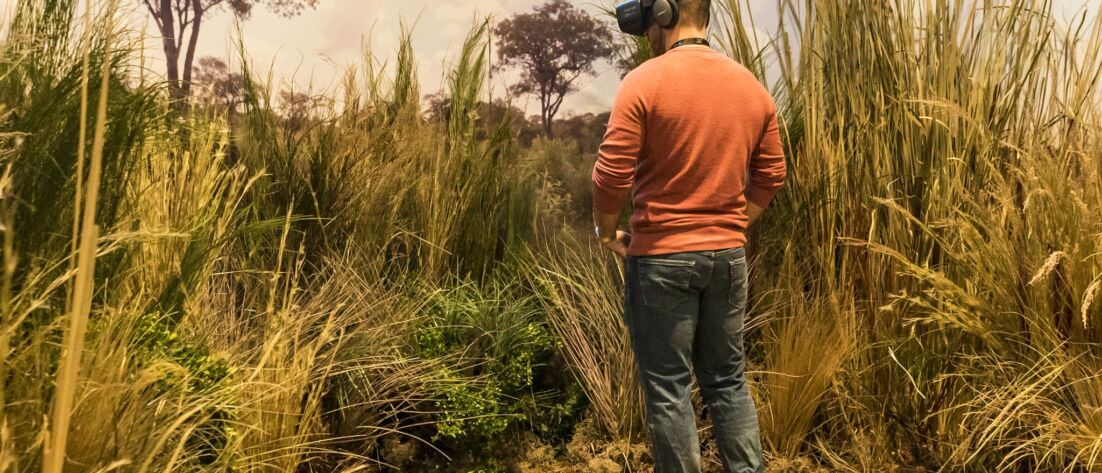
 The Tribeca Film Festival featured over 30 different VR experiences within their Storyscapes and Immersive Virtual Arcade, and I had a chance to catch up with curator Loren Hammonds about some of the highlights of the festival program with genres spanning from live-action narrative, animated narrative, documentary, interactive installations, guided tours, empathy pieces, and even a couple of immersive theater, mixed reality pieces. The overall focus and theme that connected all of the VR pieces is storytelling, both in terms of strong storytelling execution as well as in innovations around interactive storytelling.
LISTEN TO THE VOICES OF VR PODCAST
Some of my personal favorite pieces included a immersive theater, mixed reality piece called with a live actor Dram Me Close. The Last Goodbye was an incredibly powerful tour of a concentration camp by a Holocaust survivor that pushes innovations around best practices in volumetric storytelling using photogrammetry and stereoscopic video capture. Other documentary stand-outs include Step to the Line as well as Testimony, which used an innovative non-linear structure to feature direct testimony about experiencing sexual assault. One of the best narrative shorts was Alteration, which used AI-processing techniques on the 360 video to great effect. My favorite animated short was APEX, which is the latest music video by the creator of Surge. I also had some great interviews with the creators of Blackout, Treehugger, Tree, The Island of the Colorblind, Auto, Bebylon Battle Royale, Becoming Homeless, The People’s House, Remember: Remember, Falling in Love, and Beefeater XO.
Donate to the Voices of VR Podcast Patreon
Music: Fatality & Summer Trip
Rough Transcript
[00:00:05.452] Kent Bye: The Voices of VR Podcast. Hi, my name is Kent Bye and welcome to The Voices of VR Podcast. So I just got back from the Tribeca Film Festival where there were about 30 different VR experiences that were being shown as part of their storyscapes as well as the virtual arcade. So I had a chance to catch up with Lauren Hammonds, who is one of the programmers of the immersive section of Tribeca, and we talk about the primary focus of the curation, which is on storytelling, as well as some of the highlights and genres of the Tribeca Film Festival on today's episode of the Voices of VR podcast. But first, a quick word from our sponsor. Today's episode is brought to you by the Voices of VR Patreon campaign. The Voices of VR podcast started as a passion project, but now it's my livelihood. And so if you're enjoying the content on the Voices of VR podcast, then consider it a service to you in the wider community and send me a tip. Just a couple of dollars a month makes a huge difference, especially if everybody contributes. So donate today at patreon.com slash Voices of VR. So, this interview with Loren happened at the Tribeca Film Festival in New York City on Sunday, April 23rd, 2017. So, with that, let's go ahead and dive right in.
[00:01:29.311] Loren Hammonds: I'm Loren Hammonds. I'm programmer of film and immersive for Tribeca Film Festival, and I curate the virtual arcade each year. This is our second year at Tribeca, and yeah, here we are in the middle of it all.
[00:01:42.823] Kent Bye: Yeah, well I'm really impressed by the curation that you've done here and all the different range of experiences. So I'm just curious for you as you're putting together, you know, featuring the latest and greatest in narrative VR and different experimentations, what you saw as kind of the trends emerging, but also what you were trying to really focus on.
[00:02:01.452] Loren Hammonds: Yeah, I mean in terms of the focus, the curatorial focus, I was very interested in kind of concentrating on story in terms of narrative and documentary and just the way that people are delivering stories in VR. I see there's been a great evolution. So as there's that evolution in technology, I think that the creators are kind of starting to lead the content and they're even bringing the developers along or they're hand in hand saying, Here's the story that I want to tell. How can we tell it? How can we best tell it? And then in terms of trends, there have been so many amazing technical achievements just over the past year that it was important for us to give those a platform, whether it's the photogrammetry of the Last Goodbye or the amazing kind of mixed reality feel. of having a live motion-captured actress and drumming close, just the advancements in stereoscopic 3D live-action technology that you see in pieces like The People's House, which Felix and Paul are always amazing, and Step to the Line with Ricardo Lagunero. There were just so many things that were exciting and we wanted to make sure that we got a breadth of work here.
[00:03:10.388] Kent Bye: Yeah, one of the things that I was really pleasantly surprised to see was this first blend of immersive theatre and mixed reality with the National Theatre of London. And this early experimentation of live actors interfacing with you, touching you, interacting with you, narrating a story. So I'm just curious how that came about, specifically that piece.
[00:03:31.971] Loren Hammonds: Yeah, I mean, this is something that Ingrid and I have been very, very interested in. And I had seen a piece last year that Punchdrunk had produced with Samsung, and that incorporated a live actress. And that was something that was really kind of remarkable and changed your perspective and also just gave you another depth to the reality. And Ingrid actually had met with National Theatre of London and seen what they were doing with Draw Me Close, and the minute she described it and said what this is, we're like, oh, we need to bring this to our audiences, because this is something that you can't see at home, and that's something that's important to us as well as curators, is to be able to present these experiences that are really part of the, crucial part of the ecosystem of VR, where you can go out and see things that are, you can only see at festivals and you can only see you know, at conferences so that people understand the possibilities of presentation and exhibition and then hopefully also adopt for the things that are a little bit easier to see at home.
[00:04:37.868] Kent Bye: Yeah, and there's a couple other experiences here that I'd classify in that realm of not being able to really have the full experience at home, and that's both Tree and Treehugger that both are implementing, you know, haptics underneath your feet, different tricks with scent, and different experiments with passive haptic feedback as well. Maybe you could talk a bit about some of what you saw on those pieces as well.
[00:04:57.796] Loren Hammonds: Sure, I mean Tree is something that I've been excited about for a long time and I've seen it in so many different iterations and it was beautiful without the haptics and it was so powerful once they started adding those elements and this is another thing that's just, you know, to me the aim of virtual reality is to really enhance your feeling when you're experiencing the content, right? It's to not just inspire empathy but it's really to create emotion. And to be able to have these extra sensory pieces added to the VR is just next level. Scent is something that I had never seen personally before. I had had plenty of haptic experiences, but I think when Tree, and actually Tree was the first one that I had experienced with this, and I said, this is amazing. You know, they have heat and wind and scent and vibration, and you really feel fully immersed and you really feel a part of it. It's awesome, yeah.
[00:05:54.295] Kent Bye: And one of the other trends that I'm seeing narratively within these VR pieces is kind of these short-term futures, possible futures, long-term futures, looking at the implications of technology, both virtual reality as well as artificial intelligence. And so just curious to hear if you see that as a trend as well as kind of the content of these VR pieces.
[00:06:13.930] Loren Hammonds: Yes, and that was definitely an intent in curation. Some of these pieces, like Alteration, that actually does incorporate actual artificial intelligence in the piece to speak about AI is just, I mean, I love it. And then The piece that I most, you know, that I saw that first, which was very subtle but so smart to me, was Otto by Stephen Sharpe, which is, you know, it's a narrative and it's a fairly, it's a deceptively simple narrative, but the fact that it is, you know, set five minutes in the future and it's about an Ethiopian immigrant cab driver who is coping with the fact that cars drive themselves now. I think it speaks so much to people's fear of the technology and fear of this new medium when it's not anything to fear. It is something to embrace and it's something that we'll all have to adapt to. And I just thought it was a really clever way to approach it and such a perfect way to tell that story. You know, that's a story that essentially it could have been told as a 2D film, but it would not be the same experience at all. It's like the fact that He chose 360 to tell this story, and some of the shot selections and the choices of how to move that narrative forward were just really remarkable. And I think it speaks to exactly that. Yeah, we have a few pieces, I think, that kind of speak about the future, embracing the future or fearing the future. And everyone who's adapting to this technology can understand that. And it was a fun little kind of through line of the program.
[00:07:45.231] Kent Bye: Yeah, another genre that I see emerging is this guided tour type of experience, whether it's the White House or actually getting a guided tour of a concentration camp from a Holocaust survivor. or if it's a tour kind of in the sense of making the environment the main feature in terms of protecting wildlife and protecting the elephants from being poached for ivory or going underneath the ocean to be able to see what it's like to be a scuba diver underneath the Antarctic. And so to me that common thread through these is the importance of place, but also the layers of meaning that are put onto that place by humans and allowing them to talk about that.
[00:08:25.950] Loren Hammonds: Yeah. I mean, I think As we all talk about, VR has the power to transport you and those pieces that you mentioned, they're so powerful when it comes to that. I think what Catherine Bigelow and Imran Ismail have done with the Protectors is, it really does, it puts you right there in the bush with those rangers and that is an amazing way to tell the story and just such a way to kind of humanize the experience. It can do so much more than reading an article about their plight or you know, seeing an item on your evening news about it. It's fully immersive and something like the People's House, you know, which is a guided tour of the White House and spaces that you would never have an opportunity to see in the White House and guided by Barack Obama and Michelle Obama, no less. Those things truly prove what the possibility of VR You know, you can put on that headset here in the middle of New York and Tribeca, but you can also put on that headset in the Ukraine and have a guided tour of the White House by Barack. I think the implications of it are huge, and I think that for education, for entertainment, it just is revolutionary.
[00:09:38.344] Kent Bye: Yeah, there was one experience here in the mobile section. It was called the Other Dakar. And to me, that was probably one of the most surreal experiences that I've had here, where it was like, who are these people making this? And what has happened? So maybe you could talk a bit about this experience and kind of the back story behind it.
[00:09:54.354] Loren Hammonds: Sure. So the Other Dakar is by Sally Rabikan. And she is a Senegalese. designer and this is her first VR work, primarily a fashion designer. She's dressed everyone from Les Nubiens to Beyonce. She does a lot of work with design in Daba, but this piece was produced by Electric South. So Electric South is a really interesting organization to me. They're based in South Africa. This year they helped to fund five projects from African VR creators with kind of a post-futuristic look at wildly different environments. But with The Other Dakar, I think Selly brings her sensibility as a designer and as an art director to this incredibly surreal vision of all of these characters that are really just, you know, they're people that are enhanced by her visual creations. The minute I saw that one, I thought, this is exactly what VR should be used for as well. So it's about the presence and being in the presence of these characters that are really remarkable and you've never seen before, but also just about using the entire canvas there. So it's a 360 video experience and she uses the canvas so well I feel like it's like a it's almost a visual feast. You can be be looking at one character who is in these vibrant robes and then you turn around and there's someone else who's like has like an amazing hairstyle and like there's just a she's guiding you through this this experience that is really unique and I hadn't seen anything like it before so that's really where that came from in terms of putting it in the program.
[00:11:37.613] Kent Bye: Yeah, and I guess another genre within the VR that I see kind of emerging here is the completely computer-generated experiences. So whether it's Penrose Studios in Arden's Wake, or Moth and Flame with Remember Remember, or with Baobab Studios' latest Rainbow's Crow, or So maybe you could talk about, you know, there's 360 video, but there's also creating experiences that are completely created within a computer.
[00:11:59.818] Loren Hammonds: Yeah. What it is, I think a lot of people may have their entry point into VR with live action 360, but when you see what people are creating in terms of the animation and the CGI environments, this is truly a way to make the impossible possible. And with a piece like Kevin Cornish's Remember, Remember, which is about an alien invasion, like, you are crowd... I'll just, I'll give my experience of seeing that the first time there's a moment in the experience where you are behind a rack of clothes in an apartment with kind of a marauding alien and I was crouched down behind this rack of clothes like looking through and it feels so real and you feel that sense of presence. It's amazing. And then what Penrose is doing is also remarkable. What Penrose and Balbob are doing with animation are unbelievable. Eric Darnell, bringing his skill set that he had with Madagascar to animation in VR, which he did with Invasion that premiered with us last year, and with this prologue of Rainbow Crow, I think it's just beautiful. It's gorgeous. And Penrose has, they're building worlds. So that's really exciting for me. I think I've seen their work constantly add new layers. With The Rose and I, which premiered with us two years ago, and then last year we had Alamed, which I think that was an advance in storytelling and an advance in kind of ways to look at animation and ways to really make it intricate and be more about discovery. Now with Arden's Wake, they have all of those elements and they've also added scale to it. I mean, there's a huge sea monster in it that actually feels quite real even though you're dealing with animated characters. I think it's a very interesting approach to VR and it avoids the uncanny valley that you might get sometimes and that it is stylized animation and it works as kind of just transporting you to a land that you obviously couldn't be a part of. So that part doesn't stick in your brain. You just go with it and you're there. Yeah, it's great.
[00:14:01.332] Kent Bye: Yeah, and I just also want to give a shout out to Arjeet from Apex, which is an amazing music video, and to see how you can use both music and the visuals of virtual reality to have those kind of work off of each other. And also in the computer-generated realm, we have Quill and Coalustrations, where you had four different mini-experiences from Talking with Ghosts, kind of a collection of different experiences. And I would kind of categorize those as the most like a comic book that I've seen, where you have this kind of graphic novel that's in volumetric. And to me, I would kind of take a step back and wonder, well, should I be having voice actors here? Would that make it a little bit more immersive? I'm not a big, huge fan of reading in VR. But from a creator's perspective, I can totally see if you were rapidly prototyping and telling a story, that may be extra. work, but just as a style, I guess what I want to feel in VR is kind of a complete immersion without having to do a lot of extra work. But at the same time, there's kind of like this blend of trying to see how do you blend a graphic novel slash comic book into a style of 3D art within Quill.
[00:15:09.335] Loren Hammonds: Yeah, I mean I think this goes back to curatorial intent. I think, you know, I wanted to be able to show the different ways that people are approaching telling stories in VR and I thought talking with ghosts is a great way of looking at that because it is new. Quill is a tool that I think is super powerful and it may be powerful for prototyping or it may be powerful for a fully immersive experience like Dear Angelica which does incorporate on top of the quill illustration those voice actors and the score and really the sense of scale and movement that Talking with Ghosts really is, I mean, it is a comic book. They are four comic book experiences, and that was the studio's intent. They commissioned it with four different graphic novelists, and they wanted to have different approaches to show you what Quill could do and do these Quill stories. And I think that they work. They work in a completely different way. As you said, some people may not like reading in VR or feel like, why should we do this? But I think being able to actually walk around in those illustrations and even trigger some of those mini animations as you're going through the story is like a it's something I hadn't seen before. I was lucky enough to see Dear Angelica early and when Sashka and Sal had shown it to me and I was totally blown away and at the same time he said, oh let me show you some of the other things that we're doing with Quill and showed me the reservoir which ultimately became part of Talking with Ghosts and I thought this is really cool and like nothing I've seen before so I'd love for other people to see it and maybe be inspired by it as well because what we want to do is inspire people not just to adopt VR but make it as well, right? So Quill is totally available to people. If you have an Oculus Rift, you can get Quill right now and make your own graphic novel. I think that those pieces are really inspiring to illustrators and creators. I hope, at least.
[00:17:08.353] Kent Bye: Yeah, and another genre that I see emerging are the empathy pieces, so the pieces where, whether it's from Stanford University, the Becoming Homeless, or the Unrest, or Testimony, which I thought was an amazingly powerful, sort of a mix between video and VR, testimony about sexual assault. or stepping to the line, hearing the different kind of cultural trends that happen in groups of people who are in prison, contrasted to people who are not in prison, and seeing those different interactions of that mentorship, relationships that are being cultivated in that piece. So, I guess from your perspective, I'm just curious to hear some of your thoughts of curating the empathy portion of your festival.
[00:17:48.620] Loren Hammonds: Yeah, I mean I'm extremely interested in what VR can do to affect change and I think empathy without manipulation is the most powerful way to do it and I think that these pieces really do illustrate it. A piece like Testimony, it's very straightforward and it's kind of a and intentionally so. You know, the fact that they have this gaze-based interactivity where when you hold your gaze with a sexual assault survivor they actually appear to move closer to you and you do become more immersed in what they're saying and their stories and you have the ability just to kind of interact with all of these different stories and feel the real power of and the real bravery of the people in the project that are sharing their stories with you. I think that it can affect change for people to hear this from someone and really feel connected to them. A piece like Step to the Line, I think the mixture of stereoscopic 3D, which is gorgeous in that piece, and the content of being able to see the real stark differences of the incarcerated and the volunteers and mentors that are featured in there, That's one that immediately hit me very, very deeply. And I feel, you know, they've partnered with, that's a piece from Oculus VR for Good, they've partnered with Defy Ventures, so there are calls to action in these pieces. Once you get out of the headset, you can contact Defy Ventures and become involved in this and actually help to, you know, eliminate recidivism in prisons. I think this is a powerful thing. This is another moment where you can think about all of these issues and be concerned about them, but I feel that it moves you in a different way to be able to really feel as though you're there or as though you're connected to someone who is there in the experience. Yeah, I think we were really lucky to get those pieces. A piece like Unrest, you know, Jennifer Bray is also brave. You know, she had a film that was about her experience with chronic fatigue syndrome and with just kind of feeling her body rebel against her. And to be able to bring it into this piece and working with the team behind Notes on Blindness, it really achieves the goal of what she was looking for and allowing you to understand it without just seeing it as a film or reading about it or hearing her even speak about it. I think it's much, much more powerful to visualize it.
[00:20:17.358] Kent Bye: Yeah, and in terms of like storytelling innovations, I think of three pieces here. One is the drawing close with the mixed reality, live immersive theater with a live improv actor and interactions that are happening there. And then Broken Knight where it's a little bit of a branching narrative where the story splits and depending on what part of the split you're looking at, it kind of goes into different branches of the narrative. And then there's a piece that's going to be premiering at the IBM Watson room with Kevin Cornish's Falling in Love, which I had a chance to check out a sneak preview, but basically featuring the 36 questions to fall in love, but having live recordings of that with you asking the questions with IBM Watson. narrative that's interactive driven by AI technologies which I think you know over the next couple of years you're going to start to see more and more experimentations in terms of doing natural language processing input as a way of expressing agency and interacting with narratives. Yeah, just curious to hear some of your other thoughts on storytelling and the innovations that are happening there.
[00:21:16.229] Loren Hammonds: Yeah, I mean that's super exciting to me and I'm glad you mentioned Kevin's piece, 36Q. I think AI is going to be really powerful when it comes to this. When you look at a piece like The Last Goodbye, right, which is Gabor Arora and Ari Pollitz, that made this piece about a Holocaust survivor, Pincus Gutter, who was bringing you back to the concentration camp where he lost his family. Pincus was also involved in a project in which he was interviewed for, I think it was about 100 hours that he was interviewed, and they created a hologram of him. that then you can interact with through AI, right? So when you think about the potential of mixing these technologies and feeling the presence of VR and not just hologram, you know, feeling a presence of VR and being able to interact with a presence in VR, you really get closer to that true feeling of reality, right? We call it virtual reality, but We're getting closer and closer to actual interaction with people or with avatars. I don't know what you will ultimately call them, but 36Q is just a hint of that, where you can speak to someone and they'll speak back to you and really understand what the context of the conversation is. I mean, I think that's a great adaptation. It's an adaptation of that Modern Love column, as you mentioned, and I think people will be excited about the potential there.
[00:22:40.753] Kent Bye: Yeah, and, you know, in talking to Marshmallow Laser Fest, they were talking about how their piece was GPS accurate, such that, you know, eventually you may be able to actually go to the tree that they recorded and be able to experience their experience in an augmented reality sense, where you're able to see all the water kind of going up in the actual tree, which I think is really amazing to think about the combination of AR and these immersive technologies. And I've noticed that there isn't any AR pieces here and you know there was like one or two pieces that were at Sundance this year but I'm just curious to hear your thoughts about you know kind of the future of storytelling in AR and whether or not you see VR as a little bit more compelling experience of an immersive story or what kind of experiments you've started to see in AR and you know you'll expect to see a little bit more AR stories here coming up here in the future.
[00:23:31.242] Loren Hammonds: Yeah, no, I'm very hopeful for it. I think, you know, this year it was an interest of both mine and Ingrid's to maybe incorporate some augmented reality, but being that we were really, really focused on storytelling, I think we just didn't quite see anything that worked in the context of the program, but I'm very hopeful. I've seen some things that show a lot of promise for where AR can be in a very short amount of time. Between HoloLens and Meta and Magic Leap, they're all doing things that are very exciting and I'm really, really, really quite sure that next year we will be able to incorporate augmented reality and maybe before next year with some of the pop-ups that we're doing here at Tribeca you know we do things outside of just this 11-day period in different cities and maybe we'll be able to feature some of that before but absolutely I'm absolutely confident in speaking to the developers and speaking to the creators that are working in AR that this is a focus of theirs as well to kind of crack the storytelling code and augmented reality and mixed reality shortly so that they create compelling content that people will want to engage with and you know that right now I think AR works extraordinarily well for education and as a tool for architecture and medicine it's just I haven't quite found myself there like when I've tried things that are more aimed towards story yeah so
[00:25:05.477] Kent Bye: Yeah, I feel kind of the same way that I'm much more interested and compelled to what's happening in VR and storytelling than AR, and that AR seems like it's more of a pragmatic, utilitarian tool rather than a storytelling tool. Although, you know, with the announcement with Facebook and kind of the pivot of these big companies moving towards more and more AR, I think we're going to see more phone-based AR, but, you know, in terms of glasses-based narrative, I myself have not really seen anything yet that has been super compelling.
[00:25:32.541] Loren Hammonds: Yeah, no, I mean, I think it's funny because I think if you talk to anyone who's actually working in AR, there's a mix of disdain and hope for Pokemon Go, because that's like the simplest, most rudimentary version of it. But it totally caught the zeitgeist and had people like walking around looking at their phones and there's a way I think that there's a there can be an opportunity there in integrating something a little bit more elegantly but people are now familiar with kind of what that technology what the simple technology is and that's a huge breakthrough right to me I liken that to like the New York Times sending cardboard out to people where they're like picking up their Sunday paper and they say what is this thing like let me try it where they would have never had an opportunity to try it or even thought about trying it. So now they have the content, they have the tool. Phone-based AR is probably going to take off way faster than any glasses or visor or headset-based AR. But the technical potential of headset and glasses-based AR is really exciting. And I have seen some things, some that I can't talk about, that I think people will be amazed by. Yeah, so I am hopeful that we'll be able to incorporate it. There was a moment that Ingrid and I had an AR experience in January with Meta, and we talked about it for like two solid hours afterwards, just every time we saw each other. AR is the future. Yes, it is. So hopefully it'll be the future of what we do here at Tribeca Immersive as well.
[00:27:16.129] Kent Bye: And finally, what do you think is the ultimate potential of virtual reality and what it might be able to enable?
[00:27:23.075] Loren Hammonds: I just really believe in the viability of it as a medium. I really believe that when people are exposed to it, they will understand it more and really be compelled to interact with it. I think that it's exciting to see creators of such high-caliber just continuing to push the boundaries and creators from different mediums coming in here like a Catherine Bigelow or an Alejandro Iñárritu who is premiering his piece at Cannes. I think those things will also really help to open up the medium to a wider audience and I truly believe that these pieces of content that we have this year and these pieces of content that people are working on right now could really push us over the edge to audiences embracing virtual reality.
[00:28:15.228] Kent Bye: Awesome. Well, thank you so much. Thank you, Kent. So that was Lorne Hammonds. He's one of the programmers of the immersive section of the Tribeca Film Festival. So I have a number of different takeaways from this interview is that, first of all, overall, the curation of the Tribeca Film Festival was just stellar. There was just a lot of different great pieces that were there. And I ended up doing about 17 interviews with different creators amongst the total of 32 different pieces that were there. So I think one of the most surprising and innovative pieces that I saw was Draw Me Close, which was combining this live theater with kind of a mixed reality technology, as well as with an actress that was performing with you in this room-scale experience. So I've got a couple interviews on that that will be unpacking that a little bit more but I think this fusion of immersive theater and storytelling and virtual reality I think is going to be converging more and more and maybe we'll see these kind of mixed reality experiences where you're actually co-present with a live actor and or perhaps it will be more distributed on live actors that are embodying different characters within an experience that you're walking around and maybe they'll be puppeteering them and jumping in between different characters so that at some moments it'll be an AI-driven character and other moments it may be driven by a live human. And the other interesting thing is that Lauren just mentioning that he hadn't really seen very many augmented reality stories that were really ready for primetime at Tribeca this year. Sundance had a couple of tech demos, one from Meta and one with the HoloLens, but they weren't necessarily really story-driven. They were more kind of educational. And so in terms of storytelling, it sounds like by this time next year, uh, we should be expecting to see a little bit more AR type of experiences. You know, I'm just sort of extrapolating, but it sounds like Lauren has had a chance to actually try out some of the Magic Leap demos, uh, and that perhaps premiering next year at Sundance or Tribeca, I think time will tell. And, but next year, it seems like a reasonable expectation to see a little bit more of these other AR stories that Magic Leap may be working on and perhaps other companies as well. Overall, there's just a lot of really amazing stories that are starting to come out and use the affordances of VR to actually transport you to these different places. And some of the themes that I'm seeing are talking about this near potential future of the evolution of technology, whether it's artificial intelligence or augmented reality or virtual reality, or the combination of all of these, looking at how these technologies are going to change our relationship to ourselves, to each other and to the planet. So overall, most of the experiences that were being shown here at Tribeca this year were more or less in a linear format. There were a couple of experiences that were starting to play with interactivity in interesting ways. And one of those was Broken Knight, which used this mechanic where, you know, in the context of this 360 video, which was wrapped within an interactive program, it would split screens and you would be able to look either left or right at a scene that was kind of unfolding within this 360 video and depending on what you were focusing on then it would drive the narrative based upon what was happening in that scene. And so it gave like different variations and mini branches where at the end of the story it still kind of ends up at the same place but you have this opportunity to have little variations and expressions of local agencies such that you can make choices and see how the story unfolds. And as you make those choices, then there's different scenes that cut away from cut scenes that are mashed up depending on which branch that you're on. But at the end of the day, it still kind of ends up at the same point in the story. Another innovation in terms of interactive storytelling, I think, was looking at Kevin Cornish's Falling in Love, which was using artificial intelligence to be able to listen to you asking questions, going through this process of asking the 36 questions to fall in love. And he had pre-recorded responses to these questions from actors, as well as giving you the opportunity to be asked these questions and for them to listen to you as well. So I'll be unpacking that a little bit more in the future with an interview with Kevin and overall I've got about 17 different interviews with other people who are at Tribeca so I'll be unpacking a lot of these different pieces that were being shown there and kind of drawing out different lessons from each of those. So I had a chance to see pretty much all of the experiences at Tribeca and as I was talking to other people, people would often ask me, OK, what should I see? What's worth seeing? And I would ask them, well, what are you interested in? What do you actually want to go see? Because there's some things where you could only see at the Tribeca. That would be things like the Draw Me Close to be with Hamlet. as well as Tree and Treehugger. Those are experiences that were using elements of live theater, immersive theater, as well as different haptics that you weren't going to be able to see at home. And then there was really amazing narratives. I really loved the Alterations piece. And Broken Knights was also using an interesting kind of mechanic when it comes to these interactive storytelling. When it came to documentary experiences, probably the best one overall that I saw was The Last Goodbye, which was essentially giving you a guided tour of a concentration camp by a Holocaust survivor. And it was directed by Gabo Arora and just excellently produced with different photogrammetry techniques and doing a lot of sophisticated things in terms of actually bringing in the actor into the experience and maintaining eye contact and I'll have an interview with Gabo at some point kind of deconstructing his process of making this film, but that's one that I think is super powerful and was one that was probably one of the hardest ones to get into. Other documentary experiences that were really well done, we had the Step to the Line, which was a VR for Good piece. Testimony was an extremely powerful piece about women testifying about their sexual assaults and constructed in a way that allowed you to direct your attention and to jump out of a story if it was too intense, but also be able to jump around between different people giving their testimony. And I'll have an interview with Zohar Kafir on that as well at some point. In terms of the computer-generated experiences, I really loved Apex. I think that the director of that also created Surge, Harjan Varmiten, and he just has a lot of interaction when it comes to actually composing the music. using that composition of the music to have images that inspire him then he would create those images in VR and then that would kind of feed back into the music that he's creating. So he's somebody who's going back and forth between the visuals and the audio in a way that is just a very distinct vision for what he's doing within VR. So anybody who's a fan of Surge I think is going to enjoy to see his latest piece which is Apex. I think that the piece from Baobab Studios is still just very early. It was just the prologue. But the thing that was really interesting to me about that is that they're starting to bring in these Native American myths and stories of the origin story of the crow and actually collaborating with Native Americans to take these oral histories and stories and start to bring them into the modern technology and to be able to pass along that oral tradition. And I think that the things that they're doing with the Rainbow Crow is really amazing. I think it's going to be one of the first kind of VR blockbusters that are out there, especially when they are collaborating with musicians like John Legend to voice the voice of the crow. There's a great experience from Stanford about becoming homeless. It's a really powerful empathy piece that I'll be talking to the creators of that at some point, as well as the creators of Blackout, which was this experience where you are basically on a subway train and they're doing this rapid capture of people and their testimonies of these different stories of their life of whatever's happening with them and just being able to basically do mind reading as you walk around this mixed reality set that makes you feel like you're in a subway car with these different people who are having these different thoughts and you can kind of peek into their mind to hear what they're thinking. So I'll have an interview with Scatters, Yasmin, and Alexander as well. And we'll be talking to Paul Raphael about, you know, collaborating with the president and the White House to give a tour in virtual reality being narrated by Barack and Michelle Obama, as well as an independent filmmaker named Stephen Schart, who has a really interesting and poignant short morality tale piece called Auto, which is kind of looking at the future of AI and technology and its impact on humanity. And finally, there is this really amazing piece by Sananda Wild where you're going to this room and based upon the lighting effects, it was simulating you being colorblind. And so you were painting these black and white photos with different colors, but you couldn't really tell what color was what. And so it really simulated this feeling of being colorblind, which was a really powerful experience. So that's all I have for today. I just want to do thank you for listening to the Voices of VR podcast. And if you enjoy the podcast, then please do spread the word, tell your friends and consider becoming a donor to the podcast. Just a few dollars a month makes a huge difference. So donate today at patreon.com slash Voices of VR. Thanks for listening.


