I interviewed Alexander Devriendt about Handle with Care on Wednesday, December 3, 2025.
This is a listener-supported podcast through the Voices of VR Patreon.
Music: Fatality
Podcast: Play in new window | Download
Rough Transcript
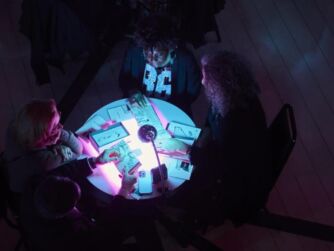
[00:00:05.438] Kent Bye: The Voices of VR Podcast. Hello, my name is Kent Bye, and welcome to the Voices of VR Podcast. It's a podcast that looks at the structures and forms of immersive storytelling and the future of spatial computing. You can support the podcast at patreon.com slash voicesofvr. So, continuing my coverage from IFA DocLab 2025, today's episode is with an immersive theater piece called Handle With Care. So this is a very unique piece from Untruth and Truth. By the way, I can never really fully pronounce that properly, but I had a chance to talk to Alexander Devrent about this piece, which is basically a really provocative idea where it's basically a box. And so when you go into the performance, there's a box that is sitting on the stage that has a light on it. And there's a note on everyone's chair that says, once everybody has read this note and you're ready to start, then open the box and the performance will start. And from that point on, then everything that happens is happening from the people that are in the audience that are becoming the participants and interactors within the unfolding of this experience. And so it's really quite elegant. And I highly recommend if you have a chance to see it, to go see it and to not listen to too much. We talk around some general overview stuff, and then we start to kind of dive into the actual content of the piece. And so There are a number of different boxes that are still available. It's unsure at this point if they're going to have like a second run, but they basically created 300 of these boxes and they've got about 50 of them left. And so if you're in an area that you can gather together 45 people to go through this experience, then yeah, get in touch with bath at a truth. There's an email that's given the course of this conversation, but, um, Yeah, we do a full unpacking of this experience and well, not full, full unpacking, but at least pulling out what I see is kind of the most interesting aspects of this experience, because you're essentially using. So this piece manages to kind of really have some complicated, emergent social dynamics that are. Really empowering people to participate in a way that has high agency, but also has enough structure for it that you feel like you're in an overall flow of a journey that is unfolding. But there's all these moments to kind of dip into your own personal deep reflections about what's unfolding within the context of the experience. So I found it really interesting. deep and rich and also conceptually from an experiential design perspective it's basically a box and a lot of instructions and how do you just have that simple thing that is able to generate so much novelty and variance and difference between performance to performance because Yeah. Based upon the timing of how everything unfolds, it's basically every time you see it's going to be pretty different. At least the two times that I've seen it had a lot of different things that were really quite different. So it's a really amazing piece. And if you do have a chance to see it, highly, highly recommend it. And there's lots of deeper thoughts. If you don't have an opportunity to have a chance to see it, that you can listen in and Tune into what I think is one of the most interesting interactive theater designers that kind of describe themselves as doing interactive theater for people who don't like interactive theater. And so they managed to kind of make it easy and accessible. And yeah, lots of really great design principles that we explore throughout the course of this conversation. So we're covering all that and more on today's episode of the Voices of VR podcast, which, by the way, this is not VR. This is totally just a box in immersive theater, but it's part of the immersive nonfiction. And the Voices of VR is very expansive when it comes to covering all that's happening in this kind of immersive storytelling and experiential design. So we're covering all that and more on today's episode of the Voices of VR podcast. So this interview with Alexander happened on Wednesday, December 3rd, 2025, in the context of Ithadoc Lab 2025. So with that, let's go ahead and dive right in.
[00:03:54.178] Alexander Devriendt: I am Alexander de Vriend. I am Artistic Director of Untruend Goed. We call ourselves a theater performance collective. And some people say we make interactive theater. Some people say we make immersive work, one-on-one theater. I like to see that we like to make experimental work for a broad audience or interactive theater for people who don't like interactive theater.
[00:04:25.171] Kent Bye: Nice. So, yeah, I know Kasper Sonnen has said that line of that you make interactive theater for people who don't like interactive theater. Maybe you could expand on what you mean by that.
[00:04:35.282] Alexander Devriendt: Well, the thing is, I basically just like to make theatre, right? And for me, theatre is inherently a medium that requires a presence of the spectator. And for me, the idea is that, look, it matters that you're there. Like with a movie, it doesn't really matter if you're there or not. The movie will just happen. Of course, there will not be interaction. But for me, it's like putting at the essence of theater. If you want to do something that is performative, theatrical, physical, it should matter that you're there. And that leans into interactive, of course. But the problem is with interactive that I think the term is sometimes... It scares people off because they always say, I don't like to be put in the spot. Like that's the sentence they will always repeat. And I understand that. I don't like that either. And I would push it further that as an audience member, I don't want to be responsible for layered content. Like I'm not ready for that. That's what I buy a ticket for. for content, an artist, a group of people who taught something through and then experienced that. But if it depends on me to make it work, in a sense of like that it becomes layered because of my response or all that, or because I should put in the effort, then I don't like it. So for me, the phrase interactive theater for people who don't like the interactive theater is just the cliche of interactive theater. I think the more the workshop you feel that some interactive place can have, and I'm not saying they exist a lot, but that's the idea that is in people's minds when you talk about interactive work.
[00:06:19.249] Kent Bye: Yeah. Yeah. I really love that. And I'd love the pieces that you've done that I've had a chance to see. I think I've seen four pieces now with the AI, TM, actually five, the funeral. And then you had this year, the handle with care. And then there was thanks for being here. So. Yeah, so I really love your approach, and I really think that it kind of fits into this interactive theater for people who don't like interactive theater. And so maybe give a bit more context for your background and your journey into making this kind of unconventional, immersive, and interactive theater.
[00:06:51.431] Alexander Devriendt: I'm trying to figure that out for myself. Why do you make the things you make? Because you just make them direct to the world, but indeed... I haven't figured out what happened, but I do have to say, like, we come from a background. Entrouvent Hoed started as a sort of poetry collective, but basically just a bunch of people who are eager to make things work. And I think the first performances that we did, poetry performances that were in the setting of like jazz bars or like they were always immediately like reacting to the audience. There was always this sense of like, you can't ignore that everybody's here. Like, and so let's not do make-believe. And I think when we grew into theater and I think mostly theater people or theater programs saw what we do and it was like, what you're doing is theater. And I was like, oh, okay, cool, nice. What is this thing, theater? And I think we kind of explored it. Like, what is, yeah, what is this medium? What are these possibilities? What are its limits? What are its... uniqueness and discovering them for ourselves. I remember at a certain point, Juri and Sophie, who were the founders of Unter und Hutten, they were there in the beginning. At a certain point, they just made a sort of weird piece where people were put into office chairs and driven around just from the idea, let's just change all the simple mechanics that you take for granted. For instance, when I made a show with teenagers, I didn't have a lot of background of you theater, you could say. So I just made a piece that I think doesn't exist yet. And that grew into once and for all, we're going to tell you who we are. So shut up and listen. I can give many examples, but I think I always like to use this phrase of look at something as if it's for the first time without assuming conventions, assuming a protocol, assuming a sort of way of doing things. Because for me, that is also the essence of what an artist should do. Look at patterns in the world, look at patterns in thinking and try to help us to have another gaze. And having formal experiments is for me always also content like if you look at at a situation at the state or i don't know a country or way of working or even in your relationship a way of behaving like it's look at to change the form because not only the content because that makes you think in a different way so for me i think that background that that journey has has never stopped
[00:09:36.624] Kent Bye: Brilliant. Yeah. And I want to dive into Handle With Care, but also recognizing that some people listening to this may prefer to see it first. And I would actually recommend people see it before you listen to too much around us talking about it. I can't help but to break down and talk about it. And also for the spirit of people who are maybe own a theater or are in this scene and maybe want to bring Handle With Care to your locale. Maybe we'll start there. Like, is this something that people can still get a hold of? And what's the process by which that people could bring Handle With Care to their local region?
[00:10:13.800] Alexander Devriendt: So yeah, thanks for the offer to do that in this way. But so the idea was everything is in the box and the box is about, I just say that a banana box, big, and we sent that to a theater and a theater buys a box And there's some instructions, but most of the instructions say, no, you don't have to do that. No, you don't have to do that. Most of the instructions are put a nice light on it, invite maximum 45 people, let them in, and set the box so that everybody can see it and be able to read. The price is really low. I think it's like one-sixth of what a normal show could be because, of course, you don't have travel costs, you don't have actors, you don't eat food, you're like... Like, so for us, it was also a way of trying to, of course, the content, we can talk about that later. But when we're talking pragmatically, it was also like, how do you reach certain locales and regions, countries, places that we wouldn't be able to do? Because as a theater company, mostly you go to urban areas, right? Like even when you travel abroad, you go to, I don't know, you go to New York and you go to Seattle or you go to Sydney, but you don't go to little towns because they can't afford you or they can't afford the travel costs. But even here in Belgium, like some theaters, like little towns for the first time dare to take the risk. Or countries like, for instance, India, they just bought the box because... For them, that's a risk to bring in an experimental theater group. But in that way, it's a sort of way of knowing. So if you want to reach out, beth at ontroerendgoed.be does all the sales. That's B-E-T-H at ontroerendgoed.be for Belgium, of course. And like we have a couple of boxes still left. I think we made 300 in the first run. And we're just now looking if we did nine languages in 12 different countries. Like it's been crazy. It's a project that also ran out of hands. But yeah, in that way also amazing. But indeed, if you haven't seen it yet, stop listening.
[00:12:24.485] Kent Bye: Yeah, I have actually seen it twice, and the two versions of seeing it were really quite radically different. But yeah, I think there's a certain amount of surprise that happens by seeing it that you're better suited to just go see it. And just to clarify, because you said there were a run of 300, do you plan on doing a second run? Do you plan on making changes? What's the plans for it in the future?
[00:12:47.304] Alexander Devriendt: Probably. I definitely want to... There's still this strange way of how to get feedback. We'll come back to that later. It's hard to get feedback by being there because the whole point is that we're not there. But for instance, your text helps me at least experience it. So we're going to see indeed how much change is needed. And of course, there's also some modular work that always needs changing. I think there's just a richness that we'll have by having this first run that I should be in the second wave, we call it. But indeed, we had a lot of co-producers, a lot of people who signed in beforehand. So we were able to make 300 boxes in nine languages. And that's the first wave. And I think there's still 50 boxes left in English, also for Korean. But there's still possibilities. And now we're just checking if it's worth it to do a second wave. Because, of course, it's like I didn't make it like every object. I think there's in the box like 190 different objects. And they all matter. And of course, I could have done this way. I just said that way more commercially viable or interesting. But indeed, you don't like we always had this thing of like, OK, we have so little control. We have so much. We don't have light. We don't have the subtleties of what an actor can do. We don't have actors. We don't have anything to have the atmosphere. So a touch of paper or a pencil or a nice little scissor or reading glasses in case... Like it all matters. So I was glad that we were able to find this way of getting it all in there.
[00:14:23.973] Kent Bye: Perfect. Well, maybe we'll transition into actually talking about the experience because it's going to be hard for us to have an interview about this project without talking about it. So the first thing I want to ask is, where do you begin with getting feedback on this type of thing? Because, you know, at the prototype session, you weren't even in the room and then you're kind of relying upon maybe secondhand. Or how do you iterate on a project that is a box where you're not there individually? And then you're developing something that you're trying to create this journey of an experience that has all these instructions in the box that people are following and it's kind of emergent and it's literally different every time it happens. And so how do you how do you settle upon a core of a structure or a process by which you even create something like this?
[00:15:07.483] Alexander Devriendt: Well, first of all, I do have to say, Kent, like with all our experience, I think we're not bad at predicting. Like I'm good at pretending to be an audience member. Like I think that's one of my skills. I'm sometimes more in the rehearsal room, the audience member than the director. Like I'm good at receiving the material that we together create. And I think that's a crucial part. role that makes this, of course, possible in the first place. But again, I think the first thing when we had this idea was, all right, time. We're not going to rush this. This is the first time we're ever going to do this. Maybe the last time. We have no experience in making something like that at all. So I think we had a timeframe over like three and a half years. which is way too much, but it was necessary to make mistakes or to not feel, we can't go back to the drawing board because we had to go back to the drawing board a couple of times. And I think the first thing that we did, like you were there at the first iteration of the first 15 minutes, I think there was a first wave of tryouts with just the first 15 minutes and then the first 20 minutes. I think we had over 30 tryouts where we just tested these ideas out, also in different cultural contexts, different social contexts. And sometimes we were there incognito, sometimes we also taped it, but also enough to understand how much being there or taping it changes the whole thing. Like, for instance, I think there at ITFA, I decided not to be in because too many people knew who I was in that context and too many professionals. So they would look at me like, is this right what we're doing? Like there would be a right or a wrong. So sometimes it was really important to just let the thing happen. And we had other people incognito in. And every time we did some sort of tryout, we went back and talked and What was fascinating in the beginning, because there's many things, but content-wise, it really changed through this tryouts. I think in the beginning, we set out that we wanted to tell more directly. But more and more, we felt like that just felt like, how do you say that, a deus ex machina or just a narrator or a know-it-all artist hanging over it. So we decided to leave that out. But what was also fascinating is, I think in the beginning, for instance, I deliberately made text widen so you would read slower. Like I thought I could control it that way. So testing that. And then, for instance, at a certain point, I wanted to control timing. If that happens on your envelope, that can happen. And if that happens when you're in a paper, but the problem is every time we tested it, something happened that we never foresaw. So we went back to the drawing board and then change it. And then we test it again. And then something else happened that we never thought was possible. And at a certain point, I was there with my wife, who's a collaborator and part of Ontroerend Goed. And we were incognito in a little town in Belgium. I don't think people knew us. And at a certain point, they asked Charlotte on stage. And this woman said to Charlotte, now you have to do this. And Charlotte was like, who knew it was wrong because she wrote the text herself. She subtly said, maybe I have to do this. And the woman said, no. You have to do this. And it was like, I'm going to give up. It's going to be their thing. Like these people are just going to be, how do you know that? How do you say that? Like just righteously think they're right. And they are. So then we decided to just give the structure of the play I think in scene four, you get the whole... In scene two, you get all the rules and in scene four, you get just the whole structure. And indeed, some people started with scene eight. I don't know why they felt like it, but it didn't feel like they made a mistake or that it became an escape room box. They didn't have to solve anything. Because you provided the structure, there's surprises, but there's no solution you have to find. And I think in the beginning, there was too much the ideal play that people never managed to reach. So I gave up this ideal play.
[00:19:23.816] Kent Bye: Yeah, there's this idea in information theory, like there's always information loss that happens so that you have an intention, but then when people read it, they have some sort of misinterpretation. And there's a couple of times where people misread something and then they were doing something that wasn't. wasn't what was supposed to happen, but it was also perfect because you give an instruction that anything that you do is perfect. It's nothing that you do is wrong, but it also gives this kind of variance between like when things happen or how they unfold. And I noticed that there's this key concept of, let's call it information asymmetry, where sometimes there will be people who know what's happening when no one else is knowing what's happening. And so there's this tension between someone who knows what's happening and then the rest of the people who don't. And I love at the beginning how you really play with that. And so I'm just curious to hear a little bit more around this concept of information asymmetry, where there's these series of instructions that get unfolded over the course of the performance and that sometimes people will have privileged information around what's going to happen next. And they're kind of in charge of leading wherever that trajectory is going to go.
[00:20:29.264] Alexander Devriendt: Yeah, yeah. I like it that it's almost also Darwinian, like because of miscoding stuff happens and things evolve and beautiful things happen. But it's indeed true. It's like, I like it how they said that this privileged way of giving information, because there's a script for us, of course, where every text is read, but nobody will see that. That doesn't exist. That doesn't even exist. Like it exists when we write it, but nobody in the room will have read everything that we've written. And so there was a script where, what if you don't do anything? What if you never engaged with the text or material or an assignment? Is this still a viable show? Is there still enough to see? That was the one script. But again, from the first get-go, I think the first part... So you have this little paper that says, when everybody has read this... and the first person stands up to open the box, the show has started. And for me, that is already key, because it is already a communal act. When everybody has read this, how do you feel that? How do you know that? Like, is that a sense? It's like, you can be selfish, of course, and just go. But for me, it's also this idea, like, when everybody has read this, so I need you all to check others. Like, if somebody's still entering, don't go. They haven't read it yet. Like... And that's already a trust that I give, but also a solitary act because some one person will decide, but also a sort of act where you also have to be aware of the whole group. But it was really important that that first person, that's going to be your leader if you don't watch out. There's going to start to be a hierarchy. And then he will have information that nobody else has. And we give that to that person because he has to or they have to read the letter in silence. And they also get the privilege of just ripping it because nobody will, like, you almost have to put it back in a puzzle, which is, of course, there's another puzzle in the show, but still, or put it in his pocket. But it's really important that that person is asked to sit down and basically doesn't have to do anything anymore. Because then, for me, the whole hierarchy stops already being obvious. Like the first person, okay, now we will, no, oh, that person doesn't, is not taking the lead anymore. And so for me, because that first person who opens the box has, of course, a very privileged situation, but that's not necessarily the person that I want the others to lead. And then, for instance, in the second text, that person has to read out loud, give this to somebody who seems like they can handle things or seems like they get things done, I think is the good translation we have. But the nice thing is that the whole audience knows that person is supposed to be somebody who get things done. Now, I had people doing that stuff who don't get things done at all. Like who put the rope, they have to hang a rope between two situations. They hanged it on plants, the plants fell. They hanged it with tape, it fell. But at least if the whole audience knows this is supposed to be somebody who get things done, there is no blame anymore. Otherwise, there's this thing If you're a bit frustrated as an audience member, like, I would do it differently, or this is going slow, but I'm giving you information that makes you conscious of the things that can be sometimes underneath. What I mean is, Sometimes when you're in the show, you can hold on to a certain feeling. Like for instance, I don't wanna interact. I feel nervous and all that. And the problem is if it doesn't release, you're gonna hold on to that feeling and not be open for the next one. But if somebody at a certain point or a text or somebody says, but you don't have to interact, Oh, oh, okay. Maybe then you're more open to what can transpire. And like, for instance, if you would, like in the beginning, somebody who gave an instruction and then somebody hang, two people hang this rope, for me, that is beautiful theater. But not everybody saw that. Some people just saw two people messing around and not getting things done. But by having this subtle information, now this assignment is given by somebody who get things done and everybody hears it. There is a joy of going that extra, how do you say that, taking that extra step and not being stuck in a feeling that can sometimes hinder you. It's maybe not the best example to make my point. Like sometimes it was really important to have information open and also sometimes really important that the information is purely personal. Because one of the moments, and it's also in the show, I think, you had a letter, right?
[00:25:18.443] Kent Bye: Yeah.
[00:25:19.124] Alexander Devriendt: And this only works if you know you're the only one. It only works if you feel this letter is written from one person in the past to me in the present. And if you would feel like the person next to me has the same letter, the whole thing would be gone. And also, but nobody understands what's happening with you. Like there's purely personal theater there, which makes the moment, I think, even more exciting, but also not really helpful for the 44 other people. But the thing is like, but okay, let's try to give everybody in the space that kind of moment. And sometimes I pushed people through the text and through the direction to the play to see these things. But basically what I do now is having these messages from other boxes where other people talked about things they saw, helping you to maybe see what's happening around you. Not saying, look around you. There's beautiful stuff to see because then, yeah, it's just a weird assignment. But giving a little nudge of like in other things, people have another gaze at other stuff. And I think one of the key moments happened for me. We were doing a test case again in a little town in Belgium. We had several ones, but that was a key moment. And somebody behind me, there were two older ladies there. And during the chaos, they were talking to each other, but I could hear them. And she said to the woman, to her friend, I assume, what did you have to do? And she said, I had to call my mother. And that's also on the little paper in the box or in some of the boxes. And she said, oh, yeah, what did you do? Because, yeah, they know her mother was not alive anymore. And then she said, I pretended a conversation with her. And I was like, this is it. This is worth it. Like, I don't think we have to push more. And I don't think other people should now look at that. No, it exists that moment between those two people. It existed that moment when you read that letter. It existed when, but let's not force everybody to look at it, but let's make sure that there's hopefully enough moments where everybody has something precious happening, realizing that other people maybe have these precious private moments too, which they always can share. That is the invitation at the end. Talk about it, share. But again, I think at that moment, I felt that Handle With Care was for me, I didn't know, worth it. Worth it to send into the world.
[00:27:58.604] Kent Bye: Yeah, getting the spectator letter provided this opportunity for me to share it with other people throughout the course of the week and other people that were in my showing, but also other people that I know were at the festival and had a chance to see it. And it became like... Sort of like an in-group out-group type of thing. Like I've been initiated into the Handle With Care experience. And so now I have a shared context that allows me to connect to other people. So it felt like that type of experience that really felt like a privileged position to be in this kind of initiated group. But it provided a context for me to start to talk to people around like, oh, what was your experience like? What was your role? What was your job? Because you have this dialectic between, I'd say, order and chaos, between a moment where things are kind of structured in a way that everybody has an opportunity to participate in a way that is this, you call it like the six minutes of chaos, where you get these roles and tasks in. Then a lot of the experience after that is like there's so much happening at the same time. Some people, it's their job to bear witness and have this like little bingo card to see if they can see different things that are happening. And so it's their role to try to survey everything that's happening. But there's so much that's happening that it almost requires people after the show to really continue that conversation and to continue to unpack it. so there's this kind of reflection of time in a way that you're asking us to reflect on time within the context of the experience of how you have the rope and have these different moments and that you're kind of keeping track of when things are happening and you're moving things around on this timeline but The spectator later, you're talking around these moments of like, you're thinking about me and I'm thinking about you. There's this moment where we're connecting and it's just a beautiful reflection and meditation on attention and living in a world where we're so distracted on our phones. Here's an opportunity for people to actually be present with each other. And also, you know, I think is really great about this experience is that you're managing to kind of architect these emergent social dynamics in a way that you don't need to a lot of technology you don't need you need some instructions and a context like a theatrical setting and an invitation for people to show up and be open to these types of possibilities but beyond that i think handle with care is one of the projects i'll probably be referring to a lot moving forward in terms of like here's how to architect emergent social dynamics with very minimalist technology, which is basically sheets of paper that are distributed amongst the people over time, that it's sort of a self-organizing thing, but also very emergent and novel and fun that it's different and variant every single time it's performed. And so, but yeah, there's this experience of a shared experience that you're able to allow people to connect to each other, but also to have these kind of emergent social interactions that allow people to connect to each other in something that's beyond just a superficial, but also for people to talk around their own visceral experience of what that was like. And I really appreciated that. And I think was fairly unique for a lot of the experiences that I've seen on the festival circuit was that this was an experience that once you've had it, you now can have a conversation with other people around what specifically other people had from their own perspective, but also what even happened in other ways that this was put on.
[00:31:20.086] Alexander Devriendt: And indeed, I don't even know. I was so grateful that we missed each other on our first Zoom, because then you wrote the text. And I think that's the closest from the did now over 200 shows, maybe. But it's the first time I really got a sense of the atmosphere that you can only have when you're there. And even then, it was your own viewpoint. But you went so thorough. that I had an idea of being with you in that space. Like, I almost had the feeling I was there. And because you took your time and you don't only summarize it, you really went into, and then this happened, and then this happened. And then I thought, and of course, you only experience the show like you wrote down. You're experiencing it in your mind. You don't experience it with facts. And the problem is like, for instance, now for feedback, most of the time programmers let us know how it was. But yeah, that's not the best way to know how a show went. Programmers look from a certain perspective and they sometimes try to disengage from their own viewpoint because they want to supposedly see more viewpoints for their audience, which I understand, which is impossible. So I was glad that you gave me this feedback. And for me, indeed, Look, if theatre only works or anything, any work of time, like whether it's a movie, a television show or theatre, you spend an hour, an hour and a half. And if only something happens in that time frame, like we didn't succeed, like... Like it only becomes important when there's a reflection that happens that you then hopefully take with you while thinking or, and that doesn't have to be explicitly talking, but indeed having a sort of starting point of what happened there is already a good conversation about, whoa, these two possibilities. And it's a very practical conversation, but the content is easily there. And indeed, I think the ending at the beginning, we really, like you talked about the ending of cleaning up and, It's interesting because the first ending we had was that we made sure that the whole group tried to make sure that nothing was left there as a sort of leave no trace behind. But the problem was that became another assignment, that became another job to do. And at a certain point, we had all this material and nobody read it. We had all these experiences and we couldn't always trust on a festival context or a pub or or an artist cafe to have this conversation. So we basically decided, let's just have the conversation in the space. Like there is, yes, there's an ending, but go on stage, grab stuff. And of course, in my mind, I hope that people would take everything with them. That's also the idea that you burn the box there as an idea of like, all the materials almost except for the hats and the cloth is also biodegradable so if you could bury it it would disappear so indeed but again i was forcing this thing and now it's more of a sort of i think the communal thing of sharing experiences was a better way of trickling into the real world instead of having an ending and leaving no trace behind and then hopefully somebody providing the conversation there. And I think at the first ITFA, the first time, the first iteration, that happened. People took that stuff, took pictures with it, hanging. But again, it didn't happen enough. You don't always have this festival context with people. So it was also like, how do you create this little festival in the show itself? And whether it's in India in the theater, whether it's the only thing to do, or whether it's in the little town where people go, like provide that in the show itself. But I understood your desire. Yeah. Thanks for cleaning up.
[00:35:11.733] Kent Bye: Yeah, just for context, we had set a time last week to talk, but I had put the wrong time in my calendar, so we missed the time. And so I had all this time set aside. And then I remember you saying that you really don't know what's happening in any of these performances. And I thought, well, at least I could try to at least do a trip report and review. There's this quote by Carl Jung in Mimi's Dreams and Reflections. People always ask Carl Jung, like, what was it like to meet Albert Einstein? And he's like, that's not even the most interesting thing in my life to think about what this encounter with Albert Einstein was. Plus, you know, our conversation was private. And so there's this quote where I forget exactly how Jung says it, but... he talks about how the only thing that really sticks with him at the end of his life are these moments that are things that are these internal evolution of his psyche and his soul and things that are really meaningful. And so as I was reflecting on my experience, I could have like recounted here's this happened, this happened, this happened, but I was trying to get to the core of the things that were really striking to me, you know, with a letter that was being read by a 14 year old boy. And he said something along the lines of like, Oh, everything's really messy and that everything's really messy in the outside world. And it was just the way that he had juxtaposed what was happening inside that space and what was happening in the outside world. And then he said it was like either pretty or beautiful outside. Yeah, and there were these moments where it was like someone from South Africa who then asked this 14-year-old boy, because he was talking around, something like write a letter to your either grandparents or your future. It was something like a letter across different generations. And then someone from South Africa was like, well, in my tradition, it is our tradition to name our relatives. And so can you give the names of your grandparents in the name of your parents? And so there was this whole – interaction that happened which was sort of a naming of ancestors and so there were a lot of things that were in this piece that were around time and there was this other thing that you asked people to basically kind of make a prediction as to like when is the first person that's in this group going to die. And that seemed to be something that was put off like at the end of, after the universe was dead, it was like the universe is going to die before someone else dies. And so there was this kind of like collective resistance to thinking that no one's going to die before the end of the universe. And then even like the box was going to survive until like the very end of the universe. And that was like, by the end that we had, um, done our six minutes of chaos, somebody had ripped open the box. And so I thought, here, here's a direct example of why this person who thought that this box was going to be immortal, that now they were wrong. And so I made it a deliberate choice to, to move that moment of now, because there's a moment that marks the here and now I marked it past the here and now so that it's in the past that this is destroyed. And so I was sort of hoping to catalyze a deeper reflection on what people thought around death and life and living. But these are the types of things that I'm thinking about in my head. I don't even know if I had a conversation about that with anybody. It's just something I did. But it was like these deeper themes that I think were being evoked. And I really loved how People could find these moments and share them with each other, either through conversation or there's a context where you feel like you can share. And so there is this feeling of like, I thought in my head, oh, the person who's coming in is going to have to clean up this big mess and I'm going to help clean it up. And I started going through and looking at it and I started discovering things that were in the box that people had discarded. And I felt like there was another layer of, I was like trying to do this archeology of the experience where I was seeing the artifacts that were left behind that allowed me to kind of project myself into someone else's experience about what that was like. So it created this whole context for me to kind of dig in and ask around and say like, what happened last year? Like, why did Avinash, when he opened the box, why did he say, Oh no. And he walks away. Like that was the instruction that he was the, the alpha male who was going to be starting it off. But it was like, the design was deliberately set up so that it would pervert that expectation. But then what happened was that the kind of order collapse where then you have like 15 people up on stage and, reading this private letter that was really meant for one person. And so the information asymmetry dynamics were completely collapsed in that. So I feel like, you know, there's so many different core dialectics that you're playing with between order and chaos, information asymmetry, and So I'm curious if you, well, if you have any response to anything I just said, or also just this question around these dialectics that you're trying to set up between like order and chaos, or when you think around dynamic tension and the building and releasing of tension, you're trying to either have information asymmetries or create these reflections around time or create these sense of order and chaos. I'm just curious if there are like some deeper principles that were guiding how you were trying to architect these different experiences.
[00:40:10.766] Alexander Devriendt: First of all, thank you, Kent, for the observations. And it's just a privilege that you're taking time to put these feelings into words and basically me hoping while creating that these things can happen, like as these thoughts can emerge. And you can't always control it. Like you can make shows that for some people really connect and for other people like, yeah, didn't connect or whatever. But the themes you're talking about, It was difficult because I didn't want to push them, but I wanted the little parcels or the little traces there, but not to discover the real point. What do they really want to say? It never had to feel like... I had this message, I had this feeling why I wanted to make this box. But the question is, is that something that I want the other people to hear? or also hopefully like have a thought process about and for me the fact that this box is just basically traveling to time and space as this like for me the whole idea the whole point of the show for me why i made it which is not important in the end but it's the drive is how do you care about people that you don't know And I think that for humanity, I think that's our biggest issue. Like, how do we care about people that we don't digitally see, that we don't yet, that don't exist yet, whether it's in climate change or in a war that is happening? Again, that's the metaphor. I mean, that's reality. And for me, this is a metaphor for it. But again, I didn't want this point to just be there. I wanted to hopefully give enough... How do you say that? Enough keys in order to feel like, oh, this door is open. But the thing is, in a normal show, you can have at least an actor as a sort of vessel for a group of artists that had a conversation. And an actor can be a sort of vessel for that information and give it to you. But now I didn't want anybody to be the vessel of that information. And also, I didn't want to have anybody do the job of doing a text the right way so it would come across as meaningful. So I think by you moving that here and now to another place, I think at least somebody else saw it and had a reflection on time. It didn't necessarily maybe active in that he wanted to speak it out loud or they wanted to say it out loud, but they saw it happening and they had a reflection on it. I think for me, it was giving the things that feel like they all exist in a sort of pattern. uh time ancestors meeting in the future this boxes in time then catching the light in the picture in this thing and then sending this light back to us like it's all in the same ballpark you could say instead of saying this is the message and we're going to give you the clues to decipher the message I left the message deliberately out because I felt people were just trying to figure out the message then. And I think at the end of the text, it's the only part. At the end of the show, you get a sort of QR code and you hear the voice of one of the actors. For each language, it's a different one. Because I didn't want to give anybody the burden of the people there to be responsible for the, how do you say that, for the end monologue, you could say. And also basically the message there is thanks for your show. Thanks for what you've done tonight. Like instead of giving an answer to it, it's more of a sort of appreciation that I wanted to send. But again, when I set out this show in the beginning, it was much more explicit than what it wanted to say. But during the trials and during the things that I felt, I was like, this doesn't work. This doesn't work if it's just a sort of artistic escape room where you have to figure out the message of the artistic layered content. No, the artistic layered content has to be done by you. And I have to give you enough tools that you don't feel like you're doing it. But it just sort of happens because people like to do the things that we ask them to. Like even the bingo that you mentioned is for me realizing that somebody is watching what you're doing. Because in the chaos, it feels a bit like nobody knows what I'm doing. Nobody's watching. But we just added in the bingo assignment. So at least you have an audience. And in that way, it becomes theatrical what you do because there's somebody watching. Like for me, even those tiny dynamics are important. And they're not explicit, deliberately not. And there's also just fun to do. But because they're fun, hopefully they will be done. Even the person saying, I don't like interactive theater, or I do like interactive theater. Maybe if a person is hanging around there and saying, I don't like it, but by suddenly hearing it out loud, you're like shared in your feeling of, no, I do like it. Or yes, I don't like it either, but let's do it. There's all these subtle things to hopefully open up little doors in your mind. That's why maybe the key metaphor is not good because the key always fits with one door. But it was like creating keys that can fit different doors that we can't predict which ones will be open and which one will lead into another. So for me, again, your oral history is for me about seeing that these doors were opened and you've used just our show as a tool for that.
[00:45:51.755] Kent Bye: Yeah. Yeah. I mean, I'm particularly attuned to time and the nature of time, the philosophy of time. And there's different philosophies of time where it comes to either monochronic or polychronic or this more linear concept of time. The chronos time versus the kairos is the quality of the moment, which is more of a cyclical moment or the auspicious moment, the right time to act. And so there's a lot of cycles that are included in this show in the sense of previous shows that have happened and previous audiences that have also been initiated into this experience that are providing their little artifacts or trip reports or write-ups that then are distributed in the context of Handle With Care. So you get a sense of other experiences that other people had and you get what it was like for other people. And so you are kind of having this meditation on different concepts of time that I really appreciated. And There was a dramaturge in ours, and I don't know if this was up to their own discretion, but they took the end of time and they put it at the beginning of the timeline. So it was like basically the big bang moment of like, this is the end of time is like a kind of eschatology with the beginning at the end. It was sort of a perversion of like, it was against everybody's expectation around what that might've meant. Again, I don't know if that was written in the text or if it was their interpretation or they were able to add that. But again, there's this reflection on the, Us being all there in a moment, but will we meet again in the future or will we talk around this in the future? But how there's this pregnant quality of that moment of that time and how that quality of moment of what experiences we're having is going to be shared amongst other people who are having that same experience, but in different moments in time. And so I feel like. this piece was really having me project out to you thinking about me in the past, but now I'm thinking about you. And so we're meeting in this kind of liminal space of the here and now, even if that you're literally aren't thinking about me, we're in this transcendent space of that nowness that we're thinking about each other. So there's this breaking away our traditional ways of thinking about time and creating this more polychronic Kairos moment that we're able to kind of meet each other in these moments.
[00:47:55.481] Alexander Devriendt: I think there was even an idea at a certain point where we dropped it because it became too complicated, where we had little... At a certain point, you have this one rope that is like the timeline, you could say. We call it the timeline. And at a certain point, we had other ropes to visualize this process that you were saying. But too many writers in the writer room I said, like, it's too complicated. People won't get it. And I'm like, oh, shit, I want to keep it. Yeah, but then you need a lot of ropes, because if you only have one other rope, and then what does it even mean? It means that there's a different timeline and a possibility. So I'm glad it's still there. But for me, this idea that this little here and now would lead with all these ropes was one of the images I had to... to give up, let's say. So I'm glad the idea how you pronounce it now is still there. Because also thinking about the future and whether it's a great grandfather or two people meeting each other or writing a birthday card for your great grandchild, those principles also worked, was indeed from the idea of like the people we don't know and the people we do know and the people we take care of, like, even though we can't literally take care of them, or you taking care of my letter and I'm taking care of you. All those things, indeed, come out of the same kernel of reflections that we wanted to make. And then I also like it that you also have this beauty of trusting the audience. They bring their own universe. Like what you said that a person from South Africa or the Sun, they both bring their universe in it. You just see them doing something that you get a glimpse of that universe that is just conversing with each other. Or when two people would meet in the future, I remember at a certain point, there was just a simple question, will this theater still be here? like will it be underwater or what like like i like it that the place brings its own universe the people bring their own universe just trust that just let them show that universe by doing little things that they want to do and whether they're changing a rope or really taking care of of reading a text nice or writing it like just make sure that they never have the feeling that they perform but that they can just be and because when they are of course in a performative setting, but you get a glimpse of the beauty behind it.
[00:50:27.068] Kent Bye: Yeah. Yeah, it's beautiful. And I definitely resonate with those deeper intentions and themes that were brought up. And I like that the fact that there was only one line because it does encourage us to think of not like a multiverse theory because I'm not a fan. It's true.
[00:50:42.554] Alexander Devriendt: Voila. You're right. I think that was the reason we dropped it. Yeah, you see, you're in the rehearsal room. That's just Dennis dropped. Okay.
[00:50:52.017] Kent Bye: There's many, there's Everett's many world interpretations that says any possibility is actual real and it creates these orthogonal universes. It's enough to know that it happened in the past, but people were also in that same timeline.
[00:51:03.564] Alexander Devriendt: I had the same with Thanks for Being Here, Francis, which started off as a show about physics, like theoretical physics, like I wanted to. But at a certain point, you just realize people don't care. I mean, they care. But when it becomes too brainy, like you gain some people, like some people will be. But I don't think when you I'm not saying simplify, but when you purify these feelings and be less explicit what's behind it, like the whole idea, for instance, and thanks for being here. When you have that person coming from outside, coming inside is for everybody just a joyful, ooh, really exciting moment. But for me, the essence is you become the one being gazed upon while suddenly for somebody outside, while the whole show was about me looking at others and looking at reality outside. And so the whole idea of looking and how somebody, an observer can change the way you behave, but it's still a fun moment and nobody has these bigger thoughts about it because they're not important. They're purely intellectual, but they provide the ground which you feel this is not a gimmicky moment, but this is a meaningful moment. And it's not just a nice idea, but it makes sense in the whole trajectory of the show. But it's trusting the audience to make those clicks instead of all explaining it. I think that's what I try to do with Untruth and Truth. Don't underestimate your audience in that they can put two things and put it together. Look, I like the craftsmanship of Spielberg, but he doesn't leave me a lot of choice. Even when he's really poetic, it's like, do you see this moment and it happened at the beginning of the movie and do you see it now? And I'm like, yeah, I know, I know, but can I do it myself, please? And again, I like that craftsmanship that you can really guide the audience, but I also like the craftsmanship that you trust the audience to make the clicks, to make the combinations and to make... Yeah, put two things together. It's like a therapist should never tell you what you have to do. You have to tell it there. The therapist has just to make sure that you say the thing that is important for you, not just hear it explaining. And I think that's what I even call interactive work. Like, because it doesn't demand you doing something, but it just asks you to be an active intellectual and emotional participant.
[00:53:30.751] Kent Bye: Yeah, and I loved Thanks for Being Here in a way that was also a piece that perverted my expectations as to what it was, but also how delightful it was to see how you're sort of using a cinematic tradition to have a camera on the audience, and then it's delayed, and you're basically just playing back the audience and shots of the audience, but there's also other theater that's happening in terms of actors that are coming in, but... We're kind of initiated into what this experience is at a certain point, and then you're bringing in someone who hasn't been initiated to come in and bear witness to what's happened to us. And so they're kind of the uninitiated bearing witness to something they have no idea what the context is, but it is...
[00:54:10.037] Alexander Devriendt: You become one. The whole audience becomes one at that moment because you're all the same to that person.
[00:54:16.119] Kent Bye: I did want to ask one follow-on question around Handle With Care because I did talk to a theater maker who brought Handle With Care. And there was a very specific instruction that you can't have spectators. So only the people who have tickets are people that are engaging. And so there's no audience per se there. And there was a part of me that after I saw it, I was like, I would love to just like watch other people go through this because I have this kind of information asymmetry. But I also wouldn't want to see it before I had a chance to actually have a chance to see it. So I can understand why you wouldn't want people to just be a spectator and that be the only experience.
[00:54:51.878] Alexander Devriendt: Also important, you're allowed to be just a spectator. Yeah. Like you're already allowed to. Like if you decide to sit in the back and not do an assignment and do that, that is the role. So I didn't want to already deliberately put you in that role. Because the problem from the moment you decided I will only be a spectator, you hinder yourself. Maybe you come in, I will only be a spectator, and then, oh, I want to do an assignment, then you go on. Or maybe you do an assignment, like, wait a minute, I just want to sit back. Like, I didn't want this role, this supposed role that you intend, also be, how do you say, flexible, be flexible for you. So if I would provide tickets for spectators, they were not allowed to do anything. And again, it would also change the hierarchy as well.
[00:55:39.583] Kent Bye: Mm-hmm.
[00:55:40.578] Alexander Devriendt: Yeah. The fact is, like, you never feel that somebody else is watching you in Handle With Care that is not in the same boat as you.
[00:55:49.274] Kent Bye: Hmm.
[00:55:50.472] Alexander Devriendt: Like from the moment there's a programmer there or a director or like in the first beginning of the idea, there was one actor to initiate the thing. Like you would have this feeling, this typical feeling that people don't like. Yeah, but I'm forced to do something and other people watching. But people in Handle With Care have done things that I would never imagine them to do just because there is nobody watching them in a way. And also the idea of In this timeframe, there is no recording. There is no archive, really. This is just a moment that is gone. It's not archived. It's not put into a certain, I don't know, algorithm as a study. So there's no spectator. There's only this moment that happened and there's nobody to witness it. And the witnesses were part of the thing. So for me, again, it would go against that feeling, I think. And that's indeed the strange sacrifice I made myself by not being there, because I think it would be easier to learn from the work and to let it grow and all that. But then I would take away this fact of having this unarchived, unwatched, uncontrolled experience piece of social artistic dynamics that happened. So again, I maybe was too soon in answering the question, but for me, it was a very important thing to not have this observer, but let the observers be part of the thing. And as you have shown in your text, you've been an observer and a participant, and that flexible role was your choice and not already set out.
[00:57:29.884] Kent Bye: Yeah, I really like that. Everybody being on the same footing and the same opportunities and they can choose, they can have the option to choose to not participate, but they're not being dictated by the different tiers of the roles of buying a ticket that was cheaper. So yeah, I really, really appreciate that. And
[00:57:47.020] Alexander Devriendt: In China, the whole discussion was really about we want extra tickets and sell extra tickets. I was like, I really had to defend it. Like, oh, no, I don't want that. It's going to be a different show. And again, I think it would work. I think it's interesting. But there's been a couple of shows in the past where there is an audience and then a certain group of that audience goes on stage and does something as if you then see what people do. But that's just Big Brother. And for me, I know it's interesting. Big Brother is interesting. I never watch it, so I don't think it's interesting. But I mean, but you're watching people who know they're being watched. And that's just a whole different dynamic and interesting field. But that's a field I deliberately wanted to avoid.
[00:58:31.883] Kent Bye: Right. Yeah, the Big Brother reality TV show version, not the Orwell book, but you're watching people, spectating people in their mundane lives. As I reread my letter, there's one other point that I just wanted to make, which is the kind of more of a philosophical point where Aristotle had like four different types of causation, which is like material cause and efficient cause, which is most of how we think around causation. reality as kind of the things that are pushing things or the material impact. But the formal cause is kind of like the blueprint of reality. And the final cause is kind of like the theology or the intention. And so you're putting in an intention for different types of things that you want. And then through the written text, kind of the air element of language that you have instructions that are kind of embedding this blueprint of an architecture of these emergent social dynamics that are different every time, but you have the structure in a way that it's unfolding that people are tapping into these formal causation instructions to embody the deeper structure that's going to facilitate a container for these emergent social dynamics that have a through line to the dramaturgy of the story that's there that is kind of emergent and co-created each time. And it's different, but really appreciated how you're able to have these transmissions of this intention of this architecture and of these emergent social dynamics. And I feel like that's the type of piece that I'll be referring to a lot just in terms of what you can do in terms of creating shared experience that has these different types of dynamics and really gives people a lot of freedom of their imagination, but also participation as they're co-creating this experience together. And so, yeah, I hope that you're able to get the rest of these packages out there. People can see it and then you consider a second run. I don't know if you make any changes or just do it the same, but I guess as we start to wrap up, I'd love to hear what you think the ultimate potential for these types of immersive interactive experiences might be and what they might be able to enable.
[01:00:29.035] Alexander Devriendt: Thanks. No, and it's true. And just to go back to your thoughts, it's indeed important to give clear enough building blocks. So it doesn't feel, again, it doesn't feel like a puzzle you need to solve, but it's more of like here, there are the tools that you can construct with, like giving the whole scenes and the possibility there is like, it doesn't, It's why people like Lego sometimes, artistic people like Lego more than Playmobil, but sometimes you also just want Playmobil. Like you want an instruction, but you also want the freedom to do what you want to do. I am referring to Lego or Playmobil because my daughter at six is really at that crucial point. Where does the creative mind happens or where is just a journey that is too difficult to start? Like, where do you feel you're guided? and triggered and again like minecraft is so successful because it has these building blocks but there's also this community that makes it work like there's also this luck that the freedom works because so many people want to engage or is that because it's clear enough how to engage with it but i think back to the idea of interactive that look at ending A, oh no, or look at ending B. And it was like the most unmeaningful decision I've ever made. So it's again, where do you put the line that it still feels like I'm getting artistic layered content and I'm just messing around with it. And by me being there, the material unfolds and my mind and my life has a place in it and it becomes part of the unfolding. And I think that's, for me, the point of every work that should be done. And in that way, you have to be active, and whether it's philosophically active, emotionally active, or... Yeah, I've just played Hollow Knight, and I basically went immediately, then I went on YouTube to check how the developers do it, and they deliberately made it difficult because they trusted that people would talk about it online. So it became a community. So you would look up the thing and talk about it and then go back. I like this intention of how do you make a community active? Because we're in a time frame where it sometimes seems like the customer has to have everything. AI is just agreeing with everything I say and lying because of it. just giving me what I want. But the question is like, I want to be an active member of the world, society, whatever. So where the work asks you to engage, I think that's where the beauty of theater for me will always be there. Because again, the movie doesn't need me to be there. Of course, it can intellectually engage me, emotionally engage me with material and And everybody still refers to Lynch because it feels like I have to do everything, but still there is this answer there, but there isn't. But the material is strong enough that I actively engage with it. But the problem is most of the entertainment doesn't require you to act it, but it requires you to zone out. And I think that's where the beauty of theatre is because you're there. And again, if the work says it matters that you're there, It requires you to be an active human with your whole universe there. And why not use that? And you can do that in a technological way or more analog way. I feel like for me, working more in an analog matter brings, how do you say that? It's not bringing back to basic because I don't want to be nostalgic. I don't want to go back to a time without or where we still have to remember phone numbers. Like, I don't think I'm okay. But there is something as a reflection of what if we're just having this moment without it for a moment? And how do you go back then into the real world? Like, for instance, for my new show, I think at the beginning, I just asked you to leave your phone. And we still have to premiere that show. But it's amazing how this little moment just changes the whole dynamic of the space. Suddenly people, we had two trials. Suddenly people are talking. Suddenly people are also socially awkward because they have to engage. Like it's fascinating. And again, it's not because I say I want to go back to the phone. But sometimes by taking something away, you appreciate the thing that's been taken away. Or you look at it at a different perspective.
[01:05:00.069] Kent Bye: Is there anything else that's left unsaid that you'd like to say to the broader immersive community?
[01:05:04.366] Alexander Devriendt: I'm really happy that Kasper kept inviting us. Because in the beginning, I was really a bit like, Kasper, what are we doing here? We don't work with technology. Like, he wanted lies there. And then he wanted, again, then I made this thing called AI, which I kind of felt like, okay, I have to do something with techniques. But then I felt like, it's nice, but I don't want to pursue it. But more and more understood why. And by meeting people like you and and Kasper and also Scarlett Kim from Words and Play. I then met and she invited me then to a Words and Play gathering in Illinois. And I'm more and more, I just feel, look, it's just a privilege. New things happen, not because new ideas necessarily happen, but because new communities collide and meet. That's where these things happen. So for me, being there at that space, listening to you gives me other insights if I would just talk with people from a performative or theatrical background. So for me, that's a privilege. So I'm happy. Yeah, I'm happy to be there. I'm happy because we forced that happening or that, how do you say, the conglomeration of ideas.
[01:06:16.278] Kent Bye: Yeah, and I love covering this space just because it does have so many interdisciplinary insights. You're coming from such a strong theatrical background, you're adding more aspects of agency, participation, but also these social dynamics that are possible and emergent within these different types of experiences. And I feel like Handle With Care is sort of like the quintessential and paradigmatic example of how to foster and cultivate these types of emergent social dynamics, even if you're using words on paper. But, you know, Staya Halema with Smartphone Orchestra uses the smartphones to be able to orchestrate different kind of emergent social dynamics. And there's been rituals that I've been in that are VR-based that are these collective rituals that we're a part of. But I feel like that there are these kind of grounding of phenomenological experiences of what makes us human that are independent across whatever technological context we're in and I feel like what you're doing is kind of exploring the potentials of that giving all the tools that you have from your design discipline so yeah it's always a we're talking on a VR podcast and this is not this is like the farthest thing from a VR but I feel like the principles of experiential design it isn't it's indeed like it's not because
[01:07:24.344] Alexander Devriendt: you put on the glasses and like you don't have to actively do something like still how much is it necessary you put this thing on and what happens when you're there i think it's a question in every meaningful medium i'm not saying in commercial mediums like if you look at from a commercial perspective i don't necessarily know how that works but even then i think they underestimate like yeah they underestimate us
[01:07:50.916] Kent Bye: Yeah.
[01:07:51.997] Alexander Devriendt: Well, who day is enough? I don't know, but I'll end with it. All right. Merci again for your nice words.
[01:07:58.564] Kent Bye: Yeah.
[01:07:58.965] Alexander Devriendt: Yeah.
[01:08:00.226] Kent Bye: Thanks for joining me. And I always enjoy seeing the different experiences that you're putting together and your continued exploration. the prototyping that you provided there at DocLab last year, and also Handle With Care. And yeah, always appreciate how you're able to use the conceits of theater to construct these unique, immersive, and interactive experiences, creating interactive theater for people who don't like interactive theater. So I think you've kind of hit that sweet spot. And yeah, thanks again for joining me here on the podcast to help break down what you're able to achieve with Handle With Care.
[01:08:32.229] Alexander Devriendt: Thank you. Bye-bye.
[01:08:34.133] Kent Bye: That's all that we have for today, and I just wanted to thank you for listening to the Voices of VR podcast. If you enjoyed the podcast, then please do spread the word, tell your friends, and consider becoming a member of the Patreon. This is a listen-supported podcast, so I do rely upon donations from people like yourself in order to continue to bring this coverage. You can become a member and donate today at patreon.com slash voicesofvr. Thanks for listening.