I interviewed Martijn de Waal about revitalizing civic engagement through immersive art on Sunday, November 16, 2025 at IDFA DocLab in Amsterdam, Netherlands.
This is a listener-supported podcast through the Voices of VR Patreon.
Music: Fatality
Podcast: Play in new window | Download
Rough Transcript
[00:00:05.458] Kent Bye: The Voices of VR Podcast. Hello, my name is Kent Bye, and welcome to the Voices of VR Podcast. It's a podcast that looks at the structures and forms of immersive storytelling and the future of spatial computing. You can support the podcast at patreon.com slash voicesofvr. So, continuing my coverage from IFA DocLab 2025, There's a DocLab R&D summit that I was covering, and I'll be writing up the report again this year. But there was someone named Martin de Waal. He's a professor of civic interaction design, which is a research group at the Amsterdam University of Applied Sciences. And so there's this really interesting coalition that I think is kind of roughly being called the Shared Realities Coalition that is including lots of different, like, research organizations within amsterdam i think mit is also involved as well and you've got all these kind of independent producers making content and also if a doc lab themselves and so this is a part of a broader initiative that there's like a couple hundred million dollars or so that is coming from the c triple ic which stands for the creative industries immersive impact coalition and so This is a broader coalition that is funding a lot of different immersive initiatives that kind of spans all these different contextual domains that's not specific to entertainment, but also medical and other enterprise applications. But in this specific context, there's a number of different immersive creators that are going to be exploring this concept and ideas of how can you start to use immersive technologies to be able to kind of reinvigorate different levels of civic engagement? Are there ways that you can kind of redesign democracy to be more interactive and participatory or just to have these different bounded contexts to be able to create experiences that are able to create emergent social dynamics or people connecting in new ways or just to think more broadly around the relationship between technology and civic life at large. part of the theme of doc lab this year was this kind of off the internet, which was kind of a reckoning of looking at how technology with relationship to humans and larger society, civic society, democracy. There's a lot of different projects that were kind of reflecting on that. And, I think there's just a broader awareness of like, well, what can be done as we kind of start into this new cycle and we have AI coming into the mix? Is there some way that we can start to actually use technology to facilitate these different interactions and experiences and not just technology, but this experiential design and these different types of immersive experiences that are being shown at IFADOCLAB? Is there a way to kind of channel that creative treatment of actuality to actually channel people's energies into reflecting around their relationship to what's it mean to be a citizen and to move from being more of like a passive citizen into being actually more active and engaged and participating into the co-construction of democracy and these different civic organizations based upon your own intrinsic interest for what you want to be involved with. And so that's kind of the idea that is being explored and so they're just you know kind of getting underway with this research program and so just wanted to talk to martin just to get a little bit more context for some of the research that he's doing there at the amsterdam university of applied sciences but also his collaboration with this broader coalition that is starting to kind of explore all these interesting ideas so i'll be very curious to kind of track to see how this continues to develop because this is kind of a broader trend of seeing ways that you're using these immersive technologies and immersive experiences to to kind of like facilitate different types of emergent social dynamics. And we'll be diving into some other specific examples of that in the piece called Handle With Care, which we'll be covering later in episode 1705. So we're covering all that and more on today's episode of the Voices of VR podcast. So this interview with Martine happened on Sunday, November 16th, 2025 at IFA Doc Lab in Amsterdam, Netherlands. So with that, let's go ahead and dive right in.
[00:04:00.612] Martijn de Waal: My name is Martijn de Waal. I'm a professor at the Amsterdam University of Applied Sciences. We have a research group called Civic Interaction Design. So we're taking an interest in the role of technology in society at a broader sense. And one of our research line is interactive public spaces. So we are really interested in how design of all kinds of technologies can create thriving public spaces that we see as an essential part of democratic societies.
[00:04:30.165] Kent Bye: Great, and maybe you could give a bit more context as to your background and your journey into doing the work that you're doing.
[00:04:36.569] Martijn de Waal: Yeah, that's a long story. I came actually from media studies, film and television studies in the 1990s. I was studying that, and that was the moment when also the internet emerged. So even though it was called film and television studies, the first courses started to be given on digital media, and this was sort of the... early 90s the time when we are talking about virtual communities and the internet or the information superhighway and yeah we were really started to wonder okay we have this new technology and what they are actually doing for a society and then i think for me there has been two inroads that are really interesting i mean the one is storytelling so storytelling as a way of Putting things that are of interest, that are important, that are urgent into the heart of conversations in society. And the other one is more experiential, right? So this is the arenas, public space kind of arenas, places where people get together and can emerge in conversations, get together, build trust. It can be... more visceral experiences, sort of being in the same space together and having some sense of a collectivity, or it could be sort of more formal places where people have rational types of debates. And I think what's interesting and immersive is that those two can come together, right? These are on the one hand powerful vehicles for storytelling and experiences, but especially if you move away from The individual experiences of me being in my own individual headset to more collective experiences, they can also be those arenas and some form of a public sphere.
[00:06:21.570] Kent Bye: Nice. And so we're here at the IFA Doc Lab. We're at the R&D Summit. And you're presenting some of your latest work today and what you've been up to. But we're here at Doc Lab that has been running for 19 years now. So I'm just curious, your first encounter of the work that's being shown at Doc Lab, since it seems like a lot of overlap between some of the themes you're talking about and some of the types of work that Casper Sun and the rest of the team here at Doc Lab have been exhibiting for the last 19 years. I'm just curious, your first encounter to what's happening here at Doc Lab.
[00:06:51.616] Martijn de Waal: You mean historically? Yeah. Probably at the very beginning. I mean, I've been following IDFA since the mid-90s. Actually, I started out as a volunteer selling tickets when I was a student, but then still more in sort of the linear film documentary space. But then towards the end of the century, I got involved more in interactive storytelling. I was a board member of a funding organization in the Netherlands, the Media Fund, which that was funding interactive storytelling projects and I also organized a masterclass myself together with other people organized by the Sandberg Institute and the Media Fund here in Amsterdam that for a period of 10-15 years sort of from around the beginning of the century brought together traditional filmmakers, designers, television producers and interaction designers to explore new media formats So I think that's, yeah, I've been guiding that masterclass for a few years. And I think that was around the same time that the DocLab also emerged.
[00:07:55.451] Kent Bye: Yeah, it was in 2007, I think, was the first year. Okay, so maybe you could just give a bit more context to some of the stuff that you were presenting today in front of the R&D Summit in terms of the funding that's coming through from the CIIIC and what that is and the remit that's being provided to this coalition of different organizations academics and exhibitors and kind of research organizations around the world and yeah just to give a bit more context for what that's all about
[00:08:20.876] Martijn de Waal: Yeah, in the Netherlands, there is a funding scheme called the CIIIC, and it stands for... I always forget what exactly it stands for, but it is about immersive. So the C is for coalition, and the other I is for immersive, and there is one I for innovation, and there are some other letters there. But basically, the idea is it's coming from innovation money from the Dutch government, right? So they see an opportunity in... The space of immersive media to become an important sector in economic and culturally in society. The fund is very large. It's 200 million, but it's also aimed very broad. So it could be about the development of immersive media in the medical sector, right? For doing operations or in the architecture and building sector or the training of police or firemen or what have you. But then there is a little corner that's very much of interest for us, which I also have reserved for artistic research, which is, of course, part of the field where new technologies, new formats, new ways of storytelling, new ways of experience are being tried out. So within that space there has been a particular call for artistic research last year and five projects have been selected. And all those five projects are coalitions between academic institutions, cultural institutions and makers in the field. It's a two-stage project. We just finished the first stage. So basically the first stage was to develop your ideas into a larger project. And we've submitted that, and we are now waiting for the go to actually continue with the second phase, where we will do the actual research.
[00:10:00.374] Kent Bye: Okay, maybe you could just give a bit of a sense of who's a part of this coalition.
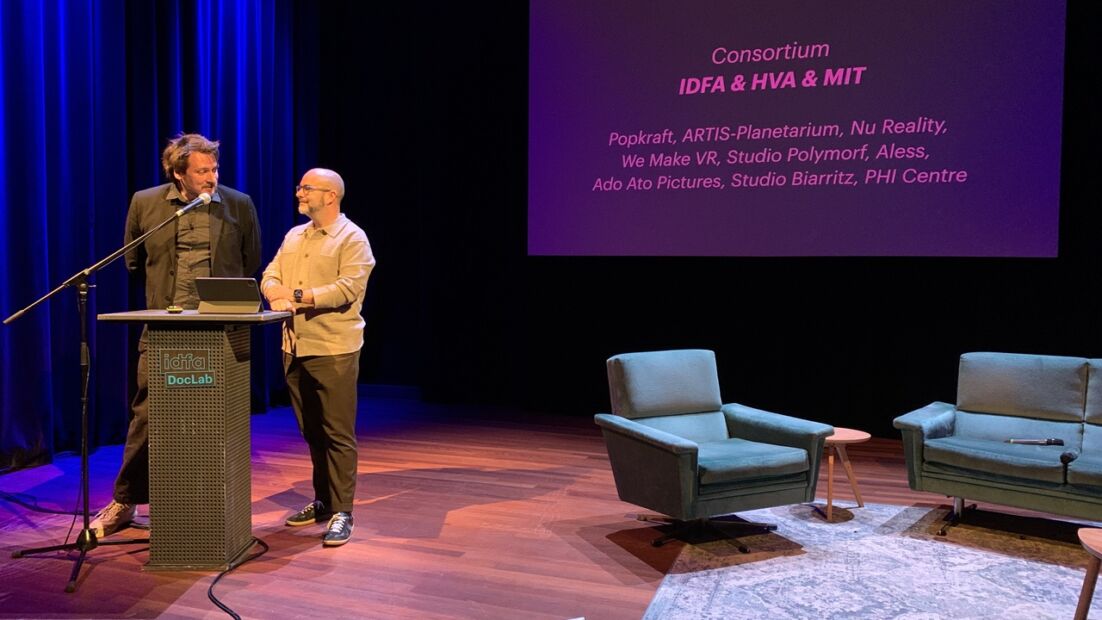
[00:10:04.317] Martijn de Waal: Yeah, so this coalition was initiated by IDFA, by IDFA DocLab, and they invited a number of makers from the Netherlands. So Studio Biarritz is in there, Polymorph is in there, Tamara Chogolu is in there, some others.
[00:10:18.469] Kent Bye: WeMakeVR, I think, was another one.
[00:10:19.830] Martijn de Waal: MakeVR is in there, right? So those are sort of the makers in the consortium. And then there's academic partners, which is us, Amsterdam University of Applied Sciences, and MIT, which has been working together with it for DocLab for a long time already, of course. And the idea is it's artistic research, so that means that Yeah, we see that actually the whole consortium is doing the research, right? Not just us who are sort of traditionally being called the researchers, but we really see what the artists and the makers are doing as sort of the prime part of the research, because they're the ones sort of who are experimenting, who are tinkering, who are trying to find ways of, in this instance, collective storytelling. And then IDFA is organizing a program around that, so they do the curation of that. And then we as researchers, it's mostly going to be me and my colleague Marianne Vosmeer from the Hafea Amsterdam University of Applied Sciences. We come in in that we sort of both try to feed existing academic knowledge on storytelling, those kind of things, into the development of new projects. So what's really interesting about this is that the whole consortium plays a role in the research, right? So usually we as the academic party are seen as the researchers but in this consortium everybody is contributing to what we see as the research and the research really is trying to figure out new ways for collective storytelling in immersive media. So we have the makers who will do some experiments with that We have the festival, the IDFA festival, who will be curating that work. Some of that will come from the makers in the consortium, but there will also be an open call, so people from around the world can send work in. And then we'll stage it at the IDFA festival, two years in a row, and then around that we will organize reflection, sort of bringing people in, trying to figure out what worked, what didn't work, and do maybe some more traditional research methods, like interviews or sort of formal analysis of the storytelling methods that are being developed.
[00:12:17.045] Kent Bye: Okay. And so I know in the physics community, there's like a theoretical side of physics and then like applied physics that's kind of doing the more testing. And so coming from a university that's more in the applied sciences, I'm curious how you describe the difference between the production of theoretical knowledge versus something that's more either tethered to industry or how do you describe applied sciences and what the output is there?
[00:12:41.129] Martijn de Waal: Yeah, in the Netherlands we have a dual system, right? We have universities of applied sciences and we have more regular traditional universities. In the latter one, the research that they do is really oriented at producing new knowledge, right? And very often they're really focused on writing papers or theoretical contributions to the field, which is very valuable. What we do as universities of applied sciences is actually... using some of that knowledge and also producing new knowledge ourselves, but really applied to professionals in the field, starting to figure out with them what are the questions that they're struggling with in terms of storytelling in the immersive field, develop some experiments together with them, have them involved as makers, research partners, and try to gather the insights that come from producing and making that work. And the way we do that, we also do write academic papers, but that's not always the most important. We also try to come up with ways of redistributing that knowledge that's more geared at professional audiences, right? Could be some form of a catalog, it could be a toolbox, it could be a website where we share blogs or maybe even a series of podcasts like yours to really sort of help the community build a body of knowledge that's really applicable Yeah, in the work, in the here and the now.
[00:14:03.097] Kent Bye: And this year at IFA DocLab, the theme is off the internet, which I think is really taking a look at the full lifespan of the history of the internet and reflecting upon where we're at and where we might be going. When you think around this relationship between technology and civic society and democracy, there's certainly been a tech clash that maybe can identify 2016 with Cambridge Analytica would maybe be a turning point where there's kind of a realization of some of the costs of big tech having so much control over our algorithms and data and accumulating all this data that can be used to sort of hack elections. And so just curious to hear how you start to think around like what you're looking at with this relationship between technology and civic society and how what's happening with immersive is an interesting vector for new research for pushing forward what's possible for how to create new ways of connecting communities and civic society and maybe even democracy.
[00:15:00.359] Martijn de Waal: Yeah exactly and I think that's exactly what our research group is about. So we're doing that in this project around immersive media but we're also doing another project with various civil society organizations where we're trying to build alternatives for social media or more sort of the groupware aspect of that because what we've come to realize is that you know we've left the digital public domain We left it completely to commercial companies to organize that for us and those commercial companies, they don't have sort of the quality of the public domain in their mind, right? They have their revenue model and their shareholder value as their sort of first target. And, well, we've seen what has come out of that, right? Fake news, polarization, et cetera. At the same time, you know, many of the things that they have been building are of really interesting use for some of civil society groups. It helps them organize, it helps them recognize each other, et cetera, except that they don't really want to do that in that sphere, you know, where their data is being stolen, where their algorithms may feed them content that is polarizing or where you don't have any agency over what you do as well, right? You build a group. and then all of a sudden the algorithm changes and nobody can find you anymore, right? You don't have any control over that. So what we're trying to do is work together with civil society organizations in the Netherlands, and they can be public broadcasting, local broadcasting. We're working with a network of patient organizations in the domain of mental health care. There are all kinds of groups who say, hey, you know, actually, we see it as our responsibility to take a part back of that public domain, right? We want to be in there and we want to sort of take care of that. But what we need is digital tools and platforms to actually do that. And we're trying to help them and design that and build that. And I think what's important here is exactly the role of those organizations that we don't see it as, Oh, you build a tool like an alternative for Facebook and you just throw that into the world. But you really tie it into organizations who see it as their mission or responsibility to actually curate and take care of that part of the public domain. I think it needs to be curated. It's not only about the design of a particular platform or group where, for example, patients can get together and do peer support. It's also about designing roles of people in those organizations to do moderation or community stewardship or design training programs for volunteers, etc. So we're looking at it at a much more integrated approach. Not just the technology, but also the organizations around it, the professional roles that emerge. And a level above that is also the governance. Sort of how do you then organize that and how do you make decisions about the further development of that?
[00:17:50.905] Kent Bye: Yeah, as I hear you speak about this more and more, it feels like there's all these kind of social sciences or maybe anthropological traditions of like the anthropology of technology or science and technology studies. I had an interview with Lisa Masseri, who is coming from more of this anthropological perspective. And so just curious, as you reflect on this interdisciplinary nature of these different projects, if you identify as coming from like science and technology studies or... any kind of social sciences or anthropology, or if it's mostly still focused on the technology, but also how it's facilitating connection, it just seems like there's kind of a fusion of different disciplines, and I'm having a little bit of trouble if it's something new or emerging, or if you're pulling in a specific kind of tradition that kind of ties it together.
[00:18:35.185] Martijn de Waal: Yeah, that's a good question. I think indeed it's a very inter or transdisciplinary thing. Myself, my background is in media studies and in philosophy, so we come more from a question of questioning what is a public domain, why is it important that we have one, how should it function, what rights should people have, etc. That's probably some of the beginning. And then we're in the University of Applied Sciences and we're actually bringing those questions into the domain of design. So I think for us what brings it together is really design. And then for us design is, for many people design is something that comes at the very end of the project, right? Everything has been sort of made by the engineers and put together, but now we need a designer to make it beautiful or to make it out of a box so people will actually buy it. But we look at design from a very different perspective, which starts at the very beginning, which is really about Getting people from various disciplines together and think about what is actually the question. Maybe reframe the question. Organizing co-creation sessions. Working with people together to get some insights into what people need. There could be some anthropology, sort of design anthropology or just regular anthropology in there. And then sort of use those insights and translate them in some... prototypes and that could solve some of the issues and then we'll test them and then we'll get them further. And from that we get insights on the one hand on the design of the things themselves, so maybe insights or patterns of what works and what doesn't work and how you can do that. You probably use a bit of communication studies in there as well. to do maybe some of the testing, but also from the discussion, also we're always, when we prototype around the projects, we always also organize what we call communities of practice, so those are the people that will actually be using those kind of tools, and we also ask them to reflect on, okay, we've made this, and we think that this is going to work in this particular way, does that resonate with you, or did we overlook something, or do you think we should go a totally different way? and from that also conversations emerge which are not so much about the tool but indeed about the role of those kind of tools in society right so it can become more conceptual or philosophical even so we're Yeah, we're trying to sort of reach those different levels where we make the tool themselves. Could be sort of anything or a technology or a product. It doesn't really even have to be technology. It can also be sort of a non-technological process. Then we look at the level of sort of roles and organizations and who has what role to play, what kind of organizations should be there. Do we need new types of institutions or are the ones that are there sort of fit to that? And on a higher level, we ask more conceptual question, right? Sort of what is civil society actually in a network society? I mean, it's not the same as it was maybe like 50 years ago, right? Because it's like a two directional process. Civil society needs tools, but then the tools also sort of reshape civil society.
[00:21:44.830] Kent Bye: Yeah, there's a couple of threads that I think are being woven together that is both reflecting on the history of the internet, but also what's been happening with some trends in immersive media and moving into more of these large-scale social experiences. And so if I go to the threads of the internet that seem to be reflecting on right now Casper Sonnen at the end of today's R&D Summit, he was talking about how the Internet had the promise that it was going to connect us, but yet, paradoxically, we kind of feel more isolated and alienated, and there's this feeling of being numb and distracted and dissociated around the escape pods of our smartphones, and that we're kind of in this... trance state of being distracted or chasing the next dopamine hit so we have that thread and that there's something around the immersive that gives us antidote of putting our phones away and being physically present to something that's alive and interesting and immersive and allows us to be really deeply connected and present to what is emerging and then also on the thread of the immersive media we've had a lot of these location-based experiences that started out as the single player experiences that were very vast and expansive and then realizing the lack of sustainability for the business models. If you're only having a throughput of a few people per hour, then that's not going to make sense with the amount of money in production. And it just doesn't have enough money to make it make sense. And so there's been a need to have more and more larger social experiences. So having people go through groups, through these kind of immersive experiences that then gives us new opportunity to create these social dynamics or think around the group shared experience of that. So it sounds like that with this funding coming through, it's at a very interesting time in the history and evolution of these two strands coming together, the people having the desire to come together, but also how do you start to really shape these emergent social dynamics that are possible for these different types of immersive experiences? And it sounds like that a lot of what you're going to be studying is, you know, how you start to cultivate that.
[00:23:36.496] Martijn de Waal: Yeah, that's exactly right. And I mean, one of the things you've been sort of alluding to is the more society is mediated through technology, sort of the more the human sort of out of the loop, right? And that's on the one hand, that's more efficient, but it really takes away all these sort of small moments of human to human contact. And increasingly, we find it more awkward, you know, to have just a conversation to a person, right? And we sort of hide behind our screen and we sort of don't dare to maybe even approach somebody or we find it sort of awkward to even talk to somebody, right? So when we were, while we were having these conversations right now, sort of what does it mean to design for collective experiences, right? And I think there is two ways that you can sort of approach that. The one is really look at it from a sort of a social psychology perspective so create these experiences like you know when you're at a concert or in a football stadium or in some sort of a ritual where you know you clap together you dance together you know it sort of creates this physical sense of collectivity and of togetherness right so that's one way. But another way could actually be maybe somewhat the opposite of that and actually is to create maybe some friction, right? Sort of to build experiences that are not seamless but sort of bring in these moments of maybe even at the beginning sort of awkward interaction, right? Sort of by creating particular prompts or by doing something that is not efficient but is more complex than that. And I think that's really important, right? Because I think For me, what's really important, again, bringing this back to democratic societies, I think for me the heart of democratic society is being able to live together with difference. So it's not about we all have to think the same or we have to become one big collective, but we have to find some sort of a common ground on which we can trust together and we can sort of be together, but we can also sort of Yeah, respect all the differences that are there and try to get a better understanding of it. Why are you thinking maybe something different about something? I mean, how is that experience for you being in the world, maybe with a different identity or sexual orientation, et cetera, et cetera. And sort of bringing those out, those differences out by sort of maybe creating friction or inviting people to sort of something that they're not used to. I think that's also very important of this notion of collectivity.
[00:26:00.663] Kent Bye: Yeah, one of the themes that I've heard discussed here at the R&D Summit was this dynamic between the funding sources and then the kind of obligation to have some sort of accounting of how successful something was, a return on the investment or metrics for success. And so I feel like with some traditional media, there's maybe established metrics for success. impact or how you're measuring whether or not the money that was invested is worth it. And so when you're in this kind of like emerging technology field and doing something that's somewhat new and different, just curious how you start to set up the checkpoints for just keeping track for yourself, but also as you report back to the funders, how do you start to justify the funding, but also have this sort of metrics for success that you're striving for?
[00:26:44.867] Martijn de Waal: Yeah, that's a good question, right? And that's, of course, something that everybody is struggling with. First, the field that we're in is not necessarily a commercial field. We're working with civic society, civil society organizations. So we work with organizations that see it as their mission to do things and make things in society that contribute to sort of democracy. Let's say libraries, for example, are public broadcasting, right? They don't do it to make money, they do it because they think that's their mission. And, I mean, they could also relay that mission now to the domain of the digital and immersive media. Having said that, of course, you know, it will cost resources to develop all that. So they do want to know whether they got a return on investment, right? Whether that's not a financial return, but that's impacting society. How do you account for that? Yeah, I think that's very difficult, right, because How do you account for the impact that a work of art has? It may change me, but is that just because I had this one single experience, or because I read something in the newspaper, I saw something on the TV, and then I had this immersive experience, and then all of that together made me shift my worldview, or induced me to act upon something like that? What is the contribution of each of those factors? It's so hard to tell that. To be honest, we haven't really found the holy grail for that, but that's certainly something that will come up at some point in the research project.
[00:28:12.722] Kent Bye: In academia, there's a lot of questions that drive research, and so I'm just curious, some of the biggest open questions that are driving your work forward or problems that you're trying to solve?
[00:28:23.348] Martijn de Waal: Well, I guess sort of the biggest project that's driving my work forward is the question of what is public space in a network society, right? We're moving to a society that's increasingly mediated through digital networks. Social structures are increasingly mediated through digital networks. We're growing more individualistic over time. And we're connected with people and institutions throughout the world. We're seeing maybe sort of a lack of trust in traditional institutions. There may be a need for sort of new types of institutions, but they're not really there yet. And I guess the question that drives me forward is exactly that, right? If we have all those changes and all those shifts, how can we make sure that a democratic society and for me, public space and civil society is sort of a vital aspect of that. How do we make that happen without sort of keeping yourself tied to ideas of what civil society was in the 50s, right? I mean, for instance, I think it was Michael Schudson who sort of also wrote this insight that citizenship has already shifted from dutified to actualizing, right, over the last 50 years. And what he means with that is dutified citizenship is... the type of citizenship that I still see my parents expressing. You grow up and it's your duty to be a part of particular aspects of society. You go to a church on Sunday, you're a member of the labor movement. You don't do that because maybe you really want it, but it's your duty as a citizen to be part of that. As we've grown more individualistic, more networked, The attachment of people to civil society causes hasn't really changed, but the nature has shifted. So he said, rather from dutified, we're sort of moving to actualizing, which is a way of citizenship where you don't do it because you feel it's your duty, but you're looking for the things that you are intrinsically motivated for, right? And then you sort of seek the networks. I mean, you might care, for instance, for the environment. So you will seek the kind of networks that are actually sort of doing something on there. Of course, it also means that it's probably a bit more free floating and sort of harder to tie people to yourself, right? But that's just one example of what I'm saying is our ideas of citizenship and civil society are changing. The way we behave is shifting. Technology plays a role in that. But if we want democratic societies to survive, we need to find new ways to do that. And I think that's sort of new ways, new spaces, new organizations, new institutions, new immersive environments. And I think that's sort of the core of the work that I'm doing.
[00:31:03.578] Kent Bye: Great. And what do you think the ultimate potential of all these immersive media and this intersection of civic society and immersive storytelling and immersive art and all those things tied together and what that might be able to enable?
[00:31:16.943] Martijn de Waal: Well, I think it can work on all those different dimensions that I just called. I mean, I think immersive can be really an interesting form to make differences experienceable, for instance. For instance, at the Venice Film Festival, I saw the installation Dark Rooms, which is an inquiry or documentary or how you would say it about... Yeah, sort of alternative sexual orientations. And for me, that was sort of a really interesting way to better understand, you know, particular scenes that I maybe have read something about, but I wasn't really involved in. Right. And the immersive nature. And I mean, I'm not saying that's the only nature. You can also make a theater piece of it. Right. But every sort of medium has its own strengths. But I mean, immersive has its own strengths and qualities to really understand. bring out different worlds and have you experience them in an interesting way. So I think that's really a potential and it's also a potential of especially the more collective experiences of really bringing together. I mean, our project is called Shared Realities because I think that's sort of the... The alpha and the omega of democratic society, at the very least, is a reality that we share. And we may think different about that reality, right? We may have different opinions about it, right? But we should have something in common that we share. And I think immersive media is a way to bring out that shared thing, the experience that we share, and bring out all kinds of... prompts that allow us to sort of reflect on that, take a stance on that, feel connected with other people, while at the same time being invited to experience how they also might see things differently.
[00:33:02.334] Kent Bye: Is there anything else left unsaid you'd like to say to the broader immersive community?
[00:33:09.237] Martijn de Waal: Oh, well, I mean, we probably could talk about this, is this for hours, right? Well, for me, what's also really exciting about this project is that we're not just looking at the storytelling aspects and sort of what it means to design experiences of conviviality or togetherness or collectivity, but we're also looking at the distribution side, right? It's great to design a story, but where can that story be told and experienced, right? And what does that mean for the types of venues that are out there? And for me, I think we're at a moment that we see I mean, the immersive field, it's not really one field, right? It's sort of diverging in so many directions. There is the 360 cinema that you can experience at home in your own headset. There is sort of the gaming variety. But for me, a very exciting development is also the crossover between the performing arts and immersive reality and finding ways of how we can make those kind of performances lasting and find a sustainable exhibition culture for that.
[00:34:16.096] Kent Bye: Awesome. Well, it's super exciting to hear a little bit more context for this project and a lot of money that's being put forth and quite a great coalition of different artists and academics and folks in the space, exhibitors, doc lab, you know, kind of bringing all this together. And yeah, I'm really excited to see where this research continues to go. And I'm sure I'll be seeing some of the experiences that come of it on the festival circuit sometime here soon. So thanks again for joining me here on the podcast to help break it all down. Yeah, thank you. That's all that we have for today, and I just wanted to thank you for listening to the Voices of VR podcast. If you enjoyed the podcast, then please do spread the word, tell your friends, and consider becoming a member of the Patreon. This is a listen-supported podcast, so I do rely upon donations from people like yourself in order to continue to bring you this coverage. You can become a member and donate today at patreon.com slash voicesofvr. Thanks for listening.