I spoke with hexe.exe, T_Braun, Shadowwulf82, RingSystem, Casperillion, Venixia, LadybugVR, & Starheart about Cathedral of Witches as a part of my Raindance Immersive 2025 coverage. See more context in the rough transcript below.
This is a listener-supported podcast through the Voices of VR Patreon.
Music: Fatality
Podcast: Play in new window | Download
Rough Transcript
[00:00:05.458] Kent Bye: The Voices of VR Podcast. Hello, my name is Kent Bye, and welcome to the Voices of VR Podcast. It's a podcast that looks at the structures and forms of immersive storytelling and the future of spatial computing. You can support the podcast at patreon.com slash voicesofvr. So continuing my coverage of Raindance Immersive 2025, Today's episode is with a piece called the Cathedral of Witches. So this is a really vast piece that has like seven different performances within the context of this Gothic church that was built by hex.exe. So hex is trans and brought together lots of different trans and queer friends who were provided with an invitation to create a piece of art that explores the relationship to their identity and their spirituality within the context of this kind of recontextualized Gothic cathedral church. And so in this conversation, we had a chance to talk to eight of the different artists. There's a few more that were not able to make it, but it's a really wide-ranging discussion that is talking around each of their journeys within the context of VR, but also how they were starting to explore the answers to this intersection between their own spirituality and their identity. Everything from meditation to live performances and music to kind of more hermetic traditions like the tarot, but also this intersection between these more metaphysical and mystical connections that people have and how virtual reality is providing this refuge for people to find friends and community, but also to find new ways of exploring their own spirituality. So we'll be covering all that and more on today's episode of the Voices of VR podcast. So this interview with Hex, T-Bron, Shadow Wolf, Ring System, Casper, Vinixia, Ladybug, and Starheart happened on Thursday, July 10th, 2025, as part of my broader Raindance Immersive 2025 coverage. So with that, let's go ahead and dive right in.
[00:01:56.400] hexe.exe: Hi, my name's Hex, Hex.exe in VRChat. And that's also, I guess, my artist name for virtual projects. And I do music and performance, different kinds of experimental performance, poetry, experimental music, some DJing, some electronic live production. And I do it in different VRChat platforms. venues and i'm also irl a poet and a performance artist so there's a lot of crossover between irl and vr projects and yeah yeah i just love the music scene in vr chat the club scene in vr chat and that's kind of that's my home in the virtual world
[00:02:46.893] Starheart: Hi, I'm Starheart. I'm a V-singer, V-tuber, composer, songwriter, performer. I've been performing music in VRChat for the last three years and been streaming on Twitch for the last eight months. So I got to write an adaptive song to perform for Hex's performance for this Raindance event.
[00:03:09.669] Venixia: Hi, I'm Venezia. I'm a dancer in VRChat. I teach Vogue and walking at the VRDA. I've been dancing for years now, and I teach Vogue, like, touch style. And then I enjoy the carving scene as well. That's where I met Hux.
[00:03:31.994] T_Braun: My name is T. Braun. I'm an interdisciplinary artist. I work with performance, and I've done quite a bit of sculpture, painting, drawing, video. And I got into VR during the pandemic, partially as a way to translate those live performance elements that I wasn't able to do then and to continue finding community. And that's led to doing a PhD about trans communities in virtual reality.
[00:04:03.650] Casperillion: I'm Casper. I'm a VJ in VRChat. I got into VR in 2020 during the pandemic and then came back after a couple years and got really into the rave scene and found VJing through looking for a way to create art again. I used to do a lot of stuff with abstract art when I had the money for a lot of paint. And VR is a good way to express that same creative side. I'm also a live production student in real life. I'm hoping to go into AV things in person eventually. Yeah.
[00:04:50.160] Shadowwulf82: My name is shadow. I've been with the art chat for, since 2014 on and off through my entire college career. And I've been a content creator as a whole for the past 10 years doing video games and music. And so in VR, just one of the many DJs. I love to explore the many worlds that are within and play funny electronic music or rock.
[00:05:26.568] RingSystem: we're the ring system there are like fucking six of us but you'll be talking mostly with rin and seal today or tonight we do extremely weird ass electronic music okay and i think ladybug um yeah yeah i can't
[00:05:48.467] LadybugVR: Yeah, so I got into VRChat like about two and a half years ago and eventually became a DJ, most known for that in VRChat, and then After about a year and a half, I started a meditation group called Queer Meditation in VR, because I had experience meditating for 25 years. And I had worked with Hex a few times for some of her events, leading meditations or DJing. So that's how I ended up in the cathedral. Outside of that, I'm also 3D artist, a professional 3D artist from school and worked in the industry for a couple years. Yeah, but besides that, I just stick with the music scene mostly in VR. Love all, you know, checking out all the rain dance stuff.
[00:06:41.283] Kent Bye: Awesome. Well, I always like to hear a little bit more context as to what kind of design disciplines and insights that everyone's bringing in into the field. But we also have like eight different people, so we're not going to be getting into everyone's complete life story or journey, but love to just get a little bit more context for each of your backgrounds and your kind of entry point into VR and specifically around VRChat and what kind of led you to being interested in this project of the Cathedral of Witches. We'll start with you, Hex, and then recount everybody's larger journey into the VR space.
[00:07:14.592] hexe.exe: Sure. And we also, there's, I guess there's really three other people who are part of the project that aren't here on the call with us. Namaron and Softly Steph and Les contributed the light system for the cathedral. And there were a couple other collaborators on other pieces of it. So it was a big collaborative, huge collaborative effort. And so I guess I'll talk about the Cathedral of Witches first and then a little bit more about my background. Does that sound?
[00:07:45.794] Kent Bye: Yeah. Yeah.
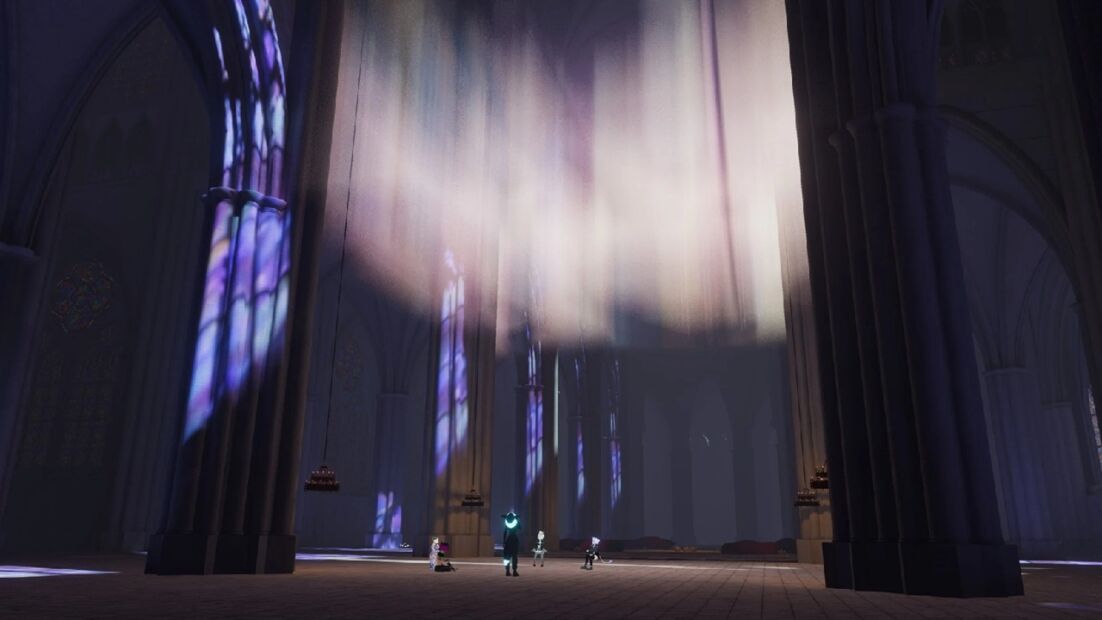
[00:07:48.718] hexe.exe: So the Cathedral of Witches is a virtual cathedral world that you can explore. It's this cavernous, moonlit, abandoned cathedral. And it's a world that I designed from scratch and spent about six months making. And I wanted a space in VRChat for experimentations and performance. So that could be experimental electronic music. That could be an evening of meditation. It could be spoken word poetry. And I wanted a really dramatic setting to put those performances in. And I've done different performances and kind of each of those areas over two or three years now in VR chat. And the last year we, in some configuration, this group of people here, we would gather for the solstices and equinoxes and. have an evening of reading tarot and playing weird music and just sharing creatively. And it was, it was just really, it was really special. It was really special to be able to mark the important moments in the year, the changing of the movement of the sun, the movements from one stage of our journey to the next together. And that was really special. So between those rituals and wanting to do a space for doing different kinds of performance, that's I wanted to make a space for that. And so that's what I did with the cathedral. And the way we designed it for this show, it was a two-hour show. And there were seven performances over the course of the evening in different spots in the cathedral. And we tried to bring people on a journey through kind of different phases of life. embodiment of spirituality so grounding and kind of a rootedness as we step into a virtual world which is kind of a funny experience being grounded in a virtual space but t brought us into the world and made some really nice connections between our virtual bodies and our physical locations and Then we eventually moved through the areas of where the spirit is in the body and through the heart and through the eventually to the third eye. And it was all different kinds of performances. I did poetry. Ring did music. A really gorgeous, it was kind of like an organ that like tumbled loose from the sky or something. And it was like organ and bells and very like swelling electronic music. But yeah, I wanted to have this big collaborative multivocal exploration of lots of different creative practices, lots of different takes on spirituality. And that's what we ended up doing. And we were part of the Rain Dance program, the Rain Dance Immersive Festival, and Maria and Fangs and the whole team there just gave us a really incredible opportunity to share our work. So this is the start of this cathedral project. I would like to have more performances there. And... I want it to kind of, I don't know, archive isn't the right word, but I want it to be a place where you can, when there's not a performance there, you can still go there and explore recordings of the performances or different manifestations of the performances. So you have a place where you can go and reflect on queer and trans spirituality and the themes that we got into and to all of our performances, um, So that that will be some public world release eventually. And other I'm hoping to translate it into other kinds of maybe a standalone quest version and maybe make a written project from it like a zine. Just different ways to share, share what it means to explore spirituality and community for queer and trans people in a virtual world. Because I think it offers us a lot of opportunities and a lot of really interesting language and tools for doing that and lots of ways to share it. So that's the idea with the cathedral. And then as far as my background, I started playing VR in 2022. So it was a little bit after the main part of the pandemic. And I was just really curious about the technology and curious what I would find. I was kind of looking for a different kind of internet, a different kind of way of connecting with people. I grew up in a very rural part of Appalachia in Virginia, and this was early Internet when early Internet was happening. For me, gaming and being on the Internet was a way to be in a different embodiment and to get out of the isolation that I was in and express myself creatively. And I was curious where that all was now. And I kind of got to explore that again when I got on VRChat. It ended up being this really exciting, creative space. And I started live streaming. I wanted to do kind of like an IRL. This was like right when I got into VRChat. I wanted to do kind of like an IRL VRChat stream where I hopped through worlds and talk to people about what i was experiencing i was reading tarot for people who were tuning into the stream and just exploring through vr chat and through streaming what it meant to inhabit an avatar and have any kind of body i wanted And that was a really cool experience. And it was exciting to be able to connect with queer and trans people from around the world and be able to talk about my story and things that I learned about myself and my body and my community and art with people from Brazil or from California or from Norway. And Yeah, that was that was really special because I had found queer community. I've lived in Philadelphia, New York, kind of the northeast city area, and I've found like really strong queer community here. And it was exciting to understand how that was an international community, actually. It was like this two things were happening when I was getting into VRChat. It was understanding the connection of like our queer and trans community around the world and how we could get together in real time in these virtual spaces or through, you know, streaming or other things like that. And then I was getting to inhabit a virtual body, you know, different avatars. And I started making my own avatars. And that was a super transformative experience. Being able to craft every part of my own body was just mind blowing. So I did a lot of writing about that. I wrote some poetry about it. I put out a chat book about it and it just kind of fed into all of the performances I was doing. And yeah, Yeah, I just kept writing through it, working through those ideas, collaborating with people on those ideas. And this is what it all kind of led to.
[00:16:07.318] Kent Bye: Very cool. And maybe we'll go through kind of an order of the performance order. So we'll start maybe with you, T-Bron, to talk a bit about your journey into VR and then leading into the invitation from Hex to be involved with the Cathedral of Witches. And we'll be diving into more detail about each of the different performances, but just trying to get everyone's kind of journey into the space. And then we'll start to unpack the process of putting this whole performance together.
[00:16:33.120] T_Braun: Sure, that sounds good. So as I mentioned earlier, I got into VRChat during the pandemic, but I did have a good friend who'd been playing VRChat for, since I think maybe 2018, and kept saying, like, you should come check this out. But I'm not a gamer, and I guess I just associated VR so much with gaming. And also the anime aesthetic is very prevalent and I don't really connect with anime. So I think I had assumptions about what VRChat is. So it took me a little while, but then during the pandemic, I was very isolated of course, and someone gifted me a VR headset and I was slowly transitioning from working with physical media like sculpture into more video work and doing some digital modeling. So I was already interested in that kind of practice. And then when I started hanging out in VRChat, I think the thing that struck me the most is that it so often felt to me not like a place where I went to do things, but a place where I went to be with other people. and unexpected things would unfold and I would be world hopping and exposed to all of these different amazing places that people had crafted. Especially I was interested in how people of any skill level from any part of the world can upload a world and seeing how imaginative people are. It really reminded me of my early online experiences. I grew up in a rural area like Hex. It was a very religious environment. And my early online experiences in chat rooms offered me kind of an escape from that or a way to understand myself outside of gendered expectations that were placed upon me and my body. So yeah, I really connected with that. I love the idea of being able to make my own avatars. And I also was doing, right before the pandemic, I was doing quite a bit of drag. So I was experimenting with a lot of gender performance and also starting HRTs. So there were all of these technologies and practices that I was already engaged with. And then VR just felt like it offered this really amazing place for me to expand and play with all of that. And I was getting into different spiritual practices like tarot and spell work, doing some stuff with crystals and like really connecting with different natural elements. So it kind of felt like these three different areas of my life, like the gender exploration, the spiritual work and VR experience. converged together into this and offered kind of a magical realm that all of those three things, I think, challenge normative ideas about what bodies are. So, yeah, that's kind of my journey with VR. And I think that's also kind of what drew me to well, meeting all these wonderful people and kind of working together, organically dreaming to the project. But I think like my, my interest in it is sustained by this love of exploring and challenging what a body is through this medium.
[00:19:53.513] Kent Bye: Nice. And I also wanted to bring in Shadow Wolf because I know that you weren't performing, so there wasn't necessarily a performance order, but you were certainly there at the beginning, helping to guide the audience through this overall experience. But let you go ahead and introduce your journey into VR.
[00:20:08.396] Shadowwulf82: Hi. So, like I said, when it came to VR, I started back in 2014 with VR. Like, when VRChat was in way old beta. I jumped into there because I watched a lot of the old YouTubers. One of the big-name YouTubers played through the game. VR has always been a part of my life in the sense of I watched Tron, Matrix... a lot of classic sci-fi movies and just video games has always been a part of my life. And this was an extension of that where I would just want to escape from my current realm into the virtual realm and just who wouldn't want to be a part of that and just live in that interconnected digital cyberspace. So when quarantine hit around 2020, I was doing virtual raving, not through VR yet, but here through Zoom calls, and then slowly found my way into, again, like VR proper, and then diving into the VR chat scene as a whole. And so, like Hex said, we started doing stuff throughout the solstices and equinoxes, full moons, all the different cycles, doing tarot readings, poetry and going from there. So it was a switch up from doing more than just the virtual music stuff that we've been doing. And so this just kind of felt a lot more, I don't know, natural. I have a minor in creative writing. And so when Hex asked me to come on board this project, I was hoping to do some tarot readings. But then slowly as how I do readings, it tends to be a little bit more extended, deep cut and very, very deep into the psyche of someone. And I can't do that on a scale of... of an audience of 60 people. So we ended up, I kind of took a little bit more of a back foot and helped with a little bit of the writing. naturally the progression of the performance as a whole. And so a lot of it just ended up falling into place with everyone's performances. So going from T to Ring System to Hex and Vinixia, Ladybug and Steph and Star and then closing it out. for my involvement for the cathedral itself, I cheekily wrote myself in as the unreliable narrator kind of person. But also it ended up being not a tour guide, but like just the guide, like somehow getting people going from one performance to the next. And then, like I said, as a writer, I ended up I haven't been able to properly practice my craft since university. And so I've been dabbling a lot in poetry in my spare time. Just whatever deep thoughts come through, I would write it down. And so I ended up writing something to help close and round out a lot of the performance as a whole. And so just give something for people to contemplate on and just ruminate with.
[00:23:24.161] Kent Bye: So it sounds like that we started with tbron, you know, you were helping to introduce us and then do we go to ring system? Is that next?
[00:23:31.736] RingSystem: I guess. So our journey into VR kind of began with, I forget when the first wave of Windows Mixed Reality devices were coming out, but it was just at the end of the Windows Mixed Reality era. So like 2018, 2019 latest, I think it was 2019. And it was our one good decision that we made in the midst of a pretty titanic mental breakdown. But we tried it off and on during various stages of our life, but discovered a roving gang of musicians through YouTube that used VRChat for weekly concerts called Modular Monday, which is where we hyper-focused for the next two years. And that's where we met Hex. And basically Modular Monday is where we learned how to basically make anything on the most bullshit tools possible. And that's kind of our creative practice these days. Our thesis for the performance was basically just soundscaping the environment we were inhabiting, which is actually surprisingly difficult because VR just plain didn't work for us at the time we were performing because of unrelated technical difficulties. And so we had to just kind of imagine the place that we had in VR like once in a pre-beta version. And we came up with this idea of basically running organs through a really complicated delay and shimmer reverb and compressor setup, and then running that into another compressor. And it's all analog except for the bits that aren't, which is most of it. But like the mixing is analog, the compressor is analog. The, some of the reverb was analog or no, not in that instance now. Yeah, that was basically it. Modular synths played a huge part in it, which is this semi-obscure format of custom synthesizers. We had just whipped up a case when news of us getting accepted went out. And we're using that shit on everything that we can get away with not actually physically moving it because it's like $1,200 worth of gear. And I don't want to lose that. but it was basically played in C minor the entire time. And there was like no click, no nothing, because I don't normally work with a click. And I just kind of free balled it for basically every single performance. There was like no notes, no, I'm going to do this part next kind of thing. Like the only idea I had for each of the performances was that the PSR 12, uh, Yamaha Oregon really, really great at Oregon, by the way. Holy shit. Get yourself a PSR 12. They sound fantastic for F2 operator FM preset Oregon. Amazing key feel on those things, by the way, that was run through an iPhone app and yeah. As for our spiritual thesis, we don't have nice memories of cathedrals. Just plain and simple. Or of church in general, literally. Cathedrals we're okay with because we've never been traumatized in a cathedral. But churches, on the other hand... Oh God, churches. So this was more of an attempt to just give it a nice ambience and make it a place that everybody from like any religion would be comfortable in. Like not even contextualizing it with word at all, because that's kind of our entire thing is wordless expression. Honestly, I have no clue I were like this. We just kind of are. We rarely use vocals in any of our work because... We just don't like our voice. And yeah, we're also horrible, horrible lyricists. Like anybody else on the team is going to be able to create way better poems and lyrics than we are. Like basically visual art was always more of our special subject in school. But spiritually, we've kind of got like a completely different approach from a lot of people here in that it's just pure chaos magic with us. Because that's kind of the closest descriptor to the way that we run our brain. Because you're speaking to Wren right now, the original host of the system. But I can switch into Seal, who is the first Tulpa of the system. And I was basically created ad hoc... during a very trying episode in our life about 2018. And it was based off of an obscure internet piece of work called the Tulpa, which is basically this independent entity you can build in your own mind. And I kind of just like sprang into existence day one. We've been rolling with it ever since. And that's basically been the core of what remains of our belief system after we entirely deconstructed Southern Baptist Christianity. Rin did it mostly on their own, but we just kind of came in and sweeped it. Because they had been heavily disillusioned with the Christian church, which is kind of what happens when you go through some form of trauma with the church, you know? But yeah.
[00:28:58.909] Kent Bye: Anything else? No, I think that's a good overview. I want to move on. I know that, Casper, which part were you a part of in terms of were you part of the performance? I'm just trying to get a sense of...
[00:29:09.398] Casperillion: Oh, so I did the screen during Ladybug and Ring System's performances.
[00:29:20.464] Kent Bye: Okay. Why don't you go ahead and go then, since you're between a couple of those different areas. Yeah.
[00:29:25.928] Casperillion: So for VR, I got into VRChat twice, actually. Originally in 2020, I just wanted to talk to more people. I had this idea that I would learn Japanese and speak to Japanese people in VRChat. I did not do that. I still can only say like two things. but I ended up meeting some cool people and I hung out for a good while until my headset broke and real life things got in the way. And I missed about like two years of the music scene basically just exploding and becoming this huge art project And I came back in 2020 to that and just, I was really amazed by everything people had been working on. Especially, I came back and saw someone I'd known from back then, Steph, who isn't with us today, but was working with us on Cathedral of Witches. And she had become like this amazing artist and was doing amazing things. I used to be an abstract artist in high school. I'm still pretty young. I don't have heaps of experience in these things, but I realized that was something I wanted to pursue again. I also got really sick of waiting to get into some of the packed VR events and realized that like, hey, if I contribute to these, I'll be able to go to them more often. And I downloaded a copy of Resolume and started messing with it and realized I loved it. And now here I am. I started having to like use a calendar to keep track of everything I'm doing in VR now. And a lot of my work is around emulating analog styles and stuff with a huge focus on texture and color texture, that kind of thing. I like getting color in a really weird way from stuff by layering two different effects on top of each other so they create. It makes it look white. But it's not actually white. It's just two conflicting effects on top of each other. And then I pull that color back out of the thing. It's weird. I don't really know how I came across that, but that's what I do. And I like these little subtle rainbows I can create with delay RGB and stuff in Resolume. I don't know. I like making things look pretty. I'm trying to communicate something incomprehensible, as a friend of mine would say. It's been really emotionally fulfilling and all of that. I also started HRT the same week as I started playing VRChat, so it's always felt very tied to my transness. even though I've been trans for over 10 years now. And yeah, I don't know, when Hexy asked me to be a part of this, I don't know, I jumped at the opportunity because that was something very meaningful to me. Spirituality as well. I got interested in paganism when I was, I want to say 15, 16, because I went to a Catholic girls' school and that was not vibing with me, but I still wanted something that felt bigger than me to like sort of focus energy into. And at that time, it was a lot of Greek gods and things. Now it feels a lot more conceptual. That shows in my work a lot of just concepts and feelings that I want people to feel, I guess. I want people to reflect on their own lives.
[00:33:28.588] Kent Bye: Very cool. And Benixia, maybe you could go ahead and share a little bit more about your journey into VR as well as your connection to this project.
[00:33:38.713] Venixia: Sure. Not the best at these kind of speeches, but I'll give it a try. I started BI a few years ago. I'm a bit of an introvert. I have some pretty bad social anxiety. So I played a lot of video games when I grew up, just escaping reality. So when I saw the remade virtual reality movie, and I saw that it had body tracking and yeah, that's what brought me into this space. And I really like dancing because you don't have to talk in order to communicate things. So when I first joined the VI, I went to the VI DA and started learning from Dusty and I've been going there ever since. Literally day one in VR, I bought everything I could. They bought a Vario headset, index controllers, 11-point tracking. four base stations. It's everything I could. And then the biggest sound for VR was being able to choose how I was seen and heard, because I don't like how I look or sound in real life. But VR lets me decide. And everyone in the ARCHA has been so encouraging and nice. It really enables you to be your true self without any restrictions that you face in the real world. That's why I spend most of my free time in there. As far as the project, I worked with Hacks previously doing visuals as well as dancing at the Sorcerer's bench. So when I was asked to join the Cathedral, of course I said yes. Hacks is the best. My performance is about being trapped and trying to break free. Whether it's external forces, like the society or other people, or it's internally like you're doing it to yourself. And the snow globe represents those forces try to contain you. My friend Kamara helped me build the snow globe and helped self-defense. So the first song, it's very robotic dancing. It's like you're a puppet on strings and you're controlled in everything you do. And you're trapped within this confines of the snow globe. And by the end of the song, you slowly start to recognize that you're trapped and you have little you can do about it. So at the end of the song, you just resign yourself to the beat. And in the second song, You start trying to resist and break free. And you're constantly pulled back into the role that you're expected in being. And throughout the song, you slowly gain more control until you finally break free. And in the third song, you finally free all those restrictions. And you can be a true soul.
[00:36:51.123] Kent Bye: Hmm. Beautiful. Thanks for that. And then we move on to Ladybug. And maybe just give a bit more context as to your background and journey into the space and the meditation you wanted to lead and you know, your kind of encounter with this project.
[00:37:06.332] LadybugVR: Sure, yeah. So I guess, yeah, my background is, I'm a Buddhist. I've been practicing on and off since, I guess, like 2000. So 99. And I was also raised Catholic. And I got into meditation because I had left the church. But I remember my mom, you know, she'd teach me how to pray. And I remember being like, well, that felt good. That feels right. Like, that feels like there's something there. You know? And I found meditation. I was like, oh, yeah, this is the same thing.
[00:37:40.862] Venixia: Thanks.
[00:37:43.365] LadybugVR: So I just kept meditating, practiced mostly Zen, some Tibetan Buddhism. And yeah, how I got into VR, I think in like the summer of 2022, I had started watching, finding on YouTube, like videos of stuff softly stuff dancing and i was like what is this like i thought at first it was rotoscoped maybe it was animated like did somebody hand animate all this because it was just a silhouette and um it took me a while to figure out that it was all real time and it just kind of blew my mind and i started watching a lot of twitch streamers watching a lot of content and then at the end of that year in the winter a partner of mine had just gotten into vr chat And so they were like, I was over there visiting. They live like, I don't know, the town over. So I was there visiting. And they were like, here, you got to check this out. So I joined on my laptop. All I had was a laptop. And the first event that I joined was an Avali army meetup of all things. It was the craziest thing. All these little tiny Avali furries like running around. So my first avatar was an Avali. And then after that, as soon as I got home, as soon as I got back to Montreal from Toronto, I got on desktop and within two weeks I had a headset and a friend of mine made some DIY slime trackers for me. And it was just like, I was, I was cooked. I was cooked chat. I was there for, I think I just passed 4,000 hours. That was a year and a half, two and a half years ago. Yeah. And I never looked back. So I had already transitioned like probably like, I think like eight years ago I started my transition. So it was like another cool level to the transition, but it wasn't like the main thing. Like I was already myself. I was already happy with myself. The VRChat just made it that much cooler and fun, you know, to be a furry and all that. Yeah, and then me and Hex met in the rave scene, certainly, I think, through our friend Grim, I think, mutual friend Grim, just hanging around Kaleidosky and stuff. And around that time, I had gone to a meditation retreat. Like, it was just a weekend one, but it was like one of those really strict ones where there's no talking, they take away your cell phone, they take away anything to write with, they take away your jewelry. They separate the sexes and you meditate for like 10 hours a day. They got free food and everything. This is Vipassana, Asanko Inka's Vipassana. And I was just sitting there. I was like, you know what? I need to start a meditation group in VR. In the middle of one of the sits, I was like, this is calling to me. So I started the queer meditation group and that, you know, attracted a lot of interest. And after that, I think Hex had asked me to lead a meditation for one of her solstice events. I think I had DJ'd also for a previous event too. And it's always just been very meaningful to me. So I've been leading meditations for about five years since just before the pandemic. I was in a group called the Queer Sangha here in Montreal. helping lead and run the group. Yeah. I'm guessing you're going to ask us more about the actual thing later.
[00:41:20.209] Kent Bye: Yeah, we'll get, we'll get into that after we bring in Starheart into the circle and hear a little bit more about your journey into VR Starheart and yeah, just your collision with X on this project.
[00:41:34.013] Starheart: Sweet, yeah. So I got into VR. I think, I don't know what order you're going to put out episodes, but, you know, we talked last year about how I found VR, you know, trying DK2 and then getting excited about it, but then taking a break and then finding VRChat. So I think I found a video by Straz, who's an employee at VRChat, and he's making videos about the rave culture and exploring gender in VR. I'm like, what? People are dancing, like 80 people, full body motion capture dancing in VR right now to like live music. This is insane. So that's what convinced me to buy a VR ready PC and an index. And while I was waiting for the index to arrive, I was just on desktop meeting people and. Yeah, so, but it was hard for me to actually find the art scene. I was hanging around mainly like mere dwelling sort of people, but just like late night conversations or just so fulfilling and world hopping and looking at myself in an avatar. And then I get out my piano for people in public worlds and start playing songs and singing for people. Yeah, that was a really fun, exhilarating experience. And with sort of in the back of my head, I had watched the anime movie Belle. I had been a big fan of Vocaloid and, you know, learning about VTuber and live performance. But I was always more interested in the 3D space versus the 2D space. Like, as much as I love anime, I think what makes 2D animation so compelling is that you can redraw every frame. And so you can have incredible expression between frame to frame with character expression and that type of thing and stretch, pull all of these great animation techniques where 3D, I think its strength lies in environment design and also the real time aspects of it, because you can map with motion capture, you can map I think much more authentically... I don't know how to say that. The live 2D, some of that stuff is incredible, what people do with live 2D models in the 2D VTuber world. But yeah, I think my use case, I'm just more excited by 3D. So yeah, finding VR chats, trying my best to explore and learn about, learning how to build Unity stuff and making my own avatar and eventually debuting as Star Knight. My intersection with Hex. I think we met for the first time at this show or at this venue called Kaleidosky, made by our friend Ru. It's a weekly event, very queer-friendly, very psychedelic, psy-trance type thing. And so we got chatting about art and music. And yeah, we didn't actually get to work together until now. So it's really cool. I'm glad that she asked me to be a part of the project.
[00:44:23.197] Kent Bye: Awesome. Well, Hex, you gave a little bit of an overview of the Cathedral of Witches, and I'd love if you could maybe recap some of the intention that you wanted to create. And as you started to invite all the different performers throughout this two-hour experience, just a little bit of my own experience of it was that there were so many awe-inspiring moments as I was going through each of these different performances, and also just the juxtaposition between being in this church, this cathedral, this symbol of patriarchy and Christianity and all these more controlling aspects of religion, organized religion, and how the performances were almost like the polar opposite in terms of this more esoteric or Gnostic or just more free expression of identity, trans identity. There was a number of flags of LGBTQ plus flags that were hanging in this church. And so it was really interesting juxtaposition. And so you're you've created this really beautiful space. Just love to if you can set the context as you started to go through the process of pulling together all of different performances and this intention of this exploration of queer trans spirituality, that you wanted to have this space be a performance and Yeah, just wondering if you can recap that. And then we'll go into each of the performances and performers and talk a bit about how each of you interpreted this intent and remit from hacks to put all this together.
[00:45:50.001] hexe.exe: Sure. Yeah. I have so much I want to just like download, but I'm going to try and condense it here. I guess the prompt that I talked with everyone about was starting with what trans spirituality means to you. Is that an idea that inspires you that, you know, where's that a starting point for? And that was very loose. It was, you know, you can However you want to approach spirituality or transness and, you know, your own expression of it. And we met up with everyone, I guess, individually. And we went to different spots in the cathedral as I was building it to try and find a space that called to each performer and try to cite those performances there. So and in that process, we were just having conversations about that. identity and spirituality and our own religious backgrounds and spiritual practices. Yeah, so that was the prompt or the starting point. Yeah, I guess for me, I grew up in a conservative Christian world, very isolated, homeschooled, very crazy, intense. And that kind of Christianity was very patriarchal, very much doubt everything about your body, doubt any kind of wisdom that comes from the world. You really have to pay attention to one way of doing things. Yeah. just like in a completely existential way. And a lot of what I healed and worked through and what came through in my own trans identity was learning to trust myself and my body and to trust the bits of wisdom and trust my experiences and, and then get creative with it. You know, what, what can I bring from my imagination, you know, for thinking about, you know, what the afterlife could be, or, you know, how do I provide for myself across time and space? You know, how do I like send myself visions of where to go and where I need to be, you know, those kinds of things, um, So that's kind of been my journey has been just kind of gathering these pieces from a lot of different, you know, a lot of it's been through art practice and experimental practice and theory and, and poetry and, And I think that the creative practice for me is about coming up with new language for, you know, my body and my experience and what I can do and languages that, you know, don't have words, you know, music, noise, things that you would not like discard or not one or one to tune out, you know. being open to experimentation, being open to just kind of a emergence, an emergent process is very important to me spiritually and very important to me artistically. So that's the spirit that I wanted to approach this with and that I approach my projects with. And yeah, that's the general energy I wanted to bring. And then as far as like placing this in a cathedral and, yeah, I wanted it to be this really dramatic backdrop. People are gonna have all kinds of different attachments to the symbol of a church. And I think an underlying narrative is, you know, what we make of our own within these kind of looming structures. And how do we pay attention to how do we support each other in our kinds of own realizations and our own creativity? And how do we make our own communities within this? And I think I've also been inspired by other people who have who are queer and trans who have explored spiritual traditions that haven't been in opposition to their queerness and transness. So I've definitely seen that in different Christian communities that I've been adjacent to. And, you know, like talking with Ladybug about, Buddhism. And yeah, so I think it was an opportunity to have, you know, there's a real contrast there. But I think it's also having this cathedral is, yeah, what else can the symbol be? And what else can we make in relation to this? And I think that, yeah, the virtual, the virtual world is a really great way to, you know, you can make anything, but you're put in a physical, immediate real time relationship with it. And so that made it a really powerful symbol to explore in the virtual world.
[00:50:42.585] Kent Bye: It was a great title too, Cathedral of Witches. I heard that you had a lot of demand for people wanting to see this because I think it's an evocative juxtaposition to have a Cathedral of Witches.
[00:50:53.516] hexe.exe: Yeah. The title is pulled from a witch hunting manual that I've kind of studied and written through. It's from the 1400s. It's called The Hammer of Witches. There's some really interesting things relating to technology and the body and how that's all policed, but yeah, the hammer of witches cathedral of witches. Yeah. That's kind of where the title originated.
[00:51:16.854] Kent Bye: Very cool. Let's go through each of the performers again to ground it into your connection to the topic of trans and queer spirituality. And then also how do you want it to translate that into the performance in this, you know, what ended up being around a two hour performance of all these things that juxtaposed together, which, like I said, was quite an amazing tour through lots of different types of performances, types of takes on the topic. And so, T, I'd love to start with you and hand it over to you to talk around your relation to the topic and how you wanted to kind of translate that into the performance.
[00:51:52.250] T_Braun: Yeah. Is it okay if I talk about the performance itself? Because I think talking through it will have me out. Okay, great. So yeah, in terms of kind of where I was positioned, I was on the rooftop of the cathedral and I was the first person So I really wanted to help set kind of the intentionality of the space and make it a reflective space. And I often do a lot of preparatory work when it comes to any kind of spiritual practice, especially when it's like a community offering like this. I have a special avatar that I've made that I use basically exclusively for spiritual work in VR. It's kind of an androgynous, like a chunky androgynous avatar with a jumpsuit that has a scrolling celestial texture. So the 2D and the 3D of my body are kind of mixed up. I have like a moon at my third eye that glows and pulses and my eyes do that as well. Then a set of chakras down my torso that also falls with light. And the cathedral is filled with these beautiful light systems that Les had made that were pulsating through this space and really felt like this disembodied spiritual force that I felt like we were all engaging with and was helping to animate the whole feel of it. So the way that I think about queer and trans spirituality, I wanted to bring that into kind of like an opening meditation. And I was kind of inviting people to consider how, in VR, we come together across time and space and are not mimicking physical space or even leaving physical space. I think the idea of IRL and virtual space being a dichotomy, while that works in terms of language and communicating, I don't think that actually reflects what it feels like. It's too stark. So yeah, I was inviting people to think about how we're not mimicking physical space. We're challenging what embodiment can be, whether that be on a trans level or also thinking about how our bodies morph and change over time. And that's really perceptible and can be felt very quickly in VR when you change avatars. But it's just a reality of what bodies are, not these fixed things. I was reflecting on that and I also did kind of like a mini meditation about feeling into the sensations of people's bodies, but then also sensing into our connection with our controllers. their headsets. I often think about VR and the internet itself as this kind of astral architecture or like web that we're physically and psychically and sort of magically connected together by. I talked about that a little bit and I also wanted to do some kind of Like often, you know, if I'm doing a physical practice, I'll do some kind of land acknowledgement. And in this case, I commented briefly on honoring the magic of the technologies that enable this virtual gathering and also considering the ecological weight of those technologies. So all of that kind of encompasses how I feel about spirituality and trans spirituality as something, while transness is something that I mentioned earlier that challenges fixed ideas about bodies. And then I did a three-card tarot spread for each of the performances, and I focused on a different topic. for both. And the topics were inspired by the way the cathedral felt and the conversations that we were all having together as a group. So we talked about themes of resonance. Of course, we reflected on community, feeling affirmed, coming together across time and space. The first evening was a reflection on transformation. And the second evening was charting new paths. And kind of two different ways I read tarot or two different formats I'm kind of working with right now. If I'm working with an individual, whether it be in VR or in the physical realm, I'll really try to tune into their energy and pull very spontaneously and we'll kind of read together, like looking at the symbols of the card and it's very conversational and I'll bring my knowledge of the history of tarot in, but I really like it to be driven by, the personal symbols that we're both seeing in the cards. And for this, I decided to really like reflect and meditate on and think about the performance, not as kind of just a moment, but like the ritual of the performance started for me quite a bit prior. And I pulled in advance to kind of ground myself and reflect on kind of what the broader feeling of what we were trying to do, how that showed up in the cards so yeah i did that and then the third part of the opening experience was making a spell jar so taking the messages that came through the tarot and also again reflecting on what we talked about as a group and the way i make spell jars is i take a tiny jar i cleanse the jar with incense i'll often write like a little message on a scroll of paper roll it up And around that, crushed crystals and also things I gather from nature that represent the messages that have come through and the themes that we were working with. And then seal it and place it on my altar as kind of a physical reminder of that gathering. So yeah, that was what the performance looked like. Oh, and then I finished with a benediction. I really liked, like Hex was saying, working with the symbols, the physical structures, the way the church is set. And having grown up in the church, like it does feel like a very powerful and charged space. And even though I didn't feel comfortable in organized religion, I always felt a lot of awe and spirituality there. So I liked the idea of using something like the idea of a benediction, like a blessing or sort of like a message for go forth. but that being through the lens of trans spirituality and virtual gathering and reimagining embodiment.
[00:58:53.544] Kent Bye: Yeah. Yeah. And there's also a mixed reality component in the sense that we have a video of you doing some of these rituals as well, but yeah.
[00:59:01.468] T_Braun: Yeah.
[00:59:02.028] Kent Bye: Kind of kick off the whole journey as we walk up the stairs and shadow. Well, if you kind of opened up, you're introducing the audience and you kind of start to guide us to where to go. You're kind of the docent in the tour guide, or I don't know if there's another phrase you had for the role that you had in terms of like helping to move the audience, but yeah. Yeah, I'd love to hear from your perspective, either your connection to the larger topic of, you know, the intersection of queer trans identity with spirituality, but also what you wanted to try to achieve as you were helping shepherd people from point to point and be our tour guide, as it were, through this Cathedral of Witches.
[00:59:43.840] Shadowwulf82: It's funny you use the word shepherd because... So like many of us, I too have come from a Christian background, Roman Catholic primarily. And so to kind of bring it through, there are different ways of like, how are we going to get people through going into the space, bringing everyone through... the concepts as a whole, because we wanted to kind of reach out to everyone in a broader spectrum because of like the whole connotation of us, like reclaiming the space for ourselves. I just wanted to kind of help guide people. I kind of just saw myself as more of like an abject, like I am, I am here, but I'm not here kind of thing. Like my namesake, I go by shadow of just, I exist here because but I will appear when you need me kind of thing. In a weird way, I am the Holy Ghost of this experience. But we were working on just ways on how to get everyone through. I don't know how to get everyone through. So I was just kind of figuring out whether I'm going to be just hand-waving everybody. And so slowly, we started integrating a lot of different ideas. So the staff that you see behind me kind of didn't come into iteration until almost like three weeks before the performance, two to three weeks before the performance. Hex, power to you for creating that thing and all the effects that you're dealing with me on how to get it to work every time we did this. And so we decided on using a tuning fork Because with us being musicians, it was like a nice tongue in cheek of, all right, in the Catholic process, at least in how I remember it, we have like bells to kind of like ring and remind everybody, hey, here's the next part, here's the homily, here's the reading, here's the blah, blah, blah, all these different parts of it. And so like, okay, well, we can do that. So that we can have like a bell to ring everyone through. And having also been raised going to a Catholic school growing up, I took theology classes. And so I studied a little bit of each of the different religions that came through. And so the chakras kind of also came into the idea. And so like, how about we put the chakras in the staff? as like a way of all right cool here's to symbolize everybody's parts through it and so that's when like we figured all right cool so first one is going to represent t which represents the earth chakra if i remember correctly i can't i can never get these off the top head properly and so each one through would represent everybody's part of it so In abbreviation, off the top of my head, like with Vinixius being the heart, that just fell into it. Like everyone's positions, it just happened to fit into place. And I kind of fell under the philosophy of you are where you need to be. And so things do just kind of fall into place as I just move through things. And so I just ended up trusting a lot of the process, trusting that I don't need to take control of everything, just do what I can to take part of and be present and still play my role into the performance as a whole.
[01:03:19.943] Kent Bye: Yeah, and it looks like we may have lost ring system, but Casper, maybe you could jump in and talk a bit about your intersection into this topic of queer and trans spirituality and also how you wanted to translate those thoughts and those experiences into the performance that you're working on. Yeah.
[01:03:38.685] Casperillion: Okay, those are two separate things for me, because being a VJ, a big part of what I do is listen to the music that's being made by the performer and interpret that into a visual experience. But my queer spirituality, I touched on it a little earlier, was me trying to find some like spiritual, I don't know, there's like a part of my soul that needed that when I was a teenager and trying to find that outside of spirituality. the Catholicism that was at my high school. Yeah. A lot of that also now in retrospect is, was a lot of meditating as well, just on my own and doing like lots of thinking on my own about like who I was and who I wanted to be. And how that translates into art, I think, is, I don't know, very abstract. I don't necessarily think about it in the moment, but there's a lot of my work that I look back on and I can see very clear themes coming out. Like, I don't know, the way I pull rainbows out of white stuff. I always have it be like very subtle and things. And that's very much how I am and how I present myself in real life. It's very like, I'm just kind of a guy now, but I have little bits that will signal to people that I'm trans or queer in some way. I also, for Ring's performance and for using the cathedral space, I wanted something that like washed over you in a way. So when we were all sitting up at the organ, I had this like white light sort of building and coming closer and closer and closer until it overwhelmed everyone. And I really wanted people to experience that feeling of like seeing something coming and then being overwhelmed by it and what that represents. I talked to a couple of people after and they had sort of different ways of interpreting that, but all having that through line of like this overwhelming feeling that then washed away and became like very just pretty to look at. It's hard to describe in words because it's all very visual to me. But I hope that makes a bit of sense.
[01:06:05.882] Kent Bye: Yeah, the way that I describe it is sort of like you're overlooking the top of the church and you have these columns of light, almost like fog. They have a holographic feel, but yeah, it was very evocative to see all the different ways that you were able to modulate the light through all that. Oh, yeah.
[01:06:26.232] Casperillion: Oh, I took a little bit about that as well, actually. I use a lot of stock footage and things and then colorize that with some different color filters and use like those lines and things to make the different little pillars of light. It's like a 2D texture being stretched out, which is a screen that Les made stretch the colors out. Yeah. I know less about the screen tech than she does, but she was unable to join us today, I think.
[01:06:59.292] Kent Bye: Yeah, I think there's certain trends within the VRChat VJ community that really reminds me of the light and sound movement, like James Durrell, and just the way that you're starting to modulate light and colors and shapes. And yeah, it just was really evocative of that. But in the context of the church, it was really quite beautiful. Thank you. Awesome. Well, let's move on to Vinixia. And I'd love to hear some of your thoughts on the topic of the intersection between queer trans spirituality and how you wanted to translate that into the context of your performance, which you mentioned a little bit about. But yeah, just love to hear you elaborate any other thoughts on the topic and the invitation to participate.
[01:07:41.241] Venixia: I will focus on my connection is about the transitioning from one state to another. So the positioning of the performance is in the back of the cathedral and there's alcoves with other snow globes and statues of my avatar in different poses. And my snow globe is right in front of the last alcove getting ready to be placed. But there's a beam of light coming from a broken geyser ceiling in the cathedral. So that's like the ray of hope in the back of the cathedral. And the other statues are like what I would become if I did nothing. And then there's the cloud of light with all the special effects that Nam worked on for me. I'll get the mood of the sun. And in the start of the performance, my skin is stone like the statue. And I'm just in the statue position, waiting for heaven to come down, to show that you're truly trapped and there's nothing you can do. You can't even move. And then as the key is turned by shadow, the stone goes away and slowly gains some movement. and become more like a postman doll while showing mind up that emphasizes like your restrictions that are still placed on you even though you you're starting to transition and then throughout the sounds you gain more fluidity And eventually at the very end, the skin goes from porcelain to flesh, but some of the bow joints and the gears and the ki remain, showing that even though you've broken free, your past is still a part of you and what you've become.
[01:09:34.755] Kent Bye: Beautiful. Yeah, I really love the spatial metaphor of breaking out of the globe. And yeah, you showed at the end of the performance that I saw, at least that it was attached to your avatar. And yeah, I just thought the just a really beautiful dance performance that like you said, all those different metaphors and symbols that are telling that larger story. Thank you. Yeah. Thanks for that. So then we moved to Ladybug. Love to hear some of your thoughts on the topic of this intersection between spirituality and transness and queerness. And you spoke a little bit about the Buddhism and the meditation. And so love to hear a little bit more elaboration on what you wanted to do with this meditation, but also any other thoughts on this, this topic and participation in this collective art project.
[01:10:18.699] LadybugVR: Yeah. Yeah. Thank you. So Hex had approached me, I think, with just the basic question, like, what does spirituality mean to you as a trans or queer person? And I originally had an idea that I didn't do. I thought maybe it was a bit too complicated, but I've had this idea for a while, and maybe I'll still do it sometime if I get... The length of time that we were given, you know, in the thing was two hours. So we only had a small amount of time for each of the shows. So that really influenced what I could do as a meditator. So like my original idea, maybe I could do it, but it would take a bit more time. Maybe I could run another meditation for one of the solstice events was to teach this idea of in Buddhism, impermanence or like emptiness, they call it. Thank you. like being trans and how trans people have maybe naturally more access to this, this idea that, you know, things are impermanent, things are made up of their own parts and each part is not necessarily the thing itself because as trans people, we have to sort of give up or admit that our understanding of something so fundamental as our own gender is incorrect. and like once you kind of change something that fundamental about your life you're like wow okay there's probably a lot of stuff that's not true so i don't know i just had this idea to sort of like teach you know and similarly with objects you know you teach like like this is a vr controller but what if you take it apart are each one of the pieces of vr controller etc kind of the teaching one of the basic teachings of buddhism so i ended up i was meditating again i was meditating one day in my room and i thought of the idea of like a dandelion seed you know that's what i start the meditation with is sort of imagining yourself as a dandelion seed and then like different objects or beings to sort of help people understand another important part of my spirituality of buddhism is the interbeing of that everything is linked to one another in this way that you can't deny your relationship to everything else And I wanted to express that. And I thought of the story idea because it's, I mean, it's cute. It's like, oh yay, I'm a dandelion seed. And then like, I'll take you on like a journey. And then you're like, at the end of it, you're like, oh shit. I don't know what it did. It opened up something in me or maybe it changed something or maybe you just understood it intellectually. The core of my spiritual philosophy is very similar to that of a Vietnamese Zen Buddhist called Thich Nhat Hanh. who created the Order of Interbeing and started a worldwide network of Sanghas all over the world. And his notion of heaven was always, you know, a place that was like, not later, like not after you die or whatever, but it was like here and now. you know, and anybody can access it. And his core philosophy was from the teachings, but it was this idea of interbeing, keeping that very close in your mind that you're related to everything and everything's related to you. And so I just took that one idea of the dandelion seed and just started building. And it was cool because as I started making it in my process of creating the meditation itself, I learned a lot about you know, the ecosystem and nature and how things relate to each other and how the migration and the birds and the moon and ocean and seaweed And everything. So I was kind of like reverse engineering it a bit. I was like, hey, what does this have to relate to this thing? And I'm like, oh, that's cool. I never knew about that. So the process of making it was really fun, too. And it just warmed my heart because it kept me in that space for so long, for so many months that after the cathedral was done, I've just been kind of on it. Cloud since then, it's been very nice. It's kind of made my practice a bit stronger for sure. Make myself a bit more stable. I think that's all I could say about that for now.
[01:14:54.247] Kent Bye: Yeah. Thank you. Yeah, it's sort of, you know, as we're going through this entire journey, you know, this is the penultimate meditation. And then we get to the final performance, which we get to use to our heart. And Softly Stuff isn't here. And I know that there was really quite an evocative collaboration. We spoke during the Q&A with Apple Blossom, who was helping to tweak an existing shader. But it had this really interesting strobing effect where Softly Stuff was dancing, but then... It was almost like creating these time captures of herself as she was dancing through. And it felt like she was kind of dancing with her own holograms. And it was just a really beautiful, evocative effect. And I'd love to hear you kind of elaborate on your role in creating these loops, these beats. I know you're not necessarily techno-electronic music as your core genre, but it seemed like this was an opportunity for you to expand out a little bit. But I'd love to hear you either... talk around both the performance but also the the larger topic and any other thoughts on this kind of intersection of transness and spirituality?
[01:15:59.955] Starheart: Sure. Yeah. So Steph and I put together a very, very fun collaboration since we had worked together the previous year in a less live way. But I wrote a track for her show last year. Says happy she asked me. I'm so glad we got to work together again. Her approach to storytelling is so poetic. Like sometimes I have to hear three or four times to even understand all the density of her word choice. And so basically we were trying to refine what was the concept that we were trying to communicate along this topic. And we kept coming back to communication. And what I really resonated with along this topic was how music is able to communicate emotions. through the air, through these vibrations. And that's literally where the word vibes comes from, is the vibrations, you know? Became really popular in the 60s, like, ah, how are the vibes? We're vibing. And yeah, but to me, it is a form of magic to see that someone could be doing like a cover song You go out to see, I don't know, someone performing with a guitar and singing. And they're doing the song. Like, they're technically singing the words and they're playing the right chords. And maybe they even have a good voice. They're singing on pitch. But you're like, yeah, that's the song. But then you hear the original artist sing it. Or someone that takes the song in a completely different direction. And it brings you to tears. It's like, it's the same chords, it's the same melody, but something's being communicated. That purposeful communication aspect, whether it's through the craft or whether it's through... And to me, there's enough that's like in that mystery that even a lot of musicians can't explain themselves of like what that magic sauce is. But yeah, so... I think, yeah. So Steph wrote some really beautiful words. I tried to communicate my perspective on that. And then, yeah, the technical aspects were super fun. Steph got to work with Apple to make these poses. So we synced it to my track's tempo. So it created the track at 85 BPM, super, super slow for dance music. But Steph was like, slower, slower, slower. And then we had a few practices to just work out what sort of vibe we were looking for. And so she had four copies. Was it three copies? And herself, I think. So it was like each quarter note in the beat or in the measure would be highlighted and that she could control the poses. And yeah, it was so cool. And the different colors triggering with the different like low frequencies, mid frequencies and high frequencies through audio link. And then the technical side on my side, I come from more of like orchestral backgrounds, jazzy singer-songwriter, pop, I guess, barely pop. I don't know. Pop song structure, but more jazzy. And so my beat production has not been incredible, but I've always loved electronic music from more of a... Composing point of view so when I've worked on indie games in the past like I've done ambience sort of synthesis type projects and so this was like really out of my comfort zone and Steph had us meet up with our mutual friend J flow who is a like actual like world champion beatboxer and it was so humbling because i've been working on music for years and years and years and to just see how effortlessly he created this drum pattern and beat and these loops these live loops that he's just doing on our discord call is like okay i gotta get good that's an amazing um yeah just like the flow and the effortless and i asked him questions very specifically oh how how do you like feel out your hi-hat sort of patterns he's like i don't know Yeah, it was just, okay, okay, I gotta just practice. I gotta get good. The version of the track that was played live was also using Logic Live Loops, which is sort of like Ableton Live Clips, where you can trigger different pre-recorded audio or MIDI regions. So I was able to write out, you know, variations in the bass line and then trigger them at different times. I broke down the drums into each element so I could build them up, break them down. Then I had some cool melodic textures and then I played some live synth pads and piano as well on top of it and singing with big reverb as well as some like little textury sort of things. So, yeah, make it up some lyrics on the fly. And yeah, it was really, really cool. I had a great time and I learned a lot. This was way out of my comfort zone. So I've been enjoying dancing. I had never really loved dance music that much before I discovered VR and actually going to clubs in VR and dancing with people and just feeling like finally getting the context for Oh, techno is not something you just necessarily listen to with zero context. Like, I needed the idea of the setting and the people and the community and the dancing and the fashion and all these other elements for me to truly appreciate the context of things like house and techno and that type of thing. Yeah. So I guess to your second question, or to maybe the first question, but I started with all the performance side, how I saw my intersection of transness and spirituality. I was really intrigued by the premise of reclaiming a cathedral. I think that's super awesome. Like I've looked at a cathedral just as a beautiful work of art, but I haven't had that connection religiously. It was more just like being enraptured by the reverb of the space, like singing in this big stone thing that took hundreds of years to build. I mean, that's really cool. So I thought, okay, my relationships with... Well, while I was working on this project, I thought, oh, I maybe don't have as much of a tie to the spirituality aspect of this other than like looking and hoping to find magic in the real world. And music's the closest thing I've found through that. But the more I thought about it, it's like, so my persona, you know, myself is Starheart. I'm an astral demon. And so clearly there's... an element of wanting to maybe by being something that's considered devious or rebellious or even evil you know in the eyes of of religion is my way of expressing this like duality or this contradiction of i like i wanted to be a really happy joyful demon who brings pretty music instead of like pain and suffering and stuff that i don't know so i i think that aspect was was definitely something that i kind of overlooked or didn't realize until recently beautiful well
[01:23:12.594] Kent Bye: This is such a rich and deep experience that you all put together. And as we start to wrap up, it's difficult to fully unpack everything because it is so rich and dense. We could go on for another couple of hours just unpacking every little nuance. But I think we get a little bit of a taste. And as we start to wrap up, I guess I'll share a thought from my experience was I was just really struck by this juxtaposition of these two symbols of the church with these new modes of finding community, finding connection, finding modes of magic and also more hermetic traditions or Gnostic traditions or Buddhist traditions, all sorts of different lineages that you're all weaving together and also using the practice of art to create this experience of awe and wonder. in the context of the cathedral, which was also designed to bring that sense of reverence and awe. So I really loved how this experience was juxtaposing all those things together in a completely new way and forming new communities in these virtual spaces. And so the final question I'll have everybody do one more round and answer is, I always like to ask people what they think the ultimate potential of this medium might be and specifically around like this intersection of spirituality and the formation of community and forming these new rituals, transcending the dogma, but also let's say the repetitive nature where my experience of organized religion has been, you know, growing up as a Lutheran was that there was a lot of performative repetition of rituals, but the kind of the meaning of the rituals seemed lost on me. Like even from the people going through, it was like, why, what does this mean? What are we doing? And, So I feel like there's an opportunity here with these new rituals to kind of set forth new practices to really be present or to really be connected or to, you know, create new practices of being together in these spiritual contexts. And so love to hear any final thoughts, reflections on the potential of the medium to facilitate this kind of new forms of spirituality.
[01:25:11.664] Shadowwulf82: I guess to kind of hop into this a little bit. Through VR, I'd say it's a lot safer of a space for a lot of people, especially like, I always worry about those who can't fully be out in the real space, or just even be able to practice these kinds of things. And so this is kind of an afterthought from what a lot of my stuff is as the agent of love, chaos, and death, in that you can find a community here that you'll find where you belong, that you can be who you want to be, who you are meant to be. And with my final poem that I had, it's supposed to be a survive to see the next day, survive to see the next sunrise and that you can do it and that in the end, our time will come is just Find ways to fill the time with good until it is that time. And so this form that I take on, I call it a gravekeeper. And so until that time comes, be yourself and love those around you. And you are free to do so. And you're no less for who you love. And that's where I'd take a lot of that.
[01:26:35.810] LadybugVR: Um, yeah, I, I mean, the medium has so much potential for accessibility to get people like Shadow was saying out of where they are, maybe they're stuck in some place that's like very repressive. And my meditation group, I always make sure to use worlds that are quest compatible so people can join on Android or they could just join on like a standalone quest that you don't have to have a giant computer or anything. I think we should try to keep, as much as possible, these events more open. Obviously, the Marine Dance one is very PC-oriented because it's such a huge world and such a huge experience. But yeah, my take on the cathedral is just reclaiming it. I'm a huge fan of reclaiming things. like, you know, in the gay community, the F slur, or the trans community, the T slur, like, just reclaim them. Like, I love that kind of stuff. And, you know, I guess as a Buddhist, I, at least personally, I've seen that a lot of the religions do have things that overlap, and there are sort of, like, larger picture truths that kind of exist in all of them, and that Yeah, a church or a mosque, you know, try to bring out the ineffable of the experience of the human condition. And I think that using a cathedral was apt for that. Yeah.
[01:28:04.187] T_Braun: Something I think about a lot is how, as a kid growing up in a religious environment, I was told all of these stories, fables, you know, Bible stories about things that never seemed like they could possibly be real. And they were all so scary and felt like they were real. designed to make me fit in a certain kind of box. But if you had told me that I would one day be existing and living in a place like VRChat, it would have been even more fantastical to me than the Bible stories I was hearing. So just in a very magical, fun, imaginative way, I would just love to see more people get to experience this level of play and exploration and expansive sense of self. I mean, even the number of non-trans people I see playing with gender or just wearing avatars that have a form of gender embodiment that they, you know, they never even considered what that would feel like, I think can be so expansive and so liberatory and can, you know, help fight something like like transphobia. So I think it's just, yeah, it's a wonderful medium. And a couple other folks have touched on the accessibility aspect. And that's the other major potential I see. I'd love to see it become more accessible financially and for more people to be exposed to the potential that happens there, even for them to know that something like meditation can happen in VR. And for folks who are socially isolated or... are neurodivergent or, you know, just even like have trouble engaging in the physical world. I've met so many folks who've talked about how VR has helped them so much open up socially and having control over, you know, how loud things are or where we are in a space or, you know, to feel comfortable even not talking. There's such a large group of community of people who don't speak at all, but, you know, enjoy these wonderful connections and friendships. Yeah. Yeah, those are things I'd like people to know about and where I hope to see the medium going.
[01:30:20.507] hexe.exe: I guess I'll throw a little bit in. It's really cool to think about technology as like a timeline. I think that's our bias to think about it in linear ways. But virtual reality feels like this kind of cast-off alternative thing that... Isn't headed towards mainstream or kind of exists, you know, that grew out of like the 2010s or something. And that's kind of analogous to, you know, the timelines of queer and trans life we, you know, exist in these other kinds of. coming of age and, you know, coming out and coming into ourselves. And I hope that we can appreciate these timelines of technology and these kind of pockets of obscurity that we have for what they are. I think that this is a really remarkable thing that we can be with each other in real time embodiment. One of the most impactful things for me that made me feel safe being out and queer and trans was this physical sensation of being in a room with other queer and trans people and feeling safe for the first time. And then, you know, it was at an art performance and, you know, in a little gallery space. You know, it was a very like warm, almost like the heat has turned too high feeling. But that for me comes from feeling the presence of other queer and trans people in their bodies. And so there's something that clicked with me in the virtual world about that. And the fact that that... especially right now, historically, is able to transcend boundaries and physical. I feel like for as much as we have this technology, our physical world feels like it's closing in around us and, you know, trying to cut us off. in some ways so i think that the virtual world has a very important role to play now in keeping us connected and i guess what i would hope from this performance and for people who came to it and for you know people who will connect with future versions of this work is I hope people are inspired to feel what needs are kind of woken up and feel these feelings that are woken up by being present. with these kinds of embodiment or being in a meditation and think about the ways you can manifest these things in your own life. What are ways that you can mark the solstices and equinoxes? Or what are the ways that you can think about your experience in the virtual world and your virtual body as a magical experience? How can you think about it as connected, like what T was talking about, how can you think about it as connected to your physical experience as a continuum? But yeah, think about your own agency and ownership in these things and your own language for them. And it's not just the technology that you use. buy and put on, you know, especially in a world like VRChat, a platform like that, you can make your own assets and you can upload your own things and you can bring your own creativity to it. So, yeah, I hope that another side of this is to, you know, think about your own things that you can make and create and imagine with this technology.
[01:34:05.475] Casperillion: I think I haven't said anything yet, but I'm also struggling to work out what to say. I guess in terms of where I see VR going, we talk about this a lot within our own spaces, but a lot of us consider currently right now to be sort of either a golden age or a a lot of realizing that we are on the cutting edge of what it is to be in VR. Things could go a lot of different ways from here. It could be that this becomes too expensive and doesn't exist in a few years, or it could explode and become everywhere, or we could be about the same. But I think now that I'm here, I don't think I can leave. So whatever it will be, I will be there. But I think for our community especially, I think... There will be more art. I think a lot of people are getting more into expressing themselves in lots and lots of different ways in VR. And my one big hope is that we find an easier way of showing people outside of this space the things that we do and the passion that we have for it. in a way they can relate and understand. Because right now, the conversation, I'm trying to do VJ stuff in real life, as well as in VR, and trying to explain to people the experience that I have and where that is, is a nightmare. But also not having all of these very moving and impactful experiences, it's very hard sometimes to not be able to share that. So... yeah, I guess, yeah, accessibility and yeah, just hoping to have more understanding and more sharing and more art and more creative things, but also trying to appreciate every moment that we have as we go. So, yeah.
[01:36:19.150] Venixia: A lot of what I was going to say has already been said. Yeah, I really just want that G2VI for everyone there have a chance to see it. It's life-changing. It really does allow you to be who you are. And it's so accessible with allowing you to create things you just can't do in the real world or it would be too expensive. Like creating giant sculptures the size of a skyscraper. like real sports you mates creating entire worlds like living in a mansion like you can do all these things and it doesn't cost anything after you get your headset and i think if more people saw that they would be more enticed maybe go ahead that's great
[01:37:10.242] Starheart: Yeah, I'm excited to see more continuity in terms of, so I've talked about in this sort of question before about artist owned venues, you know, getting some of the infrastructure stuff figured out in terms of low latency live collaboration that's going to be really exciting but also just like I think beyond that having a continuous artist driven universe like a collection of worlds is what VRChat already is but have it be more fluid in terms of being able to collaborate with each other. I love what Resonate's doing in some of their live editing tools. Some of that stuff would be welcome for more of that live collaboration aspect. I don't know. I'm just excited to see where it goes. I love what people are doing already.
[01:38:06.129] Kent Bye: Awesome. Well, like I said, I really enjoyed the Cathedral of Witches. This is one of the experiences I was the most excited to see just because it's a topic that's near and dear to my heart, these different esoteric and hermetic practices and find new ways of exploring spirituality and this recontextualization and deconstructing the symbols and creating new meaning around them and forming community. And yeah, just really fascinating to see this intersection of LGBTQ, trans, queer, spirituality, an expression of that through the diversity of lots of different expressions through artistic aesthetic and poetic and yeah just really beautiful to see all these come together and i really appreciated taking the time to break it all down so thanks again both star heart t-bron phoenixia hex casper ladybug and shadow wolf for joining me today on the podcast to help break it all down thanks kent thank you so much for having us thank you thank you thank you thank you this was wonderful Thanks again for listening to this episode of the Voices of VR podcast. And if you enjoy the podcast, then please do spread the word, tell your friends, and consider becoming a member of the Patreon. This is a supported podcast, and so I do rely upon donations from people like yourself in order to continue to bring this coverage. So you can become a member and donate today at patreon.com slash voicesofvr. Thanks for listening.