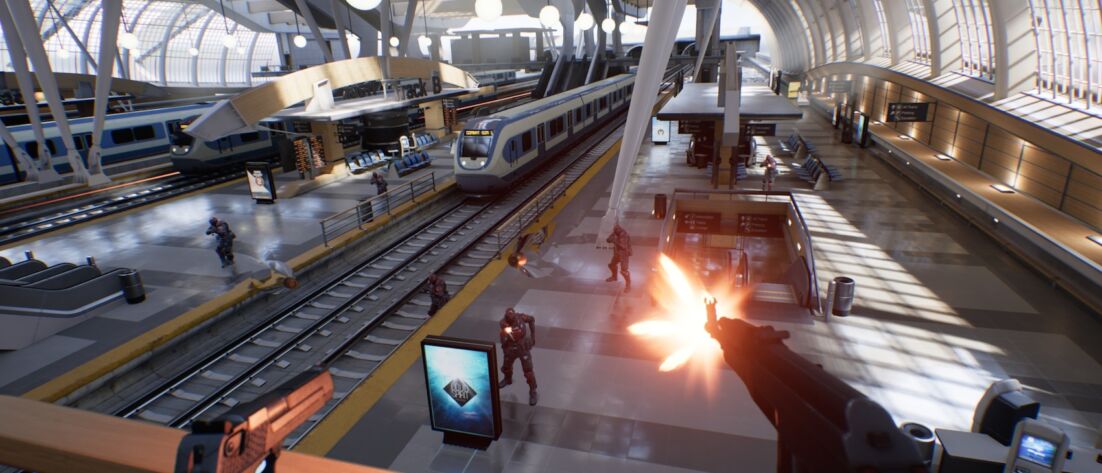
 Ray Davis is the Studio Manager of Epic Games Seattle, and he talks about working on Bullet Train, which is Epic’s latest VR tech demo that uses the Oculus Touch controllers and debuted at the Oculus Connect 2 gathering. I had a chance to catch up with Ray at the Seattle VR conference where he told me about the iterative design process behind Bullet Train, the evolution of the teleportation VR locomotion approach, and how they discovered the innovative bullet grab and throwing game mechanic.
LISTEN TO THE VOICES OF VR PODCAST
Ray Davis talks about some of the goals and motivations behind Bullet Train. Epic wanted to create an immersive VR experience that was interactive and dynamic designed for anyone to go through regardless of what their level of gaming experience might be. Lead VR engineer Nick Whiting and Creative Director Nick Donaldson collaborated on creating Bullet Train, and they wanted to explore what it means to have hand presence within a VR experience.
Ray says that there’s an art to constructing a competitive death match environment in terms of the player flows and different pickups that encourage different pathways throughout the environment. It’s not just a matter of teleporting from location to location, and Nick Donaldson took a lot of that into consideration when creating Bullet Train.
Bullet Train has definitely been the most comfortable first-person shooter experience that I’ve had in VR so far. This level of comfort is largely thanks to their teleportation mechanic in order to move between different way points that are set on a subway train and out into the station. There’s a ghosting trail that you can see after you teleport that can help you orient you to your new location. Ray says that they thought a lot about ways to design the experience so that you could have enough visual cues to maintain your orientation as you teleported between the various waypoints.
Ray says that game design process at Epic Games has always been very organic and iterative. His advice is to just make a VR experience, and then see what people want to try to do in the experience, and then implement those things if it hasn’t been implemented yet. This is how they discovered their bullet grabbing and throwing game mechanic. They noticed that people kept trying to to catch them, and so they went ahead and just added that feature. He says that their ultimate goal is to create an intuitive experience such that people forget that they’re controlling a game, and that they can get into a flow where they’re reacting with their unconscious muscle memories.
Ray says that it’s ultimately a lot of fun to develop for virtual reality when you’re the target audience, because you’re the best expert in what you find fun and engaging. Especially when they could look to their favorite Hollywood action movies, and see what they could start to recreate within their VR experience. There are a still a number of design challenges in moving something like Bullet Train from a novel tech demo into a full-fledged game, and Ray didn’t mention any specific plans for what the future of Bullet Train might be. But it wouldn’t be surprising if they were continuing to refine and develop this concept after giving more than 500 demos over the last couple of months.
There’s also a lot of these experiments in VR where these ad hoc teams at Epic are able to dogfood the Unreal Engine. And so there is a lot of feedback and improvements that are made to the engine to make it more and more well-suited to create different virtual reality experiences. Ray says that part of the culture at Epic Games is to make things, and then try to give as much away of those innovations as possible.
Finally, Ray sees that VR and AR will have a convergence and eventually replace our screen-based interfaces in monitors, laptops, tablets, and phones. He sees that VR and AR will continue to unlock a lot of actual changes with how we gather and consumer information as well as how we connect with each other.
Become a Patron! Support The Voices of VR Podcast Patreon
Theme music: “Fatality” by Tigoolio
Subscribe to the Voices of VR podcast.
Rough Transcript
[00:00:05.452] Kent Bye: The Voices of VR Podcast.
[00:00:09.895] Ray Davis: Hi, I'm Ray Davis. I'm the studio manager here for Epic Games Seattle. And yeah, we're here today showing off Bullet Train, you know, to get that out. And then really the team's kind of focused on, you know, a lot of the last minute work that went in to make Bullet Train possible. There was a lot of optimizations and some feature work. A lot of the team is focused right now on getting that stuff ready for the next release in UE 4.10, which should be coming out here pretty soon. And obviously it's an ongoing effort, so we expect every release from here on out is going to contain more and more good VR support for developers.
[00:00:42.560] Kent Bye: Yeah, so maybe talk a bit about that evolution of how you guys really honed down the game mechanics of kind of like a first-person shooter within VR.
[00:00:50.582] Ray Davis: You know, Epic's game design process, I would say, has always been very organic, very iterative. He's always used to joke of, like, you know, I've never met a designer who could just, like, hand me this document, and if we just implement it exactly the way it was described, it would be amazing and fun. For us, it's much more, somebody has a spark idea, a couple guys get excited about something, and in this case, I think the genesis really came between, you know, Nick Donaldson, who's the creative lead on Bullet Train, and Nick Whiting, our lead VR engineer, Yeah, the idea of, you know, really showcasing what can we do with these motion controllers, you know, the Oculus Touch that were coming out, and starting to explore what does it mean with hand presence. And really, just a couple ideas, you get a team together, we get built some prototypes, and he's like, hey, that works, oh, what if, you know, and then the ideas start flowing, and you, eventually you run out of time, and you gotta put it in a box and ship it, you know? So, that's where we are right now.
[00:01:36.886] Kent Bye: Yeah, and talk a bit about the innovative game mechanics that you feel like came out of that experimentation within Bullet Train.
[00:01:44.112] Ray Davis: Well, for me, I look at it as we always take our approach, even if you go back to Gears of War, right? We didn't invent the shooter by any means. We didn't invent cover. There were many other games before us that had systems like that. But what we did is we take all these various gameplay systems and put them together and make sure it's really polished and integrated and feels good, right? Because I think anybody can go into VR and do a teleport mechanic, for example, but it takes a little bit of science and a little bit of extra work beyond that to make it feel really good, really solid, make sure that people don't lose their bearing when they end up on the other side, like, and really make that a reliable mechanic And it's the same with like, it's like the last mile, you know, we spend a lot of time as console game developers making the controllers make you forget about the controller. If we're doing our job right, you're not thinking about, oh, I need to press the A button or the Y button, whatever it may be. We try to get it to that sort of muscle memory. And I think that's a lot of our emphasis in pulling Bullet Train together is fix all the things that are wonky and then let people play it and see what they try to do. That's a really fun thing with VR is, you know, every time they put the VR headset on for the first time, They instinctively try to reach out and grab and interact and do things. And so a lot of our features came online as like the bullet grabbing and tossing, right? It's just like so many people just instinctively, oh, there's a bullet in my face. Can I grab and throw it back? And you're like, when we implement it, it turned out to be fantastic, right? And yeah, that really is like a long-winded way of saying our process really is all about that just organic keep polishing and trying it. And don't be afraid to go down wrong paths because you chase down this idea. It doesn't turn out. But in the process, we end up finding something even cooler that we didn't anticipate.
[00:03:05.815] Kent Bye: Yeah, and I had a chance to try out the bullet train at Oculus Connect and be able to slow down time and grab the bullets and throw it at the enemies. That to me was one of the more compelling game mechanics that I hadn't seen anywhere else to be able to kind of actually reach out to grab something and kind of throw it and flick it and direct where it's going.
[00:03:23.135] Ray Davis: Yeah, yeah. And that one came in pretty hot. And there was a lot of fun. Once in a while there we had some really fun kinetics with being able to make fists and punch people and grab them. You can grab weapons out of it. You can actually throw the weapons at other dudes and knock them over. There's all kinds of fun cascading things that come out of that. And for me it was really exciting too. I always love when you get to work on a project where you kind of get to be the target audience. Because if you get excited or things that excite you generally can be a nice genesis for new ideas. You know, and with this motif, bullet train, you know, very reminiscent of like all our favorite 80s style, 90s action movies. It's just like anytime we're like, ah, what else can we do? It's like, What's your favorite action? Like, what is Stallone known for? And, you know, how can we bring these sort of elements into it? And it just, honestly, it makes the process a hell of a lot of fun, right? And I think it definitely, even though it gets a little tiring at times, it goes back to why it's so much fun to be in VR development or be a game developer at all right now.
[00:04:16.187] Kent Bye: And so what was your kind of role and tasks that were involved on Bullet Train?
[00:04:21.233] Ray Davis: Unofficially, I would say cat herder. I tend to try to manage out the big picture, make sure whatever resources the guys need, you know, making sure we're all on the same page as far as timeline and scope and logistics, all that sort of stuff. I'm definitely the wrangler from that point of view. And then in between that, as much as, you know, former life I was a programmer, you know, I was lead programmer in Gears of War 1 and 2, I decided, hey, maybe I get my hands dirty a little bit, you know, do some blueprints. And honestly, a lot of it was just sitting down at the last minute with the guys like, hey, we've got this bug, okay, let's walk through it and just do a little bit of code review and help out wherever I could.
[00:04:52.966] Kent Bye: And so you're giving a talk here at CVR. Tell me a bit about, like, what type of messages you want to communicate there to this audience.
[00:05:00.387] Ray Davis: So the panel that I'm participating in is looking towards the next milestones in VR and development, I think both from hardware and software and design. So I'd like to talk about what I see as sort of the next horizon, what the killer apps are going to be that make VR go from hobbyist enthusiasts into everybody needs VR in their life, right? it can truly be one of the most empowering technologies for people. But I think there's some really interesting challenges ahead of us. You know, you think about, hey, just the fact that we have to deal with a wire still, right? And we're probably going to have one for a while. That's very limiting, and I can't move and take this with me everywhere I want to, you know, interact with things. and from natural language, and then there's even more fun things of just like the design challenges of it. You know, I think there's this eagerness for everybody to pile into VR right now because it is the emerging platform, but there's a danger there. If you don't make a quality VR experience and you don't adhere to performance and all these other guidelines that we're discovering, you can really turn people off, right? And that's a big fear as well, is like make sure everybody understands the stakes and what it takes to make, you know, truly awesome VR.
[00:05:58.561] Kent Bye: Yeah, I think one of the biggest open questions in a lot of VR experiences is locomotion, and I found that the Bullet Train had some interesting innovations in terms of the trail that is both shooting out and also coming in. Maybe talk a bit about what were some of the things that you tried to do within Bullet Train to make that teleportation VR locomotion a little bit more comfortable?
[00:06:20.230] Ray Davis: Yeah, I mean, lion's share of the credit obviously goes to Nick Donaldson, our creative lead on it. You know, his background is even going back to, like, Unreal Tournament and, you know, there's a lot of art behind how you make a great competitive deathmatch map, for example, right? And they have these whole notions of player flows and how you put ammunition and pickups and the timing of that because you want to encourage different pathways through this environment. And for me, it just, you know, it's an example of, like, the difference between anybody can implement teleport. But then we look at it as like, OK, what are the visual cues that people, either consciously or unconsciously, are looking for to orient themselves? And what can we do to make sure we have this trail that shows you where you came from? And if you notice, the entire environment, no matter where you teleport, we're always recentering you back into the action. And wherever possible, we make sure there are limits to how much we can alter the FOV without breaking that immersion and people having to reset. We even joked with like, hey, maybe we do. It's like every time you teleport, there's always a trash can on your right side or something like that, right? That isn't necessarily obvious, but people start looking for those anchors and they can mentally adjust to it that much faster. And I gotta say, you know, I was a bit of a non-believer. For the record, I think teleport in some respects could be a temporary solution to this problem. You know, I hope that there's even more dynamic locomotions that people discover. whether it's expansion of room VR or some other technologies. But after what we've done with Bullet Train, I mean, you know, definitely it's a very smooth experience. I haven't seen anybody have any issue with it. Honestly, it feels quite liberating, right? You know, it's like, oh, I can go there. I can jump around. I feel a bit of freedom that I haven't really felt in any VR experience before.
[00:07:48.690] Kent Bye: Yeah, one of the things that I, my experience of Bullet Train is the doors are about to open and then there's all these people standing there about to shoot you and I felt this like, oh my God, like this is really intense. Like, wow. But there was a certain element of the Bullet Train where at some point I realized, oh, I can't really get killed. This is like, I'm kind of invincible so I can, I don't have to worry about that. So what are the sort of challenges in, you know, transforming something like Bullet Train from a tech demo where you're kind of invincible and making it into a full-on game?
[00:08:18.846] Ray Davis: Yeah, I think you touch on a great point. So many people never realize that they're invulnerable and that they can't die. And yet they have the same reactions, right? There's bullets flying at your face. It's instinctual that you're threatened and in danger. And, you know, we have those conversations every once we get feedback, oh, you know, you should put a health meter in there, and we're like, but why, right? It's just we're having so much fun. I almost look at it as more as like you're sort of putting on a performance, right? To prevent you from doing the thing you want to do seems the opposite of a designer's job, right? We want to, if this is fun, we're empowering you to do creative and interesting things, like why would we put systems to block that, you know? You know, maybe someday we could look at expanding it and put some of those more game-isms in there, but I kind of worry that that can be taken too far quite easily, because we kind of grasp, you know, it's just maybe human nature of like, well, this is what we know, so let's try to bring that in closer versus just like, you know, let's embrace it. If it works, it's work, and let's see where else we can take it, right? What other things would be not necessarily intuitive, but actually work really well in this medium?
[00:09:14.219] Kent Bye: I think one of the challenges with VR and designing games is that it's easy to have something novel like bullet train where you're invincible but yet you know going to that next level of like having hard fun where you're actually like failing or dying and then there's the skill level that's being cultivated so I think adding in some of those components kind of makes it from something that is just a tech demo into something that could be a full game.
[00:09:36.781] Ray Davis: Yeah, I mean, it's definitely a possibility. And then with that, you've got to keep in mind your audience, you know. If, yeah, if I wanted to make a VR shooter for the core gamer that knows and loves shooters and has played Halo, Gears of War, Quake, whatever, then yeah, those mechanics start to make a lot of sense. They want to be challenged, they want to have that difficulty because there's that sort of risk-reward investment, you know, the whole cycle comes into play. But if I instead am looking at, you know what, I just want to make a compelling immersive VR experience that is dynamic and interactive, that anybody, you know, most of the people that are running through Bullet Train aren't necessarily gamers, right? So the opportunity to give them an experience where they don't have to learn all these other systems that you or I as gamers would already know, they can just get in and immediately enjoy and there's no unnecessary pressure. You know, honestly, it's room for all, right? And one of the things that we've always done with Unreal and at Epic is we make things and then we try to give as much of that away and just hopefully people seeing like, hey, this combination, it's not particularly revolutionary, but it works. And I'm excited to see more and more developers take this and go make the Dark Souls of VR shooters, right? And the other spectrum as well, make content for everyone.
[00:10:35.290] Kent Bye: Great. So what's next for the VR studios within Epic then?
[00:10:40.947] Ray Davis: Yeah, well, right now, like I said, there's a bit of cleanup. We want to get stuff out there. You know, just make sure all these features are available to developers who have their own ideas and want to use Unreal for VR development. And then really just, you know, bullet train, I think we've had 500 total people. You know, the joys of VR demos is it's hard to just get people in to see it sometimes because the logistics of, you know, one person at a time. So hoping to take it to more and more VR conferences and and share some of our learnings and start looking forward to next year when so many more developers and consumers will be able to actually get their hands on through VR. I think that's going to be fantastic and I'm excited to see this onslaught of new people entering VR. I think it's going to be very exciting. 2016 will be a big year.
[00:11:23.646] Kent Bye: And finally, what do you see as the ultimate potential of virtual reality and what it might be able to enable?
[00:11:29.844] Ray Davis: I always get to be very little cheesy in tech optimism here. I think at some point, if it's 10 years, 20 years, I don't know, that's the debate, but VR and AR, there'll be a convergence, and then at some point, we solve enough of these problems that it replaces all other forms of computing. Why do I need all these other screens in the world if I have the world's best display integrated into me? And I think once we hit that level, earlier today, David Britton, you know, gave his talk, was touching about how that level of empowerment, we're hitting sort of a next, climbing the next plateau almost, right? Of like super empowerment, right? Able to connect and the fact that I'd be able to instantly have access to information at a level that beats even my smartphone in my project. And you know how like impactful that was. If you go back You and I are old enough, you remember when there wasn't the internet, and you, how did you find information? Well, you go to a library, right? And now, what's that? Google search, I can know anything about anything at a cursory level when I need it, right? And it's obviously made a huge impact on humanity. Smartphones, we can instantly talk to anybody on the planet anytime. And it's not hard to think that VR and AR will unlock even more of this actual change in how we exist and how we interact with each other. I have no idea exactly how that's going to work, but I love the idea. You know, there's so many people talking about metaverses and building the holodeck and even the matrix, you know, all this stuff that seemed purely science fiction when we were kids. Really, it's not that far from reality now, and that's very exciting.
[00:12:47.728] Kent Bye: OK, great. Well, thank you so much.
[00:12:48.888] Ray Davis: All right, thank you. It was a pleasure to talk.
[00:12:51.008] Kent Bye: And thank you for listening. If you'd like to support the Voices of VR podcast, then please consider becoming a patron at patreon.com slash Voices of VR.