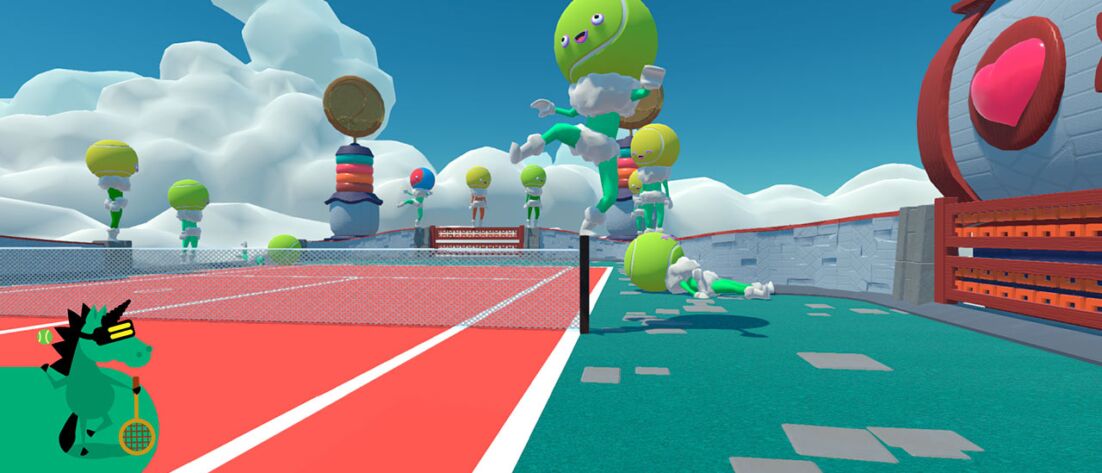
VR Unicorns is a Copenhagen-based development collective that developed #SelfieTennis. They were working on Julie Heyde’s RagnarökVR until they stated experimenting with room-scale sports experiences.
Playing tennis against yourself in VR was the first mechanic that found was really compelling and fun, and so they started doing rapid iterations on maximizing the sense of fun and play in the game. Rather than trying to create an accurate tennis simulation, they started adding in the ability to kill the audience members by hitting with balls, putting in selfie sticks, and adding other mini-games that were more about exploration of an interactive environment than making an accurate tennis simulation.
I had a chance to catch up with VR Unicorn developers Horatiu Roman & Milan Grajetzki at the Unity VR/AR Vision Summit to learn more about their game jam-inspired design process and intention behind the game.
LISTEN TO THE VOICES OF VR PODCAST
#SelfieTennis is an oddly compelling game that I found myself coming back to play again and again. The teleportation mechanic is fun, but it’s also fun to explore physics interactions within an interactive environment. ResearchVR Podcast‘s Azad Balabanian wrote an essay on how Cause & Effect is VR’s Basic Interaction where he argues that physics is how humans can predict the future. This is supports Valve’s Jeep Barnett’s theory that physics in VR is compelling because it’s how humans are able to see into the future.
I’m a tennis player, and so I actually found that my tennis skills could be a detriment while playing #SelfieTennis. If I used proper form, then I would just hit the ball in the net, and so I found that I had to alter my swing just to keep a rally going. The design goal of #SelfieTennis wasn’t to create an accurate simulation to make me a better tennis player, and in fact I imagine that if I played too much #SelfieTennis then it would make me a worse tennis player in real life.
But real tennis is hard, and an accurate simulation would not be fun for a lot of people. #SelfieTennis can be still quite challenging for a lot of people, but the learning curve is a lot faster than playing real tennis. And the teleportation mechanic is something that is so unique to VR that it can be really compelling for a lot of people. For example, here’s a video of Twitch streamer OMGitsfirefoxx in a typical evolution of how people play and explore in the game:
https://www.youtube.com/watch?v=4Ew2iJ93enk
One warning is that it’s easy to get so immersed within the #SelfieTennis experience that you either swing and hit the ceiling or wall, or accidentally throw a controller across the room. So be sure to have players wear the wrist guards while playing.
Also, the initial #SelfieTennis game does feel a bit light to justify the current $19.99 price, but hopefully there will continue to add more features and do a lot of rapid iterations and improvements over time. But it’s also a lot of fun, and a great experience to include for people playing VR for the first time because there are a lot of cute animations and interactions to be discovered within the environment.
Become a Patron! Support The Voices of VR Podcast Patreon
Theme music: “Fatality” by Tigoolio
Subscribe to the Voices of VR podcast.
Rough Transcript
[00:00:05.452] Kent Bye: The Voices of VR Podcast.
[00:00:11.974] Horatiu Roman: I'm Horatio Roman. I work as a programmer on selfie tennis. Our company's name is VR Unicorns.
[00:00:18.977] Milan Grajetzki: I'm Milan Gretzky. I'm the game designer and sound programmer, music composer on selfie tennis.
[00:00:26.440] Kent Bye: Great. So there's VR Olympics and VR Unicorns. Tell me about how this company and project came about.
[00:00:33.800] Horatiu Roman: We were working on a different project called Ragnarok, which was a much more serious horror thing, and then we started jamming on some ideas in an afternoon, and we pretty much came up with the selfie tennis idea from eating pizza, and then Milan came up with, oh, wouldn't it be funny if you could serve the ball and then teleport to the other side and then turn around and hit it back to yourself and then we're all like really excited about it and the next day I was supposed to work on something else and I just decided to just make selfie tennis so I did a prototype in two days it was really fun but it was very crappy of course with all kind of assets just taken from the internet and then we polished it for a few weeks got an artist on board three weeks ago and now we're here We also made a bunch of other prototypes which didn't really end up anywhere and this is kind of how we work. Basically we just make stuff, see what sticks. The old Ragnar project is kind of on ice right now due to the fact we're just focusing on this one, trying to launch it.
[00:01:31.955] Milan Grajetzki: And when the selfie tennis thing kind of worked out, we tried other sports things. We also have a ski jumping prototype and some other things. So we're just thinking to release a compilation of wacky sports games. And selfie tennis was the first one of that. So that was this V Olympics thing. So for now, we're focusing on this one because it's the one that is most developed right now. Maybe the other ones will come out as well.
[00:01:55.659] Kent Bye: So for people who are listening in, maybe you could describe the mechanics of what actually happens in selfie tennis. When you hit the ball you teleport to the other side of the tennis court and you have to serve your own ball back So you kind of play with yourself Yeah, so I actually am a tennis player So I immediately like threw up and had my own form and found that actually my tennis skills were a detriment to me playing the game once I got used to it, then I could start to actually play the game and hit the ball and then teleport to the other side and then start to hit the ball as well. So are you trying to make it feel like real tennis or is this going to be you trying to make it feel like a game for people who may have no idea how to play tennis?
[00:02:39.938] Milan Grajetzki: We're no tennis players ourselves, so we have no clue what we're doing. So we're just trying to make a good game and a good feel. And I think we're still working on that, and just observing how people play on events and stuff, and just doing a lot of play testing.
[00:02:53.707] Horatiu Roman: We got a bunch of feedback from actual tennis players, and it's really interesting to see how, as you said, it's usually a detriment to know tennis. Because when you try the physics in selfie tennis, of course, it's not even close to realistic. But the thing is that we're going for this wacky, thing instead because if it was like real tennis most people would have a hard time even making it work because tennis is hard I mean seriously yeah I played the most crappy tennis and I'm just terrible at it but it is because it's hard you just run around just get exhausted but in this one you can actually play even if you don't know where to pick it up And it's fun to kind of get a combo going and just kind of have fun with it. And then for real tennis players, the challenge will come in the end from doing cool stuff in the game, I guess, being able to do spins and so on. We haven't implemented most of that stuff yet. So right now it's more of a badminton thing than it is tennis, but we're working on it.
[00:03:48.949] Kent Bye: Yeah, that was probably my biggest complaint is not being able to actually put topspin on the ball. The funny thing about topspin is that most of it actually comes from the follow-through. So you're actually like looking to see what happens to the wrist. And the moment of impact isn't actually as important as like the follow-through and like completing your stroke. And so it's kind of interesting to think about like the moment of impact and then trying to keep track of all the things that happen after that in order to simulate the topspin and everything.
[00:04:14.749] Horatiu Roman: part for us is that we can start talking about those things rather than talking about the ball going through the racket and so on so it's really interesting for us to actually be at this level where we can start talking about realistic physics and simulation and so on and it's definitely a part of the game but another part is for instance shooting the audience and seeing how they bounce around and throw them off the field and just kind of doing wacky stuff apart from playing tennis and then you go back to tennis again so I mean that's why it's VR because we don't want to replicate real life we're just gonna go beyond it and then experiment with something that you couldn't possibly do.
[00:04:49.413] Kent Bye: Yeah, I think it's being able to teleport and play tennis with yourself is really actually pretty interesting and my biggest complaint would be that the velocity which the ball is coming in. As a tennis player, I know where to position my body and where I'm teleported is like the last place I would actually be if I was a real tennis player. So I would imagine the teleport system will have to evolve as well in terms of measuring where the ball is hit, how fast it's hit. Even though it's room scale, you're not covering the space as if you're running around a tennis court. That's part of the big thing about tennis is being able to judge the velocity and know where you need to be on that court.
[00:05:26.416] Horatiu Roman: What we work on is basically try to teleport the player where the ball will land or close by so that they can get a nice combo of hitting from the right side and hitting backhand and kind of getting into this flow and into a nice motion that feels good to the player. Although, obviously, we have a lot of work to do to make it feel good. It'll probably be something adaptive based on each player's play style and how good they actually are with the racket and so on. A lot of people don't know how to play tennis, do really bad motion. I mean, they don't look good playing, that's the thing. But at the same time, yeah, that works better than if you do full swings that feel natural but not for our game. Yeah, it's interesting. We're iterating on it constantly and the build you see here was not here last week for instance and we're just always evolving and getting better. But it's cool, it's nice feedback. Thanks.
[00:06:22.138] Kent Bye: Well I think part of the other thing is that there's Wii Tennis and with Wii Tennis I think they found with people who originally were playing they were doing the full swings and everything that people eventually found out that you could just do a wrist flick and they could destroy anybody that was actual tennis players. So you kind of create this sort of hybrid of a game that may be fun to play but you end up instead of like standing up and you know swinging you end up just sitting on the couch and kind of flicking your wrist and so With this game, what were some of the design goals, I guess? Are you trying to get people to move around, or is it you're trying to create something that's really unique and fun, or what would you want to be kind of like the ideal experience of someone playing this?
[00:06:59.757] Milan Grajetzki: I think it's mainly about being playful and having fun just doing it. Because I always think it's good when you design something for Wii VR, you don't have to necessarily play tennis to make a good score in our game. You can also kill the audience. You can try to hit bells on the tennis court. The tennis court is a little bit like a pinball machine. And we want to put in some mini games and mini challenges. So it's a lot more about little game design things that get added on top so that you just can have a good time in there and do whatever you want.
[00:07:29.893] Kent Bye: So what have been the things that you found people have the most fun doing then?
[00:07:33.636] Horatiu Roman: Killing the audience.
[00:07:35.958] Milan Grajetzki: Yeah, people love that.
[00:07:37.799] Horatiu Roman: We put that in as sort of a gimmick at first, and I was like, oh yeah, but try to make a good score and so on. And Julie was just testing. Julie's our third sort of member. Pretty much our boss, yeah. Anyway, so she was just killing the audience instead of playing tennis. I was like, no, stop killing them, just try to play. But this is funny. So we realized, okay, people want to do that. And then as soon as we tried it on a lot of people, actually girls tend to kill the audience much more than guys. It's really interesting to see these sort of... So yeah, it became a main feature. I mean, it's just funny to do it.
[00:08:09.095] Milan Grajetzki: I think there's not so many, like, top-down design goals or something. We just go with it and see what people like, what they react to positively, and then we keep it in and make it even more fun. And so, just game jam style, pretty much.
[00:08:23.000] Kent Bye: Yeah, I think it's pretty surprising that, you know, you'd be on a tennis court and that's probably the last thing I would think of is to kill the audience. But it seems like it's something that... Do you think it's an element of surprise or what is it that people are really liking about that?
[00:08:35.569] Milan Grajetzki: I think it has to do with not all people like playing for the goal or for the high score. Me, for example, if I play games, I don't like to do that. I like to explore and see what I can do and just experiment with the world I'm in or with the mechanics. the interaction, and it's just a fun interaction. You do something, you get a lot of feedback. The people bounce around, there's little hearts coming out of them. So, I don't know.
[00:08:57.645] Horatiu Roman: Yeah, I mean, I'm studying game design in Copenhagen, and I studied media technology before this bachelor's, so we did a lot of research on player types, and there's a lot of, sort of, psychology and things behind players' minds. Like, what do they expect from a game? What do they try to achieve? And it's definitely, people want different things from a game, so you can't put them all on the same track and give them a specific goal that they have to follow. I think we're going for a variety of things that you can do so that everybody can kind of find their own fun time in the game. And that's why I think it's going to be more successful than if we make it a proper tennis simulation where you just play tennis. Then it's going to be a few people who are really getting into it and most people say, yeah, this is very realistic and then they drop it and then play something else.
[00:09:42.432] Milan Grajetzki: Also in VR, people tend to be more creative. They just try stuff, you know, because it comes very naturally, especially in the Vive. They just try to pick up objects, throw things around and interact with everything. It's not so much like in other games where there's specific objects that you can interact with. So if you open your world up to them and invite them to do this kind of stuff, I think that that's a good way of designing.
[00:10:04.146] Kent Bye: Yeah, I guess in some ways, if you're going to make a perfect tennis simulation, then why not just go play tennis? So I can totally see why you'd want to create this crazy fantasy world where you can do things that would be impossible in real life. And I really like that insight that people like to explore and experiment and kind of see how they can have the world react to whatever they're doing. And so you have this interactive environment. From that standpoint, what other crazy interactions would you think would be fun or interesting in Selfie Tennis that would only be possible in VR?
[00:10:36.228] Milan Grajetzki: I don't know. I mean, we have some other games where we tried some weird stuff. We have a game called Race to the East, where when you crouch down, you become a giant. So if you move in the play space, you move a lot more in terms of space than you would normally. and then we created a racing game from that. So you crouch down, you move to the other side of the play space, you have to go up again, you move backward and then you crouch down again and then we were pretty much just racing each other, taking turns and getting hurt. So you can do this kind of stuff as well.
[00:11:10.295] Horatiu Roman: We made another game based on Jenga where you kind of use the same scaling mechanic to create a huge tower of bricks and then you can just become a giant and pick them up like they're little toys and then you become small again and see them crumble above you and it's just really satisfying to do these very simple things that in real life you see kids doing it. It's just stacking stuff and it's like you go into VR and it's a whole new appeal to it. It's like, wow, so funny to stack stuff. In real life you would never do that but it's just interesting.
[00:11:37.992] Milan Grajetzki: Simple pleasures. They can touch stuff and build something, sandboxy stuff. So I think it's cool to explore into a lot of directions and try a lot of prototypes. That's usually how we work. Just jam on ideas and whatever seems to work or what people think is fun, we just try to incorporate it into or develop it a little bit further.
[00:11:58.118] Kent Bye: What's one of the most fun novel experiences that you've had in VR that you've worked on and created?
[00:12:05.416] Horatiu Roman: The most fun I've had in VR was something that we often do together with Milan when we're developing. So he's in VR, he's trying out some kind of build and I'm in Unity Editor and I'm changing stuff in real time for him and then he's telling me, oh this works, this doesn't work, oh that's scary, oh that's really cool and then I'm kind of pretty much making a show for him. And then I tried the same thing where I was in VR, and another game developer friend of ours in London, we were just jamming late night after an exhibition, and he was doing that stuff for me, and putting fire on stuff, and letting a lot of bees fly around, and a huge Jenga tower. It's really crazy, but you can find some of those things on our website. So, to me, it's the interaction with another player, or maybe more players, where other people can kind of make a game for you, make a story for you, kind of interact with you while you're in VR. I think that would be a very interesting direction to go, and we actually have some plans to make some games related to that, maybe even incorporate self-tennis. But yeah, I don't really know at this point. We're going to take it as it goes.
[00:13:06.820] Milan Grajetzki: I think for the future it would be really nice if one person or even more could be in VR but other person sit on their couch with their iPad and kind of create experiences for them. So I think it's really cool like for the future to look into all the social and networking stuff and just connect players from all kinds of interfaces to be together. I think that's a really nice thing about that.
[00:13:28.519] Horatiu Roman: We have a ski jumping game, and it's so much fun to just look at people jumping and doing it, and then you switch head-mounted displays, and then you try it yourself, and then you just have a high-score list, and it just gets people involved, and the audience loves it, and everybody loves it.
[00:13:43.466] Kent Bye: What's interesting about watching somebody ski jump in VR?
[00:13:47.600] Milan Grajetzki: It looks funny and I mean you watch them and you see on the screen at the same time what happens and you instantly think I can do it better or something like that you know and then people want to try themselves and then the first time they suck and then the other people laugh so there's a very social aspect to taking turns in VR actually and I think a lot of our prototypes are like that because we always
[00:14:07.892] Horatiu Roman: Invite a lot of people and have them test our stuff even if it's not ready yet or something so we get good feedback We just hang out and it's a little bit like a little play party and everyone takes turns trying The physical aspect that helps a lot if it was a regular game where we kind of use a mouse and keyboard do stuff It wouldn't be nearly as exciting Because yeah, this is just more real in a way. Yeah
[00:14:31.668] Kent Bye: Maybe you could describe to me what it looks like when somebody is going through a ski jump in VR. What do they look like?
[00:14:38.762] Milan Grajetzki: well so they have to take the controllers in their hands and they have to like push themselves forward from to gain some speed from the ski ramp and then they crouch down and then at some point they're approaching the point where they have to jump they just jump up and some people jump really high some other people don't really dare but the thing is that most people who do it the first time they get kind of afraid or scared because it's so high it's not really dangerous or anything, but still. And I think to see that and witness that is also really funny. And then in the end, they just land and crouch down again. So I think it's very believable to them, this experience. So it's nice to watch.
[00:15:20.265] Horatiu Roman: Yeah, I like people when they kind of twist around and try to do tricks. It doesn't matter for the game, but they love it. You know, they just do a little show.
[00:15:28.390] Kent Bye: That's really interesting because, you know, like from the outside, they probably look like really silly and funny, but from their own personal experience, they just they probably feel like there are like a superstar or, you know, extreme sports hero.
[00:15:39.717] Horatiu Roman: It's that's what it is. I mean, they make a show for others. Everybody loves it. They feel good. You know, what's wrong about it? Just do it. Just be silly.
[00:15:48.872] Kent Bye: The thing that I also really found interesting is that Unity is a program that when you start playing it, then you can do dynamic editing, but when you stop it, nothing's actually saved. But it sounds like you're kind of using that feature for people who actually know how to use the engine to be able to dynamically create these whole stories and experiences by throwing in assets and making stuff happen interactively. It sounds like it can make it easier for somebody who may not necessarily know how to use all the tools of Unity to do the same thing. Then I can see that there'd be a lot of collaborative storytelling experienced generation coming directly from another person and responding in real time to how they're reacting.
[00:16:24.194] Milan Grajetzki: It's his specialty to do stuff in play mode in Unity and kind of even save it later with some hacks.
[00:16:30.579] Horatiu Roman: Most prototypes we do are a few hours and it just works and then we just iterate a bunch of times within those hours just to get the first feel and I think the more iterations you do and the quicker you do them the better the end result will be and even if you do it in a day or two you might actually have a playable game that you can start showing at conferences. Make a game in two days.
[00:16:53.525] Kent Bye: Yeah, it sounds like you guys are really adopting the Game Jam workflow aesthetic of faster iterations, get something working fastly, and then to be able to get through a lot of different ideas to see what actually works.
[00:17:04.770] Horatiu Roman: Game Jams are the best. If you want to get good at game development, you have to go to Game Jams. And don't be afraid if you don't know what to do, or you think you don't have any skills or anything. Just go find some new people to work with, try things out. Have fun and in two days you might make a cool game that you can build on later or drop it. You know, you just learn something new. In Copenhagen we just do a lot of game jams all the time. I organized Global Game Jam for instance this January at ITU where I study and had 150 people making games. most of them beginners actually, and I just saw it how they realize, okay, making games is not hard and we're just gonna make that much as we can. In Copenhagen it's already pretty big, just game jamming scene generally. I think in the US they also have a little bit of that, although it's a bit different focus I think. In Asia it's completely different that it's just very competitive it seems. People go in, they really try to make good game, trying to, yeah, better than the others or something. We're more collaborative, we're more helping each other, making cool games together. So, I don't know, I think our way is better.
[00:18:15.960] Kent Bye: So, what do you guys want to each experience in VR then?
[00:18:19.447] Milan Grajetzki: I don't know. I mean, to me, I really like if I see that people are having fun with something that I made. That's a really great feeling. So I think that's mainly what I like about it. And also very much the interaction part of it. So this whole part of taking on a headset and being in another world, it's not very important to me. But the fact that you actually can pick up things there and throw them around and just interact with the world that you're in, I think that that's interesting to me. And I think there's a long way and a lot of stuff to come with that.
[00:18:48.439] Horatiu Roman: I like recreating the world to some degree and then taking it further to something that wouldn't be possible. For example, making a physical sort of tree, for instance. You make a tree out of different branches and they're all kind of physical, so you can start breaking them and so on. You can put it on fire, but then you can make it walk and talk and do some other crazy stuff. So, yeah, it's just... I like having this creative power to just change reality in a way. If I could do it in real life, that would be cool also, but it's kind of annoying for the other people because you can put them on fire. So I just stick to the VR.
[00:19:28.819] Kent Bye: And finally, what do you think is the ultimate potential of virtual reality and what that might be able to enable?
[00:19:35.622] Milan Grajetzki: I think it's a lot about the social stuff. I think it's going to be pretty big in the next years to explore how you can interconnect with others and experience things together because it's a very special feeling to interact with someone like that. But we also, I think everyone is just scratching the surface of the stuff right now. So it's really hard to project at the moment. I think it's going to go step by step and we'll just see where it takes us.
[00:20:01.487] Horatiu Roman: Yeah, I think it's funny because most people look at VR just like they looked at many other media that it will make people alone and just kind of go into their own world and just kind of But I saw today some people were coding with the Gear VR on their face, just looking around, looking kind of stupid. But in any case, I mean, they would be on their laptops anyway. With or without the Gear VR, they would still just be on their laptops. So it doesn't change anything. But the social interaction part is really cool because you're interacting in a new environment, something that you never had before. So it does add a lot to the social interaction. But I think most of all it will enable the new experiences and just the different realities that you can go in. And then you can learn something from that and do something different. People still interact the same way they always did. That's just my view on it.
[00:20:51.892] Kent Bye: Okay, great. Well, thank you. Yeah, thanks. Thanks. And thank you for listening! If you'd like to support the Voices of VR podcast, then please consider becoming a patron at patreon.com slash voicesofvr.