 VR has the capability to take us into completely new realms, and experimental artist Isaac “Cabbibo” Cohen has been creating some of the most surreal and transportive experiences that I’ve seen. I had a chance to try out a number of Cabbibo’s Vive art experiments and then talk to him about his design intentions and process at the VR Mixer party, which ended up being one of my favorite conversations at GDC.
LISTEN TO THE VOICES OF VR PODCAST
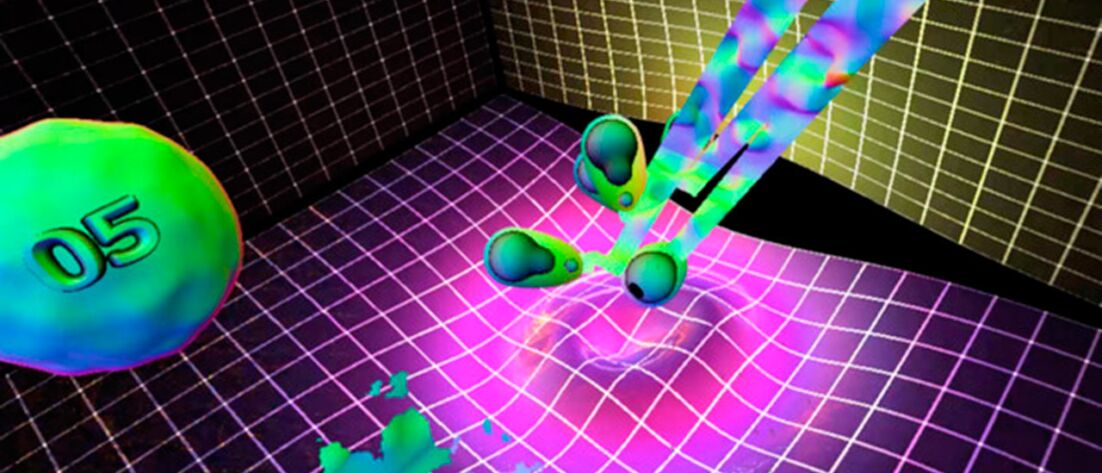
Cabbibo just released one of his visual experiments as a challenging physics-based game on the Vive called BLARP! for $3. Once you get the hang of the controls and basic game mechanic, then I think it’s one of the most fun and meditative games that I’ve played because it’s a totally unique experience with great sound design and something that’s only possible in VR with motion-tracked controllers. Here’s the trailer for <BLARP!, which is on the Steam for $3.
This article that he wrote about 10 Quick Things Cabbibo Has Learned in VR is worth checking out. And if you want to get a quick highlights of his other VR experiments, then be sure to check out Cabibbo’s Twitter media uploads. Here’s a few examples of his VR art experiments:
Everyday 5 : Hydra is hungry pic.twitter.com/yfPulmSrF3
— Cabbibo (@Cabbibo) January 10, 2016
Today's #htcvive experiment: 'Meta Cloth' : https://t.co/XRhfvjjeUhhttps://t.co/ycoejpHKYn pic.twitter.com/cMdmzRY21d
— Cabbibo (@Cabbibo) March 22, 2016
Place-able audio disformers : https://t.co/IF07RPPZeR pic.twitter.com/MFSd5UH1gE
— Cabbibo (@Cabbibo) February 19, 2016
Become a Patron! Support The Voices of VR Podcast Patreon
Theme music: “Fatality” by Tigoolio
Subscribe to the Voices of VR podcast.
Rough Transcript
[00:00:05.452] Kent Bye: The Voices of VR Podcast.
[00:00:11.976] Isaac Cohen: I'm Isaac. I go by Khabibo on the internet, and I've just been trying to make weird objects, like sculptures and life forms and pets and games and just weird things in VR, I think is the best way to describe it.
[00:00:29.928] Kent Bye: Yeah, I had a chance to try out a number of your experiences, maybe about eight experiences or so. And yeah, it's very weird and surreal. And I think that one of the things that you have is kind of experimenting with really surrealistic experiences in VR, things that you can only do in VR. And so if you were to try to characterize a theme that you try to do through all these different pieces, what would it be?
[00:00:50.920] Isaac Cohen: Yeah, I think that maybe what it is is sort of like make things that are familiar enough that you think that you should understand them and then when you realize that it's not quite what you thought it was it makes your mind like dance or like wander or play or try to comprehend the thing that it could not comprehend before and then all of a sudden that makes you curious and like that act of curiosity allows you to imbue the object with more of you. So it's like maybe like trying to reflect your curiosity back at you which excites you to be more curious. If that makes any sense.
[00:01:28.099] Kent Bye: It's like a positive feedback loop of curiosity.
[00:01:30.420] Isaac Cohen: Yeah, yeah, exactly. And like wonder and sort of just like, oh my God, I didn't think this was possible, but it's possible, you know, like letting us remember that the entire world around us is fantastic. And maybe like a lot of the way that I think of VR is it's much more like, you know, when you travel, you go to another place, you experience a different thing. And like, it's exciting to be there and you're learning a lot. but so much of that experience is what you learn there that you take back to the place that you're at and you're like oh this is different than here this is different than here like the best compliments I've gotten are when people like try something that I've done and they're like oh like it made me like think about ferns differently or like it made me like want to like touch a plant which I hadn't done in so long but it was so cool to like get to do that because like I had kind of remembered how to feel wonder again you know which is crazy to think about but I think that especially in games and a lot of these things were where it's so objective based and where you're trying to do something and it isn't so much just like well, what is this thing in front of you? Figure out what it is. So much of that is visceral reactions to things and trying to get certain things accomplished. And you don't really get to understand the place that you are or the things you're interacting with. You're just thinking about, what's next? What's the score? What's all that?
[00:02:46.815] Kent Bye: Yeah. So there's a lot of expectations we have of what reality is like. And part of these experiences is that you're really hitting this sweet spot of things that you could only do in VR. You can't have the types of physics reactions that you're having and the interactions of working with these different objects that, as you touch them, they're kind of melding in these really unique, weird, surreal ways. And so you go into these experiences and, you know, there's something about it that I don't fully quite understand why it's so compelling. But I liked it, but I don't exactly even know why I liked it. I'm sure you kind of get this curiosity and it's compelling and interesting, but people are having a little bit of difficulty as to articulating exactly why.
[00:03:25.058] Isaac Cohen: Yeah, I mean, I definitely have that problem too. Like, I've come up with a few different sort of, like, hypotheses about that, but definitely, like, there are so many times when I, like, press play in Unity, and I'm just like, oh my god, what is this thing? Like, how does this happen? Like, what's going on? Or, like, especially when it's bugs, like, I made one where whenever you pressed a certain button, it would, like, save the state of the thing, and so it would just, like, descend into chaos, and there's no way back, but it was so compelling to just, like, rip this thing apart and just be like, what is going on? I don't know, but I'm enjoying it. Until it was just so bad that you had to quit the program. I think that to me there's two parts of it. One is having enough things that are understood by the computer that the object itself is not of our scale. So when you're doing things on the CPU, especially physics on the CPU, you can't really get that many vertices that have their own spring physics, that have their own mass, that have their own velocity and damping. and springs attached to them that are repelled by audio. The amount of calculations you can do is just not enough to get so many vertices that it's more than your mind can understand. So you can only begin to understand behavior It's like you're understanding functions over objects. And I think that that's a really powerful moment, is when something is so complex that you're no longer looking at the thing that it is, but you're looking at what makes it. And that's one thing that's really interesting for me, especially about VR, because It seems like in most of the games that I play, the main consideration is what the things are. And there's a lot of really cool, like, I could never have a pet dragon that was the size of my hand, and now I can in VR. And I could never have a beach ball that was furry that was infinitely light in VR, but now I can. And for me, like, it's not even necessarily what the object is. It's like what the object is made of, because that's like what constitutes the material. And it's interesting, because like, people in the real world, industrial designers, architects have to like think about this all the time. And they have to consider like, What will this wall feel like when I touch it? And that's something that we especially in game development have not been thinking about this entire time but as soon as you start thinking of like what does this feel like and then you're starting to think about like the actual atoms of the material the thing that makes up the material like the stuff of the reality that you're in and Although that might limit you like I can't import a million models and have them all be this crazy physics to me It allows you to make a more fully actuated reality because you're having describe it to a point where like every single atom in that universe that you've made is described. It means you aren't going to have that many atoms in the universe but it definitely is going to be more than most of the VR games where when you grab it is always just like strict immediate grab It's sticky, there's no reaction, there's no breaking the object. Like the object is only the object, it's very quantized. And so you're thinking about the objects rather than the functions that act upon those objects, the sort of like flow of the space around you. Yeah, that's my hypothesis at least.
[00:06:31.409] Kent Bye: Yeah, and you know, one of the things about reality is that in order to build a building like we're in right now, you have to have like structurally sound materials, you know, and so you end up with a lot of right angles and a lot of things that aren't necessarily inherently beautiful. But yeah, when you go into nature, there's a lot of things that kind of have like this more organic feel. And so, you know, whenever people are creating art within a virtual space, It tends to have like by default this very blocky right angles and spheres and you know these fundamental shapes but yet I think it's something that makes some of your experiences so compelling is that you're starting to create these materials that feel more fluid and more dynamic and interactive in a way that just kind of transcends what you might see based on some like the basic Unity program that maybe somebody has created something in a day or two.
[00:07:18.638] Isaac Cohen: Yeah, it's really cool to think about like what we can do and what others could not do because that's almost as important like I was trying to build this scene that was impressing my architecture friend where I had like this one big room and the walls were like made of cloth and you could blow and it would take the mic input and like blow the cloth and she's like, oh, that's really cool. And then you turn around and there's this tiny little tunnel that you have to crawl through to get into another room. And I like made it so like the bed was actually where my bed was. So it's like sort of like projected onto reality. And she's like, oh, this is kind of cool. And then I had her like stick her head in the wall. And it just is this like infinite ray trace, like super thin, almost like looks like the center of interstellar, like weird thing. And she just like, oh. This is the only place that's interesting. None of those other things were interesting to me. This is magnificent. I can't stick my head in this wall. I want to know what's inside the wall. It's interesting because I feel like a lot of times those constraints or those new things that we have to do in this world suddenly become very terrifying because it's like, oh crap, I don't need to just design the wall. I need to design what's in the wall. I don't need just to design the object. I need to know what is going to happen when somebody hits the object with their head. But for me, like, that is so much of what makes this new world exciting is sort of like getting to find those like wrinkles in space where they're like these corners or little voids that we didn't know exist before but now they're just like blossoming into like their own reality and we get to address those and I think that's a lot of sort of like now we get to do all these weird shapes now we get to do all these weird objects and so much of like the excitement behind that is just like not just like what can we do but what couldn't we do and not just like what we can do but like what do we have to think about that we didn't have to think about and how can that become an asset rather than a fear.
[00:09:07.469] Kent Bye: Yeah, and I think in all of your experiences that you do, you have some sort of like interactivity that you have. And so it's responding to you in some way, either it's the Vive touch controllers or you're, you know, like you said, you're blowing, so you're making noise or sound and the environment's reacting to you. And so you have one experience in particular where you have kind of like this organic looking shape with the musical instrument, like with fur and you're, putting out these little seeds of some sort. And as the seeds are put out there, then the object is drawn to them. So you're able to actually kind of direct and control this thing, but also play it like a musical instrument. So maybe you could talk a bit about what you were trying to do in that program.
[00:09:46.386] Isaac Cohen: Yeah, totally. So I started doing VR when I was working at Leap Motion, and it was really nice. They provided me the opportunity to get to explore and think as radically as I could about what does interaction mean. And especially for the Leap, because for me, the most compelling part about it is that it moves computers closer to the human world. You know, like a mouse, for example, is such a quantized, crystallized, structured way of interacting with a computer, but like, that isn't really what computers have to be. Yes, that is easier for them to describe, maybe, and it must be, it's much more difficult to describe these organic things, but as we get more power, we can move more towards the organic. So like a lot of what I was thinking of at Leap was how to make everything just feel different. It's interesting because a lot of the thinking I was doing was around interface design and about how so much of interface design, at least in the web world, is concerned with efficiency. It's concerned with how quickly can you click this button, how quickly can you do this, how quickly can you do that. But for me, there are all these other dimensions of efficiency, say emotional efficiency. where, like, how much do I want to click that button? How good do I feel after I do that? How much after, like, I experience going through this thing, do I want to, like, tell my mother I love her or, like, talk to my friend who I haven't talked to for, like, a bunch of weeks? And, like, for me, like, that is the biggest concern is just, like, how do you make an experience where, like, it has some sort of efficiency, but, like, the efficiency is sort of, like, in how much it makes you move and how much it makes you emote and how much it makes you sort of like feel like the world around you is as real as you are and that's an interesting point because so much of what we talk about in VR is like I want to have superpowers and like obviously I want to have superpowers, but I also want the world around me to have agency. I want the world around me to get screwed up when I screw it up. I want there to be mistakes. I want there to be emotions. I want there to be, like, this depth to it. Like, for example, with the hydra, the one with all the weird arms where you're feeding it seeds, it's a bug, but I really like it where if you feed it in too many directions, like, all the arms are looking for it at the same time, and it gets all, like, tangled up in a knot, and you can't really do it. And people are like, I think I broke it. I'm sorry I didn't mean to do that you know and like that to me is like actually like a really powerful moment of just being like I need to act with care and like the moment when it's like oh I need to act with care or oh I need to act with excitement or oh I need to act with like intention or just like love maybe then all of a sudden like that to me is doing the thing that I want to do which is just getting people to feel emotions that they will want to bring into the world with them into the people around them as well.
[00:12:39.972] Kent Bye: So tell me a bit about your design process and whether or not you start with a seed of a emotion that you're trying to feel or express or a seed of you know trying to invoke feelings in others.
[00:12:49.767] Isaac Cohen: Yeah. Yeah, definitely. So like a lot of my previous work that isn't VR. So I just finished this kid's book, video game instrument sort of thing called enough. And it just is like a web page you can go to. And for that one, it was very much just like my own personal journey with pain. and with that one it was sort of like there were these certain fundamental truths that I found that I wanted to share with others but in a way where they were informed that it gets better or that there is this goodness to those that I didn't necessarily get a feel, you know? And I think that's a lot of the way that I think about stories or games or any piece of art is that it's sort of like this prism When I was a kid, I used to stare at the sun a lot. My parents would be like, don't do that. It's bad for your eyes. But I'm like, no, but I want to see what that thing looks like. But it's just too much. It's too big, and it's too bright, and it's too massive to really comprehend. But it's still obviously beautiful, and I still really want to see it, but I couldn't comprehend it. But then all of a sudden, when that white, bright light hits a prism and gets splayed out across the full visible spectrum, it takes this thing that is too big for me to see at a point and is able to unfold it across like the totality of my human comprehension so I can like understand it you know and so a lot of stories to me are about doing that and this big story specifically was about like how do I take that thing that was so bright and painful to stare at and just like unfold it in a way where people can understand it and with that understanding grow and for me like right now in VR a lot of it is just like How do I make toys so people can have fun for a moment and then come out of it and be like, oh man, I have so many ideas about what to make next. But definitely the bigger projects that I'm thinking about are much more meditative, intentional, and trying to think about these larger objects that can be refracted and diffused so that we can understand them without having to stare at the sun.
[00:14:48.870] Kent Bye: So maybe you could tell the story of what type of experiences that you want to have in VR then.
[00:14:52.775] Isaac Cohen: Yeah, oh man, the experiences I want to have in VR. Irrational exuberance, which I tried the other day, is pretty much it. Obviously I don't want to say anything about it, but it's definitely moving. like at least in the things that I'm trying to create it's about like being able to wonder at the malleability of reality and sort of like what we understand is reality is so small and when we can expand that a tiny bit to me it makes me feel more gracious about all the parts of reality like one of my favorite stories about VR is me and my friend were playing Elite Dangerous and like one night We were hanging out in IRL, and we were looking up at the stars, and we're like, let's fly to that star. So we pull out Google Sky Map, figure out what the star is, go into the NASA thing, find the actual name. go into Elite Dangerous, load it up into our maps, and fly to it, and you just get there, and it's like, and you know, it took us like 40 jumps, 50 jumps to get all the way there, and we finally get there after like an hour, and it's just like, oh my god, like that was just a point. And now it is this massive object, you know? And those are the experiences where it just is like, oh, I thought this was all it was, but there's so much more, you know? Like, I remember after Avatar came out, there's all that talk about post-Avatar depression, where it just is like people being like, oh, that world is so marvelous. Why can't my world be like that? And it was like really depressing to people. And I'm like, yo, go look up like Davin Attenborough's, him narrating banana slug sex. It's like, makes you realize that like that miracle is everywhere you know like everywhere like go look at pictures of nudibranchs like go find one of those like the mantis shrimp with like 15 trillion icons like there are miracles all around us and the more that we can see those miracles the more we notice other miracles the more we notice miracles the more we do that sort of reflection of our own awe and the more awe we put into the world And the more of that is put into the world, the more other people see that. And the more other people see that, the more they reflect it. And it becomes this prismatic kaleidoscope of our curiosity, which to me is one of the most fascinating human traits around.
[00:17:12.189] Kent Bye: And finally, what do you see as the ultimate potential of virtual reality and what it might be able to enable?
[00:17:17.694] Isaac Cohen: Yeah. Oh, man. I think that it's about understanding things, understanding with like our eyes in that like visceral human way what we could not understand before. So like I've been really into Brett Victor and his explorable explanations and like certain people like there's this one person named Haim Gingold who made an app called Earth Primer and it basically is just like a geology textbook where you play and where you like have an actual simulation where you raise the water and you see like more trees grow, which causes more, you know, wind to be caught, which causes more rain. Or you like raise the temperature and you actually see glaciers melt. And like, it's one of those moments where just like, oh, like I get global warming. I get it. Before I understood it logically, but now I get it in my heart and in my eyes and in my mind because I can see it at a human scale. I can take this thing that's so bright and blinding and far away and I can translate it to a human scale so I can understand it. The most exciting to me is classrooms, is explorable explanations. being able to like see the airflow in the room around us right now. It's being able to see the things that we could not before see. And not just of the world that we can reach, but of like the infinite world of like, what does a Tesseract look like? You know, like, what do the aliens who live on Proxima Centauri look like? You know, like, it's about like manifesting and like unfolding reality so that it becomes part of our reality and we get to like deeply understand it so that we can like feel wonder and awe and like give that to the people around us. Awesome.
[00:19:02.416] Kent Bye: Something like that.
[00:19:04.358] Isaac Cohen: Awesome.
[00:19:04.558] Kent Bye: Is there anything else that's left unsaid you'd like to say?
[00:19:08.523] Isaac Cohen: I'm excited. Yeah, definitely, definitely that. And irrational exuberance is the best. That's definitely it. Awesome. Well, thank you so much. Thank you so much, too.
[00:19:23.267] Kent Bye: And thank you for listening. If you'd like to support the Voices of VR podcast, then please consider becoming a patron at patreon.com slash Voices of VR.