I did an interview with DB Creations co-founders Dustin Kochensparger and Blake Gross at Snap’s Developer Conference of Lensfest. See more context in the rough transcript below.
This is a listener-supported podcast through the Voices of VR Patreon.
Music: Fatality
Podcast: Play in new window | Download
Rough Transcript
[00:00:05.458] Kent Bye: The Voices of VR Podcast. Hello, my name is Kent Bye, and welcome to the Voices of VR Podcast. It's a podcast that looks at the structures and forms of immersive storytelling and the future of spatial computing. You can support the podcast at patreon.com slash voicesofvr. So in today's episode, I had a chance to catch up again with the co-founders of DB Creations, Dustin Kokensparger, as well as Blake Gross. And so at the Snap Developer Summit last year, where the Snap Spectacles were announced, I had a chance to catch up with both Dustin and Blake to see a demo of their Tiny Motors AR application that they were able to develop where they were able to transform your phone into a controller and you're able to move around these model RC cars and planes and basically these different toys that you would normally play with in augmented reality. And they also recently developed a lawn sports game where the different types of games that you play in your lawn where it's basically a throwing game and a social dimensions as well. So I had a chance to talk to them just to get a sense of what they see is happening in the developer ecosystem at Snap. And also because they're game developers, they're actually moving away from what they're normally doing with their mixed reality games since they also develop quest games with the Android XR. They also had a release title on there for Samsung's Galaxy XR, which was also launching this week. And so they're in the mixed reality gaming, but also more focused and interested eventually in just doing AR types of applications. And so they've been contracted with Snap to develop some of these different games. And they're thinking in the future of how to start to monetize these things, looking at the commerce kit, which was just announced, which was being able to do in-app purchases within the context of these lenses. no news around whether or not these lenses would be sold or if they're just going to be having in-app purchases where there's like a free-to-play model by default. All that is up in the air and they're going to be exploring all the different options and potentials. And also they're potentially looking at are some of these different applications that they've been developing, would location-based entertainment be a good option for some of these? Because that's a whole other revenue stream for developers like this to start to monetize. Some of the other questions I was curious around, like, what's it like to move from like a Unity-based application development to moving over to Lens Studio, which is a lot more pared down, but also has a lot more constraints. And so just the fact that all those constraints are kind of inspiring new creative directions for where they're going to take their games and their interactions based upon the affordances of that platform and what's made available. Yeah. So we're covering all that and more on today's episode of the Voices of VR podcast. So this interview with Dustin and Blake happened on Thursday, October 16th, 2025 at the Snap Developer Conference of LensFest happening at Snap headquarters in Santa Monica, California. So with that, let's go ahead and dive right in.
[00:02:50.492] Dustin Kochensparger: DUSTIN KOGENSPAARGER- Awesome. Yeah, I'm Dustin Kogenspaarger, one of the co-founders of DB Creations. And we're an AR and VR game studio based up in the Seattle area in Washington. BLAKE ROSE- And I'm Blake Rose.
[00:03:00.855] Blake Gross: I'm the other co-founder of DB Creations, working more on the design and technical side of things.
[00:03:05.617] Kent Bye: MARK MIRCHANDANI- Maybe you could each give a bit more context as to your background and your journey into the space.
[00:03:10.672] Dustin Kochensparger: Sure, yeah. I've been working in AAA games previous to this. I was over at Bungie for seven and a half years as a producer. And I've known Blake since we were in college together. And we always kind of liked messing with AR, VR stuff, you know, as something that we liked as a side project, getting our, you know, DK1 that he bought back in the day and playing around with the stuff. And we really see a lot of potential in the space and kept up on that. And that's why we decided eventually, hey, I think the time is right. Let's see if we can actually, like, make our own studio at this, you know. And so I focus specifically on a lot of the, like, you know, project management side of things, biz dev, design, do some writing and that sort of thing. We're a smaller company, about 10 people now, and so there's a lot of hats to wear, especially when you're at the top of the charts figuring out how the thing's gonna get built.
[00:03:53.151] Blake Gross: And I was previously at Microsoft working on Xbox and then HoloLens during first party incubation app development there. I saw what I thought at the time was the consumer AR market taking off, left in 2019 and have been building AR games ever since.
[00:04:08.007] Kent Bye: OK. And we had a chance to talk last year around some of the different RSC car toy type of experiences that you had on Snap Spectacle. So we're a year later now, and you've had a chance to, I know, just launch a recent app on Snap Spectacle. So maybe just give me a bit of an update for what's happened in the last year.
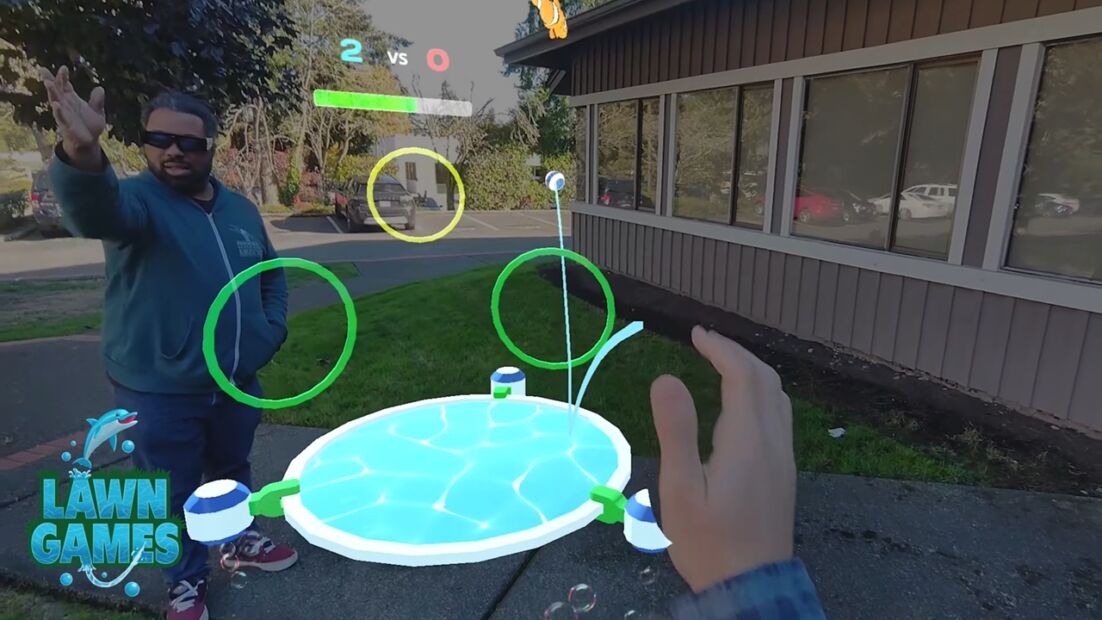
[00:04:24.252] Dustin Kochensparger: Yeah, I mean, it's been a busy year for us between sort of launching our RTS for mixed reality and virtual reality on Quest, as well as building out our next Spectacles title, which is called Lawn Games, and just came out on Monday, which is an outdoor-focused sort of replicating classic outdoor games you might play, something we really like to see more of, especially with the Spectacles being able to be outdoor-focused in a way that a lot of the other headsets aren't. We really wanted to build something that was going to focus on that kind of thing Actually, Blake was the main developer on that, so I'm sure he has some key insights on how that project came together.
[00:04:55.505] Blake Gross: Yeah, I mean, Dustin did have the initial idea, but once the development specs came towards release, it became a lot more clear what they were good for versus competing devices. And it's the hands-free aspect, it's the ability to be used outside, and it's the seamless multi-user integration. I think Snap supports up to 64 users, and all multiplayer apps get that benefit by using their framework. So we kind of did a Wii Sports-like type of game for specs, where it's easy to pick up. We have both Ski Toss, which is throwing balls into a cornhole-type board, as well as Spike Ball, which is you have to throw a ball into a trampoline to get into the hoops. And then we have an arcade mode, where it's kind of a target mode, which supports single player using their new leaderboards API, so you can try and get the high score against all your friends on specs. And then we have a pass-the-device ad hoc mode. A lot of people aren't going to have these devices at launch. Once a consumer comes out, it's going to be easy for friends to be able to play together without everyone having to have their own device. And then, of course, we support multiple specs together, like I said, up to 64 users that can go into Teams. We have this kind of unique, like, you put your hands together to form Teams UX, and then you play through our modes, try to get the high score.
[00:06:06.095] Kent Bye: OK, and are you expecting to have a location-based entertainment deployment of these different types of apps? Or was this something that was commissioned by Snap? Just give a bit more context for where you take this experience from here.
[00:06:18.959] Dustin Kochensparger: Yeah, I mean, we built this in partnership with Snapchat. We specifically wanted to build something that was hands-focused and about throwing. We know that throwing is such a core game mechanic, right? You go to the arcade, you've got basketball throwing, you've got skeeball, you've got all these different games that use that sort of body movement type of system for input. We knew that was going to be something we wanted to be able to make more things in that vein, and it's a hard problem right now. It's not something you can just drag in a component and be like, ball throwing do well so we really wanted to innovate on that and push ourselves to make you know what we consider to be a high quality throwing experience that works with people basically where they're at when we started investigating this idea specifically it was one of those things where I was like oh everyone throws the same right and then like literally just between the two of us in the office we got some like balls to throw around I grab the ball I chuck it he's like what are you doing I'm like I'm throwing the ball he's like that's not how you throw a ball. And I'm like, everyone throws the ball differently. And so this was this process of, oh, we really do have a lot of work to do to figure out how do we make sure it's always tracking you throwing the ball. So it's a fun project to kind of work on that sort of innovation. But we built it specifically to be something that people who have access to the spectacles can play. We'd love to partner with LBE if that was ever an option. But for us, the main goal was have something that lets people who have Spectacles do something that's easy to pick up and play, similar to our game Tiny Motors, right? Where it's like, I got this new device. I want to do stuff with it. We've got an experience for the controller with Tiny Motors. Now we have an experience you can do outdoors especially, which a lot of other apps might not work as well.
[00:07:46.437] Blake Gross: Yeah, I think that, like Dustin said, the main thing was just for Spectacles users. And it was a Snap-supported project. It was something that they were very interested in. Like I said, as they were thinking about the unique functionality and selling points of the glasses, this was kind of an app that showed off a lot of those. Yeah, the game in general, we went with a very unique, I think, approachable style, too, kind of in a snap style. We did Frutiger Arrow, so it's all water-themed. We have lots of, like, fun fishes and fun effects and stuff. And to what Dustin was saying about the hand controls, that was an interesting problem. You kind of think, like Dustin said, that people will... know how to throw a ball, but you run into two issues. One is you don't have the weight of an actual ball, so you have to account for that. And then two is people have a fantasy of what the throwing is like. So we did a lot of custom things here. So we actually don't use any of their grab detection. We wrote our own grab detectors. We wrote our own detectors also for where people intend to throw the thing that we found most accurate was actually dwell which is we actually kind of just have the balls velocity match where they're looking rather than where their hand ends up throwing because that's actually really difficult to detect especially like palm location while you're doing this
[00:08:56.943] Kent Bye: Yeah, I had a chance to play through it in my hotel room. I wasn't outside, but I was just playing through the different stuff. And I realized that once I got a certain mechanic, I could sort of repeat the same mechanic, but that I had to tune it in a way that the way that I throw a ball was different than how the default was, but also that The Spectacles actually has a very narrow field of view in terms of what it can detect or at least display and I don't know the camera if it has a wider field of view or like how the hands are tracking in a larger space than what I'm seeing on the display but just curious how you start to handle this challenge of like the motion of throwing ends up being a lot of it out of sight of where the camera scanning detect a lot of times and so you have to really change the way that you throw so that it's optimized for the computer vision cameras to actually see it. So just curious to hear how you start to solve that problem.
[00:09:45.426] Blake Gross: I can talk about that. Yeah, that was like the crux of the problem. I actually wrote an entire thing to figure out what the tracking camera frustum was because like you said it is bigger than the actual FOV of the device. So I wrote my own thing to figure that out and then also This is maybe like a hidden secret. The tracking accuracy exponentially reduces the closer you get to the tracking frustum. So I also had to account for that in the algorithm that we wrote because you get really bad accuracy there. So you basically want to discard the data at a point because it's not very good. And then like you said, this then reinforces this thing for users where they end up all kind of throwing like this because that's where you're just having it in front of your face and kind of flicking your hands like a kind of Wii style. Yes, that's right, because that is what the device can actually track, like you're saying, because that's the kind of optimal area that the cameras are doing the hand tracking in.
[00:10:37.596] Kent Bye: Gotcha. So sounds like you had a trip to Japan to be able to show folks the Snap Spectacles. Maybe you could share a little bit about what that was like.
[00:10:44.224] Dustin Kochensparger: Sure, yeah. Unfortunately, we didn't have lawn games available at the time to show up. But we were showing off Tiny Motors, our previous game, which is like the RC vehicle control game, where you have these little vehicles. You're moving around using the connected controller aspect of the spectacle support for the app. And yeah, we were at BitSummit. We had a booth with a wonderful company called G-Smash. I'm actually wearing their shirt. in this booth called XR Yokocho and they were specifically highlighting VR and AR developers from all over the world to bring them to Japan and show off to Japanese companies as well as the Japanese public like, hey, did you know what's going on in the XR space? Probably not, come try all these different experiences. And so we did bring our spectacles with us as well to show those off to folks and it was really cool to get to see people trying something they've never seen before. And it really showed us a lot of the bets we made with Tiny Motors. We're the right ones. We want something that's instantly playable. You can get in. You don't have to do a bunch of setup. You're just able to drop down that starting point, grab the controller, and you're playing a game. And it was really magical. People really got it in a way that they hadn't seen before. Maybe they'd tried a PSVR or something in the past, which was a lot more cumbersome, a lot more set up. Being able to slide on a pair of glasses, put a controller in your hand, and start having experience that you've never seen before of something occurring in your room was very interesting to them. We had one company that followed up with us via email who said something to the effect of like, hey, this is the first time I've ever worn a headset and played a game, and it didn't make me feel sick. It didn't make me feel bad. That's very cool. I'm very impressed with what's going on here. So really fun experience for us.
[00:12:14.857] Kent Bye: Nice. And what are some of the announcements that you're really excited around in terms of the next features that are coming here to the Snap Spectacles platform?
[00:12:22.645] Blake Gross: I would say the theme this year, if the theme last year was kind of like, oh, look at this new hardware, look at all the stuff we can do, look at the future, this year's a lot more reality-focused, I'd say, where it's like, okay, here's all the infrastructure that you can use to build great products. I think the Supabase stuff, what is it, Snap Cloud with Supabase is pretty exciting because for a while, it's been very difficult to fit within the entire Snap ecosystem to do all the constraints of a full application, and I think that unlocks a lot of stuff for us. I think like any improvements to the OS, we obviously feel because then we get to build new APIs into our apps. One of those is Commerce Kit. We're obviously very interested in how we're going to be able to monetize these applications and games in the future. And so we're definitely going to be taking a look at that to think about how that can best integrate into our existing and future games.
[00:13:08.258] Kent Bye: Nice. Anything from your front that you're excited to hear? All the news?
[00:13:11.502] Dustin Kochensparger: Yeah, I mean, obviously, monetization is the big one. But I also was at the game tools talk over in the breakout area. And that was really great to see a continued focus on game-style content. I think the sort of asynchronous multiplayer that they're pushing now. The turn-based events. Yeah, the turn-based. Yeah, that's what they call it. I thought it was initially about turn-based strategy games. I was like, that's a weirdly specific thing to build. I was like, oh, that's what they're calling, like, the async turn-based stuff. So, yes, the turn-based system, I think, is very cool for kind of almost going back in time to the, like, Facebook games a little bit, but, like, I think in a good way, where, like, you get into a rhythm with a game with someone, you're passing back and forth. Like, I'm very excited about stuff like that, especially now that they have the games drawer as well, so people can more easily... get into games while they're in that personal connection moment of chatting in Snapchat. I think there's a lot of potential there for games of all different kinds, especially on the AR front. So, yeah, really jazzed about that stuff. I can't wait to see what people can make with that and how far we can take those sorts of things combined with additional monetization tools.
[00:14:10.638] Kent Bye: Anything else that you can share in terms of all the things that you've been up to?
[00:14:14.045] Blake Gross: Well, next week, Crystal Commanders will be on a new platform, so that's pretty exciting on the Android XR stuff. Otherwise, I think we're doing a lot of work on Crystal Commanders, our MRVR RTS that will roll out over the next year. We're looking to add hand tracking to that and hand controls to that to make it more accessible. Otherwise, we have a lot of, I guess, pans in the fire right now. We have a lot of pitches going out, and there should be more releases over the next year or two.
[00:14:40.626] Kent Bye: So the Android XR being the Project Muhan and all the different new platforms. And so what can you share in terms of what it's been like to work with that platform?
[00:14:48.373] Blake Gross: Probably not. I mean, I guess a lot of it is somewhat public. A lot of it's in Unity. It's Unity 6. It's OpenXR. So I think anyone in the ecosystem who's used to those things is a pretty easy port. And I think the capability set for these type of headsets have become very standardized at this point. So I think the exciting thing about what Google's doing is having an OEM approach, an actual OEM approach to the ecosystem. And so we're looking forward to not just the upcoming Samsung headset, but other future potential headsets as well.
[00:15:17.543] Kent Bye: Nice, and love to hear any comments or reflections on how Unity has been the heart of a lot of the independent game industry, and there's also Unreal Engine, and that with this kind of pivot now with the Lens Studio, it feels like that there's a really paring down to what the game engine has been, and then kind of a tearing down and building back up all the different things that you need. Just curious to hear from your perspective as being game developers of what that's been like to have all of the infrastructure of what you're used to in Unity be completely dissolved down and have to incrementally build up what you need and all those constraints and what you're able to do with those constraints and your deeper thoughts on this trajectory of dissolving this existing game engine ecosystem that we've seen over the last decade plus for independent games.
[00:16:03.277] Dustin Kochensparger: Yeah, I mean, constraints I find to be kind of fun, personally. Like, there's something interesting about being given an amount of constraints. Obviously, there's, like, limits that are too many constraints, and that can be problematic. But especially as an independent company, and you're given a lot of carte blanche of, like, well, the platform's there. Build anything you want. Like, it's very quickly you start to be like, oh, we could make anything. What would we make? Sometimes I find having a constrained system does inspire you to build more interesting things you might not have tried otherwise because you are having to work around those things. So I think that that can add a lot to some of the ideas that we're thinking about. And I always encourage people, when you're in those situations, think about what it's doing best and build for that. When we built Tiny Motors for the Spectacles, it was like, we know the FOV of the device. We know where people are going to be able to look. Let's build something that fits in that box. because we know that those constraints exist and we want to be able to work inside of them. So I think that can be encouraging from a design perspective for me, where my side of things is. Blake may have different thoughts about the technical side of how that impacts the work that we do.
[00:17:05.759] Blake Gross: Yeah, the engine question's a good one. I think my consistent thing has been like the nice thing about Lens Studio is that because it's feature focused, it's very quick to iterate in because it's AR purpose built. Where with Unity, you're still wrangling packages and stuff. And I mean, a lot of porting work ends up being a lot of screwing around with package versioning numbers and API consistency and stuff that it really isn't that much fun and sometimes and always the best documented, whereas with Lens Studio, you don't run into any of those headaches. I guess the constraints are like lens size and stuff, but a lot of that is being more and more alleviated. I think someone said in the talk today, one of the talks today, that the real constraint now is RAM. It's really RAM and thermals. And it actually has less to do with engines now than it has to do with, like, thinking about how to create device-specific experiences. And it's less of a, you can't just do general UX for everything. It's being very specific about, okay, this is how many assets I can have. This is how much spatial scanning I can do. And being very conscious of all those different constraints. How much RAM does the existing Snap Spectacles have? I don't know. I want to say four. I'm going to say four gigs, and that's a little bit of a swag. Okay.
[00:18:16.448] Dustin Kochensparger: In the comments section, we'll let us know.
[00:18:18.951] Kent Bye: Okay, yeah. I'll maybe look it up and see, maybe add it as a show note. But in terms of tracking thermals, are there tools for you to see? Because as I, over the last couple of days, had a chance to see about three-quarters of all the different apps and lenses that were out there. Wow. And by playing it straight through for a whole day, it was basically every hour or two, it would overheat and I would have to stop. And so it did push the device to the edge, tethered to a battery. It does still kind of overheat. So I'm just curious how you start to track that and also manage that as application developers.
[00:18:51.041] Blake Gross: Yeah, the profiler tells you, I think it's milliwatts, how many milliwatts you're using. And you can literally see, like, if you turn on the spatial tracking, I think that's like 1,000 milliwatts. So then you're like, oh, and your envelope is like maybe 4,000 milliwatts or something. And running normally, you're like 2,000. So you can kind of see with that really easily, like, oh, I turned this on, it goes to this. I turn this off, it goes to this. But yeah, they have a profiler built into Lens Studio that allows you to evaluate all that.
[00:19:15.461] Dustin Kochensparger: Okay. I do think that's one of the things that we always talk about when you're thinking about building a project like this or if you're an agency or a brand or something and you want to have content built for devices. Something that I think about a lot in terms of considering talking to companies like ours because these are considerations that you don't have to make with a lot of other types of things you might do of like, oh, we're making a TV ad. Great. No, that doesn't matter. That's not that sort of thing. But there's this specialized knowledge that studios have to start building around these kind of things. thinking about thermals, which is not something you normally think about if you're making a flat screen game for Xbox or whatever, unless you're really pushing the thing. So I do find that to be a really interesting angle on all of this stuff, that we as developers have to grow our skill sets to match and understand these things so we can build stuff that doesn't just completely overheat the headset as soon as you get into things. And that's one of the things I think companies like ours can bring to the table when you're looking for partners to build this kind of thing with.
[00:20:11.229] Kent Bye: Nice. And finally, what do you each think is the ultimate potential of XR and all these spatial computing devices and gaming and AI all thrown together and what they might be able to enable?
[00:20:23.241] Blake Gross: I think we've recently gotten very excited about LBE opportunities, especially around spectacles. I think the ability for museums or marketing installations or even amusement park type stuff. People are just so willing to just put them on in a way that they aren't with cumbersome headsets. And I think more devices in that form factor are probably on the horizon. And I think that's going to help adoption a lot. So I'm really excited about that in the immediate term. In the further term, I think as these Devices get longer battery life, better thermals like we talked about, maybe integrated GPS. The kind of outdoor gaming potential is the thing that I still kind of have my eye and hope on and we want to eventually design for.
[00:21:02.932] Dustin Kochensparger: For me, in the immediate term, I'm so excited about all of the innovations in input and input tracking, like from much better hand tracking we're seeing across the board on platforms, and people innovatively using the body more. Like with the spectacles, you have your touching of your palm to activate the menu. That just feels really good. Getting to use the meta display glasses and the things they're doing with their input band, very cool. There's a lot of innovation in this space that I think is one of those, it's not the sexy part that goes with the glasses that you're wearing on your face, but it's the way people interact with the thing. Like we've talked about with Tiny Motors before, Being able to give somebody a controller that's tangible lets them dive in, but that's also cumbersome. I want to get past that to even more ways just like interact with content in ways that feel seamless to lay people that haven't used a bunch of headsets and know how they fact that the cameras work and that their hand can't be tracked when it's behind their head and stuff. They don't know any of that. They just want to have it do the thing. And so I'm very excited that we're seeing so much innovation in those spaces and like starting to crystallize some rules of the road we can all start to follow that make these things easier for people to interact with. So I'm super jazzed about that for the short term. And then long term, I'm still very bullish on local shared experiences in AR and MR. To me, that's still just the magic. Even when our RTS game for Quest, being able to see the other person playing the game, putting their army down, moving it around, That to me is just the cool stuff. You're seeing another person in the space. You're both having this hallucination almost of this AR content that you're sharing that no one else around you can see. It just creates this magic circle that I think is just the killer thing about all this and why I got into it. And as long as we keep having displays that are getting more and more see-through and more and more connected, that's what I'm excited for.
[00:22:45.452] Kent Bye: In terms of your long game, have you been able to use the new iConnect to be able to do social collaborative experiences?
[00:22:52.999] Blake Gross: I just learned about that today, so no. I will look into it. I was very curious about it, but I didn't know about it before it was announced today.
[00:22:59.245] Kent Bye: OK. So it sounds like new ways of getting people. What's the most people you've had in a shared experience so far? Three, because we don't have a lot of devices. But it theoretically could go up to like 64?
[00:23:10.201] Blake Gross: Yeah, yeah, theoretically it's 64. I think the other thing that I have to look at that iConnect thing, because I think what they were saying is that you can do a shared experience, but you don't have spatial synchronization, so I'm not sure how that works. But yeah, we have to look into it more.
[00:23:23.549] Kent Bye: Talking to Jesse McCulloch, what he was saying was that it used to be that you had to have like a scan of everything, and then It was a lot of work to get a shared experience, but it was now, if you just look at somebody, it's supposed to just orient to where you are in space relative to each other, and then from there have a shared experience. So it seems like they're trying to streamline that based upon the feedback they've got from LBE.
[00:23:44.187] Blake Gross: I mean, that would be perfect for our game, so we're definitely going to look into it. Gotcha.
[00:23:48.851] Kent Bye: And is there anything else that's left unsaid? Do you like to say the broader immersive community?
[00:23:52.461] Dustin Kochensparger: I don't know that I can think of anything. This has been pretty comprehensive. I guess the last thing I will say is I'm very excited about where we're at. There's never been more people playing in the space right now. We've got Google getting involved, Samsung getting involved. For reals, for reals. We've got Snap continuing to push forward with their platform. Meta continuing to push forward their Quest platform. There's so much occurring right now in the space that gives me a lot of hope that... We're going to keep pushing this thing ahead. We're going to keep spending money on it to make it into the dream we all have of those glasses I wear that do everything, right? And that's very exciting to me. Like sometimes in this industry, you've been in it a long time too, like it goes up and it goes down and it's like you're riding those waves. And so right now it feels like we're at a good wave going up with lots of people investing. And that makes me very excited.
[00:24:36.201] Kent Bye: Shout out to Valve with their speculative frame slash Deckard. So, you know, hearing rumblings and buzz around the potential for that as well. So curious to see if that comes to pass. But yeah, I think a lot of folks are excited to see Valve get back into the game as well. But yeah, what do you think? Anything else that's left unsaid?
[00:24:53.843] Blake Gross: I would just tell developers and the community probably to look at Snap if you're not currently looking and I think the, I mean it was even surprising to me how much form factor really matters. You go to these kind of established companies and like honestly, like when we were in Japan, they didn't care much about the quest, but they were very excited about the spectacles. They didn't really care about the constraints as much as how much they felt the form factor unlocked. So I'd say there's a lot of opportunity there that is currently kind of what we're looking into.
[00:25:20.623] Kent Bye: MARK MANDELBACHER- Form factor in terms of just glasses that you can slip on and immediately be in an experience. Is that what you mean? DAN GALPIN- That's exactly right. Yeah. MARK MANDELBACHER- Awesome. Well, thanks so much, Dustin and Blake, for sharing a little bit around what D&B Creations has been up to for last year. And congratulations on your recent launch. And curious to see how you continue to have all your games and all these different platforms as they continue to launch out into the world. So thanks again for joining me here on the podcast to help give a bit of a peek in the future of where you see XR gaming here and going in the future. So thanks again for joining me here on the podcast.
[00:25:49.042] Dustin Kochensparger: Awesome. Thanks for having us. Always appreciate it. Always good to see you at these events. And yeah, hear your side of things, too. It's awesome. Thank you. Yeah.
[00:25:54.684] Blake Gross: Thank you so much for cataloging that. I listened after, last year after you did it, I listened to all the other interviews. And they're very illuminating. And I think it's great that you're documenting this kind of subculture of the XR industry. Yeah, it depends. Awesome. Thanks.
[00:26:07.537] Kent Bye: Thanks again for listening to this episode of the Voices of VR podcast. And if you enjoy the podcast, then please do spread the word, tell your friends, and consider becoming a member of the Patreon. This is a supported podcast, and so I do rely upon donations from people like yourself in order to continue to bring this coverage. So you can become a member and donate today at patreon.com slash voicesofvr. Thanks for listening.