I did an interview with Alicia Berry, Executive Producer at Niantic Spatial, and Asim Ahmed, Head of Product Marketing at Niantic Spatial, at Snap’s Developer Conference of Lensfest about their latest Project Jade Spectacles demo. See more context in the rough transcript below.
This is a listener-supported podcast through the Voices of VR Patreon.
Music: Fatality
Podcast: Play in new window | Download
Rough Transcript
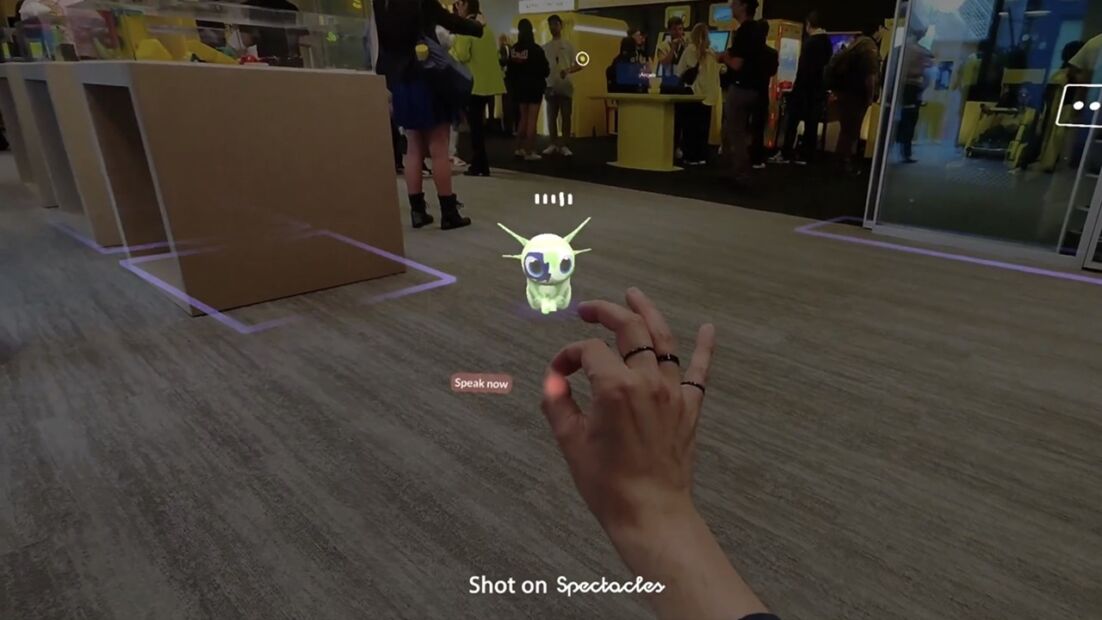
[00:00:05.458] Kent Bye: The Voices of VR podcast. Hello, my name is Kent Bye, and welcome to the Voices of VR podcast. It's a podcast that looks at the structures and forms of immersive storytelling and the future of spatial computing. You can support the podcast at patreon.com slash voices of VR. So today's episode, I'm featuring one of the best demos that I had a chance to see at the Snap Loons Fest, which is the latest iteration of Project Jade from Niantic Spatial. So they gave me a sneak peek of Project Jade at Augmented World Expo, and I had a chance to talk to both Alicia Berry, who's an executive producer there at Niantic Spatial, and as well as Asim Ahmed, who's the head of product marketing there at Niantic Spatial. So previously saw the Project Jade at Unlimited World Expo, and there was a whole section that was outside of the Long Beach Convention Center where it's like a bus stop with different murals on the ground. And so They were able to paint around that area with the VPS system where they're able to detect where you're located at a much more finely grained tolerance. So GPS is only accurate up to like 30 feet or so. And so with their virtual positioning system, they say to get it up to around a centimeter accuracy, but as they're have the different boundaries or stuff, I'd say it's probably within a foot or so. Most of the time, I think they're still ironing out all the detail level of accuracy, but theoretically they're able to get it down to a much more finely grained degree of spatial precision when it comes to anchoring things within the physical reality so there was showing a new demo of project jade which was a little bit more updated they did a whole scan of the headquarters there at snap but they had to keep doing scan over scan because you know it rained one night and then there were things that were changing and so their scanning was somewhat susceptible to different changes that were happening in the environment and so when that happened then it may like lose a tracking, but they were also like ingesting in the floor plan. So their plan is to kind of make this much more seamless so that they're able to get the floor plans of space, do maybe a scan. And then between all these different systems go between them to be able to do very site specific location based augmented reality types of experiences. Now, What they were augmenting was mostly kind of a spatial awareness with this virtual assistant. So they were doing a little bit of an outline of things that were in that environment just so you could get a sense of being spatially oriented. But you were able to have these conversational interfaces with the Paradox character where you're able to ask it different questions around the different things to see at the Snap Developer Conference, which there was a whole like 10-year retrospective of augmented reality facial filters for the past 10 years now. So they had a whole exhibition. So there was different knowledge that they had transferred over into the virtual assistant, but it also would give you a bit of a guided tour and take you to different locations of places of interest to go check out. So the whole idea is that you're able to scan in space, but also to work with these different virtual characters through a series of different AI services that are able to do the whole audio speech recognition, that they're able to do speech to text, and then from speech to text, and they go through a number of different services, one of which was Hume AI, which is trying to give a little bit more emotional expressivity for the virtual character, but also the knowledge base working with Keiichi Matsuda and the pair brain to be able to create a little bit more of a front end for the larger language model to be able to say, here's the knowledge base that you have to work from. So all these different software and services on the back end, that is this kind of AI driven aspect to it. So Certainly the most sophisticated lens that has been developed so far that is trying to integrate all these different things and then really pushing it to the edge. But it's kind of a prototype to show what's possible with all these things tied together and working together and also where they hope to take it all here in the future, which is trying to streamline it so it's a lot easier to produce these types of site-specific virtual assistants that could use augmented reality glasses to deepen the layer of connection to what's happening on that site. So overcoming all that and more on today's episode of the Voices of VR podcast. So this interview with Alicia and Awesome happened on Thursday, October 16th, 2025 at the Snap Developer Conference of the LensFest happening at the Snap headquarters in Santa Monica, California. So with that, let's go ahead and dive right in.
[00:04:17.984] Alicia Berry: Hi, I'm Alicia Berry. I've been in XR for about 10 years. In the last two years, we've been working on mixed reality and augmented reality experiences with Peridot as our center delivery mechanisms. In the past, I've worked on world-scale games, AR, VR, social apps, and big MMOs.
[00:04:38.922] Asim Ahmed: Hi, my name's Asim Ahmed, and I am head of product marketing at Niantic Spatial. And I've been in XR for about 10 years as well. I started at Niantic in 2016, and I've worked on a series of our augmented reality games, and I've followed through the split to Niantic Spatial. And over the past couple of years, I've been working very closely on the Peridot franchise.
[00:05:01.346] Kent Bye: Nice. And maybe each give a bit more context as to your background and your journey into the space.
[00:05:08.394] Alicia Berry: I started out in the space in XR at Meta. I built Facebook Spaces, which was the world's first multiplayer experience. It was glorious. Unfortunately, no one had a PC and a Rift and a Facebook account at the same time. So onto mobile. I worked across Oculus Venues, Oculus Rooms, Meta Horizon, Oculus for Business. Came over to Niantic about five years ago. Worked on Monster Hunter Now, NBA All World, Pokemon Go, Pikmin Bloom, bringing joy to people around the world. And when the company pitched us on bringing Peridot, the mobile game, to HMD headsets, we were so on board. So we took the Peridot mobile game, brought it to characters, brought some of them to Meta, Quest 3 and also Apple Vision Pro. And when Snap knocked on the door about a year and a half ago, two years, to bring Peridot Beyond onto the first generation of this AR outdoor glasses, we were so jazzed. So we've been working with Snap for the past almost two years on this, bringing the Jade 2 experience, which we're showing off here at LensFest, which is a permutation of our AWE behind the doors VIP demo. I don't know, it's all coming together at the same moment. Maps, AR glasses, gen AI, computer graphics, machine learning, computer vision. It's just a wonderful time to be alive.
[00:06:30.714] Asim Ahmed: Yeah, I found my way into the industry starting with Niantic. And so, as I mentioned, I started on the Pokemon Go team and helped launch that product back in 2016. And over the years, I had worked on a variety of other projects that we had launched or had gone through soft launches or even in early concept. I started on the Peridot team in 2020, just as we're a concept on paper. And as Alicia mentioned, we were able to bring that to market first as a mobile product. But over the years, I've really been excited moving beyond this idea of just Peridot is a game, but Peridot is this kind of ever-present AI companion that can be with you on any device. And as Alicia mentioned, we were able to bring that to MetaQuest 3. But I've been really excited about this project where we're on the Snap Spectacles. And so we launched one iteration of that at last year's Snap Partner Summit, which is called Peridot Beyond, and we've released updates over time. But what we've showed off at AWE and now at this year's LensFest is an iteration on that and kind of a glimpse of how we think about what could a cute AI companion look like that helps you navigate throughout the world. I almost think of it as like what would a next generation Google Maps look like on AR glasses where you don't just want like a 2D map interface, you want an actual companion that understands the world with rich depth. that can understand space and then can help navigate you through space, but help you learn a little bit more along the way and really deeply connect you to the world. And so I've been really excited about this idea of this expansion of the franchise in unique and innovative ways.
[00:08:07.759] Kent Bye: Yeah, I always appreciate going to these different conferences and events and Niantic Spatial always has a demo that's trying to push the bleeding edge of the technology of wherever it's at at that moment and so this demo seems to be an extension of what I saw at AWE in terms of being able to go outside and it was like a bus stop with some murals on the ground and I had the AI character that was giving me a bit of a guided tour, walking through from one mural to the next. And so similarly, here at the Snap headquarters at the LensFest, you have the latest iteration of Project Jade, where you have a scan of the space. And so you have blue outlines for where the walls are. And so having this AI character who is essentially guiding me through to these different places. And I put my fingers out in front of me, and I pinch in order to speak. And so I was basically like, where do you want to show me next? Take me on a little tour. And so basically, you have this AI character. But matching with, I guess, this combination of GPS with the virtual positioning system, VPS, maybe you could just talk a bit about, like, the stack of the technologies that you had to push forward in order to scan the space, put that into the lens, and then get everything integrated to be able to do this demo here at LensFest.
[00:09:20.799] Alicia Berry: We are the first developer that has done this. Snap has partnered with us to integrate VPS into an early version of Lens Studio and also the Snap Spectacles firmware. We were able to push it to be able to be out to the public today, but to get here was such a journey. We had to start with Scanaverse, which is one of our applications, scan the locations three days ago, then update our geospatial browser to place them in the world. Then we built a proprietary toolset to take floor plans and build routes between all of the points of interest. There's no on-rails, but all the routes can be calculated in advance, so Peridot will not walk through walls, will wait for you, will not cross a threshold without you, so you will not run into a wall or a door. As this conference has gone on, the space has changed multiple times, so we've had to re-scan and re-scan and re-scan. We're excited for a day when we've got our full Niantic tech stack on here so we can just rely on different technologies to understand where you are and not just the scans. But it's a first step. After publishing to the Niantic spatial browser, the geospatial browser, we then published this map to Lens Studio. Lens Studio allows us to overlay our series of animations, shaders, interactions, using their systems like hand tracking, head tracking, pretty much their whole tech stack, pushing the boundaries of the spectacles way past where they're supposed to be. We're over budget on heats, GPU, CPU, anything that you could be over budget, we are pushing it. Luckily, it all came together through the efforts of Snap working with us week over week over week, help us with performance analysis, testing tools, our own tools. It has been such a journey, I wish we could announce this is available to all developers, but we're still in the beginning. So we're hoping potentially sometime next year we can release this to other developers. But man, to see it live, to see you do this this morning, I shed small tears. I mean, it's only been about a quarter building it, but man, it's a push. It's a push to get here. And when you're building, everything is a moving target at the same time. It really takes a village to make something come together like this. We know that we are the most complicated lens that has ever existed and we're proud to have shipped today.
[00:11:34.670] Asim Ahmed: I think some people might look at Project Jade from the outskirts and be like, wow, that's a really simple product. But there's a lot of powerful technology that makes something like that come together. So we have the VPS, Niantic Spatials VPS, that allows us to localize the centimeter degree accuracy and have deep contextual understanding of the world. And also within Niantic Spatials technology, we have semantic understanding. So now we can understand the world, what's in the world and different objects. In this experience, we're also now connecting a really intelligent brain, an AI brain that has memory and knowledge that can recollect where you've been, what you've seen, the conversations you've had. We now map that with conversational AI. We're partnered with Hume to make that possible, to give Dot this very empathetic voice that makes it feel like a true companion versus this kind of robotic digital creature. And so when you see all these technologies come together on a really cutting edge, advanced, true outdoor AR glasses, you're bringing the best of all these amazing immersion technologies together into one experience. And it's actually incredibly challenging to do that. And the fact that we're able to bring this experience to life is a testament to the hard work that a lot of our developers are doing behind the scenes. And I think it's a really incredible glimpse of the future. And it's just like one example of the type of experience that our Niantic spatial technology can power. And so there's going to be a lot more exciting stuff to come.
[00:13:01.732] Alicia Berry: I want to give one more shout out that we didn't actually call out, but Liquid City has been helping us with Jenny Eye Brain, specifically their ParaBrain product. And it is the thing that has gone over the most iterations over time. Try to get it to feel conversational, not like you're talking to a chat bot. Their collaboration has really brought a lot of grace and beauty to the experience, and we're very happy for their partnership.
[00:13:23.140] Kent Bye: Yes, just heard from Keiichi Matsuda that he was launching the Wisp World as well that has just come out. It was a demo that I was supposed to see at AWE, but the whole entire internet went down across all the United States. So that was both on his demo and your demo got nerfed. But yeah, so he's launching that. But it seems like that's a... Kind of equivalent to nworld.ai in the way that you have a front end interface to a large language model. And so it sounds like you're working with them, but also is it Hume AI to be able to have like the, maybe just talk a little bit about the pipeline between like when you're speaking, like where does it go to be processed and is this like a knowledge base for the para brain to be able to control the content and kind of edit what is or is not available for things to share? Kind of like the body of knowledge that's shared from this AI assistant, but also the other ways that you're bringing in other services to add more emotional intonation, and other ways that you're able to have a full pipeline to have a conversational interface with an AI assistant.
[00:14:23.459] Alicia Berry: Well, we start with Snap. We use Snap ASR, I believe that's what it's called, which is automatic speech recognition. I think it goes speech to text. Hand off the text to a different series of multimodal LLMs, depending on which one we want to do based on that input. I don't want to name them because I actually don't know who they are end to end. But then we use a Notion database, which we upload into this system that provides contextual awareness for each particular point of interest. For example, we're sitting here in the courtyard. There is about 16 different faces of lenses. The Parabrain was trained on each lens background, and we allowed Snap to write the copy. What we really tried to do with Jade is to be able to create a platform where it could be branded to any location. It could be brought to any location. So Snap gave us the content, we fed it to Liquid City's Parabrain, we feed it back out through Liquid City's Parabrain, hand off to Hume, which provides the voice over the language that it's provided, and then present that back through, I believe, a spectacle service to have speech back out. So there are multiple hops, including our own Bespoke Tech, Liquid City's Bespoke Tech, Hume's Bespoke Tech, who did create a synthetic voice for the character, in addition to the wide variety of different services Snap brings to the table.
[00:15:43.496] Kent Bye: Yeah, while I was here over the last couple of days, I had an opportunity to get Spectacle's headset and just went through like three quarters of all the lenses that were released. And the thing that I really noticed was that there's like a 25 megabyte limit, and there's a lot of limited capabilities, what I've seen released so far. So when I see some of the demos that you're creating, you're really pushing the edge for the different types of capabilities that are there. But I'm also just really struck of how Snap has been moving away from these Unity-based and Unreal Engine tech stacks that have not only the Lens Studio, but all these other application layers that are also starting to be integrated into the next frontier of spatial XR applications. It feels like we're beginning a new cycle for the future of where these different types of applications are going to be going. So just curious to hear some of your reflections of moving beyond the standard Unreal Engine Unity, and where you see this fusion of all these different software and services coming together to be delivered on something like these AI glasses, what Meta's calling them, or the Spectacles head-mounted AR glasses, and the ways that you see this connectivity to the internet and all these different services that are going to be able to provide these unique location-specific experiences.
[00:16:58.649] Alicia Berry: You know, we're still limited in what we can do graphically on any headset. Using Lens Studio has been a journey. They're building it with the hardware in mind. It is nice because you can get all the way down to the firmware, which is something that Unity and Unreal can't accomplish. In my opinion, I'm speculating here, I think engine's days are slowing down. I think that there is going to be a world where you can just do prompt-based creation and the engine will move to the background. It's build this shader, build this render, add this animation, do this timing, do this collider. I don't necessarily think that people will need to understand how all these different engines work and the ins and outs and the different builds and the different All the different updates that you need to do to bring something to market and build something, I'm hoping that those days go away. But right now, we're in an engine world. But I think within the next two to three years, we're going to be in a prompt-based world or a PowerPoint for development where we will no longer need special capabilities. And I think that what is interesting about Snap is their whole lifecycle has been about non-technical builders building amazing things very quickly, and I can see where they're going. I've tried out their AI tools to generate different lenses. They're easy, they're fast, and they're good. So, I mean, the things that we're doing, we still need to have extremely talented tech artists, client engineers, rendering expertise, but I think in the future, we will only be limited by our imagination, our ability to question.
[00:18:28.510] Kent Bye: Yeah, and just curious to hear a little bit of where you go from here, because this feels like a very handcrafted experience. You have to scan it multiple times. There's things that are changing in dynamic that may be throwing off the VPS. There's a lot of re-scanning that had happened. So just curious to hear where you take your lessons learned from Project Jade in this latest iteration that's showing here at LensFest, and what's next?
[00:18:53.317] Alicia Berry: The product as it stands is pretty resilient but you're right it's the scanning and the ability to switch between a visual positioning system and something like what we're calling is a universal location service that swaps through like a world pose or a slam or a slick or you know some of the different client-side localization systems that are coming up online. Right now Where we are in our partnership with Snap, the first thing we did was VPS. It's the most powerful tool that we have. It's the best for overlaying creative content over the real world, and the fastest to localize accurately, repeatedly. But where we're going next is we're going to be integrating in our ULS system, which is our universal location service as a part of the Niantic Spatial SDK, which allows us to use those different backend technologies. In addition, we'll be expanding to different marketing events. We're expecting to be at United XR, Brussels. We're working with multiple enterprise partners in negotiations for location-based events, so tour guides of big names that we can't share, but exciting coming soon. Our Q4 goal is to make this tooling a lot more approachable internally so we can stand up an event end-to-end in under a week. It took us three days to stand up this event, so we're on our way. It did take a lot of effort from a lot of people to get here, and we hope it will take a little effort from a few people to get here even faster in just a few months.
[00:20:16.730] Asim Ahmed: I think Project Jade's a really amazing glimpse of a bright future. And what I hope to get out of it is that it can inspire others to push the boundaries of what's capable with the current technology and be creative, think out of the box, and do something wildly innovative and different. I think the power of Project Jade, just the underlying technology that it took to make this project possible, is something that can also be applicable in other areas. And we won't commit to anything, but we will say that robotics is a really interesting area. And I could totally see this technology applied to a robot. You can imagine coming to the fairy building, visiting us a couple months down the line, and maybe a robot could meet you, greet you at the front of the lobby, and take you to the kitchen because it knows where the kitchen is. And all this underlying technology that made Jade possible with this digital creature can now make robotics possible. And so I think that's a really interesting area that you'll see us potentially explore.
[00:21:19.133] Kent Bye: And I know since last time I saw both of you at MetaConnect, very briefly, there was a big announcement that was actually made by Niantic Spatial with Hideo Kojima. What can you say around this thing that was announced or sort of teased?
[00:21:31.477] Asim Ahmed: There's not too much we can actually share at this moment. But I will say, I think it's just another exciting use case of how our technology can be used in immersive ways. And what we announced in the blog post is that they'll be looking at our technology and seeing how they can bring their world to life, immersive storytelling.
[00:21:49.761] Alicia Berry: I wish we could talk all about it. It's exciting. Come visit us. Come visit us when we're allowed to talk about it. Portland to San Francisco is not very far.
[00:21:57.224] Kent Bye: All right, yeah, there was a little bit of a vague teaser trailer. Is that kind of the most information that's been released so far? Where was it announced? What was the context of where it was announced?
[00:22:07.037] Asim Ahmed: It was the 10-year anniversary for Kojima, and it was in Japan. So he threw an event and talked about a wide suite of projects he's working on, how he thinks about the last several years, the last decade, and how he's thinking about the future decade to come.
[00:22:23.868] Kent Bye: And he's in the realm of, I guess, the intersection of Gaming and how would you describe who he is for people who may not know he is because I know he's done a number of different video games, but he's sort of like the intersection of art and technology storytelling amazing storytelling legendary game developer wildly creative mind yeah, he's doing some incredible stuff and Nice, and since the last time I also saw you at MediConnect, I had a chance to actually attend the Meow Wolf in Santa Fe, the House of Return of Return, so I have a direct embodied experience of Meow Wolf now, and I know that you've continued to work on some different stuff. I don't know if there's anything else you can share around what's happening with Meow Wolf and the future of bringing that kind of immersive art into immersive technologies, and expanding the world beyond their site-specific locations, but bringing it to wherever you're at.
[00:23:16.018] Alicia Berry: You know, we really admire Meow Wolf because they have brought this museum format and made it a reproducible experience. People go back over and over and over again. And our partnership with them is to expand that outside of just their physical locations. I don't believe we can talk more about it, but some of the stuff that you're seeing here on Spectacles, we're working on with them on different formats. It's early days. We don't expect anything to be announced in the very short term, but stay tuned.
[00:23:44.520] Kent Bye: And I noticed that you each had like a meta Ray-Ban display glasses. I'm just curious to hear if you've had a chance to play around with it and any initial thoughts you might want to share.
[00:23:55.034] Alicia Berry: I mean, we're all really big fans of AR glasses, AI glasses. We're big dorks. Shan is standing over here. We all three have a pair. We're just tooling around town. My favorite part is being able to take videos and seeing what I'm taking and just do a quick finger tap and that the screen is brought up. Be able to ask directions when it's dark outside and not pull out my phone and be mugged. I'm really excited that Meta is taking this first step forward in consumer to bring just one eye, a very small display, because I think it will kickstart the rest of hardware, software developers to keep it moving. The dream that we see in our heads is coming, and Meta is helping us take that first step.
[00:24:35.086] Asim Ahmed: I think people look at it and see it as a simple product. Technology is incredibly hard. It's really hard to build hardware. And I think the device is a technological marvel for as limited as it is in its current functionality. I think if you have a meta Ray-Ban original device, just the audio, the display-less one, it's probably not worth an upgrade unless you're like a massive AR nerd like me. But I think it's an early glimpse of where future computing will head towards. And even having a little display in front of you can power so much. If you're speaking to someone in another language, it can do live translation. And you can read subtitles of what's being said. And you and I could have a complete conversation in two totally different languages without even needing to understand each other's language to have that communication. And I think that's a really powerful way that human beings will be able to connect like never before. And so I think that's one of the most exciting things to me. It's very different than something like Snap Spectacles, which is this view of true AR glasses that can be worn outdoors. And so I think over the coming years, we'll just start to see more really compelling hardware come to life. And so I'm excited. I think there's a lot of incredible types of experiences that can engage people on these types of devices, but also keep them present in the world. And it's such a different type of technology than even putting yourself in mixed reality or virtual reality. And so there's a lot more to come.
[00:26:08.919] Kent Bye: Great, and finally, what do you each think the ultimate potential of XR, spatial computing, and the combination of all these technologies with AI and all those things together and what that might be able to enable?
[00:26:22.093] Alicia Berry: I'm really looking forward to a world where the expectation of the glasses can see or the wearable can see and understand my world and provide me relevant information at the right time. If it's a game that I'm playing or if it's a navigation or if it's just a friend is calling, I think it's here. And that's the most exciting is to bring everything that's in our imaginations to the real world.
[00:26:44.912] Asim Ahmed: I think it's a path to make technology feel seamless in our everyday lives. And I think if you think 15 years ago when we saw the, maybe even more than 15 years ago when we started to see the first smartphones, probably almost 20 years at this point in time, They've started to really distract us from the world in conversations and engagements and interactions. And I think as these devices, specifically AR glasses and these other forms of wearable technology, really come to market and become ubiquitous, we'll gain more presence in the real world than actually be distracted from it. And the mission of Niantic has always been, let's connect people to the world at this greater level. I'm really excited to see the types of experiences that do that. I think we'll be able to accomplish that. And my ultimate dream is you don't get distracted as you go out. You get these extra moments of delight as you're navigating through the world. So bringing it back to Project Jade for a second, what makes me so excited about something like that is it's a companion that follows you throughout the world. But it can let you know these really interesting facts of history or whatever it might be as you're navigating through the world. I think that's one way that you can bring delight while keeping people really connected to the world.
[00:28:03.908] Kent Bye: Awesome. Anything else left unsaid you'd like to say to the broader immersive community?
[00:28:06.749] Alicia Berry: It's just been such a joy for me to watch you in this hackathon, talking to people, trying things. I feel you're just so embedded in this community, and thank you.
[00:28:16.553] Asim Ahmed: Yeah, I just want to say thank you. I think I met you a little bit over a year ago now, and so it's been amazing getting to meet you and learn more about you and just seeing how much you've kind of helped this space continue to grow. And so thank you for everything that you do for this community.
[00:28:30.077] Kent Bye: Yeah, I appreciate that. And I feel like I'm bearing witness to the thing that's already unfolding here in this community and just trying to bear witness and mark the omens and capture the stories as it's unfolding. And yeah, it definitely feels like we're in this kind of new phase of all these technologies coming together and being synthesized in a new way, you know, to see kind of how the evolution of all the stuff that's come up with with of Spectacles that seems like it's fairly limited from what it can process and put out. And it feels like a Niantic space shield is really pushing that to the literal edge of what's possible. And I'm just curious to see, as we continue to develop, where that goes. And yeah, I think this vision that Mark Zuckerberg said is the ways that we can get away from being addicted to our smartphones and our screens and find ways that these immersive technologies can allow us to be more present and connected to each other for what's happening with other people around us, but also to the world around us. And I feel like that a lot of the projects that you're working on at Niantic Spatial is trying to figure out all ways that you can use technology to mediate that. So very curious to see where this continues to go. And thanks again for joining me here on the podcast to help break down your latest demo of Project Jade and where you hope to see it all go here in the future. So thanks again.
[00:29:39.736] Alicia Berry: Thank you.
[00:29:40.156] Kent Bye: Thank you, Kat. Thanks again for listening to this episode of the voices of your podcast. And if you enjoy the podcast and please do spread the word, tell your friends and consider becoming a member of the Patreon. This is a, this is part of podcast. And so I do rely upon donations from people like yourself in order to continue to bring this coverage. So you can become a member and donate today at patreon.com slash voices of VR. Thanks for listening.