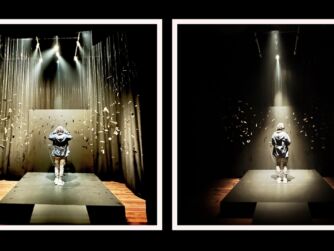
I interviewed Janire Najera & Matthew Wright from 4PI Productions and CULTVR Lab about The Rift on Monday, November 17, 2025 at IDFA DocLab in Amsterdam, Netherlands.
This is a listener-supported podcast through the Voices of VR Patreon.
Music: Fatality
Podcast: Play in new window | Download
Rough Transcript
[00:00:05.458] Kent Bye: The Voices of VR Podcast. Hello, my name is Kent Bye, and welcome to the Voices of VR Podcast. It's a podcast that looks at the structures and forms of immersive storytelling in the future of spatial computing. You can support the podcast at patreon.com slash voicesofvr. So continue my series of looking at different projects from IFA DocLab 2025 to Today's episode is with a piece called The Rift. So this is a part of the dome exhibition that was at the Planetarium, but also there was a mini dome that's around three meters or so that this was showing on a loop there at the Procter Gond. So this is a piece by Janir Najira, as well as Matthew Wright and They've been in this field of creating immersive dome experiences, and they also wanted to be able to have an exhibition space that was very flexible. And so they actually created their own dome exhibition space. And so they're very much in this scene where there's these immersive dome film festivals and they're curating and bringing artists and having all sorts of different ways that people Musicians are using these domes and different cultural events, but also independent artists. And so there's a whole movement and scene of documentary filmmakers and other filmmakers that are exploring the medium of dome content. But at the same time, a lot of these domes have events. different standards and they're not all the same and so there's a lot of things that they have to kind of navigate in order to explore this world but they've been kind of moving towards shooting a lot of this with live action and then so they're basically producing 360 videos and then they have different views that they're able to kind of export based upon the specific configurations of the different planetariums and so anyway we get a lot of the culture what's happening in the kind of independent dome production scene here on today's episode the voices of vr podcast So this interview with Janir and Matthew happened on Monday, November 17th, 2025 at Ifadoc Lab in Amsterdam, Netherlands. So with that, let's go ahead and dive right in.
[00:02:03.518] Janire Najera: Hello, so I'm Janir Enajera. I'm the creative director of the studio 4Pi Productions and the immersive venue CULTVR Lab.
[00:02:12.001] Matthew Wright: My name is Matt Wright and I'm the artistic director at CULTVR Lab and at 4Pi Productions.
[00:02:17.125] Kent Bye: Great. Maybe you could each give a bit more context as to your background and your journey into the space.
[00:02:22.228] Janire Najera: So we've been making Full Dome productions for over 10, 15 years. And in 2019, we opened our own immersive venue, which was the first immersive art space in the UK, as a way to showcase our projects, but also to facilitate other artists to produce in Full Dome, and mainly live performance from dance, theatre, live music, R&D projects, but also Full Dome cinema.
[00:02:47.162] Kent Bye: Yeah. And just to elaborate a bit more around your, your background and context and how you sort of entered into this space.
[00:02:53.624] Janire Najera: So, I mean, we met in university. We both studied photography. I did documentary. Matt studied photographic art. But when we discovered the dome screen and the dome format, we kind of fell in love. I come more from the storytelling kind of approach. And, yeah, I think it was a fascinating medium still to explore a lot how you can tell stories when the screen itself can become an environment. So we've been making lots of full-length films and productions, and then they tour to different planetariums around the world. But mainly from an artistic standpoint, I think we create content that sometimes is narrative-driven, other times it might be more abstract, but always focusing on different art forms, mainly focusing on dance, contemporary dance. We've done like five productions featuring contemporary dance.
[00:03:43.550] Matthew Wright: So when I was at uni, I was always interested in how different technologies could expand human visual perspective, basically. And I fell in love with panoramic imagery to begin with. And I started shooting wide panos. I was a big fan of David Hockney and joiners and a kind of like fractured viewpoint that provided audiences with a bigger view. Once I started shooting all the way Around in 360 I started shooting all the way up and down and I was starting to capture spherical viewpoints back before any form of VR capture or video was possible. I started getting really frustrated with capturing the world in 360 and then having to present it to audiences two-dimensionally. trapped in a two-dimensional world of capturing everything and then having to choose a point to break that spherical information onto a flat plane to turn it into a canvas or to put on the wall. So I really wanted to be truer to the medium, so I worked out a way of how to turn my photographic images, these documentations of spaces, into spherical sculptures. And then one day I was taking one of these sculptures to an exhibition in central London and I was walking over the bridge that the picture had been taken from and had this magical moment where the captured viewpoint, I was carrying the sphere through the site where I took the picture from and this magical thing happened where the sphere kind of vanished in the sense that it was a kind of captured viewpoint reflecting the environment around it. And from that point onwards I started basically documenting environments, turning them into sculptures and then reinstalling those sculptures physically in the places where the photographs were from. trapping people on the outside of a captured viewpoint. After a few years of doing that it felt like the next step would be rather than trapping people on a view looking out that they're on the outside of, I wanted to put them inside the imagery so they could look out at the view looking out and the dome was the most natural environment to do that. So initially back in 2010 we built our first immersive dome and 4Pi Productions was set up in 2013 as kind of a way to legitimise our creative practice. We'd done a lot of large artistic projects where me and Yanni had collaborated up until that point, and in 2013 we felt, OK, we should make this legitimate and form an actual company to try and make other artists... to leverage the skill set that we'd made for clients and other cultural organizations to try and persuade the world of the power of immersion before immersion was a by all catch word that was the thing to be into. So yeah, basically it's always been about putting the audience in the center of the narrative through whatever medium or technology, but it's always about placing the audience in the center of everything, which is where the name 4Pi comes from. 4Pi is a mathematical equation for the surface area of a sphere.
[00:06:38.942] Kent Bye: Nice. Yeah. And I guess maybe just recount a little bit of your journey into the dome and immersive and what captivated you to get more into showing the content in this more immersive format.
[00:06:50.548] Janire Najera: I mean, the medium has a lot of different outputs. So when we step into the first festival, we attended Full Dome UK back in 2011, I believe. So I think I was fascinated by obviously the scale of the screen, but the possibilities to do real time, play real time footage. So, you know, I saw the potential for live performance that way. But then our background as photographers, but then we kind of led more into cinematography. We started being very intrigued by how you can use live capture to push this medium a little bit further, because back in the day, most of the content, and still today, is produced using CG techniques, animation. Most of the films, 90% probably, are still made with the computers. But we really wanted to explore how moving a camera, how transporting audiences into the different locations that inspire our projects, what that could bring to an audience, basically. So we kind of specialize in live capture for Fulham over the years. And, yeah, mainly it's about the narrative and how you can have an audience that obviously you cannot control where they are going to be looking at at any given time. So how you need to guide the experience with the sound and with the visuals to kind of make it cohesive and still immersive. Hmm.
[00:08:13.931] Kent Bye: I know over the years, IFA Doc Lab has been featuring different dome exhibitions here at the Planetarium in Amsterdam. And I've had a number of different conversations, even going all the way back to 2014, where I had some conversations with some folks that were describing how to set up a projector to do full dome exhibitions. And so... It seems like this intersection between dome content and immersive VR content has a lot of different parallels of people being able to take content that was made for one format to exhibit it in another format. And then more recently, we've had Cosm in the United States in both Los Angeles and Dallas, but also the Sphere in Las Vegas, where you kind of have this exhibition of these large-scale immersive LED domes that are reaching tens of thousands of people at the same time in the case of the Sphere or Cosm. You know, 1500 in the case of Cosm doing like live sports and trying to take you to different places, but also doing kind of more narrative explorations. But just trying to get a sense of how you start to tell the story of the history and evolution of the dome as a format, because there's planetariums that have had like a hundred year anniversary that was just a few years ago. But yeah, I'm just trying to get a sense of how you think of the lineage of this type of format for showing content.
[00:09:29.304] Matthew Wright: Yeah, I think it goes back to the very first recorded petroglyphs in a cave where we'd all huddled together out of the rain to protect ourselves from predators. We started scratching marks on the walls. We got clever enough that we realised that if we scratched marks on the walls that were offset when the flames flickered. It would actually animate the petroglyphs to life. Caves, domes, they're omnipresent in architecture throughout the ages. They're one of those kind of sacred geometries that has always been complicated and hard and therefore given a certain austerity. So they're found in most mosques, most places of prayer, most religious environments. They tend to be a natural environment for humanity to come together and In the form of planetariums, obviously, it's to look up at the skies and understand what's above us. We love universal themes and stars, but when we started to access the planetariums and we fell in love with this amazing digital canvas above our heads, we wanted to... use that canvas for more than just astronomy but the physical infrastructure that underpins these incredibly expensive environments means that as an artist it's very very difficult to push the medium forward when access is so hard you know there were very few providers they're multi-million pound systems they're run on Educational remits that mean from 9 o'clock in the morning till 6 o'clock in the evening when the museum or the art centre closes, you've got school groups coming in. Every single second of every single day is important to get the next school bus in and out or the paying customers because it's an add-on experience. And then if you want to do something like a jazz performance or a contemporary dance performance, you can't because the seats are locked down and the floors tilted. And we realized very early on we'd fallen in love with a medium that has the largest network of immersive spaces in existence on the planet. And yet the artists, the creators could not get into them. And the marketplace was really only there to make edutainment or educational content to teach about stars or life sciences. So we like maybe biting off more than we can chew. We've always had a passion in reality coming from the documentary background. And so live capture is, we've always kind of been at the forefront of trying to push forward the visual language of reality within a dome, but also in shared experiences on the performance side of stuff. So CULTVR Lab, the venue we opened is basically a test bed facility to enable people artists, scientists, researchers, academics, to come together and play, because quite often it's very hard to play in a planetarium.
[00:12:16.400] Janire Najera: And also it's about the shared experience, so in a way, you know, we like all forms of immersion, but what really attracts us from the Dome is that you can be with people next to you and still feel that energy, that buzz of sharing a moment together whilst being transported somewhere else. So for us, having the aspect of bringing people together under this physical space, the Dome, and transport them digitally with the screen somewhere else, it was very appealing because the times that we are today, having that connection and the personal connection with others is important. So we wanted to create a space that still encourages people to share an experience, and we found that the Dome was the best medium for that.
[00:13:02.341] Matthew Wright: I mean, obviously, there's been a huge upsurge around the planet in large rectangular projection gallery spaces like Frameless in London or Alternet or other rectangular based projection spaces or LED spaces. But corners make a natural physical break in how we can perceive the world. There's only one true position that someone can stand in. and 360 degree visual information be correct for one person. The more people you put into that space, the more off the center. You can't have two people physically in the same space enjoying the sweet spot. Whereas in a dome, because you don't have corners, it's a very democratic audience experience. It doesn't matter how many people you put inside. Technically, perspectively, it's correct compared to something that has those arbitrary corners that just break the illusion.
[00:13:55.106] Kent Bye: Yeah, there is a couple of types of domes, because I know that something like the Cosm in the Sphere has more of a forward-facing orientation, where the seating is more at an angle, so people are looking forward at the dome. And you tend to have more of a larger sweet spot, where you can be in lots of different places and be able to see the content, whereas... here at the doc lab that's more of a concentric dome or omnidirectional i'm not sure what the term is the difference between these love to hear any sort of how you describe these technical differences but more of a concentric seating where people are seated in the round where sometimes that might work with a planetarium where you're looking at the context of the sky where everyone could see a similar location but sometimes the content actually has like a position where if you're sitting in the south orientation and then You're looking to the north and everything is focused to the south and you're going to be missing most of the content. So sometimes when I see these different translations, I'm like, oh, this would probably be better if it was in a forward facing rather than this more omnidirectional. But just curious to hear what the language is for you to start to describe some of these differences.
[00:14:58.757] Janire Najera: For us, the main reference was Society for Arts and Technology in Montreal. There is a 210 dom that goes all the way to the floor. But the main difference is that it's very flexible. It doesn't have seats as COSOM and the Sphere and the Planetarium in Amsterdam. bolt it into the ground so then it facilitates flexibility across any kind of art form that is being displayed there. So flexibility is key to be able to allow different artists to present different projects and be able to reconfigure the space attending to the needs. But when you are creating full-dome films, the main channel where your films are going to be showcased is planetariums. So in a way you need to produce them having in mind the restrictions of these spaces. So we consider when we are making a production if we might need to tilt our film, like 20, 25 degrees, 45 degrees. Normally we don't show our work in a concentric space, so Amsterdam is quite unique in that sense. because it brings another layer of complexity when you are trying to tell a story. We create the stories what we call with a sweet spot that is the main action area on the screen because you know most of the audiences in all these spaces are going to be looking, because of the chairs, to one direction mainly. So you need to keep that in mind if you are creating a full-length film to be showcased around the world. But in spaces like Society for Arts and Technology and our own place, CULTVR, you can do anything, anytime. And I think that's the beauty of understanding that let's not have restrictions from the offset. Let's facilitate that anything is possible because that's the true way of pushing the medium and exploring what is possible.
[00:16:47.282] Matthew Wright: So of the kind of 4,200 and whatever we're up to now planetariums around the world, approximately 85% of them are tilted. That degree of tilt varies a lot, but generally rate seating so that you can look over the top of the person in front of you. And because we're a binocular species, our eyes are on the front of our face. most people are looking in one direction so when you're making that decision about how to render out the content and you want to do it the highest resolution you can live capture is incredibly difficult to get the resolution you require so to do it properly you're either using smaller dual lens hemispherical cameras where you're limited by resolution and sensor size or you're using bigger cinematic cameras with wide 180 190 210 degree fish eyes but even then you're having to make a decision at the point of capture as to what you're capturing and whether you're filming it with or without a tilt if you capture everything if you capture an equirectangular you can choose in the edit so with the rift we purposely decided to shoot everything basically vr ready so that we could render out different versions tilted or not tilted we decided we'd concentrate on the first edit for an edit that would work across the majority of the potential dome marketplace for distribution that currently exists but down the line if we'd have known we were premiering here we could have done different render and played more with the dancers around the space but having done it for a number of you like like Yanni said this is our fifth contemporary dance film for the dome I think the first one was 2011 we kind of know what does and doesn't work but you just you can't there's not enough standardization across the network so for example the format is shared dome master and We were at the meeting in Immersa when the term and that decision was made that that would be the medium that would share between the different spaces and that was less than sort of 12, 13, maybe 14 years ago.
[00:18:54.817] Kent Bye: What was the format called?
[00:18:56.438] Matthew Wright: Dome Master. So that's a one by one aspect ratio circle in a square. So basically the deliveries that are shared between planetariums are basically a sequence of frames, one by one aspect ratio, circle inside that square. Normally minimum 4K by 4K, now quite often 8K by 8K, sometimes 16K by 16K. And then absolutely ridiculous if you start going towards the spheres or the cosmos where they're not using the full 360 degree field of view because they're only providing 270 or 220. left to right and then maybe 90 to 120 top to bottom whereas in a planetarium dome it's true 360 by 180 most of the time it's just that canvas is a portal to the audience's view into the world it's just that canvas changes in color contrast ratio scale color brightness which makes it very hard and also quite challenging. So we've spent a hell of a lot of time colour correcting and really refining how to make it look the best it possibly can on the broadest number of domes, but because the domes don't generally share colour, color system like we were quite shocked coming here to see how flat and desaturated the artist's planetarium was so as a creative sometimes you like you do your best but because those standardizations aren't in place and because it's on the cutting edge of technology every upgrade shifts the plate that little bit further which makes it incredibly challenging but sometimes you hit the nail on the head and it's amazing and sometimes it brings a tear to your eye
[00:20:34.528] Kent Bye: Yeah, what was interesting around seeing your piece called The Rift, and just to clarify, your piece that's showing here is The Rift because my listeners, whenever they hear The Rift, they think of the first version of Oculus Rift that is coming out. But your piece is called The Rift, and it's shown in two different contexts here, where there is a little three-meter or so mini dome that has this kind of orientation that... is more of a forward-facing experience. And so that's how I first saw it. And then when I saw it the second time, it was probably of all the different dome pieces, it was actually more similar or a way that was actually amplified in terms of the way that you were still and sometimes using that full kind of omnidirectional type of experience, where most of the experiences are forward-facing because that's, like you said, 85% of all the dome content produced is in that context so as we're seeing stuff in this more omnidirectional context it feels like maybe not as representative of how most of the stuff is going to be shown out there and also a little bit harder for me to get a sense of a translation for how some of the content that is being made for one format and translated. But I felt like your piece was able to have a consistency between the two and actually found that singing in the dome was, I was able to see more of it in a way that my center of attention was able to be like maybe a little smaller field of view in the three meter dome. Whereas with singing at the planetarium was able to see more of the experience, but also, yeah, just the way that you're playing with the full circumference of the I don't know how do you describe the perspective, but it's sort of like the camera's on the ground. But yeah, like what eye height do you usually shoot this from? Because it felt like I was almost like looking up in a way that I was on the ground. But it felt like it made sense in the view, but not all the other pieces have that same type of perspective. attention to the perspective, and I felt like your piece is really kind of using the full extent of the medium quite well. So yeah, I don't know how you sort of describe how you orient the camera in a way to make the most out of the medium.
[00:22:34.497] Matthew Wright: Yeah, so the thing to consider with live capture and contemporary dance is it's really important to show the whole body. You know, the language that's being shared is movement and form within an environment. So It's really important that you include the full body, and for that you need foreground. And we're talking about a medium that is predominantly about educating about what's above your head. So the canvas in most scenarios is a huge dome, and it's above you. And one of the reasons why, as planetariums have shifted into digital representation rather than star balls in the middle, optomechanical star balls shining in physical light... Since they've been digitized and more content is to do with earth and what's happening on it rather than what's happening above it, foreground is important. This is one of the reasons why so many of the domes are tilted. It makes it easier for the audiences to know where to focus. It allows for a larger number of audiences, which is important when it's bums on seats and education. for the rift we shot predominantly at quite a low level on purpose to give us more connection with the ground and a lower angle of view and we also most of it is about 200 degrees field of view shown within the 180 degree canvas of the dome so that forces the horizon line which in reality should be at the bottom of the dome. But if the horizon line's at the bottom of the dome, all the foreground isn't on the dome. So we cheat it in a way by basically forcing more of the environment into the shot. And because it's such a new medium, I mean, it's probably the oldest shared immersive medium, XR medium on the planet. It's got the largest network of spaces that you can share work in, even though there are those challenges. It's very complicated to produce something that works across all of them
[00:24:27.054] Janire Najera: In a way, that's the main challenge with all immersive content, how you can distribute it across different spaces. For the Dome particularly, when we are filming or any VR experience, we kind of need to hide. So that brings a lot of challenges in production because we are location-based filmmakers. So then you need to set up all the equipment or even if we will be doing an interview with someone and then you ask the questions and then you need to run around the corner and hide. So it's not like a fluid kind of approach between a relationship interviewing someone. But it's quite fun for that as well because you kind of develop another sense of, okay, how can we set up the shots and be outside of them and then still make sure that they're happening and they are correct. And then you also discover that because the domes are mainly a projected environment, only Cosomes and a dome in Prague that now is LED, and the Sphere, they use LED technology, you get the cross-reflection between the projectors beaming lots of light. which brings lots of challenges in post-production, and you need to do really heavy colour correction to compensate for that, which means that you might think you are capturing an amazing shot and the conditions are perfect, but then when you review it in a projected screen, you realise, because it was a little bit overcast just behind, it's giving more light than it should, and it kind of washes out the whole image. And sometimes you think you are achieving the best shot in the whole film, and then you cannot even use it afterwards. So it's quite hard to film, mainly to move equipment, because you have lots of grip equipment. You need to comp it out or you need to design it in such a way that it's very compact, so it's always below the camera. Don't forget the camera sees 180 or 360 around you, so it's very hard to hide the equipment. So you need to get very creative when you are capturing for the medium.
[00:26:24.255] Matthew Wright: we've always tried to make the especially with the dance films with the dance stone project we've always tried to treat the camera as a dancer we want the cinematography itself to also move and respond to the environment and the talent that's on the screen at the time so if you get a chance to see the rift again if you watch it through i don't think there's a single static shot in the entire there's movement in every single sequence whether that's a camera strapped to a drone or whether it's a small slider, whether it's a hand held on a selfie stick or whether it's slow tracking shots or floating it on a frisbee down a river. We try and hack any solution to try and inject a little bit of motion into the experience because when you add that motion into it, it's such a challenge to move a camera that sees in all directions smoothly. that it's quite often easier not to and then you get these amazing digital portals to stories or narratives but you're locked in a position and you basically you can look around see what's going on take in more of an environment but you don't get that same kind of beauty that cinematography offers the traditional filmmaker. How do I take the audience on a journey? How do I move them through a scene? How do I guide them? Because again, you can't guarantee that you might have five people under the mini dome. You might have 300 people under a big planetarium dome. Scale plays a massive part in it. A film might look great in an intimate dome and then be a little bit intimidating because if you film too close to an artist... And the artist comes in, they look like giants and if you're in a huge 20, 30 metre dome all of a sudden you feel like you're watching giants. But then you can have exactly the same footage played in a small dome and it can feel more natural and more honest. So it's an incredibly challenging medium but I think we're glutton for punishment and that's what entices us about it, it's new ground. When we started, we pitched an idea. We'd already built and designed our own dome. We had the dome. We'd used it for interactive exhibitions based around photography with standard 16.9 video footage. Then we pitched this idea to make a dance film. We got the commission and we went across to Immersa thinking we were going to learn how to do it. We got there in America and Everyone laughed at us. They were like, yep, technology's not possible. You can't do live capture yet. But we'd already pitched the idea and got the funding. We had to do it. And it's, I think, our willingness to experiment and do things that other people told us weren't possible. And the next year we went back and they gave us lots of awards for innovation and all the things that they told us you couldn't do. You can't do jump cuts in a dome. You can't do fast spins in a dome. You can't do upside down shots in a dome. You can't do under... we just ignore advice from people too scared to try it you use artistic naivety and to push through those boundaries and yeah it's always been a challenge but it's amazing to see how far the technology has advanced just in the 20 odd years that we've been in the game and seeing how much of a sector is growing and the rate that it's growing is phenomenal
[00:29:40.236] Kent Bye: Yeah, I was really impressed with that kind of... There was one shot in particular, there was like a door and it sort of moves around the corner. And I was like, whoa, what? I'm not used to seeing that. And yeah, typically, yaw rotation of sort of twisting around is something that is very motion sickness inducing for me in VR. And so I also notice like sometimes when there's a shot and... It starts to kind of subtly rotate. Then I'm like, ah, that can make me feel uncomfortable. But I feel like the shots that were in the rift, none of them, especially seeing in the big dome, gave me that sense. And I think even probably in the smaller dome is even less motion sickness inducing. I feel like, uh, In the larger dome, I was very curious to see, like, oh, I wonder if this is going to make me feel. But it was really comfortable watching it. And so, yeah, it just felt like this really dynamic music video that was being able to show so much of the spaces. And you mentioned that you've done a number of different pieces with contemporary dance. And so I'm just curious, like, how did you start to go from the background of photography to start to have the main subjects of your work as dance and just trace through this fusion of both dance the dome immersive content production and the dance and choreography that you're featuring.
[00:30:47.852] Janire Najera: So I think over the years we started working with the Wells Ballet Company, more like traditionally for their stage productions, providing immersive backgrounds like 360-degree rectangular panoramic images that they could kind of move around behind the stage when they were performing. And we did a lot of photography for them and video documentation. So we had a strong relationship with dance companies in Wales. And we also did a lot of behind the scenes and documentary and promotional materials. So it was when this, what Matt mentioned before, when we started creating what we call the Dance Dome platform, and we pitched to create three short films working with different Welsh choreographers, three different stories and ideas, styles of dance, all featuring contemporary dance, and we filmed them using different techniques, from green screen to on location, and that's, in a way, how we stepped into... dance for the dome and then later on we kind of developed a partnership with a dance company in India because it was the UK India year of CULTVR so we created our first international film called Luminality so we went to India and we worked with a dance school there, and we selected two dancers to come to Wales, and it was two Welsh choreographers, dancers, as part of it. So we filmed in both countries, and we thought this medium, the DOM, was ideal to transport people across cultures. And from there, we kind of started thinking, okay, making films is fun, it's great, we're really enjoying this, but the next step for us was to create a live performance, and we had access to very talented dancers from two different countries. So There were not any spaces in the UK where you could create this piece of work, but we were fortunate and were selected to do an artistic residency in Sade, Montreal. So we were able to bring an Indian dancer, a Welsh dancer, the musicians of the film, and we kind of developed a piece, a 35-minute piece. In a couple of weeks, we performed for two weeks consecutively, and it had an amazing reaction. Lots of audiences came, saw it. Emotionally, they were touched, they were crying at the end of it. So it kind of proved to us, OK, there is a lot of power in telling a story... combining contemporary dance, live music and the visuals that we were triggering live also. We came to the UK and we couldn't sell the work to anybody and that was kind of our catalyst to set up CULTVR Lab. We need a platform, we need a building, a space where artists can come and present live performance. So some time passed until we were able to find other partners in Zimbabwe to create the rift. And our next production that is still a little bit top secret for 2026 is also going to feature a ballet company. And we are once again going to do another dance production, more like documentary combining with real dance on a stage. We also have done documentaries. Last time, our previous project, The Voyage of Alka Kinari, we shot in Indonesia on a boat, following some incredible musicians that travel the world, advocating for more sustainable ways for touring. which brought lots of challenges because we were filming, as we explained, for this medium inside a boat that moves every single direction. And it was very hard to keep the horizon line consistent. But it was an incredible way. It was also a very well-received project. We also have done a live performance. So we also have work in documentary films alongside our dance productions.
[00:34:31.380] Matthew Wright: We try and, as a studio, a lot of our time has been taken up by setting up the venue and getting the residency programmes off the ground and presenting a programme to try and make the medium more accessible to people in Wales and across the UK. That's taken up a lot of bandwidth, but we kind of promised ourselves we'll try and do one self-initiated, large programme. full dome project a year and then in amongst the making the film we're working on I don't know anywhere between 20 to 100 live performances a year in the dome so we might have We had some amazing Chilean artists come and do an ECG headset-controlled performance, live meditation performance. We had another ECG AI-driven agent audience interactive experiment. We occasionally do club nights. We've had Mr Scruff and DJ Yoda come and adapt their AV shows for the Dome specifically. We'll have 350 people under the Dome dancing the night away together. And then the next night it might be a conference about technology or upskilling local Muslim creatives. So yeah, we've had drug nights and fundraisers and kids upskilling. Like the... Digital canvas that a dome can provide when you rip those seats out and give it a flat floor and open the doors and make it more accessible. The potential is phenomenal and the number of magical moments that have existed under that dome at CULTVR Lab for just one night. It's a joy to have facilitated even though it's incredibly hard to do it when you're kind of an independent small not revenue funded organisation.
[00:36:15.273] Janire Najera: But now the key will be to tour these productions, so they are not only like a one-off experience. Facilitating how the artists invest a lot of time in creating the work, so how can it go to other places and more audiences can enjoy it and then it becomes more sustainable. the medium can develop further because it supports lots of different creatives across disciplines from sound to CG artists to filmmakers to then the talent being dancers musicians whatever they are cinematographers anything really
[00:36:50.717] Matthew Wright: I think we're basically trying to lead by example and prove that it can be done a lot more cost-effectively to kind of shake the pre-existing infrastructure a little bit to try and get them to realise they need to up their game and open their access. To us, I think one of the most rewarding things, we have a residency strand called Catalyst 360 and through the first strand of that we had an amazing artist called Monocolour and it was really rewarding for us. He came, produced a piece of work in the lab for a week and then he was able to then tour that to about five or six different dome venues around the world and then it got adapted and was shown in the Sphere as part of something else and We recently supported him to adapt the work yet again for Arts Electronica. So just in the space of 10, 15 years since we started, we're seeing the infrastructure starting to improve and there is a little bit more standardisation and there's more cross-platform adaptability. Yeah, it's an exciting time for immersive arts.
[00:37:52.421] Kent Bye: Yeah, I wanted to ask a question around distribution just because we have within the context of the film festival circuit, you have film festivals that then show a film and then it's going to get picked up for distribution. And then there's movie theaters all over the world that can show it. And then in the context of immersive art, you know, there isn't necessarily the same type of pipeline you have. now and there's the sphere, but most of the film festivals don't even have a dome. I think it was one of the rare exceptions, but it's, you know, more concentric rather than forward facing, which is not really standard for what you normally see in the industry. And so there's also like a separate festival circuit for domes that I think is probably provided a similar outlet for some of this creative innovations, experimentations and storytellers to get inspired for what's possible, but also to have a platform to exhibit the work and cultivate the community. And so Just wondering if you can kind of outline what you see as this pipeline between like the hottest dome exhibition places are to show and what the distribution network is shaping up to be. If it has been individually owned and it's up to creators to convince individual locations or if there's places like Cosm that I think has a network of planetariums. And yeah, what that looks like in terms of like the pipeline for distribution. producers of this type of dome content and what the different pathways to develop that content, exhibit it within a festival context, and then eventually get it out to audiences.
[00:39:16.984] Janire Najera: In our case, for example, when we have done these Dance Dome films, they've been distributed across different planetariums, so they've been showcased in more than 40 cities around the world. But also we tore our portable dome to different cities, and it was another way to showcase the programme. So we took our portable dome to Macau, to Hong Kong, to Edinburgh, to Norway... So we were doing activations supported by art festivals or celebrating cultural center anniversaries or things like that that would have an outreach program showcasing immersive content. So that's another avenue that could support immersive creations. More recently, we had one of our films showcased in Mauritius in an immersive dome. We never thought we would screen our film in Mauritius. So... In a way, even in South America, there are lots of planetariums now that they are allowing artists and it seems there is a little movement starting to happen there. And in the US, you might know Macon Film Festival that also has a planetarium program as part of the more traditional film festival. So some more traditional festivals are starting to reach out to the local planetarium if they have one and create a fuldom program. But there are, I don't know, maybe between six and ten fuldom festivals around the world. Yeah, probably more now.
[00:40:36.591] Matthew Wright: potentially you've got like dome under in melbourne you've got dome fest west which is mostly out of los angeles or denver quite often immersa had full dome elements in it you've got full dome uk and then more recently there's an initiative called best of earth which is basically five or six of the world's leading full dome festivals if you're selected as part of that you then get put forward to the best of earth full dome awards and that's been running for two or three years now so yeah the the there's always been a series of full dome specific festivals and it's funny now to start seeing the more traditional festivals and cans and venice and starting to realize that domes are a viable ecosystem for shared immersion yeah
[00:41:29.144] Janire Najera: It has taken us a while, even in the UK, from our place CULTVR to kind of prove that Fulham is a cinematic medium. And in a way, over the course of a year, I mean, our cinema screenings bring a lot of audiences into our venue. So there is a lot of potential there because people, I guess, they seek more experiential activities. And we are screening different shows that they are always full and they are rooted in cinematic experiences. So I think it's a lot of potential to attract audiences. And even Cosom is doing all the sports and entertainment, but also they showcase some kind of more abstract cinema experiences as well.
[00:42:11.760] Matthew Wright: We've had maybe 1,500 people come through the doors since we've been at this festival back in Wales with just two separate shows. We've had over 1,500 audience members on Thursday, Friday and Saturday. So it's growing exponentially. We just need more open-minded spaces to exist that talk and collaborate and open their doors.
[00:42:34.830] Kent Bye: Yeah, in the context of, like, Cosm, I think that they have, like, very specific ideas of the format of, like, oh, it needs to be around this long and this type of content. And so, like, what's going to be the content that's going to be driving in audiences? And so with the piece that's more like six minutes, it may not fit into, like, their concept of what they're trying to do. And they don't necessarily have, like, a shorts program, which I think would be great to... show a series of different things, but I'm just curious what your experience has been like to try to negotiate these new places to exhibit. Like there's the sphere, which needs to get like 17 to 18,000 people in per show. And then cause them is like 1500 or so. So they have Yeah.
[00:43:32.837] Matthew Wright: It's difficult in the sense that the sphere is an amazing icebreaker. It takes us 30 seconds now to explain roughly what we do, whereas before it would take three minutes. Now we can say, oh, we work in 360 cinema, and people go, oh, I like the sphere, because there's this omnipresent, people suddenly understand. Everyone generally has gone to a planetarium once or twice in their life. They go when they're a kid on a school visit, and then they take their kids when they're later in life, or you're visiting a city, and... It's an afternoon activity to do. Everyone's visited them but we kind of park it in the back of our brain because it's edutainment that we're seeing or astronomy that we're seeing the majority of the time. The Sphere is an amazing space but its business model really just relies on the advertising on the outside. It's almost impossible for that place to make money off of the cultural activity that's happening inside it. It's the advertising revenue on the outside of it that keeps it afloat.
[00:44:31.411] Janire Najera: Mainly because to produce content for the sphere is very costly because of the resolutions that you need to produce. So that's not very accessible to lots of smaller studios out there. You need to get a really big commission to be able to render. all that content in the number of pixels that it requires. Similar to COSOM, still the resolution is quite large, so then it's not accessible to smaller producers to create films or content. So until that breaks down a little bit, that's the problem. The camera technology or the computer technology catching up with the screen technology has always been a battle, right? We think the cameras get there, then the screens get better and you need more pixels and then you are still fighting that and I think that's the main challenge of producing for the Sphere is hours and weeks of rendering basically.
[00:45:24.866] Matthew Wright: Chasing pixels is not necessarily the way that's going to make the medium more accessible. It's how you use those pixels. At the end of the day, people need to stop worrying about it being the most cutting-edge projector or the most, like, content is key until these spaces are more accessible. And it's great that a network of immersive spaces like Cosm has come into existence, but, you know, Cosm was... ex-NFL player, multi-millionaire, broadcaster, very much into sports, was able, with his funds, to buy three of the largest planetarium manufacturers and software providers on the planet. to turn them into Cosm. Those companies were in existence before they were Cosm. They were just planetarium providers. So we're entering a new realm. LED is phenomenal technology, but in a way, I think it's almost going to hold back in the short term because all it does is it pushes the financial boundaries of the spaces once again outside of a space where... producers, content creators and artists can access to make mistakes, learn and push the language forward. It's still very much an insular studio setup based on very specific, very high-end requirements that aren't standardized. You know, you can't take... It's not the easiest thing to adapt something produced for Cosm and put it in the sphere or vice versa because of the different fields of view, the different resolutions, the different ridiculous level of information that's required. It just pushes it outside of it. They had to invent their own camera system purely to be able to do live capture, you know. And then, yeah, it's a challenge that definitely needs to be addressed more on a grassroots level.
[00:47:20.325] Kent Bye: Yeah, it just reminds me of the early days of film. And at some point it gets standardized and then you can like have like more of a democratized access for more innovation, creativity. And yeah, I feel like having more independent producers, I'd like to see more of the content that would be in this circuit, have a pipeline to get into a place like that. But to also, you know, just kind of expand the palette of different types of stories that are being told in the spaces because they're right now, I'd say more visually interesting than story rich, if that makes sense. They're not like,
[00:47:49.921] Matthew Wright: meaningful moving emotions it's more of like a spectacle that i'm seeing that doesn't have like much it's not feeding my soul when i'm watching content there i think a lot of that comes down to how hard it is to access how hard it is to produce so if you're studying at university and you're doing visual media or or interactive media or something you might be fortunate that there's a small dome that you can play with and your tutor's passionate about it and you experiment a And then because there's not really any distribution channels, it's a hard way to try and make a career. So people make one or two productions and then drop out of the scene. Not because they're not passionate about the power of the medium, but because it's so hard to keep going when that network still doesn't exist to the degree that it deserves to. Slowly, the planetariums are realizing they need to do a lot more experimental programming, and more and more new builds are becoming more adaptable, even if their primary reason for existence is as a planetarium, they're being a little bit more savvy in programming. how they program and doing late nights for adults and doing more experimental programming but there's a shift and it's definitely going in the right direction possibly not as fast as we hoped to the point where we had to build our own venue because we got tired of trying to persuade other people to do it ironically some of the ones we tried to do it with are now doing it because they've seen what we're up to but yeah it's um times are changing things are going in the right direction but yeah chasing pixels is not the answer telling good stories is
[00:49:24.451] Kent Bye: Yeah, and as we start to wrap up, I'd love to hear what each of you think the ultimate potential for this type of immersive dome content and immersive media might be and what it might be able to enable.
[00:49:35.748] Janire Najera: Well, I think that's still to be discovered, see if it sticks, because there is so many immersive experiences being presented and produced around the world in different formats, using different screens or devices or technologies that I still don't know if after a few years audiences might not be as receptive as they are today because of what you were saying, a little bit more gimmicky or more Instagrammable or things like that. So I really hope that the medium progresses for the right reasons and it's more about the story and taking people to the center of the narrative and the potential of what it can do as a medium instead of just being an Instagram kind of backdrop where you spend 20 minutes, don't even take the experience in and come in and laugh and 25 quid later. That's what you take home with you. But I guess still that's to see and I think that's what is the exciting part. It depends on us where we want to take it but mainly it depends on the audiences as well that they will be supporting the journey and also obviously the tech providers who can steer to some degree what can happen as well with access to technology and the discourse of everything.
[00:50:53.567] Matthew Wright: Yeah, I think, to me, the power of a dome is the empathy it can create in the audience. When you put someone... Like, all of photographic and cinematic history up until kind of this point in time has been someone else's viewpoint, selection, frame, edit, you know, whether it's the war photographer running over the trench and getting a little bit closer... or whether it's the editor going, no, I don't like that scene, I like this scene, or whether it's the cinematographer going, no, let's do this shot upside down, or let's use a triple reverse zoom. It's always been a framed viewpoint. It's always been a perspective that someone else has selected. And with a dome show, you're not providing a view, you're putting the audience in an environment. And when you put the audience in an environment, you can transport them somewhere else, and... the actual physical effect of immersion where your peripheral vision is coming into play, which is a much more physiological effect on the body, which is one of the reasons you can get motion sickness through the effects of vection. It's because these other bits of our cognitive viewing system are coming into play that we take for granted. We think as humans that everything around us is based on what we're focusing on, But right now I'm doing this interview with you and over on the left hand side my ears are telling me that there's a big conversation going on and the door opens over here and that's all peripheral but that's what roots me as a human being in this physical space right now. So I think with us that's why we're so passionate about domes. We love VR because it enables you to transplant someone into a virtual world but by transplanting someone into a virtual world you strip them from reality. And so much of what's going wrong in modern society is because we're blurring reality and making everything snappy little tiny moments. Any medium that can bring audiences together in a shared way and hopefully tell important, evocative, heartfelt stories and create one-off moments and experiences. You know, grassroots music venues are suffering around the world. You do a gig under a dome and it's a completely different experience. I think domes will end up being everywhere eventually. And when they are, more artists will be able to play and hopefully good stuff will happen.
[00:53:17.207] Kent Bye: Awesome. Is there anything else that's left unsaid that you'd like to say to the broader immersive community?
[00:53:21.897] Janire Najera: No, I think I said this during the presentation of the film, but that we were really thankful to a festival like IDFA for giving a platform to full dome creators, because it kind of validates the medium as a cinematic medium. As we discussed, there's not many festivals that are kind of recognized as the festivals to go for traditional filmmakers that also accommodate for full dome cinema. So it's very important for full dome creators to have a platform such as IDFA festival. to showcase and present the work. And it also brings more awareness into this medium to other filmmakers that might not even understand that this could be a possibility for them to tell their stories in the future.
[00:54:04.625] Matthew Wright: Yeah, I'm thankful I get to play in such an innovative space at the end of the day. And it means a lot when you can share work that means something to you to broader audiences. So I love the international network that is the full dome field. And it's kind of nice to see it slowly getting more recognition within the wider kind of VR and XR and MR and every other R industry. abbreviation you can come up with to me full dome and domes are like the truest form of mixed reality especially when you put live performance in the mix
[00:54:40.239] Kent Bye: Yeah, Cosm calls it the shared reality, but it's sort of like their trademark term for that. So I don't know if they're open to that, but that's another way of thinking about it. But yeah, I really appreciate having a chance to sit down with both of you today to kind of explore not only your project, The Rift, but also the larger ecosystem of what's happening with Dome Productions and the sort of opportunities and challenges with distribution and the way that you kind of had to roll your own distribution platform to be able to take what you were seeing and sat in Montreal and... start from that to expand out and create your own cultural hub to show different content and many different contexts and communities and so yeah i'm excited to see how the dome can start to bring together these shared immersive experiences for people and yeah i hope to see much more domes out there as well just to have a lot more opportunities for artists like are featured here at doc lab to have platforms to be able to do these different types of social experiments and uh yeah just take the potential for mixing immersive art with immersive stories and create some transformation in the world so yeah just thanks again for joining me here on the podcast to help break it all down thank you so much really appreciate it thank you so much That's all that we have for today, and I just wanted to thank you for listening to the Voices of VR podcast. If you enjoyed the podcast, then please do spread the word, tell your friends, and consider becoming a member of the Patreon. This is a listen-supported podcast, so I do rely upon donations from people like yourself in order to continue to bring this coverage. You can become a member and donate today at patreon.com slash voicesofvr. Thanks for listening.