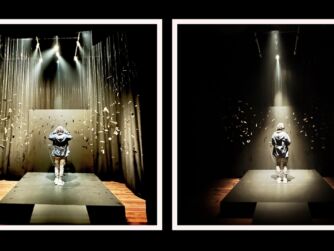
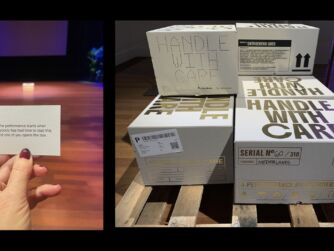
I interviewed Luna Maurer & Roel Wouters about Deep Soup on Tuesday, November 18, 2025 at IDFA DocLab in Amsterdam, Netherlands. You can also check out their Designing Friction Manifesto.
This is a listener-supported podcast through the Voices of VR Patreon.
Music: Fatality
Podcast: Play in new window | Download
Rough Transcript
[00:00:05.458] Kent Bye: The Voices of VR podcast. Hello, my name is Kent Bye, and welcome to the Voices of VR podcast. It's a podcast that looks at the structures and forms of immersive storytelling and the future of special computing. You can support the podcast at patreon.com slash voicesofvr. So continuing my series of looking at IFA DocLab 2025, today's episode is with a piece called Deep Soup by Luna Maurer and Raoul Reuters. So this is a film that's a participatory film, and so... It's kind of like a sci-fi poetic, you know, a lot of abstractions within it. And it took me a couple of times to watch through it to kind of understand some of the different deeper points that they were saying. And part of the confusion is that they're using a lot of the film submissions as these kind of poetic verbs that if you're not familiar with the verbs that they're using, then it kind of took me a couple of times to watch through it. But yeah. It's a piece that is critiquing AI in different ways. And so there's an AI character named O. And throughout the piece, they're kind of feeding O these different images that are these user generated cinematography shots that there's probably like 100 people that are credited. And so in these, there's different dialectics for each of these characters. different scenes, whether things are floating or sinking or falling or floating in the air, breaking, they've got rolling. And there's also like collapse versus like being static. And so as the AI is watching it, the AI is not able to really kind of discern at what point any of these processes are unfolding, at what point they are at. And so the AI gets kind of confused. And so a big part of this is showing that The deeper point that in the world we have a lot of applications and all those applications are trying to solve a problem and that the view of technology is that it's trying to create this frictionless existence for us. So they're using a lot of metaphors of friction to try to bring back friction and they have a whole kind of design manifesto. Uh, that's one that's called conditional design that they found previously, but the second design manifest that I did was called designing friction.com where they have a lot of these different principles where they're trying to really encourage people to reinvigorate friction as a part of ways that we're engaging with other humans. And that that's really kind of the magic of what it means to be human is to have these relationships that are coming from ways that we're kind of bumping up against each other because our life isn't frictionless, but we're kind of living into a future where it's Everything is trying to be designed so that we live in this frictionless world. So we're covering all that and more on today's episode of the Voices of VR podcast. So this interview with Luna and Rule happened on Tuesday, November 18th, 2025 at IFA DocLab in Amsterdam, Netherlands. So with that, let's go ahead and dive right in.
[00:02:52.341] Luna Maurer: Hi my name is Luna Maurer and I used to have a company together with Roel Wouters sitting next to me and we were called Moniker and with Moniker we were doing a lot of interactive participatory projects a lot of them online also immersive projects you could say but very diverse different experiences Lots of time, playful and dealing with digital technology and the effects digital technology has on our everyday life.
[00:03:24.054] Roel Wouters: Hello, my name is Roel Wouters and I used to have a studio called Monarchar together with Luna. Maro is sitting next to me. And we did basically the same things as she just said. So she said it very well. It was very well put, Luna. But we already stopped this studio like two years ago. And currently we are developing our own individual practices. But for this special occasion, we collaborated on a new film project called Deep Soup. And now it sounds as if that was a short project. That was not the case. It took us, I think, more than four years from the beginning until the end, maybe five even, Luna. And that's what we talk about today, about our new project, a short experimental science fiction film about the value of the physical world in relation to the digital world where we're so often in. And we somehow seem to have
[00:04:17.428] Kent Bye: we notice or we feel that is more important or more prominent or more invasive at times especially for our children than the physical world that is right in front of us nice looking forward to diving into the entirety of the project but before we do i always like to hear from what kind of design disciplines people are bringing in and so what kind of training and what kind of things you're bringing in into your artistic practice so just a bit more context as to your background and your journey into the space
[00:04:47.426] Luna Maurer: Well, I was studying at the Art Academy and I finished in 99. I studied graphic design and I did a master in digital media, you could say. And I in 99, I already I remember my final exam was in 1999. alternative proposal for a desktop metaphor that's supposed to be liquid fluid where folders melt into one another so I always wanted to or it was interested in this digital realm and besides that I love crafting all kinds of things outside you know and I love dancing as well so I'm trying to also bring you know movement and the meaning of movement into my practice
[00:05:34.110] Roel Wouters: I was also educated as a graphic designer. And that was the time, the early 2000s, that the web as it does now didn't really exist yet. And new media was still sort of a very fresh term. We were working with DVD burning and zip disks. That was the time. And at that time, the web and technology as a phenomenon, there was quite an optimistic idea about what technology could do. There was this promise of... ...democratization, emancipation... ...and we all thought we would share knowledge... ...and somehow get people who were in these groups all together... ...and create communities all around the world. So there was this momentum. And we were trained as graphic designers... ...but we felt like, hey, we need to somehow... ...because this graphic design was very much focused on producing end results... ...on like fixed, because there was a printing press... ...on something that would be fixed... And we were very interested, me and Luna and also Jonathan, who was at the time also our partner, in way more dynamic systems. So we were thinking about how can we find a format in what's the new role of a designer in a world where nothing is fixed and everything is constantly changing. And that led us to writing a manifesto. And we call that the conditional design manifesto, because we realize it's not so much about like the end result, about designing an end result, but designing the conditions in which something can happen. And I think that really that thought, which is now like very common ground for every like new media designer or. was at that time was very much a sort of epiphany for lots of people thinking that you could design in that way. And with that, we really did all kinds of talks, performances, workshops, works all over the world.
[00:07:26.533] Kent Bye: Yeah, I actually came across the conditional design manifesto and I was taking a look at it before our chat and noticed that it was very process-oriented. You're really focusing on the process, but also that there's a certain logic that's involved. And so maybe you could just elaborate a little bit more in terms of, like, if this was really born out of trying to go beyond any singular design discipline and trying to create more of a process by which that you could iterate with a group or just trying to understand a little bit more around how you would describe what conditional design is.
[00:07:55.458] Luna Maurer: Well, as Roel already very well put it, we were interested in designing environments, frameworks in which a process can take place. But we were actually very much interested in people and human characteristics. So we thought if we design a system very precisely with logic and have people engage or interact or play in such a system, then we are able to crystallize basically that what doesn't fit within. This way we thought we could emphasize our specific human flavor, funny, weird ideas. People also started to hack then the system or try to overcome the limitations. And that was really so exciting. So sometimes we saw ourselves almost like social scientists, you know?
[00:08:51.090] Roel Wouters: Puppeteers.
[00:08:53.351] Luna Maurer: Yeah, trying to find the sweet spot.
[00:08:56.614] Roel Wouters: You put it so perfectly nice, but do you have an example of a work along those lines?
[00:09:01.718] Luna Maurer: Yeah, of course. There are so many examples. For example, a very simple example I can explain now is the fungus series that is a sticker sheet with four stickers on the sheet, like let's say rectangular stickers. We did all kinds of different sticker shapes. And then you get into the museum and you get a sticker and you're supposed to glue it on the floor and but attach it or in the neighborhood of an existing sticker. And there were very few rules attached to it. But people would start to cheat instead of tearing the sticker apart in order to have more control. Because with only four stickers, you cannot influence the bigger picture. And people feel like, hey, I want to have more influence. So these limitations of only having four stickers triggered this creativity of people to do things that we're not supposed to.
[00:10:00.902] Roel Wouters: And this was all in a time that we were still very optimistic about how these systems at large would somehow, like how we as society and as people and as humans would benefit from this sort of, yeah, there was a sort of a techno-optimist or at least system-optimist perspective. But that changed over the years. And yeah, that led also to a new manifesto, a second manifesto. Is it about friction?
[00:10:27.573] Luna Maurer: There you go. The magic word. We wrote the, we can also call it statement maybe rather than manifesto. Designing friction statement, a call for friction in digital culture. And in this we make an analysis of the concept of friction, what friction actually is, what we mean with it, why digital technology tries to eliminate it, remove friction, create seamless experiences, and how can we bring friction back into our digital culture. So we come up with five proposals and we also state or emphasize the necessity of friction in our lives in order to feel alive.
[00:11:18.065] Roel Wouters: Yeah, I think like for a long time as a designer, basically the practice is like this. You look at the world, identify a problem, find a solution and capitalize on the solution, right? That was for years like how designers work. And that also, say, started off this whole big tech reality where we're in now, where somehow always there's this promise of, okay, you have this problem in your life. You cannot navigate on only your eyes and your map. But here there's this app, and we give you the solution for a Google map, and your life will be better. Like, small problems are solved constantly. Every app, basically, you can see on your phone is somehow the promise of a better life. And that in itself, you could say, is a very generous thing to do. But as a side effect, we also lose contact with the human factor of things. The fact that you have to argue at the moment that you're with your partner in a car driving to Paris. And then what's the shortest route or how do you get around the periphery? That makes the pizza tasting and the beer afterwards way better. It's way different than if you just like sit behind your Netflix and you just don't know exactly what happened. And obviously you're in Paris. Who cares? It doesn't really matter anymore. So we identified that the responsibility of a designer that before was only identifying problems, solving them, now also comes with the responsibility and added responsibility to see, say, like, hey, if you, with your product, with your digital product, also remove the human factor somehow, you have to do that very consciously or at least be conscious about it. And as Luna just said, you can also think or consider adding some friction where somehow there's a touch point with the reality, the physical reality around you as part of your responsibility as a designer. That's in a nutshell, it is this manifesto for friction. So it has nothing to do with world problems of saying like, hey, we're so spoiled. It's more about like, how do we want to sort of shape the reality that we're in?
[00:13:33.334] Luna Maurer: Yeah, it's one thing to add maybe that we would wish that in digital culture with digital tools, digital environments that we create, that we want, we propose that we should design them in such a way that people engage in them much more with their whole body or with much more with all senses being getting together rather than everybody isolated, smooth behind their screens. Right. Yeah.
[00:14:05.554] Kent Bye: Yeah. It seems like that in the theme of Deep Soup, there seems to be this contrast between this frictionless kind of abstraction of with our mind and interacting in these kind of virtual ethereal realms mediated by the networked Internet and the digital technology versus the materiality of living in the world and the physicality embodied in environments that are collisions with the world in a way that has gravity and friction and that there's a sense of trying to get away from these abstractions and the theoretical aspects into more of the kind of embodied and empirical aspects of life is sort of what I got.
[00:14:42.217] Luna Maurer: 100%. That's 100% correct. Yeah. So we really want to embrace and engage people interacting and also ourselves even engage more physically in the world because I feel that makes you much more happy in the end. Yeah. Well, we can talk about more, but yeah.
[00:15:02.466] Kent Bye: Nice. And so maybe you could talk around how you're taking these ideas of friction and then going on this journey of Deep Soup. Where did you begin with this project?
[00:15:11.792] Luna Maurer: Okay, I'm not answering your question exactly now because just what fitted very well what we said beforehand is that with Deep Soup, it's a story and it's a beautiful film, participatory film, but we wanted to make a tool like an example of this friction design idea where we ask people to film things, gravity, basically capture gravity with a camera in the world and send us in those films. And we wanted not so much that people film things for us, but rather also for them to have a physical experience, look again in front how do things look like and how can i look at them differently and for example i was at dinner with my daughter and my husband and usually there was a storm outside it was a bit rainy and usually we would sit and look behind the screen read your emails and then i said no let's go outside let's make a film about something floating in the air And I dragged them outside, not really, okay, let's do it. And then we had the best time of our life. We had so much fun playing one half hours in the rainy storm, trying to make super nice, capturing something flying in the air. And I was so happy in the afterwards, you know? And so like, this is exactly, oh, sorry. What we, yes, this is like this kind of thing. We feel like we want to, we want to make something where people think like, okay, let's have fun. Let's play together again. Yeah.
[00:16:57.679] Roel Wouters: Yeah, but I think it's nice about, because you could say it's a bit counterintuitive if you say, okay, you want to remove or get people away from the screens and then make like some sort of interactive participatory things where everybody has to use their camera to make something that's again on the film. But what Luna just outlined, I think is very central in this piece. These are all exercises you have to do with the two of you and you really have to look at the here and now around you and capture that. But that I think was already way more, not unnecessary to repeat.
[00:17:27.671] Luna Maurer: Yeah, but I also think it's nice that we use the phone. It's not that we say ditch all technology. It's like it's a combination of both, right? Use the technology that we have. We have slow-mo functionality. On your camera, your cell phone, you use this tool. And the physical world, you know, both. And people together around you. And that's what I like. And then come all together and watch in the end the film together on the screen. That's also part of it.
[00:17:58.639] Roel Wouters: I think that's also an interesting focus we realized. I think I realized yesterday also. But I think it was also already discussed before that we really try to now... Suppose in the beginning or mid of our career we were really busy with somehow... ...orchestrate, like, crystallize human... ...yeah, sort of the human aspect through sort of digital systems often. But now it's also somehow... ...it includes also getting people together in a physical space. So the cinema as a space where people come together... ...and enjoy something is something... Yeah, it's fundamentally different than swiping on your phone. And the idea that you first all are like separated, you all get these instructions and you have to throw something on the floor and you submit that to the project, whatever. And then you all come together and you're watching this film together. It's like such a physical experience nearly, although it's on the screen.
[00:18:53.436] Luna Maurer: No, but it's totally physical. You have to go through the city, you get there, you have a drink, you sit down. There are all these transitional moments that are part of this thing, you know? I think that's... Oh, sorry.
[00:19:05.886] Roel Wouters: Yeah, you as a performer are also way more busy with how do I as a person and a body relate to the audience that is in front of me live. That's really a shift in practice. And I think also the things that I do in my personal practice are also always related to how technology in a space manifests and what it does to the people who enter those spaces. To me, it's relatively new. I've always thought as the digital real message space. Yeah. the virtual space and I'm like way way less interested in the virtual space as a destination or as a format or a platform also not really existing anymore I think like that it's just the platforms like TikTok and Instagram that's what the web is as a social whatever and then I want to make big very big quotation marks there but um Yeah, so I think that's kind of sad also. We can just state that sad that the web as a platform where people come together really as a destination somehow has changed. Or am I getting old? Is Reddit still there? I don't know. What do you think, Kat?
[00:20:11.408] Kent Bye: I think that there's certainly one of the things that Kasper Sonnen said in the opening night was sort of the paradox of how the internet was supposed to bring us together, but yet it has this sort of alienating effect. So I think that we have this kind of dissociative experience of becoming numb and distracted, and the algorithm ends up dictating our lives in a way. So I feel like there's a way that, you know, this promise of empowerment and connectiveness and it's sort of disempowering and taking away agency in some ways so so yeah i feel like right now we're we're at a moment where we're really reflecting on the impact of the internet and digital technologies over the last like 36 years and doc lab was sort of created in that halfway point of the early beginnings of the internet and doc club was in 2007 it was iphone came out there's a lot of optimism for digital technologies and so now at a similar amount of time between when the internet started and when DocLab started. Now we're at that point where now we're kind of like reflecting upon all of this. And I feel like your project's doing that in a lot of ways.
[00:21:06.547] Roel Wouters: I also feel that, although you could say that's an, yeah, it's also, if I think back, there's way more media criticism. And media criticism, I also mean platform and digital sort of media awareness, actually, than like 10 or 15 years ago. So that's the positive side of this, that I feel like lots of people, although they cannot resist the temptations of TikTok and Instagram, they're very aware of the fact that somehow has this impact and people are willing to discuss this and debate and try to polish this in one way or another. So that's a positive note.
[00:21:40.863] Luna Maurer: Yeah. No, I observe that we are always resonating very much thematically with the theme of DocLab every year, basically. Because the year we were talking about writing the designing friction statement, phenomenal friction was the theme of DocLab. Now it's off the internet. Our project is having getting people off the internet.
[00:22:02.225] Roel Wouters: So it's... I suspect Casper to somehow have like a sort of spy coming by. Yeah, exactly.
[00:22:10.026] Kent Bye: Well, it could be that you're just tuned into the zeitgeist, the larger zeitgeist. But speaking of the friction in the beginning of encouraging friction, was that the year that you did an opening presentation of DocLab? Was that around friction?
[00:22:23.413] Luna Maurer: Yeah, well, we wrote this statement and simultaneously, while we had communications with Kasper, I'm sure he was maybe also a little bit inspired. He was a little bit inspired.
[00:22:38.830] Roel Wouters: Wink, wink.
[00:22:40.367] Luna Maurer: And then so we said, hey, yeah, but we want to do something at the exhibition because that's our thing. And he was, yeah, please do something for the opening. And then actually something crazy happened because there were lots of, how do you say, hassle? No, like...
[00:22:58.989] Kent Bye: There was a protest that happened because the war in Gaza had just started underway. And then there were some protests and then they weren't really handling it all that well. And so then they released a statement and another statement. They ended up releasing like three statements and it was not satisfactory to anybody. And so it was sort of like a lot of friction that was happening in the context of it was a cultural institution responding to this conflict.
[00:23:21.030] Luna Maurer: And then what happened was that Kasper said, no, you cannot do the performance about friction. That's impossible. And I couldn't believe it. We rehearsed so long and it was so on spot and it was so good. And then we said, you know, Kasper, we might now do the performance for you personally and you can listen to it. And after you heard that, you tell us again whether we cancel it or not. And he heard it and he said, wow. Please, yes, we have to do it. So we were really happy. So that was the story.
[00:23:52.102] Roel Wouters: It was kind of like everything was on extreme tension.
[00:23:56.167] Luna Maurer: But it was really very well received. So that was really nice. So it was also... Yeah. The necessity, I mean, it is also how you see friction, right? I mean, we were explaining a lot what it is. And yeah, it's maybe going too far to go into this now because everybody can read it online on designingfriction.com. But I think it's a very rich concept that stems from movement, stems from interaction, but it all relates also to being connected. That actually happens also in the film. We make a lot of metaphors of this in this deep soup film when you see, for example, a ball rolling over a surface. And then a voice says, wow, they dance beautifully together, but they need each other. One can only dance if the other one helps. And it is metaphorically for the fact that an object rolling or stumbling over another surface they interact in a way and there is friction and there is a sort of connection they have together because it's physics it's very simple it stems from gravity and that friction there is and that is i think a very beautiful metaphor for us people together in real life the metaphor
[00:25:23.894] Roel Wouters: I think it's just a law of nature. It feels like a metaphor.
[00:25:28.496] Luna Maurer: But you can metaphor to people.
[00:25:30.817] Roel Wouters: Yeah, but I think it might be the same force, literally. Like the fact that you need collision in order to engage. It's the same mechanic. So a metaphor, you would also really use something that's basically from an entirely different space. I think in this case, you could argue it's basically maybe the same force of nature. Yeah. in a different type yeah it's nice that you have this so on your spot because it's beautiful I also think always when I see the film and say like this one can only dance if the other one helps that I think lots of people will see like the other one where's the other one because they don't look at the floor or the surface where you engage where you're constantly attached to as an entity Because it's so present, but it's super, it's like all the time, super demanding, but we never negotiate it. We never somehow even see it because it's always there. But it's actually the force that we're always colliding. Only if it hurts.
[00:26:29.237] Luna Maurer: Then you realize it.
[00:26:30.558] Roel Wouters: Then you escape it. Yeah, for example.
[00:26:34.520] Luna Maurer: But in dance, if you dance, we actually thematize a lot the floor. But that's very specific. That's completely all you have. The floor is the only thing in your body. But in life, I mean, as you say, we never address it.
[00:26:51.101] Kent Bye: Well, I wanted to dig into a little bit of the participatory aspect of this piece because when I first saw Deep Soup, I was sent a screener link and I watched it. And then when I came here to the exhibition, I had seen the request for submissions that you had put out in terms of asking for specific things that you wanted to include in your piece. And then watched each of those different pitches in the installation and then on your Instagram reels that you had to kind of invite people into this participatory process. And then when I rewatched the project again, I was like, oh, okay, here's what they shot and here's what they were inviting with these different themes. So I was able to kind of see how you're able to kind of create these polarities, like falling, floating, sinking, floating, sticking and then collapsing. And so you have these contrasts that you're using as a kind of dialectic for this main character of this AI that's trying to discern on what side of the dialectic it's happening. And so just curious to hear this process of this call for entries, but also if before you did that, if you had a pretty clear idea as to the structure of the film that you were going to do to kind of really understand how these verbs that people were going to be shooting were going to play into the final product.
[00:28:04.097] Roel Wouters: Yeah, that was all one big construct from the beginning. No, not from the very beginning, of course. But before we started shooting, we knew already, yeah, I think for 90%, what kind of assignments or what kind of things we wanted to ask and why we needed those things. And then, of course, we made, like, slightly changes in, like, we wanted, like... some tilts or pans or that kind of stuff like how we actually put that whole idea about falling and floating and breaking that was all part of this initial writing that Luna made like in the very beginning of this project where she wrote this stream of consciousness A non-human intelligence would look at the laws of physics, but with the naivety of, you could say, a child. But I think that's not precise enough. But if something breaks, you can see, like we are so trained to see that as something that is like maybe wrong or destructive. But this entity sees like, ah, is that what you call birth? So it's really about like, hey, this collision, you can see it as death, but you can also see it as something, as the place for something new. That sort of intuitive writing, that led, that we both sort of valued as something, as the starting point of the project, as where we built this whole thing around. And that basically led, that always stayed the center of the project. And we built basically this whole construct, this whole film around it, yeah.
[00:29:29.411] Luna Maurer: Yeah, it has many facets, you could say, this work, because it's very, you know, we hope to make it also very cinematographic, you know, with very good DOPs, cinematographers, the film around, and then it has those contributions, this whole campaign. the vlogs that we both become actors in to make people contribute and it was a lot of work everything and a lot of filming and then going to all kinds of places coming up with examples Thinking of small examples that people can get triggered, but also not getting afraid. Oh, I have to make such a great film. And then also a little bit, you know, more bigger, complex examples. And yeah, I don't know. I feel like this project has lots of facets. It was a lot of work and... I hope it's going to live on a little bit, a while now, because now that's the first version that we made. And this whole construct of this film is set up in such a way that we can easily put in new contributions. If another community would say, hey, a festival or whatever, an organization say, let's make our own version of this film because we want... our folks to also play with all those instructions and then we can do a new version
[00:30:55.031] Roel Wouters: You could imagine that an other version of this project where like other people would just Luna explained. Do you think it would add to the project if you would be able to browse, for example, multiple versions?
[00:31:09.285] Kent Bye: Well, I think the film itself, it helped me to watch it a couple of times because it wasn't immediately clear when the kind of user generated content was coming in. And so to kind of understand that. The themes based upon what you were requesting around these different dialectics of, you know, it's, you know, stable and collapsing. Is it falling? Is it floating? Is it rolling? Is it breaking? You know, all these requests that you're putting out like these primary verbs. I had that in my mind as I was watching it the second time, and then I was like, oh, okay, here's how those verbs are playing in as a metaphor and how this main character is actually confused as to this ethereal AI-O character who is trying to understand what is happening in the scene and not really quite understanding it as this metaphor for how AI reads all of our data. It doesn't really have any understanding. It's just kind of like mashing things together. And so it's this idea that there are fundamental things that you can only learn by living in embodied experience and having within the context of neuroscience. It's like embodied cognition where we have these embodied experiences where we learn around the world. And when you put these systems that have no embodied experiences or world models, then it starts to break out into the abstractions and it gets a lot of things wrong. Yeah.
[00:32:25.044] Luna Maurer: Yeah, so thank you very much for putting it so well. That was exactly the challenge when writing that we imagine it's written from outer perspective of a character that doesn't know gravity. It doesn't have an understanding of gravity, but sees all these things that are happening here and doesn't understand what is happening. So therefore makes a completely different interpretation of it. But then how to write that? without using those words of falling or breaking, that was really difficult. to write something with words about these phenomena without using these specific words, but other interpretations. Descriptions. Descriptions, yeah. But that's also the fun part. It was a challenge, right? And what could you see in it, you know? That was, I mean, the fact that water is seen in this film as a portal, like somebody that controls here. Some may enter, others are not allowed in because they drift on the surface. So these visions, these imaginations of water as something that is in control of something, this is what we really like. And hopefully this also comes across for the audience when they listen to it.
[00:33:44.495] Roel Wouters: I think the participatory aspect that you were referring to is something that was... I think it's also a topic on itself. Sorry, I just... No, let's go back, because you were in the middle of something. I realise now, I don't want to interrupt you like that. No, I just was completely spacing out. You were asking about the participatory, and I was thinking about the dilemma... I'm Black Advent.
[00:34:12.186] Kent Bye: Luna, did you have anything that you wanted to jump in?
[00:34:13.847] Luna Maurer: No, I don't know where you were. You want to talk about participation? Because we were just talking about the interpretation, an entity that doesn't... Well, I hope that it is beautiful for people to listen and look at the world as what they recognize right away things are full, but hear a different story about it. I don't know how that feels. For me, it's so really clear, obviously. But I don't know. How was it for you?
[00:34:48.412] Kent Bye: The first time I watched it, there was a lot of things that I didn't quite understand the first time around. And then when I saw the primary verbs that you were asking for, and then I rewatched it, I think I understood what was happening a little bit more. Because it is a bit of a kind of abstract science fiction film. And so... I'm entering into a new logic and like, what is the logic? And so I think the first time around, I was like, what is the logic of this world? And then when I saw like, oh, this is how you were asking around these specific concepts and ideas. And I was like, oh, okay, well that actually, you know, I wonder if I would have seen that first, if I would have understood more of... the concepts of the film so then when I watched it again then I understood more of the ways that you were using these primary words that often had like an opposite either it's falling or floating and so then like I said the main character in the film represents this AI is trying to discern things and so and you know another thought that came up was that there's This dialectic between substance metaphysics and process relational metaphysics, meaning that there's a world with substance metaphysics where you tend to see the world as these static concrete objects, and that's the only thing you see. And then more of a process relational philosophy is that things are dynamic and unfolding or are continually changing. And that this AI is in the substance metaphysics perspective thinking that, oh, this is just static. And then all of a sudden it falls and it's like, oh, wait, and it can't quite understand how it's going from one state to the next. It can maybe identify static shots, but in terms of an entity, it doesn't really understand the dynamic flow of what it means in the world because it has no reference point. I think in this film, it's sort of like showing this like, oh, it might be able to identify a fixed moment of a state, but not really understand the full context of how things are unfolding in a process. And so that was sort of what I was focusing on the second time that I watched it.
[00:36:33.698] Luna Maurer: So beautiful. I'm really glad to hear you talk about it. That's very rich. I love it that these thoughts get triggered when somebody watches this like that. So that makes me really happy. But another question is, if you would, the first time you watch it and you wouldn't get it, the thing that you do get, how is the experience then? Is it then just... Is it missing something?
[00:36:59.045] Kent Bye: Well, no, so I think it's sort of like difficult because I've seen like all the other experiences here. And so it was sort of like as I was preparing to come here, I watched the screener and then I was like, OK, but then there's an installation component. So then I was like getting more information. So it's a little bit of like a detective because I'm also doing an interview. And so because I'm doing an interview, then I want to kind of dig in a little bit more and see like, well, maybe there's something that I missed or I don't get.
[00:37:21.464] Roel Wouters: If you would just see it as a poem. So we also somehow trust. We know there will not be so many people like you, Kent, who completely dive into it. I mean, we would really love to, but we also are realistic and not everybody will do that. But I sense and what I felt, and I also get back from people watching it, that they only get very... they don't get it really as a thing. And it's also not necessary. I think it's also nice that it's more as a poem that just hints towards this concept that you were just so beautifully describing and maybe not completely understand. And I think that's also fine in certain ways that it just sort of opens it up a bit. And the other thought that I had, like now we had this first version with all people from our own bubble and the DocLab bubble and basically the people who are sort of participants. We're also super curious to see what it does to the meaning of the film and the substance of the film if a completely different group of people would make these assignments and these contributions. And whether that somehow also... each into the meaning a bit, or if that different context would also create a slightly different perspective or narrative in the story. Of course, the voice will not change and the whole logic will not change, but that's something that I maybe... We aim for also that at one day that we'll be able to make a work where this is really in an elegant balance, where the contributions made intuitively would really inform the story and give it an angle or an edge in a different way.
[00:38:58.735] Kent Bye: Yeah, just a quick response in terms of like recalling my first impressions of the piece was that, you know, it's a piece called Deep Soup. I'm gathering by either the synopsis or just kind of watching it that it's a metaphor for artificial intelligence. We're sort of throwing all this data into the algorithm. And so it's, you know, we're in this phase where AI is kind of like doing a lot of data colonization. It's like sucking in all this data. There's usually not much consent for how that process is happening. And so, you know, as artists, you're sort of like, putting all these things into the AI for it to be trained and then one of the things that really stuck with me was noticing at the end and the credits of like he had credited over like a hundred different contributors and then that was like oh wow I didn't realize that this was like that so many people it's really cool to have so many people that were participating rather than generating AI art or something of course it wouldn't make sense for you to do that within the context of this piece but it was just the sense of like it's nice to know that there's still people out there that are Going through the trouble of collaborating with that many people to create something like this. And so then when I came to DocLab, then I realized, oh, well, this was sort of an open call that was put out as an artistic project. And OK, that's how that happened. And so then when I watched the second full time of the film, trying to see how. the themes that were in that were kind of related to as verbs that kind of helped me understand the context of the film even more so and being able to discern this is a contribution. This is from this verb. Okay, this is how that verb is coming in into this moment. of the film and seeing how you're kind of using it. But the first time I saw it, I wasn't making like a translation of like, oh, this image is relative to this concept. And so it was only after I kind of knew the full context of the participatory film that I understood what the film was trying to say, if that makes sense.
[00:40:44.507] Luna Maurer: Yeah, totally. Yeah. I'm now a bit not worried, but we will have a screening on Thursday in iCinema. And there we don't give a little introduction before, but we have like two slides in front of the film just supposed to explain that these are real contributions by people. And I worry now a little bit that people get this because I think it's quite important to understand if you enter the film that all those footage is coming from people and it's not from us i mean that would be very weird i think so too so is it a plan that we can just yeah we could just say like hey we just want to give like a short introduction it's part of the screening i think it's uh it's a good idea our physical existence and our voice saying something in front of the film is part of the film it's part of the screening
[00:41:40.184] Kent Bye: Yeah. And as I was going through your different calls for entries, you have the very first frame, you have an image of what you're going for, like floating, and it says, give us an image of floating. And you know, if you put all those into one slide, then you can get a sense of like, here are the things that you were asking for. And that could be also a very quick way of doing that. Because as I was going through, I was just kind of watching him and I have a habit of screenshotting things I want to remember. It's sort of like a photo diary. And so I was going through, I was like finding that, okay, here's the best moment from this film that shows that, you know, and it usually it was the first frame that had that little like instruction, give us a film of something or other. And then, yeah. So anyway, that's the thought.
[00:42:19.856] Roel Wouters: Yeah, but we will not be able to change the DCP for Thursday. But it's a nice idea. I think also we learned so much from screening it for a live audience. That was also, of course, we are not like, let's say, filmmakers. We are routiniers in lots of aspects in this field, but not per se as filmmakers. And it was very exciting and very nice and also very stressful, but also very nice to be there together with all these people in this space. Yeah.
[00:42:45.410] Luna Maurer: I have a question for you, Kent. Are you more triggered to film something when you see such a flog, like Call for Action, or after seeing the film itself?
[00:42:55.658] Kent Bye: Oh, for me personally, I mean, it's hard to say because the film's done and the deadline has passed.
[00:43:04.705] Roel Wouters: We will, Side by Side West or any other, we will start it up again.
[00:43:09.741] Kent Bye: Yeah, I mean, it's hard to say, like, in terms of, like, potentially. I mean, if I was back home and, you know, seeing a new, fresh round or, yeah. It depends on the context and the moment. It's hard for me to know right now, theoretically. So, I mean, yeah.
[00:43:24.431] Roel Wouters: It's a bit of a thought exercise, but if you imagine you wouldn't have seen the film at all, would you be triggered by first just, like, the mystery about a film that will be screened at something you don't know what it will be exactly and then receive these vlogs? You would first see the film and say like, hey, there's a possibility that you can contribute to this film. And here are, these are the examples. If you compare those two scenarios, what would you, I asked this also.
[00:43:51.579] Kent Bye: Yeah, I think so. After seeing the film, I'm more likely because there's like the shot of a skateboard with shoes on it that doesn't have any feet or legs and it's just rolling down. And I was like, oh, that must be a rolling one. And that's really interesting that someone decided to do a rolling of a skateboard with shoes, which is not something you would necessarily expect. And I was like, oh, that's fun that they saw that contribution. Like, oh, this is surprising a novel and it includes in the film. So it's sort of like an exercise to see like what would be fun or interesting that would be.
[00:44:20.224] Roel Wouters: You also think already about the selection procedure and what will make the cut or not. So that's also, yeah, I can imagine. We never really considered that to be a big factor for people to decide to contribute or not. But I think it's really true. People are so excited to see their own, of course, their own contributions on the screen. And there's no place for everybody to be featured prominently. So you probably think strategic about this as well.
[00:44:45.352] Kent Bye: The second time I watched it was sort of like recognizing the contributions of other people and really appreciating the novelty of some of the ones that were very unique things that maybe went way beyond what you were even expecting for that as a concept. But it's sort of giving you more of a palette of things to work with as you're creating it. So it's just this idea of like the contributions, making it like more of a richer, interesting experience for everyone.
[00:45:07.662] Roel Wouters: Yeah, totally.
[00:45:08.463] Luna Maurer: Yeah, they're also very different qualities. Somebody yesterday told me, yeah, but the one in New York with the balls floating in the air, that's not a contribution, right? This is really your footage.
[00:45:20.080] Kent Bye: Oh, yeah.
[00:45:20.581] Luna Maurer: I was like, no, of course. Why would we all of a sudden... put it now your own you know where why would we do that it's very funny because it was definitely yeah but the camera was so good you know the quality was high what kind of mobile phone is that yeah and then you see also very crappy shitty pixelated
[00:45:39.592] Roel Wouters: Somebody throwing a remote control on the couch, which we both really love because it was so badly compressed and so few frames. But it's just that we felt like that. You think about these people, okay, I'll just do it. Here's my car. I'll just throw it. And there's also a conception. I love my car, actually. I like them both. I think it's just, but that's like conceptually so strong. You know, you say, okay, get rid of the remote control. And there's like this whole layer of like sort of thinking behind, but not filming per se. And yeah, I think that is nice. If you zoom into all the details of people who thinks, yeah,
[00:46:16.058] Luna Maurer: But also those facts, yeah, what I like so much about this collection of those contributions, that they're all so different, and each of them is really beautiful just to watch the movement, because most of the movements are captured in slow motion. And then you, all of a sudden... It's still sort of you look at the movement and then you can see so much beauty in these movements that it's just a throw of this thing. But actually, you see how it turns and how the colors of the different buttons of the remote control and the sofa where somebody sat. And, you know, there's so much beauty.
[00:46:58.564] Kent Bye: beauty all of a sudden in all those little things that I think that comes for me across yeah yeah I did want to ask around your thoughts on AI because it seems like this film overall is making commentary and you're creating this whole idea of like a physical model that it's training which is sort of like a antithesis to something that's more abstract or intellectual or intelligence model it's more physical and so but As I was watching it, the word that came to mind is like this metaphor for AI slop, where you kind of have this green, slimy type of water where you're throwing these contributions of these images into this soup, the deep soup, as it were. But I'd love to hear any reflections on AI or the prompts that really were catalyzing for you to create this piece that is in some ways trying to deconstruct it or have other ways for people to do something that is not what's happening now.
[00:47:53.157] Luna Maurer: Well, talking about AI, I mean, we said it at the beginning of this conversation, I think that we are very worried and critical about the fact that all these concepts that come along with AI is all about comfort. and ease and I don't have to bother. It's going by itself. It does it for you. You don't have to sweat anymore. It's all the labor is done and all this bubble that we get in becoming friends with a machine. And so this worry, basically, it's not about, oh, the machines take over our work. It's not that. It's really this mindset that it creates itself. in us humans and taps into this basically thing that we like work to get away from us but in the end this is not how we get connected in the world so this critique basically or that's why we celebrate this physicality of the world with this film basically that's why we want to reactivate to see hey look how much joy this is and not the ease and automatism. That's why the main character O, that sort of is a representation as well of the AI, you could say, we refer to it as a world that comes from where everything is smooth, soft, glides past each other, eternal harmony, everything is, you know, like that.
[00:49:27.196] Roel Wouters: I think another problem with AI, or maybe a contradiction in AI, somehow as we see it as a society, it feels as something very novel, as something that's new, is entering our lives. But also we must realize that all the data it's trained on is all from the past. So it is nothing that's in this thing is somehow about the future. It's only like a big mix of, you could say, nostalgic, or at least like things from the past, because literally these are all recordings, writings that happened back in time. so it's very weird that somehow we see there's a future of something there's a future in ai but basically there's no future in there i think that's also the most repulsive thing about this that is never really proposing something truly new but somehow it's disguised as something new And, yeah, so that as a sort of weird juxtaposition in our heads also played a role in trying to... We also didn't want to sort of make it a complete AI bash or like completely say, okay, this is not... Because it's so easy and it's also happening so often. So we really tried to find a perspective that was not so much about like only renting or judging AI, but somehow also trying to somehow present it in a way that... We somehow are... There it also stops a bit in my head, therefore maybe it's also... Yeah, you want to say something? Okay, continue then. Finish first. So we wanted to not just only judge it, but also somehow... try to find a space where it can exist and can coexist, but then somehow in relation to the physical world. And that, of course, can also be both dystopian, but maybe it's also something super nice that's a bit unknown. And we felt like, on the one hand, this AI is naive and it's sort of seeing the physical world as a complete new... something and has this like beautiful perspective and on the other hand it's also maybe if you really were able to train it maybe it's also able to shift our world physically completely upside down and really start playing with the rules of gravity anyway yeah I wanted to mention that we were also in the process of
[00:51:39.088] Luna Maurer: quite a long time busy with thinking in which way can we integrate AI also in sense of that the script would be altered by the user contributions. So the user contribution would be fed and then the voice would be altered, the script would be altered based on the contribution. So that was the plan as well for a while. and then we realized that we have made quite many experiments and in the past project with prompt where I am writing things and we realized that it wouldn't work out we were sure that we would be better in the end if we just decide we're precise and we know what we want to exactly say and not having the sometimes funny sometimes to the point but a lot of times also maybe shitty versions So we sort of decided, no, let's not do it. Let's go back to the traditional way, basically, of the authorship.
[00:52:38.932] Roel Wouters: I also feel that we can say more about AI by not using it in this context than actually using it. And it's really about that uncanny feeling that somehow AI... When you use it as a sort of co-creator, it's often so boring. It's often so boring. So there's like... We got bored.
[00:52:59.418] Kent Bye: We got bored.
[00:53:01.498] Roel Wouters: And also, so... But somebody else asked me, like, so there's no AI in here in this whole film? You didn't use anything? Like, no prompt writing, nothing? Not a single improvement on the script or anything? And I could confidently say no. But then, that's not true. We have, like, at the moment you start uploading your contribution... There is an analysis made because we thought, okay, we have an analysis made and then the voice of our character or like any sort of abstract voice gives comments to the things that you do based on an AI analysis. And we also did that because... Yeah, we did that also. Yeah, we did it also because we somehow also agreed as contractually agreed that AI should be part of it. But I think even for that, I think also it's not that we don't want to play with it. It's not that we don't want to sort of investigate in the space at all. We are also very curious, but we don't really see benefits for an authorship position.
[00:54:00.922] Kent Bye: Nice. And finally, as we start to wrap up, I'd love to hear what each of you think the ultimate potential for this type of immersive art and participatory interactive art might be and what it might be able to enable.
[00:54:13.857] Roel Wouters: I feel we are really like this old social optimists. We really see like if in relation to technology, I think we still really want to have this spirit of the old web that somehow technology can also be used to connect people, truly connect people, not in the social media way like so, but in a really social way. At the same time, if you're realistic, it's also we are also a bit dinosaurs in that regard, I think. Simultaneously, yeah, that's also what we are and what we do. So I also can carry that with pride, I guess. I don't know. But I don't know. How do you think about that?
[00:54:48.115] Luna Maurer: Yeah, I think if I see Casper and the program, how it's unfolding every year here, and this year especially also, that people, I mean, the topic of the internet, that people want to make more embodied experiences, or that VR... turns into xr you know like much more integrated other sensory experiences or you know that you can look through the screen so you can see also the physical world around you at the same time i think maybe that's also an optimistic way there will be tendencies to yeah get more physical get more in the space so i think yeah somehow technology maybe gets smaller in that sense you know more immersed in that you don't really maybe realize it so much you know that kind of stuff i also see my children if they go out of their house or they want to put their phone away they want to somehow they don't want to
[00:55:50.269] Roel Wouters: be let's say served like an experience that's only tailored for their Instagram feed they want something real they want some a real engagement they want to go home with like some substance or a friend or something that is and of course all like you could say in a different way as we used to clubbing or anything when we were young so it's all way more precise I think in some ways and more considered but they really want to engage with other people and I think that's very promising
[00:56:19.957] Kent Bye: Nice. Is there anything else that's left unsaid that you'd like to say to the broader immersive community?
[00:56:24.900] Luna Maurer: Take off your headset. Yeah. And I think, yeah, make immersive work where physicality, where other people, where you really have to engage with each other, I think, for real, and not only mediated via screen.
[00:56:47.248] Roel Wouters: And I think also a big shout out to all the indie small tech optimists that's still out there that still feel the urge to compete with experience against the big tech mainstream consumer products. Because although your product seems to be small with a small audience, I think these are the seats that eventually will be the key to turn over the hegemony of the big tech industry.
[00:57:12.079] Kent Bye: Awesome. Well, Luna and Ruel, thanks so much for joining me here on the podcast and to break down a little bit more around the process of Deep Soup and all your conditional design manifesto and a new designing friction manifesto. And yeah, I think that there's another aspect of the participatory nature of this film that I really appreciated after seeing the installation and seeing the context on which those clips were coming in. And it reminds me of that early 2004 era, Zay Frank did a whole year-long video blog series where he was including lots of different clips. And I just really appreciate what kind of like creative innovations that happen when you're inviting that kind of user generated content that kind of help flesh out the deeper themes that you're talking around. And yeah, also just this deeper concept of how friction is such a key part of the physicality of what it means to be an embodied human being in this world today. And we shouldn't forget that as we move into these more layers of abstraction that AI can lead us into. So thanks again for joining me here on the podcast to help break it all down.
[00:58:09.338] Luna Maurer: Thank you very much. It was very nice.
[00:58:12.020] Roel Wouters: Lovely conversation. Thanks, Ken.
[00:58:14.002] Kent Bye: That's all that we have for today. And I just wanted to thank you for listening to the Voices of VR podcast. If you enjoyed the podcast, then please do spread the word, tell your friends, and consider becoming a member of the Patreon. This is a listen-supported podcast, so I do rely upon donations from people like yourself in order to continue to bring you this coverage. You can become a member and donate today at patreon.com slash voicesofvr. Thanks for listening.