I interviewed Queer Utopia: Act I Cruising director Lui Avallos at Venice Immersive 2023. See more context in the rough transcript below.
This is a listener-supported podcast through the Voices of VR Patreon.
Music: Fatality
Podcast: Play in new window | Download
Rough Transcript
[00:00:05.452] Kent Bye: The Voices of VR Podcast. Hello, my name is Kent Bye, and welcome to the Voices of VR Podcast. It's a podcast that looks at immersive storytelling, experiential design, and the future of spatial computing. You can support the podcast at patreon.com slash voicesofvr. So continuing on my series from Venice Immersive 2023, today's episode is number 4 out of 35. So this is a piece called Queer Utopia Act 1 Cruising that is within the context of identity and self. So this is a piece that is looking at cruising, the act of cruising for LGBTQIA folks from the 80s, looking into the history of some of these folks and using a lot of point cloud representations, but also creating these imaginal nostalgic memories from generative AI. So it's got a bit of a theatrical staging where you're introduced to someone who is calling you a friend and then you're going through these different spatial experiences and getting a bit of a history of the experience of being identified as LGBTQ plus IA in the 80s and the different aspects of exile and the experiences of sex and also disease and the pandemic that was happening with the AIDS crisis at that time. So this is a center of gravity of emotional presence, a linear narrative that's taking you through the story. There's light and interactivity to progress the experience and to engage you into the environments in different ways. And it's got this strong degree of environmental presence of designing these different spatial contexts to be able to metaphorically describe some of these different experiences. So that's what we're covering on today's episode of the Voices of VR podcast. So this interview with Louis happened on Monday, September 4th, 2023 at the Venice Immersive in Venice, Italy. So with that, let's go ahead and dive right in.
[00:01:49.808] Lui Avallos: My name is Louis Avalos. I am a Brazilian Portuguese director and screenwriter. I started working with film. I have a background in film and now I'm dedicating myself to work with VR.
[00:02:03.084] Kent Bye: Great. Maybe you could give a bit more context as to your background and your journey into VR.
[00:02:07.267] Lui Avallos: Sure. So as I said, I have a bachelor in film studies. I moved to Portugal to do a master's in multimedia art. And during this time, the pandemic hit. So I was in my house trying to find something very complex to learn in order to, I don't know, make the pandemic get a little easier. I must say. And I decided I wanted to learn how to work with virtual reality. And I did my first piece called Handwritten, which is a 360 film, very experimental, very essayistic about the pandemic. And once I was done, I liked the result. I think aesthetically wise, it was very weird and different. And I wasn't sure if it was, I don't know, relevant or if it was a fit for film festivals. but I started submitting it anyway, and it got accepted in a few film festivals, and we premiered it at Doc Leipzig in 2021, and that, in a way, threw me inside of the VR community, and I started learning more about it, knowing more people, getting more inspired about the works, and yeah, that was the beginning of it all.
[00:03:12.836] Kent Bye: Great, and so I understand that Queer Utopia was a part of the College Biennale, so maybe you could talk a bit about how that came about.
[00:03:20.435] Lui Avallos: Yes, I found out about the PNLE College virtual reality program right after I did my first piece. And I was, of course, super interested. So I started writing this treatment of a story that I wanted to tell. Maybe not a story, but about a topic that I wanted to approach in virtual reality. So I wrote this first treatment, which was an investigation about the phenomenon of cruising, because I thought since it's about spaces and people could be a great fit to explore in virtual reality. Yeah, I submitted and it got accepted and it was absolutely amazing, this process of the residency. I think the methodology of the college is absolutely amazing, how it's built and how the experts and the tutors and everyone else approach your work and how much care and dedication you have from experts to help you to find your way into building what you want to build. So we were one of the 12 projects selected worldwide. It was also during the pandemic. So the first phase, it was all online, which was incredible. My producer, Rodrigo, he was very skeptical about VR at first. And our first phase was literally inside of VR for nine days. It was super intensive, super immersive. And by the end of the ninth day, he was like, OK, this is amazing. We have to find a way to make this work. So, throughout this process we had a lot of help from these experts from different areas in order to help us make our idea, which was a very rough idea, about what we wanted to do. And to turn it into a project that was more solid, with more distribution opportunities, more clear when it comes to the story, the UX and everything else. So at first it was a 360 film, again just like handwritten, super essayistic, super experimental. And throughout this experience we used this opportunity to try to be a bit more ambitious and do a 6DOF project, even though we both come from film and didn't have this experience or knowledge about the pipeline. But yeah, so during the residency from the 12 projects, we were also selected to be one of the top three. So we came to Venice in March 2022 to keep further developing the project, which was amazing as well to be here in Venice for the first time, developing the project and fine tuning it to be production ready, which was super helpful as well. And the rest was this path of trying to fund, trying to find partners for development, for building, and everything else. But in a way, I think this process of the residency really helped us to take this idea, this rough idea, and turn it into something that was more accessible to our audiences, that could make more sense to more people. And yeah, I guess that was it.
[00:06:13.941] Kent Bye: Great. So yeah, maybe you could give a bit more context for Career Utopia Act 1 cruising.
[00:06:20.643] Lui Avallos: Sure. During this process of the residency, we, from the beginning, had the title Queer Utopia. And throughout the development, we understood that this title was a bit over-promising, because it's impossible to talk about either utopias or queerness from one single point of view. But we also had the starting point from cruising, which is something that, in a rougher sense, it's more related to the experience of gay men. So we decided that we wanted to keep this investigation about the phenomenon of cruising, but we wanted to focus specifically on this generational aspect of it. Because throughout the residency we started interviewing over 60 year old queer men about their cruising experiences and it was so shocking to us how it was way more about their generation, like their stories that they told, it was way more about their generation and their experiences and their identities than the phenomenon of cruising itself. So we understood there was a lot of complexity when it comes to politics and to segregation of the queer community. So this was our starting point. So using the title Act 1 Cruising for us meant that we're doing this project, this first project, using this one lens, this point of view. But for us, it's important to keep further developing this project with new episodes from different people inside of the queer community from different point of views and identities as well.
[00:07:47.419] Kent Bye: And so do you have a sense of what Act 2, 3, or 4 might be?
[00:07:50.364] Lui Avallos: I mean, for now, I can't really say, because we're still talking to a few people and developing a few ideas. But this is something that we might be sharing very soon.
[00:08:00.406] Kent Bye: OK. So you have a sense of where the arc might be going, but you just can't talk about it yet? Yes. OK. OK, so Aquan Cruising. So maybe you could go back to what was the pitch that you gave to the Biennale College?
[00:08:14.009] Lui Avallos: Sure, so we started this as I said with the phenomenon of cruising and I guess the idea, the pitch and I think what made people more interested and emotional about the project was something I said right after we finished the residency which was that we started from the phenomenon of cruising and the architectural, social, political aspects of it. But then once we started interviewing these men and their stories, something became very clear, which was that the queer community, who is now elder, are the people who started the fight for LGBTQ rights. And since their advanced age, they might be with us for, let's say, 20 more years. and there's this gap between them and their stories and their lives and the reality that we live right now in a way that it is this generation was almost erased in a way by AIDS and by segregation and oppression and I believe their stories have a lot to teach us in society when it comes to this history of queer rights and also about their stories and their life stories and the people that they lost and everything that they have been through. So I think the most important part of the project and what was more, I don't know, emotional and meaningful about the pitch was this generational aspect of it. Then for us, it became something really important. And in a way, I believe it was something that people never thought about in the spaces that we were. So this became the main issue and the main focus of the project development.
[00:09:48.405] Kent Bye: Can you take me back to the moment that you realized that you wanted to tell this story? A bit more context for how you came across this as a story that you wanted to tell.
[00:09:56.966] Lui Avallos: I came across the photographs of Alvin Baltrop, who was an African-American photographer that used to photograph by the margins of the Hudson River in New York City. His pictures are really amazing and really strong. This pier by the margins of this river used to be an abandoned place that was a cruising space, but also a place that avant-garde artists used to meet and paint and gather. And it was a very dangerous place in a way, and it was also a reflect of segregation. And his photographs, they kind of show this in a way through the cracks in architecture. You can kind of see, like, as a metaphor, the cracks for the segregation of queer community. And I believe his photographs, they're very, in a way, complex. Because from a point of view, it could be this sexual liberated paradise or whatever. But at the same time, you can see this aspect of segregation. And for me, that was really complex. And it was something that, since it was about places and people, it was something that I wanted to try to achieve in virtual reality. And virtual reality, since it's immersive, for me, it felt like the perfect medium to try to tell the story and do this.
[00:11:08.932] Kent Bye: So it sounds like you were able to locate some queer men from this generation and start to do interviews. As you're starting to explore this as a topic, you started to discover that it's not just about the act of cruising, but more about the identity of them, but also how the larger social, economic, and political context was forcing them being exiled into these contexts of where the cruising was happening. but there's a larger political context that you wanted to also cover. So maybe you could talk about how you went from there into continuing to develop this as a story that you wanted to tell in VR.
[00:11:43.676] Lui Avallos: Sure. So I think the first turning point for us, it was during the first phase of the A.B. & Ally College when we started interviewing this man. When interviewing this man as a young queer man, their stories were very strong and slightly shocking to me because I believe I was interviewing this man to, I don't know, hear stories about the act of cruising itself, but all their stories revealed something else, something deeper than that, about their identities and about how they were unable to be themselves, like how those spaces who was in margins, in a way, were the only place that they could express, in a way, their identities and subjectives, in a way. So this, in a way, became important to us, to create this, in a way, personal relationship with these stories that began with this phenomenon and then they were going deeper and deeper and deeper about themselves, about their relationships, about the relationships they never got to have because of this segregation aspect, or either about people that they lost, So, I guess, being in touch with these stories, I guess, shifted a lot what we wanted to do. And more than that, I think, going through their stories, we also faced the AIDS crisis, because they all mentioned it, and it was also something that became, in a way, important for the project. I don't believe it's a project about it, but in a way, it's impossible to not talk about it. Because all of them, throughout their stories, they also mention how empty those places became when the AIDS crisis hit. And after speaking about it, they were also talking about the people that they lost and how afraid they felt. and how many people could have been here and could have done amazing stuff. There was something that made me really emotional about it. I think it was before a pitch that I did throughout the process of finding funding. which was that the actor Leslie Jordan passed away and I came across a tweet from someone saying that he was amazing and asking people to imagine how many Leslie Jordans we could have had if this pandemic didn't hit. And the replies from the people to this tweet, it made me super emotional because it was from people from this age group, like queer men from this age group, speaking about and telling stories about people they lost and also about how the younger generation had no idea about what they went through. and also some of them in a way were like thanking how thoughtful this tweet and this message was because people don't really think about them. So in a way I felt this inspiration to in a way represent them and give them a voice because I feel like elder people in a way, in a broader way, they're underrepresented in media and I believe queer elder people are even more underrepresented.
[00:14:48.017] Kent Bye: Yeah, and so as you start to develop this project I had a chance to see the Act 1 cruising of Queer Utopia ahead of Venice Immersive 2023 and it feels like I was at a one-man show or a theater play where I'm taking on this journey but it's using the affordances of VR to take me across a number of different scenes and moments and There's like this point cloud volumetric aesthetic that you've developed and watched the behind the scenes video and all this other additional fashion that then is then abstracted into the point cloud representations. And so you're kind of taking us into this time travel back into these moments in time and taking us through a series of different scenes and moments. So as you develop to eventually to where you got to in the final piece, How did you go from those initial interviews and start to sketch this out, whether it's through a screenplay, whether it's through greyboxing, whether it's through iterating between the environment and the acting? How did you start to piece this together?
[00:15:47.775] Lui Avallos: I believe the first thing that came together was the script in a way that before it was a more essayistic experimental experience and we understood through this process of the residency and through our tutors that in order to make people understand the complexities of the issue we're trying to approach, we could make a narrative. So I think this was the first thing that became important to Rodrigo and I. We gathered these interviews and we thought about a way of how we could build a character that could, in a way, represent them all, which was a very difficult task. So this was the main starting point, thinking about this character. Who was Gabriel, this character? who he was and try to develop the complexities of the character to then think about the story. So the second thing that came to our mind was the loss of memory that the character would have, because he's a retired playwriter who's losing his memories and in a way needs help from the spectator. to bring these memories together, to reconstruct and keep them. So this memory loss, this oblivion for us, meant in a way this forgetting of this Korean memory, in a way that is something that we have to fight against. And it kind of became like, how can we use this character to preserve Korean memory and to make the spectators and the viewers vectors for these memories and help us and help us as a society to maintain and to keep these memories and push them forward. From this idea of the forgetting, the point cloud aesthetics became something that we wanted to explore. So we started doing this research about the aesthetics and having bodies in the experience for us. It was very important, but in a way we didn't want to do something that would make the bodies recognizable, because the more you do that, the less you can represent in the broader sense. So we just wanted to give people an opportunity to fill up the gaps in the story, in the story, in history, with their own thoughts and their own memories and the people that they know. And it's something that is so nice and for me it's one of the things that I love to hear the most about people who watch it. Most of them always say, he reminds me of someone. He reminds me of my uncle. He reminds me of someone I met. He reminds me of, I don't know, like a friend that my mother's had or something like that. So this was also important. Throughout the process, I think MoCap as well was something that, a technology that we used. that for us it was important to give this alive touch to the characters, since you're not able to see them completely, at least their movements, it was something that for us became important. And I think about the building of the environments, We were inspired by these pictures of Alvin Baltrop and also by this idea of these cruising spots that you can find in any city. So we did this sort of research about this environmental storytelling, but in a way it kind of becomes a bit surreal because we're also using elements of the theater. So the house of the character, the window suddenly becomes a stage and you have a performative act.
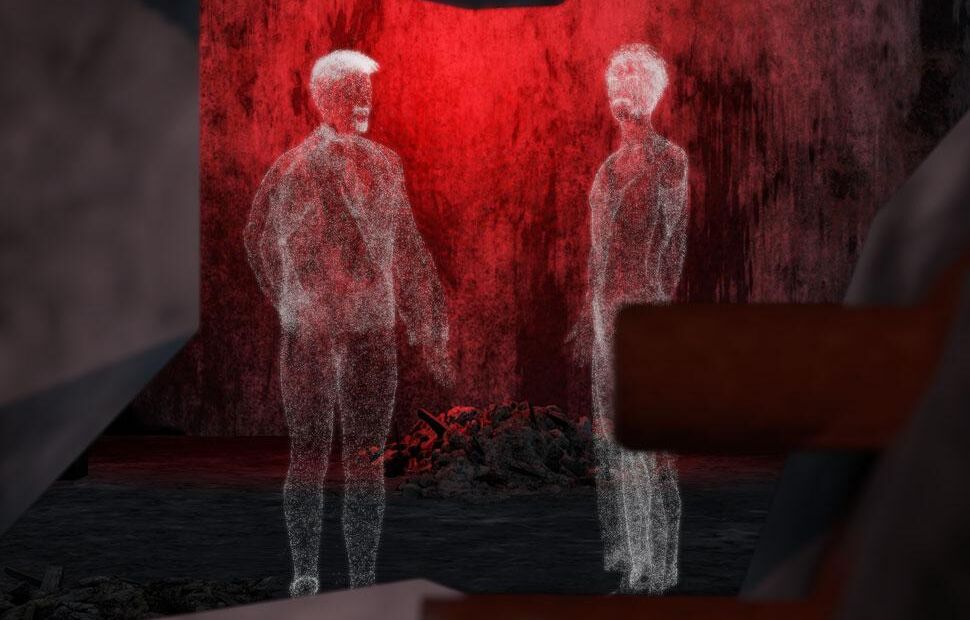
[00:19:01.759] Kent Bye: Yeah, yeah, I really uh enjoyed the overall experience and I felt like it did feel like a guided tour or one-man show but also because you have someone who's speaking to you directly kind of breaking the fourth wall in some sense like speaking to me as an audience directly but it has like more of a theatrical staging and then move into these scenes where now I'm a ghost and I'm like watching this encounter that is played over a couple times, but it's sort of like this initiation of an interaction of cruising that has a glance that's sort of a turning point. Just to be transported into these scenes that are more fleshed out, you have a solidity in the environment with posters and references to the 80s. but you have these ghostly apparitions of these point cloud representations of what you see as the outlines and enough to get a sense of these characters as they're interacting. And so, yeah, I'd love to hear any elaboration on both the decision for the voice of the narrative of kind of speaking to the audience, And I think it kind of bookends, it comes back near the end of that. But you go through a number of vignettes that feel more cinematic, where you're more of a ghost versus being someone that's being addressed.
[00:20:18.492] Lui Avallos: Yes. So I think the most important thing for us about this character is that we wanted him to be super relatable. And something that we also developed throughout the residency was, OK, we're talking about cruising, or at least we're coming from cruising. And how do we make this accessible or at least understandable for all audiences? Because virtual reality is sort of like a niche yet, and doing a niche thing inside of a niche, it was something that was super strict. I believe we wouldn't be able to access and to speak to a lot of people. The goal of this character for us, it was to speak to the audience disregarding who they are. So queer people, non-queer people, we wanted to make it accessible and make people feel close to this character. So this decision of making him speak directly to the person, it was something that for us was this starting of this relationship in a way that he calls, the character calls the viewer dear friend. So we wanted the entire experience to feel as if it was this meeting, this re-encounter of two dear friends who haven't seen each other for a very long time. So this decision of speaking directly to the person was to bring them closer, was to make them, in a way, feel more emphatic about the character. But also, since we're going through his memories, this process of just witnessing as a disembodied spectator was also important, as if the viewer is like a voyeur inside of this experience. So in a way, we wanted to use this contrast between addressing the person directly, but also letting them witness what is inside of the mind of this character that we developed.
[00:22:06.629] Kent Bye: Yeah, I remember the first scene that I'm embodied into this ghostly character that I'm asked to open up a bathroom door to sort of kick things off. I watched this at home in a build that you had sent over and the interaction wasn't like triggering and so I didn't have a sense of what was on the other side. It seemed to progress despite the fact that I wasn't able to engage with it. So you're asking people to do these little embodied interactions at some points to progress the narrative. But if they don't, it seems like it progresses anyway. But I'd love to hear your description of this inclusion of these affordances of like opening a door or these little triggers to trigger the next piece of the narrative and what you were trying to achieve with trying to engage the user's embodiment or agency in that particular moment.
[00:22:52.960] Lui Avallos: Yes, the interactions in this experience, we wanted them to feel very organic as people were inside of places, but also they play a role of this very metaphorical getting into inside of his universe. So, one of the first scenes, the character says that he committed the first of many transgressions inside of the bathroom without telling what it was. So we wanted to play a little bit with this curiosity of the spectator and give them like an opportunity to like sneak into it if they want. And also we have another interaction that the person is surrounded by footage of queer people using cracks in walls, again referencing Alvin Baltrop. And the idea was also to use this as a metaphor for the segregation in order for them to move forward they have to push the walls from the inside to the outside and also sneak into this door. So it's a linear narrative experience but we wanted in a way that we wanted to build something that it wasn't just passive that we wanted to, you know, use gestures and actions that in a way could feel this voyeuristic act of being in this in-between of should I spy through this crack or should I push this wall? Should I look here?
[00:24:11.616] Kent Bye: So there's a segregation between the queer community and the broader community and that by creating these walls it's a symbol of that barrier that you're trying to break through in some ways.
[00:24:20.232] Lui Avallos: Yes, exactly. Even in the voiceover, it feels like the character is almost testing this relationship with the audience. Like, okay, I committed these transgressions without telling what it was and saying, okay, would you want to know what it is? Since it's a topic that is a bit sensible and maybe controversial that is cruising. So we wanted to give in a way this edge to the audience to be able to take actions and do this when they were ready or not because thinking of this queer character speaking with a non-queer audience there is complexities about the level of understanding that people might have about what they're seeing, or if they're about to see something that might be too shocking for them. So I think this plays a little bit with this idea of us trying to engage with different audiences, but not doing something that was extremely shocking to them in a way that they would not engage with the message behind all of this edginess in this controversial issue.
[00:25:21.285] Kent Bye: Is there a difference of how the story progresses, whether or not you take the action or not?
[00:25:25.588] Lui Avallos: Yeah, we don't want people to get stuck in a way. In virtual reality sometimes, pieces that have interactions that are mandatory to go to the next step, sometimes people get stuck. That happens a lot. And for us, we wanted to give them time to be able to explore, but as we said, we don't want them to be stuck. So they have time to explore, and they have time to take the actions that they need to take. And if they do not, the experience moves forward anyway. And I believe this also has a relationship with us trying to bring audiences that are not in VR to VR, specifically people who are older. We want people who are the character to watch our experiences. So in a way, we didn't want to create technical UX barriers that would make them not enjoy the experience the most.
[00:26:14.626] Kent Bye: Yeah, that makes sense. Yeah, for whatever reason, when I went through it, it wasn't triggering the door opening. But it didn't sound like there was a different path. So there's this really provocative scene where I'm looking through a crack and seeing a series of sexual acts in the distance and with this red light. And talking about the AIDS crisis, you have this sequence where you start to turn off those red lights and this metaphor of that these acts that people may be committing in that moment may be transmitting AIDS that may lead to their deaths. So for me, it was really quite a moving moment in the piece where you were talking about the impact of AIDS on this community, but visually representing it in this multi-layered way with looking through a crack, like you said, inspired by this photographer, but also just the spatial metaphor of that, I just found to be really quite powerful and effective.
[00:27:06.397] Lui Avallos: Thank you so much. Yeah, this scene is usually the one that people get emotional the most from the reactions that we had. And yeah, this is an important scene in the script, like in the arch, because for the first time, the character actually gets vulnerable. So he's telling stories about his life. And at this point, I believe is the turning point. And yeah, we wanted to use these interviews that we did and how all of them went through this moment. And for us, it was one of the most emotional moments as well. So we wanted to find a way to make this more, I don't know, more meaningful and to use, again, all the symbols that we're using. So I guess the scene was as an attempt to use the cracks, which was important, the sexual acts that were also important, and also the point cloud bodies that were also important and how to merge them into telling the story about this absence and this almost erasion of this community.
[00:28:04.109] Kent Bye: My memories of some of these experiences can get a little bit fragmented, but I do remember that there was a scene near the beginning where I'm in a fairly closed room with not a lot of stuff in it, but to emphasize this sense of exile and isolation and segregation that was happening in this community. Yeah, maybe it's worth recounting the full arc of the story just so I can help remember my own memory of the piece but also the different beats that you're saying because I remember it sort of opens up in an apartment where you're introduced to this main protagonist composite character that is being introduced as a friend and then I'm in the bathroom scene and then maybe sort of go through the different sequences that you have in the piece.
[00:28:43.798] Lui Avallos: Yeah, sure. The arch of the experience starts with the viewer meeting this man inside of his apartment. This man calls the viewer dear friend. It sounds like a very light chat and they're like re-encountering after a lot of time without seeing each other and then suddenly he reviews something important, which is he's losing his memories and he needs the help from the spectator to go through this journey. So from this moment we have this hybrid between memories and some scenes that were a bit more like a fantasy. So we witness a cruising moment inside of a bathroom and then we have this development of this metaphor of being stuck inside of a box watching through cracks of footage in which the viewer had to push to move forward. And then we again come back to the bathroom and you witness some other cruising episodes Then we also have different environments, such as this spear that we just talked about in spite of Alvin Botrop. In the middle of it, a bit of fantasy scenes about what this character feels and the bodies that were in his history. And by the end, we're back to this apartment, and then he shares the memory in a more solid way with the spectators, who then become a vector of these memories, these important memories that he's sharing.
[00:30:05.801] Kent Bye: Okay yeah there's a couple things there as I remember the sort of arc of the story where yeah there is a scene where you're totally surrounded by cruising sexual encounters but that was certainly a striking and alluring scene. I noticed that there was a warning in the Venice Biennale program that said this is a mature program you will not be able to see this if you were less than 18 years old so this is more mature content being represented. Yeah I'd love to hear the ways that you decided to represent some of these sexual encounters?
[00:30:37.428] Lui Avallos: Yes. Well, it's a piece that in a way starts from the phenomenon of cruising, and I believe it was impossible to disregard sex or sexual acts inside of the story. I think it would be too... hygienizing it too much. But our goal was not to do something explicit, not to do something that it was too much for people to watch. I mean, It's just particle-made bodies interacting, so I believe this is not something super shocking. I think it's more suggestive than explicit. And for us, this is important because, as I said, we're trying to make this more accessible to audiences. And when I say audiences, I don't mean children, but people from all different backgrounds. And doing this in an explicit way maybe could push people away. So we wanted to, of course, use the sex that it is inside of the story in a suggestive way to make people understand it, but in a way make them still engage and understand that it goes further than that. It's not about that. It's about something else. It's about something broader and something deeper and more meaningful than just the casual sex that this community has and have.
[00:31:49.832] Kent Bye: Yeah, and as you are in that scene in the box where you are representing being isolated and segregated, you do have these cracks and you see these films on the other side, which later you come back to some of these films that feel like a little bit more refined generative AI memories that have a bit of like a dreamscape of cloudy early 2022-2023 generative AI aesthetic of images that feel like they're constructed to represent these memories from that era. So maybe you could talk about the images both in the scene with the box with the cracks and then later you have this cinematic reflection of this era.
[00:32:30.231] Lui Avallos: Yes, so AI plays a very important role inside of the experience when it comes to these archived images. We wanted to create some sort of performative memory and speculative memory of this generation. So for us, thinking about that, it was a generation that was partly erased. We wanted to get the aesthetics from artists that were present at that time, or as Alvin Botrop photographed spaces during that time. We wanted to use these aesthetics to generate archive images, like speculative archive images, in a way that it will give life and faces to these people that we didn't manage to see because they were gone because of this pandemic. So, in the box scene, we wanted to show the images to the spectator in a more fragmented way, in which they couldn't see very well because there was a crack between them. And by the end, in the final scene, you actually get to see all of these images blend together in this image of what could be this utopia. there is a book that was super important for us throughout the development called Cruising Utopia by José Esteban Muñoz and he uses this expression that he calls cast a picture of a queer utopia and this is what we attempted to do we wanted to in a way first throughout the arch show these images in a fragmented distant way and then bring them in a way now that the that the viewer know what happened and knows his story and know what these memories are about, they can see them like clearly blending together. And also in the pier scene, they can see as well these archive images through a crack, I believe is the most emotional part of the piece, when the character talks about people that he lost, those images are also AI generated. And for us, this is important from a conceptual point of view, because it takes this technology, this entire hype of the AI that we're living right now, and it's an attempt to use it in a meaningful way, you know? Because people get emotional for real, and they get emotional seeing these images and understanding that these people, they're not here, and they don't exist. Their stories and their memories could have been told and shared if this pandemic didn't happen, you know?
[00:34:44.168] Kent Bye: Yeah, I really agree that it is a powerful use. It felt like the stories that people have of near-death experiences of having their life flash in front of their eyes. It felt a little bit like that type of imagery that you would see for someone whose memories are coming up there. because of the generative AI, it's got the slight edges that are blurry or just slightly uncanny or off a little bit that I read them as generative AI rather than as real photos. If that makes sense, I can sort of see the artificial nature of them in a way. But in the process of creating those, did you use a specific model or specific prompts or how did you go about generating that specific images with trying to match the both look and feel and aesthetic of that?
[00:35:27.489] Lui Avallos: So this aesthetics of being images generated by AI from now, like from this period, like 2023, it was important for us. We want to, in a way, use the aesthetics of this non-perfect AI images as part of what we were trying to do. So we decided to use platforms that would give this feel. So we used Runway. We gather images from the 80s, from the 70s, 80s, and 90s, and we used Runway to all kinds of footage to generate this. And the images that got too perfect were the ones that we didn't use because this blurriness of AI is something that it was important for us from a conceptual point of view.
[00:36:09.818] Kent Bye: Okay, so you're training with a set of images that you're entering in, and then from that set of images, then you're generating new images.
[00:36:15.242] Lui Avallos: Yes, exactly.
[00:36:17.143] Kent Bye: And in the final scenes, I remember, was there another stage with another actor or something that came up and did a little performance or something? What was that about?
[00:36:24.772] Lui Avallos: So this was us trying to reference the ballroom scene because it was also something important throughout this process. It's something that is being relived right now as a symbol of the queer community and we believe this was something that it was important to talk about this queer utopia and use images and symbols of queer utopia if we do not talk about the ballroom scene. So we had the amazing performer Felicia Hunter which was the Miss Drag Lisbon in 2052, and she performed this act. And yeah, for us it was important to have this performative act and to bring these symbols and to showcase them inside of the experience to help broaden a little bit the point of view of this character.
[00:37:08.932] Kent Bye: And so the experience is kind of bookended, starting with this composite character that's greeting you as your friend, and then starting to explore these memories. And at the end, he comes back, and what's the final message that he's giving you?
[00:37:21.559] Lui Avallos: I believe the final message should be that these walls between him and you as a viewer, whether you are a queer person or a non-queer person, these barriers, they're now gone. And that you are now part, you're a vector for these memories. So if before he was going to leave us, and these very important and meaningful memories would have been gone, now they're not, because they're part of you. So we have this interaction that his body is made of particles, and then they are transferred to the viewer, and they can play with them while they listen to his final message, which was also very highly inspired by the book, Cruising Utopia, by José Estevão Muñoz. So I believe the final message will be this, keeping these memories alive, turning viewers and people who engage in the experience as vectors for this casted image of this queer utopia.
[00:38:16.047] Kent Bye: Yeah, I think the thing I was left with was just this real sense of being moved by the piece and certainly the moment of looking through the cracks. But also, like you said, a bit surprised about how on the surface about cruising, but also how it's tying together all these other aspects of essentially being in exile from the larger community and this feeling of segregation and discrimination and also experiencing this pandemic of AIDS. as well. And so yeah, really powerful beginning of this piece. And I'm looking forward to where it goes in the future. And I guess as you move forward, what are the things that you're wanting to carry forth in this spirit, which, you know, as you recount all that stuff, I'm just reminded of like these indigenous traditions of oral storytelling and how like knowledge is passed through the transmission of stories. And it feels like in some ways you're creating this oral storytelling tradition of transferring of these memories and the way that the piece is structured and formed is in this kind of exchange of that transmission. So I think it's a powerful idea to think about what's this kind of oral transmission mean, but using the medium of VR to have this type of what feels like more of a direct transmission from this composite character that's representing all these other stories.
[00:39:26.875] Lui Avallos: Yes, absolutely. I think, for us, the most important thing is being able to keep this queer memory alive, in a way, through different perspectives. So, for this episode, we're using these photographs of Alvin Bartraub and references of queer artists from that time. For the next episodes, we wanted to keep doing this and to find communities and people and point of views that could help us have a better understanding, or at least, as Munoz would say in his book, cast a picture of this queer utopia. And for this, we need different point of views, and we need a lot of people and a lot of point of views being represented. So this is important for us, I must say. So memory, having different point of views, and keeping this casted image of this queer utopia alive.
[00:40:13.595] Kent Bye: Great. And finally, what do you think the ultimate potential of virtual reality and immersive storytelling might be, and what it might be able to enable?
[00:40:23.702] Lui Avallos: I mean, VR has this potentiality as a medium of things that were not possible before. So interactivity and immersion used at the same time, it is something very powerful. And it's something that we're now discovering. If you think about it, it's something super recent. I come from film. I believe my interest in virtual reality comes from film. And as a lot of people say, We're probably leaving the era of the cinema of attractions in VR. And I guess I'm pretty much interested in how this all will unfold when we get to the avant-garde movements and how much we can do with VR beyond entertainment. And I feel like we're starting to get there as a VR community. And I think that's super, super exciting. So I'm very excited. about the next steps and how we could use VR, of course, thinking about technology, but thinking about language, medium, and how can we construct meaningful experiences that can bring people together and discuss things in a deeper, more human and idealistic way. Great.
[00:41:35.182] Kent Bye: Is there anything else that's left unsaid that you'd like to say to the larger immersive community?
[00:41:40.705] Lui Avallos: I think that's it, yes. Thank you so much for having us.
[00:41:44.153] Kent Bye: Yeah, thank you. I really enjoyed the piece and looking forward to the next acts as you move forward. So yeah, like I said, it's a deeply moving piece and tapping into this new form of this oral transmission that you have started with. And yeah, looking forward to see how you pluralistically represent all these different perspectives and try to create a mosaic of this queer utopia through these memories. So thank you.
[00:42:06.323] Lui Avallos: Thank you. Thank you, Ken.
[00:42:08.048] Kent Bye: Thanks for listening to this interview from Fitness Immersive 2023. You can go check out the Critics' Roundtable in episode 1305 to get more breakdown in each of these different experiences. And I hope to be posting more information on my Patreon at some point. There's a lot to digest here. I'm going to be giving some presentations here over the next couple of months and tune into my Patreon at patreon.com slash voices of VR, since there's certainly a lot of digest about the structures and patterns of immersive storytelling, some of the different emerging grammar that we're starting to develop, as well as the underlying patterns of experiential design. So that's all I have for today, and thanks for listening to the Voices of VR podcast. And again, if you enjoyed the podcast, then please do spread the word, tell your friends, and consider becoming a member of the Patreon. This is a listener-supported podcast, and so I do rely upon donations from people like yourself in order to continue to bring this coverage. So you can become a member and donate today at patreon.com slash voicesofvr. Thanks for listening.