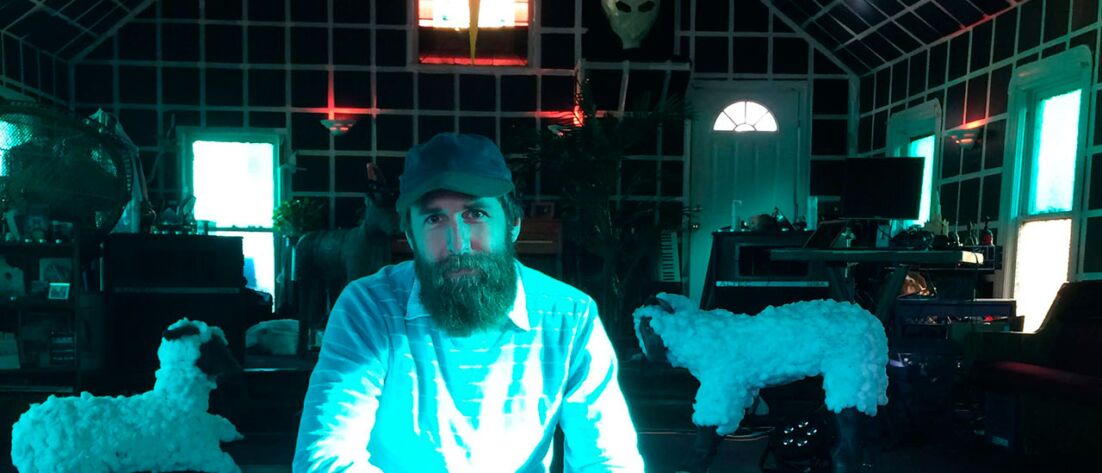
Matt Henderson is a visual artist from Portland, OR who has been creating art installations of abstracted Christmas nativity scenes for the past six years. Matt has been inspired to use virtual reality in order to document and preserve his “NTVTY” installations, and he talks about some of the unique hardware he’s used. He’s also started the weekly Portland Immersive Media Group gatherings, and subsequently received a grant to buy additional VR hardware. Matt shares his journey into virtual reality starting with being an avid listener to the Voices of VR podcast, and eventually into creating a collective of artists interested in pushing the limits of VR experiences that are possible.
LISTEN TO THE VOICES OF VR PODCAST
In my interview with Pete Moss of Unity, he told me that he’s the most interested in what pure artists do with virtual reality because they are the best-placed people who have been looking at new perspectives on existence. Pete says that VR provides new pathways into the brain and just as renaissance scientists were also artists, he see’s VR as a that new medium that is similar to how perspective painting helped to cultivate new modes of thinking.

Hearing this from Pete, I immediately thought of Matt who started integrating VR into his “NTVTY” scenes after getting into VR through listening to the Voices of VR podcast. Matt would listen to episodes while at work, and got inspired to buy a couple of DK2s for his alien baptism experience that is facilitated by a gravity-inversion table. This year, he’s recreated the previous 5 years worth of installations within a room-scale Vive experience.

After attending the monthly Portland Virtual Reality meetups, Matt decided to hold more frequent VR hacking sessions at his ex-church home in Portland that’s decorated to look like the Holodeck. He was able to win a grant in order to buy motion capture suits, 3D scanners, VR headsets, and a gaming PC in order to create a series of holistic healing experiences through pop-up installations under the umbrella of VR Spa. One idea that they’ll be working on includes “cute overload therapy” where you would be interacting with a number of different cute creatures in VR while receiving haptic feedback by an attendant who’s wearing furry gloves.
VR art installations provide the opportunity to push the limits beyond what a more scalable consumer VR experience might be able to provide. But since there’s not a lot of pressure to produce a replicable consumer experience, then there’s more opportunities to do one-off and non-sustainable experiments. I’d expect that we’ll see marketing companies and ad agencies start to adopt these types of high-end art installation and nomadic experiences that would not be feasible within someone’s home.
Matt is looking forward to experimenting with the latest VR technology from an artist’s perspective, and sharing a variety of different experiments as part of the Portland Immersive Media Group’s VR Spa project. For more larger concepts and predictions for what Matt wants to explore, then be sure to check out his audio essay titled “Checking in with my social network: Observations and predictions of virtualization.”
Become a Patron! Support The Voices of VR Podcast Patreon
Theme music: “Fatality” by Tigoolio
Subscribe to the Voices of VR podcast.
Rough Transcript
[00:00:05.412] Kent Bye: The Voices of VR Podcast.
[00:00:12.147] Matt Henderson: My name is Matt Henderson, and I'm a multidisciplinary artist living in Portland and working in immersive media, also known as virtual reality. I got into VR, as you well know, Kent, listening to your podcast. And maybe before that, it was an experience that you worked on on DK1 in 2014, shadow projection. And anyways, that was the first time virtual reality kind of cropped up on my radar outside of Lawnmower Man. So that was really exciting to see. I really remember liking the low-grade graphics and retro computer graphic look of it. And I thought that that would be a great way to remake some 3D art installations that I had made at that time as a form of documentation. I had these very elaborate art installations that were actually nativity scenes. They were elaborate and labor-intensive, and I wanted to remake them in VR so that they could be experienced on the web or downloaded or just exist virtually. So yeah, maybe you could expand on the nativity because, you know, this is something that as an artist for a number of years you had, you know, around Christmas time. Tell me what you were doing and what the goal of that was. Okay, so that's a little bit of a backstory, and it starts in 2010 when I moved into a former church in Northeast Portland. And I was looking to use the space as an artist, as sort of an art studio, sort of a live-work scenario. And we ended up hosting a lot of events there, some of them were music-related, some of them were visual art-related. And particularly each Christmas, we started doing this oddball nativity scene that featured sometimes me and my friends posing as the nativity with hand-sewn costumes and paper mache animals. At least that's how it started. And it was a very tongue-in-cheek thing. But it also resonated on a level with the people who attended and was a lot of fun. So the next year we did an alien nativity and then the following year it got more abstract from there and it just kind of became this excuse to do a collaborative project together around the holidays, decking the halls, so to speak, in our own way. But it got very abstract and just became a good excuse to make a really elaborate art installation that was very experiential. So that happened for five years in a row, and on the fifth year, we incorporated two Oculus Rift DK2s, and that was 2014, after having listened to Voices of VR for about four or five months leading into that. So yeah, talk a bit about some of the actual hardware that you had. I had an experience that you had in Nativity that I actually never experienced before in VR. It was quite unique. Maybe you're referring to the gravity inversion table? Okay, so basically I happened upon this piece of exercise equipment that is for stretching out your lumbar, and it takes a person physically and allows them to turn themselves more or less upside down, or at least recline themselves to varying angles. So, it just seemed like, aesthetically, a cool piece of virtual reality furniture, in the physical sense. And then, conceptually, it was a matter of, okay, what are we going to do with this? So, we decided to create this virtual baptism experience. And it was, you know, kind of new-agey. It was, you were on a platform in the sky. You know, there was a Unity skybox around you that was actually quite beautiful. And then you were baptized by an alien there. Okay. Yeah, you're kind of lean you lean you get leaned back and then as you go you sort of go underwater and then you come up and you kind of see the alien there. So to me, it's just kind of combining, you know, something with, you know, being inverted upside down and starting to kind of almost feel like this anti-gravity thing and then be tracked within VR. You know, one of the recent interviews that I had with Pete Moss from Unity, he was Talking about what he was really interested in is seeing what artists were interested in doing with this medium of virtual reality and I immediately thought of some of these experiences that, you know, you had been creating because it's something that I had not seen from any other kind of commercial application because there is no real commercial application. You're trying to give somebody an experience through this kind of art installation that may be one off. You'd have to go to the very specific location to see it. And that's the only place you could see it with all this additional hardware and the technology there. So as an artist, what type of experiences are you trying to create in VR then? Well, I think that year in particular, I was trying to kind of capitalize on the novelty of VR, but also bearing in mind that I wanted to make something meaningful beyond that. But I couldn't deny that there was this great opportunity to not only introduce myself to this medium that I'd only been hearing about, hearing the excitement in people's voices about what they're experiencing. So I wanted that for myself, but then I also knew that even before I'd tried it for myself, I knew that I wanted to share that excitement with other people. But it's just thrilling to, from an artist's perspective, have a medium where you can really create an experience from the bottom up and subject people to it in a very controlled way, and that it includes audio, that it includes visual information, that it can include haptics. that it can include other interactions with the physical world that are corresponding to virtual experiences and kind of meshing the two. I mean, that's just an artist's dream. So I knew before I'd tried virtual reality that it was something that not only suited my skill set, because I've got a background as a graphic designer, but that it was something that I was going to get really into. Yeah, and so in the last January of 2014 here in Portland, we started the Portland Virtual Reality Meetup, which has been essentially meeting once a month since then and building a community here in Portland. And one of the things that you've been doing is also been starting to meet weekly with a subgroup of that. And maybe you could tell me a bit about the Portland Immersive Media Group and how that started and where that's going now. Right, so since then I started attending the monthly Portland virtual reality meetups and realized that, oh, it would be cool to start meeting weekly to kind of keep my head in the space and make sure that at least this one time a week I was getting together with other people interested in the medium and working with it or talking about it. And also creating experiences, creating games is such a collaborative process by necessity. People have different areas of expertise and they all kind of come together to create something that is interactive. So, you know, I need to learn. I'm still learning and I need people around me who know things that I don't. So through the weekly meetups that have been happening at the church where I live, it's been great to forge these new relationships, work out sort of creative chemistry with a smaller group than the monthly meetups. It's amounted to us essentially forging a collective that we call Portland Immersive Media Group. So upon forming this collective, we hatched this idea for something called VR Spa, which together wrote and submitted a grant proposal to the Precipice Fund, which is facilitated by a local art organization in Portland called Portland Institute for Contemporary Art. And they are redistributing funds from the Andy Warhol Foundation for Visual Art. And so anyways, we authored a grant that was successful. So now we have some money to spend on some very cool VR equipment, like a motion capture suit, 3D scanner, headsets and peripherals, and a great gaming PC. Tell me a bit about what's coming up next with what type of projects you want to create with the VR Spa, but also what's going to be coming up here with the sixth iteration of the Nativity. OK, so I'll start with VR Spa. So in concept, the VR Spa is a pop-up spa that presents a rotating menu of wellness offerings and experimental therapies. So basically it's an excuse for us to get very experimental with this new medium and just explore it for ourselves. I think that arts organizations are very lenient in terms of how accountable they're going to hold you for exactly what's been articulated in a grant. We know that we're going to create some really cool things in 2016 and we're really eager to share them. So a couple ideas that we've had, for example, are something we would call cute overload therapy, where you're pawed by virtual animals while given furry-mitted haptic feedback by the facilitators in the real world. So that's an objective of ours, is to kind of merge the virtual and the physical and play with that dynamic in a gallery setting or at least a physical world setting. Another idea that we've had that I liked is a sort of Sisyphean leaf blower simulation where you're trying to clear the leaves off of your lawn, but your neighbor is trying to do the same. Presented as sort of an alternative meditation where you actually have a modded leaf blower that you're holding in the physical world, but it's also represented virtually. And we kind of realized, well, you could really blow leaves, but you could blow just about anything. So who knows what other things could be attached to the particle system in that case. Yeah, I think that, you know, my experience is that, you know, some of these room scale type of experiences where you have your body and you have the opportunity in an installation to be able to do things where you could have a single person there touching you and giving you this very specific haptic feedback at specific points or, you know, recreating some sort of passive haptic feedback in a room where you're able to mix like this. virtual reality with actual real sensations. And, you know, there's some other companies here in Portland that have been doing some of that as well. But the point is, is that this is something that you're not going to be able to just buy and then experience. This is something that is going to be very unique in terms of, you know, providing something that can go way beyond what the normal consumer grade VR is going to provide, especially when you start to add all these additional things with both the haptics and the people that are going to be required to be able to do some of these things. Yeah, it'll be interesting to see how it feels to show up to these events with our equipment and facilitate these experiences for others, because I've done it enough already to know that it can be kind of exhausting, also really rewarding. So everything about what we're going to get up to in 2016 feels very up in the air, and that's exciting. But yeah, we're just going to feel it out and kind of follow our joy. And so yeah, maybe you could tell me a bit about what's in store for this year's nativity scene and how virtual reality is going to play a part of it. Right, so basically this is the sixth year that we've hosted this artist-created annual nativity scene that essentially started as a tongue-in-cheek joke, you know, these were essentially professed atheists or agnostics standing in as the nativity, you know, so it was kind of irreverent but it was also done in such a way that was respectful. or at least we stuck to the formula initially. It was traditional, there was classical Christmas music playing in the background. But since then, we've really kind of abstracted from the nativity and it's just become this different thing entirely. But it's something that myself and countless people that have been involved with creating it over these past years have really poured themselves into. And so just imagining that those experiences could live on archivally is why I got into VR. And of course now I've got all sorts of other ideas, but this year I'm going to present all the past year's nativities in a virtual reality experience where they're navigable, similar to levels of a video game. And how I've done that, not to spoil the experience, though that's the great thing about VR is you can't really spoil it. You have to experience it. So you can talk about it all you want. You can even show it on a screen, but that's not spoiling it. So basically what I've done is I've taken the floor plan of the church that I live in, and I've reproduced it five times in unity in the shape of a cross. So, the cross is going to be a navigation tool, symbolically. In the sort of intro level, you're going to be tasked with finding this cross in the room that will glow and correspond with your controller glowing as you approach it. So, you'll be tempted to interact with this cross. You'll pick up the cross and then you'll see Roman numerals 1 through 5 kind of depicting where on the cross you could potentially visit. These are each levels you could say. And it's actually going to be a navigation scheme similar to the one that we developed working together, Kent, on the crossover experience. which is to say you have a model of the space that you're going to enter into and you're going to point it where you want to go on the model and then be transported there. So for me, it's kind of a weird astral projected version of the space that has been a very intimate sort of transformative vessel for me. And to be able to depict that in virtual reality is so exciting, and I can't imagine a medium that would otherwise make that possible. So there's still a lot to do between now and December 20th when the exhibit opens, and it will continue to be a work in progress, but that's what one could expect to see. Yeah, and one of the things that's really striking about the place you live in, in the ex-church, is that you've put all these tiles that kind of reproduce the feeling of being in the holodeck. I got to say that having a sneak peek of this environment where I'm in a virtual environment and I'm noticing things. And then when I come out of the environment, I realize, oh, wow, you've really recreated this environment. And I started to notice the real environment even more than I had before after going into the VR experience. And so what this kind of represents to me is as an artist, you may do an art installation and you've been doing the nativity scenes once a year for the past five years. But they're just a one-off thing that may last a week. But now that you're creating it in virtual reality, you're in essence creating an archival experience that anybody in the world could experience, but also they could experience at any time. Absolutely. And I think that's what makes VR potentially kind of the new internet, you know, the new webpage. Once there's a way to navigate through all of these distinct experiences that are going to get created in the coming years, you know, it will be the new 3D internet and That's kind of what I saw as happening and why beyond all these aspects of like, oh, experience through embodiment rather than through a flat 2D screen. It's just that it just seems like so obviously the future of how people are going to interact with different ideas and organizations and businesses and all manner of things online. I see the internet and virtual reality as merging. Yeah and to me it's also just really striking to kind of hear your story from going to the last year and a half from starting to listen to the Voices of VR podcast while at work and then getting a DK2 and creating the experience and then the meetups and now getting all the technology and then getting a hold of a Vive dev kit and then also getting a whole grant where you could buy all this equipment moving forward to by this really cutting-edge perception neuron, mocap suit, or a 3D scanner, or, you know, really souped-up gaming PC, as well as all the latest virtuality head-mounted displays. And so, maybe you could just kind of, like, go back and take me back, and where this all started for you, and, you know, kind of reflect on where you're at now. Well, so I'm a very active creator. And so for me, I try to keep my living expenses and my overhead as low as possible. I have a good but relatively low paying job that allows me to listen to podcasts all day. That's something that works well for me. I need flexibility and I need like free headspace. So how I was able to bring myself up to speed on all that was going on in the VR space and Learn about all these tool sets that have become Integrated into what I've been trying to do. I learned all that while on the job listening to podcasts I went to the Institute of Voices of BR, and yeah, it's been a really good learning tool. So it's really kind of incredible that that's possible, that we've arrived at a time where you can receive an education while earning your living. And that's pretty cool, and it just seems utterly unique to our era. So I think it's been a matter of, for me at least, having specific ideas about how and why I wanted to get into VR, and voicing those ideas, and then really going after the necessary resources to make that possible. So yeah, the recent grant award has just been huge, and will really open up some opportunities for us, really give us an edge in being able to work with some really bleeding-edge tech And so finally, what do you see as kind of the ultimate potential of virtual reality and what it might be able to enable? Well, of course, I've heard this question asked a few times. So I thought about it a little. I'm prepared to go out on a limb and say that I think virtual reality in the coming 10 to 30 years is going to be so transformative that It won't be long before we look back and we wonder what happened. I think that VR and AR are obviously headed in similar directions, at least in that the content pipeline to the two distinct modes of presentation are so similar. It's more about the content, and I think the implications will be so sweeping. Once the creative community really gets a handle on these tool sets, and once the tool sets are made more simple to use, I see it as transforming how we interact with one another. I see it as greatly affecting human intimacy and sexuality. I think it's going to open up inner dimensions of our psyches. I think that it will have effects that we would look on as very strange or maybe even damaging from our current vantage, but it's important to keep in mind that we have to go through those evolutionary steps to arrive at those places where we're prepared to integrate technology and that it happens through an evolutionary process. I don't think that we can really predict what's going to happen, but I don't think virtual reality or augmented reality are gonna go away. I think it's just a matter of how and in what ways are they gonna get integrated and what's the timeline. But I'm taking the long view on it and I think that something really monumental happened in late 2013 or throughout 2014 and now the ball is rolling steadily forward Great. And anything else that's left unsaid that you'd like to say? Well, I made an audio essay that, if anything, is a very, to me, will be a very unique document looking back on it a year from now, three years from now, five years from now. But I'd encourage anyone to listen to it. It's called Checking In With My Social Network, Observations and Predictions of Virtualization by Matt Henderson. Basically, this was something that I produced throughout my own kind of gestation period, trying to wrap my head around, you know, okay, what does the onset of commercial virtual reality mean? And also, I was processing a lot in terms of what about these social networks and what sort of effects have they already had on our consciousness? And I had decided that I thought that those effects were already pretty profound and kind of placing a considerable stress on culture for people to really integrate them in a way that was comfortable. So it's about social networks, it's about virtual worlds, and it's about virtual reality. And the feeling I got that these were soon to kind of merge in a way that was going to, again, be very profound. So yeah, check it out. Also, you can check out VR spa club. That's our website we have a sort of a teaser video there currently and Portland now has a lending library where Qualified applicants can check out certain pieces of VR equipment to help their development or show their work Okay, great. Thank you. Thanks Kent
[00:23:39.689] Kent Bye: And thank you for listening! If you'd like to support the Voices of VR podcast, then please consider becoming a patron at patreon.com slash voicesofvr.