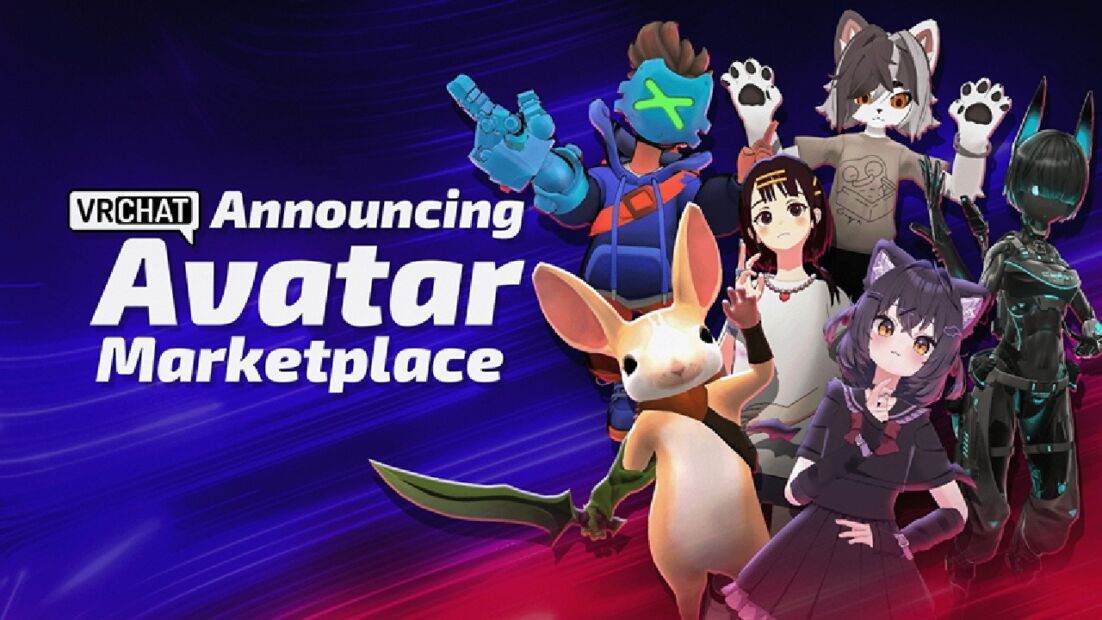
I spoke with Kaki Navarre & Aev about the launch of VRChat’s Avatar Marketplace. See more context in the rough transcript below.
This is a listener-supported podcast through the Voices of VR Patreon.
Music: Fatality
Podcast: Play in new window | Download
Rough Transcript
[00:00:05.458] Kent Bye: The Voices of VR podcast. Hello, my name is Kent Bye, and welcome to the Voices of VR podcast. It's a podcast that looks at the structures and forms of immersive storytelling and the future of spatial computing. You can support the podcast at patreon.com slash voicesofvr. So on today's episode, I'm going to be diving into a conversation that I had with Kaki Navari and Ave. They are talking about the VRChat avatar marketplace, which is like newly launched for avatar creators to be able to sell avatars to VRChat users. So I came across VRChat at Augmented World Expo. They don't usually come to these festivals, but they were showing what's happening with the avatar marketplace to different users at Augmented World Expo, but also, you know, potentially moving out into more enterprise clients. VRChat did have layoffs about a year ago, back in June of 2024, where they laid off around 30% of their customers. staff. And so they are in the process of trying to figure out the monetization schemes. And they're launching the avatar marketplace in the hopes that they're going to be finding new revenue streams to be able to create, you know, a sustainable platform. So they're actually targeting more new users rather than the power users that already have the ability to kind of upload all their custom avatars. But they just want to make it more easy for people that are coming onto the platform to find avatars that they like and want to pay for. So Well, covering that, I did ask some questions around some trust and safety and more broader economy questions. And that's not necessarily their field. And so they gave some answers, but they're not authoritative. So I did have a chance to follow up with the new trust and safety lead that they connected me to. And that'll be in the next conversation where some of the different concerns that were brought up in the previous episode of 1634 by Harry X around some of the different concerns. trust and safety gaps that this concerned user was finding in vr chat for not safe for avatars not taking like fast action to take them down we'll be covering some of the broader plans for trust and safety in the next interview with the new trust and safety lead june young row so overcoming all that and more on today's episode of the voices of vr podcast so this interview with kaki and ave happened on tuesday june 26 2025 so with that let's go ahead and dive right in
[00:02:17.805] Aev: I'm Ave. I go by a username. I got caught with that pretty early on in VRChat days. I've somehow now been in VR as an industry for quite a long time. Just recently passed my seven-year mark at VRChat. I joined mid-2018. VRChat had just had its first major viral moment. Concurrent user count at the time was maybe 200 people and it jumped up to 20,000. As you can imagine, the team was extremely busy and doing their absolute best just to keep the service running at all. At the time, I was managing a contact center for Google support. And so as the users went up, so did the support tickets. And I came in to help with that situation and get us off on the right foot with all of the new users. Over time, helped with production, was focused on releases at VRChat, so making sure they were more consistent, more stable, and had some exciting stuff in them. Built out production at VRChat over time, so hired a team of producers. And now I'm in an interesting space where I'm kind of supporting Graham, our CEO, on special projects and efficiency and making sure that things go as well as they can kind of across the company. So that's what I've been doing.
[00:03:30.990] Kaki Navarre: And I'm Kaki Navaray. I have been obsessed with computer graphics in general, since I got my hands on my first copy of Maya as a teenager, but I got into VR mainly at Disney. So I was there for about a decade prior to joining VRChat. And I worked on a number of different immersive technology projects, a couple involving VR headsets, but also looking at applications of game engine software more broadly. So using Unity and Unreal to produce television animation, to make interactive content for virtual production, those types of applications. And then when this role at VRChat opened up, I jumped at the chance to work in a creative adjacent role, working at the forefront of immersive social. And currently I'm the director of product for creators. That's my passion. I'm obsessed with building technology and service at the creative process. And I focus on our creator-facing roadmap, so that includes the VRChat SDK, the Creator Companion, and also the VRChat content ecosystem more holistically. So VRChat's creator economy and the avatar marketplace have been a big focus for me this past year. But I also look after our creator relations function, which is led by the one and only fax machine.
[00:04:50.287] Kent Bye: Very cool. And maybe each of you could give a bit more context as to your background and your journey into working in the virtual reality space. I particularly like to hear all the different educational strands, the design disciplines, and I feel like each person based upon their journey is bringing unique perspectives. So I always like to get a bit more context as your journey into the space.
[00:05:10.250] Aev: Gotcha. Yeah. I mean, my journey was a little bit unconventional. When I joined VRChat, the company had already been around for a surprisingly long amount of time. I think there were people at the company who had already been there for almost five years. And of course, there were the early VR days, DK1 and all of these exciting moments. And I wasn't really there for that. I think my earliest VR experience was cardboard. And I for whatever reason didn't really speak to me. It wasn't really what I thought VR could be. And I didn't pursue what really VR was becoming at the time. So in that moment, I'd been working managing that contact center. We were doing a variety of different things. It was a very high volume type of situation. And I believe it was YouTube was the first thing that actually got me to see VRChat. Individually and personally, sandbox games have always been the thing that I'm the most excited about, whether it's Minecraft, Garry's Mod, these things where you can create your own experience. So as soon as I saw VRChat in these videos long ago, Nags, Joey Bagels, these role play type of videos, I was so impressed. I needed to know more. I needed to see more about what this kind of crazy environment was. So I reached out. I started getting involved. I started trying VRChat, first in desktop. I think as a lot of people do, as soon as I saw how much fun I could have in that type of environment, I moved to VR so quickly from desktop mode of going in Steam. And I made so many friends along the way. VRChat, while it had grown a lot in that moment, it was still pretty small. You would normally run into the same people if you went to the same public spaces. So it was kind of a personal and a professional development at the same time for me, getting into the company, understanding what we were working on, what we were working towards, and what we still now are working towards. It's been a wonderful time.
[00:07:06.459] Kaki Navarre: So I talked a little bit about My initial exposure to VR earlier. I'll say, so the early days Abe was talking about around the sort of meta acquisition of Oculus, those were really exciting. When I was within Disney, it felt like every week there was a new awesome demo. The content that was coming out of Oculus Story Studio, I remember being one of the first things I saw and was particularly impressed by. There's a great one about a little porcupine named Henry. And I worked on a couple different experiments in the early days. We did a 360 streaming video for Radio Disney that was a lot of fun and looking not just in terms of headset VR, but thinking about VR across a range of modalities. So VR is part of a broader spectrum of mixed reality. And then also a spectrum of what can you do with spatial computing more broadly. So that has always been a really, really interesting area and career focus for me. And then VRChat was the first time that I've really gotten to think about it in a platform context. So that's been a lot of fun and. One of the things that was particularly exciting to me was just the range of creative expression that's possible on a platform like VRChat, where effectively anything you can do in Unity is possible with some constraints. So that's what gets me really excited about our platform, but also about the medium in general, to continue to contribute to that and find ways to unlock boundless creativity.
[00:08:53.325] Kent Bye: Yeah, well, it was about a year ago on June 12th, 2024, where VRChat had some layoffs. And there was a lot of discussion that was around like, how is VRChat as an entity going to move towards this path of profitability? And I think there's the VRChat Plus, which has got some revenue stream. But I think the big bet has been on the creator economy being the introduction of something where There is this value exchange, whether it's you're going into worlds and buying different assets or getting more features. You know, there's the avatar marketplace that you just launched recently. So I'd love to hear from your perspective, some of the different challenges that you've had in terms of launching this, because I know that it was announced many years ago and then a slow rollout with beta testers. It seemed like there was a lot of caution of like wanting to really get things right and to be things in balance. And so I'd love to hear from your perspective, like what that story is of the creator economy and the marketplace and what were some of the reasons why it took so long to finally get it live and launched?
[00:09:56.973] Kaki Navarre: So I can only speak to the more recent. I've been at VRChat for about a year, but I think one of the interesting things that we found is getting a new content type off the ground in the context of a marketplace is something that takes a decent amount of iteration and getting right. And we needed to kind of check those boxes for all of our existing content types, worlds and groups, and now avatars before we could really invest in the marketplace and create our economy holistically. So what I'm really excited about is now that we have those three content types out of the gate, Anything that we invest in is as a sort of general creator economy capability benefits everyone. It benefits world creators. It benefits group creators. It benefits avatar creators. So I think we're going to see some acceleration from here. The other thing I can share in the context of avatar marketplace specifically is that there's definitely a balancing act. between speed to market and perfecting the UX. And we've, you know, we've done about a bunch of iteration there, but in all cases, it's been an exercise of trying to get a foundation out in the world that we can improve upon, learn and iterate. And there are a million small things that we aren't going to get right. And sometimes big things. I think we're certainly perfectionists in the sense that we all hold VR chat extremely dear. We care a lot about our creators. We want to make sure that their content really shines. And so right now, as we reflect on the launch of Avatar Marketplace and think about what's next, we have bigger roadmap plans. And I can talk about a couple of examples if that would be interesting. But we're also trying to really refine and tweak and get a lot of the specific details correct. down to really small things. Like we got a bunch of user feedback on the try and wear button and how we can potentially refine that. So that's just like a little example of something where, yeah, it's a small thing, but it's a small thing that our users interact with every day. And so we want to get both the sort of micro and macro level decisions right.
[00:12:01.786] Aev: Yeah, that all lends to me. I mean, I don't have all of the context on the older history for bringing creator economy to VRChat. I will say that a lot of care goes into that process, and that can really affect the timeline. That was the first moment, other than VRChat+, which feels kind of separate to the experience, where we were bringing purchases as a possibility into the experience. And there was a lot of concern and people from the community not being sure how that might come in. A lot of people did think that the day after that came out, that there would just be paywalls everywhere and you couldn't get to your friends and you got to pay to unlock gates and all this stuff. And we haven't seen that. And our creators have actually been really thoughtful in the way that they monetize and kind of offer both for everyone, also for people who bring support to those creators.
[00:12:52.711] Kent Bye: Yeah, so I want to dive more into the specifics of the Avatar Marketplace. But before we do that, I wanted to just ask briefly around Augmented World XO and having a presence there. Because back at Silicon Valley Virtual Reality Conference 2014, that's where I first met Jesse Jodry. And he was like four or five months into even launched VRChat back in 2014 with Graham Gaylor. And then subsequently after that, from like 2014 to 2019, I would run into either Jesse or Graham or someone else from VRChat and would have pretty regular interviews with folks around what was happening at VRChat. But then After the pandemic, there was just not as many conferences that VRChat was going to. And so just curious to hear, like, what was the decision to have a booth at Augmented World Expo? There tends to be a lot of industry folks, but also enterprise folks. And so just curious of what type of conversations you were having there and if there's other plans that VRChat has to like expand out into these other enterprise contexts.
[00:13:52.631] Aev: Yeah, I'll start us off there. AW was a lot of fun. It's really nice to be able to go to an event like that physically. That's not something that VRChat does too often. There's a lot of opportunities for shows. And at least speaking way back, at a certain point, the team was actually very small for a long time. And putting in all of the effort to travel and put together these things, it was a pretty big distraction for the team. So there was a moment years and years ago where we said, OK, Maybe conferences are not exactly what we should be focusing on. Let's just make VRChat as great as we can, and we'll see where the future takes us. So being able to be there was amazing. So many great people to talk to, whether it's companies, community members, sometimes both. In this particular case, what we were doing is we kind of had a split booth set up. We were there with Sawhorse, which is a really capable and kind of incredible 3D creation company. And they are one of our first partners as we're launching Avatar Marketplace, bringing kind of like professional level content into that space and introducing companies like that. So awesome partner. It was really nice to meet them and be there physically with them as well. So both of us were there and kind of talking about either Avatar Marketplace or Sawhorse and what they do, how we were working together. And really just, you know, a lot of people coming by were just excited to see that we were there. You know, people know that we're not too commonly in these spaces. And so really common question was, what are you guys doing here? Oh, this is so cool. And the answer from us was just, we're chilling. We're just talking to people. We're getting a vibe from the community, from enterprise, from companies. and seeing how people are feeling. And that was really nice.
[00:15:38.027] Kaki Navarre: Yeah, for me, I can say, so this was my first time interacting live with VRChat users and creators in the real world. And so that was super cool. One of the really awesome things to see was just understanding the social dynamics a little better. So meeting groups of people who use VRChat to stay connected across the globe who said, oh, you're interested in this. My friend is over there. Let me have them come over and have a conversation. So that was really cool. I was able to talk to VRChat users and a couple of VRChat creators and understand in a little bit more depth what they see as VRChat's unique value proposition. We interact digitally with our community members all the time. We do user research, but there's something about being there in person that adds another layer. And there were a couple of amazing soundbites. I think one gentleman said something along the lines of, VRChat is the greatest repository of creative expression that's ever existed, which was really lovely to hear. And then something else that came out as a theme was sort of the humanity of the platform. So that was really wonderful. It's inspiring to me as we think about how to build roadmaps that really double down on the magic of what makes VRChat unique. So that was really cool. And then another really interesting thing that happened a bunch of times was the number of people, and this is me putting my director of product for creators hat on, who stopped by the booth and they don't identify as creators, but they are creators. They'd say, oh, I'm not a creator. I just built this world because I wanted to experience it. And that was really fascinating, particularly as we're starting to try to understand our creator population in more of a structured way. There's really extraordinary diversity there along a number of different dimensions. So what motivates people, their backgrounds and skills, the types of content that they create and understanding that better helps me and helps the team think about prioritizing roadmap initiatives that have the greatest overall impact for our creators and also the VRChat ecosystem. So just really cool to put some real world people and faces to the community members we interact with primarily digitally, as Abe has said, historically.
[00:17:45.781] Kent Bye: And maybe you could elaborate a little bit more around this collaboration with Sawhorse. And what specifically was Sawhorse doing with the creator economy? And, you know, are they generating avatars, making avatars? Because, you know, you're selling avatars on VRChat now. So are they like a creative agency production? Just kind of give a little bit more details as to what exactly they're doing.
[00:18:08.345] Aev: Yeah, as we're bringing Avatar Marketplace to the entirety of VRChat, a lot of the people creating avatars are individuals. They are working with what they have. A lot of these people have learned to make avatars because of VRChat. But there's a huge industry with a lot of professionals making amazing content. We're trying to see what it looks like for them to enter the space as well, to start interacting with our creators, start getting involved, bringing potentially brands and recognizable content into that space as well through those connections. So really kind of covering the board. Yeah, I mean, that's the summary. They're a very strong partner for the 3D creation and leaning into what that might mean for VRChat long term.
[00:18:51.954] Kent Bye: Okay, well, we're about three or four weeks into the avatar marketplace launch. And just curious to hear a bit more around like, how's it been going so far? And what were some of the pain points you were trying to solve in terms of like, you know, for most times that people want to upload an avatar, they would have to have a PC, they would need to get unity, they would need to go through this whole complicated process of getting everything wired up and uploaded. And so it wasn't necessarily truly accessible for everybody if they really wanted to customize the look and feel of their identity on the platform. So just curious to hear a little bit around the launch, how's it been going and some of the different things that you were trying to achieve with this.
[00:19:29.147] Aev: Yeah, I'll start us off. I'd love to hear from Kaki on this, definitely. I think that that's been going great so far. It's a new thing for us, right? A lot of these things that we're building, it's the first time that we've been able to bring this kind of functionality and this pathway of support for creators directly into the platform. So there's also a lot of things to learn, right? But even with all of the things that we might be learning through the process, I think it was... You said it's about three weeks now. At least a week ago, there was kind of a moment in the Discord server where we communicate with our sellers that we brought on so far, where everyone started celebrating that they've now paid their rent with money that they've made from Avatar Marketplace. And that's a great feeling, right? They have Avatar sales on a variety of platforms. It's not the only place, but it's bringing their content and their creations to... that user base that hasn't really been able to access it before. If you're not able or interested in using Unity, Blender, these 3D tools to find an avatar that fits you and your personality, that you get to have some ownership over, this is the first moment that people have been able to do that. And so being able to see the support that has come to creators so far is exciting. The community, I got to shout them out. They've been amazing. Like the activity in the discussion and all of the thoughts that people are sharing and ideas on what content to make next, you know, they're jamming on new avatars and showing off works in progress and giving advice and it almost as a total side effect, like that space has been really amazing. Yeah. We've also been bringing in a lot of creators over time. We had a pretty big spike in applications of people who want to join Avatar Marketplace when it went live. Shout out again to Fax Machine, a member of our team who has been doing phenomenal work processing all of those applications. But we've been bringing on a lot of creators into that space. They are now getting their avatars listed. They're now starting to see the sales come in from that system. So it's been a lot of fun. There's a lot to celebrate, for sure.
[00:21:35.014] Kaki Navarre: Yeah, I'll plus one what Abe said about a big, big goal of the creator economy is enabling creators who want to, not everybody wants to, to earn a living on our platform, building the content that they love. The other thing it enables us to do is it gives us a route to invest back into the platform and create more features and experiences people love. I'll share sort of one other interesting anecdote we're seeing in the launch data, which was a bit of a pleasant surprise, which is that the avatar marketplace has been really popular with new users. And this is particularly important to us, not just from an economy standpoint, but we know that self-expression and identity is such an important part of what it means to be a VR chat user and to exist on our platform. And so providing us with a way to increase diversity and accessibility of avatars to folks who are new to the platform, probably even if they've used unity, they're not familiar with our SDK. That's really exciting in terms of creating a more engaging and just overall positive experience. So we're really excited to see that. And that's one of the trends that we're monitoring closely.
[00:22:40.954] Kent Bye: Hmm. Yeah, I did an interview with Kay Guillory a number of years ago, and I published it last year in episode 1408. And I started to dig into the history of the origins of VRChat. And what I found was kind of interesting in the sense that Jesse Jodry came on in the release of 0.3.5. which was on March 15th, 2014. So it was basically like the third iteration. It was the first public association that Gestry had. And it was launching with VRChat now with custom avatars. So from the very beginning, probably because in a lot of ways, Graham wasn't really like a computer graphics guy. And so they needed to have like the ability to have user generated content. So from the very beginning, there's been this openness to being able to upload your own avatar. And in the discussion that I had with a number of community members last year after the VRChat layoffs, you know, Unix, I think, was one of the person that said, you know, once that VRChat opened up to other assets, then the quote asset genie was out of the bottle, meaning that most of the ways that folks are monetizing these platforms have been through identity expression and avatars. And so it's interesting that VRChat's now in this kind of hybrid mode where you're still having that. And what we've seen is that there's been these third-party entities like Gumroad and Booth where avatar creators could go sell their avatar creations and have the majority of the money paid go to those creators. And so now as they move over to this built-in custom, it's more seamless, a possibility for more scale, but the revenue split is more around 50-50 for those creators. And so you have this trade-off that a lot of creators will have to make, which is, Can they make more money if they sell less offsite or make more if they're selling onsite? So just curious to hear a little bit more around this revenue split 50-50, you know, how you, if there's other options that are out there that are less, how you start to navigate this fragmented nature of the economies of VRChat that are so much of are happening offsite and trying to find ways to incentivize the content creators and avatar creators to come on and use the custom built-in tools.
[00:24:56.832] Kaki Navarre: Yeah. I think the sort of simplest way to answer that is that we view it as additive. We're not asking creators to be exclusive to our platform. That was one of the very first things we told them when we reached out to talk about the Marketplace. And it's also, by the way, one of the reasons we decided not to include source files in the V1 of Avatar Marketplaces is we thought about how do we create the most holistic value for creators and for the community? We wanted to address a net new opportunity. External markets for source files already exist. There's a thriving ecosystem there, but it's largely a different audience. The vast majority of people who are purchasing on Avatar Marketplace have never used our SDK, have never uploaded an avatar. So it's really a new thing where now we are the only ones who can provide buyers with the ability to instantly access purchasable avatars in client while supporting their favorite creators. And I can talk a little bit to the specifics of the revenue split. So as you said, our rev split is approximately 50% to creators. The majority of the remaining revenue goes to paying platform fees to companies like Meta. That's about 30%. So that just is what it is. Sometimes we think of that as like the tax we pay for the instant entitlement and client. And then the remaining 20%, it covers our cost to build and operate a marketplace. It also covers partner fees like our payment providers. And again, one of the great things about that is it enables us to invest back into the platform and create features and experiences people love on VRChat. But, you know, we're very cognizant of the fact that 50% is not a small number. We've had a lot of dialogue with our creators about that. And so when we were thinking about how to responsibly structure a marketplace, something that was really top of mind was making sure that we made that creator share as large as it could possibly be while having a sustainable marketplace.
[00:26:55.695] Kent Bye: Dave, did you have any additional thoughts on that?
[00:26:58.453] Aev: I mean, I think Kaki summed it up pretty well. I think it's kind of an ongoing conversation. I will say that just in the conversations we've had with creators, that was one of the questions, you know, the things that we wouldn't be sure of. Would the launch of Avatar Marketplace have a noticeable effect on sales on external platforms? And just from the comments that we've seen and the discussions that have happened in that server, so far we're seeing no impact whatsoever. So the external markets, as we suspected, are just a very different audience. All of the revenue that the creators are seeing so far has not been a cannibalization of their existing sales. It's just additive. It's something extra to be excited about.
[00:27:38.066] Kent Bye: I'm really struck with the 30% tax that is on all of the platforms from iOS, Android to Meta. So I know that Tim Sweeney from Epic has been bringing lawsuits. There's different antitrust lawsuits and trying to have the ability to have alternative stores and alternative payment systems and having links to buy off the platform through a web browser to get past some of those 30%. So it seems like this is an area where there could be continued movement towards, you know, having more of that money being paid, not just go to the platforms, but also go back to the creators. So, but that, that seems to be larger ecosystem things that are going on in terms of EU has the digital markets act and other things like that, where they're trying to create less of a antitrust problems with these platforms that are going to be taking that 30% tax forever, but really just struck by, you know, how that in this case directly impacts the creators so directly.
[00:28:34.738] Kaki Navarre: Yeah. And we're, you know, we keep an eye on the macro environment. This is very much just version one. And so we're going to continue to monitor that and make the best possible strategic decisions we can to create opportunities for our creators and best possible experience for users.
[00:28:52.972] Kent Bye: And so in just terms of some of the larger ethical issues around avatars, the fact that you can have avatars that are not safe for work, it doesn't look like the avatar marketplace is allowing not safe for work avatars, but there is the ability to have not safe for work avatars that are in private instances and between consenting adults. There seems to be a policy at VRChat where if you're streaming or broadcasting publicly, then there are more constrained things you can do. But if you're in a private instance, with other people, then there seems to be a lot more leeway for that. So I'm just curious to hear, like, how do you tell the story of the existence of not safe for work avatars within the context of VRChat and what are the contexts where it's okay and not okay?
[00:29:35.495] Kaki Navarre: I can talk about it in the context of the marketplace, right? The marketplace has really wide access. Any user is instantly able to view any avatar on our platform. So we knew we had to hold ourselves to a very high standard there. And we're also early in our technology journey in terms of thinking about that more mature content. So we launched age verification earlier this year, last year. There's a huge amount we can do with that. I would say we're very much in inning one. And so thinking about the possibilities that a technology like that could open up for the marketplace in the long term so that users who are age verified and are interested in more mature content can do those things in private spaces is something that is certainly on our radar. We don't have any specific plans for it right now. But that's kind of how I think about it in the context of the marketplace is at launch, we needed to take an approach that we knew would be safe for a wide audience. And that was our number one priority was prioritizing the safety and comfort of everybody who comes to the marketplace and to our platform. So yeah, that's how I think about it. And I think there's a huge amount of opportunity and user needs are different and diverse. And that's something that we're really thoughtful about as we establish policy and then also think about our marketplaces and
[00:31:00.635] Aev: opportunities for creators to monetize yeah definitely i mean candidly i'm not the one to be speaking to our trust and safety policy um one thing i will say is that the comfort of every person in vr chat is critically important private space or not if something gets reported and it's not in line with vr chat's terms of service you know that will be investigated it'll be handled So it's not necessarily that private space is a fair game or a free space. It's that we have these rules, we take it seriously. And when people have anything happens that they're uncomfortable with or that they report, we follow up on that.
[00:31:39.406] Kaki Navarre: And I can add one more piece of context as well in terms of the marketplace and just kind of how we think about our trust and safety strategy. So we kind of, it's a two pronged approach. The first is sort of more proactive moderation. So we manually review every avatar that's submitted to ensure it's consistent with VRChat's public guidelines. And we're also checking, by the way, to make sure that avatars are functional, that they need a high visual and technical bar because we want to protect our buyers' investments. And then the second piece of that, as Abe was speaking to, is reactive moderation. So we've enhanced our internal tooling and processes to account for avatar marketplace so that in the rare instances when something problematic does find its way into the marketplace, we're prepared to respond.
[00:32:27.133] Kent Bye: Yeah, I did record an interview with a VRChat user named Harry X. He was reporting a number of these different avatars that had violating features within the public avatar. So it seems like that there's different SDKs that when you go into the expressions menu, you can start to turn on these different features. And so it seems like that there's at least some automated systems and manual systems. And so as you come up with a very small team on VRChat, but also dealing with concurrent users and the hundreds of thousands and millions of users, there seems to be like a scaling issue where if some of these are coming in, then you have to have like a mix of both automated systems, but manual moderation, just in normal social media, we have content moderation, which is still things like some of this would fall into that, but there's also conduct moderation, which is trying to deal with the specific conduct, but In this, it could be a combination of both the TOS violating avatars with on top of the conduct, trying to mitigate harm that's done. But yeah, just what's the challenges there in terms of both the conduct and creating this balance of both these automated systems and having a team to help do all that moderation?
[00:33:41.877] Aev: Yeah, I mean, I think that it's something that gets tackled from a huge variety of angles. We recently brought on a really incredible trust and safety expert that we're really excited to be working with, June, who has been really kind of getting strategy in all of those different areas. I think for what you just mentioned, it's a really important point, which is that There's the conduct, the behavior, and then there's the content itself. And so we see that pretty often, or sometimes an avatar may be totally unassuming, but if used to be offensive, it can now be a problem. So determining where that moderation line falls can definitely be difficult. And I'm glad we have experts working in those fields. For automated systems, I mean, we're looking at every kind of technology available. Of course, as AI is getting more and more popular, we're looking at that. When people upload images to VRChat to use for a variety of the custom image features that we have, we do scanning on those things. And we make sure that things that come back, well, are either automatically blocked or reviewed. So there's a range of things that we're working on there. And it's a constant battle, right? UGC is a difficult space to be in for these things. But I think that we have the right people on it. And we're looking at all the different options.
[00:34:57.836] Kent Bye: One of the things that I've noticed within VRChat is that you have a wide range of different ratings of the performance of avatars from good to poor. So basically the more fidelity you have in your avatar, that sometimes means that when you're in these instances that you can either have less people or it creates more performance issues if too many people are in low-performing avatars. So it seems like there's this trade-off between the amount of compute resources that you have, the expression of your identity dialed up to the highest it can be, but the more that you do that, you could create a worse experience for other people, but also potentially limit the number of people that could even be in that instance. And so... Just curious to hear some around this dynamic of the performance of the avatars, of having something that was very open in the beginning. But what's your strategies for trying to either get it down to more performant avatars? Or in a way, it seems like this is left up to the runners of specific events where they have to have people change into an avatar that's more performant in order for them to enter. But that seems to be something that is either self-policing or they have to enforce, but... Just curious if there's other algorithmic things to kind of hard enforce certain performance limitations or just this general dynamic that you've faced with this trade-off between the performance of the avatars and having a good experience for everyone.
[00:36:21.038] Aev: Yeah, this is a great question and one I might have to time box because I could talk forever about avatar performance. It's a really difficult space to be working in. If you're just in a room with one other person, if their avatar is what 10 or 20 people might be in a crowded event and you have the same experience and things run well, maybe that's okay. But we don't really have a system that is extremely dynamic in that way. The avatar performance rank system was designed a long time ago, and it's done an okay job at keeping people aware of the impact of avatars. But at the same time, I think we know that there's a lot of potential future improvement for properly measuring the performance impact of avatars. There are also factors that are more difficult to work through. So as we look at external marketplaces, performance from what I believe at least has gotten worse and worse over time and over the years, just on average. If you go and ask some people, we are at the point where I have heard opinions that avatars are higher quality by having worse performance. If Polycount gets up to 700,000 or a million on one avatar, it's like, oh, that's a great avatar. Look how complex it is. It's not the fault of individuals for that type of perspective. They just see the numbers and they're in that environment and It is what it is. So really that all boils down to, for me, if you're selling an avatar and buyers don't change behavior based on how it performs, then I think you're incentivized to put more and more things on there and more features and more spawnables and toggles and outfits and all these things that really can ramp up the performance cost. And if people keep buying it, or maybe they buy it more, you know, you're going to keep doing that. So one of the things that is difficult, but I think is critically important about VRChat's avatar marketplace is that we're being pretty stringent on how heavy those avatars can be. There needs to be some kind of factor that creators need to keep into account to keep that at a reasonable level, because we're able to look at these external marketplaces and see that things will ramp over time.
[00:38:38.293] Kaki Navarre: Yeah, I'll add two more things there. One is, I think, you know, as Abe said, with trust and safety, this discussion is one that we can approach from so many different angles. Avatar optimization is just one angle, but that is an area where we are looking at tools to support our creators with better automated optimization. The other thing I'll touch upon lightly, which is a little more future looking, is avatar customization. So as Abe mentioned, like, Something that is very performance heavy is when toggles change the mesh. But right now, that's one of really just two ways that sellers can offer customization to buyers without source files. They can do that or they can list variants of the same avatar as bundles. And so, well, I don't have anything specific to share today in terms of our roadmap plans. I will say that customization is something that we are thinking about very seriously. We're thinking about a couple of different ways to achieve that. Again, because we know that uniqueness, identity, self-expression are absolutely core to the reasons that our users choose to select an avatar, buy an avatar, be an avatar on VRChat.
[00:39:46.069] Kent Bye: Yeah, I mean, as of right now, if you want to change your shirt, you have to upload entirely new models. It seems like having a wearables feature for you to change the skins of your avatars in a lot more streamlined way seems like something that we've seen a lot in other platforms from like Roblox and Fortnite and other virtual world, Second Life even. But it seems like that having easy way to have wearables, accessories could be another area for base model. I wanted to ask around just in terms of the instance sizes. It seems like 80 seems to be what I see a lot. I've heard of some instances during special events, like maybe New Year's Eve when there's tests that go up to maybe 120, 150, maybe up to 180 or 200. So just curious to hear if with the avatar optimization, if that would enable having like larger instance sizes, if that's some of the bottleneck or if there's other benefits bottlenecks that are more at the level of the serialization of the code that are too low level that you're constrained by whatever Unity is doing. Because I know Tim Sweeney has talked around the verse programming language trying to overcome some of these different limitations to expand out the concurrency numbers per instance. So just curious to hear what's on the forefront of expanding out the instance sizes. And if that's tied to avatar sizes in a way that if they're more reasonable, then you can start to push the number of people in the same instance.
[00:41:13.257] Aev: Yeah, I mean, instance sizing is tricky as well. And one of the factors that matters for performance, especially in the PC space, which is where you typically see these really high instance or high population instances, is it's PC. Everyone has very different kind of hardware performance capabilities of each individual PC. That can totally change kind of what environment they can be comfortable in or what the avatars need to be brought down to in order to be like a smooth experience. We've done those high capacity tests and they've actually gone very well. So it's possible, but it's something that we are... Investigating very carefully. I think there's nothing to announce now. One of the things that I will say is that, you know, VRChat, typically the way people like to be in VRChat is in smaller spaces. Like most of the time people spend is with a group of friends in a comfy space, you know, just having a relaxing type of environment where less people is a bit of the focus. On the other end, we have these incredible events. The DJ scene in VRChat is phenomenal at this point where 80 people is cool, but you just kind of want to ramp it up as far as you can. Or in the future, performances, things that might really lean into a higher cap. So it's something we're aware of, but we're not really the ones to speak to it. And I think it's something that we do very carefully.
[00:42:38.791] Kaki Navarre: Yeah, there's more to the story than avatars, although avatars are certainly an important piece of the puzzle.
[00:42:46.240] Kent Bye: We'd love to hear any comments on the VRChat Plus and how that's been going, just because I know that when it launched, there wasn't really too many features or benefits. You know, it was more of, hey, the users that really want to support VRChat as a platform to continue to exist. And so it's more of a patronage model. But I think over time, you started to add more features for folks to be able to have more benefits from VRChat Plus membership. So Just curious to hear a little bit more around, you know, how that has continued to expand out for what other types of incentives you've been creating in order to draw more people in to become VRChat Plus subscribers.
[00:43:23.033] Kaki Navarre: Yeah, I'll say this isn't either of our core area, but at a high level, you kind of hit the nail on the head. We're thinking about it less as a patronage model and more as a live services model. We're at a reasonable cadence. VRChat plus subscribers should expect that there will be new value added of a certain sort. Whether that's early access or that's exclusive features, we're experimenting with a couple of different models, but we're really committed to making sure that it's a value add subscription service for some of our highest engaged users.
[00:43:56.963] Aev: Yeah, I think Kaki nailed that one as well. It's a difficult place to be in, especially when we launched. It was an option for people to support VRChat, but certainly not something that we want to feel like a requirement to use the platform. You don't go to VRChat on Steam and have to pay just to download it. We're free for a reason. So while that is great, as people are subscribed to VRChat+, we also want to reward them for supporting us and bring them cool new things to try out. And the team in charge of this has been doing a phenomenal job this year in having a really quite fast cadence of new features, new experiments, things to be excited about, I think at a monthly basis at least. So it's been really cool to see that. I believe the reception has also been pretty great. People have definitely felt like their support is going further or that they are being able to access more interesting features as a result of supporting VRChat, which we're thankful for. Yeah.
[00:44:56.231] Kaki Navarre: We also love seeing folks gifting VRChat Plus to friends. That's been a really wonderful dynamic, something that's been really great to watch and successful new feature for us. So gifting is something that we think we're going to continue to focus on.
[00:45:10.037] Kent Bye: Mm-hmm. One of the things that I've noticed of VRChat over the years is that in terms of user-generated content, people being able to upload avatar representations of different intellectual properties that were unlikely unlicensed. And so I'm just curious, as VRChat continues to expand out into now having more economies and selling of avatars, if there's more of a reactive sort of just when a DCMA complaints come in, then you react to them or more proactive of like taking down content that doesn't have explicit consent to be able to have on the platform. And VRChat's always been in this kind of wild west middle ground where it's like fair use or maybe not, or like it's, it just seems very liberal in its approach towards intellectual property of other representations in avatar form. So just curious how, as you start to move into this new phase of selling avatars, how does that question play into the enforcement of DCMA or getting a hold on to some of these more expansive use of intellectual property on the platform?
[00:46:17.657] Kaki Navarre: Yeah. Well, I'll say, you know, in general, protecting IP is absolutely critical to any content oriented platform. We are a content oriented platform. So that has always been and will always be critical. I think what's new, so I can't really share a ton about what we're building or our internal processes. The thing about content protection is the more you talk about it, the less effective it is to some extent. But I will offer that one of the things that's been really wonderful about working more closely with sellers is it is just another conduit of information to better understand some of the content protection challenges that we're seeing, including when things are sold on third-party marketplaces. And then it's impossible to control what happens with the source files, which is one of the reasons we decided not to do source files in version one of Avatar Marketplace. So I think the number one thing I would say is that it is increasing our learning velocity and that it is definitely a high priority for us and we're working on it.
[00:47:21.291] Kent Bye: Yeah, and I guess the easy anti-cheat was also deployed in a way to prevent people from ripping other people's avatars and reselling them, which I think was a problem for a while for people stealing other avatars and reselling them. I'm not sure if the easy anti-cheat has been a good mitigating factor for that type of behavior of folks ripping avatars, because that was certainly another concern around avatars.
[00:47:44.209] Kaki Navarre: Yeah, I mean, we recently released asset bundle encryption, which was new. And, you know, the thing about any content protection effort is that we're never going to be done investing. Rippers are creative. And so the only way to keep up with them is to continue to focus on it. And so EQS was helpful, but it's not going to solve everything. And so we're going to continue to invest and it will continue to be an area of focus.
[00:48:09.949] Aev: Yeah, exactly. It's a forever problem. This is a talking point, not from me, but one that I hear relatively often, which is, why don't you guys fix ripping? Just fix ripping. It's like, well, if we fixed ripping, we'd have a product that's worth arguably more than VRChat, right? We'd be doing pretty well. So... It's a forever challenge, but what we can do is always be working on it, making it harder, making it so that whatever you can get isn't as useful. It's more difficult to turn back into something that is viable. So it's something we care a lot about, but it's also one of the most difficult problems technically posed by being a 3D application.
[00:48:49.176] Kent Bye: Great. And finally, what do you each think is the ultimate potential of virtual reality and what it might be able to enable?
[00:48:59.016] Aev: OK, this feels like I do a lot of interviews, and one of the questions for me can often be, how is VR? What do you think about VR? And I have to cap my response very frequently. There are so many things that I could lean into here. I think that I probably speak more specifically to VR chat, but a lot of these things apply to VR overall as an industry and as a platform. To pick a few, I think, first of all, identity is something that matters a lot to me. It's something that I think VR enables in a more real way than mostly any other experience that is available. You get to choose how you represent yourself in the way that you are the most comfortable with. And that means a lot to people. The more time people spend in VRChat, the more likely they are to find an identity that is them. And they might change that over time, but there's this basis of who you are. And that's a big deal for a lot of people. I think that generally, I'll pick one other one which is just the distance being able to connect with people in a way that is genuinely real like your brain thinks this is real this person is in the room they're sitting right next to me like that feeling is so powerful and being able to take that to an online space where you know I'm so thankful that just because of VRChat I've been able to make friends all over the world and those things tend to be friendships that go into real life. I go travel to other countries and meet up with people and they are immediately friends just like they are in VR chat. So that connection being global and being so real is special to me. And I think that that's one of the most powerful things that we're able to bring to people around the world.
[00:50:49.325] Kaki Navarre: Yeah, I'll mention two things. The first definitely has overlap with what Abe spoke to. It's social connection with that sense of presence And I think it's interesting to think about how that manifests in both small and large group contexts. Avid mentioned earlier, a lot of our users get a lot of joy out of VRChat in smaller groups. And I'm definitely somebody who really appreciates the one-on-one interactions and what's possible in terms of connecting remotely with one or two individuals. But I also, I I'll never forget the first time I was in a big group in VR, that sense of presence, that sense of kind of being part of something bigger in a virtual way. that I think is really unique and special. And then the second thing I'll speak to is just infinite creative possibility. It is a medium where absolutely anything is possible. You can make anything, you can be anything, you can do anything. And that is so incredibly cool. And I think that it allows human creativity and ingenuity to run free and reach potential that is not always possible in the physical realm. And I can't wait to see where that takes us in the coming years.
[00:52:00.353] Kent Bye: Is there anything else that's left unsaid that you'd like to say to the broader immersive community?
[00:52:04.898] Kaki Navarre: I think just thank you. Thank you for engaging with us. Thank you for loving VRChat. Thank you for the feedback. That's how we learn and iterate and get better. And so to all of our users and creators, we really appreciate you.
[00:52:18.967] Aev: I can't second that enough. VRChat is user-generated content. It's the worlds, it's the avatars, and it's the people. We're nothing without the community, which is phenomenal. I'm thankful to have been able to see it from where we were long ago and where we are now and how many people have been able to have these experiences. amazing magical experiences and make new friends. We've seen weddings recently. We got a few wedding invitations to the team. So it's been pretty cool.
[00:52:50.384] Kent Bye: Awesome. Well, I'm just finishing up my coverage of Rain Dance Immersive 2025. So I've had an opportunity to go to a number of different events over the past month. And yeah, there's still a lot of really amazing art and culture that's being generated on VRChat and always appreciate seeing what's happening on the platform. It's kind of a very unique place of really pushing forward, being on the bleeding edge of social VR. And yeah, it's created a magic from the very beginning of enabling users to control their own identity and to upload their own world. And there's been something that It's been like the perfect mix of what we want to see on a metaverse platform. So yeah, just really appreciate both Kaki and Abe to share a little bit more around this path towards profitability, sustainability, and starting with the avatar marketplace and other initiatives that you have. Just really appreciate hearing a little bit more around what you're doing and where you hope to take it all here in the future. So thanks again for joining me here on the podcast.
[00:53:39.843] Kaki Navarre: Thanks for having us. And thanks for a number of great conversations over the years.
[00:53:45.149] Aev: Just to say also thank you for the invitation. I will say I've been a VRChat over seven years now, and I've seen your name pop up all the way through all of those seven years. So it's great to see that you're doing this. Glad to finally be able to meet you like this.
[00:54:00.438] Kent Bye: Thanks again for listening to this episode of the Voices of VR podcast. And if you enjoy the podcast, then please do spread the word, tell your friends, and consider becoming a member of the Patreon. This is a supported podcast, and so I do rely upon donations from people like yourself in order to continue to bring you this coverage. So you can become a member and donate today at patreon.com slash voicesofvr. Thanks for listening.