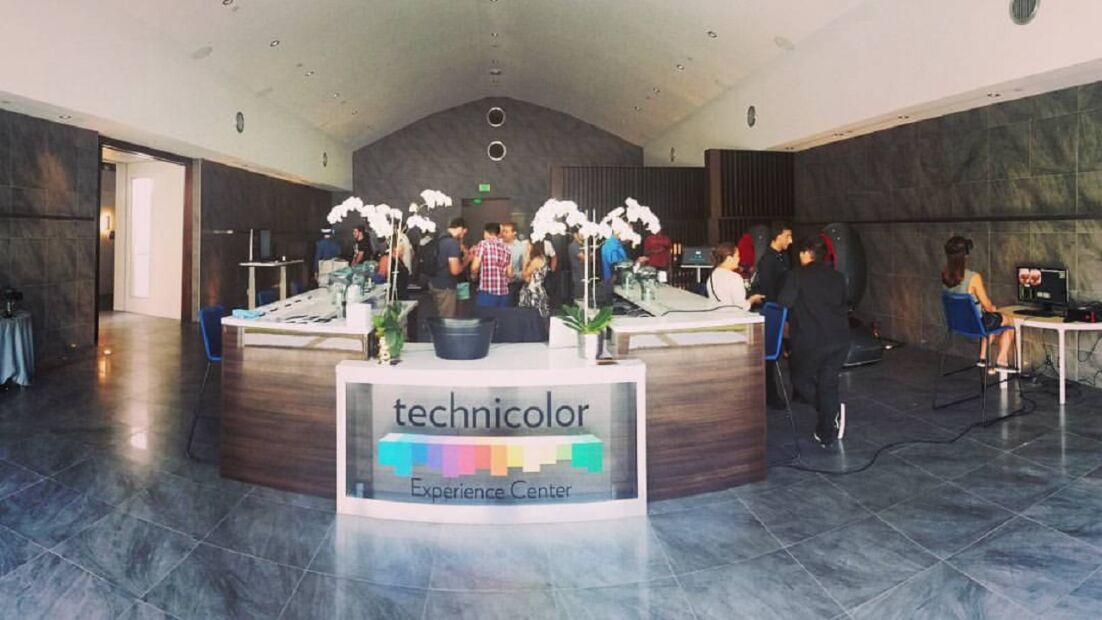
Flashback to SXSW 2019 with Marcie Jastrow talking about the Technicolor Experience Center, and the Mars Home Planet location-based experience. Jastrow is featured in the 3rd chapter of Yale anthropologist Lisa Messeri’s In the Land of the Unreal: Virtual and Other Realities in Los Angeles field study conducted in 2018.
This is a listener-supported podcast through the Voices of VR Patreon.
Music: Fatality
Podcast: Play in new window | Download
Rough Transcript
[00:00:05.452] Kent Bye: The Voices of VR Podcast. Hello, my name is Kent Bye, and welcome to the Voices of VR Podcast. It's a podcast that looks at the future of spatial computing. You can support the podcast at patreon.com slash Voices of VR. So I'm going to be starting a five-episode series leading up to the release of The Land of the Unreal, Virtual and Other Realities in Los Angeles. It's a landmark anthropological field study of the political ecology of virtual reality based in Los Angeles in the year of 2018. But it really expands out digging deeper into the phenomena of virtual reality from both a anthropological perspective, but also a science and technology studies perspective. So Lisa Masseri actually spent a year in Los Angeles, embedding herself into a number of different places and talking to different people. And so leading up to the conversation that I have with Lisa, which is going to be the last in this series, I'm going to be drawing upon different people that end up being pretty main characters within the context of her story. And given the fact that I've gone to a hundred different events over the last decade, I sometimes will go to 20 events in the course of a year. And that was what was happening to me in 2018 and 2019, where I was traveling once every three weeks on average, and was accumulating this vast repository of interviews that I wasn't able to always publish in real time. So I'm going to be digging into some of these unpublished material in my backlog. So I'll be starting with Marcy Joustow, who at South by Southwest of 2019, they were actually showing this experience that they're working on throughout the course of 2018. It was called Mars Home Planet, which was like a collaboration between the Technicolor Experience Center, as well as with NVIDIA and HP and Epic Games. And they were using like a positron chair. So there was like a lines for like a really long time to be able to see this at South by Southwest. I had a chance to see the experience and then talk to Marcy a little bit, both of her journey into working with the Technicolor Experience Center, but also her vision for where this location based entertainment could go in the future. So that's what we're covering on today's episode of the Voices of VR podcast. So this interview with Marcy happened on Tuesday, March 12th, 2019 at South by Southwest and Austin, Texas. So with that, let's go ahead and dive right in.
[00:02:18.284] Marcie Jastrow: I'm Marcy Jastrod, I'm the SVP of Immersive Media for Technicolor. I also run the center, which is called the Technicolor Experience Center. So the whole point of the center is to be a hub for Immersive Media for all of the brands of Technicolor, like MPC, The Mill, all these visual effects post-production companies. And the idea was to really understand workflows and building and changing over to Game Engine and how do you build Immersive Media. So it's not just about AR, VR, or MR. It's everything. It's ultimately 3D LED screens and anything that kind of is non-traditional media.
[00:02:58.367] Kent Bye: Can you tell me about how this came about from Techacolor? Where did this begin for you and for the company?
[00:03:04.046] Marcie Jastrow: So I've been in the space for four years, about four years, yeah. And I got involved because four years ago at Sundance, there are two people who are really good friends of mine, Ted Galliano and Ted Shilowitz, both of whom were very, very early adopters in this whole world. And they wanted someone to kind of help take the reins, who could speak to studios, who could speak to creatives, who understood how to build content in a repeatable, expandable way, right? And that's what I did my whole life, is I worked in post-production and worked on big feature films and was able to break down the technology for the creatives so that the creatives could have what they wanted. And then I would straddle that line between the studio and the creative. Creative wants more money. Studio doesn't want to give them more money. How do I make them both happy? And so Ted and Ted, the two Teds, ultimately said, you need to get into this. And I'm like, and honestly, I wasn't into it. I was like, this is not for me. I don't understand why I would put anything on my head. And then I met Guy Shalmadine, an MPC had done The wheelchair one, I can't remember. Catatonic. Yeah, Catatonic. And when I did Catatonic, I was like, OK, now I get it. Maybe I'll get into it. And that's kind of been what it is. It's just been this journey of really wanting to look at the best content, curate the best content, educate people, monetize it, sell it, package it up, and make sure that we all have jobs five years from now. I mean, really, that's my ultimate goal.
[00:04:41.020] Kent Bye: Well, what does Technicolor do? Maybe we could talk about the evolution, because I think of it as like color on film, but you know, obviously we've moved away from film. So like, what is Technicolor and how's the immersive media fit into a larger ecosystem?
[00:04:53.250] Marcie Jastrow: So, that's funny. So Technicolor was a lab based business. We created the three strip process, right? And so we were the company, one of the two main companies that had labs all over the world. And our function was to take the film from the developer, to all of the theaters. They would thread it up on the projectors and that was our responsibility. When digital came on age about eight years ago, we saw the erosion in the market of actual celluloid and the transition to digital screens. So at the time I was working at another post-production facility creating what is the new Onset Daily system because you weren't developing film anymore and everything was a new stream of digital media. That company got bought by Technicolor and then I went along to Technicolor to be head of sales. So ultimately Technicolor then decided to get out of the lab business, become a wholly digital company. So what does that mean? That means that in post-production you edit, you color, you make titles, you create sound. We do all of that in our normal post-production operations in Technicolor. But then we have brands. So we have MPC. MPC is responsible for like the Jungle Book. So all of those animations, all of those beautiful pictures, MPC does. And then they have an advertising and marketing branch of MPC. And then we have the Mill. Mill is one of the most innovative advertising and marketing companies, where they're doing very cool stuff in automotive. And then we have Mikros, which does animation. And then we have a games and animation division in Bangalore. And so what we became from this film company, we became a fully digital studio that is creating content all day long. So in order to create something that you can sell and make it repeatable, you have to build the pipeline and the infrastructure in order to do that. Why is Technicolor the company that should be building all of this content? Because we understand it. We only touch content. And we've done more animation. We're the largest advertising and marketing company. We're the largest visual effects company in the world. And this goes very close to what all that is.
[00:07:13.155] Kent Bye: Yeah, one of the surprising things, as I've been covering the VR industry, is the impact that Guy Chevalmer-Dean's Catatonic has had in surprising ways. I've talked to Morgan from Vantage Point, where she started a whole company to train people to be aware of sexual assault, sexual harassment, but she was inspired by Catatonic. And then talking to the creators of The Way Back, where they were creating experiences for their parents who have neurodegenerative diseases, but they were shown the power of VR by watching this horror experience of Catatonic. What was your experience of Catatonic? Were you like, you realize that there was something that's happening here in the media?
[00:07:46.971] Marcie Jastrow: Yeah, I just felt there was a shift, right? There was a shift in my brain thought and the way entertainment was going to be consumed. And so for me, it scared the hell out of me and the entire content moved me. I was completely emotional after I saw it. And so, you know, and yeah, you go to a movie and you watch a movie and you're passively hearing a story. What I was really interested in is at that point, I knew the tech was only going to get better. The content was only going to get better. And this was like the glimmer of hope of something new and interesting. And I'm curious. And that's also why they probably wanted me to get involved with it, because I'll break it. I will figure out a way to break it to then be able to build it so that we can scale it.
[00:08:32.243] Kent Bye: One of the things that I'm noticing from the Technicolor is that you're probably doing a lot of working on other projects as a contractor coming in, existing IP, but also generating your own advertising content. But virtual reality seems to be so new that there's a bit of just creating content just to see what the medium can even do. So where did that begin for Technicolor? What were some of the first experiences that you created?
[00:08:53.713] Marcie Jastrow: Yeah. So here's the deal. Technicolor is a work for hire company. So a lot of what happened was when I made the decision to go into this, I became head of business development for all the brands for VR and AR and MR. And at the time, it was really only just VR. And we got involved with the Martian with VRC, but ultimately we were working on the film, so we had all the assets. So the idea was, oh, well, we'll just take the assets and decimate them and put them in a game engine and create the Martian experience with VRC. Because Rob was at VRC. But that didn't work. And so what we realized, that became a disruption in the industry. And because of that disruption, we would be able to take advantage of it. And how were we going to take advantage of it? We were going to teach the entire entertainment and media side how to do virtual production. And so it became a tool, right? So we are now hoping to shift every major feature film into using virtual production so that assets are going in their game engine and then they can take advantage of it cross-platform. Right now, you create an asset once, it's never used again. And so now you can democratize your asset library. It doesn't matter, you're creating a chair, it's the same chair, but nobody ever uses that same chair again. And so we decided, instead of us trying to shove something in a game engine and make it work, let's shift the industry and change it to be game engine friendly.
[00:10:25.418] Kent Bye: Well, to me it's fascinating to see how fast this has progressed because you have what used to take the RenderMan many hours to render out a single Pixar frame, but now you have real-time game engines that are running at 90 frames a second and you're potentially able to match the same physically based rendering Output that you know, especially if it's a limbic you're able to potentially output it and render it out But it's almost like in real time rather than all this time But it sounds like that the paradigm shift to go from that Asset where you had all the time in the world to render it out as complex as you wanted to sort of make it Simplified enough that it is able to be performant, but also look good enough as the same as well So do you feel like you've been able to match that same level of quality? I
[00:11:09.003] Marcie Jastrow: I think we're getting there, and that's kind of what the whole point of Mars was, our project that's here at South By. So we're using immersive as the tip of the spear, right? And Technicolor is very well-known in the entertainment and media area, but we're not so well-known in architecture. We're not so well-known in theme park. design and creation. We're not so well known in the medical space. So the idea is how do we create new verticals for us in VR and AR and MR is perfect for that, right? So when we opened the tech, which is what I call the Technicolor Experience Center, the whole point was to bring the partners together, bring people together from the hardware manufacturers to the software manufacturers to the game engine developers and bring everybody together and bring storytelling to a new level. And so when we opened it, we needed a project. And so with NVIDIA and HP, we decided we were going to imagine through crowdsourcing what it would be in the architectural business to pre-visualize assets. So the whole concept of this was to take a CAD drawing take it into game engine, pre-visualize the asset, and then now you can put together an experience, right? It seemed to make sense at the time, and it did. We created this, the assets that were coming in from the crowd was incredible, but then when we actually got them into 3D modeling, it was fantastical. It was like, honestly, So while I love that proof of concept for architecture, I was like, wait a minute, this could actually function as a location-based VR project. And wouldn't it be interesting, because VR has a big problem right now. We're not getting enough marketing from the HMD companies to actually market to the consumers, so that the consumers actually know what the hell VR, AR, and MR is. So we, as the community, have to go out and educate the consumers. So when we were building Mars, I have always been a salesperson, so it's very hard to work in an industry where there's nothing to sell. And there was no, like, easy drop-in of VR, right? It's very complicated. You need headsets, you need computers, you need lots of people, you need docents going in and telling you what to prepare for. And if you don't know anything about hand controllers, you're totally screwed, because you can't really experience it. So, Positron had been a partner of ours since VRLA, four years ago, three and a half years ago, and I loved it. I loved it because what I knew inherently is that, yes, the hardcore VR people want to walk around and they want to explore, but the normal consumer who doesn't even know what they're doing, you can't make them step into something that they don't know what to do. It's just not rational. So, we had to do a crawl, walk, run approach, right? Positron's perfect for that. And because of the form factor of the chair, it helps with the haptics, it helps with cutting nausea, it helps with feeling you're going on a dark ride. It's almost like going to the Pirates of the Caribbean or Peter Pan in Disneyland. It is the new way of a theme park. And so we decided at that point to pivot and said, hey, let's build this in the chair. Let's make the first piece of content that is specifically made for the chair for entertainment. And then as we build this piece of content, let's model what that might look like. What's your throughput? How many chairs do we need in order to make money? How much can we sell the tickets for? How do we drop it in somewhere? So then we started looking at footfall. And, you know, I love VR arcades, I love hyper arcades, but I like where there's lots and lots and lots of people, because then you only need a certain percentage, right, to then monetize something. So I then started looking at where Heavy Footfall was, and I'm like, oh my god, did you know there's 54,000 museums in the world? and that footfall is anywhere from 50,000 to 750,000, and they actually pay for an upsell for a ticket, I was like, oh my gosh, this is our market. They all want to innovate, they all want to figure it out, but they want it to be non-friction. because VR has a shit ton of friction, right? So when you drop these eight chairs into a museum, you now look like you're innovative. You now have a Trojan horse where you're showing content that people can't really have readily at home. They think it looks cool. And so now you start a repeatable, sustainable distribution system if you lay all these chairs out. If you're laying all these chairs out, you now have a way for studios to feel like, oh my gosh, I can create content and I will get eyeballs on it. So it was really what we've been doing is we've been working the forward back rather than working back forward. And so that's ultimately what we've done is we created this experience called Mars on Planet. put it in the chair, and now we are starting to look at the museum verticals and slicing them up, taking other content, putting it in the chair, and then seeing if we can create this sustainable, repeatable distribution system.
[00:16:23.160] Kent Bye: Oh yeah, I think it's brilliant. And Marshmallow Laser Feast has an experience at the Satya Gallery called We Live in an Ocean of Air, and then they've had it extended once and then extended again, so I feel like It's a good match for people who are open to have those types of deep immersive experiences and are really able to commit like a full half hour or an hour to really seeing both the installation, watch other people in the experience, and then having the experience themselves. And what I was super impressed with by actually going through Mars Home Planet was the degree of sophistication of the architectural visualization that was in there that was in some ways a speculative design for what would it look like if you actually went to Mars in like 50 or 100 years. What would it look like? What would the architecture be? And it was like this guided tour that I felt like, had it not been in VR, I might have personally got a lot more motion sickness by locomoting around. But I feel like the Positron chair was really able to mitigate that. But I have a question. What's the back story to the architecture? Where did you get that architecture? Was that real architecture from speculative design? Where does that come from?
[00:17:20.538] Marcie Jastrow: So it was a crowdsourced project. And so what happened was a company called Launchforth basically put out to the world, we're going to build Mars. So all the scientists, all the engineers, all the designers who think they know how to design for Mars, send in your drawings. So then we had a community manager, a guy named Dave Witters, who actually is a game engine artist, and he would look at the designs, and then we would pick what designs we wanted. So it ultimately ended up being 450 assets. And so we took those assets, but then we had to tell the story, right? It would have been kind of boring if you were just sitting there looking at these assets. So we needed to create a story and what my thesis was is, why do you want to go to Mars anyway? And I didn't want it to be about blowing up the world and make it something bad. I wanted it to be like speculative of like, why would you want to go to Mars? And it's not easy. It's not going to be easy living on Mars. So why do you want to do that to yourself? And so that's kind of we had a world building day where we brought in a bunch of NASA people. We wanted it to be rooted in science, but we wanted it to be engaging and entertaining as well. And so we brought all these people in the room. We had one day of world building. And the next thing you know, we get the story of why do you want to be a Martian and what possessed you to do that? And so we started asking why, why, why, why, why? And that's how it kind of all developed.
[00:18:42.598] Kent Bye: Wow. That's amazing. And what were some of the reactions of people that are from NASA to be able to see this experience once it was finished?
[00:18:48.712] Marcie Jastrow: So I was just doing a panel and Abby said that some NASA people were here and one of the women just started bawling. Because, you know, imagine living all of your life and you're looking at one thing and you can't imagine it because you can't get there. And did you know that 44% of the people would rather do a simulation than a game? And that's what VR does, right? It allows us to simulate something that you cannot do. You just can't physically do here. And so that's why it works for Mars, because nobody's really on Mars, right? And we can't really go to Mars today, but we can through VR. And so it's interesting because, you know, I think people also try to be nice to you, especially when you're someone who's a leader of the community and is a thought leader in VR. You know, I wanted to make sure that what we were making also solved some of the VR problems. Like, I had a lot of things I wanted to tick off my list, right? And I feel like we did that. I feel like I'm so proud of this project, because at the end of the day, it was about taking pre-visualization of architecture assets, and we actually created this experience that people get out of, and they love it. And they think it can change the way in which we talk about VR, which, to me, makes me super happy, and that I've accomplished something.
[00:20:08.422] Kent Bye: What do you call the genre of this experience? Is it sci-fi, or future dreaming, or world building, or speculative design, or like a guided tour? How do you make sense of it? It seems like it's blending a lot of things that I don't know if I've seen something that's quite like it. So how do you think of it or describe it?
[00:20:24.172] Marcie Jastrow: I just think it's a damn good story, you know, with beautiful assets and it could be a pre-visualization of a city. It could be just a good story. Like, that's the beautiful thing. It doesn't have to be in a box. It's something that can be whatever it wants and live wherever it wants to live. If I now need to go to an architect and say to him, look, why are you not doing this? Like, this is how you pre-visualize. This is what you should be doing. If you want to raise $60 million or $100 million for a brand new office building, why are you not pre-visualizing it? For construction, it's amazing. My husband, here's a really interesting story. My husband is in the glass business. He does high, high-end architectural glass. And oftentimes, he has to add the glass in before the building is even done so that people come and scout to see what it's gonna look like. And the glass brings so much value to it. And we're like, why don't you just build it in VR? So these useful things that we need is what VR needs. We need it to be useful in order for people to make sense of it because right now it's very speculative and that's what I think we did with Mars.
[00:21:34.546] Kent Bye: I think that when I look at the overall XR industry, I look at what Microsoft is doing in terms of really going after the enterprise market and for me I have a little bit of questioning as to whether or not both the HTC Vive and Oculus, actually HTC has been doing a great job of engaging with enterprise clients and But Oculus has kind of like left a lot of that on the table and really focused that the gaming was going to be the thing that was going to take this into the mainstream. But I feel like even Magic Leap is a little bit of like ignoring the enterprise market and thinking that this consumer play is going to be the thing that's going to make it. I'm excited about the quest and where the quest goes, but I'm just skeptical that without looking at these broader technology evolution and diffusion curves, that there's something about these enterprise markets that VR has some real problems that it can help solve. It's almost like a knockout home run, like no brainer. So is Technicolor going to start to diversify into some of those enterprise markets and beyond just entertainment?
[00:22:26.974] Marcie Jastrow: Yeah, that's my goal. We're not in the museum space, so that's a really great space to be in. We're not in the architecture space. We're not in the medical space. But I needed to choose something, right? I needed a focus. What we've done for the last four years, and I talk about this a lot, is we've played shiny ball, right? So it's like peewee soccer. A new headset comes out, everybody runs to the new headset. A new piece of content comes out, everybody runs to that piece of content. That's gonna be our savior. That's what it is. Oh, I want everything to work in VR, but until we make it useful. So the reason why the smartphone worked is because you use it for a phone first. But then you were able to get texts. Then you were able to get your email. It became a useful machine. Then you were able to go on the internet. And it was seamless, right? So why I think enterprise is where to focus is because if you're starting to use it in your office every day and you can't live without it, or you're using it as a design tool, or you're using it as a way to pre-visualize something, It becomes more than just a gag. It becomes more than just a game. It becomes more than just a fly-by-night thing, because you're actually using it on a daily basis, which then you now understand. People start getting educated in it. They start consuming content differently. And it's all about content, really, at the end of the day.
[00:23:48.605] Kent Bye: Well, I know that I've talked to one person who's working on the virtual production team on Ready Player One, and I know that there's been a lot of different companies that work on all sorts of projects, but where can you say that some of these virtual production tools have started being used on different projects?
[00:24:02.597] Marcie Jastrow: Well, I can't really talk about that, unfortunately. That's why I don't want to work for a higher stage. Because you can't talk about your wins, right? So there's a lot of big feature films right now that are starting to use tech scout tools, where you photogrammetry where you want to go for a tech scout, rather than sending the entire crew. You photogrammetry, you scan the entire area. You can start blocking your moves, you can move things around. People are starting to use it for production design and how do you visualize what a scene looks like. There's a lot of people, really good work being done in acting and how do you pre-block and how do you redo the scene over and over. Directors are using it. So I feel like we're making a lot of inroads on the entertainment side as a tool, which is important. Because now if you get all these storytellers, you know, who are making big, large feature films, and they start evangelizing about how awesome the tools are, then they're like, you know, people flock to them. And you're right. I feel like I don't understand it. What I don't get, and it's so frustrating, is if I'm a company, and I am building these headsets, and I want to get these headsets to the consumer. Why are we not educating the consumer better? Why are we only looking at one subset? We should be looking at everything. And I just feel like we've gotten lazy over the last four years of continuing to educate. And so my little slice of the pie with entertainment and media is educating the directors in the studios, right? And if I can make it easy for them to want to get into a headset, For them, it becomes useful. Then, it becomes a game changer.
[00:25:50.171] Kent Bye: So, what do you want to experience in immersive media?
[00:25:53.772] Marcie Jastrow: What do I want to experience in immersive media? Gosh, that's a really hard question. I've seen so many experiences, right? I want to experience watching it grow and monetize, honestly. I want to see what that looks like in VR. You know, I think for me, I want to see AR become the next computing platform. I really do. I think that that will be super cool. When I'm wearing, instead of my head buried into the phone, I can actually look up and see people around me as I'm looking at my email and I'm not buried in my phone all the time. And I think it needs to be super useful in order for people to use it, right? So I'm excited about that. That's really what I want to see in VR. For me, I just think going to Mars was super cool. Like, I want to go to the Maldives next, and I want to go do a flyby somewhere, and I want to look at new stories, and how can we deliver those stories. I'm super hyper-focused on the distribution of it right now, so probably won't be making a lot of content for a while, which will be interesting to come back to that, but I feel totally blessed and grateful. This has been such a journey for four years of my life, and I've learned so much, and I've taught so many people, I've been a mentor to so many people, and the community is super amazing. The more we continue this uphill battle of what we're doing, it's like we become closer. And we really know who's driving it and how we're going to get there. So that's what I want to experience. And I want to experience that in VR.
[00:27:32.676] Kent Bye: So for you, what are some of the either biggest open questions you're trying to answer or problems you're trying to solve?
[00:27:38.965] Marcie Jastrow: So throughput, big one. So what we did at South By, the reason why we chose South By to premiere Mars, we actually showed it at Seagraph because that was in the contract for us to show Mars. This was not at all what the project was supposed to be. What happened at Seagraph, we had three and a half hour lines and that was super interesting because we got a lot of really good feedback and so we went back. What took three months, we went back and then we perfected the camera track and we perfected a lot of the music and the sound and really worked on making it a kick-ass experience. But that is the piece of content we're going to learn everything on, right? So throughput, we're going to understand how long does a piece of content need to be in the wild? How do people interact with that content? How much money will they pay for a ticket price for that piece of content? Will they pay a ticket price? Do they find it useful? Do they like it? Do they want more of it? So I think that's why Mars is so amazing is we can really plan it out and get it into large football areas and get massive groups of people in. and get them to enjoy it the way that we do.
[00:28:46.089] Kent Bye: Great. And finally, what do you think the ultimate potential of virtual reality is and what it might be able to enable?
[00:28:54.773] Marcie Jastrow: I have no idea. I mean, honestly, we pontificate all the time about what it's going to be. And it's probably going to be one thing that happens that kind of blows it all out of the water. And that's my hope. But I think it's going to be everybody working together to get it out there. And I feel like I feel like we just need to be patient. I just feel like patience is a really important thing because you don't want to rush it either. That's what happens. You only have one chance to get people in a headset. You do not want to blow it. And that's really where the disappointment lies for me is that if I am making this headset and I am rolling it out and hundreds of thousands of jobs are depending on it, watch your content. make sure that it's super easy for people to get in. You know, if that person doesn't engage in three seconds, they're out. And that's really, you know, what immersion is, right? And the minute you break the immersion is the minute you've lost your consumer.
[00:29:56.123] Kent Bye: Is there anything else that's left unsaid that you'd like to say to the immersive community?
[00:30:02.287] Marcie Jastrow: Keep going. We're not done yet. We have a lot of work to do, but I have faith.
[00:30:09.837] Kent Bye: Awesome. Great. Well, thank you so much.
[00:30:11.318] Marcie Jastrow: Thank you.
[00:30:12.480] Kent Bye: So that was Marcy Jastrow. She was, at the time of this interview, the Senior Vice President for Immersive Media for Technicolor. And we were talking a little bit about the Mars home planet that was showing at South by Southwest Immersive in 2019, as well as the Technicolor Experience Center. So I have a number of different takeaways about this interview is that, first of all, Well, I wanted to give a little bit of a follow up for what ended up happening because there's a lot of visions for what Marcy wanted to do with taking this Mars home planet, the location based entertainment experience that at the time this was like March 2019. And so this was even before the quest had come out. And so everything was like PC based VR and using these positron chairs. So, in the book of The Land of the Unreal, Virtual and Other Realities in Los Angeles, Yale anthropologist Lisa Masseri was embedded into the Technicolor Experience Center throughout the year of 2018 as a scholar-in-residence. As an anthropologist, it's very difficult getting access into different places within Los Angeles, so Marcy actually invited her in to research what was happening in the context of the XR community. And so she's prominently featured in her chapter three called Tinseltown and Technology, Producing Virtual Reality in the Dream Factory. And Lisa has a little bit of a follow-up for what happened after this. She says, the ecosystem that Jastrow ended up focusing on for the Technicolor Experience Center, also known as TEC, was developing and selling VR experiences catered to museums. Jastrow felt confident that this would be a success, but Technicolor refused to give her the resources she needed to realize her vision. Jastrow had to lay off most of the tech staff in December of 2018 and January of 2019. Many found work in other parts of the immersive industry, with some going to digital domain, ILM, and gaming companies expanding into VR. Jastrow stayed on at Technicolor as the VP of Immersive Truth January of 2020, when she became the Chief Marketing Officer at Evercast, a platform for remote collaboration specifically targeted at media creators. So her vision to take this into different museums ended up not coming to pass because Technicolor didn't fund it. I think at the time there was obviously a lot of investment and money that would have been required to have this PCR based experience out there. I thought it was a really incredible experience. And based upon the crowds at South by Southwest, I think it would have been a huge hit. So just I'm reflecting on some of the different narratives and stories that are being told within the context of Misari's book of The Land of the Unreal. She's really tracking in all these stories in the context of Los Angeles, but also these women-led initiatives within the context of VR. And so this is one of the examples in a case study looking at the potentialities for where this could go in the future, but not coming into actuality just because of the division that was being put forth by Jastrar wasn't given enough resources to really realize it. I actually ran into Jastrow at South by Southwest in 2022, where she was working on the Shiba crypto metaverse as this kind of immersive experience that was driven by this cryptocurrency and translating a lot of her skills into producing these immersive experiences in the cryptocurrency context. And it was showing there at South by Southwest back in 2022. So I'll be diving much more into a number of the other different people that were featured in the context of Masseri's book and the following episodes, and then diving into the conversation with Lisa herself. So that's all I have for today. And I just wanted to thank you for listening to the Voices of VR podcast. And if you enjoy the podcast, then please do spread the word, tell your friends, and consider becoming a member of the Patreon. This is a listener-supported podcast, and so I do rely upon donations from people like yourself in order to continue to bring you this coverage. So you could become a member and donate today at patreon.com slash Voices of VR. Thanks for listening.