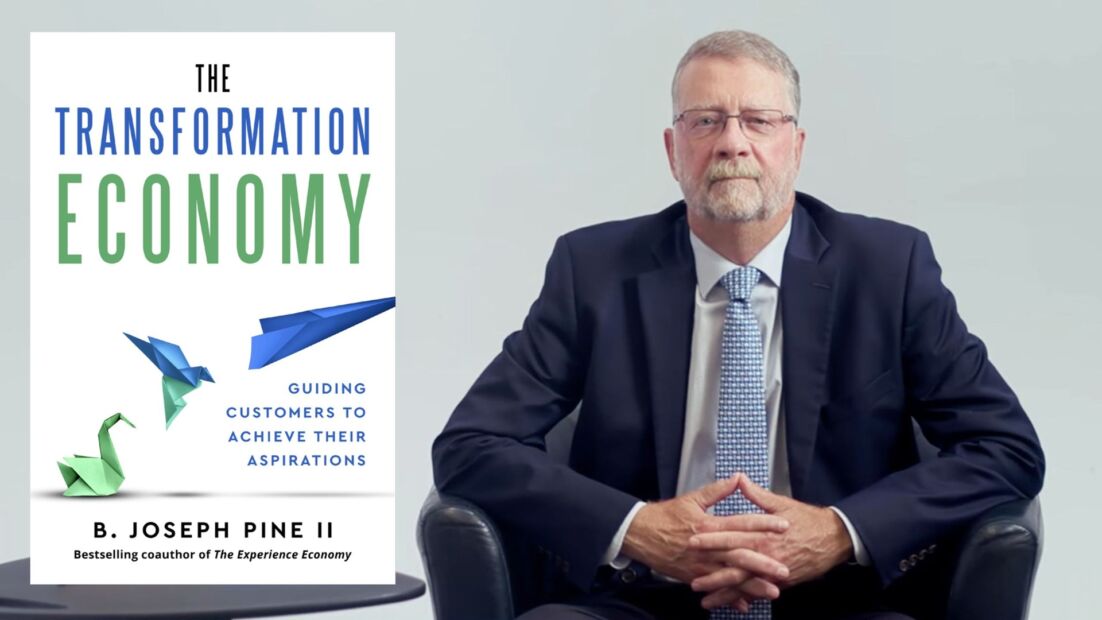
On February 3rd, 2026, Joe Pine released The Transformation Economy, which is a follow-up to The Experience Economy co-written with James Gilmore and published in 1999. They identified a key pattern of how economic offerings have evolved beyond commodities, goods, and services, and moved into experiences as well as transformations.
Their prescient predictions about these underlying patterns in the late ’90s took many years of convincing businesses of their merits. But after a few decades, their core ideas of The Experience Economy have taken root, and now it is much easier to see how consumers have shown that they are willing to pay for memorable experiences.
Now Pine is back at it again with The Transformation Economy with ideas that have been there from the very beginning, but he told me that the world wasn’t ready yet, and he wasn’t ready either. About 5-6 years ago, Pine started to hear from designers at World Experience Organization events talking about the transformative intent behind their experiences. This was the catalyst indicating to him that it was time to finally write this book, and he started researching the topics of aspiration, positive psychology, human flourishing, and the dynamics of transformation.
I had a chance to interview Pine about The Transformation Economy, and in my write-up below I provide an overview of some of his biggest ideas, some of my personal reactions, how they relate to the XR industry, and finally some of my disagreements on where value comes from. Despite some of my philosophical disagreements with Pine, I still see a lot of value in the frameworks laid out in his book. He describes a roadmap towards a future where the core values driving a critical mass of businesses have evolved to focus on helping their customers fulfill their deepest aspirations, find meaning and purpose, and promote human flourishing.
Progression of Economic Value
Pine & Gilmore first theorized about a hierarchy of economic value in a 1997 article titled: “Beyond Goods and Services: Staging Experiences and Guiding Transformations.” They originally called it “The Economic Pyramid,” and described it by saying, “The inexorable march of competitive forces drives the advancement of economic offerings over time: commodities are extracted from the environment to make goods, then delivered as services, which are scripted to stage experiences, which then guide those persons or enterprises in a transformation.”

of Pine’s The Transformation Economy (2026).
Within their “Welcome to the Experience Economy” article in the 1998 issue of Harvard Business Review and in their 1999 book The Experience Economy, they started calling it “The Progression of Economic Value” as shown in the figure above. In The Transformation Economy on page x, Pine describes each of the five distinct economic genres as well as their associated verb / function,
- Extract Commodities (fungible stuff)
- Make Goods (tangible things)
- Deliver Services (intangible activities)
- Stage Experiences (memorable events)
- Guide Transformations (effectual outcomes)
There is an inevitable gravity towards commodification, and the antidote is customization. This insight first came to Pine in 1994 after he wrote a book in 1993 titled Mass Customization: The New Frontier in Business Competition that explored how Mass Production was moving into Mass Customization. When customization is applied to a service, then it yields an experience. When customization is applied to an experience, then it has the potential to yield a transformation that could be life-changing. Here’s how Pine & Gilmore described this progression to transformations in their original 1997 article,
“The way out of the commodization trap in which so many service companies find themselves is to move up an echelon of value and stage an experience. But experiences are not the utmost in economic offerings. Just as customizing a good automatically turns it into a service, so customizing an experience turns it into something distinct. If you design an experience so in tune with what an individual needs at an exact juncture in time, you cannot help but change that individual — guiding him to (and through) a life-transforming experience. Transformations are a fifth economic offering, whose value far exceeds that of any other.”
Pine also says in The Transformation Economy that “Eliminating human contact is a surefire way to commoditize yourself.” Technology has an inclination to move more and more towards automation and creating “frictionless experiences,” but I see the value of human intuition, emotion, relationality, community, and meaning being a differentiating factor in the transformation economy. I suspect that it will be really beneficial to deliberately embrace friction and tension that comes from interacting with other humans as explored in the piece called Deep Soup. I see the movement towards the transformational economy as a bit of an argument against automating too many things with AI because people will be craving authentic human contact.
Key Concepts and My Personal Experience of The Transformation Economy
The Transformation Economy book is written with the intention to become a transformational experience within itself. There are many pointed questions throughout the book that helped shape my overall framing through the lens of my business.
My first reading of the book was focusing on trying to understand the origin, development, and evolution of Pine’s provocative ideas to explore within my interview with him. My ongoing second reading of the book has catalyzed me to reconceive some fundamental notions around my identity, as well as the story of why I do what I do with The Voices of VR Podcast.
So much of my work has been driven by a fundamental impulse to bring about change in the world. My motivation to cover the frontiers of emerging technology with XR, AI, immersive storytelling, and experiential design has been because I’ve seen the transformative power of embodied and immersive experiences to potentially bring about some meaningful changes in the world.
I’m also very much drawn to philosophical frameworks like Process Philosophy that provide some key metaphysical foundations leading to a paradigm shift around the underlying nature of experience and reality itself. Here’s a graphic from Andrew Davis’ upcoming Whitehead’s Universe book that lays out some of the scaffolding of this paradigm shift from substance metaphysics to process-relational metaphysics.
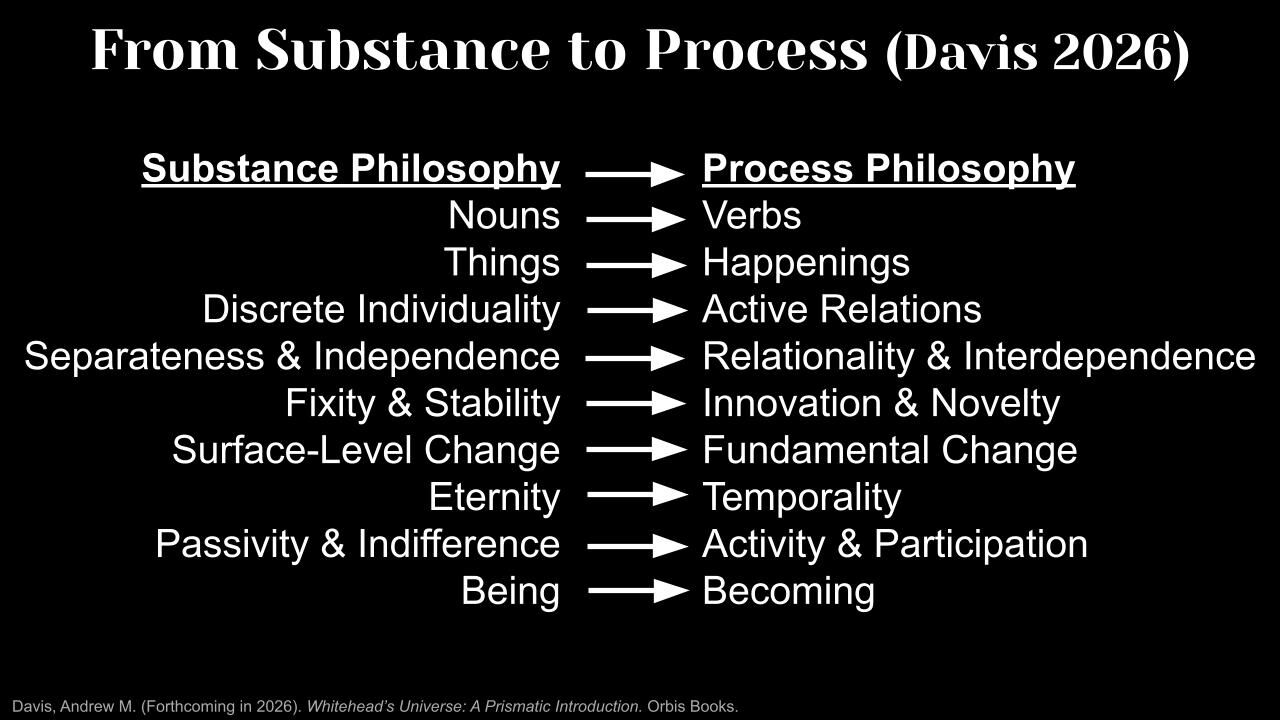
One of the key concepts that really stuck with me from Pine’s The Transformation Economy was at the beginning of the third chapter that says, “All transformation is identity change.” Pine cites Suzy Ross’ definition of identity as “all the ways you can complete the statement ‘I am . . .’ ” He says “From / To” statements are also key where you might say, “I was X, now I am Y.”
I really resonate with these definitions of identity since they’re very flexible and practical. Once I became aware of these “I am …” statements, then I started to hear them all the time. I found myself naturally making and reflecting upon identity statements, which provide clues to changes that I aspire to. As an example, I’ve often found myself saying something to the effect of “I’m more a knowledge artist than a viable business person.” So in essence, my aspirational, identity-transformation statement is “I am a terrible business person, but I aspire to become a thriving independent scholar and transformational change agent.”
Reading through The Transformation Economy has been really inspiring since it’s the first business book I’ve ever read where I can really see myself in these frameworks. Pine has been giving me language to articulate the possible futures that I’d love to live into, but yet the business models around the transformation economy are still nascent, uncertain, not very well specified, and rapidly developing.
Each business will have a unique blend of commodities, goods, services, experiences, and/or transformations that they’ll be offering, and so it is unlikely that there will be a universal formula that works across all contexts. I’m still meditating on this statement where Pine claims that your business is what you charge for. He says on page 22,
“A business ultimately defines itself by what it charges for. If you charge for undifferentiated stuff, you’re in the commodities business. If you charge for tangible things, you are in the goods business. If you charge for the activities your people do, you are in the services business. So, economically, you are in the experience business if and only if you charge for the time customers spend with you.”
Pine says that experiences are inherently ephemeral, and sometimes the only thing you keep from it is the memory, which can fade over time. He contrasts this with his definition of transformations, which he shares on page 10 as, “Transformations are effectual outcomes that change individuals in a lasting way. Where experiences are memorable, transformations are effectual.”
This implies that the business offering of transformations actually has more of an ongoing time commitment. Businesses in the transformation economy will be helping “aspirants” (Pine’s preferred term for customers in the transformation economy) achieve their aspirations of transforming from one state into another state over longer periods of time.
Aspirants will need to invest time, be patient with results, make progress, but also deal with periodic regressions. I’ve been reckoning with how I am what I charge for, and I can’t help but think about the logistical difficulty in trying to escape the real-time accounting of how we’ve conceived of value delivered by goods, services, or experiences in the past. Pine elaborates on the paradox of deferred, value exchange payments within the transformation economy on page 23 by saying,
“You are what you charge for. With transformations, then, what customers value is achieving their aspirations. Inputs don’t matter, only outcomes. To align what you charge for with what your customers value, you must charge for the demonstrated outcomes your customers desire. Even if you choose not to charge for change, you’ll receive immense benefit from thinking through everything your enterprise does as though its income were dependent on customer outcomes—because ultimately it is.”
Pine elaborates on a number of different strategies for how businesses could charge for outcomes starting on page 194 including providing money-back guarantees for transformation, success fees, income share agreements, or outcome funds.
I suspect that there will be even more emerging transformational economy business model options that have yet to be fully specified. Pine does say that he categorized donation-based models, (e.g. the Voices of VR Patreon), under “Success Fees.” He describes these success fees on pages 196-197 by saying, “companies get paid not a predetermined amount but one established after the fact or on an ongoing basis, based on outcomes. Success fees are not an all-or-nothing proposition with a set fee; the end amount charged varies based on a sliding scale of how much value was realized.”
Pine doesn’t explicitly call out Patronage models, but what he says fits well with gifting culture approaches where I’m able to freely provide goods, services, experiences, and artifacts with transformative potential to as broad of an audience as possible, and rely upon 2-5% of that audience to become contributing patrons if they find enough value in those offerings.
Pine’s book provides a clear roadmap that has been helping me come up with more of a near-term and long-term plan for how I could become even more of a transformational change agent within my work. I aspire to actively brainstorm and experiment with new approaches towards embodying and enacting a flourishing transformation economy approach as I continue to make my way through my second reading of The Transformation Economy.
What the XR Industry Can Learn from Pine’s Encapsulation Idea: Moving Beyond Onboarding and Offboarding
At the end of my interview with Pine, he lamented that the XR industry has not taken up producing very many transformational experiences. I suspect that Pine is referring to the consumer market of VR gaming, and he may be unaware of the hundreds of immersive stories and pieces of immersive art that have been featured on the film festival circuit, cultural institutions, and the frontiers of location-based entertainment over the past 14 years. I do believe that many of these could be considered to be a part of the transformation economy. See my previous coverage of over 600 immersive stories, and a write-up of other experiences featured in the introduction and conclusion of the IDFA DocLab Think Tank Report that I wrote.
While it is true that not ALL of these experiences could be classified as transformational, then there are certainly some that achieve that and others that are aspiring to.
But one key lesson that Pine points out is that there’s a formula for facilitating transformational experiences through a series of four phases that he calls “encapsulation.” He describes it on page xvi by saying, “Again, it’s about encapsulation: preparing people for the experience they are about to have, helping them reflect on it afterward, and then integrating the changes they desire to make into their lives.” See the visual graphic of encapsulation below.

Nearly all XR experiences and immersive stories exhibited on the festival circuit have some form of preparation, which is usually referred to as “onboarding.” Sometimes there’s an explicit contemplative reflection phase that can be referred to as “offboarding,” although offboarding rituals are usually more focused on logistics rather than any deep or retrospective contemplation of what was just experienced.
Pine’s insights into the importance of the preparation and reflection phases immediately before and after the experience places new emphasis on the importance of “onboading” and “offboarding,” and perhaps the industry would be well-served to adopt Pine’s language and intentions around “preparation” beforehand and “reflection” afterwards.
One thing that’s clearly lacking in the XR industry is any sort of ongoing integration phase that happens over time after these experiences are over. Typically whenever the experience ends, then that’s the end of the economic offering and value exchange. But transformational experiences provide the promise of an ongoing relationship. Pine says on page 93, “Integration takes that reflection and puts it into action. This is where people — if they were mere guests before, they are full aspirants now — go beyond mere experience to begin serious work on the transformation itself, with your guidance.”
As soon as I hear about guiding people through transformative experiences over time, then it immediately makes me think about the wide frontier of various transformational, psychological, somatic, experiential, esoteric, hermetic, and panexperientialist frameworks available. I have a preference towards some of the depth psychological techniques and lineage developed by Carl Jung, as well as the subsequent formulizations of archetypal psychology by Jungians like James Hillman and philosophers like Richard Tarnas. Internal Family Systems is also an exciting and emerging modality of trauma therapy that has been extensively validated through peer-review studies, and it also has a lot of overlap with Jungian ideas. The frontiers of different approaches and frameworks are vast, and perhaps the transformational economy market will help to discern which transformational frameworks provide the most utility over time and to the broadest set of people. If outcomes-based funding takes off, then we may see a renaissance of cutting-edge depth psychological techniques proven by the market.
A big topic at the recent Mind-at-Large Conference was the transformative potential of psychedelic experiences. I can see psychedelics playing an increasingly important role within The Transformation Economy as it intersects various spiritual traditions as well as the frontiers of technology. The intersection of these three distinct strands was the focus of the Awakened Futures Summit that I covered in 2019, which you can find within my broader coverage of the Consciousness Hacking movement.
To return to Pine’s idea of encapsulation, experiential designers, LBE content creators, and immersive storytellers have the opportunity to go beyond being just a part of the experience economy of creating meaningful events if they put more intention into the onboarding and offboarding, and think about if any follow-up is feasible. The onboarding phase could be used to more deliberately prepare and prime audience members for any potential transformation, and then during the offboarding phase, providing a space to debrief and reflect on the experience can also help to create a context for deeper transformation. The big key missing ingredient is the follow-through and check-ins that help guide the “aspirant” towards their goals of becoming more of who they are.
My Disagreements with Pine on Where Value Comes From
During our conversation, Pine and I had a pretty core political and philosophical disagreement about the primary source of value. Pine leans upon a number of libertarian economists associated with the Cato Institute including Deirdre Nansen McCloskey, the Superabundance authors Marian L. Tupy and Gale L. Pooley, as well as the Hoover Institution’s Thomas Sowell, who all make claims that value of wealth creation and innovation are primarily coming from the private sector. For additional context, The Cato Institute’s Unbound Journal is also where Peter Thiel argued in 2009 that “I no longer believe that freedom and democracy are compatible.” So the natural extreme of this type of libertarian-based, market fundamentalism ideology can include democratically-backsliding authoritarianism.
There are many political and philosophical reasons why I reject this type of market fundamentalism, but the most compelling economic argument comes from renowned scholar Mariana Mazzucato. Her book The Entrepreneurial State: Debunking Public vs Private Sector Myths provides evidence for how many of the the most compelling technological innovations that we think of can be traced back to public funding. I’ll dig into that details of her arguments in a moment, but I wanted to first set the context for what she’s arguing against.
Pine gives some pretty staunch defenses of capitalism starting on page 31. He says,
“It’s become de rigueur in many circles to decry capitalism and the free-market economy for giving rise to inequality and social injustice — and they most certainly have their ills. But those ills can be traced in considerable measure to one fundamental issue: businesspeople not understanding that capitalism, business, and enterprises exist to foster human flourishing. Despite that, capitalism is the greatest force for human flourishing ever invented.”
While Pine did acknowledge some ills of capitalism, he also dismissed other critiques around wealth inequalities. Whether you believe if innovation and wealth creation can be more attributed to the private sector or whether the public sector should get more credit dictates both WHERE value is actually coming from, and what to actually do about it. I’m on Mazzucato’s side of public funding, and I disagree with the libertarian leanings of Pine.
Let’s dig into the arguments from both sides.
I was surprised to hear Pine claim that wealth inequality could be primarily attributed to envy. But then I found some specific references to this idea within Superabundance, which was published by The Cato Institute in 2022, where Tupy and Pooley elaborate on these very points. These two paragraphs from pages 104-105 elaborate on their claims for how wealth inequality is actually just envy, and how it’s also actually the “midwife of progress.” I’d like to point out that they attribute the creation of value, wealth, and innovation as primarily coming from the private sector.
“Let us now move beyond the theory of social comparison and look at some of the ways in which a focus on relative income inequality might be counterproductive in the real world. First, preoccupation with income inequality risks normalizing envy, a happiness-destroying emotion condemned by all the main religions and moral codes. There is nothing wrong with income inequality, provided that it was fairly arrived at. Most people understand, for example, that the wealth of Apple cofounder Steve Jobs was the result of the entrepreneur’s vision and hard work. Jobs, in other words, did not steal his money. He earned it by creating value for others. The proper lesson to derive from his achievement ought to be inspiration, not envy.
“Second, income inequality is in many ways the midwife of progress. People who break from the pack by developing an innovative, useful product such as an iPhone can become very rich, but by adopting the new product, the society profits as a whole and moves forward. The same is true of new modes of social cooperation, production processes, and the like. Put differently, progress would be impossible if society prevented people from trying out and benefiting from new things. Just consider what the world or the future of humanity would have looked like had the Luddites stopped the Industrial Revolution or the innovation of new drugs and sources of energy had been throttled by the precautionary principle (i.e., risk avoidance).”
Tupy and Pooley cite Steve Jobs and Apple as being the exemplar of innovation that produced the iPhone, but the scholarship of Mariana Mazzucato in the 2024 edition of The Entrepreneurial State: Debunking Public vs. Private Sector Myths shows the exact opposite. She says that “In fact, there is not a single key technology behind the iPhone that has not been State-funded.” She elaborates by saying,
“Indeed, nearly all the technological revolutions in the past—from the Internet to today’s green tech revolution—required a massive push by the State. Silicon Valley’s techno-libertarians might be surprised to find out that Uncle Sam funded many of the innovations behind the information technology revolution. The iPhone is often heralded as the quintessential example of what happens when a hands-off government allows genius entrepreneurs to flourish, and yet the development of the features that make the iPhone a smartphone rather than a stupid phone was publicly funded. The iPhone depends on the Internet; the progenitor of the Internet was ARPANET, a program funded in the 1960s by the Defense Advanced Research Projects Agency (DARPA), which is part of the Defense Department. The Global Positioning System (GPS) began as a 1970s US military program called NAVSTAR. The iPhone’s touchscreen technology was created by the company FingerWorks, which was founded by a professor at the publicly funded University of Delaware and one of his doctoral candidates, who received grants from the National Science Foundation and the CIA. Even SIRI, the iPhone’s cheery, voice-recognizing personal assistant, can trace its lineage to the US government: it is a spinoff of a DARPA artificial-intelligence project.”
Here’s a graphic that demonstrates just how many of the technologies behind the iPod and iPhone were actually state sponsored.
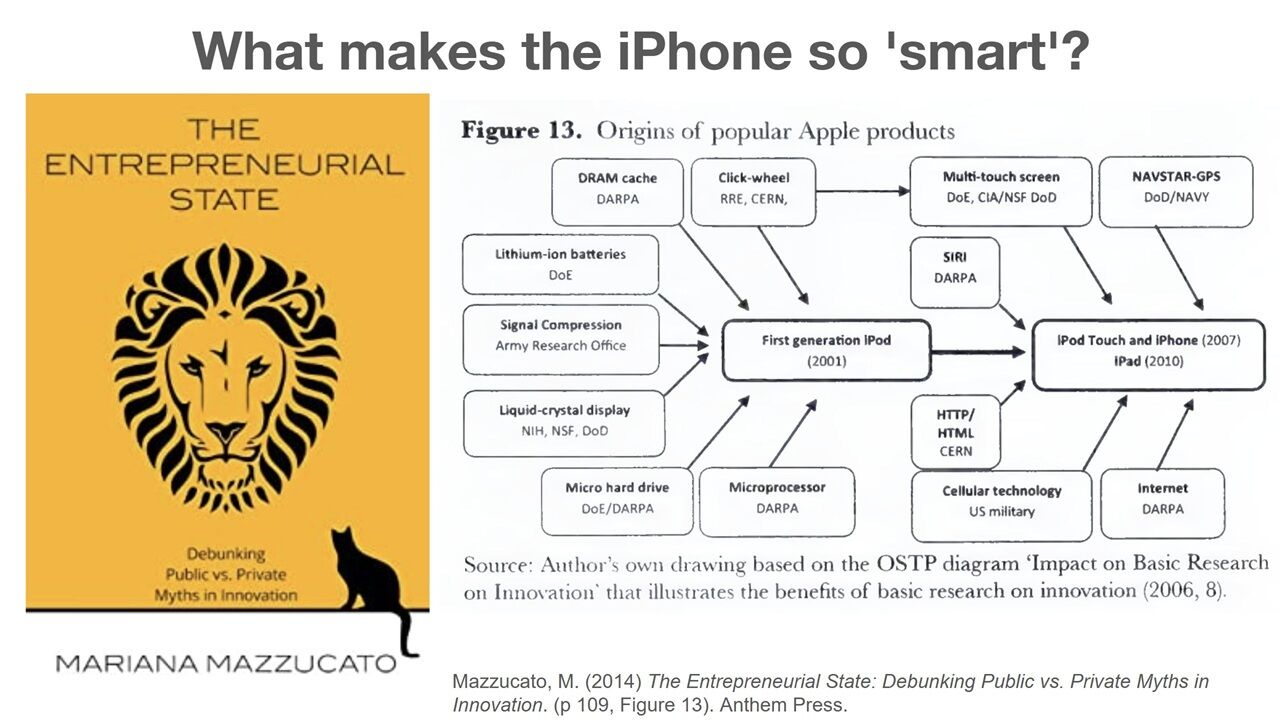
As Mazzucato brilliantly argues, so much of the value of the innovations of the iPhone have come from the public funding of fundamental research. But the libertarian perspective is that the primary wealth creation is coming from private companies like Apple, and so these wealth extractors should claim the majority of the value and dismiss the very real wealth inequalities as “envy” or that it’s actually the “midwife of progress.” When in fact, the core value of innovation is coming from public funding, and so wealth inequality should be addressed by taxing the wealthy and reinvesting back into the public itself.
Market fundamentalist ideologies are usually so deeply entrenched, that I don’t actually expect that there will be any amount of facts that contradict their myths for where value, innovation, and wealth-creation actually comes from. But I do think it’s important to explicate some of these intellectual arguments that counter the types of myths of where value comes from and who is actually creating wealth. Mazzucatto’s says in the Preface of The Value of Everything: Making and Taking in the Global Economy (2018) ,
“We often hear businesses, entrepreneurs or sectors talking about themselves as ‘wealth-creating’. The contexts may differ – finance, big pharma or small start-ups – but the self-descriptions are similar: I am a particularly productive member of the economy, my activities create wealth, I take big ‘risks’, and so I deserve a higher income than people who simply benefit from the spillovers of this activity. But what if, in the end, these descriptions are simply just stories? Narratives created in order to justify inequalities of wealth and income, massively rewarding the few who are able to convince governments and society that they deserve high rewards, while the rest of us make do with the leftovers…
“It is… only through an open debate about value – its sources and the conditions that foster it – that we can help steer our economies in a direction that will produce more genuine innovation and less inequality, and which will also transform the financial sector into one that is truly focused on nurturing value creation in the real economy. It is not enough to critique speculation and short-term value extraction, and to argue for a more progressive tax system that targets wealth. We must ground those critiques in a different conversation about value creation, otherwise programmes for reform will continue to have little effect and will be easily lobbied against by the so-called ‘wealth creators’.”
I fundamentally disagree with Pine’s libertarian assessment of where value and innovation comes from, and so it does concern me that the seeds of The Transformation Economy may be developing to only service a particular subset of people who are wealthy enough to afford it.
Pine did write on pages 30-31 acknowledging some of the ills of capitalism, and that the antidote would be a combination of both moral imagination as well as core values of all businesses to center human flourishing as the most valuable thing. He says,
“Many caricature the “invisible hand” as greed anthropomorphized, but in fact, as journalist Daniel Akst put it, Smith “recognized that if commerce is to promote human flourishing, it must be guided not just by unbridled self- interest but by values and a moral imagination… those ills [of capitalism] can be traced in considerable measure to one fundamental issue: businesspeople not understanding that capitalism, business, and enterprises exist to foster human flourishing.”
I do love Pine’s call to imagine what an economy would look like if it were indeed centering human flourishing. However, it is still a bit of a dream, a fantasy, and a speculative worldbuilding exercise that preferences the aspiration that human flourishing is the most important value driving capitalism today, when I think that it is self-evident that is much more about greed, profit, and short-term thinking. My perspective is that there are many ways in which the broader institutions of capitalism themselves need to undergo a pretty radical transformation at the cultural, legal, and political levels for the full extent of human flourishing to happen.
Pine’s perspective seems to be that “capitalism is the greatest force for human flourishing ever invented,” but I believe that’s a conclusion that stems from believing that value, wealth creation, and innovation stems from the private sector.
While Pine did acknowledge some of the ills of capitalism, I don’t expect that the market fundamentalist libertarian scholars that he is citing are providing any viable solutions beyond arguing for even less government control and even more Laissez-faire capitalism. There are some interesting ideas about values and the good life within the book Mass Flourishing by economist Edmund Phelps, but I don’t see very many prescriptive solutions being put forth by any of these scholars.
Mazzucatto does offer a number of cutting-edge, theoretical solutions around the mission-based funding within her book Mission Economy: A Moonshot Guide to Changing Capitalism (2021). She summarizes these big ideas on page 211 saying,
“The ideas in this book have been inspired by many. But it is probably significant that the previous chapter, looking at new theory, cites so many women scholars who have put life at the centre of the economy, not the economy at the centre of life: Hannah Arendt’s work on the public life, vita activa; Elinor Ostrom’s on creating community via the commons; Kate Raworth’s on the construction of a circular economy which minimizes waste; Stephanie Kelton’s on the power of long-run finance and an outcomes-based budgeting process; Edith Penrose’s on the dynamic capabilities of value-creating organizations; Carlota Perez’s on tilting the playing field towards a smart green transition. It is to the future young women scholars and practitioners that this book is also dedicated.”
While I can’t unconditionally recommend all of the dimensions of Pine’s economic and political philosophy underpinning his frameworks, I can get behind how the future of business value will be coming from deeply personal and meaningful experiences that catalyze potentially life-changing and transformative experiences on an individual and collective level. And I believe that many of the very problems that he’s identifying about capitalism can be found within Mazzucato’s work.
Conclusion
I still believe really strongly in core message of The Transformation Economy as a really powerful framework that connects the dots between meaning, purpose, and value as well as with human flourishing and aspirations. I’m naturally drawn to continually evolve, grow, and transform in my own practice, and so much of my work is also around all of these collective paradigm shifts that we can start to get a glimmer of through the lens of emerging technologies like XR, AI, immersive storytelling, and experiential design. I’m excited to continue to dive into the interactive exercises, but also to dive more deeply into the types of transformational experiences that immersive artists are making — not only on a personal level, but also addressing many collective issues of our day.
Podcast: Play in new window | Download