Canada’s Prime Minister Mark Carney gave a rousing speech at the World Economic Forum on January 20, 2026 about the rupture of the rules-based order of the globalized economy, and he emphasized the need to build new coalitions to sustain the pressure coming from the United States’ emerging authoritarianism. Carney said, “Great powers have begun using economic integration as weapons, tariffs as leverage, financial infrastructure as coercion, supply chains as vulnerabilities to be exploited. You cannot live within the lie of mutual benefit through integration, when integration becomes the source of your subordination.”
Just as globalized, economic integrations are being weaponized by the United States, then Big Tech’s integrations woven throughout our lives will continue to become the source of our own subordination, especially as surveillance capitalism heads towards its logical conclusion of an all-pervasive, AI Big Brother, perhaps eventually explicitly tied into authoritarian governments.
The AI Big Brother has already started within the context of private companies, but with the outdated Third-Party doctrine of the Fourth Amendment, then any data given to a third party has “no legitimate ‘expectation of privacy’.” From UNITED STATES v. MILLER (1976): “The Fourth Amendment does not prohibit the obtaining of information revealed to a third party and conveyed by him to Government authorities.” So the US government can request almost any data shared with a third party without a warrant, and given Big Tech’s cozy relationship to a democratically-backsliding US government, then who knows what kinds of backroom deals are being made to automate data sharing.
We’re already in an era where almost all data given to a third party is not considered to be private, and you can start to see some early indications for how this can go wrong in Taylor Lorenz’s interview with 404 Media’s Joe Cox about ICE’s surveillance technologies. It seems likely that we are entering into the very early phases of Orwell’s worst nightmare of a 1984 surveillance state powered by Big Tech’s AI.
In this op-ed podcast episode, I connect some dots between Carney’s Davos speech about the hegemonic forces in the geopolitical sphere and the parallels with Big Tech’s push towards “contextually aware-AI,” which is just an always-on AI that is surveillance capitalism on steroids. Carney’s speech provides a lot of insights for how Canada is navigating this new reality where the rules-based order on the International stage seems to be dissolving. One of his deepest insights is to simply name the truth, and to describe precisely what is happening. He refers to a powerful story from Vaclav Havel’s The Power of the Powerless where shopkeepers eventually “took their [propaganda] signs down” during communist rule after they were no longer willing to live within a lie.
Carney says: “The system’s power comes not from its truth, but from everyone’s willingness to perform as if it were true, and its fragility comes from the same source. When even one person stops performing, when the greengrocer removes his sign, the illusion begins to crack. Friends, it is time for companies and countries to take their signs down.”
Taking down metaphoric signs breaks the spell of the collective performative ritual that sustains the power of an authoritarian regime. Taking a sign down is also the embodiment of the first lesson of Timothy Synder’s On Tyranny, which is “Do Not Obey in Advance.” This lesson is certainly easier said than done, and I’ve been surprised how pervasive and powerful the chilling effects to remain silent can be. I find myself self-censoring, going dark on social media, and just generally not speaking the full truth as I see it. So this episode is a step in that direction of trying to name things as I see them, but also drawing the parallels between these broader political contexts and how they’re collapsing into the technological contexts.
As a society, one sign we’ve been holding up is that we’ve collectively been willing to mortgage our privacy by giving our data to Big Tech because it allows us to get access to software and services for free. But as the line between Big Tech and authoritarian governments continues to blur, then I expect to see more people start “taking down their signs” of tolerating surveillance capitalism by tapering down or cutting off their relationship completely.
I’m already seeing some signs of this resistance to Big Tech starting to happen with the resurgence of dumb phones to counter smart-phone addiction, quitting social media to reduce the algorithmic filter bubbles that curate our realties, and a implementing a digital detox to unplug from the Internet in favor of more embodied, immersive, and experiential entertainment. We’re starving for authenticity as social media networks are flooded with AI slop because it makes numbers go up, but yet it is a profoundly dehumanizing experience that feels like it’s the logical extreme of novelty-optimized AI dopamine machines leading us to an Idiocracy dystopian future.
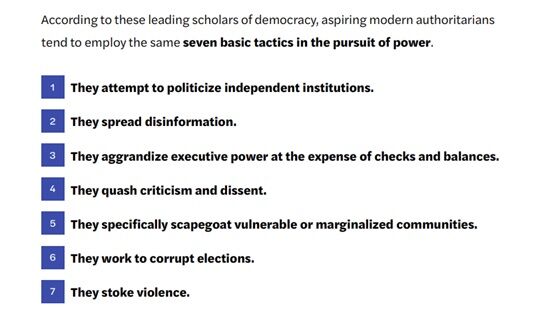
With the democratic-backsliding in the US, the Trump Administration has been following the “seven basic tactics in the pursuit of power” as detailed by The Authoritarian Playbook (2024) as they politicize independent institutions, spread disinformation, pursue the unitary executive theory at the expense of checks and balances, quash criticism and dissent, scapegoat vulnerable and marginalized communities, work to corrupt elections, and stoke violence with their Operation Metro Surge.
I’m seeing the abandonment of due process, and I’ve lost all faith in the enforcement of the rule of law as the Department of Justice has been weaponized. This abandonment of the rules-based order of the rule of law has a profoundly destabilizing psychological impact, and other countries have also been reckoning with it. In response, the Prime Minister of Canada Mark Carney has called for new coalitions of the middle powers given that the United States has chosen to abandon rules-based order in favor of coercive negotiating techniques. The US is leveraging their asymmetry of power to turn all relationships into a transaction that can be won or lost. Canada is unwilling to bend the knee to these authoritarian ways, and is making the call to arms for all middle powers to unite in order to resist the power of these hegemonic forces. There is a real strength in collective resistance, and so Canada is taking a hybrid approach towards coalition building. Their approach is primarily led by collaborating with countries that have shared values, but they also recognize the need for more pragmatic, ad-hoc, “variable geometry” coalitions based upon mutual benefit or interest.
Just as countries are thinking about how to maintain their sovereignty, we are all entering into a new era that has moved beyond a rules-based order. So people around the world are also thinking about how they can maintain their own sovereignty in the context of Big Tech’s push towards an all-pervasive, AI surveillance machine.
One recent example of Big Tech’s surveillance aspirations comes from an internal Meta memo shared with the New York Times arguing that the political chaos in the world right now makes it the perfect time to push out controversial tech that would normally get a lot of blowback. They’re considering launching facial recognition features for their RayBan-Meta AI glasses as they callously characterize this moment as a “dynamic political environment where many civil society groups that we would expect to attack us would have their resources focused on other concerns.” This type of realpolitik moral reasoning follows the logic of surveillance capitalism, which completely ignores the broader potential cultural and legal impact of their technologies in favor of their short-term gain. I’ve previously written about how Meta’s dream of contextually-aware AI is a dystopian privacy nightmare within the Proceedings of Stanford’s Existing Law and Extended Reality Symposium.
The always-on and persistent sensing from face-mounted cameras embedded into glasses is the next frontier for Meta, but this persistent capturing from wearable technology across all contextual domains will start to change the legal definition of our “reasonable expectation of privacy.” This is because part of the legal test laid out by Harlan’s concurring opinion in KATZ v UNITED STATES (1967) is what “society is prepared to recognize as reasonable.” In other words, whatever the culture accepts as the boundary between public and private contexts becomes a part of the legal test for what the government considers to be protected by the Fourth Amendment. So an always-on AI surveillance from wearable face cameras will inevitably change these legal definitions and weaken everyone’s Fourth Amendment protections.
Even if all of the raw data remained on these devices, then inferences made from devices would not be protected if they’re shared with a third party. Imagine a noisy raw camera feed from Meta’s AI glasses is processed, but it makes some incorrect inferences from computer vision algorithms or hallucinations from a large language model, then these incorrect inferences could end up in the hands of a government and used as evidence against you in a court of law. The film Coded Bias does a great job of elaborating how marginalized communities have been harmed by biased algorithms that have been integrated into automatic decision-making in the context of policing, housing, employment, etc.
Carney’s roadmap has many lessons that we can also apply to our own encounters of a new reality. He named the truth of this situation and is taking Canada’s metaphoric sign down signaling that they are no longer willing to live within a lie. Canada is untethering itself from their relationship to the United States as the US takes an authoritarian turn into democratic backsliding, and abandoning the rules-based international order that has always been only partially true.
Carney’s speech is incredible because in it he clearly names what is happening with the dissolution of the rules-based order in the geopolitical context, provides an antidote of collective action by those who do not wield the most power, and shows the power of breaking the spell of performative rituals of obeying in advance. Hearing someone so clearly name the truth was a cathartic experience for me, and I feel like I could draw so many parallels with how this collective story can inform our personal relationships to AI, Big Tech, and impulses of surveillance capitalism towards an all-pervasive, AI Big Brother.
There are so many nuggets of wisdom in Carney’s speech, and it feels like it’s capturing the zeitgeist of the moment across so many different contextual domains. Hopefully you’ll find some value in listening to his speech as I attempt to contextualize it with what’s happening in the XR industry and each of our relationships to Big Tech. There’s a lot of harsh realities in the world right now, and so Carney’s speech gives me a lot of hope for the future as we each name formerly useful fictions, take our metaphoric signs down, stop participating in performative rituals, and call out more gaps between rhetoric and reality.
This is a listener-supported podcast through the Voices of VR Patreon.
Music: Fatality
Podcast: Play in new window | Download